

Cuando alguien hace la pregunta “¿los tomacorrientes GFCI se dañan?”, puede que realmente esté preguntando cuánto tiempo durará un tomacorriente antes de fallar. No hay una respuesta definitiva o absoluta a esa pregunta, ya que cada situación es única; por lo tanto, cada tomacorriente GFCI debería funcionar correctamente siempre que no haya otros factores que contribuyan a su falla, como la exposición a entornos que puedan causar daños (por ejemplo, calor extremo, humedad o daños por agua). Hay varios tipos diferentes de tomacorrientes GFCI con diferentes clasificaciones de voltaje, que a su vez tendrán diferentes vidas útiles si se utilizan de acuerdo con sus propósitos previstos y las pautas del fabricante.
Además de saber cuánto tiempo suelen durar los tomacorrientes GFCI, es necesario que cualquier persona que considere usar un tomacorriente GFCI en su hogar o instalación entienda los problemas potenciales asociados con el uso de tales dispositivos, así como los pasos a seguir si el dispositivo deja de funcionar correctamente y se ha determinado que está fuera de los límites aceptables de su propósito previsto y las especificaciones del fabricante. Por lo tanto, todos deberíamos tomarnos el tiempo para aprender sobre los tomacorrientes GFCI para que podamos tomar decisiones informadas sobre la durabilidad de los circuitos eléctricos y los electrodomésticos utilizados en nuestros hogares y negocios, además de ayudar a proteger a nuestra familia, amigos y empleados de los peligros potenciales relacionados con el uso de tomacorrientes GFCI.
La respuesta a su pregunta es ‘sí’, y sí, el GFCI fallará con el tiempo. En general, la vida útil de un GFCI es de aproximadamente 10-15 años; La vida útil de un interruptor de circuito GFCI es de 15-25 años; Si se instala en un área sujeta a humedad, o al aire libre, la vida esperada es de aproximadamente 7-12 años debido a factores ambientales. La sustitución debe hacerse de inmediato para los modelos GFCI de tipo antiguo fabricados antes de la introducción de dispositivos de auto-prueba. La falla silenciosa es la situación más peligrosa donde la unidad GFCI aún le suministra energía y no tiene protección contra fallas a tierra. Un GFCI en funcionamiento se disparará en un tiempo de aproximadamente una cuarentava de segundo ante una fuga de 4-6 miliamperios. Las pruebas mensuales por parte del consumidor pueden determinar si el GFCI está funcionando; La prueba se realiza presionando el botón de prueba para apagar la energía; y reiniciándolo para volver a encender la energía. Se debe entender que el costo del GFCI en sí ($15-$40) es muy pequeño en comparación con el costo de contratar a un electricista con licencia ($80-$200) para instalar el GFCI; El costo se basará en una serie de factores, incluyendo la ubicación geográfica y el tipo de caja eléctrica utilizada para montar el GFCI.
Necesitamos tener mucho cuidado con lo que esto dice, ya que así es como ocurre la falla.
Un GFCI utiliza un pequeño transformador de corriente que compara constantemente la corriente que fluye a través del cable caliente con la corriente de retorno a través del cable neutro. En un GFCI que funciona correctamente, las corrientes en ambos cables son iguales. Si hay incluso una pequeña fuga en algún lugar del circuito, las lecturas diferirán, y el mecanismo activará un interruptor mecánico para abrir el circuito.
A continuación, considere lo que le sucede a este dispositivo durante 15 años. Picos de tormentas y cuando la red cambia. Disparos repetitivos. Calor de los electrodomésticos que consumen mucha energía. Clima húmedo. Y cuando entra agua. La electrónica que realiza la detección se deteriora debido a todos los peligros del entorno. Y cuando se deteriora, casi falla de una manera peligrosa.
La falla ocurre de dos maneras. O el mecanismo de disparo deja de funcionar correctamente, lo cual es obvio ya que no puede mantener el RESET. O — lo que es más peligroso — el sensor deja de funcionar mientras el enchufe continúa funcionando. Los GFCI modernos pueden realizar auto-pruebas donde realizan verificaciones internas. Los GFCI más antiguos fabricados antes de que se implementara la tecnología de auto-prueba no tienen forma de indicar que algo está mal.
Este es el punto principal del consejo dado por los expertos en el campo — “pruebe el GFCI una vez al mes” no es solo un requisito burocrático. Es la única forma de detectar el GFCI defectuoso que ha dejado de funcionar.
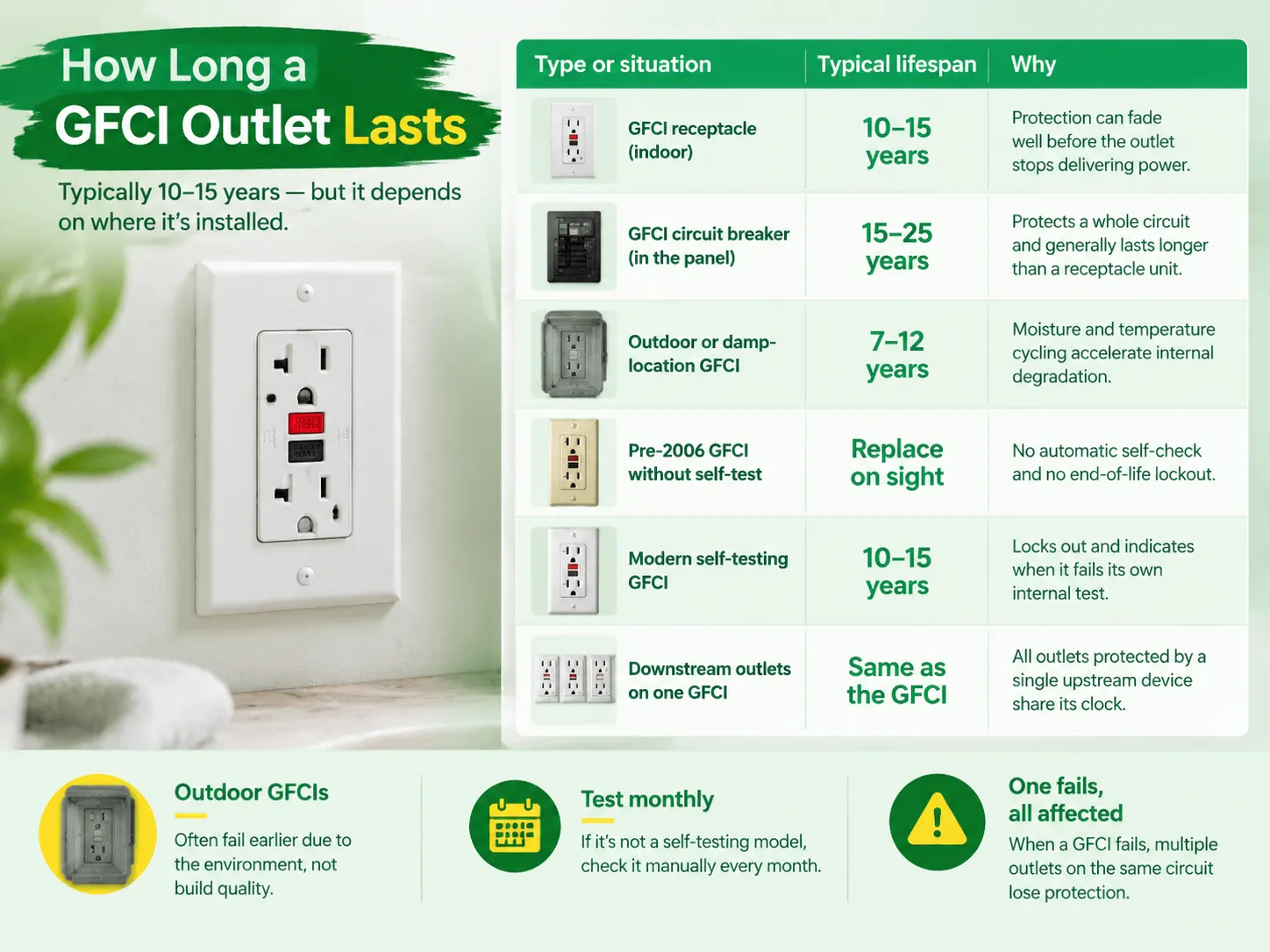
“Diez a quince años” es el número principal, pero donde se instala el enchufe lo cambia mucho.
| Tipo o situación | Vida útil típica | Por qué |
|---|---|---|
| Receptáculo GFCI (interior) | 10–15 años | La protección puede desvanecerse mucho antes de que el enchufe deje de suministrar energía |
| Interruptor de circuito GFCI (en el panel) | 15–25 años | Protege un circuito completo y generalmente dura más que una unidad de receptáculo |
| GFCI para exteriores o ubicaciones húmedas | 7–12 años | La humedad y el ciclo de temperatura aceleran la degradación interna |
| GFCI anterior a 2006 sin auto-prueba | Reemplazar a la vista | Sin auto-verificación automática y sin bloqueo de fin de vida |
| GFCI moderno con auto-prueba | 10–15 años | Bloquea e indica cuando falla en su propia prueba interna |
| Salidas aguas abajo en un GFCI | Igual que el GFCI | Los receptáculos ordinarios protegidos por un solo dispositivo aguas arriba comparten su reloj |
Dos cosas interesantes a tener en cuenta. Para empezar, un GFCI para exteriores puede ser de la misma marca que el modelo interior, pero es probable que falle mucho antes debido al entorno de instalación en lugar de su calidad de construcción. En segundo lugar, cuando el GFCI reanuda la tarea de proteger la cadena de receptáculos regulares detrás de él, todos los receptáculos que dependen de ese GFCI sufren pérdidas juntos. Por lo tanto, típicamente, cuando se trata de la falla del GFCI, las personas descubren el problema cuando notan que varios receptáculos están funcionando mal en lugar de solo uno.
El punto más significativo de la tabla es el factor de prueba. Si su dispositivo ha sido instalado antes de la aparición de las variedades de auto-prueba del dispositivo, tendrá que probar el dispositivo manualmente cada mes para hacer un seguimiento de su estado de funcionamiento.
No todas las fallas de GFCI son el mismo problema, y la solución varía. Aquí están las que representan la mayoría de los casos.
| Falla | Lo que observas | Lo que está sucediendo | Solucionar |
|---|---|---|---|
| Falla de detección silenciosa | Nada — el tomacorriente funciona normalmente | Circuito de detección degradado; el dispositivo ya no detecta fallas a tierra | Reemplace inmediatamente. El botón de PRUEBA es el único detector |
| No se mantendrá en reinicio | RESET salta directamente hacia afuera | Mecanismo desgastado, o una falla activa aún presente | Desenchufe todo y vuelva a intentarlo; si aún no se mantiene, reemplace |
| Tomacorriente completamente muerto | Sin energía, botones sin respuesta | Falla interna, o sin suministro del panel | Verifique primero el interruptor, luego reemplace el dispositivo |
| Bloqueo de fin de vida | Luz de falla encendida; sin energía | La unidad de auto-prueba detectó su propia falla y se bloqueó por diseño | Reemplace — este es el dispositivo funcionando correctamente |
| Disparos molestos | Se dispara repetidamente sin nada enchufado | Falla genuina, humedad en la caja, o una unidad desgastada de disparo sensible | Seque y diagnostique primero; reemplace si la falla persiste sin nada conectado |
| Daño térmico | Placa frontal caliente, decoloración, olor a quemado | Terminación suelta o sobrecarga creando calor por resistencia | Deje de usarlo. Esto es un riesgo de incendio, no solo una falla de protección |
Este punto realmente necesita reiteración. Placas frontales calientes u olores a quemado que emanan de un receptáculo no son normales — y esto no es específico de los GFCI, sino que indica que puede haber una conexión suelta en su sistema eléctrico. Incluso si el GFCI sigue funcionando, todavía hay un peligro de incendio. Apague el interruptor y hágalo revisar.
Además, hay algo que decir sobre el hecho de que el dispositivo tiene una vida útil. Los GFCI modernos de auto-prueba están diseñados para bloquearse permanentemente cuando ya no pueden garantizar ningún nivel de protección, lo que significa que un receptáculo muerto con una gran luz es un comportamiento perfectamente normal. Busque esta característica al comprar un reemplazo: un dispositivo que indica que ha dejado de funcionar es mucho más útil que uno que solo lo deja preguntándose. Si desea ver cómo se ve eso como una categoría de producto en lugar de una descripción, los dos formatos más comúnmente utilizados en trabajos residenciales y comerciales ligeros son el estándar Receptáculo GFCI para instalación en caja de pared y las variantes resistentes a la intemperie diseñadas para exteriores y lugares húmedos.
Si bien los GFCI generalmente comienzan a mostrar sus problemas sin notificar al usuario de antemano, todavía hay señales comunes a las que estar atento, que se enumeran a continuación en orden cronológico, comenzando por la que ocurre primero:
Una señal más que a menudo se diagnostica erróneamente: si el GFCI se dispara cada vez que conecta un electrodoméstico, eso no significa que sea un GFCI defectuoso. Intente conectar otro dispositivo en ese GFCI. Si funciona correctamente con otro dispositivo pero se dispara con un secador de pelo, necesita desechar el secador de pelo. En caso de que todo se dispare, el dispositivo o la humedad en el circuito pueden ser la razón de eso. Si el interruptor se dispara pero no el GFCI, entonces indica que hay un problema con la capacidad del circuito.
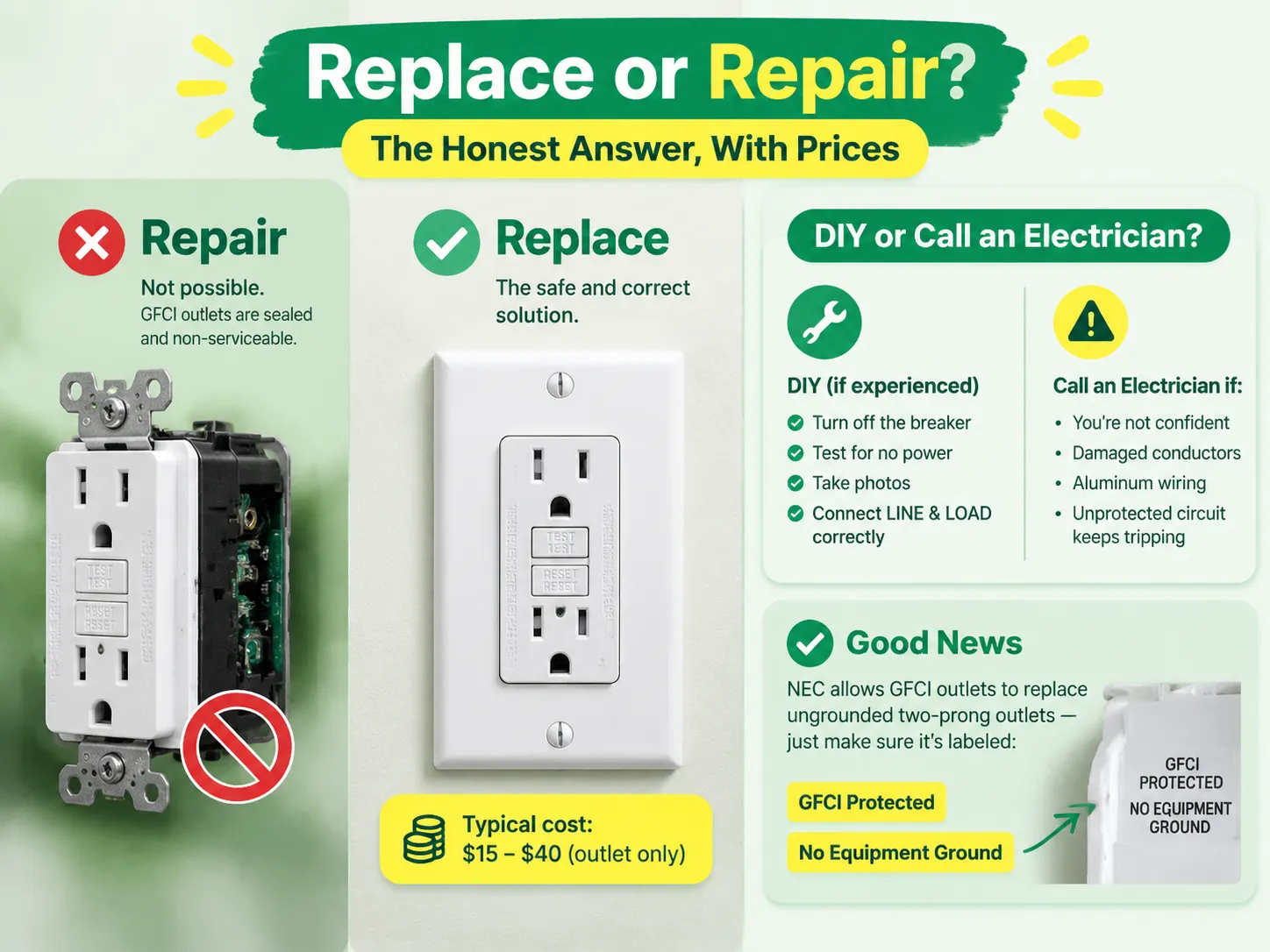
Existen tanto una versión de esta consulta que puede ser respondida como otra versión que no puede.
La versión que se puede responder: ¿Es posible reparar un tomacorriente GFCI? No se puede hacer; un receptáculo GFCI viene como un sistema electrónico sellado o no reparable. Dado que carece de piezas reemplazables por el usuario, ninguna persona es capaz de reparar el circuito de detección interno en ningún otro lugar aparte del lugar donde se fabricó. En caso de que la protección esté comprometida, el dispositivo deberá ser reemplazado por uno nuevo, ya que eso es simplemente lo que implica el diseño del producto.
La versión que no se puede responder: ¿Debería realizar la sustitución de forma independiente o llamar a un electricista? La respuesta a esta pregunta depende mucho de sus propias habilidades y también de los requisitos impuestos por su jurisdicción local. Cambiar un GFCI es realmente simple para alguien con experiencia en tratar con cables vivos: apaga el interruptor, verifica con un probador, toma fotos del cableado antes de tocarlo y conecta los terminales LINE y LOAD de manera adecuada. El error más común en esta operación consiste en hacer la conexión correcta utilizando los cables LINE y LOAD de manera incorrecta.
Los pasos y los escollos se cubren con más detalle en esta guía sobre reemplazar un tomacorriente de pared de manera segura, incluyendo las verificaciones que vale la pena hacer antes y después. Si no está seguro de si puede realizar las reparaciones usted mismo — o si hay un riesgo de que la caja tenga conductores dañados, cableado de aluminio, o tenga un circuito no protegido que sigue disparándose — deténgase y llame a un electricista. Los problemas eléctricos son uno de los pocos tipos de reparaciones que pueden matar a alguien que comete un error al intentar arreglarlo sin ninguna experiencia.
Otro hecho que es interesante saber es que, de acuerdo con las reglas directas del NEC, es posible usar receptáculos GFCI para eliminar tomacorrientes de dos clavijas sin conexión a tierra. Siempre que el nuevo tomacorriente esté marcado como “GFCI Protected” y “No Equipment Ground”, tiene un gran beneficio para la seguridad sin tener que gastar dinero en cableado.
Eilling es una cuestión de tiempo y dinero, así que tenga cuidado y conozca sus opciones.
| Artículo | Costo típico | Notas |
|---|---|---|
| Receptáculo GFCI, estándar | $15–$40 | Modelos resistentes a la intemperie y de auto-prueba se encuentran en el extremo superior |
| Interruptor de circuito GFCI | $40–$90 | Protección a nivel de panel para todo un circuito |
| Probador GFCI enchufable | $10–$15 | Confirms wiring and lets you test the outlet externally |
| Electrician, residential replacement | $80–$200 per outlet installed | Most of the cost is labour and diagnosis, not the device |
| Bathroom or difficult location | $120–$300 per outlet installed | Higher when the box needs work or the outlet has to move |
| Multiple outlets in one visit | Lower per outlet | The economic case for doing them together rather than one at a time |
Electricians charge different rates depending on the region and the type of work they are doing, but rates remain stable enough to help with planning.What this means in practice is that it is usually cheaper to replace components on your schedule than to wait until something fails.
Electronics can’t be stopped from aging, but they can be kept from aging too fast. Most of the things that shorten the life of a GFCI are issues related to its environment or the electricity it receives.
People tend to overlook the argument regarding the environment point. For instance, if a fixture is rated for fifteen years in a corridor, it will only last half as long in an area that has a defective hose bib. If you’re specifying outlets for damp or outdoor locations, weather resistance isn’t an upgrade — it’s the requirement, which is exactly what separates a general-purpose unit from a weather-resistant GFCI designed for damp and outdoor installation.
It is fully prevention procedure that requires less than a minute for execution in each outlet.
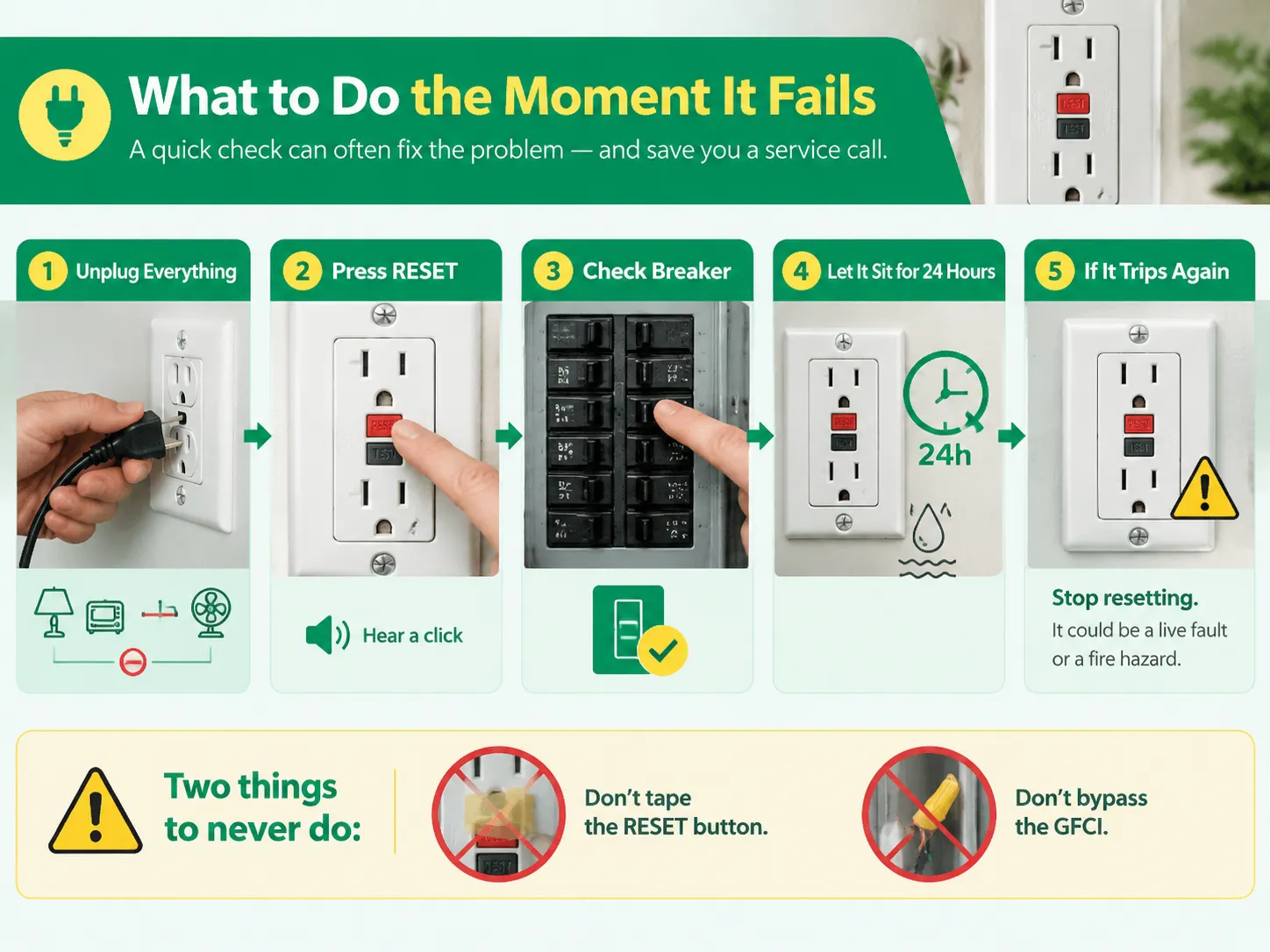
When the outlet is not working or the Ground Fault Circuit Interrupter is not working, there are several steps to follow. It does not take much more than five minutes and it actually helps save money on unnecessary service calls.
There are two things that should never be done: do not tape the RESET button and do not bypass the GFCI because doing one of those things is not a good idea, either. If you want the diagnostic sequence in more detail — what each symptom points to and which ones you can fix yourself — this guide to what to do when a socket or outlet stops working walks through the same logic with the wiring-side checks included.
Requirements vary according to the jurisdiction and age of the property so it is always advisable to check the local code. Despite this, more or less the list designated by the NEC includes locations where water and electricity could meet:
If your house was built before the date the requirement was instituted and the outlet was not updated, the code states that the given element can remain. However, this does not mean that this outlet was safe.
One clarification that is essential to be done is that GFCI and circuit breaker do different jobs, and both are necessary.
| Dispositivo | Protects against | Trips at | Where it lives |
|---|---|---|---|
| Disyuntor | Overcurrent — overload and short circuit | Rated amps (15 A, 20 A, etc.) | Distribution panel |
| GFCI | Ground faults — current leaking to earth through a person or water | 4–6 milliamps | Receptacle or panel |
| AFCI | Arc faults — dangerous arcing in damaged wiring | Arc signature detection | Panel, or combination devices |
A breaker would allow five milliamps of current to pass through your body without any problem — it won’t trip. That’s where the GFCI comes in, so it should be understood that a GFCI should not be used as a substitute for a breaker and vice versa.If you’re trying to understand how the two layers work together, the relationship between breakers and the outlets they feed is set out in this explanation of circuit breakers and the outlets and switches they protect, and it’s worth five minutes if you’ve ever wondered why a bathroom has two separate devices doing apparently similar jobs.
There’s something we can’t forget about when we discuss GFCIs – their manufacturing process. First and foremost, GFCIs are component-supply products, and the reliability of their sensing circuit boils down to component selection, quality control at the manufacturer’s place, and end-of-line testing. Hence, companies like igoto supply switches, plus sockets, outlets, and power strips, including GFCIs, to their distributors and contractors. This is also the reason why published standards matter when it comes to purchasing – a GFCI that doesn’t meet the applicable UL standard does not become cheaper but is just a different product that looks very similar.
You can check this by using a lamp. Plug the lamp into the protective switch, press TEST, and you should see that the lamp goes out and the RESET button pops out; if you press RESET button afterwards, you should see that the power is restored. If TEST doesn’t work and RESET can’t be pressed down, then it means the protection has failed and the unit needs to be replaced, even if the electrical appliances are powered normally. You may also check for some other indications like warm or discolored faceplate, a fault light blinking or shining continuously, regular tripping when nothing is being plugged into the device or difficulty with pressing down RESET.
Normally, a GFCI outlet remains functional for approximately a decade or a decade and a half whereas a GFCI breaker does its job for slightly longer. Due to the presence of moisture and humidity outdoors, most devices don’t last more than 10 years. Furthermore, devices produced before self-testing systems were introduced should be changed out even if they are not broken because they cannot reveal whether they are malfunctioning or not.
Substitute it when it fails any of such checks: either it doesn’t turn off the electricity, the reset is not persisted or a device has triggered self-test lockout lock, or the unit hasn’t reset itself even after the disconnection and drying of the circuit. In case it’s aged more than 10 to 15 years or is older than self-testing devices, then it can be replaced based on the age alone. It has to be replaced without a delay in case the device is warm, burnt or emits odour.
The primary causes are degradation due to aging of the sensing electronics, the number of times power surges and lightning hits, frequent tripping cycles that have taken a toll on the mechanical latch, moisture ingress into the enclosure and heat stress due to overloaded wires and/or loose terminations. It is significant to differentiate whether the aforementioned problems are due to appliance defects or real ground faults, as a GFCI that trips only when a certain appliance is plugged in is likely discovering an actual current leak in that appliance rather than a GFCI malfunction.
GFCI outlets do fail, and it’s important to note how they fail. GFCI outlets do not give a warning; they keep working like they’re meant to. The light keeps turning on and off, and that vital function — the cutting of power when current is leaking through a person — may fail without any visible sign at all.
The take-home point is 10-15 years lifespan for a receptacle, 7-12 years lifespan in damp places, and a trip time equal to about 1/40 second at 4-6 mA for a working device. In practice, the device costs between $15 and $40 and costs another $80-200 to install, making this simple little device the difference between just getting a shock from a bathroom outlet and getting seriously electrocuted.
For this reason, test every month. Press TEST, see the power goes out, press RESET. If the device does not work just as it should, it must be replaced — it cannot be fixed. If the device has served you for more than 10 years, yes, replace it on your schedule, not in an emergency situation. When buying the replacement, always opt for self-testing devices that can alert a user before breaking down, which is a huge advantage over devices that will stop working without any warning.

Cuando alguien hace la pregunta “¿los enchufes GFCI se dañan?”, realmente puede estar preguntando cuánto tiempo durará un enchufe antes de fallar. No hay una respuesta definitiva o absoluta a esa pregunta, ya que cada situación es única; por lo tanto, cada enchufe GFCI debería funcionar correctamente siempre que no haya otros factores que contribuyan a […]

Comprar interruptores inteligentes en Bucks County es relativamente complicado, siendo la dificultad más una cuestión de las características del mercado inmobiliario local que de la disponibilidad de los sistemas. Se puede conducir desde Solebury, donde algunas de las casas pueden datar de la década de 1790, hasta Warrington, donde algunas construcciones más nuevas fueron construidas […]

El control de iluminación inalámbrico tiene un pequeño secreto sucio: aunque a menudo funciona excepcionalmente bien en demostraciones, tiende a decepcionar a las personas en sus hogares. El culpable rara vez es la aplicación; en cambio, se encuentra detrás de la pared. Esta guía presenta las opciones de manera ordenada. Seis formas de controlar la luz de forma inalámbrica, cinco protocolos que […]

 No.6 Tuozhan Road, Leshang Pioneer Park, puerto de la bahía de Yueqingwan, ciudad de Yueqing, provincia de Zhejiang


