

Quando qualcuno pone la domanda “le prese GFCI si guastano”, potrebbe in realtà chiedere quanto durerà una presa prima di guastarsi. Non c'è una risposta definitiva o assoluta a questa domanda poiché ogni situazione è unica; pertanto, ogni presa GFCI dovrebbe funzionare correttamente finché non ci sono altri fattori che contribuiscono al suo guasto, come l'esposizione a ambienti che potrebbero causare danni (ad esempio, calore estremo, umidità o danni da acqua). Ci sono diversi tipi di prese GFCI con diverse classificazioni di tensione, che a loro volta avranno diverse durate se utilizzate in conformità con i loro scopi previsti e le linee guida del produttore.
Oltre a sapere quanto durano di solito le prese GFCI, è necessario che chiunque stia considerando di utilizzare una presa GFCI nella propria casa o struttura comprenda i potenziali problemi associati all'uso di tali dispositivi, così come quali passi intraprendere se il dispositivo smette di funzionare correttamente ed è stato determinato che è al di fuori dei limiti accettabili del suo scopo previsto e delle specifiche del produttore. Pertanto, dovremmo tutti prendere tempo per conoscere le prese GFCI in modo da poter prendere decisioni informate riguardo alla durata dei circuiti elettrici e degli apparecchi utilizzati nelle nostre case e aziende, oltre ad aiutare a proteggere la nostra famiglia, amici e dipendenti dai potenziali pericoli legati all'uso delle prese GFCI.
La risposta alla tua domanda è ‘sì’, e sì, la presa GFCI si guasterà nel tempo. In generale, la durata di vita di una presa GFCI è di circa 10-15 anni; La durata di vita di un interruttore GFCI è di 15-25 anni; Se installato in un'area soggetta a umidità, o all'esterno, la vita prevista è di circa 7-12 anni a causa di fattori ambientali. La sostituzione dovrebbe essere effettuata immediatamente per i modelli GFCI di tipo più vecchio realizzati prima dell'introduzione dei dispositivi di auto-test. Il guasto silenzioso è la situazione più pericolosa in cui l'unità GFCI continua a fornirti energia e non ha protezione da guasti a terra. Una presa GFCI funzionante scatta in un intervallo di tempo di circa un quarantesimo di secondo su una perdita di 4-6 milliampere. Il test mensile da parte del consumatore può determinare se il GFCI sta funzionando; Il test viene effettuato premendo il pulsante di test per spegnere l'alimentazione; e ripristinandolo per riaccendere l'alimentazione. Si deve comprendere che il costo del GFCI stesso ($15-$40) è molto ridotto rispetto al costo di assunzione di un elettricista autorizzato ($80-$200) per installare la presa GFCI; Il costo sarà basato su una serie di fattori tra cui la posizione geografica e il tipo di scatola elettrica utilizzata per montare la presa GFCI.
Dobbiamo fare molta attenzione a ciò che questo dice, poiché è così che si verifica il guasto.
Una presa GFCI utilizza un piccolo trasformatore di corrente che confronta costantemente la corrente che scorre attraverso il filo caldo con la corrente di ritorno attraverso il filo neutro. In un GFCI funzionante, le correnti in entrambi i fili sono uguali. Se c'è anche una piccola perdita da qualche parte nel circuito, le letture differiranno e il meccanismo attiverà un interruttore meccanico per aprire il circuito.
Successivamente, considera cosa succede a questo dispositivo dopo 15 anni. Picchi di tensione da tempeste e quando la rete cambia. Scatti ripetitivi. Calore da elettrodomestici che assorbono molta energia. Tempo umido. E quando entra l'acqua. L'elettronica che effettua il rilevamento si deteriora a causa di tutti i pericoli dell'ambiente. E quando si deteriora, quasi fallisce in modo pericoloso.
Il guasto si verifica in due modi. O il meccanismo di scatto smette di funzionare correttamente, il che è ovvio poiché non puoi far tenere il RESET. Oppure — il che è più pericoloso — il sensore smette di funzionare mentre la presa continua a funzionare. I GFCI moderni possono eseguire auto-test in cui effettuano controlli interni. I GFCI più vecchi realizzati prima dell'implementazione della tecnologia di auto-test non hanno modo di indicare che qualcosa non va.
Questo è il punto principale del consiglio fornito dagli esperti del settore — “testa il GFCI una volta al mese” non è solo un requisito burocratico. È l'unico modo per rilevare il GFCI malfunzionante che ha smesso di funzionare.
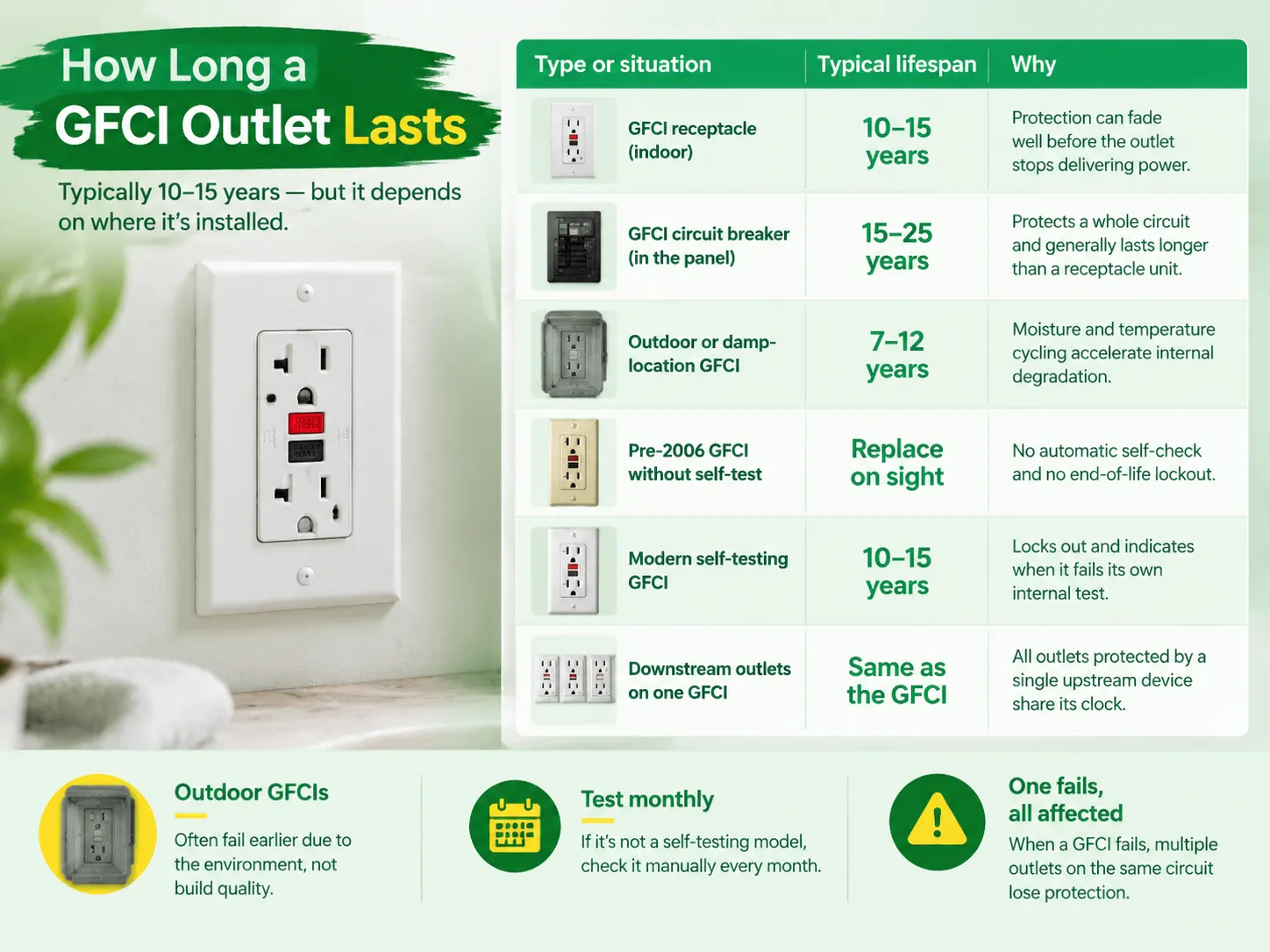
“Dieci a quindici anni” è il numero principale, ma dove è installata la presa cambia molto.
| Tipo o situazione | Durata tipica | Perché |
|---|---|---|
| Presa GFCI (interno) | 10–15 anni | La protezione può svanire molto prima che la presa smetta di fornire energia |
| Interruttore GFCI (nel pannello) | 15–25 anni | Protegge un intero circuito e generalmente dura più a lungo di un'unità di presa |
| GFCI per esterni o in luoghi umidi | 7–12 anni | L'umidità e il ciclo di temperatura accelerano la degradazione interna |
| GFCI pre-2006 senza auto-test | Sostituire a vista | Nessun auto-controllo automatico e nessun blocco di fine vita |
| GFCI moderni con auto-test | 10–15 anni | Blocca e indica quando fallisce il proprio test interno |
| Prese a valle su un GFCI | Stesso del GFCI | Prese ordinarie protette da un singolo dispositivo a monte condividono il suo orologio |
Due cose interessanti da notare. Per cominciare, un GFCI per esterni può essere della stessa marca del modello interno, ma è probabile che si guasti molto prima a causa dell'ambiente di installazione piuttosto che della qualità costruttiva. In secondo luogo, quando il GFCI riprende il lavoro di protezione della serie di prese regolari dietro di esso, tutte le prese che dipendono da quel GFCI subiscono perdite insieme. Pertanto, tipicamente, quando si tratta di guasti del GFCI, le persone scoprono il problema quando notano diverse prese che non funzionano invece di solo una.
Il punto più significativo della tabella è il fattore di test. Se il tuo dispositivo è stato installato prima dell'apparizione delle varietà di dispositivo con auto-test, dovrai testare manualmente il dispositivo ogni mese per tenere traccia del suo stato di funzionamento.
Non tutti i guasti del GFCI sono lo stesso problema, e la soluzione è diversa. Ecco quelli che rappresentano la maggior parte dei casi.
| Guasto | Cosa osservi | Cosa sta succedendo | Le specifiche di cablaggio in una normale installazione USA sono le seguenti: nero che trasporta corrente di fase (o fase commutata), rosso che rappresenta il secondo deviatore (in cavo 14-3/12-3), bianco come neutro (si noti che i bianchi sono interconnessi internamente, non nell'interruttore), e filo nudo/verde per la terra. Nel caso di UK/UE, il marrone indica la fase, il blu indica il neutro (ma se funziona come deviatore/fase commutata, è rivestito di marrone), e il giallo-verde indica la terra; inoltre, le etichette usuali utilizzate nei terminali sono COM, L1 e L2 – COM porta la corrente di fase da un interruttore e la corrente di fase commutata da un altro. Il principio alla base di tutto ciò rimane più o meno invariato; tuttavia, è essenziale prestare attenzione alle specifiche dei colori e alle etichette. Per un confronto visivo di come sono costruiti diversi tipi di interruttori, la nostra guida a |
|---|---|---|---|
| Silent sensing failure | Nothing — outlet works normally | Sensing circuit degraded; device no longer detects ground faults | Replace immediately. TEST button is the only detector |
| Won’t hold on reset | RESET pops straight back out | Mechanism worn out, or an active fault still present | Unplug everything and retry; if it still won’t hold, replace |
| Completely dead outlet | No power, buttons unresponsive | Internal failure, or no supply from the panel | Check the breaker first, then replace the device |
| End-of-life lockout | Fault light on; no power | Self-testing unit detected its own failure and locked out by design | Replace — this is the device working correctly |
| Nuisance tripping | Trips repeatedly with nothing plugged in | Genuine fault, moisture in the box, or a hair-trigger worn unit | Dry and diagnose first; replace if the fault persists with nothing connected |
| Thermal damage | Warm faceplate, discolouration, burning smell | Loose termination or overload creating resistance heat | Stop using it. This is a fire risk, not just a protection failure |
This point really needs reiteration. Warm faceplates or burning odors emanating from a receptacle are not normal — and this isn’t specific to GFCIs but indicates that there may be a loose connection somewhere in your electrical system. Even if the GFCI is still functioning, there is still a danger of fire occurring. Shut off the breaker and have it checked.
Furthermore, there is something to be said about the fact that the device has a life span. Modern self-testing GFCIs are designed to permanently lock out when they can no long guarantee any level of protection, which means that a dead receptacle with a great light is perfectly normal behavior. Look for this feature while shopping for a replacement: a device that indicates it has stopped working is far more useful than one that just leaves you wondering.If you want to see what that looks like as a product category rather than a description, the two formats most commonly used in residential and light commercial work are the standard GFCI receptacle for wall-box installation and the weather-resistant variants built for outdoor and damp locations.
While GFCIs usually start displaying their issues without notifying the user beforehand, there are still common signs to look out for, which are listed below in chronological order, starting from the one that occurs first:
One more sign that is often misdiagnosed: if the GFCI trips every time you plug an appliance into it, that doesn’t mean it’s faulty GFCI. Try plugging in another device in that GFCI. If it successfully works with another device but trips with a hairdryer, you need to discard the hairdryer. In case everything trips, the device or moisture in the circuit may be a reason for that. If the breaker trips but not the GFCI, then it indicates that it’s a problem with circuit capacity.
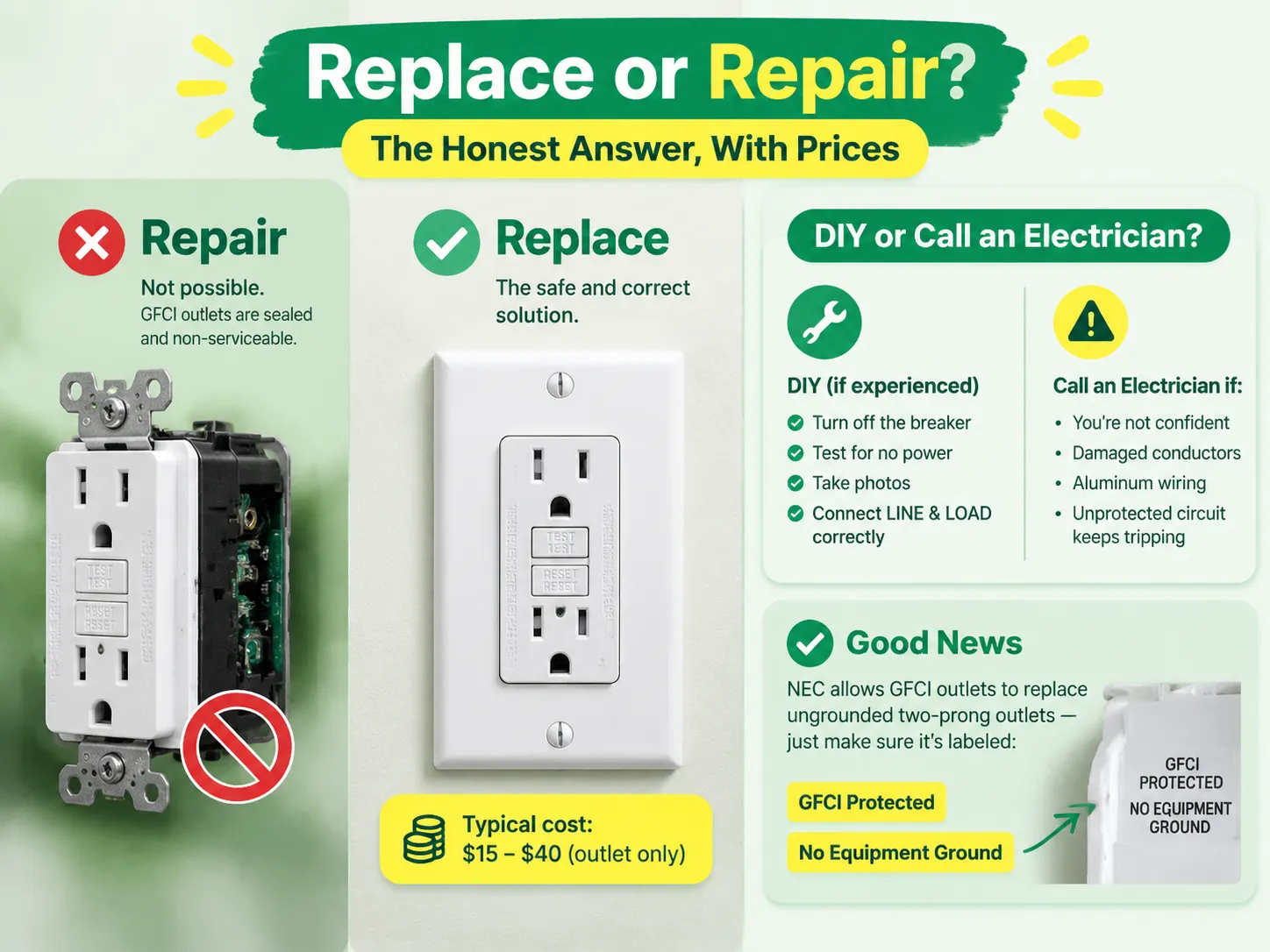
There exist both a version of this inquiry that can be answered and another version that cannot.
The answerable version: Is it possible to repair a GFCI outlet? It cannot be done; a GFCI receptacle comes as a sealed or non-serviceable electronic system. Since it lacks user-replaceable parts, no person is capable of repairing the internal sensing circuit anywhere else apart from the place of fabricating it. In case the protection is compromised, the device shall be replaced with a new one as that is simply what the product’s design implies.
The unanswerable version: Should you perform the substitution independently or call for an electrician? The answer to this question depends a lot on your own skills and also on the requirements imposed by your local jurisdiction. Changing a GFCI is really simple for someone experienced in dealing with live wires: you shut off the breaker, check it with a tester, take photos of the wiring prior to touching it, and connect the LINE and LOAD terminals in a proper manner. The most common error in this operation consists of making the right connection using LINE and LOAD cables in a wrong way.
The steps and the pitfalls are covered in more detail in this walkthrough on replacing a wall socket safely, including the checks worth doing before and after.If you are not sure whether you can perform the repairs yourself — or if there is a risk that the box has damaged conductors, aluminum wiring, or has an unprotected circuit that keeps tripping — stop and call in an electrician. Electrical problems are among the few types of repairs that can kill someone who makes a mistake trying to fix it without any expertise.
Another fact that is interesting to know about is that, according to the straight NEC rules, it is possible to use GFCI receptacles to do away with ungrounded two-prong outlets. As long as the new outlet is marked as “GFCI Protected” and “No Equipment Ground,” you have a great life-safety benefit without having to spend any money on rewiring.
Eilling is a matter of time and money, so be careful and know your options.
| Articolo | Costo tipico | Note |
|---|---|---|
| GFCI receptacle, standard | 1–40 | Weather-resistant and self-testing models sit at the upper end |
| GFCI circuit breaker | $40–$90 | Panel-level protection for a whole circuit |
| Plug-in GFCI tester | $10–$15 | Confirms wiring and lets you test the outlet externally |
| Electrician, residential replacement | $80–$200 per outlet installed | Most of the cost is labour and diagnosis, not the device |
| Bathroom or difficult location | $120–$300 per outlet installed | Higher when the box needs work or the outlet has to move |
| Multiple outlets in one visit | Lower per outlet | The economic case for doing them together rather than one at a time |
Electricians charge different rates depending on the region and the type of work they are doing, but rates remain stable enough to help with planning.What this means in practice is that it is usually cheaper to replace components on your schedule than to wait until something fails.
Electronics can’t be stopped from aging, but they can be kept from aging too fast. Most of the things that shorten the life of a GFCI are issues related to its environment or the electricity it receives.
People tend to overlook the argument regarding the environment point. For instance, if a fixture is rated for fifteen years in a corridor, it will only last half as long in an area that has a defective hose bib. If you’re specifying outlets for damp or outdoor locations, weather resistance isn’t an upgrade — it’s the requirement, which is exactly what separates a general-purpose unit from a weather-resistant GFCI designed for damp and outdoor installation.
It is fully prevention procedure that requires less than a minute for execution in each outlet.
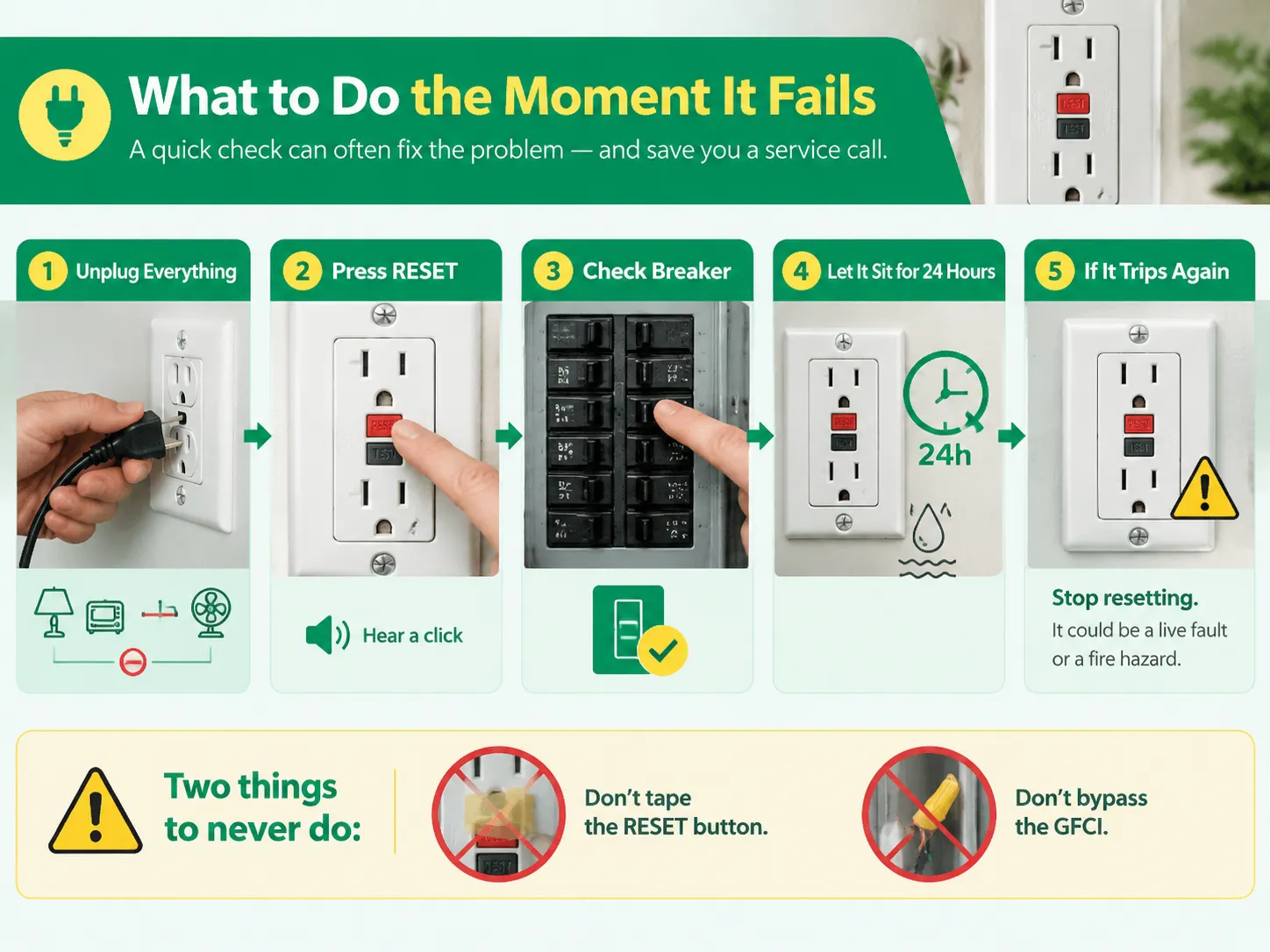
When the outlet is not working or the Ground Fault Circuit Interrupter is not working, there are several steps to follow. It does not take much more than five minutes and it actually helps save money on unnecessary service calls.
There are two things that should never be done: do not tape the RESET button and do not bypass the GFCI because doing one of those things is not a good idea, either. If you want the diagnostic sequence in more detail — what each symptom points to and which ones you can fix yourself — this guide to what to do when a socket or outlet stops working walks through the same logic with the wiring-side checks included.
Requirements vary according to the jurisdiction and age of the property so it is always advisable to check the local code. Despite this, more or less the list designated by the NEC includes locations where water and electricity could meet:
If your house was built before the date the requirement was instituted and the outlet was not updated, the code states that the given element can remain. However, this does not mean that this outlet was safe.
One clarification that is essential to be done is that GFCI and circuit breaker do different jobs, and both are necessary.
| Dispositivo | Protects against | Trips at | Where it lives |
|---|---|---|---|
| Interruttore automatico | Overcurrent — overload and short circuit | Rated amps (15 A, 20 A, etc.) | Distribution panel |
| Interruttore differenziale | Ground faults — current leaking to earth through a person or water | 4–6 milliamps | Receptacle or panel |
| AFCI | Arc faults — dangerous arcing in damaged wiring | Arc signature detection | Panel, or combination devices |
A breaker would allow five milliamps of current to pass through your body without any problem — it won’t trip. That’s where the GFCI comes in, so it should be understood that a GFCI should not be used as a substitute for a breaker and vice versa.If you’re trying to understand how the two layers work together, the relationship between breakers and the outlets they feed is set out in this explanation of circuit breakers and the outlets and switches they protect, and it’s worth five minutes if you’ve ever wondered why a bathroom has two separate devices doing apparently similar jobs.
There’s something we can’t forget about when we discuss GFCIs – their manufacturing process. First and foremost, GFCIs are component-supply products, and the reliability of their sensing circuit boils down to component selection, quality control at the manufacturer’s place, and end-of-line testing. Hence, companies like igoto supply switches, plus sockets, outlets, and power strips, including GFCIs, to their distributors and contractors. This is also the reason why published standards matter when it comes to purchasing – a GFCI that doesn’t meet the applicable UL standard does not become cheaper but is just a different product that looks very similar.
You can check this by using a lamp. Plug the lamp into the protective switch, press TEST, and you should see that the lamp goes out and the RESET button pops out; if you press RESET button afterwards, you should see that the power is restored. If TEST doesn’t work and RESET can’t be pressed down, then it means the protection has failed and the unit needs to be replaced, even if the electrical appliances are powered normally. You may also check for some other indications like warm or discolored faceplate, a fault light blinking or shining continuously, regular tripping when nothing is being plugged into the device or difficulty with pressing down RESET.
Normally, a GFCI outlet remains functional for approximately a decade or a decade and a half whereas a GFCI breaker does its job for slightly longer. Due to the presence of moisture and humidity outdoors, most devices don’t last more than 10 years. Furthermore, devices produced before self-testing systems were introduced should be changed out even if they are not broken because they cannot reveal whether they are malfunctioning or not.
Substitute it when it fails any of such checks: either it doesn’t turn off the electricity, the reset is not persisted or a device has triggered self-test lockout lock, or the unit hasn’t reset itself even after the disconnection and drying of the circuit. In case it’s aged more than 10 to 15 years or is older than self-testing devices, then it can be replaced based on the age alone. It has to be replaced without a delay in case the device is warm, burnt or emits odour.
The primary causes are degradation due to aging of the sensing electronics, the number of times power surges and lightning hits, frequent tripping cycles that have taken a toll on the mechanical latch, moisture ingress into the enclosure and heat stress due to overloaded wires and/or loose terminations. It is significant to differentiate whether the aforementioned problems are due to appliance defects or real ground faults, as a GFCI that trips only when a certain appliance is plugged in is likely discovering an actual current leak in that appliance rather than a GFCI malfunction.
GFCI outlets do fail, and it’s important to note how they fail. GFCI outlets do not give a warning; they keep working like they’re meant to. The light keeps turning on and off, and that vital function — the cutting of power when current is leaking through a person — may fail without any visible sign at all.
The take-home point is 10-15 years lifespan for a receptacle, 7-12 years lifespan in damp places, and a trip time equal to about 1/40 second at 4-6 mA for a working device. In practice, the device costs between $15 and $40 and costs another $80-200 to install, making this simple little device the difference between just getting a shock from a bathroom outlet and getting seriously electrocuted.
For this reason, test every month. Press TEST, see the power goes out, press RESET. If the device does not work just as it should, it must be replaced — it cannot be fixed. If the device has served you for more than 10 years, yes, replace it on your schedule, not in an emergency situation. When buying the replacement, always opt for self-testing devices that can alert a user before breaking down, which is a huge advantage over devices that will stop working without any warning.

When someone asks the question “do GFCI outlets go bad”, they may really be asking how long an outlet will last before failing. There is no definite or absolute answer to that question as every situation is unique; therefore each GFCI outlet should properly work as long as there are no other factors contributing to […]
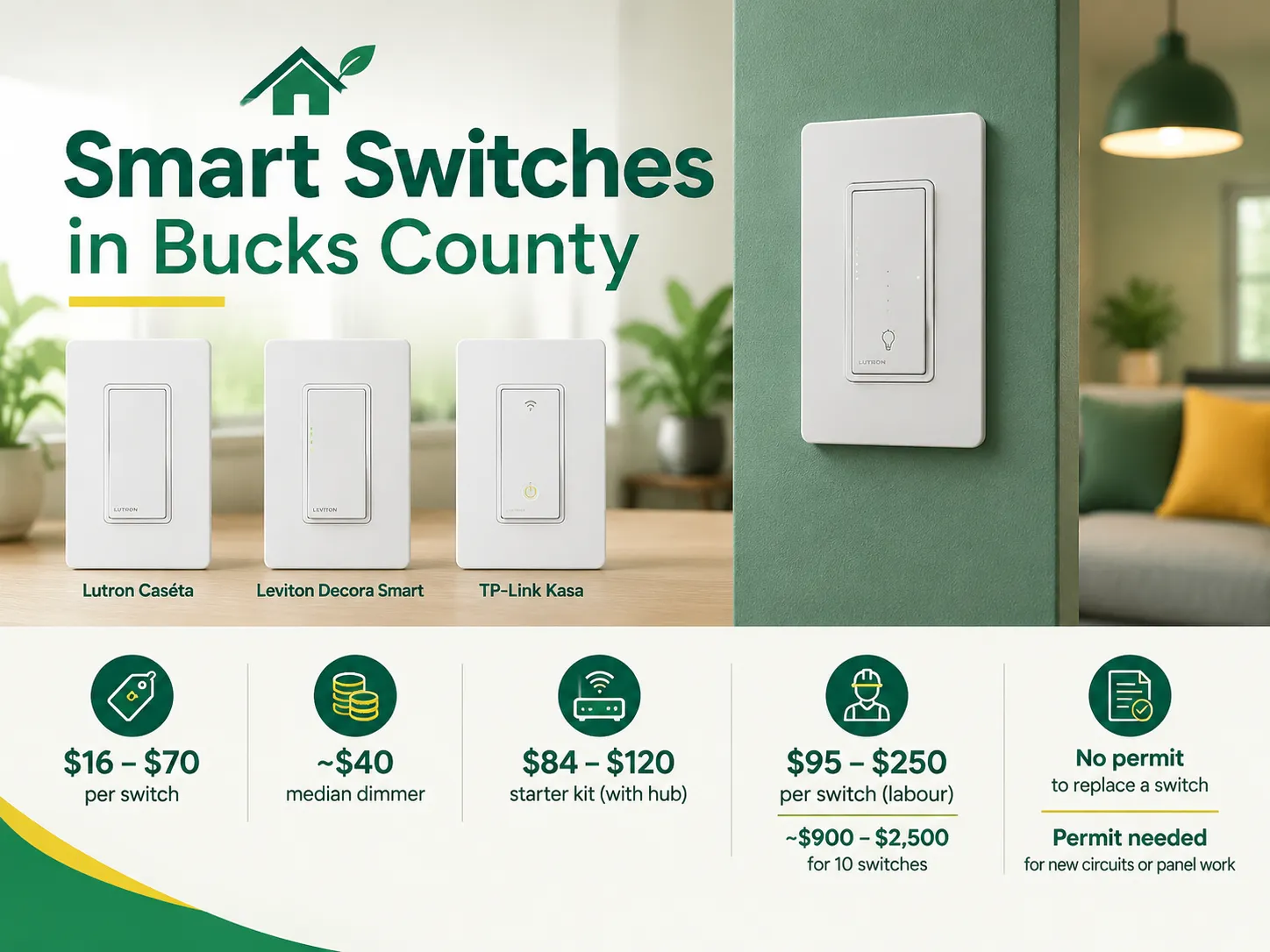
L'acquisto di interruttori intelligenti nella contea di Bucks è relativamente complicato, con la difficoltà che è più una questione delle caratteristiche del mercato immobiliare locale piuttosto che della disponibilità dei sistemi. Si può guidare da Solebury, dove alcune delle case possono risalire agli anni '90 del 1700, a Warrington, dove alcune costruzioni più recenti sono state costruite […]

Il controllo dell'illuminazione wireless ha un piccolo segreto sporco: mentre spesso funziona eccezionalmente bene nelle dimostrazioni, tende a deludere le persone nelle loro case. Il colpevole è raramente l'app; invece si trova dietro il muro. Questa guida presenta le scelte in modo ordinato. Sei modi per controllare la luce in modalità wireless, cinque protocolli che […]

 No.6 Tuozhan Road, Leshang Pioneer Park, porto della baia di Yueqingwan, città di Yueqing, provincia di Zhejiang


