

“Two-way switch two lights” is one of the most searched terms for wiring in the UK, as well as one of the most confusing, since it denotes two different actions that carry the same name. The first is the possibility of having the lights controlled using one switch position (turning both on and off from one plate, which is a mere parallel connection, doable with virtually any switch). The second interpretation means that the two-way switching (i.e. staircase) is used to control the same light from two different locations for two lights. While it is possible to implement it in reality, a specific wiring scheme is necessary and the number of cores should be taken into account as well. There is also a third definition of the term: a double switch used to control two separate lights independently. The information below helps in differentiating between the three definitions and explaining the circuitry for each of them, as well as the things that a two-way circuit is not able to do and the reasons why the well-known “one switch stopped working” issue occurred.
In short: you can control two bulbs via a single switch and there are three ways of wiring it up. (1) One switch controls two bulbs. Both bulbs can be wired up in parallel and will always be on/off together as it is the easiest way of wiring them. (2) Two-way control: two switches controlling pairs of two bulbs from two locations (staircase switch) with the switches connected with a common and two traveler wires; in this case both bulbs remain grouped and can be controlled from any location. (3) Double switch control: two independent bulbs are fed by a double switch with two independent switches — they can be controlled separately.
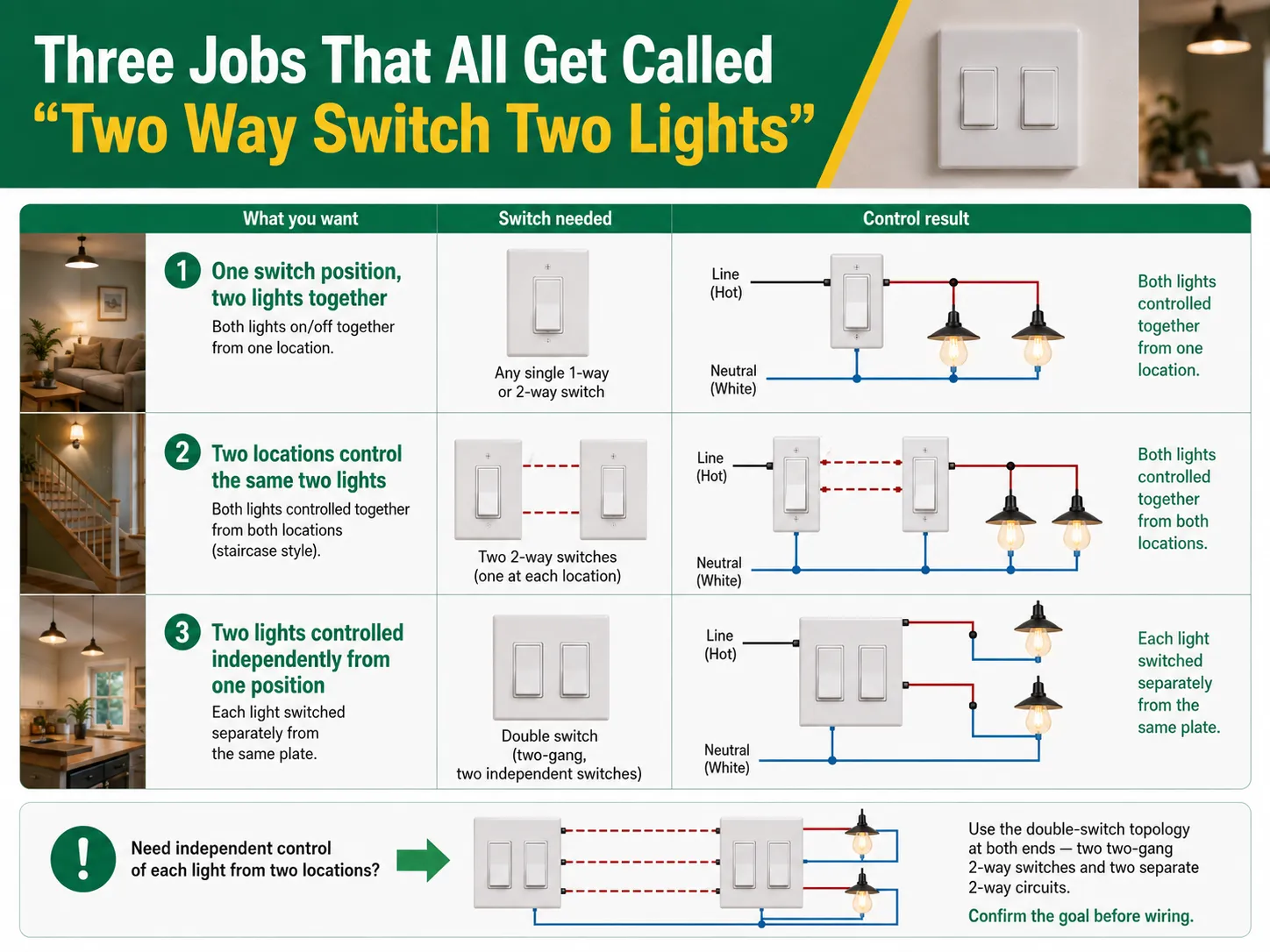
Before making a purchase, determine which of the three setups apply to your switches since the hardware and cabling are different for each type.
| What you want | Switch needed | Control result |
|---|---|---|
| One switch position, two lights together | Any single 1-way or 2-way switch | Both lights on/off together from one location |
| Two locations control the same two lights | Two 2-way switches (one at each location) | Both lights controlled together from both locations (staircase style) |
| Two lights controlled independently from one position | Double switch (two-gang, two independent switches) | Each light switched separately from the same plate |
If you need to control a light from two different locations, you will need to install double switches at both ends. This set-up requires two sets of wires to be installed, making this the most complicated case; therefore, you should always confirm what the goal is before proceeding with wiring.
The simplest solution to the dilemma of whether it is possible to join two lamps to one switch is simple: Hook your lamps up in parallel.
As for wiring the switch, it consists of a cable that supplies power (in brown) and a switched cable (out). The switched cable goes first to the live terminal of the first lamp, and the live cable from the first lamp is connected to the second lamp. The same applies to the neutral wire (in blue): it links the first lamp to the second one. As for the earth wire (green/yellow), it connects together all wires in any configuration. With the lamps connected in parallel, both of them will receive constant voltage and run independently of each other (one of them can be out of order and the other will be unaffected).
When installing the lamps, be careful not to exceed the capacity of the switch: in UK plates the current is kept at 10A (around 2300W at 230V); thus you can use two ordinary LEDs or even halogen lamps which take a few watts.
Here, we have job of staircase switching — controlling the same light switch from two different locations — used for two lights instead of one. The concept is the same as that of any normal two-way circuit, except that both lights are connected to the load side.
The wiring is performed in the same way as for a normal two-way circuit but with a three-core cable (brown, black or grey, blue sleeves with brown or black for marking one wire as live and plus earth). At Switch 1: the line (the brown wire coming from the consumer unit/fitting) is connected to the common terminal; two strappers are connected to two L1/L2 terminals. At Switch 2: two strappers are connected to two L1/L2 terminals, while the wire to the lights is connected to common. Two lights are connected in parallel to that wire, in the same way as in Job 1. At the moment one of the switches is flipped, the respective strapper becomes live, changing the state of both lights regardless of the location.
The principle is that every two-way switch has three terminals: one common and two travelers. Two switches create a circuit through which the lights turn on if both switchers are connecting to the same strapper and off if they connect to different strappers. This is the essence of staircase switching. For an explanation of how the various switch types fit together, our guide to the different kinds of electrical switches covers 1-way, 2-way, and intermediate switching in one place.
When “two lights from one switch point” means that the control is independent, it is necessary to use a double switch (a two-gang switch): two independent switches are installed on one panel and use one back box. Each of the switches connects to the incoming current and outgoing line independently. The two halves share only the incoming power supply (and the neutral, which passes through in the ceiling, and not at the switch).
For the wiring, connect the live supply into the double switch and connect the live supply across both common terminals. A separate line should be taken from both of the switches L1 (or, in the case of a one-way double switch, the L1 terminal only) to each of the lights. Neutral and earth are connected in each light fitting. This is the standard type of wiring where the two lights are controlled independently.If you also want dimming on one or both lights, the same double-gang form factor is available with dimmer internals — our guida all'installazione degli interruttori dimmer covers the safe steps for swapping a standard switch for a dimmer.
There are really serious reasons behind this search phrase. A homeowner intends to put a second pendant light, and it is important that the lights come from the same switch. A landlord is remaking a landing and wants hallway lights to be operated from both floors. A construction worker is changing the old kitchen plate and requires control over the downlights and the lights above the island without using two back boxes. All these cases can be considered real jobs that are compliant with codes — the only important issue is to match the wiring topology with the type of control, i.e. one may really fail if considering wiring Job 1 of Job 2 wiring (two cores instead of three), hence the phrase “everything worked right on the table but failed in the wall.”
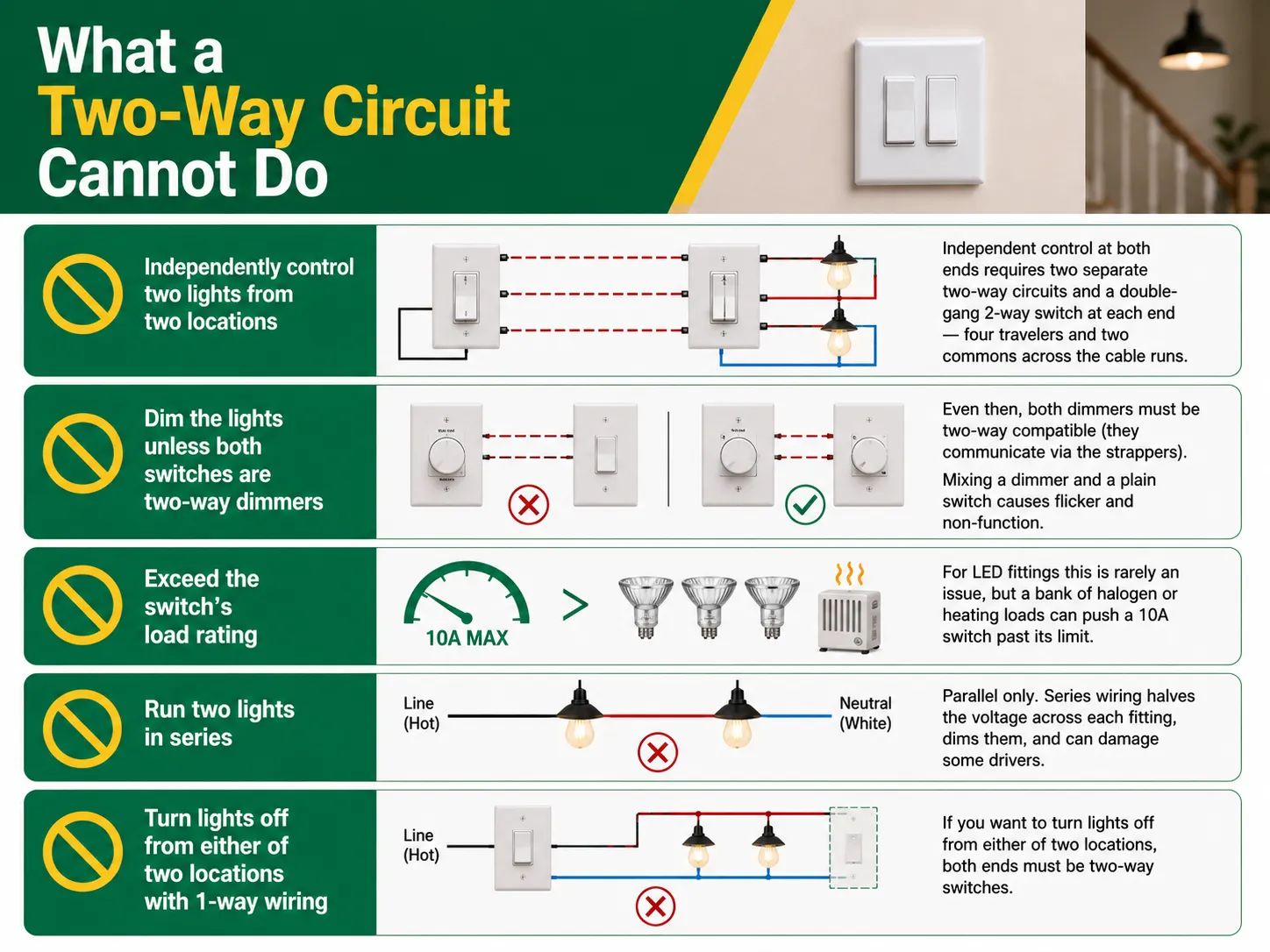
Knowing the limitations can help avoid frequent mistakes:
In this job category, mistakes mostly occur in wiring; here are some of the more frequent gaffes.
The type of switch you are asking for depends on the control that you require: if you have one switch operating two lights at the same time, it is simply known as a “switch” because it works in parallel with both lights; if you have two switches operating the same lights from different positions, it is known as a two-way switch (three-way in America); if you have two switches operating the lights independently but they are located on the same plate, it is known as a double switch, or two-gang switch. The term “two way switch two lights” refers to one of the last two.
For a UK type two-way switch (having three connections), the brown live wire and wire going to the light will connect to either of the two common connections while the strapper wires will connect with L1 as well as L2 connections at both switches. As for a North American type switch, we will call the dark screw common and travelers will be the use of the two brass screws in the switch.
Connect the power supply with the common way terminal of the switch to both switches, then wire the light from respective switch L1 terminal with the light fitting. Connect neutral and earth for both the fittings in respective positions in the double switch so that both lights will now have independent operation through the switch. This setup is useful in kitchens and corridors and other locations needing operation of two separate lights from just one switch.
Yes, the two lights can be connected in parallel directly to the switch, with the power supply going to the common live side. Ensure that the wattage is not more than the capacity of the switch and avoid series wiring.
The term “two way switch two lights” represents three different job opportunities with three separate wiring topologies. The whole importance lies in choosing the right wiring type. The case of controlling two lights from one switch is just a normal parallel job any switch could do; two lights controlled from different places is a genuine two-way job defined by strappers connecting the boxes; and the case of controlling two lights separately from a single switch requires a special two-way switch. The process of changing switches and sockets on the same wall is described in our article on upgrading USB wall sockets. The problems arise when making a mistake: putting two-core cable where three-core is required, using a live wire as a traveler, and connecting lights in series. Use the right topology, label the wires according to BS 7671 standards, measure load parameters, and cut off the power supply before working to have the switch installed and work successfully for long.
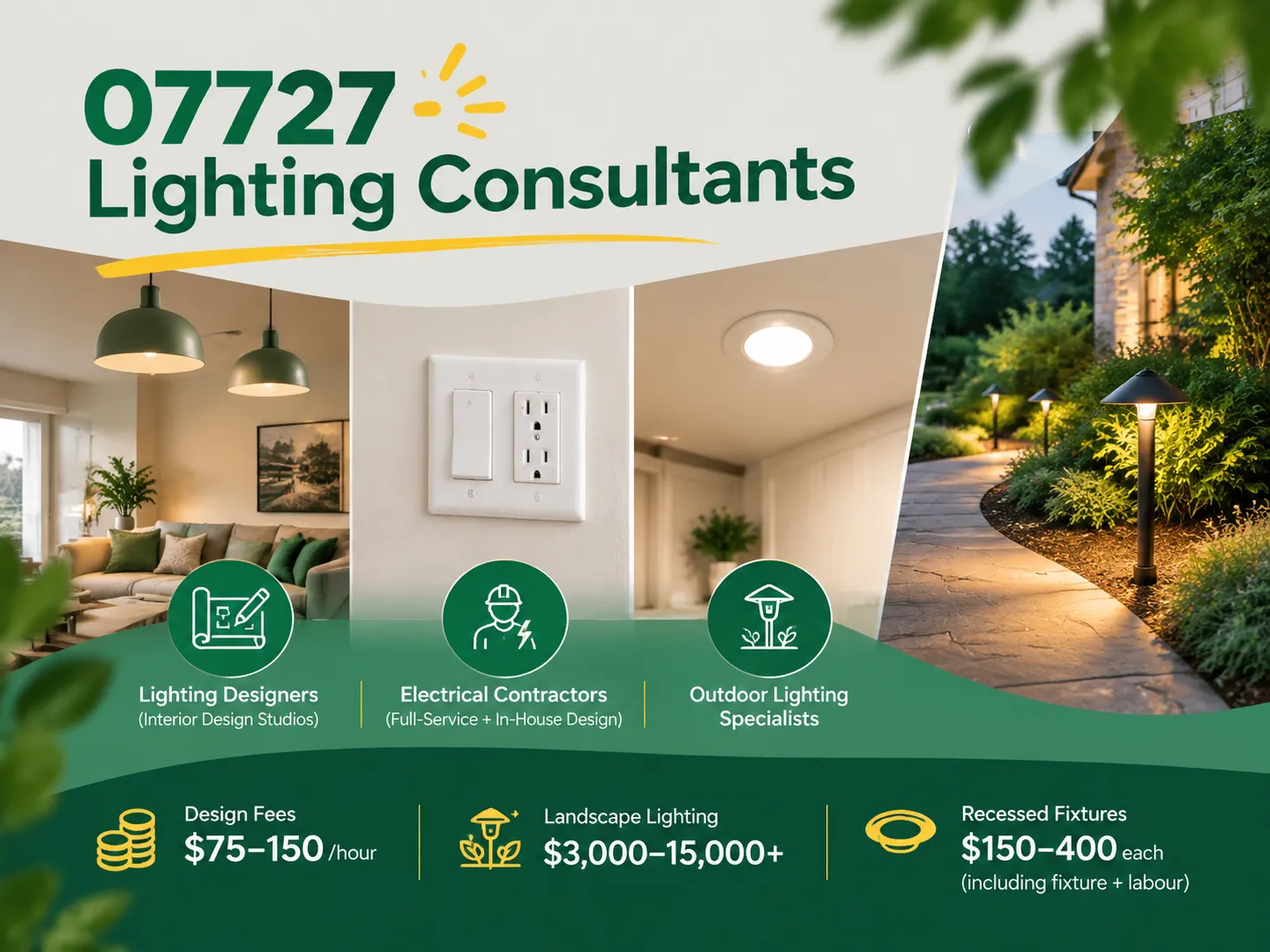
Farmingdale, insieme a parti di Wall Township e Tinton Falls, New Jersey, condivide lo stesso codice postale di 07727. La maggior parte delle case costruite dagli anni '50 agli anni '90 esiste ancora oggi. La maggior parte dei proprietari di case sta ristrutturando le proprie abitazioni piuttosto che costruire nuove case. I proprietari tendono a spendere molto di più su […]

Il termine “07984 lighting consultants” dà alle persone l'impressione che le cinque cifre rappresentino un codice postale di qualche tipo che indica il luogo in cui i consulenti di illuminazione forniscono servizi. Questo è, tuttavia, errato: non esiste un'area postale codificata 07984, che è solo un codice di telecomunicazioni mobili in Gran Bretagna. Questo significa che il […]

San Francisco non è il mercato medio per il controllo dell'illuminazione. Il patrimonio edilizio è vecchio e denso, e il codice elettrico non consente tante installazioni elettriche quante sono consentite quasi ovunque altrove negli Stati Uniti. La maggior parte delle case che desiderano un'illuminazione complessa sono edifici vittoriani o edoardiani dove nessuno vuole iniziare ad aprire […]

 No.6 Tuozhan Road, Leshang Pioneer Park, porto della baia di Yueqingwan, città di Yueqing, provincia di Zhejiang


