

Aankomen in New York, Toronto of Mexico City met een tas vol opladers uit Europa, Engeland of Australië, stelt de reiziger voor een uitdaging, aangezien de elektrische stopcontacten in de hotelkamer volledig anders zullen zijn dan die in hun land en de geleverde stroom minder zou zijn dan de apparatuur aankan. De stopcontacten in Noord-Amerikaanse stijl zijn identiek over het hele continent, van Canada tot Panama, waardoor het een grotere gebruikersbasis is, maar tegelijkertijd verwarrend voor reizigers.
De gids schetst veel nuttige details over Noord-Amerikaanse stopcontacten en stekkers, waaronder de twee stekker types (A en B), hun standaarden gedefinieerd door NEMA, de spanning en frequentie (120V en 60 Hz), de stopcontactontwerpen, de landen die vergelijkbare systemen hebben en de noodzaak voor reizigers om uit te zoeken of ze een adapter, een omvormer of helemaal niets nodig hebben.
In Noord-Amerika worden stekkers en stopcontacten van Type A en Type B gebruikt, die voldoen aan dezelfde NEMA-standaard in de VS, Mexico en Canada, en het grootste deel van Midden-Amerika en het Caribisch gebied. Type A bestaat uit twee platte parallelle pinnen, terwijl Type B dezelfde twee platte pinnen heeft met een ronde aardingspin die onder deze twee pinnen te vinden is. De VS, Canada, Mexico, Japan en grote delen van Latijns-Amerika kunnen hun stekkers rechtstreeks in de stopcontacten gebruiken. Bezoekers uit het VK (Type G), Europa (C/E/F), Australië (Type I), China en de meeste Aziatische landen moeten een adapter gebruiken om de vorm van hun stekkers aan te passen.
Type A (ook wel NEMA 1-15 genoemd) is de conventionele Noord-Amerikaanse tweepolige (of platte mes) stekker die twee platte messen heeft die ongeveer 1,5 mm dik en ongeveer 15,9-18,3 mm lang zijn. De afstand tussen de twee pinnen is ongeveer 12,7 mm. Type A stekker is ongeaard, heeft geen aardingspin en heeft een stroomsterkte van 15A/125V.
De twee messen van een stekker zijn meestal gepolariseerd. Eén van de messen is breder dan de andere; bijvoorbeeld, de breedte van de neutrale pin is ongeveer 7,9 mm, terwijl de breedte van de fasepin 6,3 mm is. Het ontwerp zorgt ervoor dat de stekker slechts in één richting kan worden ingestoken, wat de veiligheid van de lamp of het apparaat garandeert.
Objecten waarvoor de Type A stekker wordt gebruikt: kleine apparaten en dubbel geïsoleerde gadgets zoals lampen, opladers voor mobiele telefoons, draagbare radio's, tweepolige kabels in verschillende apparaten. Gebruikers van apparaten met deze Amerikaanse tweepolige stekker kunnen de stekkers vinden die niet alleen in type A stopcontacten passen, maar ook in type B stopcontacten.
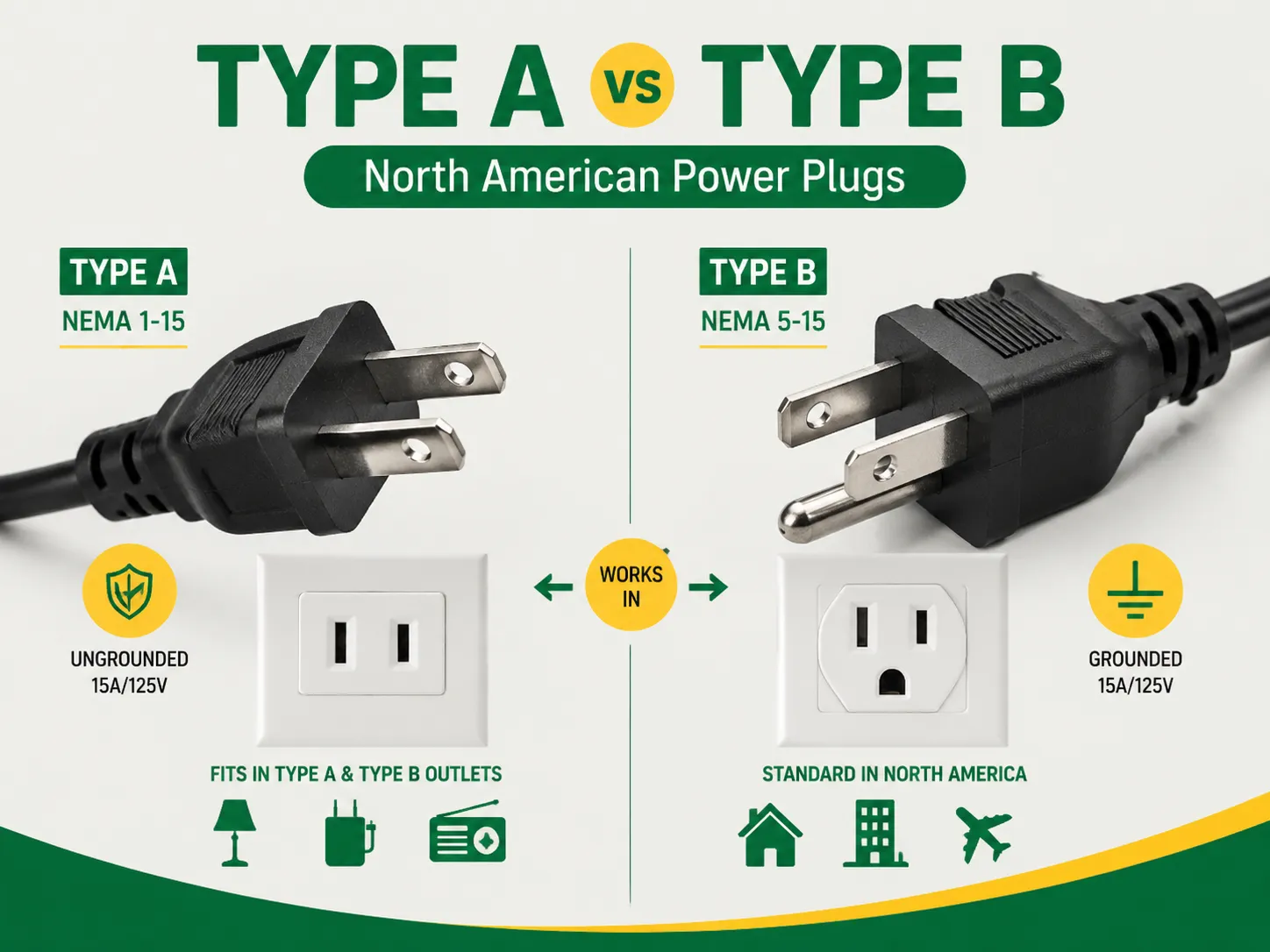
Officieel bekend als NEMA 5-15, is Type B de standaardstekker geworden in Noord-Amerika en gebruikt dezelfde dubbele platte parallelle messen als Type A, plus een ronde (U-vormige) aardingspin onder de messen; deze pin heeft een diameter van 4,8 mm en is iets langer dan de messen, wat ervoor zorgt dat de aardingspin als eerste contact maakt voordat de stroom wordt ingeschakeld. De nominale stroom voor deze stekker is 15 A/125 V.
Waar Type B te vinden is: overal, aangezien deze stekker is geïnstalleerd waar gebouwen sinds de jaren 60 zijn gebouwd en werd gebruikt in huizen, hotels, kantoren en luchthavens in de VS, Canada en Mexico. In de meeste gevallen is het moderne stopcontact van Type B, maar heeft het USB-C oplaadpoorten, en zijn TR-sluiters nu onderdeel van de code in nieuwbouw. Type A stekker past in een Type B stopcontact, terwijl een Type B stekker niet in een Type A stopcontact past (aangezien de aardingspin geen verbinding kan maken).
Als u stopcontacten in een Noord-Amerikaans pand aan het upgraden bent, volgen moderne stopcontacten — inclusief USB-geïntegreerde en slimme opties in de IGOTO stopcontactreeks — hetzelfde Type A/B/NEMA-voetafdruk, zodat ze in elke standaarddoos passen.
NEMA staat voor National Electrical Manufacturer’s Association, die de normen voor stekkers en stopcontacten in Noord-Amerika vaststelt. De belangrijke codes zijn:
| NEMA-code | Gebruikelijke Naam | Configuratie | Nominale Waarde |
|---|---|---|---|
| NEMA 1-15 | Type A | 2 platte parallelle pinnen, ongeaard | 15A / 125V |
| NEMA 5-15 | Type B | 2 platte pinnen + ronde aarde, geaard | 15A / 125V |
| NEMA 5-20 | Type B (20A) | 2 platte pinnen + aarde, één mes 90° gedraaid | 20A / 125V (keukens, badkamers) |
| NEMA 6-15 / 6-20 | 240V stopcontacten | 2 platte pinnen + aarde, voor 240V apparaten | 15-20A / 240V (drogers, AC, EV) |
| NEMA 14-30 / 14-50 | Droger / fornuis / EV | 4 pinnen (2 fase + neutraal + aarde) | 30-50A / 240V |
Voor reizigers zijn alleen types 1-15 (type a) en type 5-15 (type B) relevant — alle andere types zijn gespecialiseerde stekkers met hogere stroomsterkte. Wat in elk hotel en huis te vinden is, is een 120V universeel stopcontact.
Noord-Amerika werkt op een 120-volt, 60-hertz systeem – wat identiek is in de VS (120V), Canada (120V) en Mexico (hoewel Mexico iets hoger is met ongeveer 127V). Dit spanningsniveau is ongeveer de helft van wat de rest van de wereld gebruikt (220-240V), wat het andere deel van de algehele compatibiliteitspuzzel vormt.
Het spanningsniveau werkt ook in:
Het spanningsniveau is niet compatibel met het VK, Europa, Japan, Australië, Nieuw-Zeeland, China, India, Singapore en het grootste deel van Afrika, omdat zij allemaal 220-240V gebruiken en verschillende stekker vormen hebben.
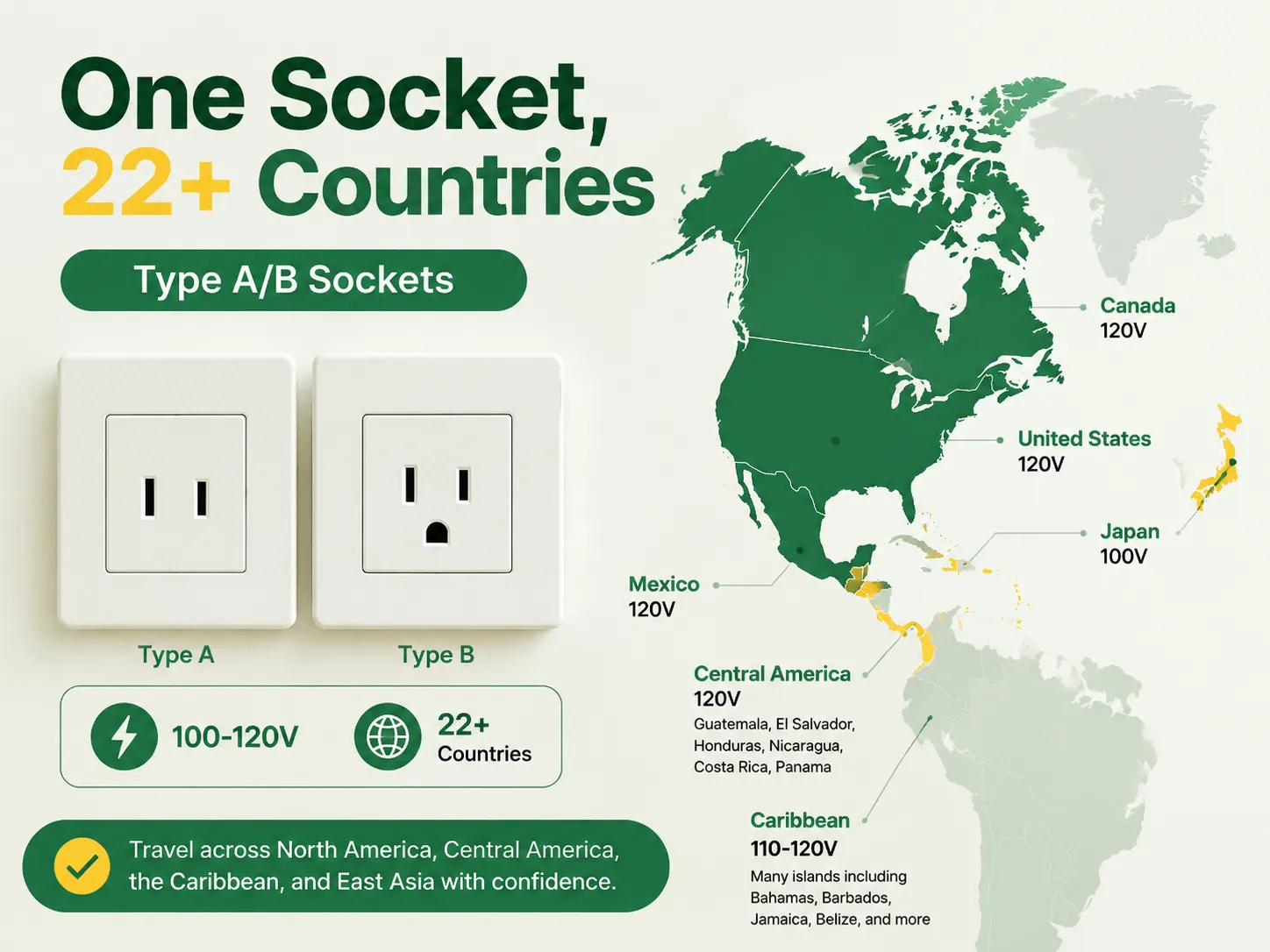
De elektrische standaardisatie van Noord-Amerika is ongeëvenaard: één stekkerontwerp wordt in meer dan 22 landen gebruikt. In dit opzicht zijn de stekkers identiek in de volgende regio's:
Al met al kan iemand vanuit de VS naar Canada reizen en tot halverwege de wereld, naar Panama, nooit nadenken over de stekkeradapters, wat dit elektrische systeem zo reizigersvriendelijk maakt voor mensen uit de VS.
| Land / Regio | Home Plug | Adapter Nodig? | Spanningsomvormer Nodig? |
|---|---|---|---|
| VS, Canada, Mexico | A / B | Nee | Nee |
| Midden-Amerika, meeste Caribisch gebied | A / B | Nee | Nee (110-127V) |
| Japan | A / B | Nee (stekkers passen) | Meestal nee (100V vs 120V) |
| Taiwan | A / B | Nee | Nee (110V) |
| Verenigd Koninkrijk / Ierland | G | Ja | Ja (voor apparaten die alleen op 230V werken) |
| Vasteland Europa | C / E / F | Ja | Ja (voor apparaten die alleen op 230V werken) |
| Australië / Nieuw-Zeeland | I | Ja | Ja (voor apparaten die alleen op 230-240V werken) |
| China | A / C / I | Misschien (A past; C/I hebben adapter nodig) | Ja (220V vs 120V) |
| Zuid-Korea | C / F | Ja | Ja (220V) |
| Indië | C / D | Ja | Ja (230V) |
Belangrijke opmerking: een adapter kan alleen de vorm van de stekker compatibel maken, maar verandert niets aan de spanning. Als een Britse föhn bijvoorbeeld met alleen een adapter in een Amerikaans stopcontact wordt gestoken, krijgt deze 120V waar het 230V zou moeten krijgen, wat betekent dat deze nauwelijks zal werken en zichzelf tot gevaar zal opwarmen.
Algemene regel: als er INPUT: 100-240V (of 110-240V) staat, kan het apparaat op dubbele spanning werken en heeft het alleen een adapter nodig. Als er alleen 120V of 230V staat, is het enkelvoudige spanning, en als het uit een land met 230V standaard komt, heeft het een omvormer nodig in Noord-Amerika. De meeste telefoonladers, laptopadapters, camera-laders en tandenborstelladers zijn dubbele spanning, terwijl de meeste haardrogers, krultangen en oudere apparaten dat niet zijn. Voor de bredere logica van internationale stekkers en stopcontacten — en hoe het NEMA-systeem past binnen de wereldwijde standaarden — onze gidsen voor verschillende soorten elektrische schakelaars en stopcontacten en de basisprincipes van dimmer installatie behandelen de hardwarekant van wandapparaten.
Een snelle controle duurt slechts tien seconden; u hoeft alleen maar te kijken naar het kleine etiket op het apparaat of op de voeding, meestal gelegen in de buurt van de kabelingang.
| Label Tekst | Betekenis | Nodig in Noord-Amerika (uit een 230V-land) |
|---|---|---|
| “INGANG: 100-240V, 50/60Hz” | Dubbelspanning, wereldwijd | Alleen adapter |
| “INGANG: 110-240V” | Dubbelspanning | Alleen adapter |
| “INGANG: 100-120V” | Enkelvoudige spanning (NA/Japan standaard) | Alleen adapter als uit 120V land; omvormer als uit 240V land |
| “INGANG: 220-240V” | Enkelspanning (230V standaard) | Adapter + omvormer |
Als u reist vanuit een land waar de spanning tussen 220V en 240V ligt, moet u ofwel een haardroger met dubbele spanning meenemen of een reisfohn gebruiken die door het hotel wordt verstrekt.
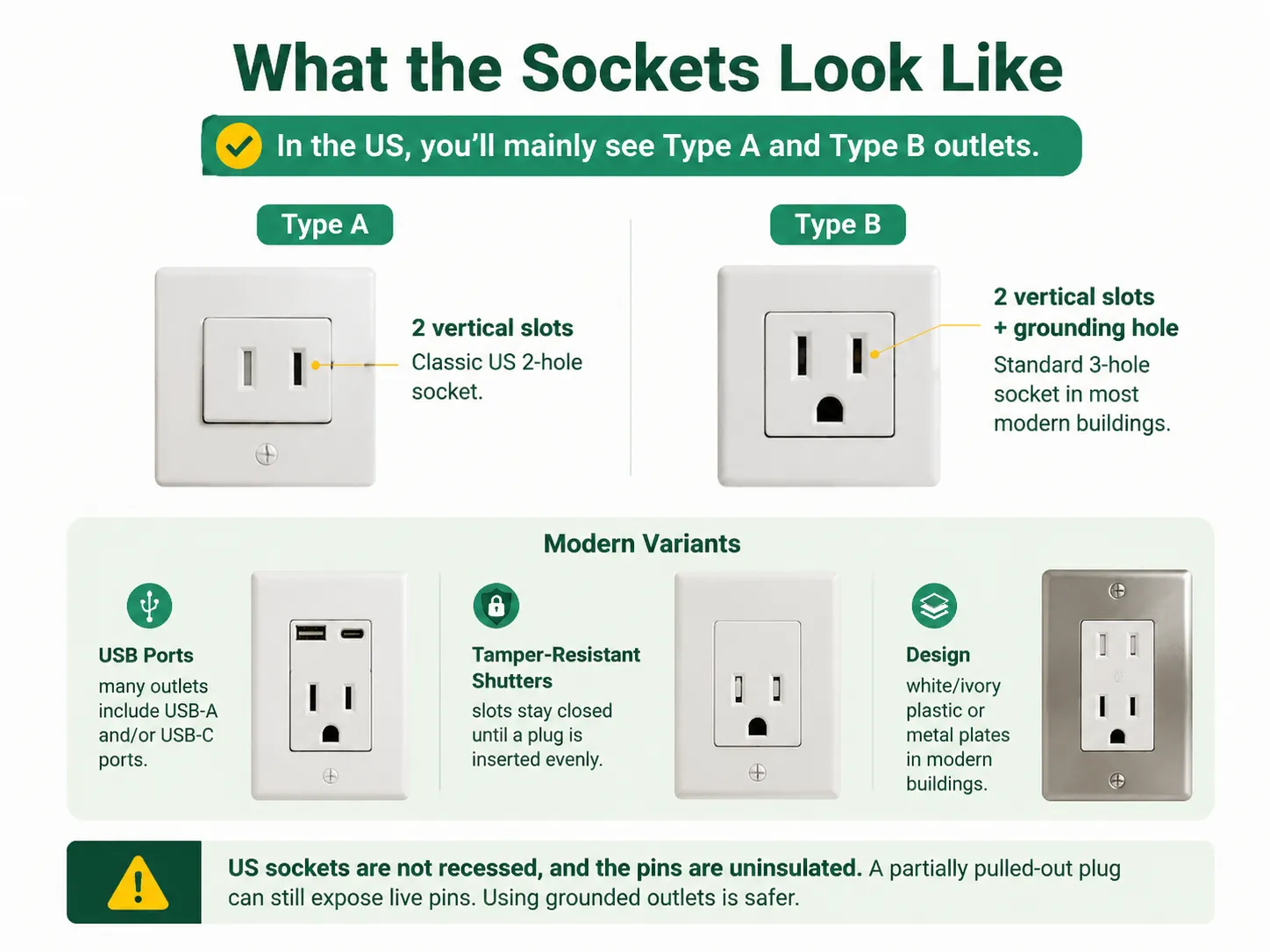
Het identificeren van de connectoren vergemakkelijkt het reizen:
Het Amerikaanse stopcontacttype staat erom bekend dat het niet in de muur is ingebouwd en dat de pinnen geen isolatie hebben, wat betekent dat een gedeeltelijk ingestoken stekker nog steeds blootliggende pinnen heeft. Het is veilig genoeg bij normaal gebruik, maar het is nog een reden om geaarde, gecertificeerde stopcontacten te gebruiken — zoals de sabotagebestendige en met USB uitgeruste stopcontacten in de gids voor het upgraden van USB-stopcontacten, en de slimme wandbedieningen die beschikbaar zijn in het IGOTO assortiment slimme schakelaars voor dezelfde standaard Noord-Amerikaanse voetafdruk.
Voor frequente reizigers die pendelen tussen regio's met een 120V en 240V stroomvoorziening, is het raadzaam om hoogwaardige universele adapters te gebruiken ($25-$45).
De stekkers en stopcontacten die in Noord-Amerika worden gebruikt, zijn onder meer Type A (met twee platte parallelle pinnen die ongeaard zijn, bekend als NEMA 1-15) en Type B (met twee platte pinnen en een ronde pin die als aarding fungeert — NEMA 5-15). Het systeem wordt gebruikt in de VS, Canada, Mexico, het grootste deel van Midden-Amerika en een groot deel van het Caribisch gebied. Het gebruik van Type A stekkers past in beide soorten stopcontacten, terwijl Type B stekkers de nieuwe vereiste standaard zijn in alle hedendaagse gebouwen.
Er zijn twee soorten elektrische stekkers: type A (NEMA 1-15) die 2-pins niet-geaard is en voornamelijk wordt gebruikt voor dubbel geïsoleerde apparaten en opladers. Type B (NEMA 5-15) is een 3-pins geaarde stekker die voornamelijk wordt gebruikt voor elektrische apparaten en computers. Hun nominale waarde is ook hetzelfde op 15A en 125V.
Absoluut correct. Canada gebruikt, net als de VS, precies dezelfde Type A en Type B stekkers, dezelfde spanning van 120V en dezelfde frequentie van 60Hz. Vandaar dat een Amerikaanse stekker en een Canadese stekker onderling uitwisselbaar kunnen worden gebruikt. Normen vastgesteld door de NEMA in de VS en de CSA in Canada bepalen de compatibiliteit van deze stekkers.
In de Verenigde Staten van Amerika worden types A (NEMA 1-15) en B (NEMA 5-15) stopcontacten gebruikt op 120V/60Hz. De type B is de twee sleuven met verticale openingen en één rond gat voor aarding en is de huidige standaard; aan de andere kant is type A duidelijk de twee verticale sleuven in oudere gebouwen waar Type A stekkers bruikbaar zouden zijn. NEMA 14-30 of 14-50 stopcontacten met hoger vermogen zijn alleen voor drogers, fornuizen en opladers voor elektrische voertuigen.
Het Noord-Amerikaanse type stopcontact is een voorbeeld van standaardisatie. Het Type A en B stekkersysteem, dat werkt op 120V/60Hz, wordt gebruikt in meer dan 22 landen in Noord-Amerika, van Canada in het noorden tot Panama in het zuiden. Daarom, als men 120V stekkers gebruikt, is het de eenvoudigste connector om te gebruiken in elektriciteitsgerelateerde apparaten. Voor bezoekers uit 220-240V landen is deze standaardisatie opnieuw nuttig omdat het eenvoudig te herkennen is: type A/B adapter voor de vorm en een spanningsomvormer voor elk apparaat dat op één spanning werkt — gebaseerd op de tien seconden verificatie van het “INPUT” etiket.
Met andere woorden, voor elke reiziger die naar Noord-Amerika komt, is het antwoord: de stekkers uit de VS/Canada/Mexico/Japan passen er gewoon in; iedereen anders heeft de adapter nodig; reizigers uit de 230 V regio moeten een spanningsomvormer krijgen voor elk van hun enkelspanningsapparaten — labels gecontroleerd, en een geschikte universele adapter gekocht zal alle problemen oplossen, waardoor bezoekers alleen kunnen genieten van het prachtige landschap van Noord-Amerika, zonder zorgen over verbrande opladers.
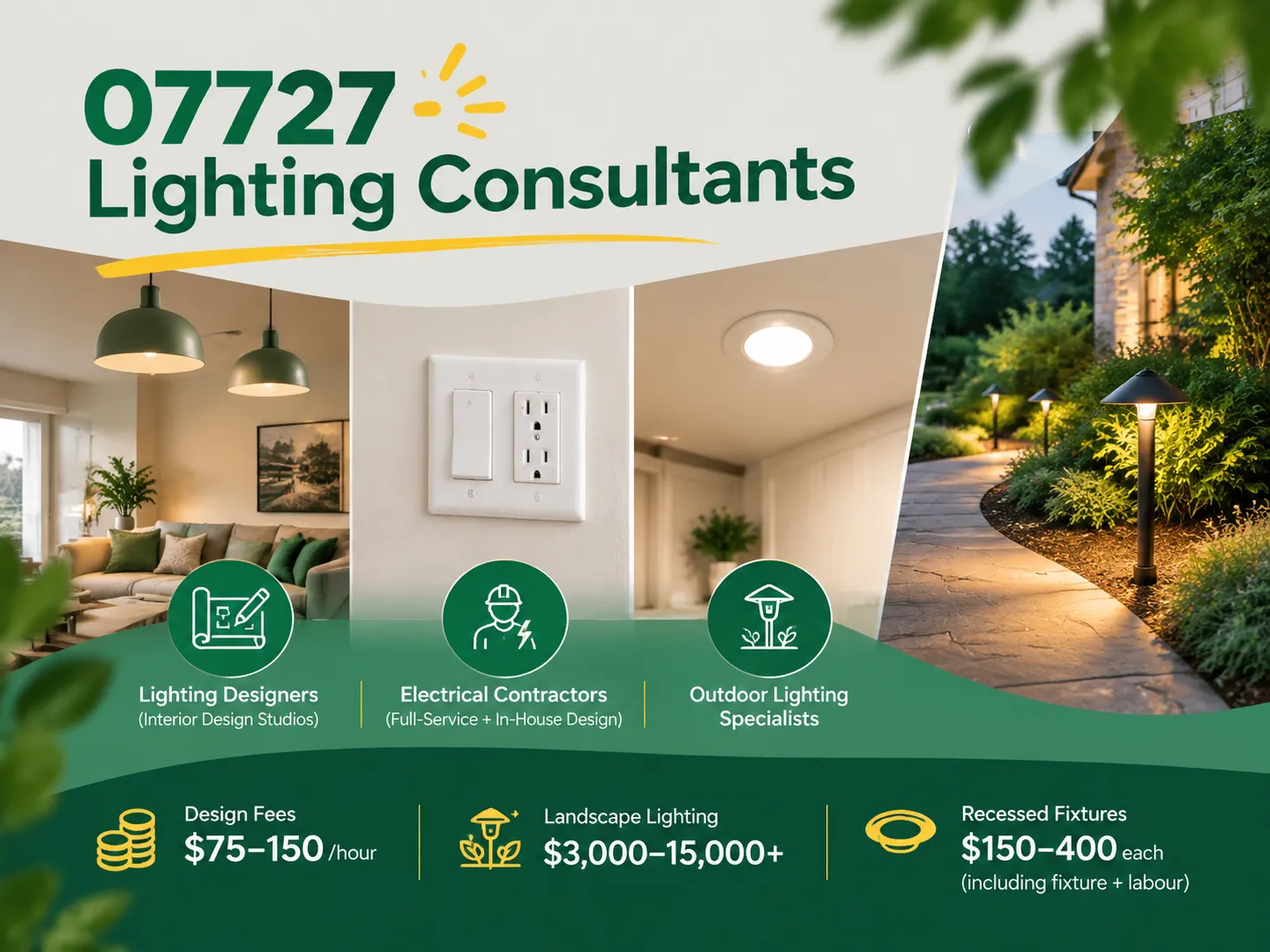
Farmingdale, samen met delen van Wall Township en Tinton Falls, New Jersey, delen dezelfde postcode van 07727. De meeste huizen die zijn gebouwd van de jaren 1950 tot de jaren 1990 bestaan nog steeds vandaag. De meeste huiseigenaren renoveren hun huizen in plaats van nieuwe woningen te bouwen. Huiseigenaren geven de voorkeur aan veel meer uit te geven aan […]

De term “07984 verlichting consultants” geeft mensen de indruk dat de vijf cijfers een soort postcode vertegenwoordigen die de plaats aangeeft waar verlichting consultants diensten verlenen. Dit is echter onjuist: er is geen postgebied gecodeerd 07984, wat alleen een code is voor mobiele telecommunicatie in Groot-Brittannië. Dit betekent dat de […]
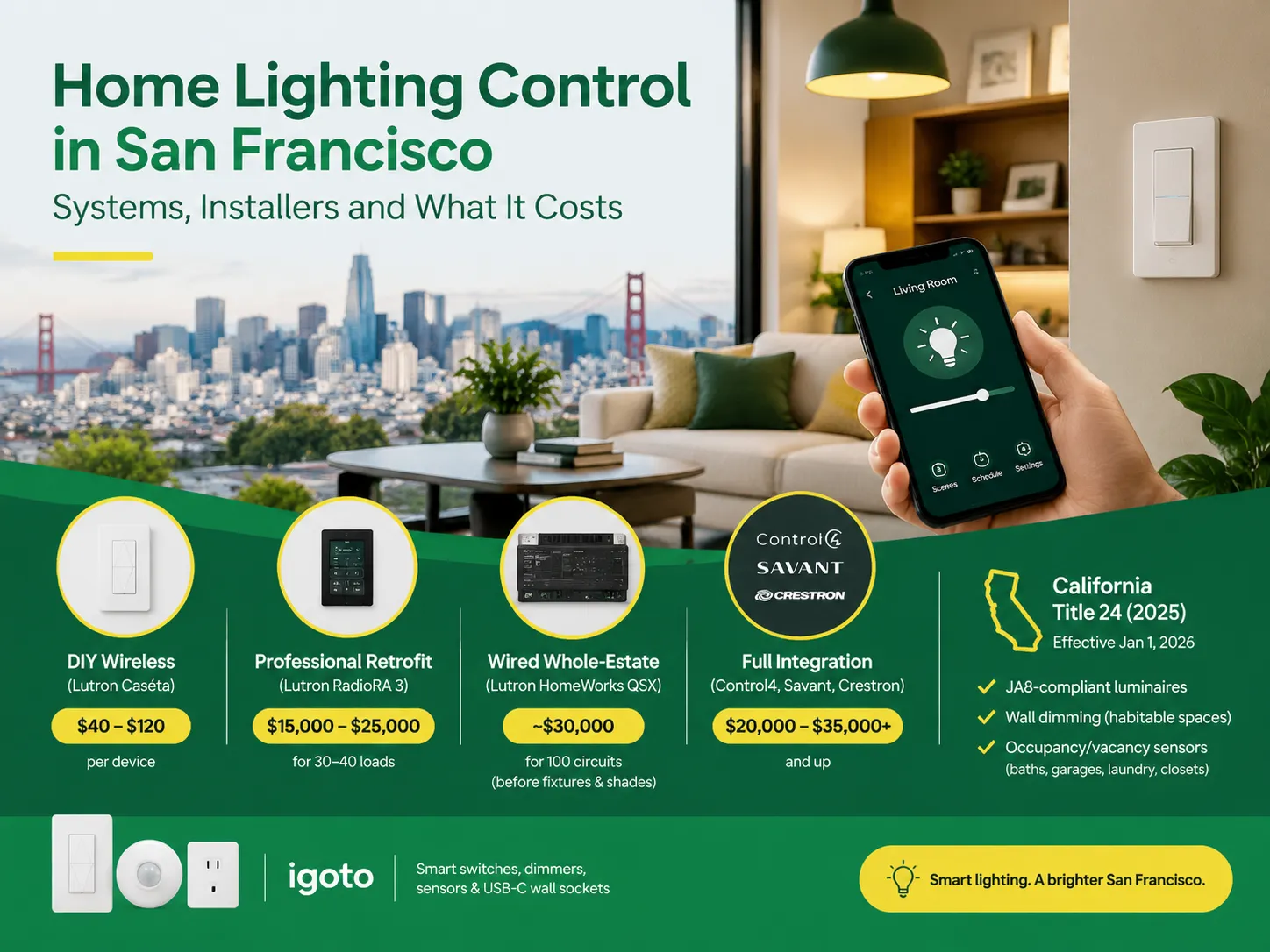
San Francisco is niet de gemiddelde markt voor verlichting controle. De woningvoorraad is oud en dicht, en de elektrische code staat niet zoveel elektrische installaties toe als bijna overal anders in de VS. De meeste huizen die complexe verlichting willen zijn Victoriaanse of Edwardiaanse gebouwen waar niemand wil beginnen met het openen van […]

 No.6 Tuozhan Road, Leshang Pioneer Park, Yueqingwan Bay Harbor, Yueqing stad, provincie Zhejiang


