

Quando alguém faz a pergunta “as tomadas GFCI falham”, pode estar realmente perguntando quanto tempo uma tomada durará antes de falhar. Não há uma resposta definitiva ou absoluta para essa pergunta, pois cada situação é única; portanto, cada tomada GFCI deve funcionar corretamente, desde que não haja outros fatores contribuindo para sua falha, como exposição a ambientes que possam causar danos (por exemplo, calor extremo, umidade ou danos por água). Existem vários tipos diferentes de tomadas GFCI com diferentes classificações de voltagem, que, por sua vez, terão diferentes vidas úteis se usadas de acordo com seus propósitos pretendidos e diretrizes do fabricante.
Além de saber quanto tempo as tomadas GFCI geralmente duram, é necessário que qualquer pessoa que considere usar uma tomada GFCI em sua casa ou instalação entenda os problemas potenciais associados ao uso de tais dispositivos, bem como quais etapas tomar se o dispositivo parar de funcionar corretamente e for determinado que está fora dos limites aceitáveis de seu propósito pretendido e especificações do fabricante. Assim, todos devemos dedicar um tempo para aprender sobre tomadas GFCI para que possamos tomar decisões informadas sobre a durabilidade dos circuitos elétricos e aparelhos usados em nossas casas e negócios, além de ajudar a proteger nossa família, amigos e funcionários de perigos potenciais relacionados ao uso de tomadas GFCI.
A resposta à sua pergunta é ‘sim’, e sim, o GFCI irá falhar com o tempo. Em geral, a vida útil de um GFCI é de aproximadamente 10-15 anos; A vida útil de um disjuntor GFCI é de 15-25 anos; Se instalado em uma área sujeita à umidade, ou ao ar livre, a vida esperada é de aproximadamente 7-12 anos devido a fatores ambientais. a substituição deve ser feita imediatamente para modelos GFCI mais antigos feitos antes da introdução de dispositivos de auto-teste. A falha silenciosa é a situação mais perigosa onde a unidade GFCI ainda fornece energia e não tem proteção contra falhas de aterramento. Um GFCI funcional irá desarmar em um intervalo de aproximadamente um quadragésimo de segundo em uma fuga de 4-6 miliamperes. Testes mensais pelo consumidor podem determinar se o GFCI está funcionando; O teste é feito pressionando o botão de teste para desligar a energia; e redefinindo-o para ligar a energia novamente. Deve-se entender que o custo do próprio GFCI ($15-$40) é muito pequeno em comparação com o custo de contratar um eletricista licenciado ($80-$200) para instalar o GFCI; O custo será baseado em uma série de fatores, incluindo a localização geográfica e o tipo de caixa elétrica usada para montar o GFCI.
Precisamos ter muito cuidado com o que isso diz, já que é assim que a falha ocorre.
Um GFCI usa um pequeno transformador de corrente que compara constantemente a corrente que flui pelo fio quente com a corrente de retorno pelo fio neutro. Em um GFCI que funciona corretamente, as correntes em ambos os fios são iguais. Se houver até mesmo uma pequena fuga em algum lugar no circuito, as leituras diferirão, e o mecanismo acionará um interruptor mecânico para abrir o circuito.
Em seguida, considere o que acontece com este dispositivo ao longo de 15 anos. Picos de tempestades e quando a rede muda. Desarmes repetitivos. Calor de aparelhos que consomem muita energia. Clima úmido. E quando a água entra. A eletrônica que faz a detecção se deteriora devido a todos os perigos do ambiente. E quando se deteriora, quase falha de uma maneira perigosa.
A falha ocorre de duas maneiras. Ou o mecanismo de desarme para de funcionar corretamente, o que é óbvio, já que você não consegue fazer o RESET segurar. Ou — o que é mais perigoso — o sensor para de funcionar enquanto a tomada continua a funcionar. GFCIs modernos podem realizar auto-testes onde fazem verificações internas. GFCIs mais antigos feitos antes da implementação da tecnologia de auto-teste não têm como indicar que algo está errado.
Este é o ponto principal do conselho dado pelos especialistas na área — “teste o GFCI uma vez por mês” não é apenas um requisito burocrático. É a única maneira de detectar o GFCI com mau funcionamento que parou de funcionar.
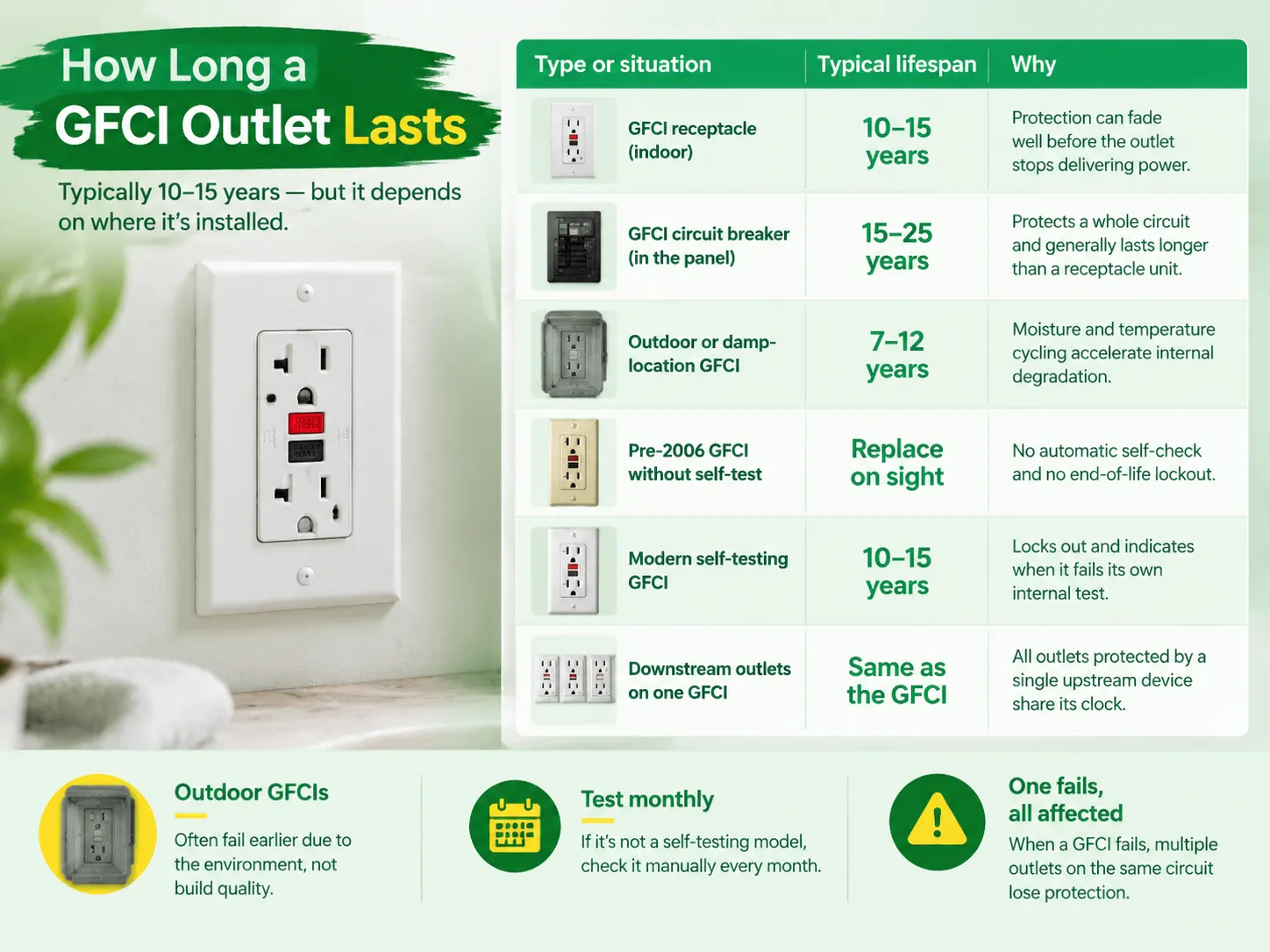
“Dez a quinze anos” é o número principal, mas onde a tomada é instalada muda muito isso.
| Tipo ou situação | Vida útil típica | Por quê |
|---|---|---|
| Receptáculo GFCI (interno) | 10–15 anos | A proteção pode diminuir bem antes de a tomada parar de fornecer energia |
| Disjuntor GFCI (no painel) | 15–25 anos | Protege um circuito inteiro e geralmente dura mais do que uma unidade de receptáculo |
| GFCI para locais externos ou úmidos | 7–12 anos | A umidade e a variação de temperatura aceleram a degradação interna |
| GFCI anterior a 2006 sem auto-teste | Substituir à vista | Sem auto-verificação automática e sem bloqueio de fim de vida |
| GFCI moderno com auto-teste | 10–15 anos | Bloqueia e indica quando falha em seu próprio teste interno |
| Receptáculos a jusante em um GFCI | Igual ao GFCI | Receptáculos comuns protegidos por um único dispositivo a montante compartilham seu relógio |
Duas coisas interessantes a notar. Para começar, um GFCI externo pode ser da mesma marca que o modelo interno, mas provavelmente falhará muito mais cedo devido ao ambiente de instalação em vez de sua qualidade de construção. Em segundo lugar, quando o GFCI retoma a função de proteger a sequência de receptáculos regulares atrás dele, todos os receptáculos que dependem desse GFCI sofrem perdas juntos. Portanto, tipicamente, quando se trata de falha do GFCI, as pessoas descobrem o problema quando notam vários receptáculos apresentando mau funcionamento em vez de apenas um.
O ponto mais significativo da tabela é o fator de teste. Se seu dispositivo foi instalado antes do surgimento das variedades de auto-teste do dispositivo, você terá que testar o dispositivo manualmente a cada mês para acompanhar seu estado de funcionamento.
Nem todas as falhas de GFCI são o mesmo problema, e a solução difere. Aqui estão as que representam a maioria dos casos.
| Falha | O que você observa | O que está acontecendo | Corrigir |
|---|---|---|---|
| Falha de detecção silenciosa | Nada — a tomada funciona normalmente | Circuito de detecção degradado; o dispositivo não detecta mais falhas de aterramento | Substitua imediatamente. O botão TEST é o único detector |
| Não mantém na reinicialização | O RESET sai imediatamente | Mecanismo desgastado ou uma falha ativa ainda presente | Desconecte tudo e tente novamente; se ainda não mantiver, substitua |
| Tomada completamente morta | Sem energia, botões não respondem | Falha interna ou sem fornecimento do painel | Verifique o disjuntor primeiro, depois substitua o dispositivo |
| Bloqueio de fim de vida | Luz de falha acesa; sem energia | Unidade de auto-teste detectou sua própria falha e foi bloqueada por design | Substitua — este é o dispositivo funcionando corretamente |
| Desarme indesejado | Desarma repetidamente com nada conectado | Falha genuína, umidade na caixa ou uma unidade com gatilho sensível desgastada | Seque e diagnostique primeiro; substitua se a falha persistir com nada conectado |
| Danos térmicos | Placa frontal quente, descoloração, cheiro de queimado | Terminação solta ou sobrecarga criando calor de resistência | Pare de usá-lo. Isso é um risco de incêndio, não apenas uma falha de proteção |
Este ponto realmente precisa ser reiterado. Placas frontais quentes ou odores de queimado emanando de uma tomada não são normais — e isso não é específico para GFCIs, mas indica que pode haver uma conexão solta em seu sistema elétrico. Mesmo que o GFCI ainda esteja funcionando, ainda há perigo de incêndio. Desligue o disjuntor e faça uma verificação.
Além disso, há algo a ser dito sobre o fato de que o dispositivo tem uma vida útil. GFCIs modernos de auto-teste são projetados para bloquear permanentemente quando não conseguem mais garantir nenhum nível de proteção, o que significa que uma tomada morta com uma luz ótima é um comportamento perfeitamente normal. Procure por esse recurso ao comprar um substituto: um dispositivo que indica que parou de funcionar é muito mais útil do que um que apenas deixa você se perguntando. Se você quiser ver como isso se parece como uma categoria de produto em vez de uma descrição, os dois formatos mais comumente usados em trabalhos residenciais e comerciais leves são a tomada GFCI padrão para instalação em caixa de parede e as variantes resistentes a intempéries projetadas para locais externos e úmidos. Embora os GFCIs geralmente comecem a apresentar seus problemas sem notificar o usuário com antecedência, ainda há sinais comuns a serem observados, que estão listados abaixo em ordem cronológica, começando pelo que ocorre primeiro:.
O dispositivo começa a desarmar com mais frequência do que antes. Com o tempo, dispositivos mais antigos tornam-se excessivamente sensíveis e começam a desarmar em casos que normalmente tolerariam. O aumento na frequência de desarme é o primeiro sinal a ser observado.
Mais um sinal que é frequentemente mal diagnosticado: se o GFCI desarma toda vez que você conecta um aparelho, isso não significa que é um GFCI com defeito. Tente conectar outro dispositivo nesse GFCI. Se funcionar com outro dispositivo, mas desarmar com um secador de cabelo, você precisa descartar o secador de cabelo. Caso tudo desarme, o dispositivo ou a umidade no circuito podem ser a razão para isso. Se o disjuntor desarma, mas não o GFCI, então isso indica que é um problema com a capacidade do circuito.
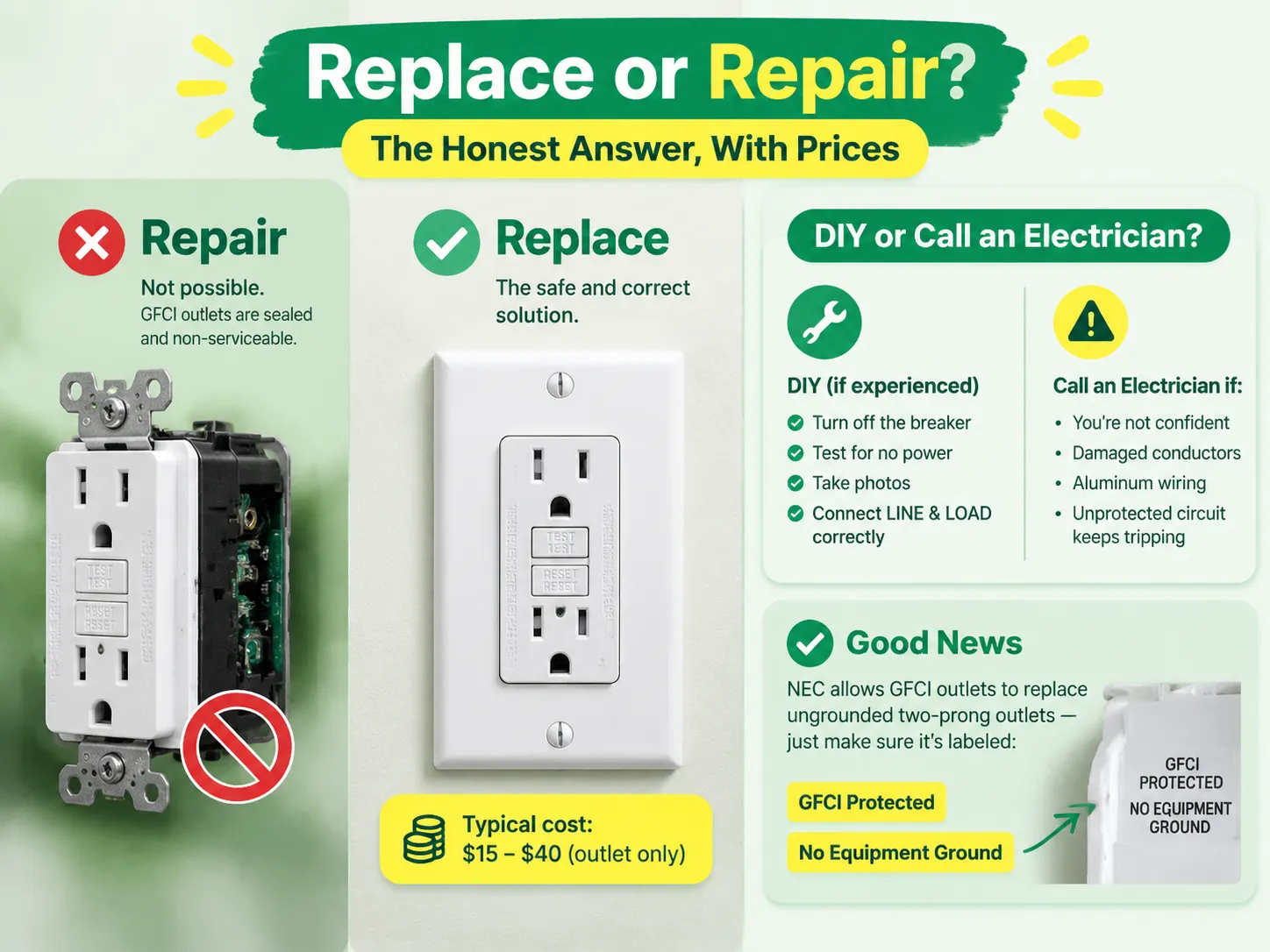
Existem tanto uma versão dessa consulta que pode ser respondida quanto outra versão que não pode.
A versão que pode ser respondida: É possível reparar uma tomada GFCI? Não pode ser feito; uma tomada GFCI vem como um sistema eletrônico selado ou não reparável. Como não possui peças substituíveis pelo usuário, nenhuma pessoa é capaz de reparar o circuito de detecção interno em qualquer outro lugar além do local de fabricação. Caso a proteção esteja comprometida, o dispositivo deve ser substituído por um novo, pois é simplesmente o que o design do produto implica.
A versão que não pode ser respondida: Você deve realizar a substituição de forma independente ou chamar um eletricista? A resposta a essa pergunta depende muito das suas próprias habilidades e também dos requisitos impostos pela sua jurisdição local. Trocar um GFCI é realmente simples para alguém experiente em lidar com fios energizados: você desliga o disjuntor, verifica com um testador, tira fotos da fiação antes de tocá-la e conecta os terminais LINE e LOAD de maneira adequada. O erro mais comum nessa operação consiste em fazer a conexão correta usando os cabos LINE e LOAD de forma errada.
Os passos e as armadilhas são abordados com mais detalhes neste guia sobre como substituir uma tomada de parede com segurança, incluindo as verificações que valem a pena fazer antes e depois. Se você não tem certeza se pode realizar os reparos sozinho — ou se há risco de que a caixa tenha condutores danificados, fiação de alumínio ou tenha um circuito desprotegido que continua desarmando — pare e chame um eletricista. Problemas elétricos estão entre os poucos tipos de reparos que podem matar alguém que comete um erro tentando consertá-lo sem qualquer experiência.
Outro fato interessante de saber é que, de acordo com as regras diretas do NEC, é possível usar tomadas GFCI para eliminar tomadas de dois pinos não aterradas. Desde que a nova tomada esteja marcada como “GFCI Protegida” e “Sem Aterramento de Equipamento”, você tem um grande benefício de segurança sem precisar gastar dinheiro com reestruturação.
Eilling é uma questão de tempo e dinheiro, então tenha cuidado e conheça suas opções.
| Item | Custo típico | Notas |
|---|---|---|
| Tomada GFCI, padrão | $15–$40 | Modelos resistentes a intempéries e de auto-teste estão na faixa superior |
| Disjuntor GFCI | $40–$90 | Proteção em nível de painel para um circuito inteiro |
| Testador GFCI plug-in | $10–$15 | Confirms wiring and lets you test the outlet externally |
| Electrician, residential replacement | $80–$200 per outlet installed | Most of the cost is labour and diagnosis, not the device |
| Bathroom or difficult location | $120–$300 per outlet installed | Higher when the box needs work or the outlet has to move |
| Multiple outlets in one visit | Lower per outlet | The economic case for doing them together rather than one at a time |
Electricians charge different rates depending on the region and the type of work they are doing, but rates remain stable enough to help with planning.What this means in practice is that it is usually cheaper to replace components on your schedule than to wait until something fails.
Electronics can’t be stopped from aging, but they can be kept from aging too fast. Most of the things that shorten the life of a GFCI are issues related to its environment or the electricity it receives.
People tend to overlook the argument regarding the environment point. For instance, if a fixture is rated for fifteen years in a corridor, it will only last half as long in an area that has a defective hose bib. If you’re specifying outlets for damp or outdoor locations, weather resistance isn’t an upgrade — it’s the requirement, which is exactly what separates a general-purpose unit from a weather-resistant GFCI designed for damp and outdoor installation.
It is fully prevention procedure that requires less than a minute for execution in each outlet.
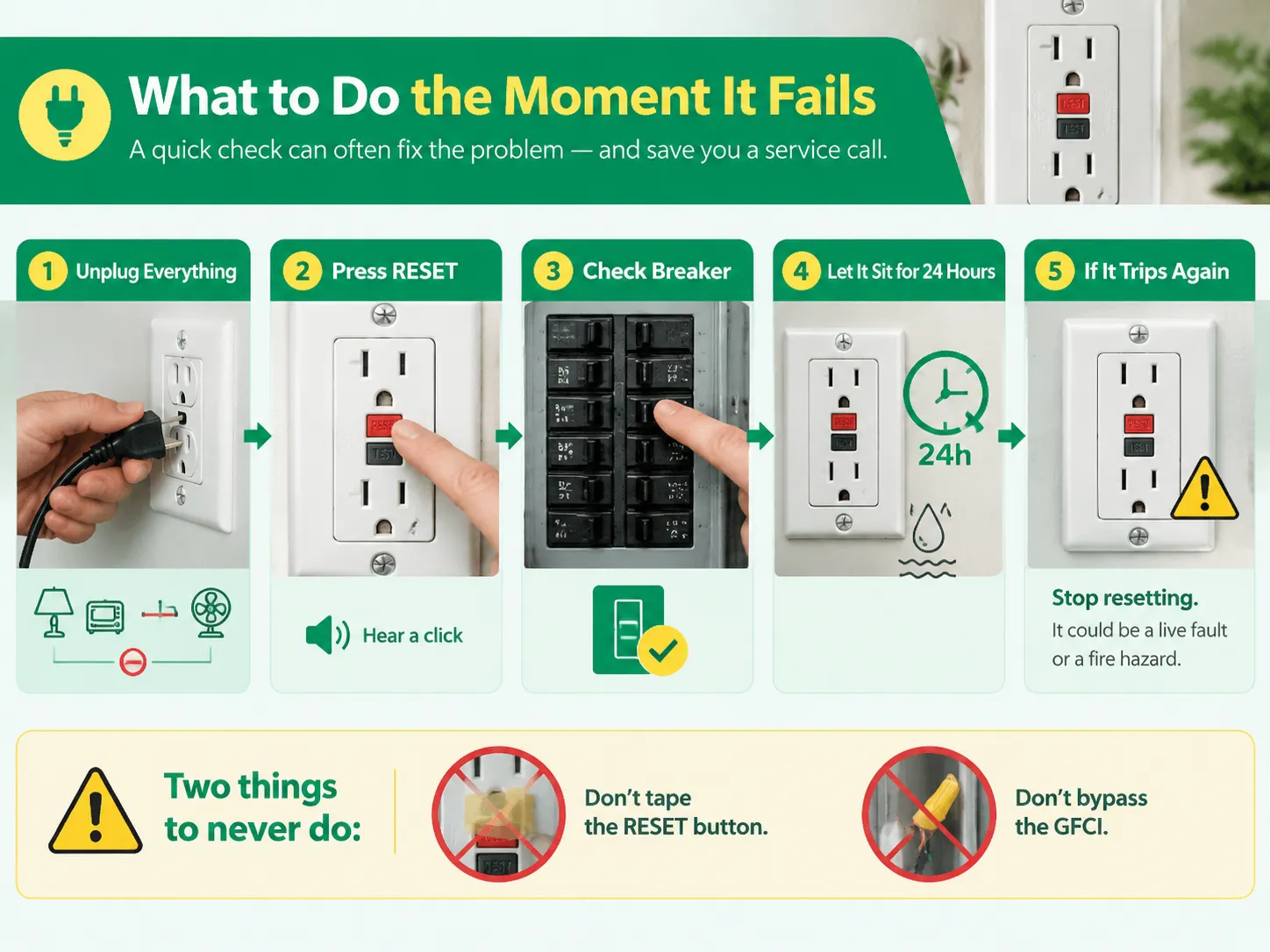
When the outlet is not working or the Ground Fault Circuit Interrupter is not working, there are several steps to follow. It does not take much more than five minutes and it actually helps save money on unnecessary service calls.
There are two things that should never be done: do not tape the RESET button and do not bypass the GFCI because doing one of those things is not a good idea, either. If you want the diagnostic sequence in more detail — what each symptom points to and which ones you can fix yourself — this guide to what to do when a socket or outlet stops working walks through the same logic with the wiring-side checks included.
Requirements vary according to the jurisdiction and age of the property so it is always advisable to check the local code. Despite this, more or less the list designated by the NEC includes locations where water and electricity could meet:
If your house was built before the date the requirement was instituted and the outlet was not updated, the code states that the given element can remain. However, this does not mean that this outlet was safe.
One clarification that is essential to be done is that GFCI and circuit breaker do different jobs, and both are necessary.
| Dispositivo | Protects against | Trips at | Where it lives |
|---|---|---|---|
| Disjuntor | Overcurrent — overload and short circuit | Rated amps (15 A, 20 A, etc.) | Distribution panel |
| GFCI | Ground faults — current leaking to earth through a person or water | 4–6 milliamps | Receptacle or panel |
| AFCI | Arc faults — dangerous arcing in damaged wiring | Arc signature detection | Panel, or combination devices |
A breaker would allow five milliamps of current to pass through your body without any problem — it won’t trip. That’s where the GFCI comes in, so it should be understood that a GFCI should not be used as a substitute for a breaker and vice versa.If you’re trying to understand how the two layers work together, the relationship between breakers and the outlets they feed is set out in this explanation of circuit breakers and the outlets and switches they protect, and it’s worth five minutes if you’ve ever wondered why a bathroom has two separate devices doing apparently similar jobs.
There’s something we can’t forget about when we discuss GFCIs – their manufacturing process. First and foremost, GFCIs are component-supply products, and the reliability of their sensing circuit boils down to component selection, quality control at the manufacturer’s place, and end-of-line testing. Hence, companies like igoto supply switches, plus sockets, outlets, and power strips, including GFCIs, to their distributors and contractors. This is also the reason why published standards matter when it comes to purchasing – a GFCI that doesn’t meet the applicable UL standard does not become cheaper but is just a different product that looks very similar.
You can check this by using a lamp. Plug the lamp into the protective switch, press TEST, and you should see that the lamp goes out and the RESET button pops out; if you press RESET button afterwards, you should see that the power is restored. If TEST doesn’t work and RESET can’t be pressed down, then it means the protection has failed and the unit needs to be replaced, even if the electrical appliances are powered normally. You may also check for some other indications like warm or discolored faceplate, a fault light blinking or shining continuously, regular tripping when nothing is being plugged into the device or difficulty with pressing down RESET.
Normally, a GFCI outlet remains functional for approximately a decade or a decade and a half whereas a GFCI breaker does its job for slightly longer. Due to the presence of moisture and humidity outdoors, most devices don’t last more than 10 years. Furthermore, devices produced before self-testing systems were introduced should be changed out even if they are not broken because they cannot reveal whether they are malfunctioning or not.
Substitute it when it fails any of such checks: either it doesn’t turn off the electricity, the reset is not persisted or a device has triggered self-test lockout lock, or the unit hasn’t reset itself even after the disconnection and drying of the circuit. In case it’s aged more than 10 to 15 years or is older than self-testing devices, then it can be replaced based on the age alone. It has to be replaced without a delay in case the device is warm, burnt or emits odour.
The primary causes are degradation due to aging of the sensing electronics, the number of times power surges and lightning hits, frequent tripping cycles that have taken a toll on the mechanical latch, moisture ingress into the enclosure and heat stress due to overloaded wires and/or loose terminations. It is significant to differentiate whether the aforementioned problems are due to appliance defects or real ground faults, as a GFCI that trips only when a certain appliance is plugged in is likely discovering an actual current leak in that appliance rather than a GFCI malfunction.
GFCI outlets do fail, and it’s important to note how they fail. GFCI outlets do not give a warning; they keep working like they’re meant to. The light keeps turning on and off, and that vital function — the cutting of power when current is leaking through a person — may fail without any visible sign at all.
The take-home point is 10-15 years lifespan for a receptacle, 7-12 years lifespan in damp places, and a trip time equal to about 1/40 second at 4-6 mA for a working device. In practice, the device costs between $15 and $40 and costs another $80-200 to install, making this simple little device the difference between just getting a shock from a bathroom outlet and getting seriously electrocuted.
For this reason, test every month. Press TEST, see the power goes out, press RESET. If the device does not work just as it should, it must be replaced — it cannot be fixed. If the device has served you for more than 10 years, yes, replace it on your schedule, not in an emergency situation. When buying the replacement, always opt for self-testing devices that can alert a user before breaking down, which is a huge advantage over devices that will stop working without any warning.

Quando alguém faz a pergunta “os tomadas GFCI estragam?”, pode estar realmente perguntando quanto tempo uma tomada vai durar antes de falhar. Não há uma resposta definitiva ou absoluta para essa pergunta, pois cada situação é única; portanto, cada tomada GFCI deve funcionar corretamente enquanto não houver outros fatores contribuindo para […]

A compra de interruptores inteligentes no Condado de Bucks é relativamente complicada, com a dificuldade sendo mais uma questão das características do mercado imobiliário local do que da disponibilidade dos sistemas. Pode-se dirigir de Solebury, onde algumas das casas podem datar da década de 1790, até Warrington, onde algumas construções mais novas foram feitas […]

O controle de iluminação sem fio tem um pequeno segredo sujo: enquanto muitas vezes funciona excepcionalmente bem em demonstrações, tende a decepcionar as pessoas em suas casas. O culpado raramente é o aplicativo; em vez disso, está atrás da parede. Este guia apresenta as opções de forma ordenada. Seis maneiras de controlar a luz sem fio, cinco protocolos que […]

 No.6 Tuozhan Road, Leshang Pioneer Park, Yueqingwan Bay Harbor, cidade de Yueqing, província de Zhejiang


