

France uses the European electrical standard of 230 volts and 50 Hz with a unique variation wherein the socket has the earth pin inside the socket as a protruding male pin. This means that travelers can use a Type C or a Type E/F plug with Type E sockets, while the voltage is not a problem for people traveling from Europe since they are already using 220/240 volts. The only concern will be travelers coming from the UK, the US, Australia, and Japan who are left to ponder the type of adapter to carry since their devices only operate at 110/120 volts.
This guide has information regarding plug and socket types in France, the 230V/50Hz system, countries that can use French sockets, which ones use converters only, as well as answers to the many questions that people ask.
France makes use of a Type E plug socket which consists of two round pins with a protrusion of the male earth pin, at a voltage of 230V and frequency of 50Hz. The European two pin plug fits perfectly into the Type E, as well as Type F Schuko plugs too. So if you might be looking for a single adapter for France for travelling purposes, look out for a standard Type C adaptor. For those travelling from Germany, Netherlands, Spain, Portugal, Poland or nearly all countries in the European continent, there’s no need for adaptation at all. However, those visiing from UK with type G sockets, USA and Canada (Type A/B), Australia and New Zealand (Type I) as well as Japan (TYPE A/B) will require either type C or type E/F adapter.
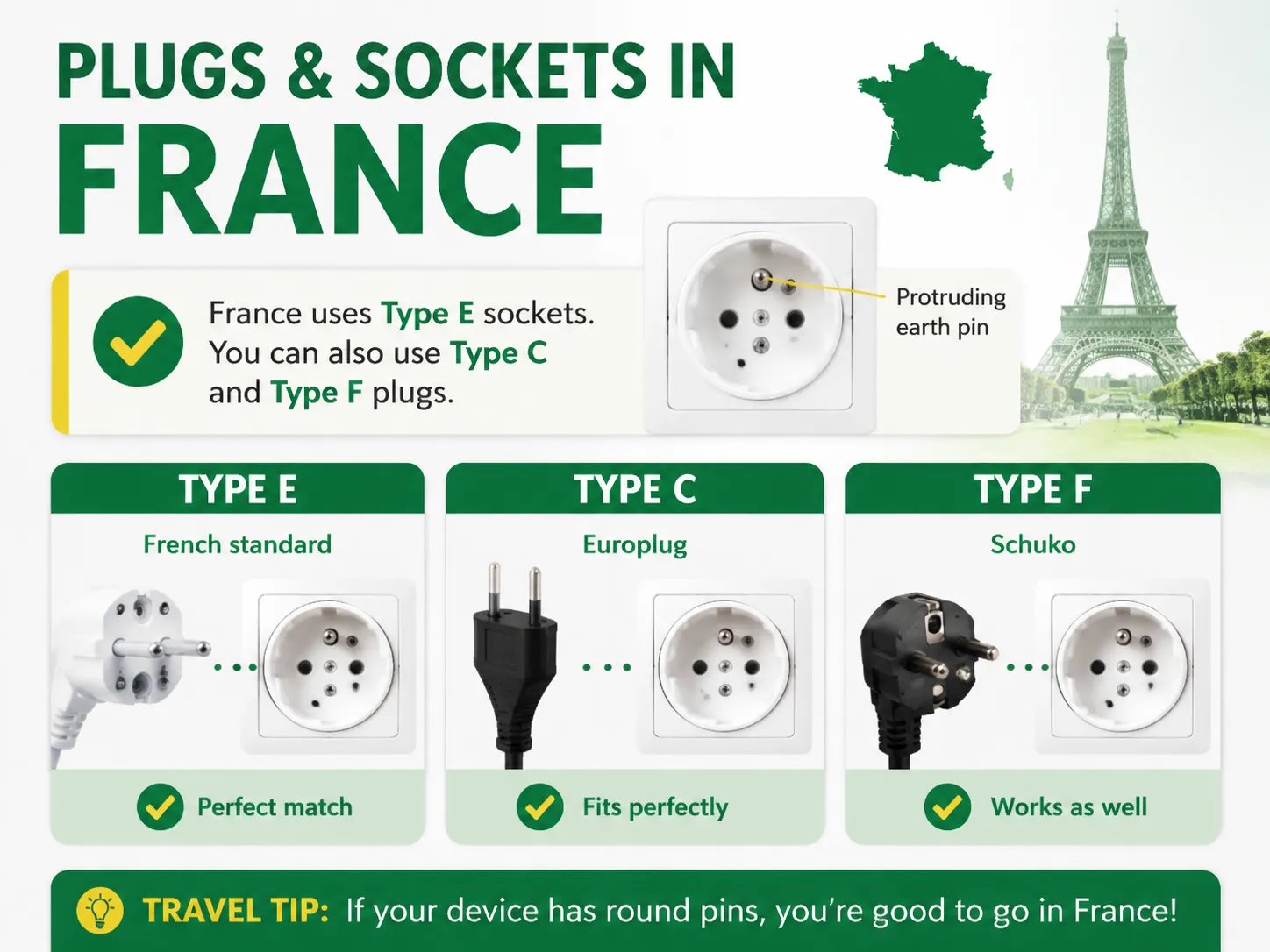
France makes use of a Type E plug socket which consists of two round pins with a protrusion of the male earth pin, at a voltage of 230V and frequency of 50Hz. The European two pin pFrance is a country classified under Type E in terms of its sockets. One of the main features that distinguishes French wall sockets from those of their neighbouring country Germany is the following:
In summary, French sockets can accommodate Type C, Type E and Type F plugs and one European plug can be used to charge different devices.lug fits perfectly into the Type E, as well as Type F Schuko plugs too. So if you might be looking for a single adapter for France for travelling purposes, look out for a standard Type C adaptor. For those travelling from Germany, Netherlands, Spain, Portugal, Poland or nearly all countries in the European continent, there’s no need for adaptation at all. However, those visiing from UK with type G sockets, USA and Canada (Type A/B), Australia and New Zealand (Type I) as well as Japan (TYPE A/B) will require either type C or type E/F adapter.
France operates at 230 volts with a frequency of 50 hertz. Equipment made to operate in the 220-240 volt category is safe to use; appliances rated at 100-240 volts (dual voltage) simply need a plug adapter; while the single voltage category (typical US equipment such as hair dryers, curling irons and travel kettles) will be damaged by 230 volts if not fitted with a voltage adapter. The 50 hertz frequency is only a consideration when using devices driven by motors (clocks, some fan motors), whereas equipment utilizing a charger or power supply will not be affected.
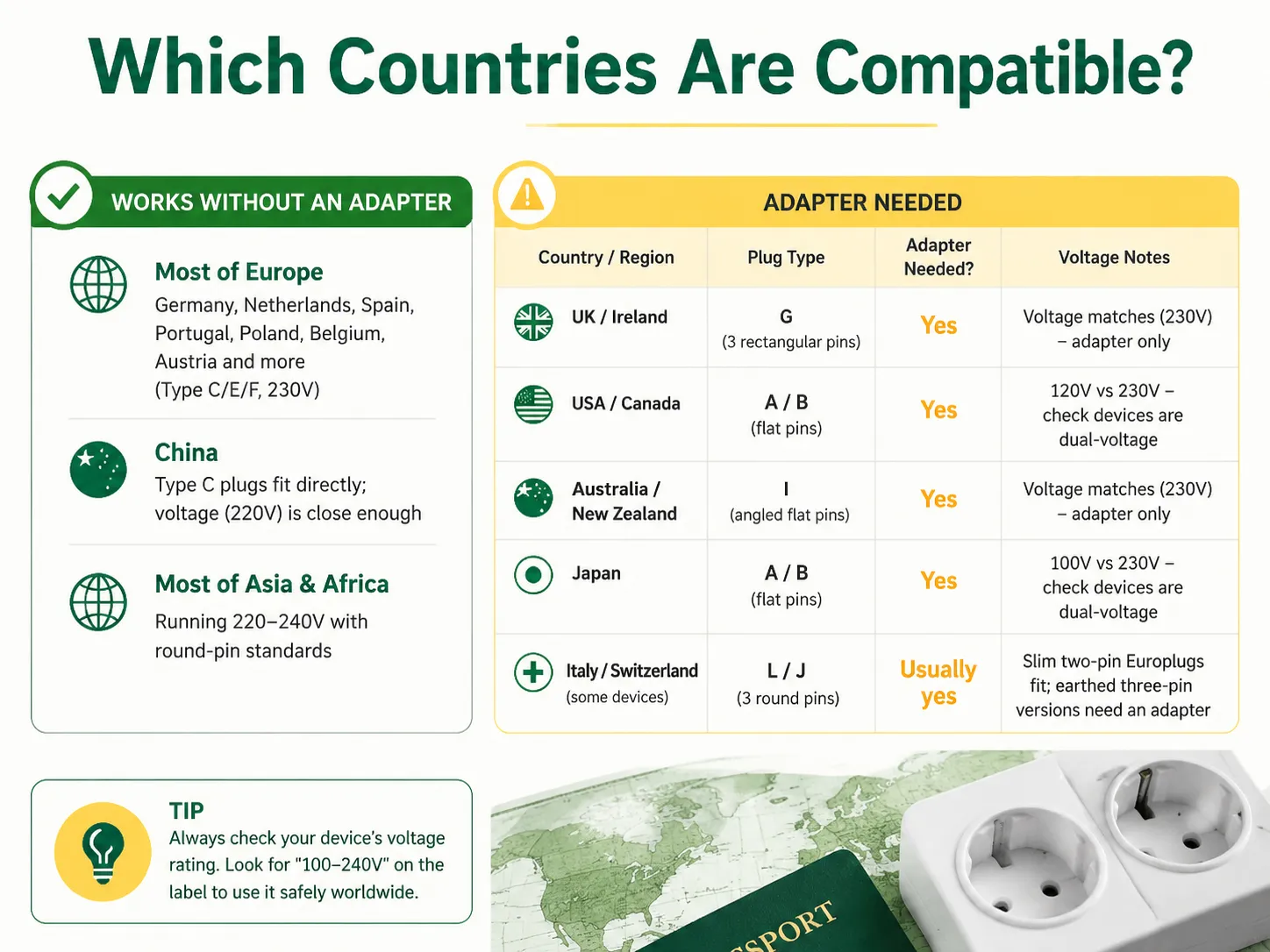
If your plugs are of the European round-pin type, then they will fit into French power sockets, as they also operate on the same voltage. These countries have the same requirements for power adapters:
Countries that require adpater:
| Земља / Регион | Тип утикача | Потребан адаптер? | Voltage Notes |
|---|---|---|---|
| УК / Ирска | G (three rectangular pins) | Yes — Type C/E/F adapter | Voltage matches (230V) — adapter only |
| USA / Canada | A / B (flat pins) | Yes — Type C/E/F adapter | 120V vs 230V — check devices are dual-voltage |
| Аустралија / Нови Зеланд | I (angled flat pins) | Yes — Type C/E/F adapter | Voltage matches (230V) — adapter only |
| Јапан | А / Б | Yes — Type C/E/F adapter | 100V vs 230V — check devices are dual-voltage |
| Italy / Switzerland (some devices) | L / J | Obično da | Slim two-pin plugs fit; earthed three-pin versions need an adapter |
For Italy and Switzerland, it should be noted that Type C plugs will fit the French socket, however, washing machines, refrigerators, dishwashers etc., where the appliance has a third (earth) pin in addition to the two pins, would need to use a different plug and therefore might require an adapter. The same “which standard, which adapter” logic is why understanding plug and socket families matters generally — our guide to different kinds of electrical switches and sockets explains the underlying hardware families.
As far as France is concerned, you can either use the Europlug Type C adapter or use a World Travel Adapter set to the European two-pin position. Since French Type E sockets can accept Type C plugs, the Europlug adapter will suffice for charging your phone, laptops, cameras as well as power banks. If you are using a universal adapter with European pins, it is the best buy for multi-country travels as one unit will work across France as well as the rest of the continent. If using computers with power bricks or hair dryers etc,. then an adapter that has a provision of earth connection should be used.The same European-standard thinking applies at home when you choose sockets for your own walls — our водич за надоградњу УСБ зидних утичница covers the modern options.
Travelers and buyers have often wondered about the differences between Type C and Type E/F plugs. To answer this question, it is necessary to understand some practicalities in addition to theoretical points:
Therefore, it is valid to consider Type C plugs fully valid for charging devices in both France and Germany while devices with earth protection must be protected by the appliances with protection or have a special adapter.
The difference that avoids damage to electronics:
So before connecting any electrical appliance to the French outlet, please read the label first. If it indicates “100-240V”, then it means that an adapter is needed only. In the case where the appliance is rated at single voltage of “110-120V only”, then either a voltage converter is needed or please leave the appliance at home.The same check applies in every 230V country, including the standards covered in our USB fast-charging outlet guide — matching the device to the supply is the whole job.
Everything you need to pack for France.
You need a Europlug (Type C)plug with 2 round pins or a universal plug adapter set to work for Europe. Since French Type E outlets accept Type C plugs, you can use a regular europlug adapter across all French electrical outlets. Travelers from the UK, US, Canada, Japan, and Australia use the same adapter for their travels; continental Europeans usually don’t need one at all.
In practice, yes. Type C plugs can fit into Type E and Type F sockets as far as the round pins are concerned (the earth pin is simply not used) and Type E plugs can fit into Type F sockets of the two plug types from each country. For double insulated chargers, they are absolutely interchangeable; but for earth appliances, use an E/F plug converter to provide the earth connection.
At the very least, you will need to use a Type C adapter, as it will fit into all of the Type E plugs for charging devices. However, if you are bringing earthed appliances or devices, use an E/F plug adapter for it to work. You can use a universal plug to provide both since it will work with both plug types across most of the continent as well.
Yes. The 2-pin round plug (Type C Europlug) can work for all French outlets as far as the only problem is if the plug is flat US/UK style, then a Type C adapter must be used; plus if you are bringing a 110-120V appliance, it will also work in 230V outlets, which can damage the unit.
France’s electrical system is quite user-friendly: everyone can use type E sockets fitted for type C or for type F plugs; 230 volts/50 Hertz is comparable to the 220-240 volt systems used in many countries around the world; and our compatibility guide allows different European countries to use type C plugs, while readers from the UK and Australia will only need to bring a universal adapter. So, traveling to France has never been easier; just do the following: take type C or other universal adapter with you, check all devices you want to take along to be sure they operate at 100-240 volts, and leave hair dryers and other appliances that do not accept a range of voltage back at home. All you need is a simple two-pin Euro plug that connects in countries such as Germany, Spain, and many others, so it is easy to just plug into an outlet in France as well since they all operate on the two-pin type system and are the same there as well.

Farmingdale, zajedno sa delovima Wall Township-a i Tinton Falls-a, New Jersey, deli isti poštanski broj 07727. Većina kuća izgrađenih od 1950-ih do 1990-ih još uvek postoji danas. Većina vlasnika kuća renovira svoje kuće umesto da gradi nove domove. Vlasnici kuća obično troše mnogo više na […]

Termin “07984 konsultanti za osvetljenje” stvara utisak da pet cifara predstavlja poštanski kod neke vrste koji označava mesto gde konsultanti za osvetljenje pružaju usluge. Međutim, to je netačno: ne postoji poštanska oblast sa kodom 07984, koji je samo kod mobilne telekomunikacije u Velikoj Britaniji. To znači da […]

San Francisco nije prosečno tržište za kontrolu osvetljenja. Stambeni fond je star i gust, a elektro kod ne dozvoljava onoliko električnih instalacija koliko je dozvoljeno gotovo bilo gde drugde u SAD-u. Većina kuća koje žele složeno osvetljenje su viktorijanske ili edvardijanske zgrade gde niko ne želi da počne da otvara […]

 Но.6 Туозхан Роад, Пионирски парк Лесханг, лука у заливу Иуекингван, град Иуекинг, провинција Зхејианг


