

يتم مراجعة كل من هذه القواعد بمزيد من التفصيل أدناه. هندسة وضع المقبس، متطلبات دائرة الفرع المخصصة، أنواع المقابس التي تلبي الكود، أسئلة 15A و 20A، الاختلافات بين البلدان فيما يتعلق بالقواعد، تفاصيل التركيب التي لا تجتاز الفحص، ما يجب مراعاته عند شراء المنتج، متطلبات الإضاءة والمروحة في نفس الغرفة، والتجديدات.
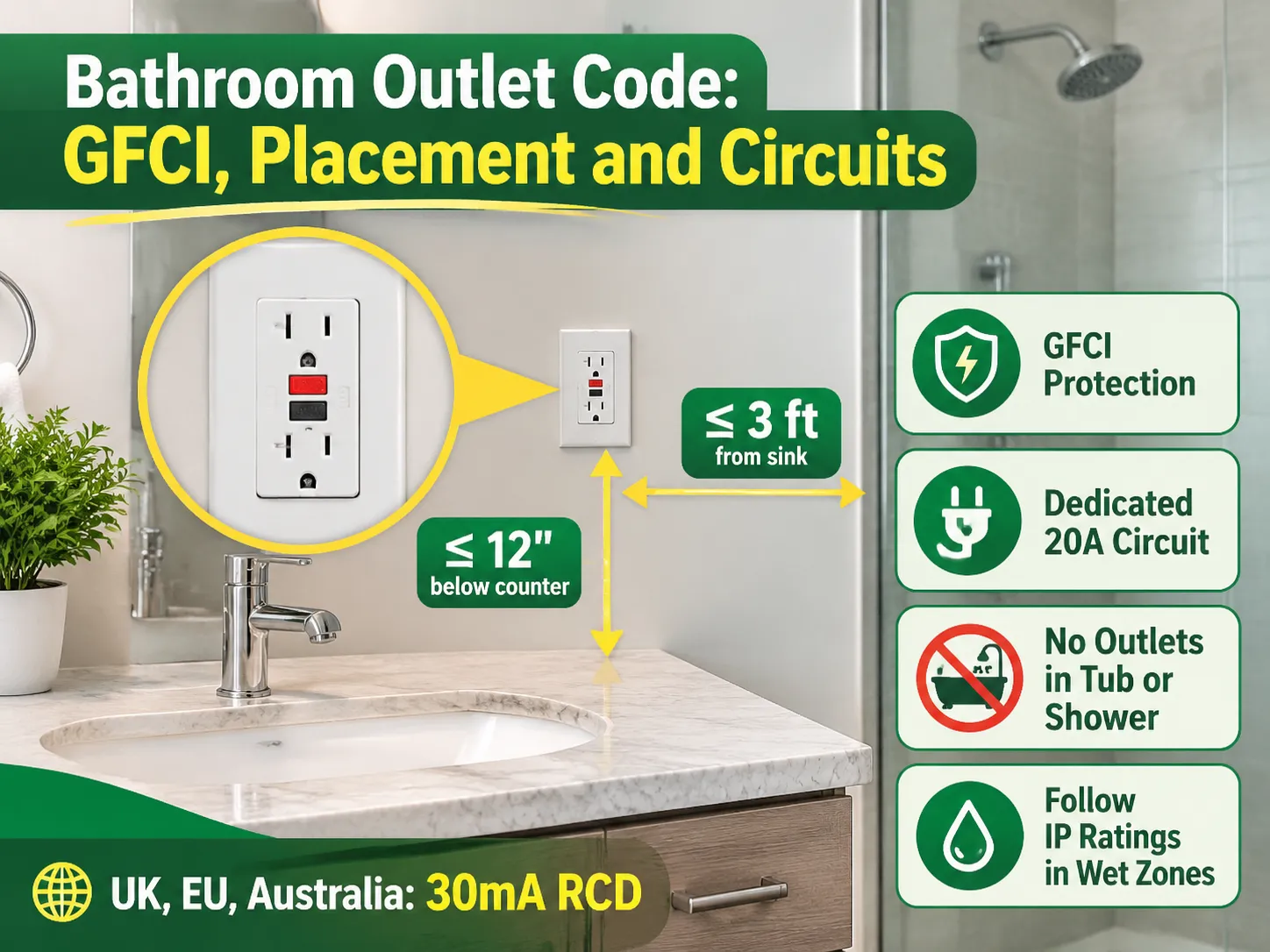
إجابة سريعة: في الولايات المتحدة، يجب أن يحتوي كل مقبس يستخدم في الحمام على حماية GFCI (قاطع دائرة التيار الأرضي)، ويجب أن يكون هناك مقبس واحد على الأقل ضمن 3 أقدام من حافة الحوض/المغسلة، ولا يزيد عن 12 بوصة تحت ارتفاع سطح العمل. يجب أن تكون مقابس الحمام موجودة على دوائر فرعية مخصصة بقدرة 20 أمبير (20A) تستخدم حصريًا للحمامات. لا يجوز تركيب أي مقبس حمام في مناطق الحوض أو الدش. ما يعادل GFCI في أمريكا الشمالية هو حماية RCD بتيار متبقي 30mA في المملكة المتحدة، أيرلندا، أستراليا والاتحاد الأوروبي. حيثما يتم تركيب مقابس عادية في المناطق الرطبة، توجد قيود، ويجب أن تلبي المقابس تصنيف IP للمنطقة التي تم تركيبها فيها.
الغرض من GFCI هو مراقبة الفرق في تدفق الكهرباء بين السلك الحار والسلك المحايد. عندما يكون الفرق بينهما بين 4 و 6mA، فهذا يشير إلى أن بعض التيار قد تسرب. عادة في الحمامات، يعني ذلك أن التيار كان يتسرب عبر شخص يقف حافي القدمين على أرضية مبللة. يقوم GFCI بقطع التيار الكهربائي المتدفق إلى الشخص (أي الشخص الذي يقف على أرضية مبللة وقدماه على اتصال بالأرض) خلال بضع ميلي ثانية بعد اكتشاف تيار كهربائي يتسرب من المقبس.
هناك ثلاثة أجهزة يمكن استخدامها لتلبية هذا المتطلب. الأول هو مأخذ GFCI، الذي سيحمي نفسه وأي شيء آخر متصل بالمأخذ وسيتم تغذيته من التيار الواصل من بعده. الثاني هو قاطع GFCI، الذي يحمي الدائرة بأكملها، وهو الخيار الوحيد الذي يمكن استخدامه في الحالات التي لا يوجد فيها مأخذ GFCI لإعادة تعيين تيار GFCI إلى الصفر أو إذا كانت الدائرة تغذى من مصدر لا يوفر خيار استخدام مأخذ (مثل أحواض الدوامة). الثالث هو GFCI “الواجهة الميتة”، وهو جهاز يتم تركيبه على قطعة من المعدات حيث يتم توفير الكهرباء ولكن مستخدم المعدات ليس على اتصال بها أو بالقرب منها (مثل عندما تكون المعدات على رف).
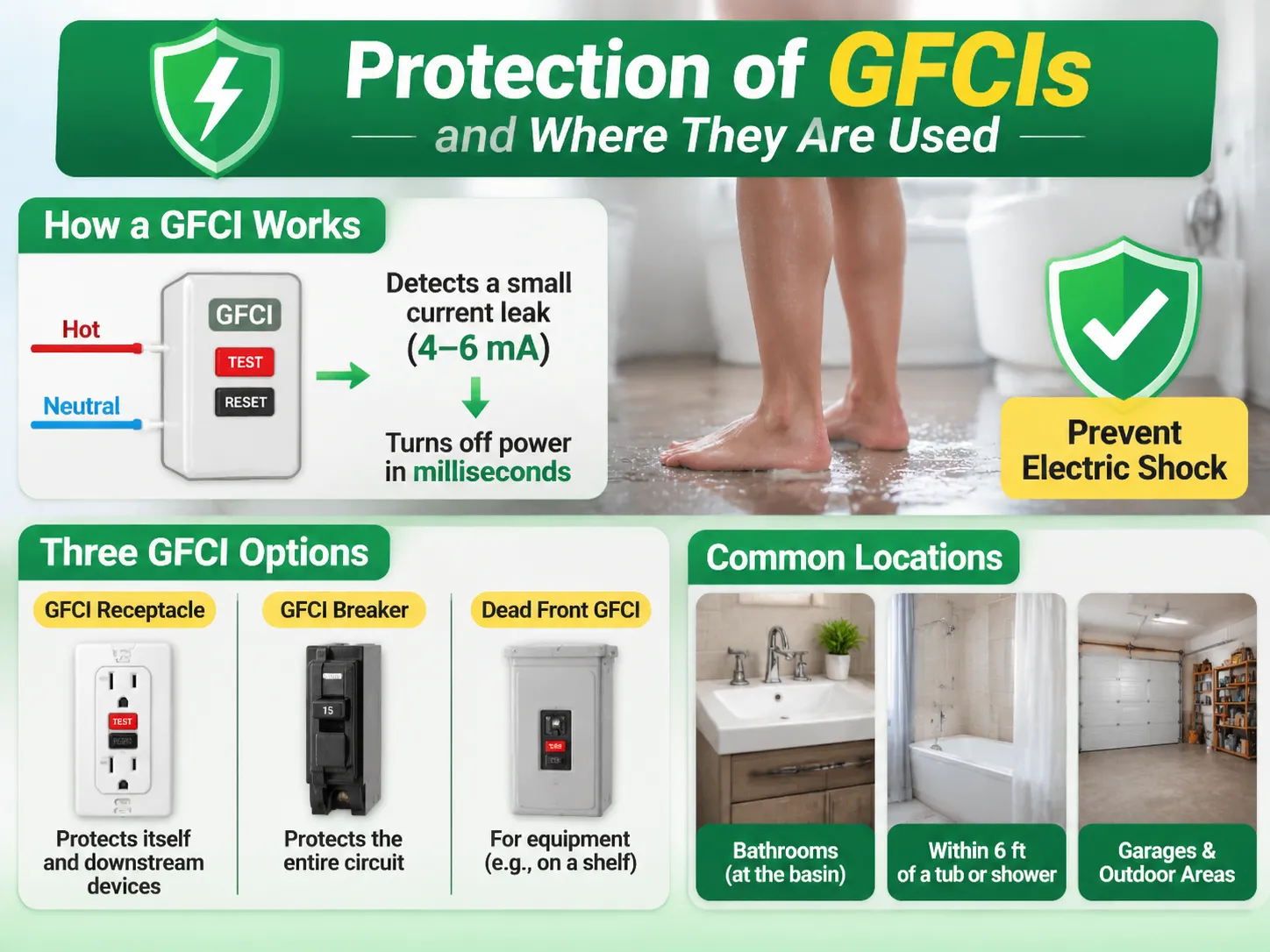
الاختيار مهم لسبب واحد، وهو مكان إعادة تعيين GFCI. مأخذ GFCI الموجود عند الحوض سهل جدًا لإعادة التعيين وسهل على صاحب المنزل التحقق من وظيفته شهريًا، وهذا هو السبب في كونه الجهاز السائد المستخدم في أعمال السكنية.
قاطع GFCI (قاطع دائرة الحماية من التيار الأرضي) هو جهاز أمان مهم يمنع حدوث زيادة في الحمل الكهربائي في حالة حدوث فشل كهربائي. توجد أجهزة GFCI في المرائب أو أماكن أخرى قد لا تتوفر فيها مساحة كافية لوضع مأخذ GFCI مباشرة أمام الجهاز المحمي. عمومًا، ينقطع قاطع GFCI عندما يحدث فشل كهربائي في مأخذ GFCI الذي يحمي نفس الدائرة. ينقطع القاطع ويوجه الشخص الموجود بالخارج مرتديًا منشفة عندما ينقطع GFCI، ولهذا السبب ستجد أن معظم تركيبات القواطع تحدث في المناطق التي تحتوي على حوض استحمام أو على طول دائرة خارجية، وكذلك في الحالات التي يكون فيها المأخذ موجودًا خلف لوحة مثبتة بشكل دائم.
يمتد متطلب حماية GFCI إلى ما هو أبعد من الغرفة التي يقع فيها الجهاز. على سبيل المثال، يجب حماية أي مأخذ يتم تركيبه ضمن ستة أقدام من الحافة الخارجية لحوض الاستحمام أو الدش بواسطة GFCI، حتى إذا كان المأخذ موجودًا في منطقة لا تندرج تحت تعريف “الحمام”، كما هو الحال غالبًا في غرف النوم حيث يوجد مأخذ بالقرب من جدار سباكة مشترك؛ في هذه الحالات، يكون المأخذ فعليًا موجودًا على دائرة حمام.
فهم كيفية عمل مأخذ GFCI ولماذا يقع عتبة الفصل عند 5 مللي أمبير سيساعد المستهلك على اختيار النسخة المناسبة من مأخذ GFCI أو قاطع GFCI التي تلبي احتياجاته. شرح كامل لـ كيفية عمل أجهزة GFCI متوفر ويجب قراءته قبل اختيار نسخة مأخذ GFCI أو قاطع GFCI من هذه الأجهزة.
ال قاعدة الحوض 3 أقدام يتعلق بالمسافة من الحافة الخارجية للحوض إلى أقرب مخرج كهربائي أفقيًا. لذلك، من المهم أن توفر مأخذًا لجميع الأحواض. إذا كان لديك وحدة مغاسل مزدوجة بحوضين، فيجب عليك توفير مأخذ واحد لكل حوض، وعادةً ما يكون من الممكن تلبية متطلبات الحوض من خلال توفير مأخذ واحد يقع بين الحوضين طالما أنه ضمن متطلبات المسافة لكليهما. من المهم ملاحظة، مع ذلك، أن المأخذ الموجود داخل خزانة الأدوية لا يُحتسب، لأنه لا يُعتبر في متناول اليد بالمعنى المقصود من قبل الكود.
أحد التفاصيل التي غالبًا ما يهملها المثبتون هو حد الارتفاع بالنسبة لتركيبات المآخذ.
لا يمكن أن يكون المأخذ المثبت على وجه أو أفقيًا على خزانة الحوض أكثر من 300 مم أسفل أعلى الحوض. يمكن أن يكون الارتفاع فوق سطح العمل متوسطًا لمأخذ غالبًا ما يكون حوالي 1100 مم عاليًا وعلى نفس مستوى مركز الملحقات الأخرى، لكن معظم الناس يميلون إلى وضع مآخذ الحمام فوق مستوى زر البطن حتى يسهل الوصول إليها من الأرض.
على سبيل المثال،, لا يوجد قياس لمنطقة الحوض والاستحمام، بل هناك تقييد أو حظر لتركيب أي مآخذ في هذه المنطقة. لا يمكن تركيب أي مأخذ داخل حوض الاستحمام أو كابينة الدش، ولكن سيتم الحكم عليه بناءً على المنطقة المقاسة 3 أقدام أفقيًا و8 أقدام عموديًا من الحافة العلوية لحافة حوض الاستحمام أو عتبة الدش.
الاستثناء الوحيد لهذه القاعدة هو في حالة الحمام الصغير الذي لا يحتوي على مساحة جدارية كبيرة. في هذه الحالة، يقتصر الاستثناء على مأخذ يمكن تركيبه على الحائط المقابل مباشرة لحوض الاستحمام (وبالتالي قريب من المنطقة الرطبة).
كما أن التركيبات الضوئية مرتبطة بهذا الشكل الهندسي. على غرار قاعدة المآخذ، غالبًا ما يتم الخلط بين تكوين التركيبات الضوئية وقيود وضع المآخذ. على وجه التحديد، يجب أن يكون للتركيبة المثبتة فوق حوض الاستحمام نفس قيود الوضع مثل المأخذ (3 أقدام أفقيًا و8 أقدام عموديًا) ويجب أيضًا أن تكون معلمة للاستخدام في المواقع الرطبة والرطبة جزئيًا.
أما بالنسبة للمفاتيح، فيجب تركيبها حيث لا يمكن لشخص أن يلمس كلًا من تركيبات السباكة والمفتاح في نفس الوقت.
أحب أن أفكر في قاعدة دائرة 20 أمبير (والسبب في اختلاف مآخذ الحمام) على أنها انعكاس مباشر لمجفف الشعر.
يستخدم الجهاز العادي بين 1500 و1800 واط، مما يترجم إلى 12.5 إلى 15 أمبير على 120 فولت؛ لذلك، فإن دائرة بهذا الحجم (15 أمبير) ستتجاوز الحمولة إذا كان شخص ما يجفف شعره ويشاهد التلفاز في نفس الوقت، مما يسبب انقطاعًا فوريًا. تسمح دائرة 20 أمبير المخصصة بهذا المستوى من الاستخدام دون حدوث انقطاعات غير ضرورية.
بالنسبة لدائرة 20 أمبير، هناك أمران يجب مراعاتهما لتجنب حالة التحميل الزائد: أولاً، يجب توصيل الدائرة بكابل 12 AWG؛ وثانياً، يمكنك توصيل عدة مقابس معًا لحمام واحد، بشرط ألا تخدم الدائرة أي شيء خارج الحمام. إذا كان لديك حمام واحد، وفقًا للاستثناء، سيسمح بتشغيل الإضاءة ومروحة العادم على نفس الدائرة نظرًا لأن الحمام الواحد هو حمل صغير؛ لذلك، لا يوجد مبرر لتشغيل دوائر إضافية.
هذه النقطة الثانية تثير ثلاثة اعتبارات عملية حول كيفية عمل هذه الدوائر. إذا قمت بتركيب مقبس 20 أمبير على دائرة 15 أمبير، فلن يعمل المقبس. هذا يعني أن الدائرة يجب أن تكون مصنفة بنفس تصنيف المقبس. أيضًا، يجب أن يكون المحايد للدائرة مصنفًا لـ 20 أمبير؛ وهذا مهم في حالة استخدام محايد مشترك في تركيب قديم. أخيرًا، في حالة وجود عدة حمامات، يجب ألا تتصل الدائرة بدائرة الإضاءة؛ وإلا، إذا انقطعت دائرة المقبس، سيتسبب ذلك في ظلام جميع الحمامات، وهو عكس ما تهدف إليه الدائرة المخصصة.
عند العمل مع الحمامات، ستجد خمسة أنواع من الأجهزة. النوع الذي يفكر فيه معظم الناس هو المقبس المزدوج القياسي.
يحمي مقبس GFCI المزدوج من تيارات الخطأ الأرضي عند المقبس؛ حيث تفتح الستائر عند إدخال كلا الشوكتين في المقبس. تتراوح تكلفة مقابس GFCI المزدوجة بين $18 و $30، وغالبًا ما توجد في الحمامات القريبة من الأحواض.
لا يوفر المقبس المزدوج القياسي حماية من تيار الخطأ الأرضي؛ يجب توصيله بعد مقبس GFCI أو قاطع GFCI. يتراوح سعر المقبس المزدوج القياسي بين $3 و $8.
يحتوي مقبس GFCI مع شواحن USB على حماية مدمجة من تيار الخطأ الأرضي بالإضافة إلى قدرات الشحن. تُستخدم عادةً على مناضد الحمام لشحن ماكينات الحلاقة الكهربائية وفرش الأسنان. تتراوح تكلفة مقابس GFCI مع شواحن USB بين $25 و $45.
في الحمامات الأوروبية والأسترالية، توفر وحدة تزويد الحلاقة طاقة كهربائية لماكينات الحلاقة عبر محولات معزولة (كما هو موجود في المملكة المتحدة/أيرلندا). تناسب هذه الوحدات المنطقة 2 في الحمامات البريطانية والأيرلندية وتكلف عادةً بين $25 و $60.
مقابس Schuko أو BS IP44 مصنفة للاستخدام حول الماء وتوفر مقاومة للماء (أي أنها تمنع الرشاشات)، ولذلك توجد عادة في الحمامات الأوروبية والأسترالية خارج المناطق الرطبة. يتراوح سعر مقبس IP44 عادة بين $10 و $25.
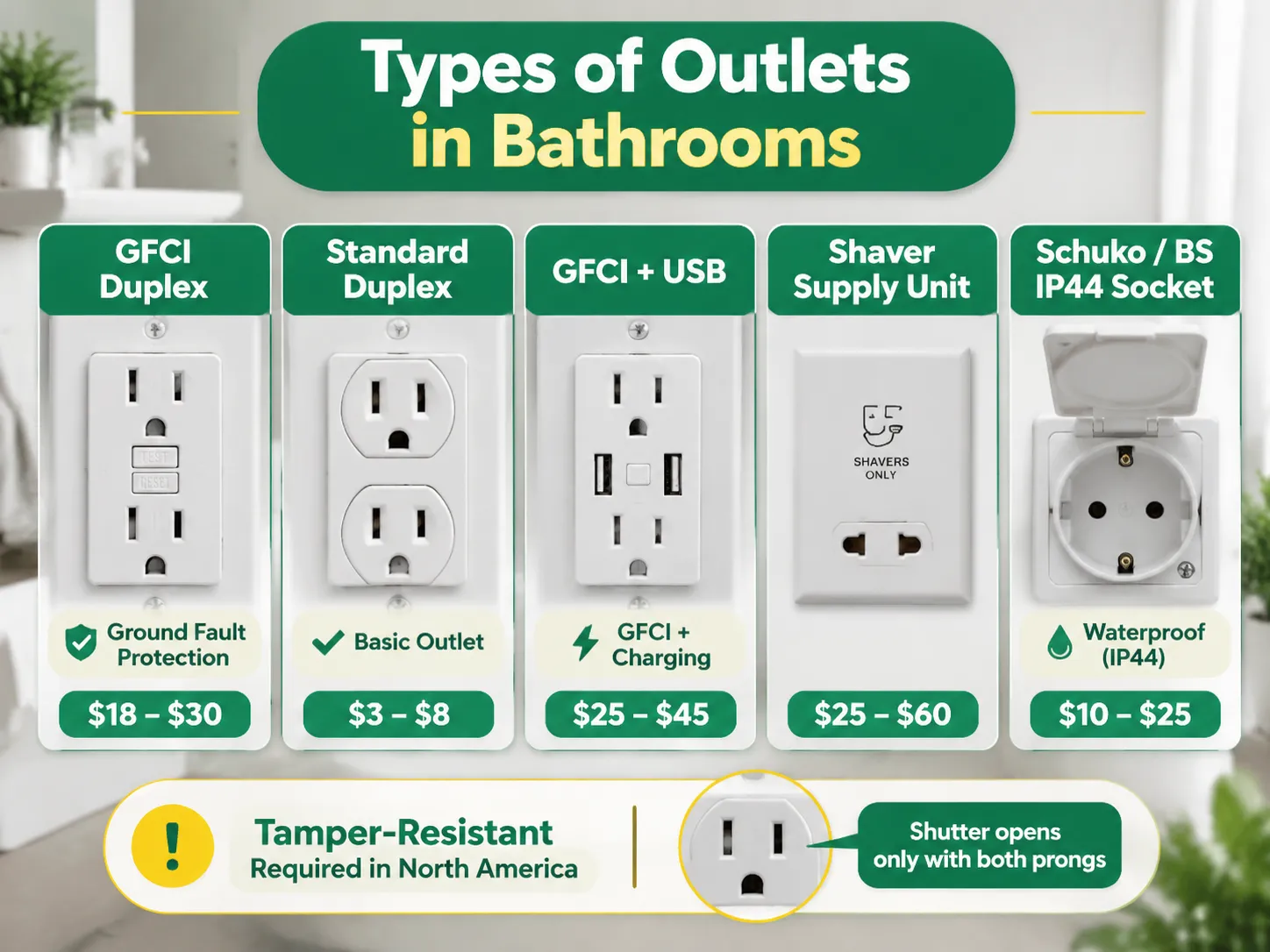
In North America, the code requires that if you replace or install any receptacles, they must include the tamper-resistant shutter. The shutter is spring-loaded and opens only if both prongs are inserted into it; you can expect to pay one or two dollars more for a tamper-resist receptacle over a normal receptacle.
| Outlet type | السعر النموذجي |
|---|---|
| GFCI duplex receptacle | $18 to $30 |
| Standard duplex receptacle | $3 to $8 |
| GFCI receptacle with USB chargers | $25 to $45 |
| Shaver supply unit | $25-$60 |
| Schuko or BS IP44 socket | $10 to $25 |
| Tamper-resistant receptacle | one or two dollars more |
The last two rows of this comparison chart reflect what an average European (or Australian) consumer may see when shopping for receptacles. Most bathroom socket outlets in the UK do not have a general-purpose socket outlet at all; instead, UK bathrooms are equipped with shaver supply units that contain isolated transformers located in a zone designated as Zone 2. This is why a UK visitor searching for an electric hair dryer will look for a two-prong receptacle capable of accepting an electric shaver plug, rather than a hair dryer plug.
For orders by the thousand of projects using the American format switch and socket configuration and plate systems associated with NEMA, the first row is where you’ll find the countries of North America. A project order uses the NEMA configuration, and corresponds with the plate systems.
A device rated at 15A or 20A, must match the circuit being used. The relationship only goes one way. A 20A receptacle can be used on a circuit rated at 20A. A 15A receptacle will work too, because the 15A device is protected by the circuit rating and the load it will see. However, using a 20A receptacle on a 15A rated circuit is a defective installation because that device is rated for more load than the circuit can handle.
For bathrooms, the result is that using a 15A GFCI receptacle on a 20A rated circuit is both code compliant and very common. In fact, many 15A GFCI receptacles are rated for 20A feed-through configurations in any case; therefore the 15A designation is for the configuration of the receptacle only, and does not denote how much current can be passed to downstream receptacles.
The exception to this rule is if a dedicated appliance with a 20A plug is to be used, such as a large whirlpool heater, or a commercial hand dryer. In this instance, a 20A receptacle and a dedicated circuit are required. These installations should be specified separately, rather than assumed to be general bathroom outlets.
Every developed country mandates that all bathrooms use residual current protection, but they specify how this requirement will apply based on a variety of factors including device type, zone geometry, and how much residual current protection each will provide. Each developed market has a specific residual current protection for a bathroom but not all developed markets have the same residual current protection devices. In this case, the two differences are represented by the methods used to provide residual current protection.
| دولة | Protection method | Socket rule | Zone requirement |
|---|---|---|---|
| الولايات المتحدة الأمريكية | (a) 4 or 6 mA GFCI | (b) all bathroom outlets are standard duplex, (c) TR is mandatory | Receptacles are not allowed in the tub or shower area. |
| Ireland & UK | 30 mA RCD on circuit | ordinary socket limited; wall-mounted shaver unit in zone 2 | BS 7671 defines zones 0, 1, and 2 by distance from water. |
| EU | 30 mA RCD, with some circuits limited to 10 mA | IP44 socket is allowed outside of the risks of water | IEC 60364-7-701, IPX4 in zones 1 and 2. |
| Australia & NZ | 30 mA RCD | any socket outlets must have IP rating | AS/NZS 3000 zone geometry and IP rated accessories. |
| Gulf States & Middle East | 30 mA RCD | BS or Schuko minimum IP44 socket outlet | IEC zone geometry; frequently enforced by consultant. |
The primary differences between the North American and European approaches to residual current protection are (1) North America protects a low number of areas at risk due to proximity to a sink, whereas (2) Europe protects the entire entire installation at 30 mA and relies on the IP rating of the equipment at the risk area.
This may clarify why a European bathroom can include an electrical socket while a North American bathroom uses a device that must be specifically designed for use in North America due to their differing country codes and standards related to the required or acceptable product used in each of these regions.
The plug types also work under the same rationale. In North America, an electrical socket in a bathroom is typically a NEMA 5-15 or 5-20, while in the UK it may be a shavers socket, in Germany it may be the Schuko style with a hinged cover, and in Australia it would be a Type I with a weatherproof cover. The reason the various types of plugs in North America require separate electrical sockets is because of electrical requirements and code restrictions for each style of plug.
Most bathroom installations fail to pass inspection for six reasons related to something other than the device itself. A GFCI outlet must be the first receptacle in a circuit so that all of the downstream receptacles on the circuit are also protected. If installed in a location that cannot be accessed by an electrical plug tester (such as in a cabinet), a GFCI will be unable to provide a test signal. If a GFCI outlet is installed without an equipment ground, a plug tester will not be able to test the GFCI. A GFCI outlet installed on a 15 A circuit would not meet the minimum requirement of being a dedicated 20 A outlet. A GFCI outlet located within the bathtub zone is prohibited, and therefore may not count toward the total number of receptacles required for a bathroom. Finally, a GFCI that has been painted over is considered a defect and indicates that no testing has been performed on the device since it was installed.
A seventh reason, which is not necessarily a code violation, but is also a practical issue, is the insufficient depth of the outlet box for the specific type of GFCI being installed.
GFCI receptacles are designed to be deeper than standard duplex receptacles; therefore, If the electrical box installed in the wall during the tile installation is too shallow to allow for proper installation without excessive protrusion of the plaster ring, it will be more expensive to fix than simply checking the depth of the box prior to the installation of tile.
Another consideration is the cable used. To supply a 20-amp circuit in a bathroom, 12 AWG cable must be utilized, and this presents an issue to home builders as the 12-3 cable contains three conductors instead of the normal two. Additionally, extra unused conductors within a box must be properly terminated, rather than leaving them cut off at the back of the box.

What separates a bathroom-rated product from a non-bathroom rated product? Four main things must be considered when selecting a bathroom rated product’s listing to the appropriate standard, counterfeiting is an actual issue on some internet-based sales sites. The shutter mechanism of the tamper resistant outlet must be installed if required by the local electricity code. The terminals’ design must provide better torque retention than backstab connections, as a bathroom outlet sees more plug/unplug activity than any other outlet. Lastly, the plate of the bathroom outlet should be stainless steel or brass. Plated metal will show watermarks as compared to moulded plastic.
When selecting a brand in this category, it is generally less about performance and more about having the correct product available. For example, the larger brands in the United States, such as Leviton, Legrand, and Hubbell, have a complete selection of the many variations of GFCI, TR, and USB products available.
Due to lower cost, manufacturers in China will typically provide the same products as manufacturers in the USA but with one key difference: the product must be listed for the specific market into which the item is being supplied.
Our manufacturing is on the “wholesale project” side of the equation. We produce receptacles and switches for wholesale and project supply, also producing tamper-resistant duplex and GFCI configurations to accommodate both European plate configurations and North American plate configurations, and we are a component manufacturer, not a lighting manufacturer, so our catalogue is organised by device and plate configuration rather than room.
When we tell potential customers what to check prior to purchasing a device, we advise to check the listing, the plate type, and the type of GFCI (self-test vs. non-self-test). A Self-Test GFCI performs an internal check every few seconds (on the power supplied to it) to confirm that it is functioning correctly, and if the device fails, it will lock out. This is the only way to know that your GFCI installed in a bathroom for 8 years will still work when it is needed.
When it comes to compliant lighting, fans, and switches, all three of these devices share the same room, but they have different requirements. The luminaire must be approved for use in a damp location over the bathtub, and any surface that may receive water spray of any kind also needs to be compliant. The fan must be vented to the exterior of the building and never to the roof structure, and on the circuit for the bathroom, it will consume its 20-A of power; therefore, it shares the circuit with the two other devices in the same room.
In the North America, bathrooms require GFCI receptacles. These outlets must also meet any Tamper Resistant requirements set forth by the local jurisdiction. They must be installed on a dedicated 20-amp circuit, with at least one GFCI protected receptacle located no more than 3 feet from each sink or washbasin. In the United Kingdom and Ireland, bathrooms generally require Shaver Supply Units, which should be located in Zone 2, and should not be regarded as General Socket Outlets (unless an extension lead is permitted), and should be connected to a 30mA RCD.
For North America, the typical designation of the protective device is GFCI receptacle or duplex GFCI/TR; the equivalent in the United Kingdom is known as shaver socket or electric shaving supply unit; the common name in Europe and Australia is IP44 socket outlet with RCD upstream protection; so essentially the names are indicative of the method of protection and the type of enclosure in which they are housed but all products perform the same functions regardless of geography.
The circuit must be rated at 20 amps; this means a 15 amp GFCI receptacle (the receptacle outlet listed here) on the 20 amp circuit is allowed and is the standard. A 20 amp receptacle outlet will only be used to receive power from a device that has a 20 amp plug, i.e., large hot tub heaters. A 20 amp receptacle must not be installed on a 15 amp circuit.
The three requirements for bathroom receptacle outlets are: (1) GFCI; (2) at least one receptacle within three feet of the outside edge of each basin and no more than twelve inches below the counter; (3) all receptacle outlets must be installed on a dedicated 20 amp bathroom circuit. No receptacle outlet is permitted to be installed inside a bathtub or shower stall.
The only exception to this is where the dedicated 20 amp circuit serves only a single bathroom. If that is the case, both the lighting and fan may be installed on the same dedicated 20 amp circuit for that bathroom. A dedicated 20 amp circuit may not serve any other room(s).
According to the base National Electrical Code, AFCI protection is not required for bathrooms; instead, the requirement for GFCI protection specifically addresses risks of electrical shock. However, some states have amended the National Electrical Code to require AFCI protection on all dwelling circuits, therefore; a dual-function breaker will provide both protections.
There are three requirements which govern the installation of bathroom receptacle outlets, and there is one prohibition. These requirements are GFCI protection, a receptacle outlet located within 3 feet of the outside edge of each basin, all receptacle outlets shall be connected to a dedicated 20 amp circuit, and no receptacle outlet shall be allowed to be installed within a bathtub or shower stall. All other information in this article is additional detail supporting the four requirements above.
The detail that ultimately determines whether the installation will remain successful is located at the location of GFCI protection. Locate GFCI protection where it is easily accessible; routinely test the GFCI protection monthly and consider purchasing a self-testing GFCI if your budget allows; keep in mind that the failure of GFCI protection systems typically occurs without any audible or visible indications; therefore the room generally has no indications of danger present.
Each of these rules is reviewed in more detail below. The geometry of receptacle placement, the dedicated branch circuit requirement, receptacle types that meet the code, 15A and 20A questions, differences among countries with regard to the rules, installation details that do not pass inspection, what to consider when buying a product, lighting and fan […]

دبي – سوق سهل لشراء أجهزة التوصيل الكهربائية وسوق صعب لاختيار جهاز التوصيل الصحيح للاستخدام في أي مشروع. جميع العلامات التجارية الدولية لها تمثيل واسع في دبي؛ يمكن تسليم المنتجات خلال أسبوع واحد من تقديم الطلب؛ ويتم الحصول على التأهيل لاجتياز فحص DEWA من قبل جميع الموردين بناءً على DEWA […]
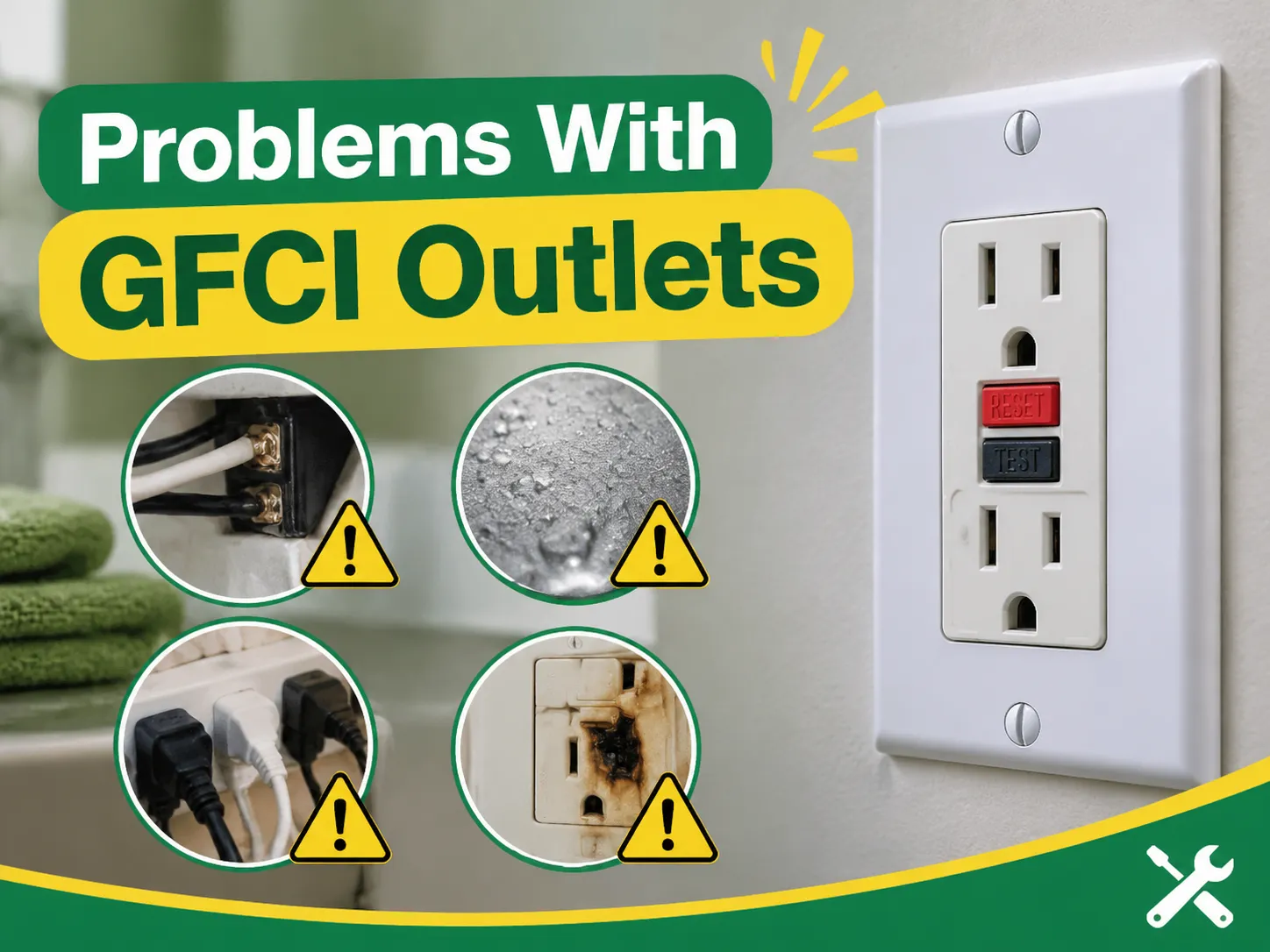
A ground fault circuit interrupter is the only appliance in the house that it is failed in a visible manner. It disconnects at an unexpected time, does not initiate re-setting, or give up after years in the service leaving an illusively safe circuit. Most issues searched by the customers fall into four categories of buyer’s […]

 رقم 6 طريق Tuozhan، حديقة Leshang Pioneer، ميناء خليج Yueqingwan، مدينة Yueqing، مقاطعة Zhejiang


