

San Francisco není průměrným trhem pro ovládání osvětlení. Bytový fond je starý a hustý a elektrický kód neumožňuje tolik elektrických instalací, kolik je povoleno téměř kdekoli jinde v USA. Většina domů, které chtějí složité osvětlení, jsou viktoriánské nebo edwardiánské budovy, kde nikdo nechce začít otevírat zdi. Tato situace činí většinu literatury na toto téma pro tento místní trh bezcennou.
Tento článek poskytuje podrobnosti o ovládání osvětlení v domácnosti v San Franciscu, jeho čtyřech typech řešení, systémech a místních integrátorech, kteří je instalují, místních specializovaných cenách pro rok 2026 a právních předpisech, které jsou v Kalifornii relevantní při rozhodování.
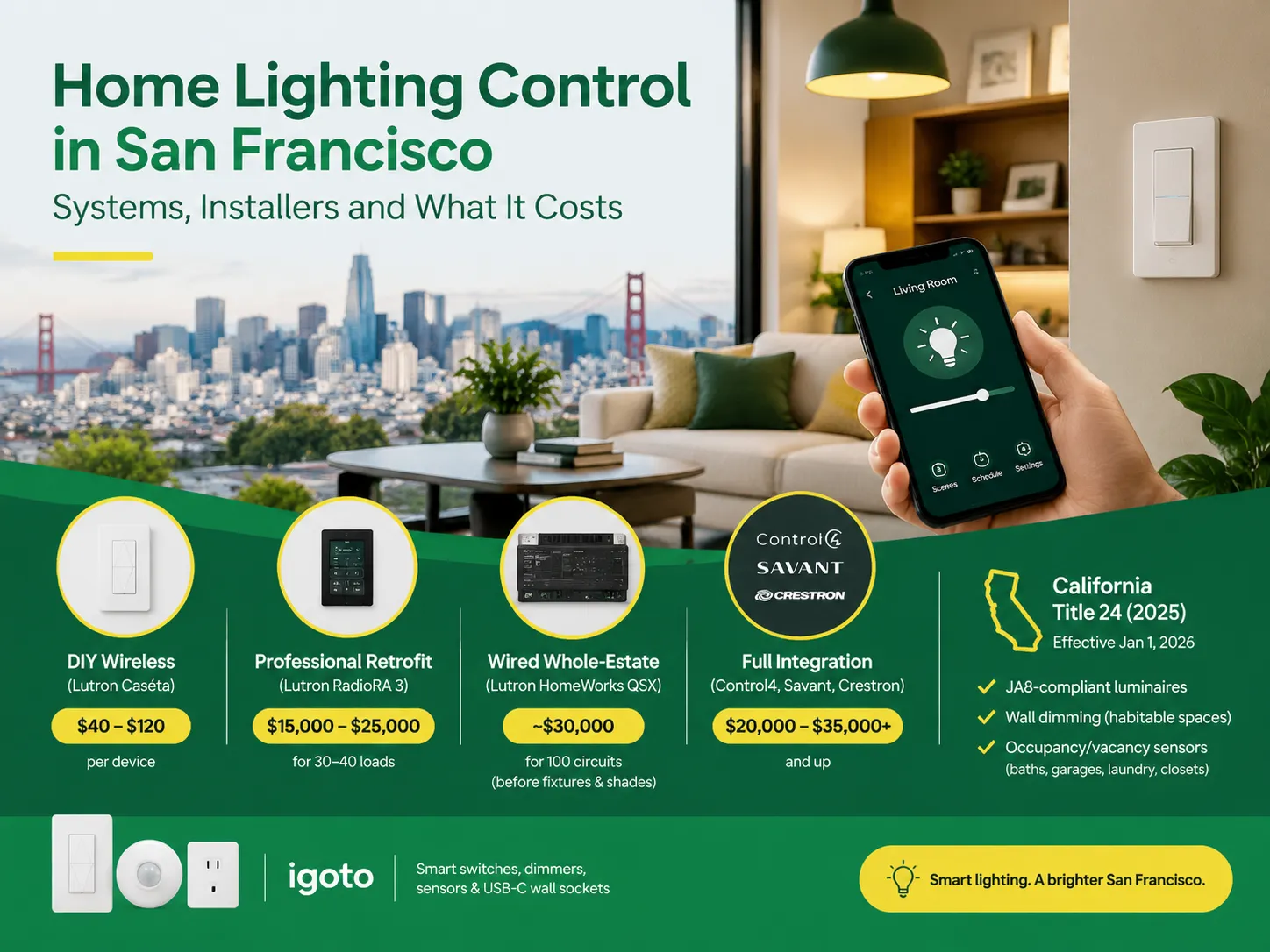
Dostupná řešení lze rozdělit do čtyř kategorií. Prvním empirickým přístupem by byly bezdrátové stmívače od Lutron Caséta za ceny $40 – $120 za zařízení. Pokud jde o systémy pro dodatečné vybavení stávající infrastruktury, vedoucím modelem v této oblasti se zdá být systém Lutron RadioRA 3, který by stál kolem $15,000 – $25,000 za úklid 30 až 40 zátěží. Pokud jde o drátové systémy pro celou nemovitost, nejdražší, ale pravděpodobně nejspolehlivější alternativou by byl systém Lutron HomeWorks QSX, který by stál kolem $30,000 bez jakýchkoli příplatků za svítidla a stínidla do projektu. Nakonec, pokud je úplná integrace do systému chytré domácnosti důležitější než náklady na instalaci, mělo by se použít s Control4, Savant nebo Crestron systémem. Ať už byla zvolena jakákoli možnost, uživatel musí mít na paměti, že budou existovat systémy splňující normu JA8 a přítomnost jakýchkoli nástěnných stmívačů v bloku bytů v jednotkách, které mohou být použity.
Termín zahrnuje tři odlišné návrhy, které jsou zabaleny dohromady jako jeden. Prvním je pohodlí: lze ovládat skupinu světel najednou, buď pomocí klávesnice, aplikace pro smartphone nebo hlasových příkazů. Druhým je nálada: to zahrnuje scény, které poskytují specifické intenzity světla a barevné teploty pro vaření, jídlo, čtení nebo zábavu. Třetím je shoda a efektivita: je známý automatickým vypínáním světel a stmíváním, čímž splňuje předpisy o energetické účinnosti a snižuje spotřebu energie.
Pro většinu země je třetí princip považován za vedlejší produkt. Nicméně Kalifornie přistupuje k problému z opačné strany – účinnost předpisů Title 24 o energetické účinnosti, které vstoupily v platnost 1. ledna 2026, se vztahuje na povolené nové stavby a úpravy. Jakákoli renovace, která zahrnuje osvětlení, je automaticky považována za projekt řízení v Kalifornii, bez ohledu na přání vlastníka. Je to výhodné pro zákazníky, protože dodatečné náklady spojené s vylepšenými řídicími zařízeními jsou výrazně minimalizovány díky požadavkům předpisů.
Klíčovým faktorem, který definuje vše ostatní, jsou typy budov. Mnoho domů v San Franciscu, zejména před druhou světovou válkou, používalo technologii dřevěných rámů a omítky, latě a spínače. Mnoho současných zařízení vyžaduje přítomnost neutrálního vodiče v rozvodné skříni, protože proud neprochází žárovkou během vypnutí. Domy postavené před rokem 1985 obvykle nemají neutrální vodiče v rozvodné skříni, což nutí spotřebitele přehodnotit svůj výběr zařízení. Kontrola neutrálního vodiče během návštěvy na místě — nikoli po podpisu nabídky — je nejdůležitějším předprodejním krokem při retrofitu. Mechanika, jak se tato zařízení liší od obyčejného spínače, je pokryta v našem vysvětlení o tom, co je chytrý spínač.
Dalším regionálním prvkem je cena za přehlížení chyb v designu. Viktoriánské designové prvky, jako jsou omítky a obrazové lišty, činí špatně provedené práce chybami, které jsou snadno viditelné, jako například klávesnice, která není na správném místě, nebo velký kus zařízení, který je nucen umístit do prostoru, který je mělčí, než by měl být. Na místním trhu je kvalita plánování důležitějším diferenciálním faktorem než budoucí značka procesoru.
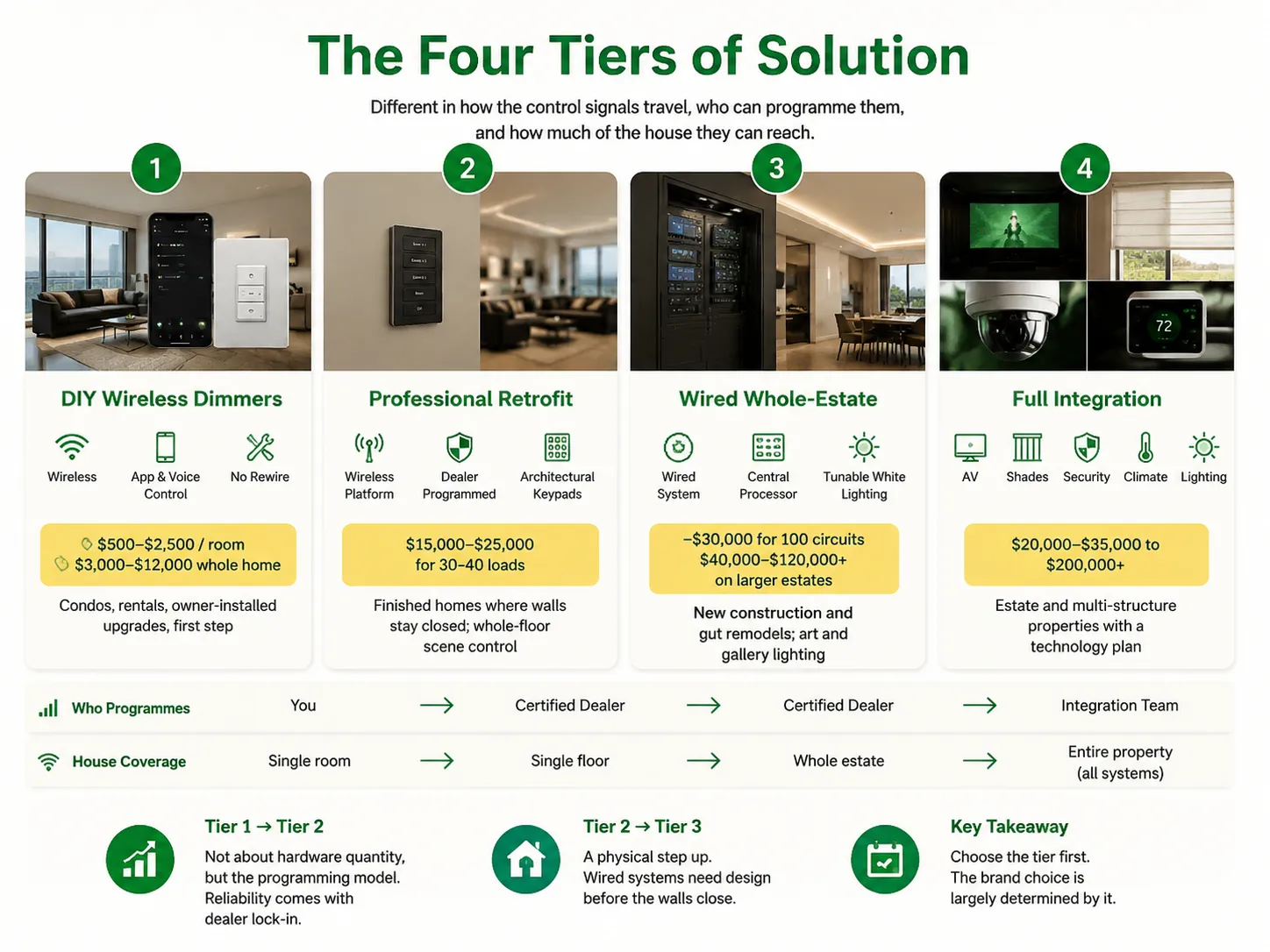
Ve městě lze téměř všechny projekty klasifikovat do jedné ze čtyř kategorií. Kategorie se liší z hlediska cest, kterými signály řízení procházejí, kromě toho, kdo je programuje a jak daleko ovlivňují budovu. Je důležité nejprve určit úroveň, než si vyberete značku, protože to určuje vybranou značku.
| Úroveň | Jak to funguje | Typické náklady | Nejlépe vyhovuje |
|---|---|---|---|
| 1 — DIY bezdrátové stmívače | Stmívače s vysokým napětím plus most; žádné pře kabelování; ovládání aplikací a hlasem | $500–$2,500 za místnost; $3,000–$12,000 za celý dům | Byty, pronájmy, vylepšení instalované vlastníkem, první krok |
| 2 — Profesionální retrofit | Bezdrátová platforma pouze pro dealery na stávajícím vedení; architektonické klávesnice | $15,000–$25,000 za 30–40 zátěží | Dokončené domy, kde zdi zůstávají uzavřené; ovládání scén na celém patře |
| 3 — Drátové celé nemovitosti | Systém založený na procesoru, drátové klávesnice, laditelné bílé svítidla | ~$30,000 za 100 obvodů; $40,000–$120,000+ na větších nemovitostech | Nová výstavba a kompletní rekonstrukce; osvětlení umění a galerií |
| 4 — Plná integrace | Osvětlení jako jeden subsystém celého domácího platformy s AV, žaluziemi, zabezpečením, klimatem | $20,000–$35,000 až $200,000+ | Nemovitosti a vícebudovy s technologickým plánem |
Rozdíl mezi úrovní 1 a úrovní 2 není nutně v množství zapojeného hardwaru, ale spíše v metodě programování. Takže v úrovni 1 programování provádí vlastník, zatímco v úrovni 2 programování provádí dealer a má výhradní právo na servis, což lze interpretovat jako zdroj spolehlivosti a zámku. Co se týče rozdílu mezi úrovní 2 a úrovní 3, ten je skutečný a fyzický. Pokud je zapojeno určité drátové řešení, musí být dráty a ovládací panel také nastaveny předem. To je důvod, proč volba úrovně 3 učiněná po dokončení prací odpovídá úrovni 2. V bezdrátových úrovních také rádiový protokol rozhoduje o tom, jak spolehlivě zůstávají zařízení připojena, a chyby při uvedení do provozu se tam objevují týdny později jako přerušení — sekvence je uvedena v našem průvodci na jak nastavit chytrý světelný spínač Zigbee.
Cena v ovládání světla zahrnuje řadu komponentů. Konkrétně se jedná o kombinaci ceny zařízení na zátěž plus cena procesoru plus cena klávesnic a cena programování. Zákazník, který hledá cenu pouze na základě zařízení, nebude brát v úvahu cenu procesoru, která se obvykle stává nejdražší částí celého procesu.
| Platforma | Na zátěž | Procesor / opakovač | Signál | Poznámky |
|---|---|---|---|---|
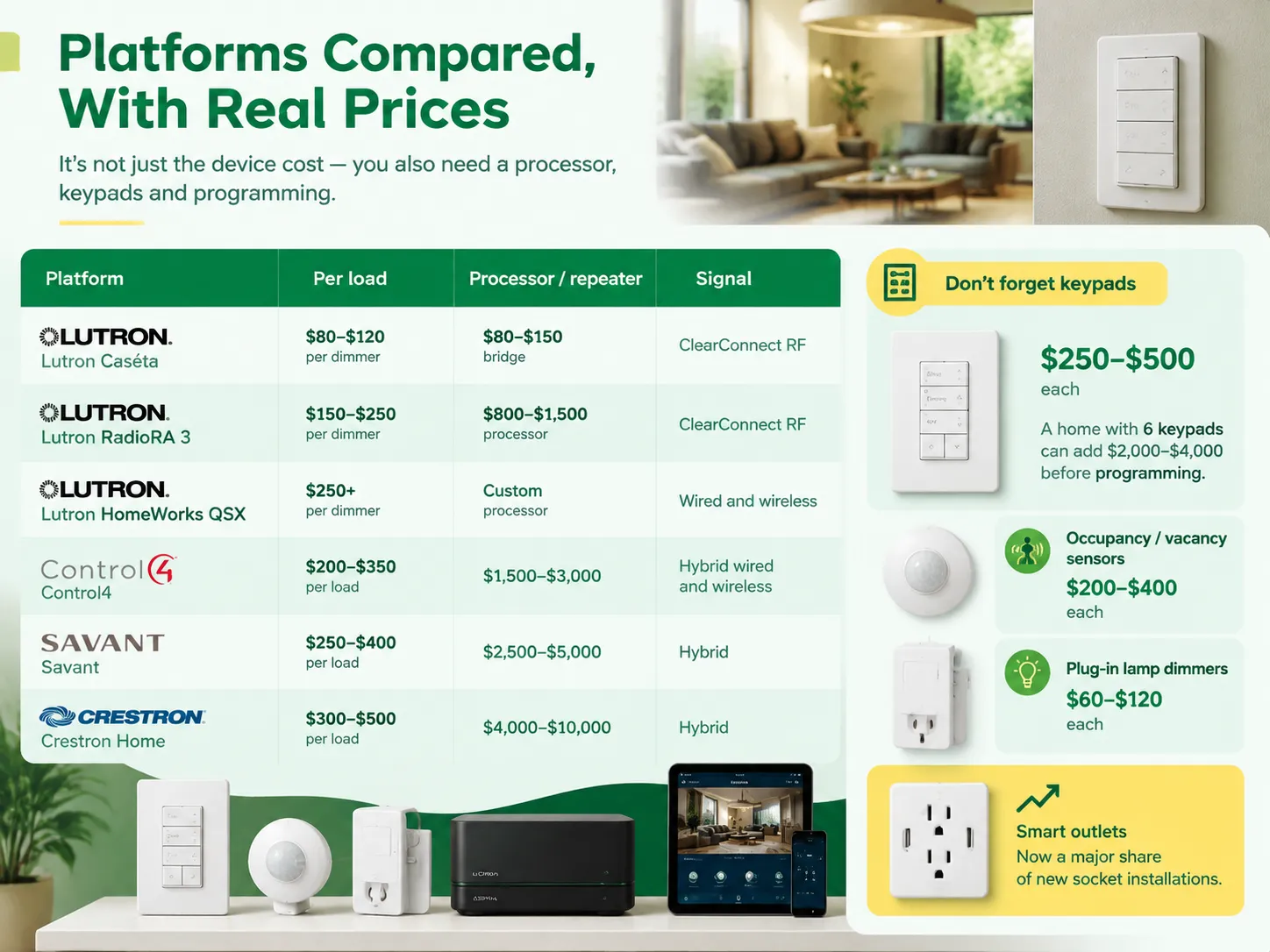
| Lutron Caséta | $80–$120 za stmívač | $80–$150 most | ClearConnect RF | DIY-installable; works with Apple Home, Google, Alexa; limited to around 50 devices |
| Lutron RadioRA 3 | $150–$250 per dimmer | $800–$1,500 processor | ClearConnect RF | Dealer-only programming; retrofit-friendly; up to roughly 200 devices |
| Lutron HomeWorks QSX | $250+ per dimmer | Custom processor | Wired and wireless | Required for the full Ketra tunable-white fixture line; new build and gut remodel |
| Control4 | $200–$350 per load | $1,500–$3,000 | Hybrid wired and wireless | Unified lighting, AV, security and climate in one app |
| Savant | $250–$400 per load | $2,500–$5,000 | Hybrid | Interface quality and scene design; strong in design-led residences |
| Crestron Home | $300–$500 per load | $4,000–$10,000 | Hybrid | Large and multi-structure estates; extensive programming |
Keypads have a greater influence on price than most homeowners assume. Each four to seven button architectural keypad costs around $250 to $500, and if the home has keypads located in the master bedroom, front door, kitchen, living room, master and garage entry closet, the owner pays $2000 to $4000 before programming. This amount spent is worth it, because keypads enable you to feel the system as part of the house rather than an application. Occupancy and vacancy sensors cost about $200 to $400, and plug-in dimmers vary from $60 to $120 in price.
The subsequent hardware component — the actual wall dimmers, switches, sensors and sockets — is the fastest-growing market today as smart sockets are becoming the biggest players in the installation of new sockets, while USB-integrated sockets take about one-third of all socket demand at the moment.Trends and market structure are covered in our industry analysis of the light switch and electrical socket market.
This trade is regulated by some licensing requirements in California. The classification of the license is also important – the low-voltage and lighting control tasks are assigned to contractors with a C-7 license, while the C-10 electricians are in charge of the rough electrical wiring and the line-voltage work. If a contractor has one license but not the other, he can either subcontract or ask you to organize separate services.
| Poskytovatel | Base and coverage | Platforms | What sets them apart |
|---|---|---|---|
| Regent5 | Bay Area; SF, Peninsula, South Bay, East Bay, Marin, Monterey | Savant, Control4, Crestron, Lutron HomeWorks QSX and RadioRA 3, Ketra | Holds both C-10 and C-7 licences (CSLB 1033103) and runs a San Carlos design centre with working keypads and two Ketra colour-rendering rooms |
| Proava Tech | San Francisco and Marin County, operating since 2015 | Lutron, Control4, Crestron, audio and IP surveillance | C-7 Low Voltage Systems licence (#1122813), $2 m insured, family-operated, with a long record of multi-site commercial rollouts |
| Jewell’s Quality Home Systems | San Francisco through the wider Bay Area | Savant, Crestron, Lutron Diamond dealer | Three generations and over 50 years in Northern California; lighting design and automation under one roof |
| Full Spectrum Technology Group | Concord; East Bay, Napa County, Los Gatos | Savant, Control4 | HTA-certified team with remote monitoring; founded 2020 |
In practice, there are three test questions that set these companies apart, and these questions will never be found on a website. First, ask who programs the system. If the programming belongs to a home and exists strictly on a dealer’s computer, this will create problems for selling and servicing. Then ask what happens when the manufacturer ceases producing the platform, as it often happens: certified dealers have the knowledge of legacy versions which allows them to provide services and transfer data instead of starting from scratch.
Finally, make sure to ask which license is actually covering your needs. Although working with a contractor and a licensed electrician on the high-voltage side is a normative situation, if a company cannot say what license applies to the job it offers, be careful. The local area for servicing should also be taken into account — a truck that has to travel for a long distance will be very slow in the evening on Friday.
The price of a RadioRA 3 system installed in a San Francisco house measuring 4000 square feet and having around 30 to 40 managed loads by professionals would be around $15,000 to $25,000. On a like-for-like basis, the cost for a similar number of circuits for HomeWorks QSX will be around 50% greater, and the two systems also use different wiring, keypad and processor technologies so there is no sensible way of upgrading one to the other, which means that a project that may eventually involve QSX has to begin with the selection of a QSX platform.
Though larger homes might raise the cost even further. The cost of an installation of a HomeWorks QSX lighting system with 100 circuits usually starts at around $30,000 before taking lights, shades, and installing costs into consideration, while for properties with multiple buildings, Ketra products, and motorized shades the total may reach $75,000 to $200,000. All-in-one platforms offer similar prices: a Control4 lighting system with 30-40 loads will cost around $20,000 to $35,000, and property equipment and installation prices do not fall below six figures in case of systems such as Crestron and Savant that combine audiovisual equipment with lighting, shades, security, and climate control systems.
The issue that is typically neglected while budgeting but emerges later arises during installation. When constructing a new building, pre-wired low voltage systems are financially advantageous. Depending on the scope of the project, the overheads may range from $1.50 to $4.00 per sq ft and a project for a 4000-sq-ft house incurs expenses of around $6,000 to $16,000 and the price of the final stage of the installation is much higher. In case of an upgrade, however, failure to install a neutral device may lead to significantly increased installation expenses as the cost of the device might go from $20-35 to $40-80 for the no-neutral version.The device side of that budget — sensors, dimmers, sockets — is where a range like the USB-C wall socket range sits, and specifying devices to match the control platform is cheaper at design stage than reconciling them afterwards.
The standards set forth in Title 24 of 2025 will go into effect on January 1, 2026, pertaining to all new residential buildings built and any renovations with a permit. There are four components making it easier for the lighting design in San Francisco to follow the state standards.
The main requirement of JA8 is that all installed luminaires have to comply with the approved standards on lighting including exceptions for interior lighting of exhaust fans and range hoods as well as other lighting elements under five watts. The concept of JA8 should be applied as it refers not only to efficacy but also to color rendering index, dimming down to 10 per cent, startup time, flicker level, and noise level. Otherwise, a cheap LED and a suitable LED will behave differently on the dimmer unit.
It should be noted that occupancy and vacancy sensor with automatic off must be installed for one of the lights in either bathroom or garage. Also, wall-mounted dimmers should be available for all kinds of lighting in all habitable rooms but there are some exemptions from the rule. While modifying the lighting system in any of the living rooms and kitchens, dimmers that will be used should comply with the standards spelled out in NEMA SSL 7A.
Some fixtures require installation of manual switch and either photo-eye and motion sensor or photo-eye and time switch. Energy management system that meets the requirements for dimming and dimming based on occupancy can become a solution provided that it operates as it is required and does not go around the necessary controls. Some practical comments should be made – “Title 24 Compliant” labeling is prohibited by California legislation and there are no exceptions to this rule.
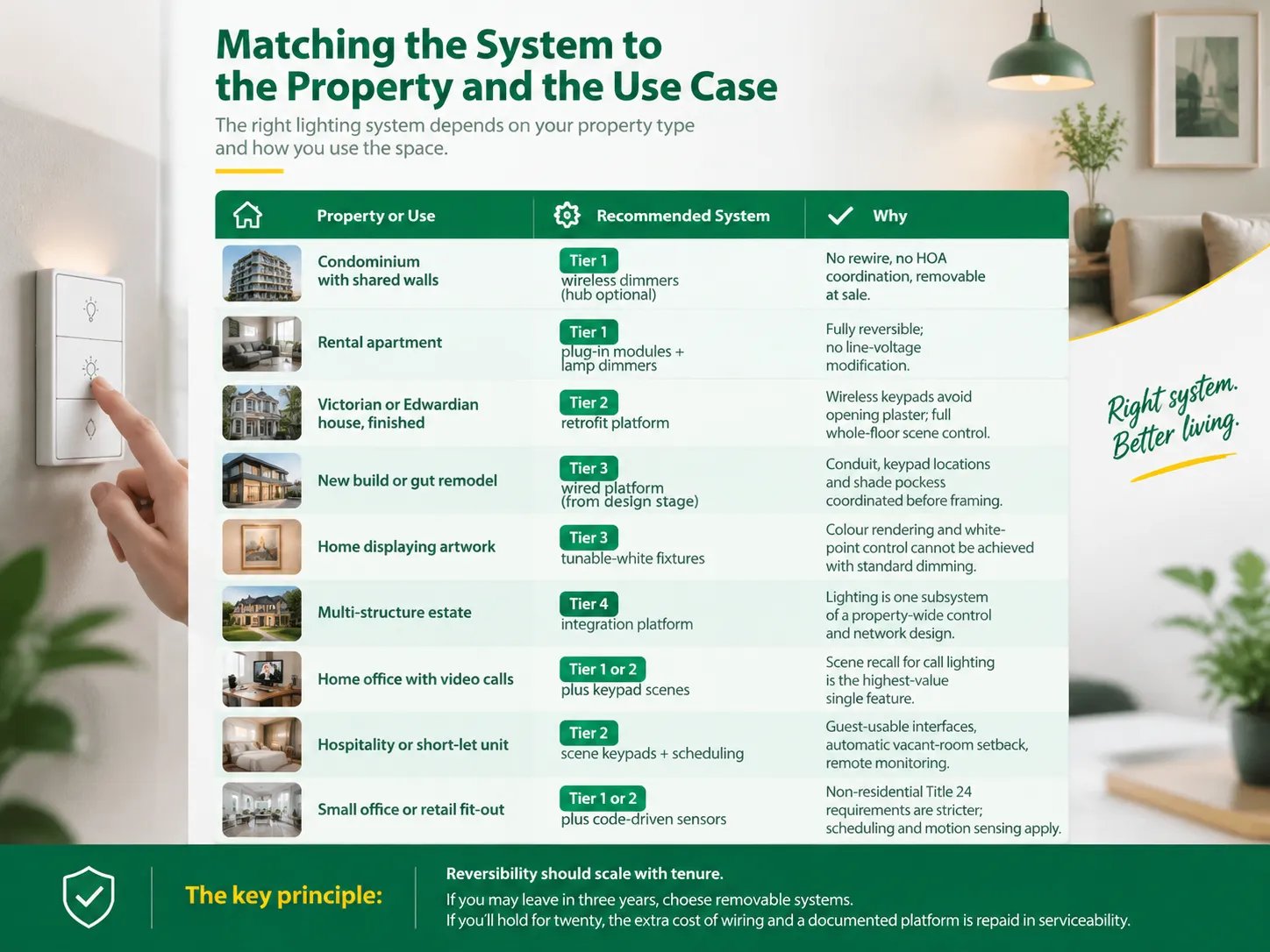
The decision for which tier to choose solves nearly all the projects, but the property type and the application of it affect the decision. The table below shows how these decisions are normally made in the Bay Area.
| Property or use | Practical recommendation | Proč |
|---|---|---|
| Condominium with shared walls | Tier 1 wireless dimmers, hub optional | No rewire, no HOA coordination, removable at sale |
| Rental apartment | Tier 1 with plug-in modules and lamp dimmers | Fully reversible; no line-voltage modification |
| Victorian or Edwardian house, finished | Tier 2 retrofit platform | Wireless keypads avoid opening plaster; full whole-floor scene control |
| New build or gut remodel | Tier 3 wired platform from design stage | Conduit, keypad locations and shade pockets coordinated before framing |
| Home displaying artwork | Tier 3 with tunable-white fixtures | Colour rendering and white-point control cannot be achieved with standard dimming |
| Multi-structure estate | Tier 4 integration platform | Lighting is one subsystem of a property-wide control and network design |
| Home office with video calls | Tier 1 or 2 plus keypad scenes | Scene recall for call lighting is the highest-value single feature |
| Hospitality or short-let unit | Tier 2 with scene keypads and scheduling | Guest-usable interfaces, automatic vacant-room setback, remote monitoring |
| Small office or retail fit-out | Tier 1 or 2 plus code-driven sensors | Non-residential Title 24 requirements are stricter; scheduling and motion sensing apply |
In general, the principle indicates that reversibility should correlate with length of stay. If the tenant is leaving in 3 years, opt for systems that are easily removable. If the property is going to be occupied for 20 years then the cost incurred in the equipment and documentation is justified by the service provided.Owners who want the decision framed around their home rather than a product line will find the trade-offs laid out in our guide to choosing the right smart switch.
Whether it is the tenacity of the walls, the status of the state, or the extent of your control over the house that determines your choice between different systems? For simple rentals/condos and individual room upgradings, Lutron Caseta is the least risky option as it utilizes the pre-installed wiring of the property and could be easily removed later. For finished houses where you want a number of keypad scenes on different floors or just 30-40 loads installed professionally, RadioRA 3 is the best system to choose with an approximate price of $15,000-25,000. In case you want to build a new construction or remodel the entire house or value the effect of art and colors, wired options such as Lutron HomeWorks QSX would suit you best. The main point is to pay attention to whether the walls are closed or not because if the walls are already closed it would no longer be feasible to take advantage of the wired options.
The three options for implementing smart home technology are ranking from the least reliable to the most reliable. Scheduling means programming the home system to switch on and off at certain times regardless of whether there are people inside. Geofencing or an out-of-the-house mode kicks in when the last mobile device leaves the premises. It is very handy but the functioning of geofencing highly depends on GPS accuracy. The best way to access the entire system from anywhere is through the app produced by the company. To guarantee security, the best idea is to implement a randomized evening routine that does not repeat each day and controls the lights in all the rooms. This idea should ideally also combine the work of outdoor lighting that operates on a time clock. Note that smart home devices that rely on cloud technology cannot function properly without the Internet.
By level of sophistication, in the currency of 2026. Caséta is the most basic system used by the homeowners; its starter pack is around $180 to $320, while an extra dimmer costs between $40 and $120. Home installation services cost between $5,000 and $12,000, contingent on how many appliances you install. RadioRA 3 is only available through dealers, with dimmers costing between $150 and $250 plus the processor costing $800 to $1,500. Overall, it makes the installation of a load home with a total of 30 to 40 lasting about $15,000 to $25,000. HomeWorks QSX is a smart luxury home automation system costing about $250 and more per dimmer, plus a custom processor costing about $30,000 without counting fixtures, curtain control and installation services.
Using the platform’s app, on-line or with voice control through Apple Home, Google Home and Alexa where applicable. Remote control is initiated from your phone and involves the vendor’s cloud and the processor being used locally. As a result, three elements are necessary for the remote control function: stable Wi-Fi on the processor, the internet present, and the cloud service being in operation. The important design question is what happens when one of those three fails. It is advisable to store scheduled automation and keypad scenes on the processor so the home can function as supposed even without the cloud and rely on the app as a supplement instead of the fundamental part. In case you leave your property unattended for a long time, create the scenes connected with the security of the house only on the basis of local schedules and remote monitoring, rather than depending on the app that needs manual control from another time zone.
Lighting controls in San Francisco constitute a planning challenge that should take precedence over product issues. The legislation requires lighting systems to automatically adjust and/or turn off in living environments. The manufacturer’s choice is limited to whether walls are open. Once the timing and requirements are established, the company can successfully place the order while overcoming some risks.
There are three points to remember. The neutral must be checked before the quote is accepted, as one survey result will change the list, cost, and the tier. Determine the owner of the programming files before signing a contract — without ownership of this crucial element, it will be impossible to implement the project. The right tier must be established before the manufacturer is chosen — if the wired solution is selected after the installation of carpentry, it will not be affordable. Following these points, the lighting system can do its job effectively and efficiently.
San Francisco is not the average lighting control market. The housing stock is old and dense, and the electrical code does not allow for as many electrical installations as is allowed almost anywhere else in the U.S. Most homes that want complex lighting are Victorian or Edwardian buildings where no one wants to start opening […]
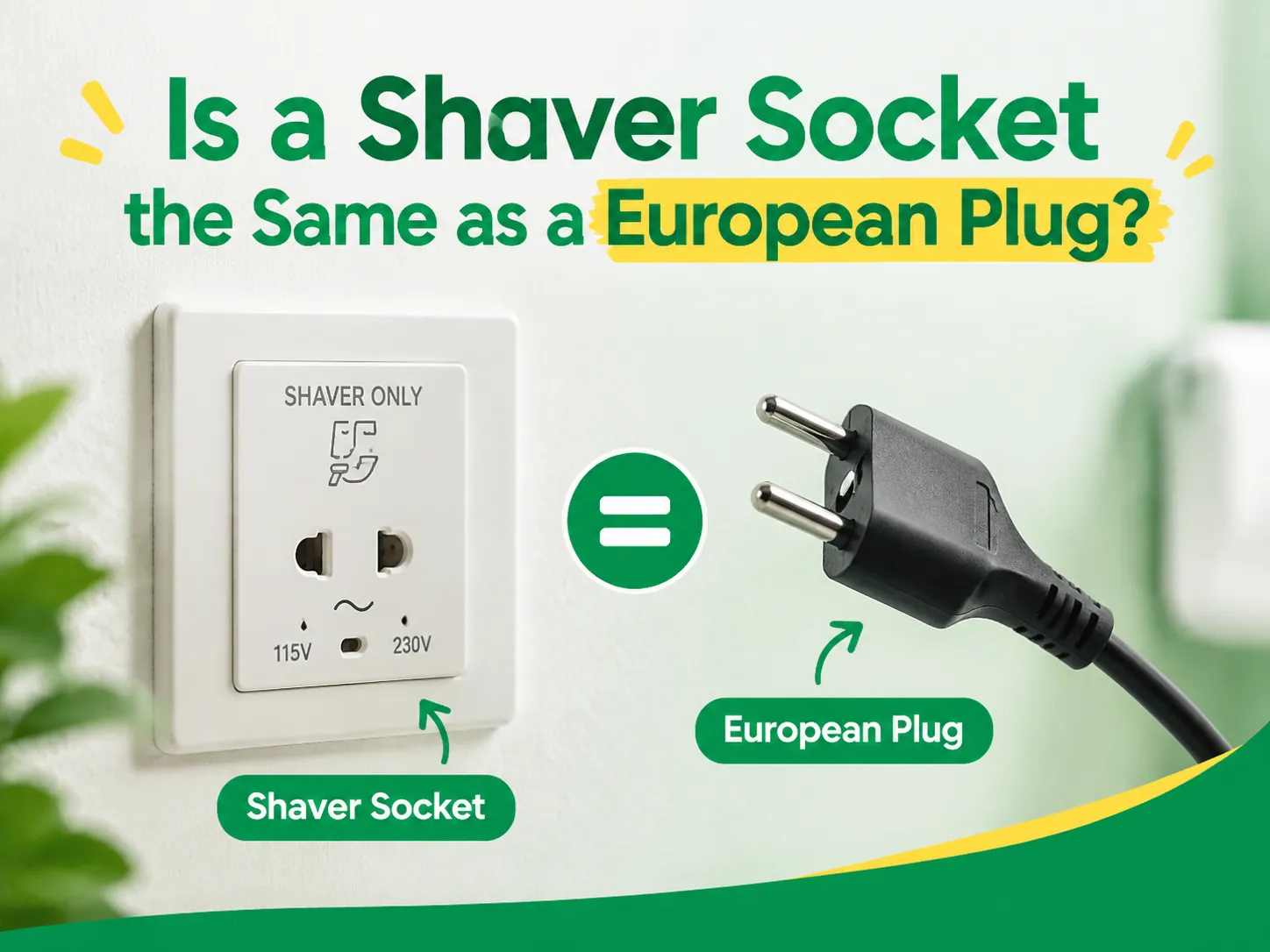
I když se zdají být podobné, obě mají kulatý tvar se dvěma kolíky a fungují při napětí 230V. To vysvětluje, proč někteří turisté používají evropskou zástrčku s britským holicím strojkem nebo se diví, proč nelze holicí strojek zapojit do zásuvky Schuko v španělském hotelu. Ve skutečnosti […]
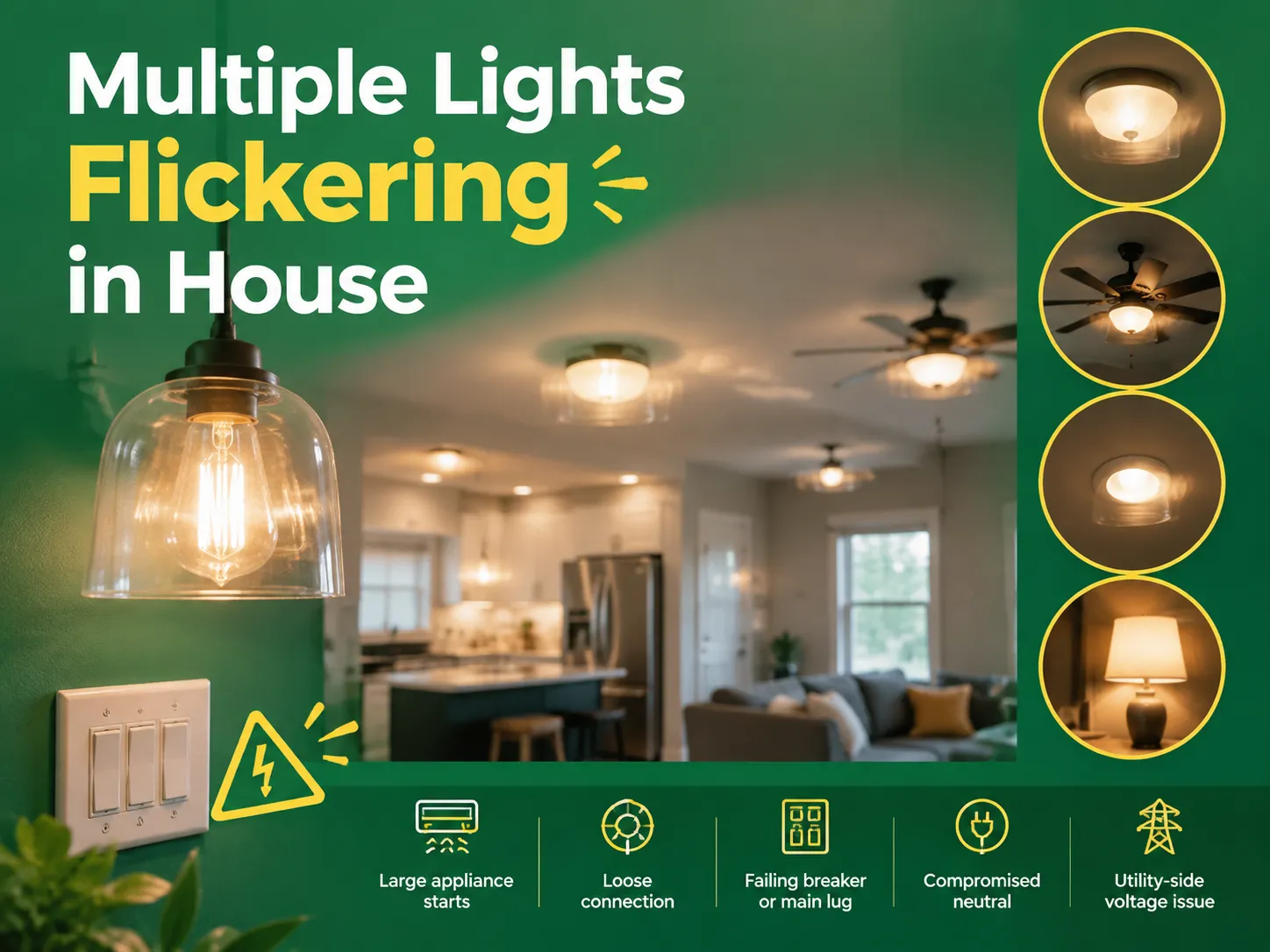
Blikající žárovka může být interpretována jako místní problém — žárovka je opotřebovaná, světelný zdroj je špatně připojen, nebo to může být tím, že máte levný stmívač. Ale pokud bliká více než jedna žárovka současně, v různých místnostech, musíte situaci vidět jinak. Mnoho blikajících žárovek signalizuje […]

 No.6 Tuozhan Road, Leshang Pioneer Park, Yueqingwan Bay Harbor, Yueqing city, Zhejiang Province


