

The unique Australian plug designs are not derived from American and European designs as well. Even if the design looks simple it cannot be used in any plug according to international standards. Even when considering the use of Chinese plug with the same idea as the Australian plug, this device is illegal in Australia as far as we need to be in accordance to the plug wiring rules. Therefore, using this plug abroad will mean that Australians can only use one kind of a plug in foreign countries and travelers coming to Australia in compliance with the laws regulating the importation of goods to Australia will not encounter many plugs that do not fit the regulatory standards.
Subsequently, you will learn about the Australian plugs while being abroad and you will discover their names, international regulations forming these standards as well as their general appearance. In addition, you will get familiar with the types of plugs which fall under Australian plug standards.
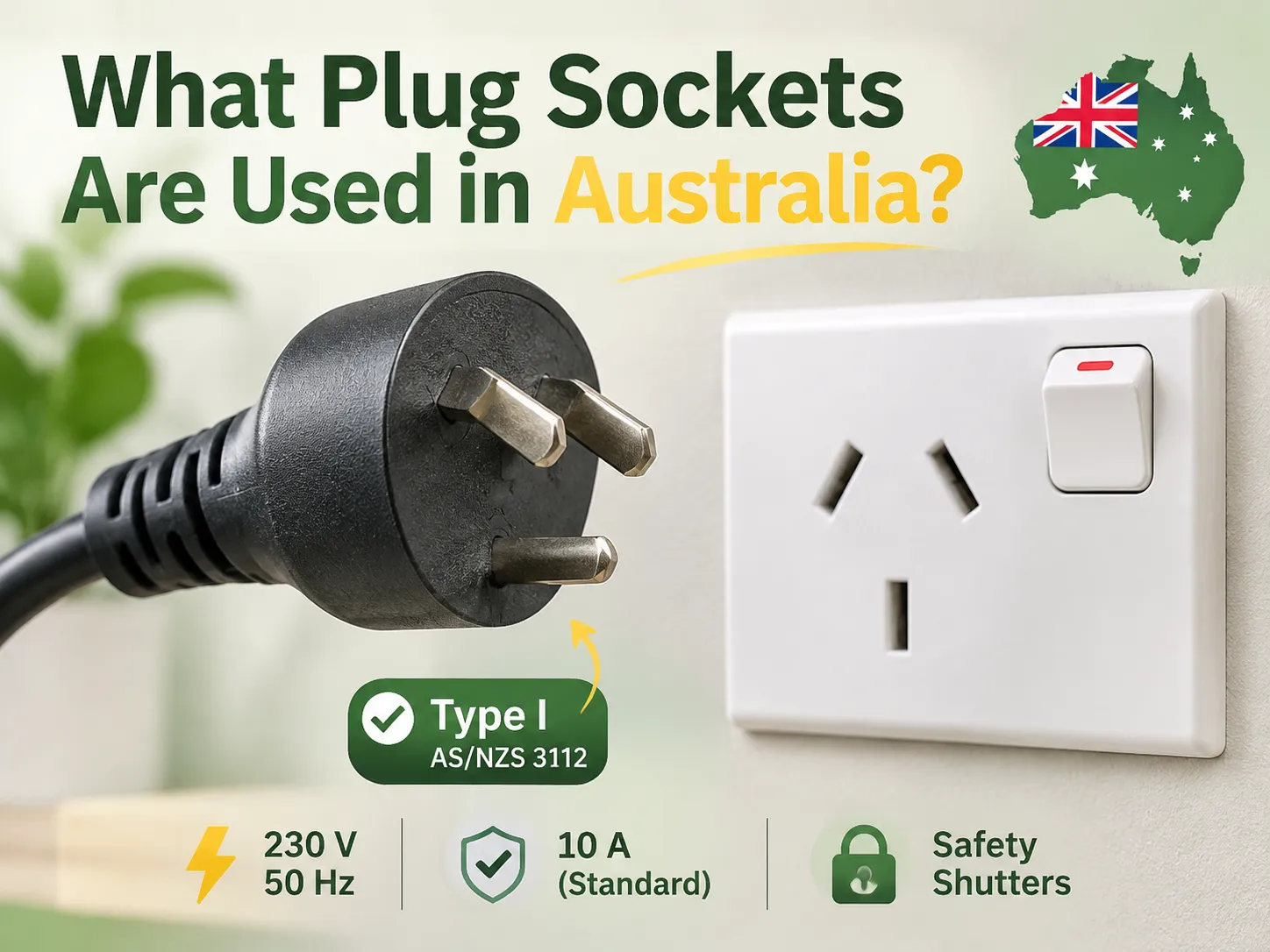
According to AS/NZS 3112, type I socket and plugs are used in Australia and New Zealand systems that use 230V AC voltage at the frequency of 50Hz. The design of type I socket has a semi-circular letter ‘V’ composed of three prong connectors. The distance between the live prong and neutral prong is equal to 13.7 mm, and the earth prong is situated on top of that part of the connector at the distance of 20 mm. The amp rating for type I socket varies from 10A to 15A but in existence are also plugs with bigger amps, but due to bigger prongs, they cannot be used in type I sockets. However, there is some protection on neutral and live prongs since April 2005. Most of the appliance designs used in the country have safety switches, which are absent in European and USA designs.
The search volume regarding the same entity in Australia is divided into four definitions, and knowing which term is appropriate helps to avoid confusion while reading specifications or ordering supplies.
The practical advantage of this issue is that when the specification uses the wrong word the document sounds strange. When the Australian electrician orders receptacles, they will assume that the document refers to the American project and will ask what the product is.
The specification for the approval and testing of plugs and socket outlets is referred to as AS/NZS 3112, and it is a joint specification established by Standards Australia and Standards New Zealand. The products sold in both of the countries need to comply with this standard. The compliance path for the socket outlet involves the process of certification, which means that testing should be performed by a laboratory that is recognized and by a responsible supplier that is registered.
In informal naming, the configuration is referred to as Type I, and the design is unmistakable: it consists of three flat blades arranged in an inverted V shape, and the prong at the bottom center is used for grounding while the live and neutral prongs extend at angles of 30 degrees from vertical. The ground prong of the plug is longer in its length in comparison to the other two prongs, being 20 mm long and the rest being only 17.35 mm long.
The other requirement is regarding the insulation that was added in 2005, and it is often a cause for compliance failures. Since April 3, 2005, the standard has required the half-insulation of live and neutral prongs, meaning that at least the first 10 mm of the prongs is to be insulated from electric current. The need for this requirement is that there could be a case when a plug is partially pulled out from a socket and someone touches the live prongs.
There are two standards that are worth mentioning. The first one is AS/NZS 3100, which has general requirements related to electrical devices, and the second one is AS/NZS 3000 that describes the requirements for the wiring: cable sizes and RCD protection. Even if a product conforms to the standard, the installation may be considered non-compliant, since compliance assessment is done by different people.
From physical details, the buyers distinguish between the certified product and its imitator, which involves checking four parameters.
The nominal supply of electricity in Australia is at 230 volts with a frequency of 50 Hz which is actually a standard but there was a time when 240 volts was the norm. The formal business still remains in practice and standards allow for the supply voltage to vary from 216 volts to 253 volts. The voltage supply at different locations may vary depending upon the distance and loads of the feeders.
The above mentioned history explains the confusion that surrounds this practice. In 1980s, Australia switched to 230 volts from the norm 240 volts to stay at par with the international standards but the physical supply of electricity has not changed. The devices labeled at 240 volt still function well in the Australian market. The devices labeled at 220 to 240 volts are built to cope up with the above mentioned differences while devices labeled only at 220 volts are running slightly above the rated voltage which seems to be fine for the switched mode supply.
The figure of 50 Hz holds more significance than many travelers expect it to be because the device with synchronous motors would only work at the frequency that they are specifically designed for. Hence a device operating at 60 Hz on the 50 Hz voltage would run 17% lower than normal speeds. The kitchen appliances which base their time system from the electricity source would also run a little slow due to 50 Hz power supply.
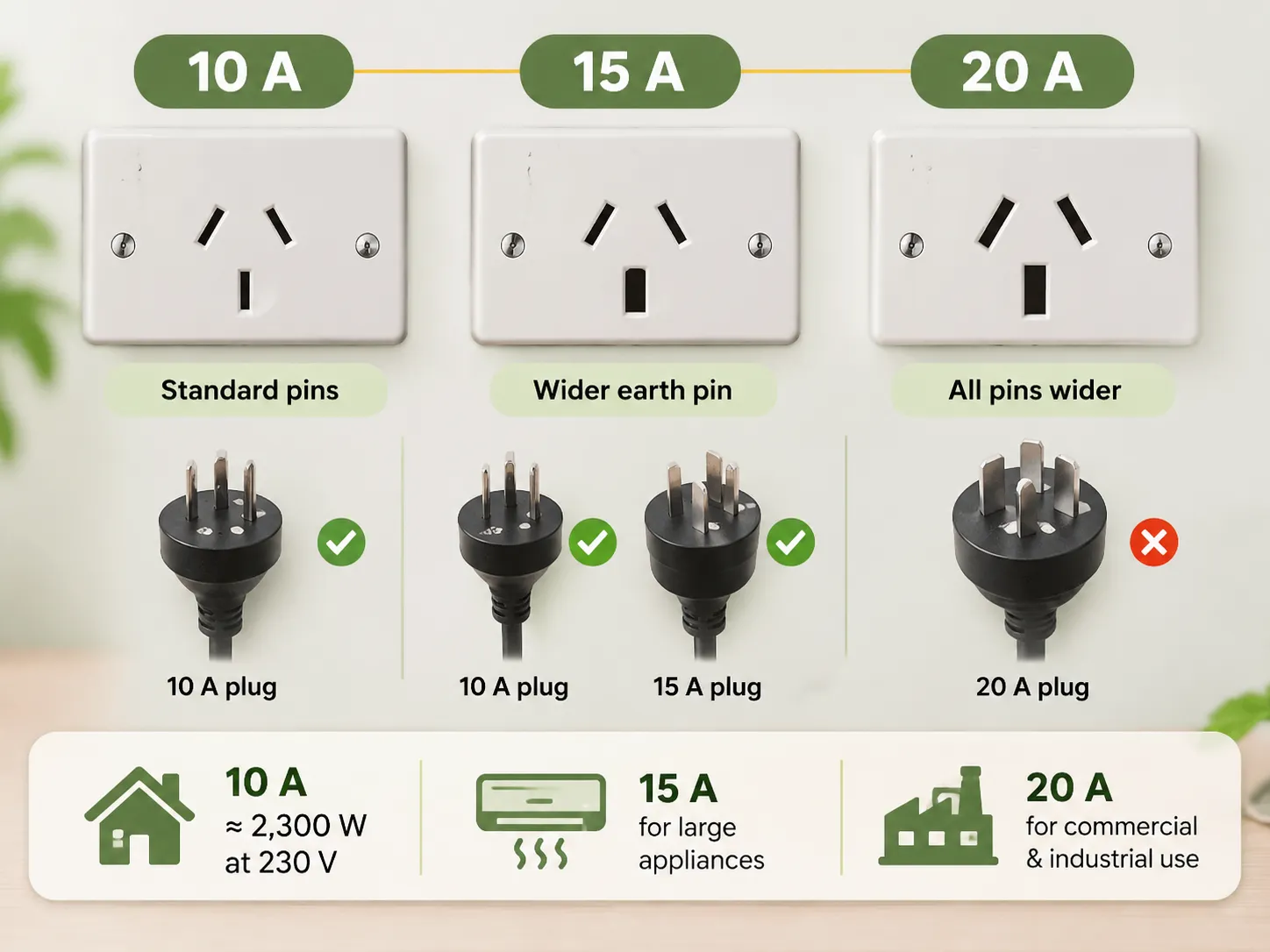
There are three ratings featuring the Type I layout, and the cleverness lies in how they are separated in line with the principles of conventional writing in the electrical industry. Instead of using different forms for each rating, this standard simply uses wider pins such that a higher-rated plug cannot fit in a lower-rated socket.
| Calificación | Disposición de pines | Compatibilidad | Uso típico |
|---|---|---|---|
| 10 A | Standard blades, earth 20 mm | Fits 10 A, 15 A and 20 A sockets | General domestic and commercial |
| 15 A | Earth pin widened to 8 mm | Fits 15 A and 20 A sockets only | Air conditioners, heaters, large appliances |
| 20 A | All three pins widened | Fits 20 A sockets only | Industrial equipment, welders, heavy machinery |
The situation is such that a 10-amp device can be used with any socket in Australia, whereas a 15 amp device can only be used with a properly rated socket. This explains the fact that in our country, houses with air conditioning have a socket sticking out of the wall that looks different from the rest. The fact that a 15-amp socket recognizes a 10-amp plug is indicative of the backward compatibility of sockets, while the opposite statement does not hold true. It is this asymmetry that is a clear-cut design decision in order to eliminate some kind of user mistakes.
Speaking about the recommendations for fitting specification, one can say that kitchens, laundries, and other places having high-load devices must have at least one 15-amp outlet. The rest of the sockets within the house must be 10-amp. One can come across the double GPO with double 10-amp sockets very often, while the 15-amp single outlet often gets specified, but gets forgotten till the appliance comes.
Homeowners are usually surprised to learn how extensive the variety of options can be, since knowing what they are is crucial during the implementation of projects.
The short version is that almost everyone needs one. The long version is worth a table, because the type of adapter differs.
| Proveniente de | Plug there | Voltage and frequency | What you need |
|---|---|---|---|
| Reino Unido | Tipo G | 230 V, 50 Hz | Solo adaptador de enchufe |
| Europa | Type C, E, F | 230 V, 50 Hz | Solo adaptador de enchufe |
| United States, Canada | Type A, B | 120 V, 60 Hz | Adapter plus converter for non-dual-voltage devices |
| Japón | Type A, B | 100 V, 50 or 60 Hz | Adapter plus converter, lower voltage |
| Porcelana | Type I and A | 220 V, 50 Hz | Often fits, not compliant, use an adapter |
| India | Type C, D, M | 230 V, 50 Hz | Solo adaptador de enchufe |
| New Zealand, Fiji, PNG | Tipo I | 230 V, 50 Hz | Nothing |
The distinction of interest is the one between adapters and converters. An adapter is a device that changes the configuration of the prongs of the plug without changing the electrical input or output. However, a converter is a device that will change the voltage according to the device it is used for, and the converter has to be rated for the wattage of the device. For example, a US -made hair dryer requires a converter, while a laptop charger rated 100-240 volts only requires the use of an adapter since it is not affected by the electricity requirements.
China is a special case in this aspect. The Chinese Type I plug, in principle, usually fits into an Australian outlet, and this is exactly the issue, as its prongs are shorter and the thickness of the blade can be different. Some older models of this device do not have insulated prongs. The plug connected to an outlet with a slightly thinner blade heats up more than it should, and heat at an outlet leads to all potential failures that can arise.
A plug adapter presents three issues that should be understood prior to plugging in any device.
A foreign plug adapter does not make an illegal socket legal. If a Chinese or Argentinian plug has been installed in Australia, it has been done illegally even if it works and will be flagged by an inspector. The supply of Australian compliant switches and sockets is organised around the AS/NZS document trail for that reason.
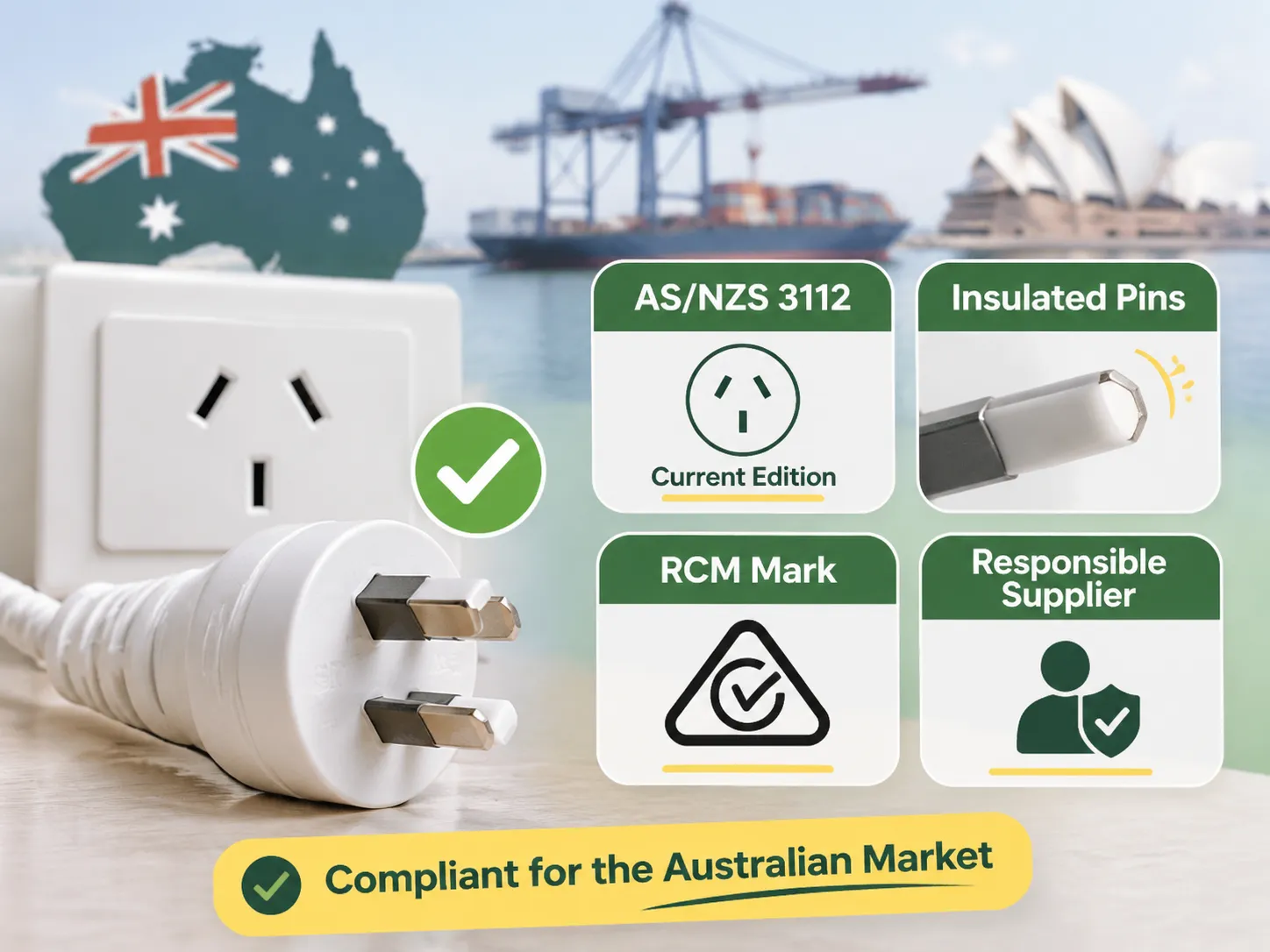
In case of importing sockets instead of employing their usage, the compliance route is the full program. Sockets belong to the category of equipment that means that the certification process takes place, rather than self-declaration, and no deviations are allowed.
The product needs to be subjected to AS/NZS 3112 test, as well as the respective part of AS/NZS 3100, in a laboratory recognized by the EESS. The certificate has to specify the name and the manufacturer of the product, and the certificate for a similar product from another manufacturer is not transferable. The supplier has to be registered in the EESS database as a responsible supplier for the corresponding product to have the Regulatory Compliance Mark along with the supplier’s details, as in case of a recall, it cannot be conducted without the responsible supplier.
Failures occurring during the inspection rather than at customs usually deal with dimension issues such as pin length, insulation length, shutter working mode, terminal size when using the conductors with a 2.5 mm² and 4 mm² cross-sectional areas, or the mounting distances from the local socket. None of the above problems can be identified on the product picture, which is why the sample and the test report are more important than the pictures presented in the catalogues.
For a project that needs the full package, the high rise project supply work done for Australian sites is a useful reference for how the document trail is organised across thousands of devices and several construction stages, and it is the kind of reference worth asking a supplier for before a container is ordered.
Our company produces dip switches and plugs that are compliant in New Zealand and Australia. Our product range includes 10A and 15A sockets, USB outlets, dual GPO plates, and water-resistant types with designs that can fit various types of wall boxes. Our clients are mainly developers, contractors, and distributors, as we don’t sell in retail; thereby, our conversations mainly revolve around certification and specification of our products.
We do know three important things on any project: First, we use a batch of goods with accompanying AS/NZS test documentation for this batch without any delay during the production. Another thing is that we do not consider our designs as specials ones but rather as standard units made in plate/module combinations. Lastly, we inform our clients when their desired designs are not certifiable for Australia, which usually happens with USB outlets.
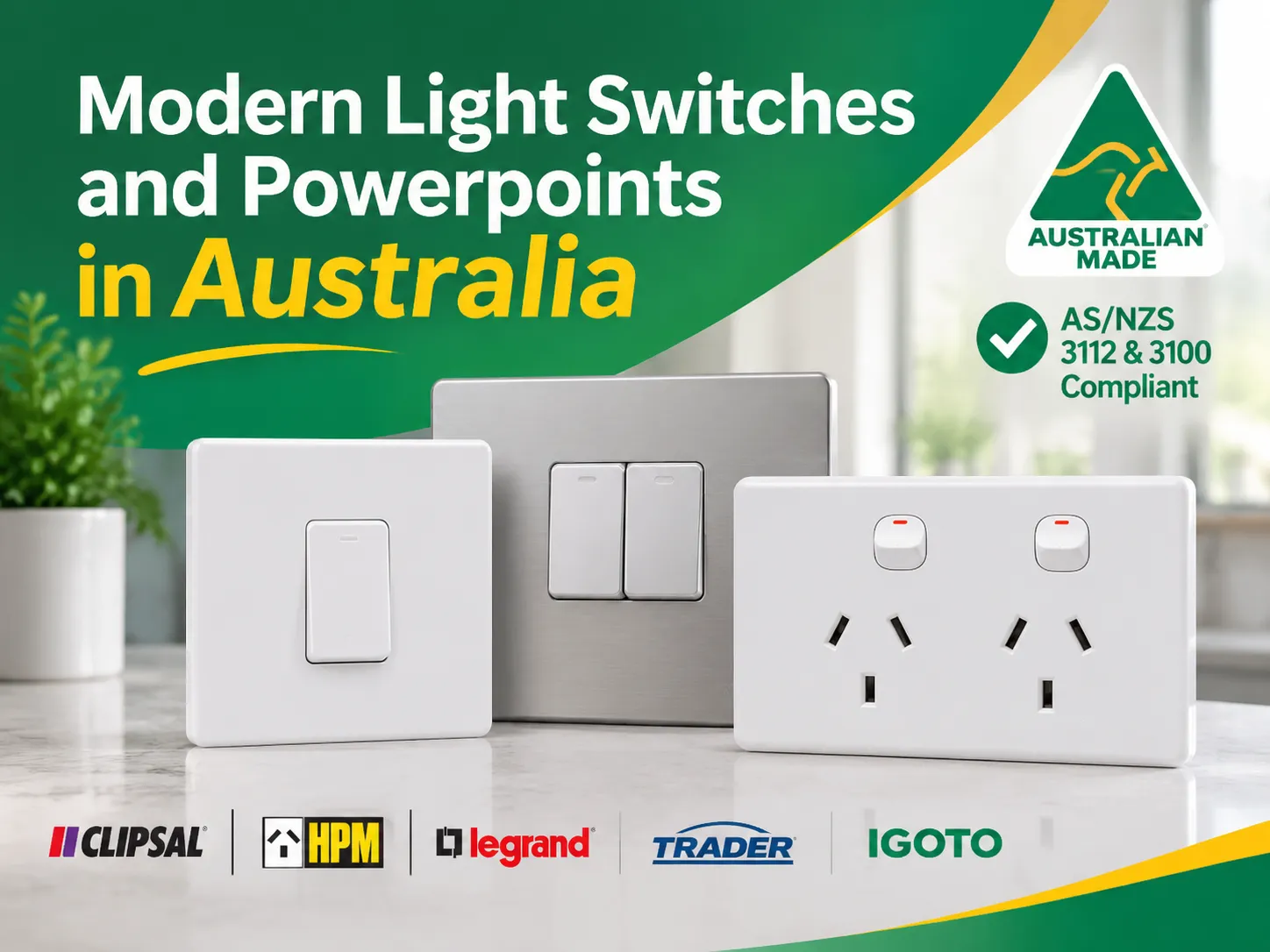
For a buyer comparing brands before writing a specification, the brands that dominate Australian wall sockets are worth knowing, because a specification naming an unfamiliar brand in a market where the electrician stocks three names ends with a variation order and a delay.
Australia uses the Type I plug which consists of 3 flat angled pins at 230 V. Meanwhile, the UK has the Type G plugin that has a bigger 3-pin plug which has rectangular pins and a fuse that operate on 230 V and 50 Hz. Since the voltage is the same, the device doesn’t need a voltage converter but only a plug adapter, still UK plugs cannot connect to Australian sockets without that.
Not only the plug is different though. Australia has a voltage of 230 volts and a frequency of 50 Hertz with type I plug. The USA does not have this in common because it has a voltage of 120 volts and a frequency radius of 60 Hertz and has plug types A and B. Products from the USA have to be used with a converter, not with the help of an adapter unless the product indicates that it can work at 100-240 volts. Also, any item having a motor or a clock functions differently at a frequency of 50 Hertz due to its construction even though voltage set up is done.
A Type I adapter, often referred to as an AU adapter, is capable of accepting plugs from Europe, the United Kingdom, and the United States of America as well as providing Australian pin outputs. You should examine the label that is attached to the device; if the label specifies a voltage of 100 to 240 volts and a frequency of 50/60 hertz, it means that a passive adapter will do the job. If the voltage mentioned is just 120 volts, it indicates that you might need a converter with electrical rating compatible to process the wattage of the device. If the device has a motor or uses a derived clock, the frequency will have the same importance as volts.
No. Canada applies the Type A and Type B plug at 120 volts 60 Hz just like the USA. Meanwhile, Australia applies Type I at 230 volts 50 Hz. Hence, a device from Canada will require a plug adapter and, if it does not feature dual voltage functionality, a voltage converter. However, in the case of laptops and telephones, since they are dual voltage devices, only a plug adapter will be needed.
Ever since 2005, Type 1 plugs have become part of the Australian electric plug market where a voltage of 230V and a frequency of 50Hz is used. There are three different current ratings that are chosen based on the size and isolation of pin. The country plugs have a switch and a safety shutter in every socket. In view of the four above-mentioned aspects, foreigners will have no troubles answering any questions that they may have about plugs. For example, knowing the terms that are used in Australia in these situations may be important.
Product compliance includes the fact that a product is produced according to the standards requirements. The minimum information required in order for a product to be sold is the reference number or model of the product along with contact information of the importer.
The unique Australian plug designs are not derived from American and European designs as well. Even if the design looks simple it cannot be used in any plug according to international standards. Even when considering the use of Chinese plug with the same idea as the Australian plug, this device is illegal in Australia as […]

When searching for “07498 lighting consultants”, one usually starts with a specific address, that provides approximate routes. In this case, “07498 indicating a location” means that it is a place close to New York border, while the user needs to get the name of some nearby company or agency in order to compare prices. The […]
Although marketing switches and sockets in Australia, at first sight, sounds relatively easy, buyers from overseas would soon find out that the going may not always be smooth once they have to deal with imported plates, because they operate on 230V at 50 Hz, the distances between mounting screws are dissimilar (84 mm instead of […]

 No.6 Tuozhan Road, Leshang Pioneer Park, puerto de la bahía de Yueqingwan, ciudad de Yueqing, provincia de Zhejiang


