

Bár hasonlónak tűnnek, mindkettő kerek formájú, két tűvel rendelkezik, és 230V feszültségen működik. Ez magyarázza, hogy miért használ néhány turista európai dugót brit borotvához, vagy miért csodálkozik, hogy egy borotvát nem lehet bedugni egy Schuko aljzatba egy spanyol szállodában. Valójában különböznek, mivel a tű átmérője és távolsága nem azonos, mert a két szabványt különböző célokra találták ki. Nem számít, hogy információra van szükséged ezekről a dugókról az utazásodhoz, vagy tudni szeretnéd, hogyan kell bekötni egy fürdőszobát. Ez a útmutató elmagyarázza, hogy mit tartalmaz mindegyik szabvány, mik a különbségek, és hogyan tudod vizuálisan megkülönböztetni őket.
Nem, mert bár a borotválkozó aljzat és az európai dugó két különböző entitás, a kettő nem cserélhető közvetlenül egymással. A brit borotválkozó szabvány, a BS 4573, két darab 5,1 mm vastag hengeres vezetéket használ, 16,7 mm távolsággal, és 0,2 A teljesítményértékkel rendelkezik. Ezzel szemben az európai Europlug szabvány két darab 4 cm vastag hengeres vezetéket használ, és a távolságuk körülbelül 18,6 mm – 17,5 mm között változik, 2,5 A értékeléssel. A borotválkozó dugó tűi sokkal szélesebbek, mint az Europlug tűi, ami azt jelenti, hogy az első nem illeszkedik a C, E vagy F típusú aljzatokba. Ezenkívül meg kell említeni, hogy ezeknek a dugóknak bizonyos műszaki jellemzői vannak. Valójában minden brit borotválkozó aljzat transzformátorral rendelkezik, és szabályozások vonatkoznak a dugók áramlására és teljesítményértékeikre.
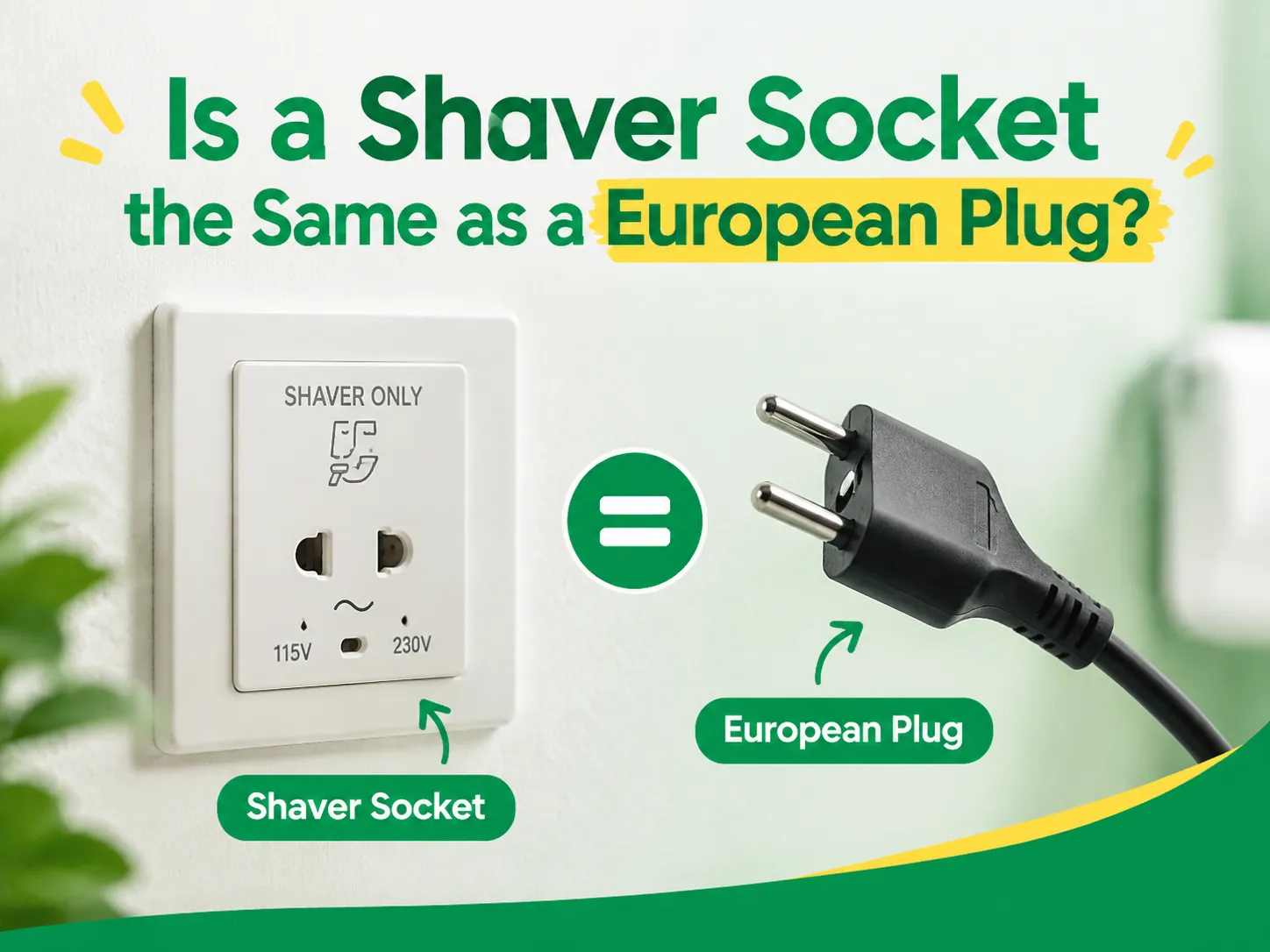
Ez a benyomás teljesen indokolt, mivel a két dugó egy közös őstől származik, és közös megjelenéssel rendelkezik. A brit borotválkozó dugó két kerek tűvel rendelkező dugó, amely fedetlen és kicsi. Az Europlug is egy két kerek tűvel rendelkező dugó, amely fedetlen és kicsi. Első pillantásra úgy tűnik, hogy ugyanazok.
Valójában három helyzetben inkompatibilisek. Először is, a tűméreteik különböznek, ezért a borotválkozó dugó nem illeszthető az Europlug aljzatba. Másodszor, a tűk távolsága eltérő, így még ha az átmérőjük azonos is lenne, a brit tervezésű borotválkozó dugó nem illeszkedne az Europlug aljzatba. Harmadszor, mivel a brit borotválkozó aljzat szigetelt transzformátorral rendelkezik, eltérő elektromos jellemzőkkel bír, mint az Europlug aljzat.
Egy pontosítást kell tenni: vannak olyan borotválkozó aljzatok, amelyek hosszabb érintkezőkkel rendelkeznek, amelyeket kifejezetten mindkét dugó típus használatára fejlesztettek ki. Sok multifunkcionális borotválkozó rendszer különböző típusú dugókkal működik, mint például az amerikai A típusú és az ausztrál kétpines dugó is. Tehát ha a szabványokról beszélünk, az a megállapítás, hogy a dugók nem kompatibilisek, és hogy a dugó nem illeszkedik az aljzatba, igaz, míg a valóságban léteznek speciális aljzatok, amelyek lehetővé teszik, hogy ne tapasztaljunk ilyen félreértést.
A brit borotválkozó dugót és aljzatot a BS 4573 határozza meg, amelyet először 1970-ben publikáltak. A dugónak két kerek érintkezője van, amelyek átmérője 5,1 mm, amit gyakran 0,2 hüvelyknek is neveznek. Az érintkezők közötti távolság 16,7 mm, ami körülbelül öt nyolcad. Az aljzat 200 mA-ra van korlátozva és minősítve. Bár a BS 4573 nem határoz meg minősítést a dugóra, az alkalmazandó IEC ütemezés 0,2 A-t rendel hozzá.
A dizájn öröklődött, nem pedig feltalálták. Az érintkezők méretei megfelelnek az 1930-ban bevezetett, elavult BS 372-es 5 A kétpines dugó dizájnjának. Az egyetlen funkcionális különbség a modern borotválkozó és ősének között az új verzió érintkezőin található szigetelt hüvelyek jelenléte, valamint egy másik kábelrögzítő dizájn, amely lehetővé teszi, hogy a kábel felülről, ne pedig oldalról lépjen be az aljzatba.
Ami megkülönbözteti a borotválkozó aljzatot bármely más aljzattól, az nem az érintkezők elrendezése, hanem inkább az, ami magában az aljzatban található. A borotválkozó tápegység szigetelő transzformátort alkalmaz, ami magyarázza, hogy miért biztonságos ilyen aljzatot használni olyan helyeken, ahol minden más aljzat tilos. A szigetelő transzformátor fontos funkciója, hogy elválasztja a borotválkozó áramkört a földtől, ami azt jelenti, hogy a készülék meghibásodása nem okoz problémát a felhasználónak. Az egység emellett korlátozza az elektromos áramot: az IEC 61558-2-5 szerint az egységnek minimum 20 VA, maximum 50 VA teljesítménnyel kell rendelkeznie.
A fenti tények meghatározzák a dizájnból származó három gyakorlati jellemzőt. A teljesítmény kimenete alacsony, így a borotválkozó aljzat használata nem teszi lehetővé hajszárító működtetését, függetlenül az adapterek használatától. Az egység borotválkozó jelzéssel van ellátva az IEC 60417-5225 szerint, és néha még a “csak borotvák” felirat is szerepel rajta, bár az utóbbi nem kötelező. A dizájn általában két aljzatot tartalmaz, amelyek normálisan 230 V és 115 V feszültséget biztosítanak, lehetővé téve ezzel az észak-amerikai látogatók számára, hogy feszültségátalakítók nélkül használják készülékeiket.
Az elektromos áram korlátozása miatt az aljzat biztonságos a tervezett használatra: elektromos borotvák vagy elektromos fogkefék csatlakoztatására mosdókagyló mellett. Az Egyesült Királyság elektromos fogkefái is BS 4573 dugóval rendelkeznek, így bizonyítva, hogy mindkét készülék ugyanannak a szabványnak van alávetve. Borotválkozó adapter esetén a borotválkozó aljzat helyett a BS 1363-3 megköveteli, hogy 1 A biztosítékkal, biztonsági redőnyökkel, szigetelt érintkezőhüvelyekkel és “CSAK BOROTVÁK” felirattal rendelkezzen.
A vezetékes eszközök szélesebb családja, és hogy egy ilyen speciális aljzat hogyan illeszkedik a gyakoribb típusok közé, áttekintésre kerül a különböző típusú elektromos kapcsolók és eszközök.
A Europlug, amelyet C típusúként és CEE 7/16-ként is ismernek, egy lapos dugó, amely két tűvel rendelkezik, és különösen a II. osztályú berendezésekhez használják Európa-szerte. A Europlug fő különbsége a többi dugóhoz képest az szigetelésében rejlik, nem pedig fizikai jellemzőiben. Mivel a dugó nem földelt, bármely európai aljzatban használható, feltéve, hogy szigetelt tűkkel rendelkezik. A dugó felépítése lehetetlenné teszi, hogy a felhasználó élő alkatrészekhez érjen, miközben a dugót különböző kialakítású aljzatokban használja.
A Europlug tűinek mérete 4 mm a csökkentett távolsággal. Kezdetben a tűk közötti távolság körülbelül 18,6 mm, és a tűk végénél 17,5 mm-nél rövidebbé válik. Ezt szándékosan így alakították ki, mivel a tűk kissé ferde kialakításúak, ami lehetővé teszi, hogy érintsék a 4,8 mm-es méretű aljzatokhoz készült érintkezőket, így lehetővé téve a Europlug használatát a francia vagy belga aljzatokban.
A Europlug 2,5 A és 250 V jelöléssel rendelkezhet. Az alacsony érték azonban a Europlug lámpákban, töltőkben és elektronikában való használatának köszönhető, nem pedig az aljzatok korlátozásának. Bármely európai aljzat képes kezelni akár 16 A-t is, köszönhetően az elektromos telepítésben biztosított védelemnek.
Fontos megkülönböztetni a Europlugot egy másik típusú Euro dugótól, a CEE 7/17-től vagy kontúrdugótól, amelynek 4,8 mm-es kerek tűi vannak a kerek test belsejében, és széles körben használják nagyobb teljesítményű berendezésekhez. Bár a fényképeken hasonlónak tűnnek, a CEE 7/17 dugó nem illeszkedik a Europlug aljzatokba.
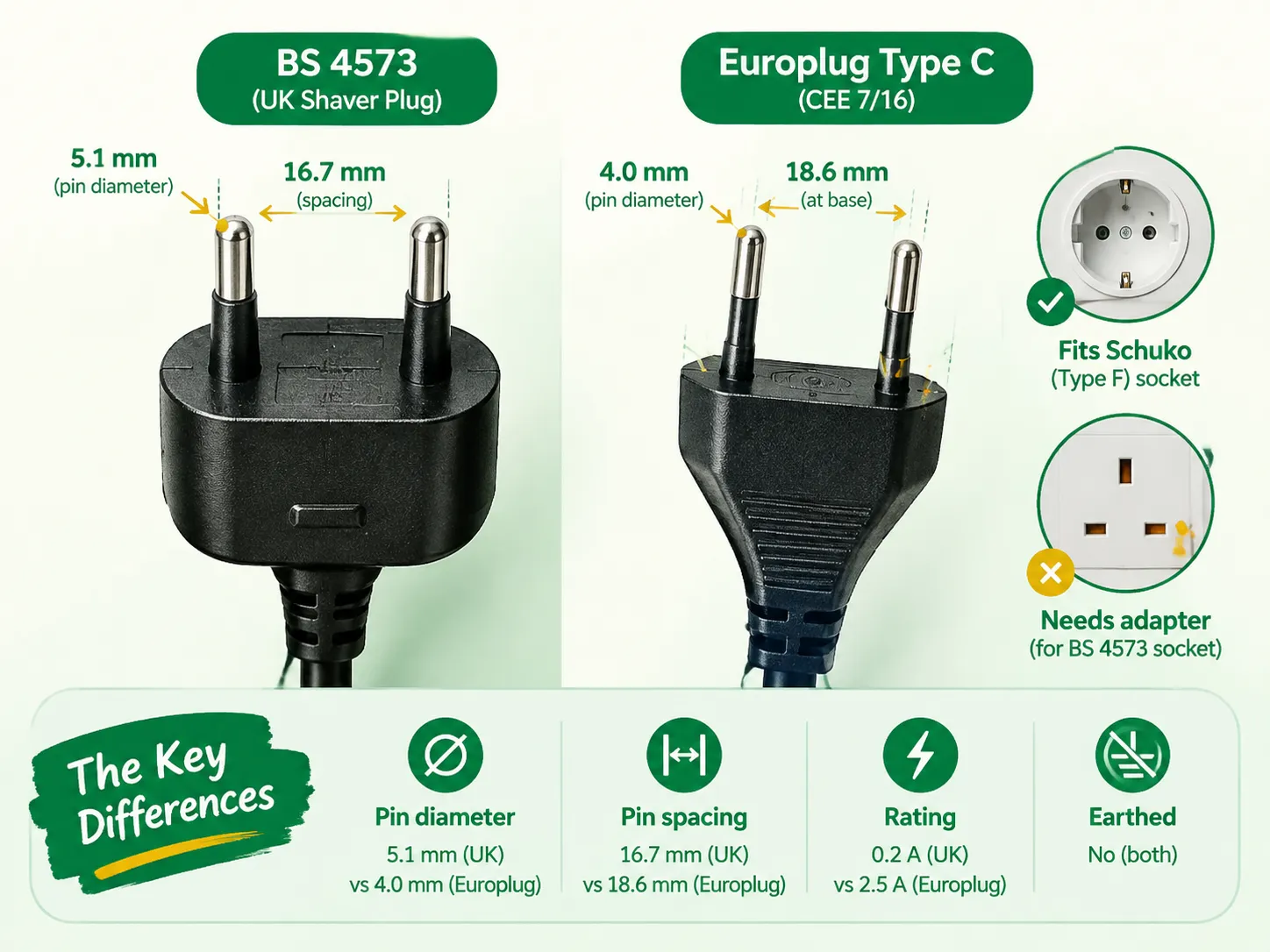
| Paraméter | BS 4573 borotválkozó dugó (UK) | Europlug C típus (CEE 7/16) |
|---|---|---|
| Tű átmérő | 5,1 mm (0,2 in) | 4,0 mm |
| Tű távolság | 16,7 mm (5/8 in), párhuzamos | 18,6 mm az alján, a tűk végénél 17,5 mm-re szűkül |
| Tű elrendezés | Párhuzamos, szigetelt hüvelyek | Enyhén konvergáló, valamennyire rugalmas |
| Névleges érték | 0,2 A az alkalmazandó IEC ütemezés szerint | 2,5 A |
| Földelt | Nem | Nem |
| Eredet | Az elavult BS 372 I. rész 5 A dugóból származik (1930) | II. osztályú készülékekhez fejlesztették ki a kontinentális Európában |
| Illeszkedik egy Schuko (F típusú) aljzathoz | Nem — adapter szükséges | Igen |
| Illeszkedik egy BS 4573 aljzathoz | Igen | Csak hosszúkás érintkezőkkel rendelkező aljzatokban; egyébként adapter szükséges |
The two pieces of information to keep in mind are 5.1- and 4.0-mm diameter and 16.7- and 18.6-mm spacing. This also means that the 5.1-mm pin is too thick for a connector designed for 4 mm and that the 16.7 mm distance is too small for a connector having the contacts at 18.6 mm apart at the inlet.
This is where the two diverge most sharply, and it explains why they exist as separate standards rather than as variants of one.
| UK shaver socket | Európai fali aljzat | |
|---|---|---|
| Isolating transformer | Yes — the defining feature | Nem |
| Current limit | 200 mA | Typically 16 A, limited by circuit protection |
| Power rating | 20-50 VA per IEC/EN 61558-2-5 | Up to 3,680 W at 230 V and 16 A |
| Outputs | Usually 230 V and 115 V | 230 V single phase |
| Permitted in a bathroom | Yes — the only socket type allowed | Generally restricted; regulation varies by country |
| What it can run | Shaver, electric toothbrush, low-power charger | Any appliance up to the circuit rating |
| Why it exists | To make a socket safe in a wet location | To supply general-purpose power |
The effect of the transformer must be clearly outlined: shaver sockets are not power sockets because they have a low power rating, but because the isolation that makes them safe means that they cannot pass much power. Trying to draw more than their rating will not damage the system but it will stop working instead, and quite often a safety device will operate.
Another effect is that a shaver socket cannot act as a replacement of an ordinary socket in the bathroom. The shaver is assigned a particular function just like that, and installation of a general-purpose socket there is a different matter altogether.Where a project needs a socket with modern charging capability as well as compliant safety, the options are a separate discussion, and the features and ratings involved are covered in our article on USB fali aljzatok és gyors töltés.
The geographical span indicates most of the practical confusion.
BS 4573 shaver sockets can be found in Great Britain and Ireland and are used in bathrooms in peoples’ homes and hotels around the world.In several locations in Asia, the Middle East and Africa, several hotels use the shaver socket in combination with various other types of sockets to cater to the various types of traveling guests including the guests traveling with their shavers. The fact of the matter is that shaver sockets are nowadays widely used in many countries because of the high demand for their use together with other types of sockets even though BS 4573 standard is officially British.
Europlugs are available in a large number of countries in Europe that adopted the European socket standards, including Germany, Italy, France, Spain, Greece and others. Europlug is used mainly for low-power devices to be connected to the wall socket of Type F or E.
However, that is where the conflict comes from. As a British traveler comes to Spain, they discover that the socket there accepts a different type of plug. As a Europlug traveler comes to the UK, they also find out that their device cannot be plugged into the socket in the bathroom.
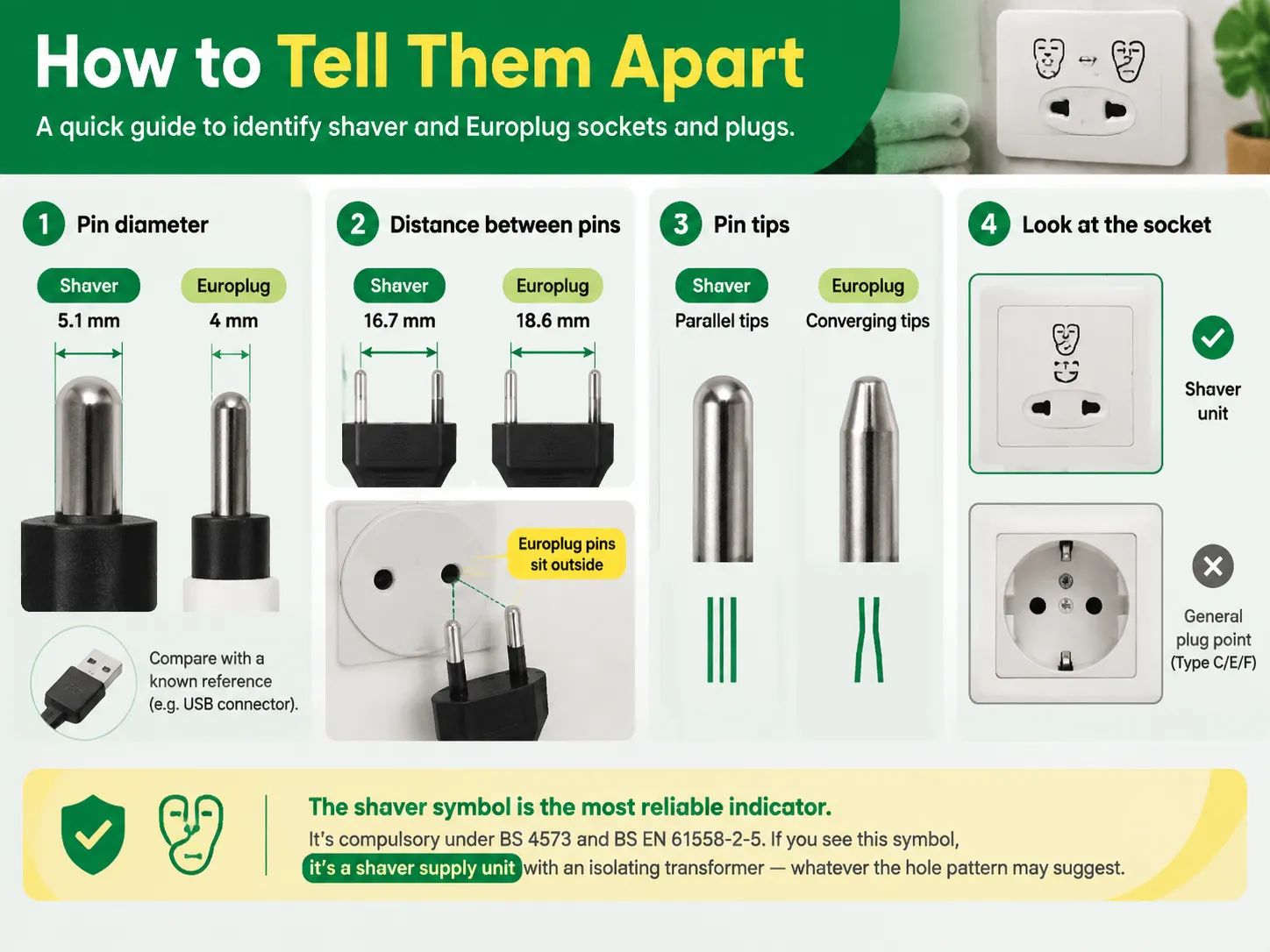
A plug or socket can easily be identified by four simple checks, and only the first one requires a little bit of effort.
The shaver symbol is the single most reliable indicator on a socket, because it is compulsory under both BS 4573 and BS EN 61558-2-5. A socket marked with that symbol is a shaver supply unit with an isolating transformer, whatever the physical hole pattern may suggest.
With adapters, the situation can be more complicated than with many other socket types, which is worth understanding.
A BS4573 shaver plug has its own socket type that will not match any other countries’ sockets and so needs an appropriate shaver plug adapter to work abroad. Such adapters do exist and can even accommodate a European Type C or a US Type A plug and, on rare occasions, even an Australian Type I plug. The unfortunate aspect of a shaver plug is that the large dimension of its pins as well as their distance from each other make it impossible to use it with most universal travel adapters – cheaper versions can slightly stretch to allow the plug go through, but in general, the rule is that the better-made the universal adapter is, the less likely it is to accept a British shaver plug or toothbrush plug.
For a person traveling abroad the easier solution is to buy a local electric appliance. A razor bought in Europe and from a European supplier you can be sure will have a standard Type C Europlug that allows it to be used both with local sockets and British shaver sockets, which means that no adapter is needed.
The same principle of reverse application is true for projects involving electrically driven devices. If it comes to having a shaver socket in a bathroom, this socket shall be considered a special shaver equipment that has a transforming energy device and is marked properly, and not just a regular socket with a shaver plate applied to it. The necessity of having the unit compatible with a Europlug or not is the issue of design; usually elongated contacts that allow for accepting both socket varieties shall be used.The specification detail that separates a compliant device from a lookalike is the same discipline that applies to any wiring device, and it is set out in our guide to choosing an electric switch and socket manufacturer.
Where a socket is being replaced rather than newly specified, the safe working sequence is the one used for any wiring device, covered in our article on egy világító kapcsoló cseréje.
And where the installation includes dimming or other controlled loads on the same circuit group, matching the device to the load follows the principles in our guide to dimmer kapcsoló telepítéséhez.
Not in a straightforward way. The British BS 4573 electric shaver plug features 5.1-mm pins set 16.7 mm apart, whereas in a European socket the design is with 4-mm pins approximately 18.6 mm apart, which means that the shaver plug’s pins are too thick and too close for the socket. A separate plug adapter must be used because of this. The only exception is shaver supply units with long pin contacts that are designed specifically to accept both Euro plugs and BS 4573 plugs, however this is a characteristic of type of sockets but not of the standard.
The plug needed for low power devices like chargers, lamps and small gadgets is the Europlug (Type C, CEE 7/16), designed to work with Types C, E and F sockets in the rest of Europe. However, for appliances requiring more electricity — hair dryers, travel kettles, etc. — it is necessary to use either a Schuko (Type F) plug or the French (Type E) plug, since the Euro plug can only take 2.5 A. Travellers from the UK, Ireland, USA, Canada, Australia and New Zealand must use a travel adapter, as their plugs cannot fit the European plugs directly.
It is correct; and it is the same way in the United Kingdom. In order to allow them to be charged using the bathroom shaver outlet, British electric toothbrushes are shipped with the same BS 4573 two-pin plug as electric shavers. The current limit of the outlet is 200 mA, and it has a power rating between 20 VA and 50 VA, which is enough for it to be used as a toothbrush charger, but it is the use of the isolating transformer in the system that makes it safe to use near the sink. It is typical for European electric toothbrushes to come with a Europlug that may allow the appliance to be used with a shaver socket only if this socket is fitted with the dual elongated contacts.
From a physical point of view, it is possible to cut off the two-pronged plug in order to replace it with a domestic plug. However, there are two warning to take into account. First, appliances that come with a shaver plug are made to function with the unique supply of a shaver socket. That means that if it happens to get connected to a socket of a different type, its isolation will be removed. The importance of this issue largely depends on the type of the appliance, so the manufacturer should be consulted with prior to making any modifications. Second, whatever the new plug is, it’s essential for it to conform to standards and to be fused correctly.
Due to the characteristic of being dual voltage shaver supply units that provide 230 V and 115 V outputs. The 230 V output usually includes the use of BS 4573 shaver plugs, Europlugs, and Australian plugs on occasion, while the 115 V output would use a two pin NEMA type A plug for guests who might bring their equipment with them and do not require an extra transformer. The two outputs are available because of the design of the isolating transformer that can provide one of the two required voltages, which is the reason hotels use these devices.
A shaver socket differs from a European plug in several ways, which are very likely to deceive consumers. For instance, British shaver standards accept 5.1 mm of pin dimensions with 16.7 mm distance, thus limiting electricity usage up to 200 mA due to an isolating transformer. On the contrary, the Euro plug supports different pin size that is roughly 4 mm with the distance of 18.6 mm and electricity rating of up to 2.5 A. These two aforementioned aspects (one pertaining to dimensional differences while the second concerns electrical differences) account for many issues: shaver socket cannot run a hair dryer, while European devices that were bought locally operate in British sockets while British shaver sockets cannot fit Spanish wall plugs. Thus, the next piece of advice for travelers from engineers is to purchase their devices on the territory they intend to use them.
Although they seem to be alike, they both have a round shape with two pins, and they function at a voltage of 230V. This explains why some tourists use a European plug with a British shaver or wonder why a shaver cannot be plugged into a Schuko socket in a Spanish hotel. In reality, they […]
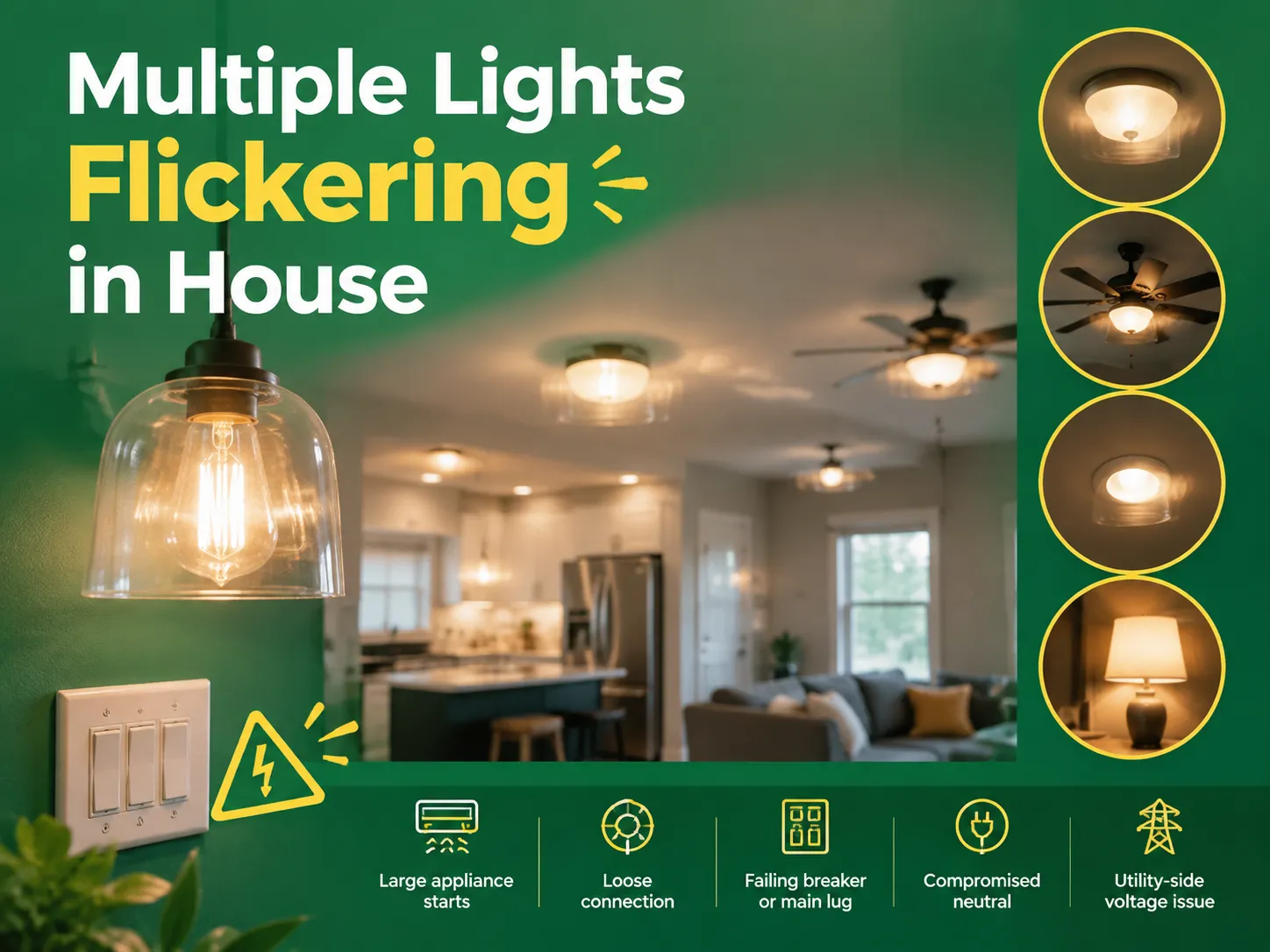
A villogó izzó helyi problémának tekinthető — az izzó elhasználódott, a világítótest rosszul csatlakozik, vagy lehet, hogy van egy olcsó fényerőszabályzója. De ha több izzó villog egyszerre, különböző helyiségekben, akkor másképp kell látnia a helyzetet. Sok villogó izzó jelez egy […]
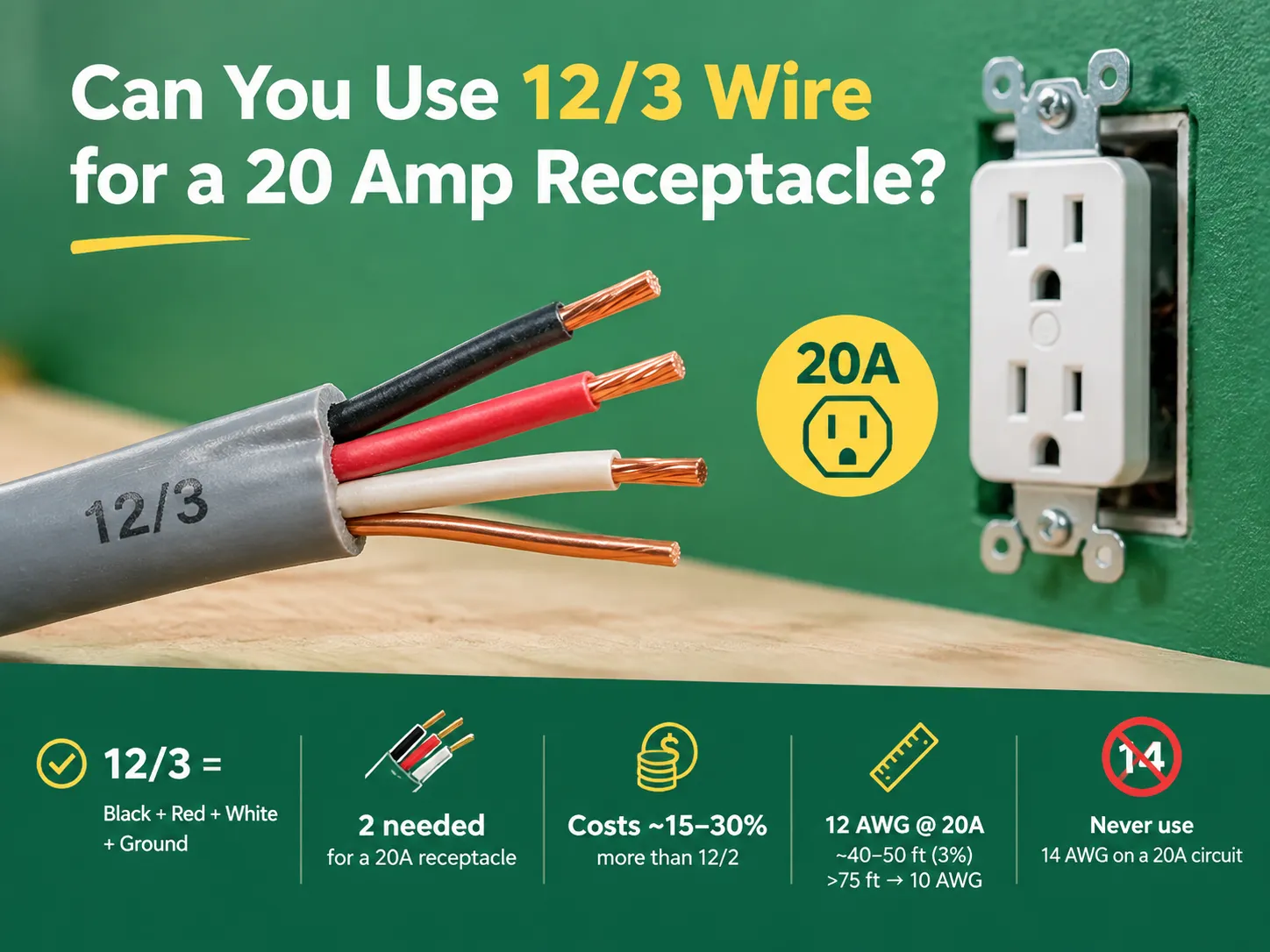
A tizenkét huzal és a húsz amperes áramkörök annyira jól illeszkednek egymáshoz, hogy a kérdések általában egy másik forrásból merülnek fel. Lehet, hogy a szerelőnek van egy darab 12/3-a, ami egy korábbi vezetékezési projektről maradt, vagy talán a beszállítónak csak 12/3 kábelei vannak raktáron. Felmerül a kérdés, hogy […]

 No.6 Tuozhan Road, Leshang Pioneer Park, Yueqingwan Bay Harbor, Yueqing város, Zhejiang tartomány


