

Il filo da dodici gauge e i circuiti da venti ampere si abbinano così bene che le domande sorgono generalmente da una fonte diversa. Può darsi che l'installatore abbia un pezzo di 12/3 avanzato da un progetto di cablaggio precedente o forse il fornitore ha solo cavi 12/3 in magazzino. La domanda sorge se la presenza di un conduttore extra abbia conseguenze per il cablaggio domestico. La risposta sembra semplice ma solleva alcune questioni di codice che influenzano l'uso dei fili, comprese le limitazioni dei conduttori piccoli nel National Electrical Code, il modo in cui il filo da dodici gauge può trasportare venti ampere prima che sorgano problemi di caduta di tensione, quali vantaggi può offrire un conduttore aggiuntivo e cosa può accadere se un conduttore risulta sottodimensionato. La seguente guida discute tutti questi aspetti così come i requisiti di installazione per le prese.
Risposta breve: Infatti, il filo di rame 12/3 è adatto per un circuito di presa da 20 A e corrisponde alla dimensione minima di filo richiesta nel National Electrical Code (NEC) menzionata nell'Articolo 240.4(D). Il “3” indica che il cavo ha tre fili isolati, cioè nero, rosso e bianco, più un filo di messa a terra nudo. Pertanto, hai bisogno solo di un filo nero e di un filo bianco in un circuito da 20 A, con il rosso lasciato inutilizzato o utilizzato in un circuito secondario. Si prevede che un filo 12/3 costi 15-30% più del 12/2, e l'altro filo influisce sui calcoli di riempimento della scatola. Per quanto riguarda la caduta di tensione, il 12 AWG funziona bene a 20 A fino a circa 40-50 piedi. Dopo circa 75 piedi, la caduta di tensione supererà 3% specificato dal NEC per i circuiti, e dovrebbe essere utilizzato il 10 AWG.
Il metodo di denominazione dei cavi elettrici è semplice poiché richiede solo due cifre, entrambe significative.
La prima cifra indica il calibro del filo utilizzando il Sistema Americano di Calibro dei Fili. Ad esempio; un calibro di filo di 12 AWG è un filo di rame largo 2,05 mm. La seconda cifra indica quanti conduttori ci sono nel filo. Nell'esempio del nome del filo 12/3 significa che ci sono tre conduttori isolati in totale. Nel caso del cavo 12/3 NM-B i tre conduttori sono nero, rosso e bianco isolati. C'è anche il quarto filo che è il filo nudo.
Pertanto, 12/3 non è un prodotto unico; piuttosto rappresenta un semplice cavo di dodici gauge. Quindi il tipo di cavo di 12/2 nel suo significato e nelle sue qualità. In America i colori dei cavi determinano il loro ruolo; i cavi neri e rossi sono i cavi sotto pressione elettrica, il cavo bianco è il cavo che non trasmette corrente, mentre quello nudo è utilizzato per collegare tutti i dispositivi in un circuito richiesto. Le convenzioni che si applicano ai dispositivi che questi conduttori alimentano sono trattate nella nostra panoramica di diversi tipi di interruttori utilizzati nelle installazioni elettriche, e la stessa logica si applica al cablaggio delle prese.
Nella situazione di creare il circuito per un dispositivo elettrico standard da 20 A deve esserci un cavo attivo, un cavo neutro e il cavo di terra efficace nudo. Pertanto, può essere applicato un cavo 12/2 e il quarto non è affatto necessario; tuttavia, sorge la domanda se il cavo in eccesso possa influenzare il funzionamento del cavo.

Le linee guida sono concise e chiare.
Limitazioni di sovracorrente per piccoli conduttori. L'articolo 240.4(D) del National Electric Code (NEC) limita la protezione da sovracorrente per piccoli conduttori, limitando l'uso di 14 AWG a 15 ampere, 12 AWG a 20 ampere e 10 AWG a 30 ampere. Pertanto, a causa della limitata capacità di dissipare calore durante le sue operazioni, 12 AWG diventa il cavo raccomandato per circuiti da 20 A mentre 14 AWG non può svolgere questo ruolo, anche se è praticamente in grado di farlo.
Ampacità. Quando si considera l'ampacità, è fondamentale considerare il tipo di conduttore così come la classificazione della temperatura dell'isolamento e le condizioni di installazione. Per quanto riguarda il rame 12 AWG, si può fare affidamento sul valore di 20 A specificato in associazione con 60°C e sul valore di 25 A associato a 75°C. Il cavo NM-B è comunemente considerato in riferimento alla classificazione di 60°C, il che significa che 20 A è esattamente il valore necessario, senza alcun margine di sicurezza extra. Tuttavia, se la temperatura ambiente è troppo alta o i conduttori sono raggruppati, la riduzione inizierà a influenzare l'ampacità pratica.
Conduttori non in uso. Nulla vieta l'utilizzo di conduttori non utilizzati. L'unico requisito è che tali conduttori siano terminati in modo sicuro, evitando cortocircuiti.
Riempimento della scatola. In termini di riempimento della scatola, qui è dove la necessità di un conduttore extra può effettivamente comportare alcuni costi. Secondo l'articolo 314.16 del National Electric Code (NEC), deve essere considerata la somma di tutti i conduttori. Quando si incorpora un quarto conduttore isolato in un cavo, è necessario verificare che la scatola possa accoglierlo.
Un conduttore che non è in uso può essere utilizzato bene se pianificato con attenzione, come spiegato qui sotto.
| Opzione | Come funziona | Requisiti e avvertenze |
|---|---|---|
| Termina e lascialo | Termina il conduttore rosso con un connettore a entrambe le estremità e contrassegnalo come non utilizzato | Completamente conforme; conteggialo per il riempimento della scatola; lascialo abbastanza lungo da identificarlo in seguito |
| Circuito di derivazione multiwire | Nero e rosso forniscono due circuiti separati che condividono il singolo neutro bianco | Richiede i due conduttori non messi a terra su fasi opposte e la disconnessione simultanea di tutti i conduttori al pannello, tipicamente tramite un interruttore a due poli o un collegamento approvato; le disposizioni GFCI e AFCI necessitano di attenzione |
| Due prese, un cavo | Alimenta la prima presa sul nero, collegala in serie a una seconda posizione sul rosso, o dividi una presa duplex | Consentito dove la scatola e la valutazione del dispositivo lo permettono; una duplex divisa richiede un tab di rottura e, in alcune configurazioni, un interruttore a due poli |
| Commutazione a tre vie o multi-luogo | Usa il nero e il rosso come conduttori viaggiatori tra gli interruttori | Un uso legittimo del 12/3, anche se il circuito è un circuito di illuminazione piuttosto che un circuito di presa |
| Circuito a 240 V | Nero e rosso come i due conduttori non messi a terra, terra per sicurezza, bianco cappucciato | Non può servire una presa standard a 120 V; necessita di un dispositivo a 240 V o di un carico a 240 V |
Esaminiamo da vicino il circuito multi-filo perché è la ragione dietro l'acquisto del cavo 12/3. È un errore molto tipico, quindi vale la pena considerarlo con attenzione. Quando due circuiti condividono lo stesso filo neutro, la corrente attraverso quel filo equalizza i due circuiti invece di sommarli, il che funziona solo quando i fili provengono da due fasi diverse. È importante fare questo correttamente perché altrimenti il filo neutro dovrà trasportare la corrente totale di entrambi i circuiti, quindi la legge richiede che in tali casi il circuito venga disconnesso dall'alimentazione immediatamente, e l'uso di un interruttore a due poli è la prassi comune in tali casi. Nel caso in cui il circuito multi-filo fornisca energia a apparecchiature che dovrebbero fare affidamento su interruttori GFCI, diventa molto più complesso e infatti, molti elettricisti scelgono di non utilizzare quel tipo di circuito in cucine e bagni.
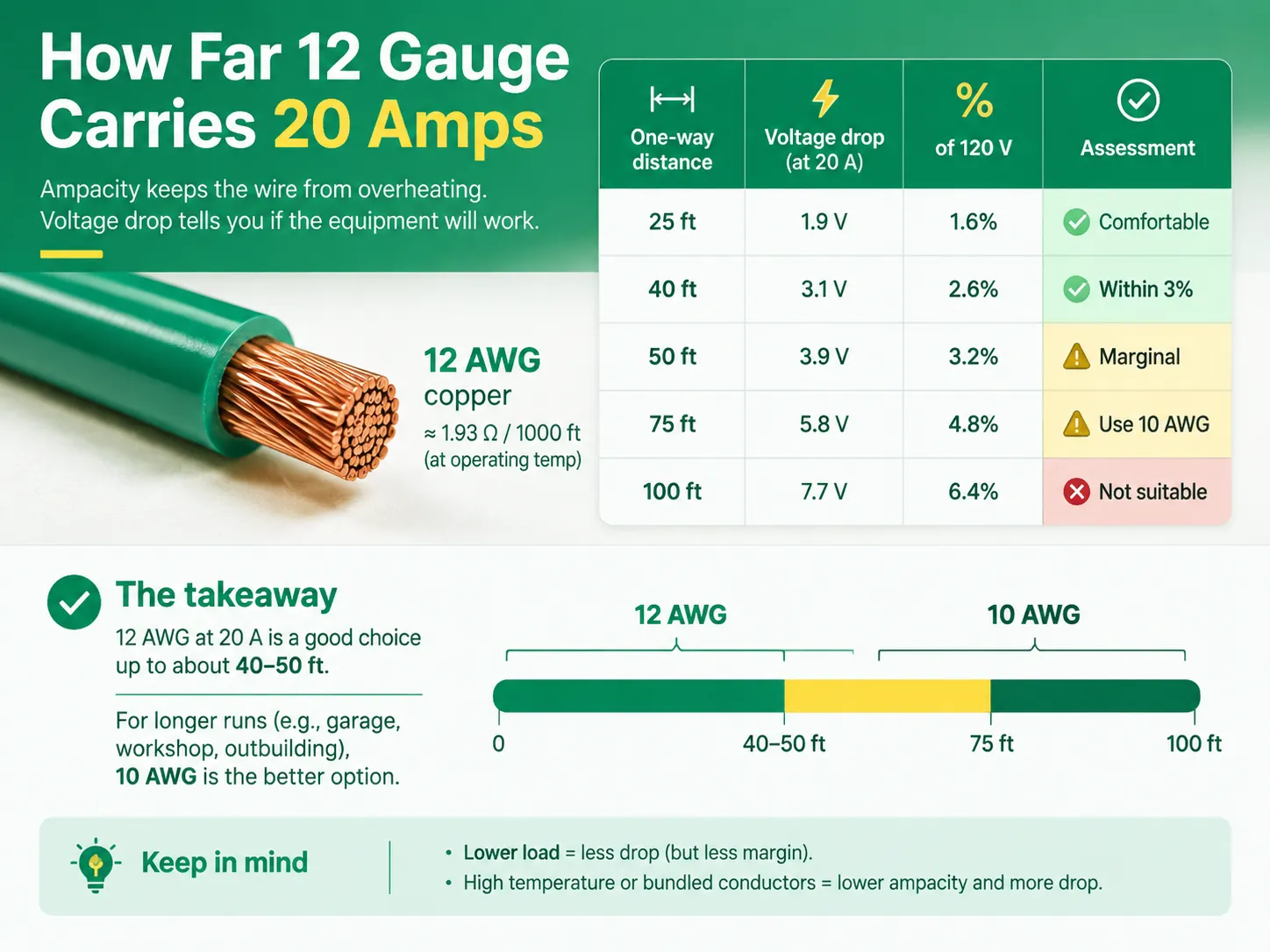
L'ampacità indica se il filo si surriscalderà, mentre la caduta di tensione determina se l'apparecchiatura all'altra estremità funziona correttamente.
Secondo il NEC, la caduta di tensione in un circuito di derivazione non dovrebbe superare 3%, mentre la caduta di tensione totale dal punto di servizio al punto di utilizzo non dovrebbe superare 5%. Il NEC quindi consente alcune variazioni da questi valori nel codice residenziale, ma essi esistono comunque.
La ragione dei valori sopra è che le apparecchiature si comportano male a causa di tensioni basse. A tensioni basse, i motori funzionano a temperature elevate, l'elettronica si resetta e i carichi resistivi non funzionano come previsto.
The twelfth gauge copper wire has a resistance of about 1.93 ohms per 1,000 feet at the operating temperature. In 120 volts circuit, the total voltage drop when carrying 20 amps is calculated as presented below.
| One-way distance | Approximate voltage drop at 20 A | Percentage of 120 V | Assessment |
|---|---|---|---|
| 25 ft | 1.9 V | 1.6% | Comfortable |
| 40 ft | 3.1 V | 2.6% | Within the 3% recommendation |
| 50 ft | 3.9 V | 3.2% | Marginally over the recommendation |
| 75 ft | 5.8 V | 4.8% | Too much; step up to 10 AWG |
| 100 ft | 7.7 V | 6.4% | Clearly unsuitable |
On a practical note, 12 AWG cables can handle up to approximately 40-50 feet and 10 AWG is suitable for lengths of about 75 feet or above. Since residential circuits have many receptacles that fall within this distance, the combination is considered standard. Distances in cases of circuits connected to the detached garage or some other outbuilding have to be calculated.
There are two factors involved in the decline in number. The first is that in a circuit that rarely draws the full 20 amps, there is less drop. However, designing on this assumption does not give you any margin for any errors. The other factor involves derating the conductors and the drop that is caused due to the wire’s background temperature or if the envelope has too many wires inside.
Failing in a known way, undersized conductors in a 20 A circuit help bring about the code’s strict insistence on 14 AWG wire.
The popular mistake is to install a bigger fuse to avoid nuisance tripping. However, it can be dangerous because in case of using 12 SWG wire with 20 A circuit connected to a circuit with 30 A fuse, wire will be able to heat up, and it will happen without activating the circuit breaker.
| Cavo | Use it for a 20 A receptacle circuit? | When to choose it |
|---|---|---|
| 14/2 | NO | 15 A circuits only; prohibited on a 20 A circuit by NEC 240.4(D) |
| 12/2 | Yes — the standard choice | Ordinary 20 A receptacle circuits; cheaper, easier to pull, less box fill |
| 12/3 | SÌ | When you need a second ungrounded conductor: multiwire branch circuits, 240 V loads, or traveller conductors |
| 10/2 | Yes — oversized | Long runs where voltage drop exceeds 3%, or high-temperature derating |
| 10/3 | Yes — oversized | 240 V circuits at long distance, or 30 A circuits |
A basic 20 A receptacle circuit likely calls for a 12/2 wire size. While you could use 12/3, this is actually unnecessary since normally there is no use made of the third conductor. If you have some 12/3 leftover, using it does not increase costs in principle apart from some additional box fill and some extra labor to run it through the framing.
When it comes to working with 12 AWG wire, note that the wire is generally stiffer than 14 AWG, as well as it bends more stiffly, leading to the complication of the installation.
The sequence below assumes a conventional daisy-chained receptacle circuit with the cable used in 12/2 fashion. Safe isolation and verification come before anything else, and the general technique — including how to identify conductors when colours are unconventional — is covered in our guide to replacing a light switch, which follows the same discipline.
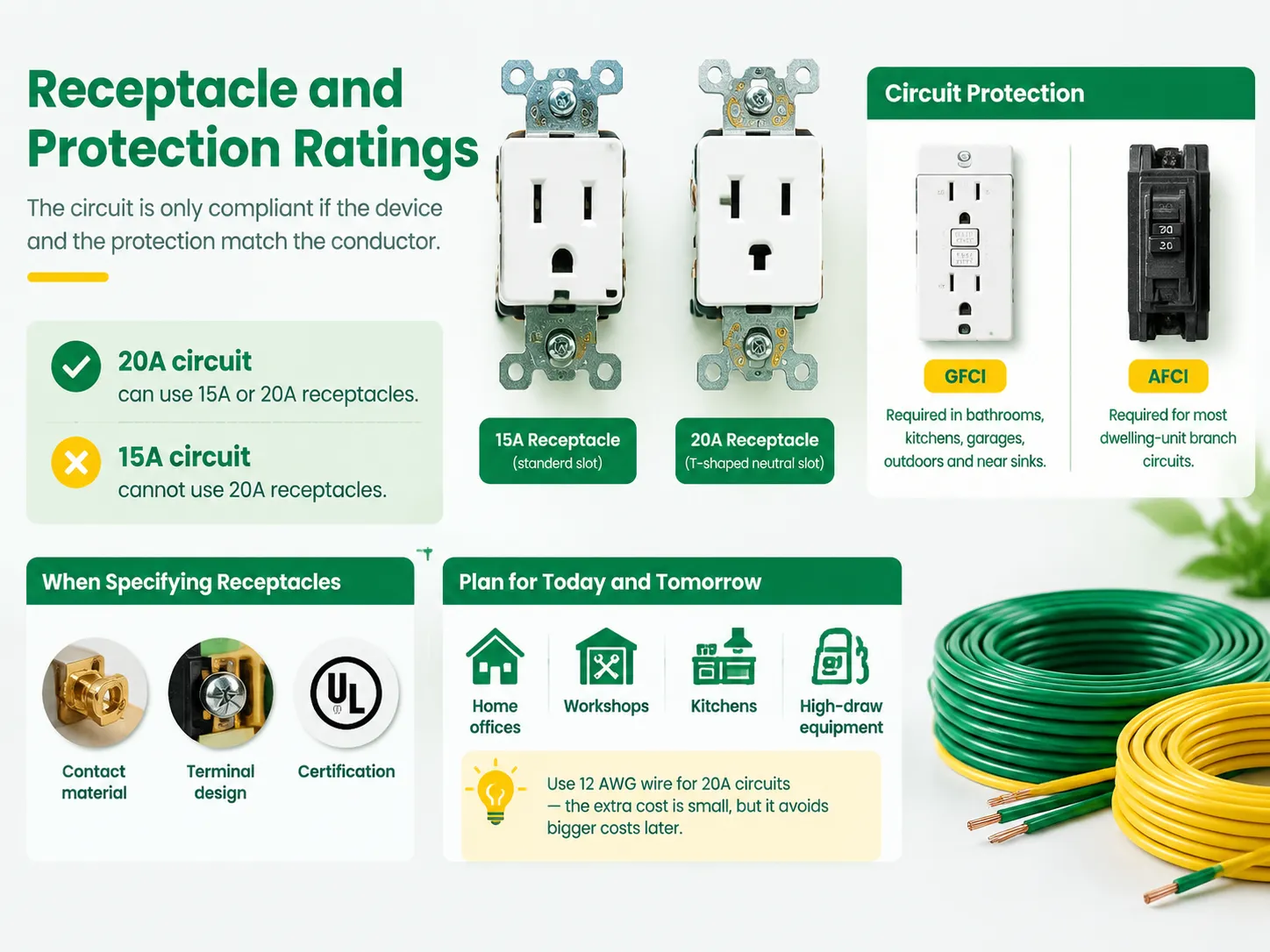
The circuit is only compliant if the gadget and the protection coincide with the conductor.
Receptacle Capacity. A 20 A circuit may have a 15 A receptacle in use. This may surprise some people, but 15 A receptacle is fit for transferring 20 A through to devices relying on it, hence, making it admissible for a 20 A circuit. Conversely, a 20 A receptacle should not be mounted on a 15 A circuit as the latter is not able to provide the power of the device. As to the majority of households, the difference will be seen in face style, which is the way the receptacle looks and in a certain quality of the device, which is better in most cases.
Where receptacles are being specified for a project rather than replaced one at a time, the selection criteria extend to contact material, terminal design, and certification — the same discipline set out in our guide to choosing an electric switch and socket manufacturer.
Capacity is the other half of that decision. Modern receptacle circuits increasingly support more than lamps and vacuum cleaners, and the load profile of the devices plugged into them is changing, as discussed in our article on prese a muro USB e ricarica rapida. Planning the circuit for that reality costs nothing at the wiring stage and a great deal later.
A representative example of how a modern device in this family is documented is our FS328-V dimmer specification, which is the level of detail a specifier should expect before committing a circuit to a device.
One final note for people who install a 20 A circuit: 20 A circuits are being used more often for home offices, workshops, kitchens, or any other location that has a lot of powerful appliances. The cost of using 14 AWG or 12 AWG wire is not much different when considering the cost of opening up a wall later, therefore it might be best to use twelve gauge.
Absolutely. Twelve-gauge copper is a universal wire for any typical 20 A circuit due to it (Secretary Committee (erroneous text: “due to its”), National Electric Code or NEC) being the lowest size acceptable by NEC under the rules for small conductors provided in Article 240.4(D). Standard wire assembly for a 20 A company is a 20 A receptacle using 12 AWG wire and protected with a 20 A breaker. The only requirement is the circuit protection shall follow the convention and must be calibrated at 20 A. This means one cannot install 12 AWG wire and substitute a 30 A breaker for a standard company operation since such actions would disable the protection provided to the wire.
In practice, twelve-gauge copper is the generally accepted wiring solution as well. An alternative solution for 20 A circuits would be ten gauge wire; however, this is only necessary for runs of wire longer than 75 feet where the voltage drop is nonnegligible, or if wire is exposed to high temperature or tightly bundled with other conductors. Fourteen-gauge wire cannot be used in 20 A circuits since according to Article 240.4(D) fourteen AWG wire only limits the performance at 15 A.
When it comes to 20 A current conduction capacity (ampacity), the answer is yes – conducted current is mainly limited by voltage drop rather than the distance. With regard to 20 A of conducted current, 12 AWG copper wires have nearly 3.9 V drop at 50 ft run length and nearly 5.8 V drop at 75 ft run. Therefore, the voltage drop ratio at 20 A of current conduction is approximately 3.2% and 4.8% respectively which allows for the distance of up to 40-50 ft for a 20 A current conduction along 12 AWG wire without any significant voltage drop. In case of longer wire runs it would be better to use ten AWG wire.
Yes, it is possible to install 12/3 wire to a socket as it does not contradict any regulations. One need only close the red wire to both ends in order to utilize it exactly the same way as it is done for 12/2 wires. Another alternative could be a multiwire circuit installation powered by 12/3 cable.
The installation will be highly unsafe, as well as not compliant with any wiring regulations. The thing is that under normal conditions nobody can use fourteen gauge wire for conduction of more than 15 A since Article 240.4(D) of the (wrong phrase: “the”) National Electric Code says that fourteen AWG wire is limited to 15 A. This is why current load will overheat the wire making it unfit for the installation.
For a circuit with a receptacle of 20 A that is made with twelve-three wire, it is permissible as well as reasonable and does not compromise whatsoever. Twelve AWG is the least that the code allows for a 20 A outlet and the extra insulated wire may or may not be used, and compliant capping can be done in two minutes. The important part of making the circuit safe is everything that surrounds the cable: a 20 A circuit being protected with a 20 A circuit breaker, wall socket that corresponds to output rating, GFCI or AFCI protection that is mandated by location, correctly torqued terminations, and run that is short enough for impedance to stay below three percent. If all the above is above board, then the question of whether to use 12/2 or 12/3 depends on convenience and cost rather than compliance.
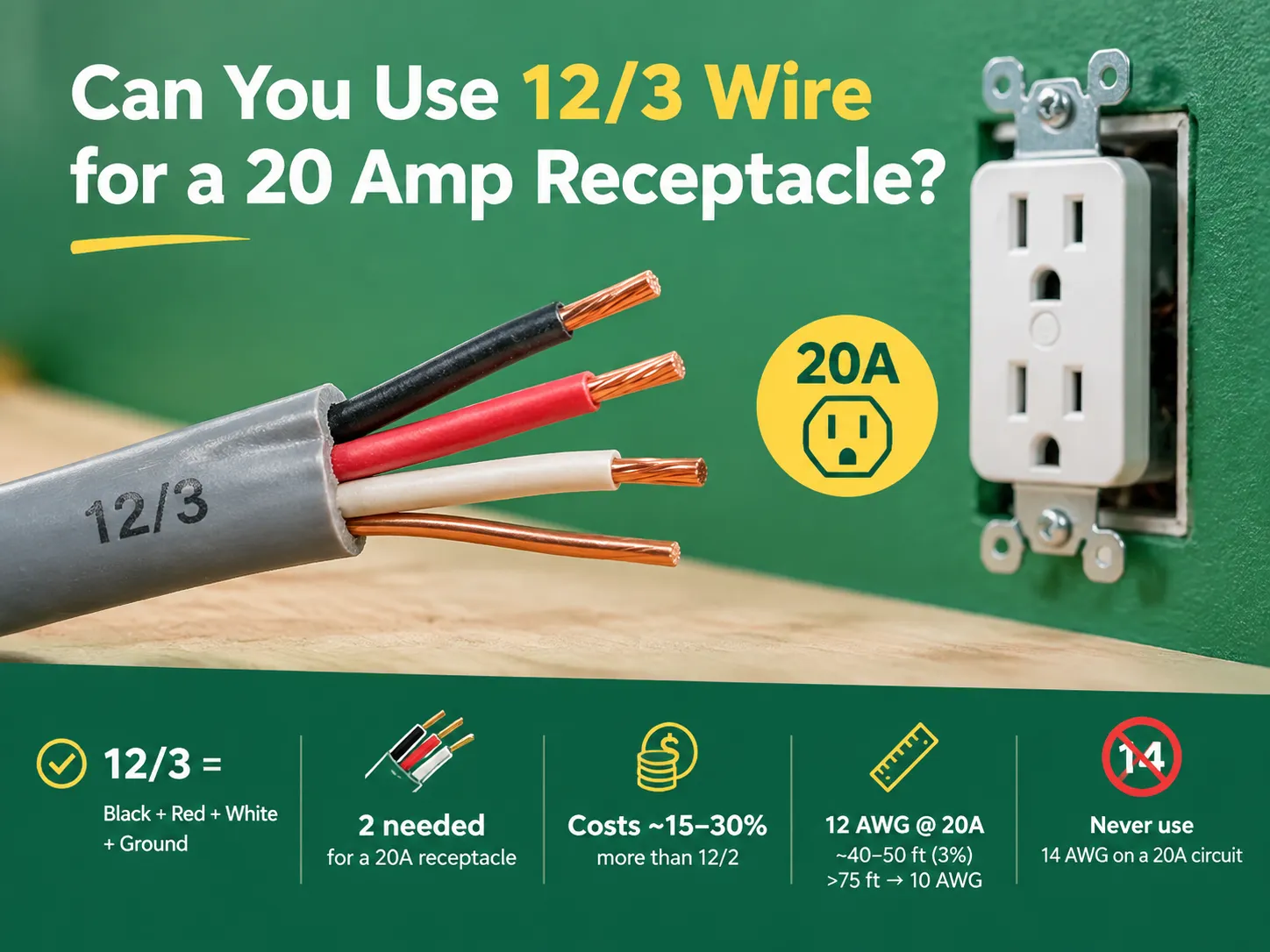
Twelve-gauge wire and twenty-amp circuits go together so well that the questions generally arise from a different source. It may be the case that the installer has a piece of 12/3 left over from an earlier wiring project or perhaps the supplier only has 12/3 cables in stock. The question comes up as to whether […]

L'eccezionale situazione presente nel settore degli apparecchi elettrici di Dubai, che combina apparecchi conformi agli standard britannici con regolamenti di un'utility e un'agenzia nazionale che sovrintende all'attuazione delle normative nazionali, richiede che gli apparecchi siano in grado di resistere alle alte temperature e all'umidità che si verificano nella regione a causa della sua posizione costiera, e anche […]

“Quanti punti di alimentazione sono consentiti su un circuito da 20 ampere?” è una delle domande più popolari che le persone si pongono quando si tratta di fare lavori elettrici a casa. Sfortunatamente, è anche una delle domande a cui è stata data la risposta più errata; la maggior parte delle persone fornirebbe un numero basato su opinioni personali piuttosto […]

 No.6 Tuozhan Road, Leshang Pioneer Park, porto della baia di Yueqingwan, città di Yueqing, provincia di Zhejiang


