

Una lampadina che lampeggia può essere interpretata come un problema locale: la lampadina è usurata, l'apparecchio di illuminazione è collegato male, oppure potrebbe essere che hai un dimmer economico. Ma se ci sono più lampadine che lampeggiano simultaneamente, in stanze diverse, devi vedere la situazione in modo diverso. Molte lampadine che lampeggiano segnalano un problema a monte: una connessione elettrica comune, un circuito comune o l'alimentazione. Queste sono informazioni essenziali, perché alcuni problemi potrebbero essere risolti cambiando la lampadina, mentre altri presentano un reale pericolo e necessitano di un intervento urgente da parte della compagnia elettrica o di un elettricista autorizzato.
La risposta a questo è semplice: se le luci lampeggiano in stanze diverse contemporaneamente, è molto probabile che sia il risultato di un problema nel circuito a monte, ad esempio connessioni allentate in una o più parti del circuito, interruttore difettoso e/o morsetti, neutro interrotto o tensione irregolare sul lato della compagnia elettrica. La cosa più importante da determinare per rispondere a questa domanda è quando si verifica il lampeggiamento. Se le luci si spengono ogni volta che un grande elettrodomestico come l'aria condizionata, il frigorifero, la pompa del pozzo o l'asciugatrice inizia a funzionare, indica spesso una caduta di tensione a causa di una connessione allentata o insufficiente. Se il lampeggiamento si verifica indipendentemente dall'accensione di elettrodomestici di grandi dimensioni, si dovrebbe sospettare un danno nel filo neutro o nella linea di alimentazione, che potrebbe essere il peggior scenario possibile. Se il lampeggiamento si verifica solo in un circuito, il problema si trova in quel circuito specifico. Il lampeggiamento da solo non significa rischio di incendio, ma se il lampeggiamento si verifica insieme a odore di bruciato, ronzio, placche calde o luci lampeggianti, significa effettivamente un'emergenza: spegni tutto e chiama un elettricista/compagnia elettrica!
Il numero di apparecchi nell'analisi è il primo aspetto critico da esaminare, portando alla suddivisione dell'analisi in tre parti.
Se solo un apparecchio lampeggia, il problema è localmente confinato o all'interruttore, al driver, al componente della lampada o alla presa. Il cablaggio è a posto.
Se diversi apparecchi lampeggiano, il problema sembra trovarsi lungo il cablaggio, il che può indicare la connessione della scatola di giunzione, l'interruttore automatico o un dimmer o interruttore responsabile dell'alimentazione di diversi apparecchi.
Nel caso di luci che lampeggiano in modo intermittente attraverso diversi circuiti e stanze, il problema si trova a monte dei circuiti di diramazione nella scatola di giunzione, nella connessione principale, nel filo neutro o nel fornitore di servizi. È questo caso che presenta il maggior pericolo.
C'è un'altra dimensione che deve essere considerata oltre al numero di apparecchi che lampeggiano: se il lampeggiamento corrisponde a un certo evento nel tempo. Il lampeggiamento che avviene insieme all'accensione di determinati apparecchi suggerisce che ci sia un problema con la tensione e la generazione del carico. Il lampeggiamento che è casuale, continuo o si verifica quando nessun apparecchio è acceso suggerisce un guasto di fornitura o un guasto di connessione dei cablaggi. Il lampeggiamento che si verifica in determinati periodi della giornata e peggiora durante le ore di punta indica un carico dell'utility e un guasto della connessione termica. Stabilire queste connessioni è la parte principale della diagnosi e non richiederà molto tempo.
| Causa | Modello | Gravità | Chi lo ripara |
|---|---|---|---|
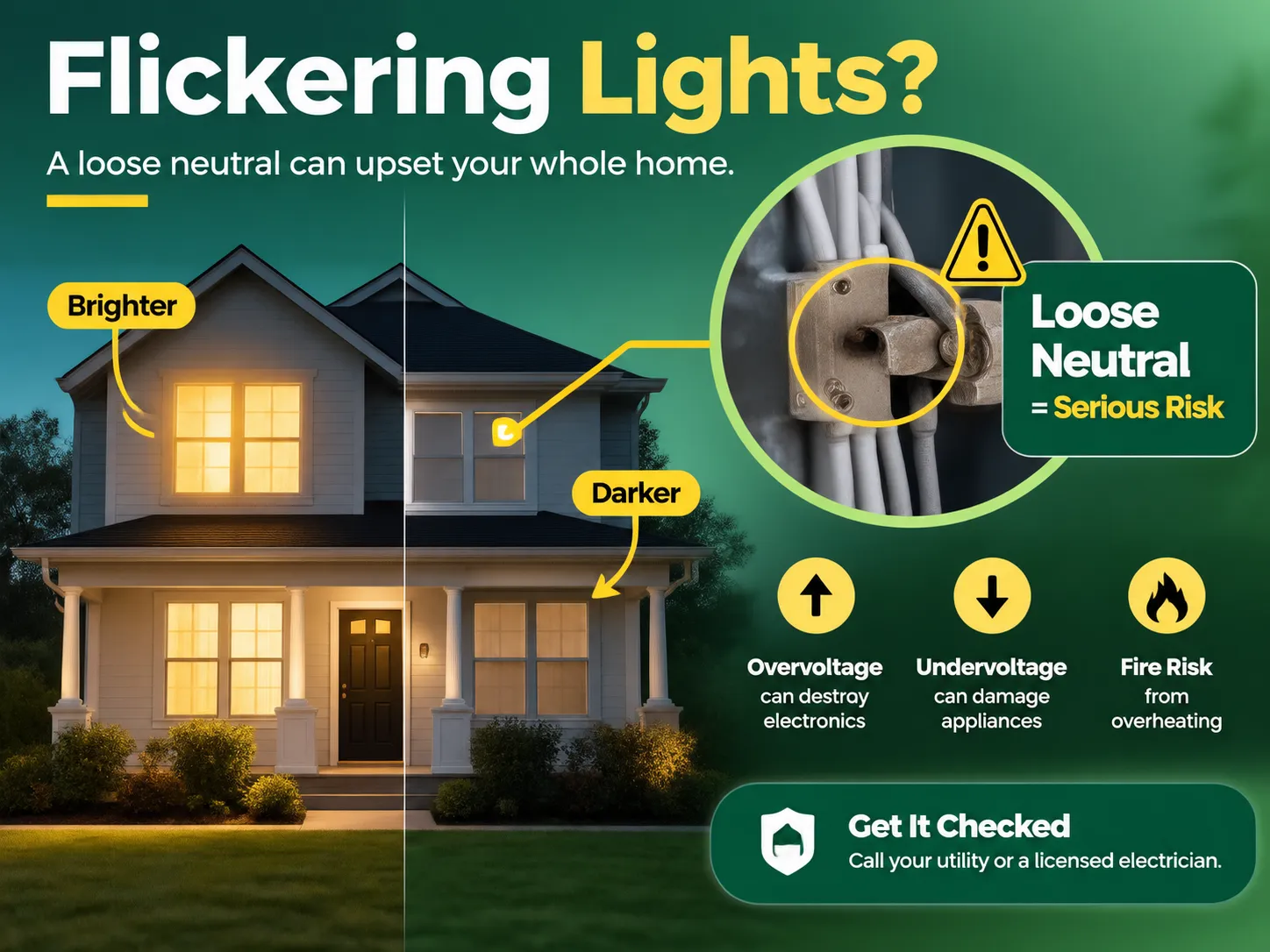
| Neutro di servizio aperto o allentato | Lampeggiamento continuo o legato al carico in tutta la casa; alcune luci brillanti mentre altre sono fioche nello stesso momento | Emergenza — rischio di sovratensione che distrugge l'attrezzatura e di incendio | Utility e elettricista autorizzato |
| Connessione allentata del morsetto principale o del interruttore principale | Lampeggiamento in tutta la casa, spesso accompagnato da ronzio o calore nel pannello | Emergenza — arco a corrente elevata | Elettricista autorizzato |
| Connessione allentata in un box di giunzione condiviso | Lampeggiamento sui circuiti alimentati attraverso quel box; potrebbe peggiorare quando gli apparecchi su quei circuiti sono in funzione | Alto — riscaldamento resistivo all'articolazione | Elettricista autorizzato |
| Interruttore automatico guasto | Lampeggiamento su un circuito; interruttore caldo, ronzio o scatti più frequentemente | Alto | Elettricista autorizzato |
| Fluttuazione della tensione dell'utility o un trasformatore di distribuzione guasto | Lampeggiamento in tutta la casa, a livello di quartiere, spesso correlato al clima o al carico | Moderato a alto, a seconda dell'entità | Utilità |
| Cablaggio sottodimensionato o caduta di tensione eccessiva su un lungo tratto | Lampeggiamento quando i carichi su quel tratto assorbono corrente | Moderato — stress dell'attrezzatura, nel tempo | Elettricista autorizzato |
| Dimmer incompatibile con lampade LED | Lampeggiamento o scintillio sul circuito dimmerato, spesso a livelli bassi; potrebbe influenzare diversi apparecchi su un dimmer | Basso — fastidio piuttosto che pericolo | Proprietario di casa o elettricista |
| Driver LED guasto o elettronica della lampada | Singolo apparecchio o un lotto dello stesso modello | Basso | Proprietario di casa |
| Neutro condiviso su un circuito di ramificazione multiwire | Flicker or equipment misbehaviour when loads on the paired circuits run | Moderate — often a wiring error | Elettricista autorizzato |
| Aluminium branch conductors with poor terminations | Flicker with load, particularly in older properties | High — known fire risk | Elettricista autorizzato |
The table gives importance to neutral connection in modern split-phase service systems. It is the neutral connection that helps stabilize 480 volts in the two hot wires. When loose or high-resistance problems occur, the reference of the neutral changes. This causes the two hot wires to become unequal in voltage. If this happens one hot wire may have a voltage above what it is supposed to carry while the other hot wire may get a voltage lower than the standard voltage. Therefore loads connected to the two wires would behave as if they are connected in series. The outcome of this phenomenon is not just mere flickering of lights; it may result in high voltage on one side of the house and low voltage on the other.
Some of this process can be done safely while some not. The instructions which appear below stop where the panel becomes loose and might pass.
The discipline of testing before touching is the same as for any electrical work, and the sequence for a fixture-level job is set out in our guide to sostituire un interruttore della luce, which covers isolation, proving dead, and safe termination.

The required repairs will depend on which layer is causing the issue.
Where a dimmer cannot be made to work with a given fitting — usually because the lamp electronics and the dimmer’s output stage are fundamentally incompatible — the alternatives are covered in our article on dimming LED lights without a dimmer switch.
A number of identical light fittings failing shows that there is a common issue with such fixtures; that is the driver electronics. The warranty can come into play here, and it is likely that replacing these fittings will be more affordable than repairing them.
Flickering lights do not necessarily represent a danger. For many years, a low-quality LED bulb connected to an incompatible dimmer will flicker without any threat to safety. The only query that one could have in such a case is if the flickering is a result of a hot joint.
A problem should be taken as a proper hazard and action should be taken if any of the following indicators appear:
What happens is that the loose connection has a higher resistance than that of copper. Therefore, when current passes through the faulty connection, it produces heat. The resulting heat burns the surface of the wire and increases resistance, which leads to even more heating. The process repeats herself. Therefore, the faulty connection is more dangerous than light bulb failure.
Several devices in the system can be at fault for flicker, while knowing who to blame can help save time.
| Dispositivo | Flicker symptom it causes | Azione |
|---|---|---|
| LED lamp | Individual fixture flickers or shimmers; often a batch from the same production run | Swap for a known-good lamp to test |
| LED driver | Flicker that worsens over time or appears at certain brightness levels | Replace the fitting or driver |
| Interruttore dimmer | Flicker or buzz on the dimmed circuit, particularly at low output | Match the dimmer to the load, or replace it |
| Standard switch | Flicker when the switch is touched or wiggled; warm plate | Replace, and check the terminations behind it |
| Lamp holder or socket | Flicker that changes when the lamp is moved | Replace the holder |
| Interruttore automatico | Flicker on one circuit with warmth or buzzing | Replace with a device listed for the panel |
| Outlet or receptacle | Flicker correlated with a load plugged into that outlet | Replace; back-stabbed connections are a common culprit |
When it comes to changing light switches and plugs, quality of the product comes in play. Instead of the most economical product, specification-grade technology with screw terminals and excellent contact components ensure high performance of the devices in the circuit already experiencing problems. The selection criteria — certification, contact material, terminal design, and documented ratings — are the same ones set out in our guide to choosing an electric switch and socket manufacturer, and they matter most where the installation has a history of heat or intermittent faults.
Understanding which switch type is appropriate for the circuit also prevents the mismatches that cause an installation to be reopened later, and the families are described in our overview of diversi tipi di interruttori utilizzati nelle installazioni elettriche.
The majority of flickering issues occur due to connections that either have never been properly done or have been slowly but surely failing for years.
The answer is negative. Temporary dimming caused by a major motor start-up is a standard phenomenon due to inrush current, and a low-cost LED bulb used with an incompatible dimmer may flicker for an indefinite time without a technical problem. The most important indicator of a problem is the pattern: continuous flickering, flickering that appears independently from the load, flickering accompanied by heating, smell, or noise, and flickering that results in brightening in some parts of a house and dimming in the other parts of it. All of these patterns are indicative of the connection or supply fault rather than a characteristic of a lamp driver and should be investigated.
If a number of bulbs connected to one fixture flicker together, it could be caused by a driver/ballast issue, especially if the bulbs were replaced at the same time and all of them are flickering. If several different fixtures connected to one switch or dimmer flicker, then the switch/dimmer becomes the common point, and its compatibility with the load should be checked. If the lights powered from different circuits flicker together, then check the shared connections upstream and the power source, as it is impossible to have a common fixture problem in this case.
This is totally dependent on the symptoms and the flickering pattern.Such flickering on an LED circuit (which has no heat, smell, or sound) is simply a nuisance instead of a risk, and its resolution involves either compatibility with a proper dimmer or an improvement in the lamp quality. Flicker that is accompanied by warmth, buzzing sounds, a burning odor, or alternating bright and dim light in multiple rooms can be viewed as a risk to safety, and thus needs urgent attention. In case of doubt, the simplest thing to do is to turn off all devices in the affected circuit and turn off the main switch; the actual repair is less expensive than potential damage taken.
The flicker itself does not create danger as the cause of flickering (the loose or high-resistance connection) has to do with it. Current passing through a poor joint generates heat at that very point, thus causing the oxidation of a conductor, which raises resistance and generates even more heat. Eventually, steady functioning of the whole above-mentioned cycle leads to arcing, which can ignite the surrounding material. Various warning signals that flicker has transformed from a nuisance into a danger include smell of burning stuff, warm faceplates with changed colors, buzzing or crackling sounds, burnt marks, and frequent failures of the devices on the same circuit. All of these need immediate shutting down of electronics and the assistant of an electrician to be summoned.
Yes, it can and is the worst common cause of the whole house flicker. In a split-phase supply system, neutral serves as a reference point, maintaining equal parameters of both 120V phases. When it is loose and has high resistance, it can cause the two phases to be divided as one of them will become more powerful, while the other one will require supply of energy. The appearance of lights appearing in some part of the house while they are fading in another part indicates that there can be damaged electronics and even burned engines instead of ordinary flickering bulbs. It is better to hurry up and turn off the power from the main switch and call either utility or an electrician.
The presence of several flickering lights is a sign rather than a diagnosis. In order to determine the cause of multiple flickers, two questions must be answered: the number of affected circuits and simultaneous events. Flickering lights in one fixture indicate a lamp or driver malfunction. Flickering lights in one circuit indicate a shared connection problem or malfunctioning circuit breaker. Flickering lights occurring in the whole house, especially in case of some lights glowing brighter while some dimming in different rooms, indicate a neutral problem or supply issue — this situation is the one that can cause equipment damage or fires. Learn the symptoms of nuisance flickering and dangerous flickering — heat, smell, buzz, burn marks, bright and dim lights, and turn off the power at the main switch instead of simply watching the lights. Fix the problem yourself by replacing dimmer, lamp, or improperly connected device. Leave panel, lugs, and connections to an electrician and report your flickering issues to the utility company instead of waiting for something to break down. There are usually normal explanations of flickering; in case of unusual ones, it’s better to pay attention to them immediately.
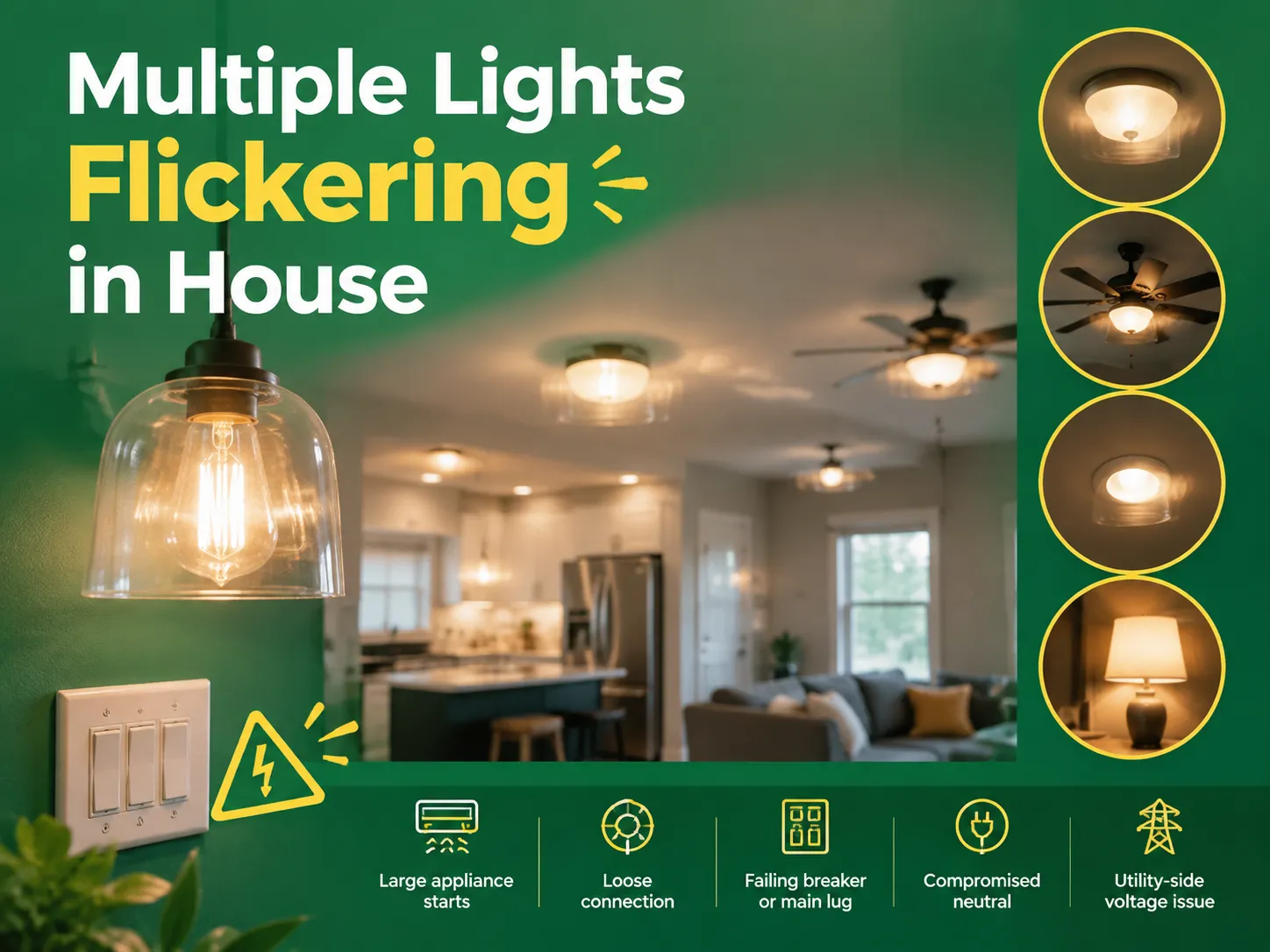
A flickering bulb can be interpreted as a local problem — the bulb worn out, the light fixture connected poorly, or it could be that you have a cheap dimmer. But if there is more than one bulb flickering simultaneously, in different rooms, you need to see the situation differently. Many flickering bulbs signal a […]
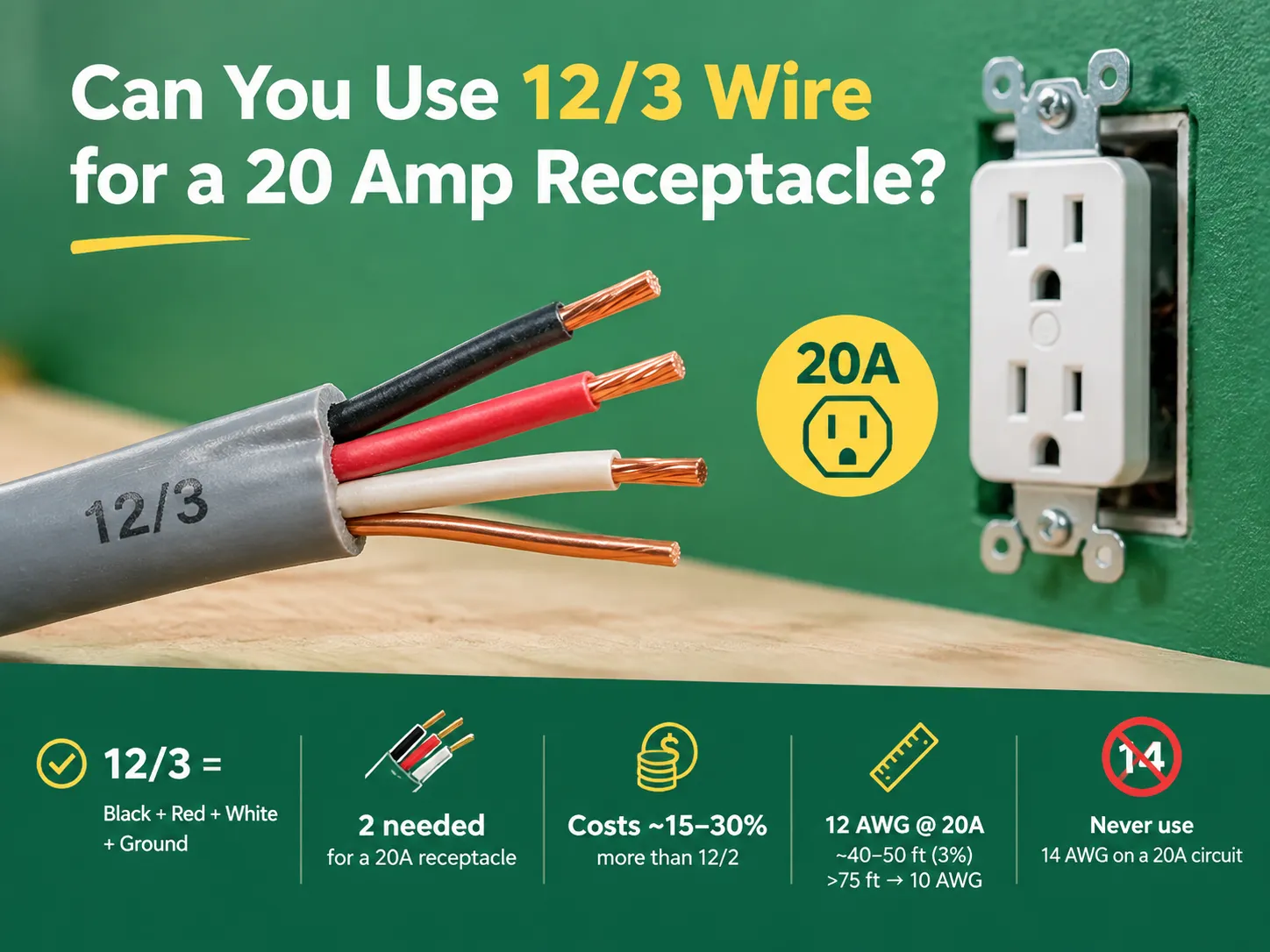
Il filo da dodici gauge e i circuiti da venti ampere si abbinano così bene che le domande sorgono generalmente da una fonte diversa. Può darsi che l'installatore abbia un pezzo di 12/3 avanzato da un progetto di cablaggio precedente o forse il fornitore ha solo cavi 12/3 in magazzino. La domanda sorge se […]

L'eccezionale situazione presente nel settore degli apparecchi elettrici di Dubai, che combina apparecchi conformi agli standard britannici con regolamenti di un'utility e un'agenzia nazionale che sovrintende all'attuazione delle normative nazionali, richiede che gli apparecchi siano in grado di resistere alle alte temperature e all'umidità che si verificano nella regione a causa della sua posizione costiera, e anche […]

 No.6 Tuozhan Road, Leshang Pioneer Park, porto della baia di Yueqingwan, città di Yueqing, provincia di Zhejiang


