

Ognuna di queste regole viene esaminata in dettaglio di seguito. La geometria della posizione delle prese, il requisito del circuito dedicato, i tipi di prese conformi al codice, le domande su 15A e 20A, le differenze tra paesi riguardo alle regole, i dettagli di installazione che non superano l'ispezione, cosa considerare quando si acquista un prodotto, i requisiti di illuminazione e ventilazione nella stessa stanza e le operazioni di retrofit.
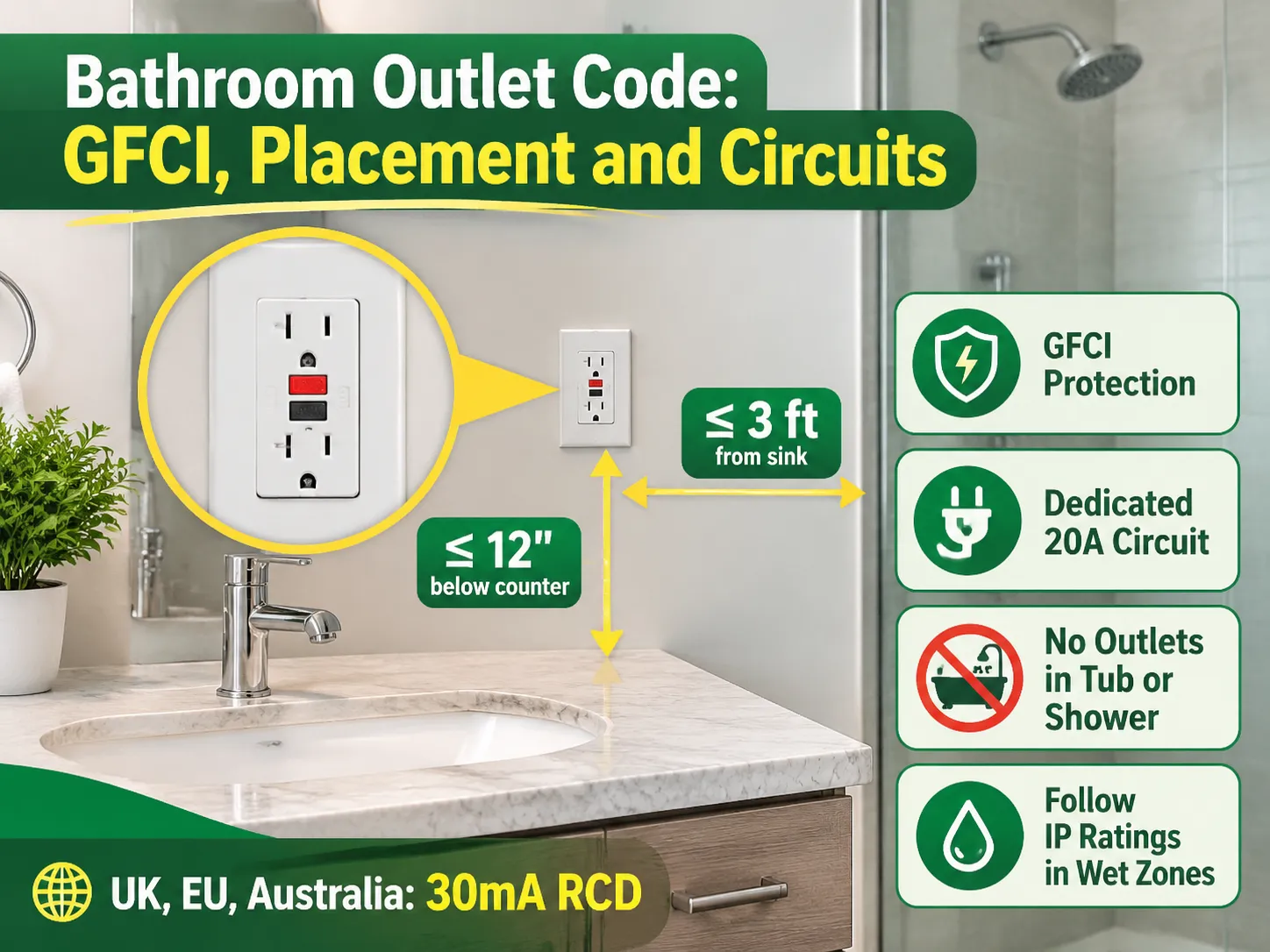
Risposta rapida: Negli Stati Uniti, ogni presa utilizzata in un bagno deve avere protezione GFCI (Ground Fault Circuit Interrupter) e almeno una presa deve trovarsi entro 3 piedi dal bordo del lavandino/bacino, e non più di 12 pollici sotto l'altezza del piano di lavoro. Le prese del bagno devono essere collocate su circuiti dedicati da 20 Amp (20A) utilizzati esclusivamente per i bagni. Nessuna presa del bagno può essere installata nelle aree della vasca o della doccia. L'equivalente del GFCI del Nord America è la protezione RCD da 30mA (Residual Current Device) nel Regno Unito, Irlanda, Australia e UE. Dove vengono installate prese ordinarie in zone umide, esse sono soggette a restrizioni e devono rispettare la classificazione IP della zona in cui sono installate.
Lo scopo del GFCI è monitorare la differenza di flusso di elettricità tra il filo attivo e il filo neutro. Quando la differenza tra essi è tra 4 e 6mA, ciò indica che una parte della corrente è fuoriuscita. Tipicamente nei bagni, ciò significa che la corrente stava fuoriuscendo attraverso una persona che stava in piedi a piedi nudi su un pavimento bagnato. Il GFCI interromperà l'alimentazione che fluisce verso la persona (cioè una persona in piedi su un pavimento bagnato con i piedi a contatto con il terreno) in pochi millisecondi dopo aver rilevato una corrente elettrica fuoriuscita dalla presa.
Ci sono tre dispositivi che possono essere utilizzati per soddisfare questo requisito. Il primo è una presa GFCI, che proteggerà sia se stessa che qualsiasi altro dispositivo collegato alla presa e che sarà alimentato a valle. Il secondo è un interruttore GFCI, che protegge l'intero circuito, ed è l'unica opzione che può essere utilizzata in situazioni in cui non si dispone di una presa GFCI per azzerare la corrente del GFCI o se il circuito è alimentato da una fonte che non consente l'uso di una presa (ad esempio, vasche idromassaggio). Il terzo è un GFCI “dead front”, un dispositivo installato su un apparecchio dove viene fornita elettricità ma l'utente dell'apparecchio non è in contatto o in prossimità (ad esempio, quando l'apparecchio è su uno scaffale).
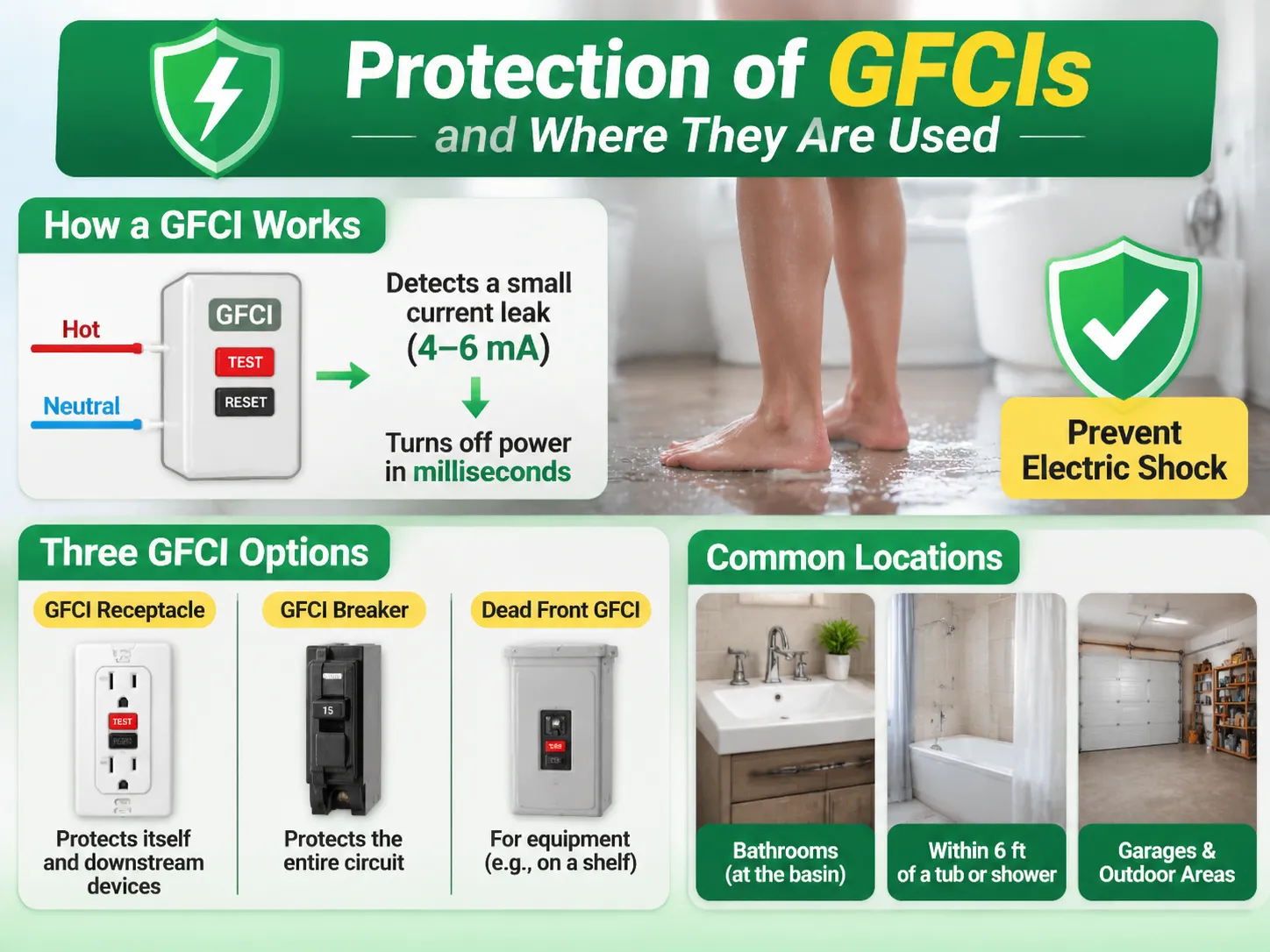
La scelta è importante per un motivo, ovvero dove il GFCI verrà azzerato. Una presa GFCI posizionata vicino al lavabo è molto facile da azzerare e semplice per il proprietario di casa da controllare mensilmente per verificarne il funzionamento, motivo per cui è il dispositivo GFCI predominante utilizzato nei lavori residenziali.
Un interruttore GFCI (ground fault circuit interrupter) è un dispositivo di sicurezza importante che previene sovraccarichi di circuito in caso di guasto elettrico. I GFCI si trovano in garage o in altri luoghi dove potrebbe non esserci spazio sufficiente per posizionare una presa GFCI direttamente davanti all'apparecchio da proteggere. Generalmente, un interruttore GFCI scatta quando si verifica un guasto elettrico sulla presa GFCI che protegge lo stesso circuito. L'interruttore scatta e indirizza l'occupante all'esterno indossando un asciugamano quando il GFCI scatta, motivo per cui la maggior parte delle installazioni di interruttori si trova in aree con vasca o lungo un circuito esterno, così come in casi in cui una presa è posizionata dietro un pannello montato permanentemente.
Il requisito per la protezione GFCI si estende oltre la stanza in cui si trova l'apparecchio. Ad esempio, qualsiasi presa installata entro sei piedi dal bordo esterno di una vasca o doccia deve essere protetta da GFCI, anche se la presa si trova in un'area che non rientra nella definizione di “bagno”, come spesso accade nelle camere da letto dove è presente una presa vicino a una parete con impianti idraulici condivisi; in questi casi, la presa è effettivamente collegata a un circuito bagno.
Comprendere come funziona una presa GFCI e perché la soglia di intervento a 5 mA si trova dove si trova aiuterà il consumatore a scegliere la versione della presa GFCI o dell'interruttore GFCI che meglio soddisfa le proprie esigenze. Una spiegazione completa di come funzionano i dispositivi GFCI è disponibile ed è lettura obbligatoria prima di selezionare la versione della presa GFCI o dell'interruttore GFCI di questi dispositivi.
IL Regola dei 3 piedi dal lavabo si riferisce alla distanza dal bordo esterno di un lavabo alla presa elettrica più vicina in orizzontale. Pertanto, è importante fornire una presa per tutti i lavabi. Se si dispone di un doppio lavabo con due bacini, allora è necessario fornire una presa per ciascun lavabo, e di solito è possibile soddisfare il requisito del lavabo fornendo una singola presa posizionata tra i due lavabi purché sia entro entrambi i requisiti di distanza. È importante notare, tuttavia, che una presa situata all'interno di un armadietto per medicinali non conta, poiché non è considerata accessibile nel senso previsto dal codice.
Un dettaglio spesso trascurato dagli installatori è il limite di altezza relativo all'installazione delle prese.
Una presa montata sulla faccia o orizzontalmente sul mobile del lavabo non può essere più di 300 mm sotto la parte superiore del lavabo. L'altezza sopra il piano di lavoro può essere media per una presa che è spesso intorno a 1.100 mm di altezza e allo stesso livello centrale di altri accessori, ma la maggior parte delle persone tende a posizionare le prese del bagno sopra il livello dell'ombelico in modo che siano facili da raggiungere dal pavimento.
Per esempio, non esiste una misura per l'area della vasca e della doccia, ma piuttosto una restrizione o divieto di installare prese in questa area. Nessuna presa può essere installata all'interno di una vasca da bagno o di una cabina doccia, ma sarà valutata in base all'area misurata a 3 piedi in orizzontale e 8 piedi in verticale dal bordo superiore della vasca o della soglia della doccia.
L'unica eccezione a questa regola riguarda un piccolo bagno che non ha molto spazio a parete. In questo caso, l'eccezione è limitata a una presa che può essere installata sulla parete direttamente di fronte alla vasca da bagno (e quindi vicino alla zona umida).
Anche i corpi illuminanti sono correlati a questa geometria. Similmente alla regola delle prese, la configurazione dei corpi illuminanti è spesso confusa con le restrizioni di posizionamento delle prese. In particolare, un corpo illuminante installato sopra una vasca da bagno ha le stesse restrizioni di posizionamento di una presa (3 piedi in orizzontale e 8 piedi in verticale) e deve essere anche marcato per ambienti umidi e bagnati.
Per quanto riguarda gli interruttori, devono essere installati dove una persona non possa toccare contemporaneamente un apparecchio idraulico e l'interruttore.
Mi piace pensare alla Regola del circuito da 20A (e al motivo per cui le prese del bagno sono diverse) come un riflesso diretto dell'asciugacapelli.
Un'unità normale utilizza tra 1.500 e 1.800 watt, che si traduce in 12,5-15 ampere a 120 volt; pertanto, un circuito di questa dimensione (15 ampere) si sovraccaricherebbe se qualcuno si asciugasse i capelli e guardasse la televisione contemporaneamente, causando un immediato scatto. Il circuito dedicato da 20 ampere consente questo livello di utilizzo senza che nulla scatti inutilmente.
Per un circuito da 20 ampere, ci sono due cose da tenere a mente per evitare una situazione di sovraccarico: primo, il circuito deve essere cablato con cavo 12 AWG; e secondo, è possibile collegare più prese insieme per un bagno, a condizione che il circuito non serva nulla al di fuori del bagno. Se si dispone di un singolo bagno, secondo l'eccezione, l'illuminazione e la ventola di scarico saranno autorizzate a funzionare su questo stesso circuito a causa del fatto che un singolo bagno rappresenta un carico ridotto; pertanto, non vi è alcuna giustificazione per eseguire circuiti aggiuntivi.
Questo secondo punto dà origine a tre considerazioni pratiche su come operano questi circuiti. Se si installa una presa da 20 A su un circuito da 15 A, la presa non può funzionare. Ciò significa che il circuito deve essere classificato allo stesso modo della presa. Inoltre, il neutro del circuito deve essere classificato per 20 A; questo è importante nel caso in cui si sia utilizzato un neutro condiviso in un'installazione più vecchia. Infine, in una situazione con più bagni, il circuito non dovrebbe mai essere collegato al circuito di illuminazione; altrimenti, se il circuito della presa scatta, causerà l'oscurità in tutti i bagni, il che è contrario a ciò per cui il circuito dedicato è previsto.
Quando si lavora con i bagni, si trovano cinque tipi di dispositivi. Quello a cui la maggior parte delle persone pensa è la presa duplex standard.
Una presa duplex GFCI protegge contro le correnti di guasto a terra alla presa; le sue persiane si aprono quando entrambe le spine sono inserite nella presa. Il costo delle prese duplex GFCI varia da $18 a $30, e si trovano più comunemente nei bagni vicino ai lavandini.
Una presa duplex standard non fornisce protezione contro i guasti a terra; dovrebbe essere collegata a valle di una presa GFCI o di un interruttore differenziale GFCI. La fascia di prezzo per una presa duplex standard è compresa tra $3 e $8.
Una presa GFCI con caricabatterie USB ha una protezione integrata contro i guasti a terra oltre a capacità di ricarica. Sono tipicamente utilizzate sui mobili da bagno per caricare rasoi elettrici e spazzolini da denti. Le prese GFCI con caricabatterie USB generalmente costano tra $25 e $45.
Nei bagni europei e australiani, un'unità di alimentazione per rasoi fornisce energia elettrica ai rasoi tramite trasformatori isolati (come quelli presenti nel Regno Unito/Irlanda). Si collocano nella Zona 2 nei bagni britannici e irlandesi e generalmente costano tra $25 e $60.
Prese Schuko o BS IP44 sono classificate per l'uso vicino all'acqua e forniscono impermeabilizzazione (cioè si sigillano contro gli schizzi), e si trovano quindi tipicamente nei bagni europei e australiani al di fuori delle zone umide. Una presa IP44 generalmente costa tra $10 e $25.
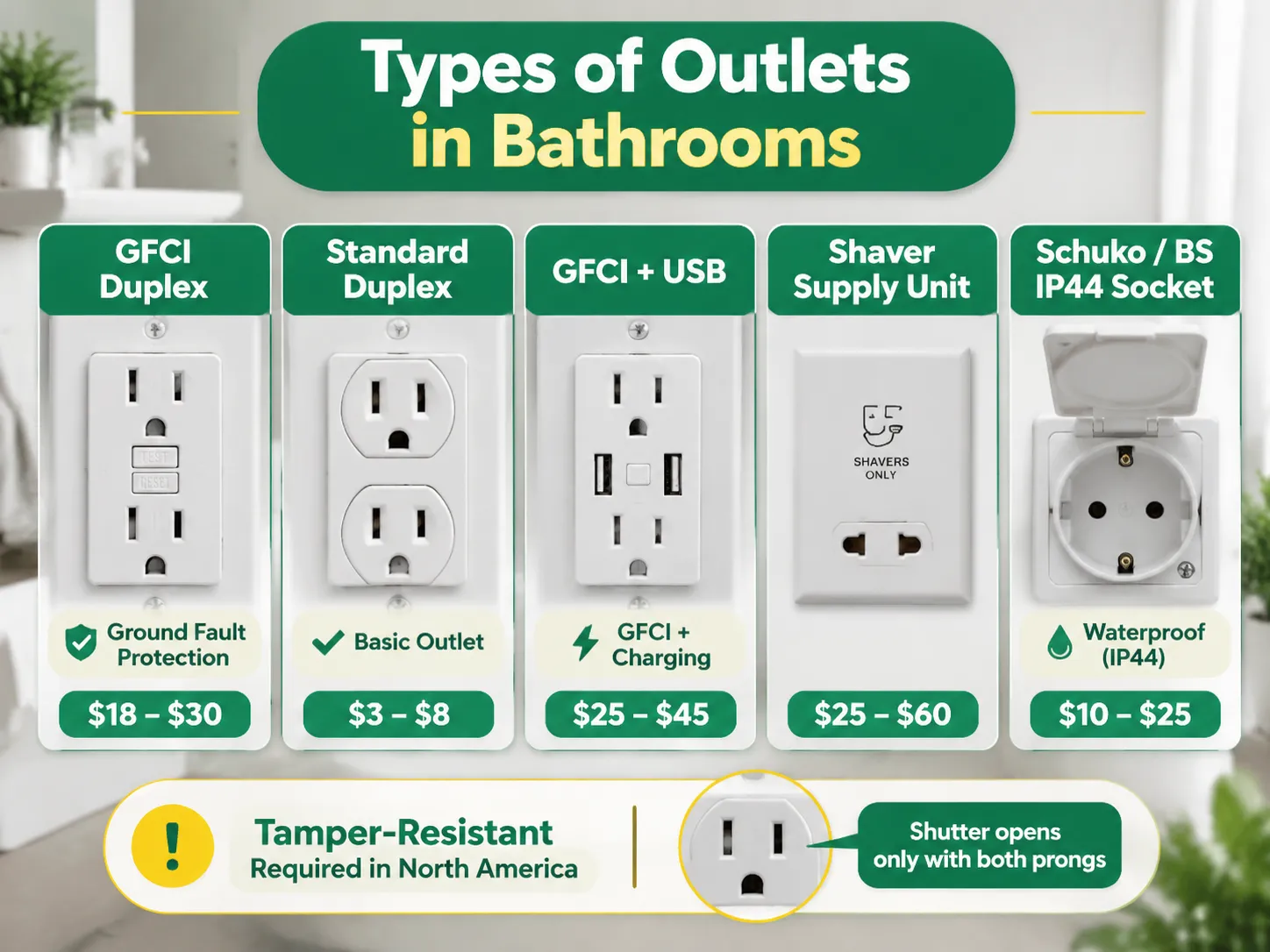
In North America, the code requires that if you replace or install any receptacles, they must include the tamper-resistant shutter. The shutter is spring-loaded and opens only if both prongs are inserted into it; you can expect to pay one or two dollars more for a tamper-resist receptacle over a normal receptacle.
| Outlet type | Prezzo tipico |
|---|---|
| GFCI duplex receptacle | $18 to $30 |
| Standard duplex receptacle | $3 to $8 |
| GFCI receptacle with USB chargers | $25 to $45 |
| Shaver supply unit | $25-$60 |
| Schuko or BS IP44 socket | $10 to $25 |
| Tamper-resistant receptacle | one or two dollars more |
The last two rows of this comparison chart reflect what an average European (or Australian) consumer may see when shopping for receptacles. Most bathroom socket outlets in the UK do not have a general-purpose socket outlet at all; instead, UK bathrooms are equipped with shaver supply units that contain isolated transformers located in a zone designated as Zone 2. This is why a UK visitor searching for an electric hair dryer will look for a two-prong receptacle capable of accepting an electric shaver plug, rather than a hair dryer plug.
For orders by the thousand of projects using the American format switch and socket configuration and plate systems associated with NEMA, the first row is where you’ll find the countries of North America. A project order uses the NEMA configuration, and corresponds with the plate systems.
A device rated at 15A or 20A, must match the circuit being used. The relationship only goes one way. A 20A receptacle can be used on a circuit rated at 20A. A 15A receptacle will work too, because the 15A device is protected by the circuit rating and the load it will see. However, using a 20A receptacle on a 15A rated circuit is a defective installation because that device is rated for more load than the circuit can handle.
For bathrooms, the result is that using a 15A GFCI receptacle on a 20A rated circuit is both code compliant and very common. In fact, many 15A GFCI receptacles are rated for 20A feed-through configurations in any case; therefore the 15A designation is for the configuration of the receptacle only, and does not denote how much current can be passed to downstream receptacles.
The exception to this rule is if a dedicated appliance with a 20A plug is to be used, such as a large whirlpool heater, or a commercial hand dryer. In this instance, a 20A receptacle and a dedicated circuit are required. These installations should be specified separately, rather than assumed to be general bathroom outlets.
Every developed country mandates that all bathrooms use residual current protection, but they specify how this requirement will apply based on a variety of factors including device type, zone geometry, and how much residual current protection each will provide. Each developed market has a specific residual current protection for a bathroom but not all developed markets have the same residual current protection devices. In this case, the two differences are represented by the methods used to provide residual current protection.
| Paese | Protection method | Socket rule | Zone requirement |
|---|---|---|---|
| Stati Uniti | (a) 4 or 6 mA GFCI | (b) all bathroom outlets are standard duplex, (c) TR is mandatory | Receptacles are not allowed in the tub or shower area. |
| Ireland & UK | 30 mA RCD on circuit | ordinary socket limited; wall-mounted shaver unit in zone 2 | BS 7671 defines zones 0, 1, and 2 by distance from water. |
| EU | 30 mA RCD, with some circuits limited to 10 mA | IP44 socket is allowed outside of the risks of water | IEC 60364-7-701, IPX4 in zones 1 and 2. |
| Australia & NZ | 30 mA RCD | any socket outlets must have IP rating | AS/NZS 3000 zone geometry and IP rated accessories. |
| Gulf States & Middle East | 30 mA RCD | BS or Schuko minimum IP44 socket outlet | IEC zone geometry; frequently enforced by consultant. |
The primary differences between the North American and European approaches to residual current protection are (1) North America protects a low number of areas at risk due to proximity to a sink, whereas (2) Europe protects the entire entire installation at 30 mA and relies on the IP rating of the equipment at the risk area.
This may clarify why a European bathroom can include an electrical socket while a North American bathroom uses a device that must be specifically designed for use in North America due to their differing country codes and standards related to the required or acceptable product used in each of these regions.
The plug types also work under the same rationale. In North America, an electrical socket in a bathroom is typically a NEMA 5-15 or 5-20, while in the UK it may be a shavers socket, in Germany it may be the Schuko style with a hinged cover, and in Australia it would be a Type I with a weatherproof cover. The reason the various types of plugs in North America require separate electrical sockets is because of electrical requirements and code restrictions for each style of plug.
Most bathroom installations fail to pass inspection for six reasons related to something other than the device itself. A GFCI outlet must be the first receptacle in a circuit so that all of the downstream receptacles on the circuit are also protected. If installed in a location that cannot be accessed by an electrical plug tester (such as in a cabinet), a GFCI will be unable to provide a test signal. If a GFCI outlet is installed without an equipment ground, a plug tester will not be able to test the GFCI. A GFCI outlet installed on a 15 A circuit would not meet the minimum requirement of being a dedicated 20 A outlet. A GFCI outlet located within the bathtub zone is prohibited, and therefore may not count toward the total number of receptacles required for a bathroom. Finally, a GFCI that has been painted over is considered a defect and indicates that no testing has been performed on the device since it was installed.
A seventh reason, which is not necessarily a code violation, but is also a practical issue, is the insufficient depth of the outlet box for the specific type of GFCI being installed.
GFCI receptacles are designed to be deeper than standard duplex receptacles; therefore, If the electrical box installed in the wall during the tile installation is too shallow to allow for proper installation without excessive protrusion of the plaster ring, it will be more expensive to fix than simply checking the depth of the box prior to the installation of tile.
Another consideration is the cable used. To supply a 20-amp circuit in a bathroom, 12 AWG cable must be utilized, and this presents an issue to home builders as the 12-3 cable contains three conductors instead of the normal two. Additionally, extra unused conductors within a box must be properly terminated, rather than leaving them cut off at the back of the box.

What separates a bathroom-rated product from a non-bathroom rated product? Four main things must be considered when selecting a bathroom rated product’s listing to the appropriate standard, counterfeiting is an actual issue on some internet-based sales sites. The shutter mechanism of the tamper resistant outlet must be installed if required by the local electricity code. The terminals’ design must provide better torque retention than backstab connections, as a bathroom outlet sees more plug/unplug activity than any other outlet. Lastly, the plate of the bathroom outlet should be stainless steel or brass. Plated metal will show watermarks as compared to moulded plastic.
When selecting a brand in this category, it is generally less about performance and more about having the correct product available. For example, the larger brands in the United States, such as Leviton, Legrand, and Hubbell, have a complete selection of the many variations of GFCI, TR, and USB products available.
Due to lower cost, manufacturers in China will typically provide the same products as manufacturers in the USA but with one key difference: the product must be listed for the specific market into which the item is being supplied.
Our manufacturing is on the “wholesale project” side of the equation. We produce receptacles and switches for wholesale and project supply, also producing tamper-resistant duplex and GFCI configurations to accommodate both European plate configurations and North American plate configurations, and we are a component manufacturer, not a lighting manufacturer, so our catalogue is organised by device and plate configuration rather than room.
When we tell potential customers what to check prior to purchasing a device, we advise to check the listing, the plate type, and the type of GFCI (self-test vs. non-self-test). A Self-Test GFCI performs an internal check every few seconds (on the power supplied to it) to confirm that it is functioning correctly, and if the device fails, it will lock out. This is the only way to know that your GFCI installed in a bathroom for 8 years will still work when it is needed.
When it comes to compliant lighting, fans, and switches, all three of these devices share the same room, but they have different requirements. The luminaire must be approved for use in a damp location over the bathtub, and any surface that may receive water spray of any kind also needs to be compliant. The fan must be vented to the exterior of the building and never to the roof structure, and on the circuit for the bathroom, it will consume its 20-A of power; therefore, it shares the circuit with the two other devices in the same room.
In the North America, bathrooms require GFCI receptacles. These outlets must also meet any Tamper Resistant requirements set forth by the local jurisdiction. They must be installed on a dedicated 20-amp circuit, with at least one GFCI protected receptacle located no more than 3 feet from each sink or washbasin. In the United Kingdom and Ireland, bathrooms generally require Shaver Supply Units, which should be located in Zone 2, and should not be regarded as General Socket Outlets (unless an extension lead is permitted), and should be connected to a 30mA RCD.
For North America, the typical designation of the protective device is GFCI receptacle or duplex GFCI/TR; the equivalent in the United Kingdom is known as shaver socket or electric shaving supply unit; the common name in Europe and Australia is IP44 socket outlet with RCD upstream protection; so essentially the names are indicative of the method of protection and the type of enclosure in which they are housed but all products perform the same functions regardless of geography.
The circuit must be rated at 20 amps; this means a 15 amp GFCI receptacle (the receptacle outlet listed here) on the 20 amp circuit is allowed and is the standard. A 20 amp receptacle outlet will only be used to receive power from a device that has a 20 amp plug, i.e., large hot tub heaters. A 20 amp receptacle must not be installed on a 15 amp circuit.
The three requirements for bathroom receptacle outlets are: (1) GFCI; (2) at least one receptacle within three feet of the outside edge of each basin and no more than twelve inches below the counter; (3) all receptacle outlets must be installed on a dedicated 20 amp bathroom circuit. No receptacle outlet is permitted to be installed inside a bathtub or shower stall.
The only exception to this is where the dedicated 20 amp circuit serves only a single bathroom. If that is the case, both the lighting and fan may be installed on the same dedicated 20 amp circuit for that bathroom. A dedicated 20 amp circuit may not serve any other room(s).
According to the base National Electrical Code, AFCI protection is not required for bathrooms; instead, the requirement for GFCI protection specifically addresses risks of electrical shock. However, some states have amended the National Electrical Code to require AFCI protection on all dwelling circuits, therefore; a dual-function breaker will provide both protections.
There are three requirements which govern the installation of bathroom receptacle outlets, and there is one prohibition. These requirements are GFCI protection, a receptacle outlet located within 3 feet of the outside edge of each basin, all receptacle outlets shall be connected to a dedicated 20 amp circuit, and no receptacle outlet shall be allowed to be installed within a bathtub or shower stall. All other information in this article is additional detail supporting the four requirements above.
The detail that ultimately determines whether the installation will remain successful is located at the location of GFCI protection. Locate GFCI protection where it is easily accessible; routinely test the GFCI protection monthly and consider purchasing a self-testing GFCI if your budget allows; keep in mind that the failure of GFCI protection systems typically occurs without any audible or visible indications; therefore the room generally has no indications of danger present.
Each of these rules is reviewed in more detail below. The geometry of receptacle placement, the dedicated branch circuit requirement, receptacle types that meet the code, 15A and 20A questions, differences among countries with regard to the rules, installation details that do not pass inspection, what to consider when buying a product, lighting and fan […]

Dubai – Mercato facile per acquistare dispositivi di cablaggio e mercato difficile per selezionare il dispositivo(i) di cablaggio corretto da utilizzare in qualsiasi progetto. Tutti i marchi internazionali hanno ampia rappresentanza a Dubai; la consegna dei prodotti può avvenire entro una settimana dall'ordine; e la qualificazione per superare l'ispezione DEWA è ottenuta da tutti i fornitori basata su DEWA […]
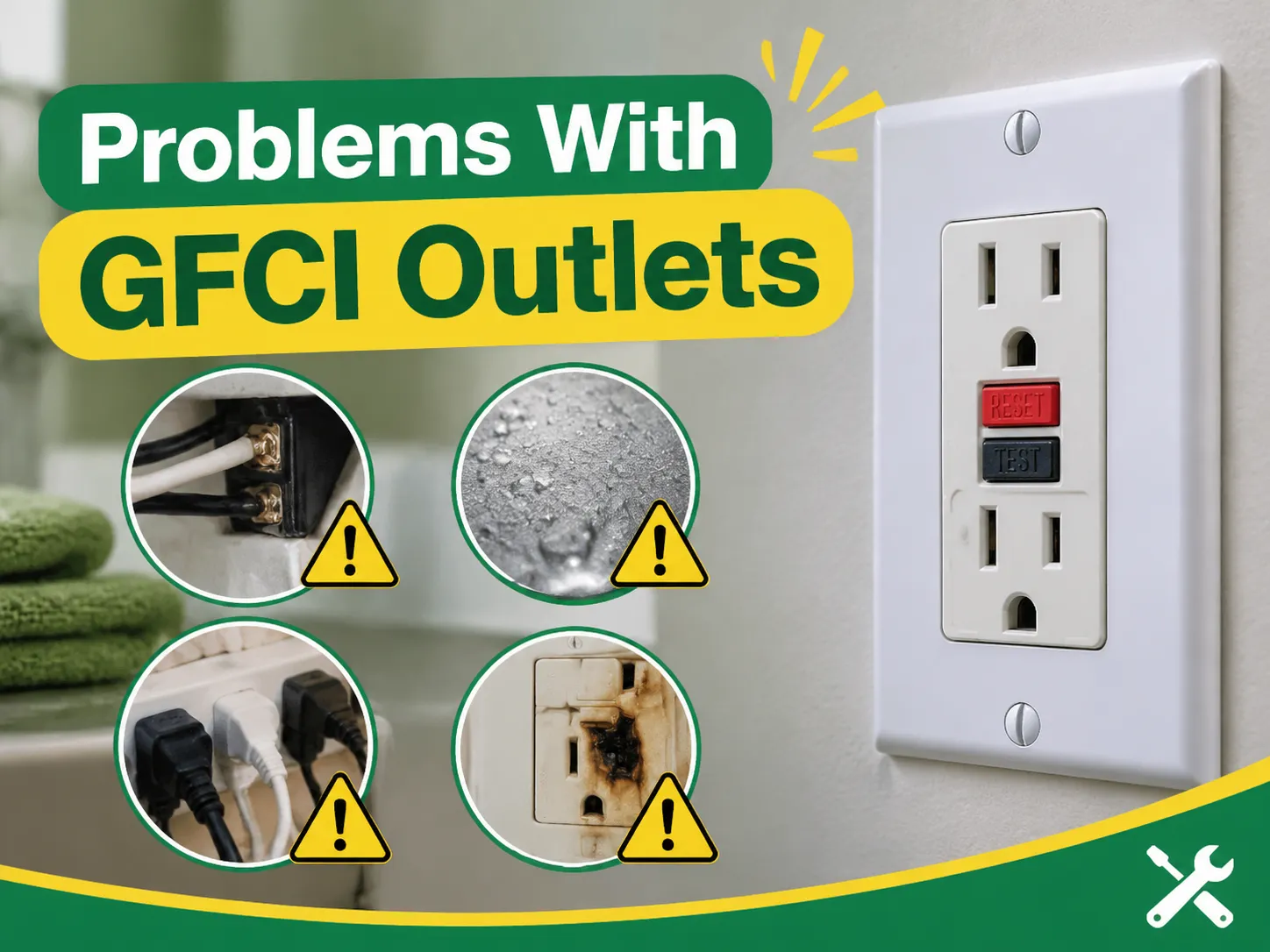
A ground fault circuit interrupter is the only appliance in the house that it is failed in a visible manner. It disconnects at an unexpected time, does not initiate re-setting, or give up after years in the service leaving an illusively safe circuit. Most issues searched by the customers fall into four categories of buyer’s […]

 No.6 Tuozhan Road, Leshang Pioneer Park, porto della baia di Yueqingwan, città di Yueqing, provincia di Zhejiang


