

Collegarsi in Vietnam è un lavoro facile rispetto alla maggior parte dei paesi in Asia e così è far morire uno dei gadget. Le spine sono accettate a livello globale, ma il voltaggio no. Questi due fatti sono veri per ogni hotel in Vietnam da Hanoi a Can Tho ed è utile conoscerli per evitare molti problemi. In questa guida imparerai cosa si trova nella parete, quali tipi di spine si adattano dove e quali tipi di viaggiatori avranno bisogno di un adattatore nelle loro valigie. Sarai anche informato sulla differenza nei requisiti riguardo alle prese elettriche per edifici e camere d'hotel.
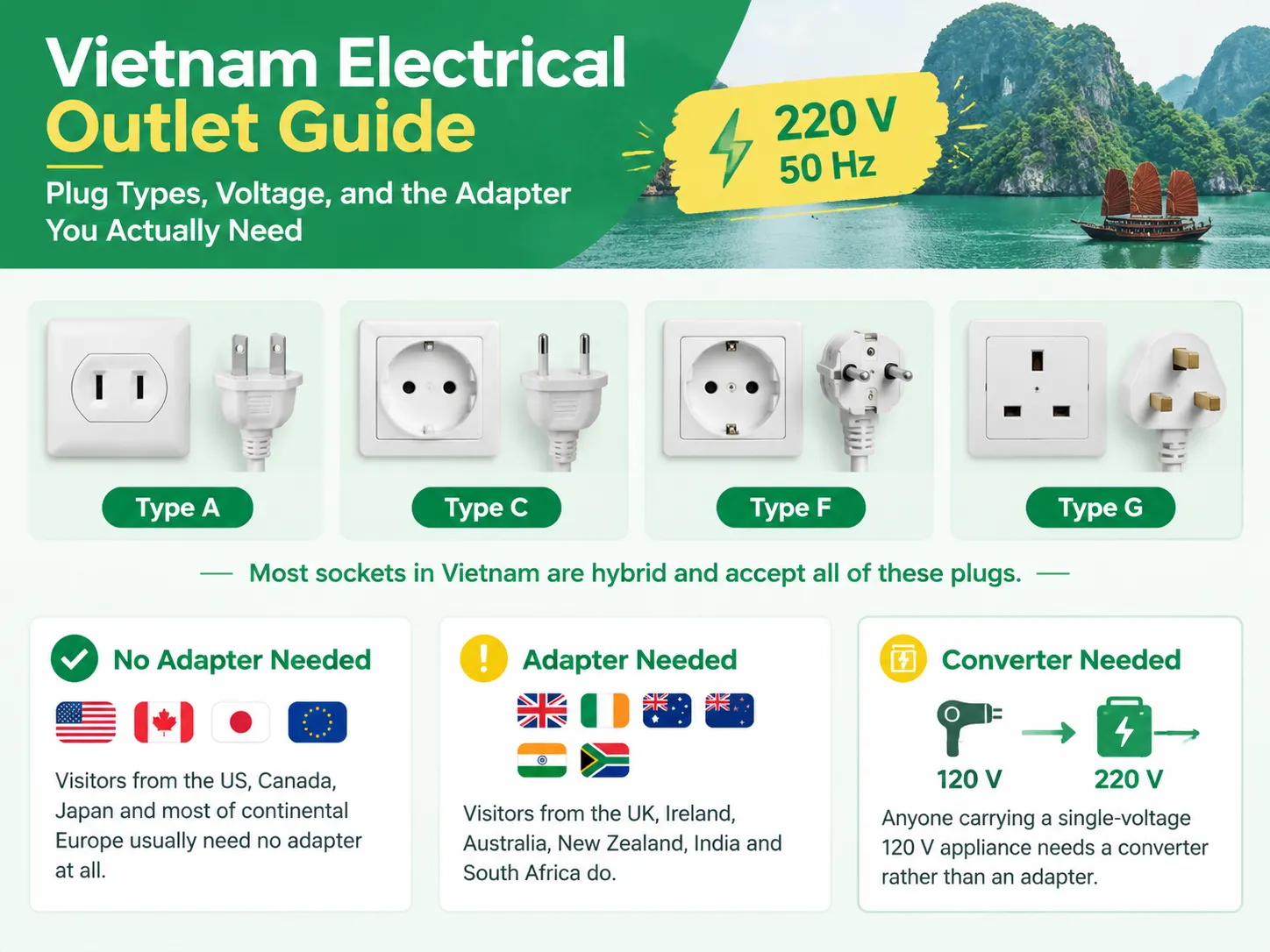
Risposta breve: il Vietnam utilizza un voltaggio di 220 V a 50 Hz e tipi di spina A e C – rispettivamente a pin piatto e a pin rotondo, con spine di tipo F utilizzate anche in edifici moderni e tipo G utilizzato in alcuni hotel di livello superiore. Per lo più, le prese utilizzate sono ibride e in grado di accettare vari tipi di spine. I turisti provenienti da USA, Canada, Giappone e dalla maggior parte dell'Europa continentale di solito non avranno bisogno di un adattatore, a differenza di coloro che provengono da Regno Unito, Irlanda, Australia, Nuova Zelanda, India e Sudafrica. Un viaggiatore che porta con sé un apparecchio a voltaggio singolo di 120 V dovrà portare un convertitore.
| Provenendo da | Tipo di spina | Adattatore necessario | Problema di voltaggio |
|---|---|---|---|
| Stati Uniti, Canada, Messico | A, B | No, A si adatta | Sì, se il dispositivo è solo 120 V |
| Giappone | A, B | NO | Sì, dispositivi 100 V |
| Regno Unito, Irlanda | G | Di solito sì | NO |
| Germania, Francia, Paesi Bassi, Spagna | C, E, F | Raramente; Schuko necessita di una presa ibrida | NO |
| Australia, Nuova Zelanda, Argentina | IO | SÌ | NO |
| India, Sri Lanka | C, D, M | Spesso sì | NO |
| Sudafrica | M, N | SÌ | NO |
| Cina | A, C, I | Di solito no | NO |
Ci sono due sorprese in queste tabelle per i viaggiatori provenienti dall'Australia e dagli Stati Uniti. Le informazioni raccolte indicano che gli australiani pensano che i loro apparecchi funzioneranno ovunque in Asia, basandosi sul fatto che hanno funzionato perfettamente a Bali e in Thailandia, mentre in Vietnam non funzionano. Nel frattempo, gli americani pensano che sarà necessario un adattatore per il viaggio in Vietnam, che è a 220 volt, mentre non c'è tale necessità poiché le forme dei pin fisici sono le stesse.
Il tipo A è uno dei due pin piatti paralleli utilizzati negli Stati Uniti e in Giappone. Non è messo a terra e ha una capacità di voltaggio di 15 A e 125 V rispettivamente. Anche se è il tipo più vecchio in Vietnam, tuttavia, domina ancora al di fuori delle aree urbane.
Il tipo C è l'Europlug, con due pin rotondi di diametro 4 mm. Non è messo a terra e la sua valutazione è di 2.5 A. È stato utilizzato durante il periodo in cui i francesi erano in Vietnam.
Il tipo F è la spina Schuko. La Schuko ha due pin rotondi, ciascuno di 4,8 mm, e due clip di terra laterali con una valutazione di 16 A. La Schuko è presente in edifici più recenti e hotel moderni, spesso nelle stesse prese delle spine di tipo A e tipo C.
Il tipo G è la spina rettangolare con fusibile del Regno Unito. La spina del Regno Unito è valutata a 13 A. La spina è utilizzata principalmente in hotel moderni e appartamenti serviti.
Il tipo D è la spina indiana a tre pin rotondi. È ancora utilizzata in alcuni edifici antichi nel nord dell'India.
La tassonomia completa, comprese le dimensioni dei pin e le valutazioni di corrente associate a ciascuna forma, è esposta in questo riferimento a i tipi di prese a muro utilizzati in tutto il mondo, che vale la pena consultare prima di acquistare un adattatore per un viaggio in più paesi.
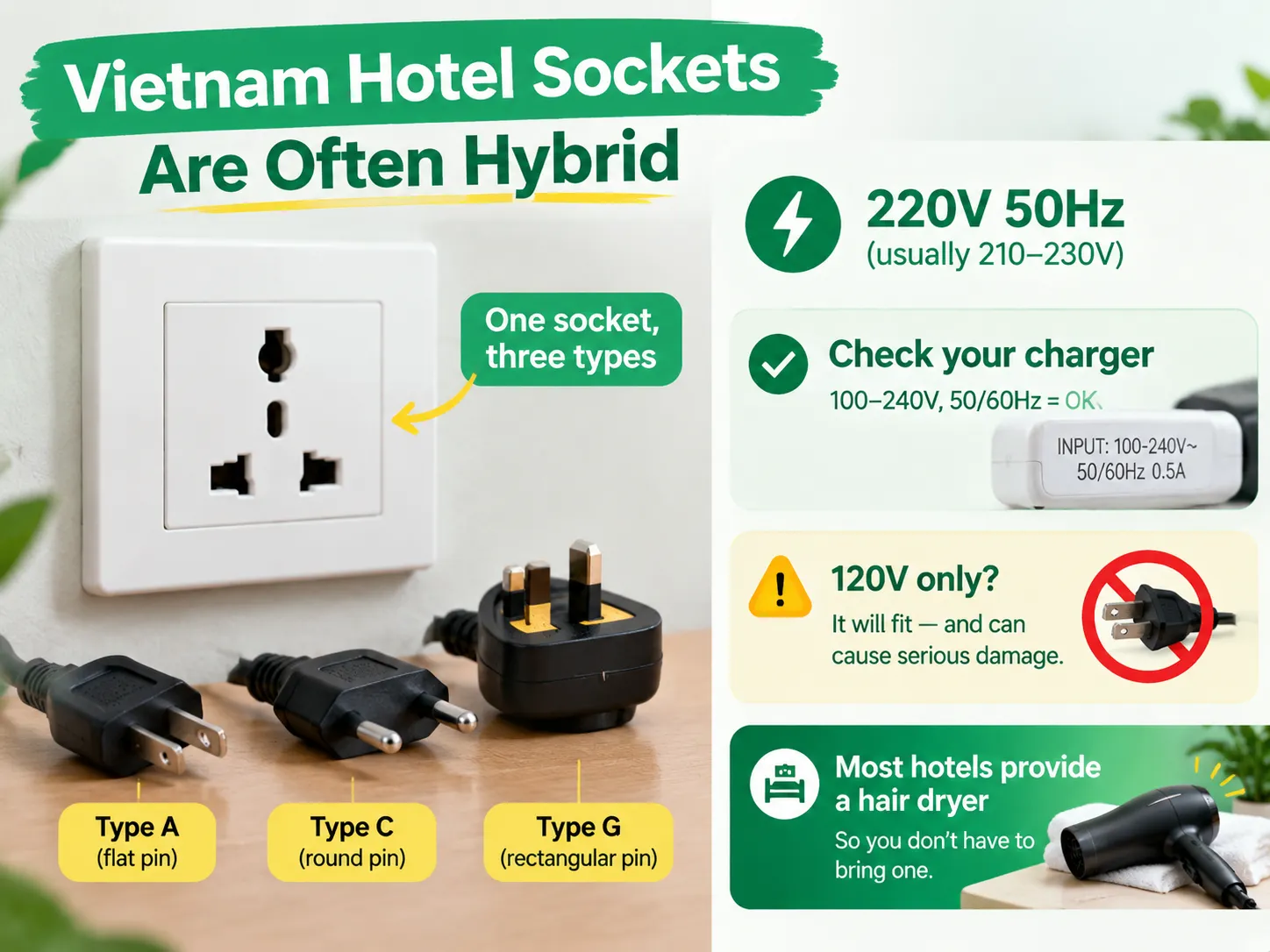
Molte delle prese trovate in Vietnam sono chiamate “tre-in-uno” poiché possono ospitare tre tipi distinti di pin su una singola presa. Molti altri luoghi nel mondo hanno utilizzato design simili, ma la differenza è che le prese in Vietnam sono diverse dalle prese universali che accettano tutti i tipi di apparecchi ma non fungono da punti di messa a terra. Invece, le prese in Vietnam sono costruite per accogliere diverse tensioni e sono vendute come prodotti pratici.
Il motivo di ciò è l'eredità degli edifici in questo paese: risalente al periodo coloniale francese e all'Unione Sovietica fino a un decennio di rapida sviluppo e all'ultima ondata di costruzione focalizzata su hotel di lusso. I proprietari di hotel che ristrutturano hotel costruiti negli anni “90 preferiranno utilizzare queste prese ”tre-in-uno” in modo che i loro ospiti possano collegare i propri dispositivi indipendentemente dagli standard di tensione locali. La Thailandia ha risolto lo stesso problema allo stesso modo, e il risultato lì è un insieme altrettanto variegato di prese descritto in questa guida al tipo di presa elettrica della Thailandia.
Per il viaggiatore, la domanda chiave “la mia spina si adatta?” dipende interamente da quale edificio ci si trova, ed è per questo che la tabella sopra ha utilizzato il termine “di solito” per definire gli adattatori di alimentazione in ciascun paese. Un turista britannico che soggiorna in un hotel a quattro stelle a Ho Chi Minh City scoprirà che c'è una presa di tipo G incorporata nella scrivania. In una guesthouse a Dalat, non lo farà!
Il Vietnam ha mirato a una tensione nominale di 220 V e una frequenza di 50 Hz, fornita da EVN o Elettricità del Vietnam. La tensione effettiva dell'elettricità che scorre dalla presa può variare da 210 V a 230 V, ma in estate diminuisce ulteriormente durante le ore di punta, il che può essere un problema per dispositivi sensibili come i condizionatori.
La regola generale è lì per gli accessori di ricarica che possiedi. Controlla semplicemente ogni dispositivo di ricarica e vedrai la tensione indicata di “100-240 V, 50/60 Hz,” il che significa che la maggior parte dei caricabatterie, compresi quelli per telefoni, laptop, fotocamere, power bank e spazzolini da denti prodotti negli ultimi 15 anni possono funzionare bene in Vietnam semplicemente utilizzando un adattatore per spine. L'unico sistema in cui quel controllo fallisce è il modello nordamericano da 120 V, motivo per cui il tipo di presa nordamericana Ottobre 22, 2026.
A simple “$120” means that the machine is going to fail immediately, and most likely also burn. What’s dangerous is that it will fit. An American hair dryer will perfectly plug into Vietnamese Type A socket and will give double voltage. Hair dryers, curling irons, straighteners, old electric razors, and cheap kitchen appliances are the most frequent victims.
Most mid-class and good hotels provide hair dryers, which single-handedly eliminates the most common failure from your packing.
In North America and Japan, devices make use of a frequency of 60 Hz while most countries operate at a frequency of 50 Hz. Dual-voltage devices are indifferent to the frequency as they rectify AC supply to DC in their circuits. However, devices that have an AC motor or clock have to take the frequency into account.
If an induction motor made for 60 Hz is run on 50 Hz, it will operate about 17% slower. It will also consume more energy in performing the same task. An AC clock will lag 10 minutes an hour. Old stereos can create hum due to magnetic interference from transformers. However, none of the devices will break down entirely, but will give faulty performance that will be blamed on the devices rather than supply.
For the short term, such variation may be of no consequence; however, those importing machinery to Vietnam or installing electrical fittings in factories where such machines are used should take the frequency into account when designing the specifications.
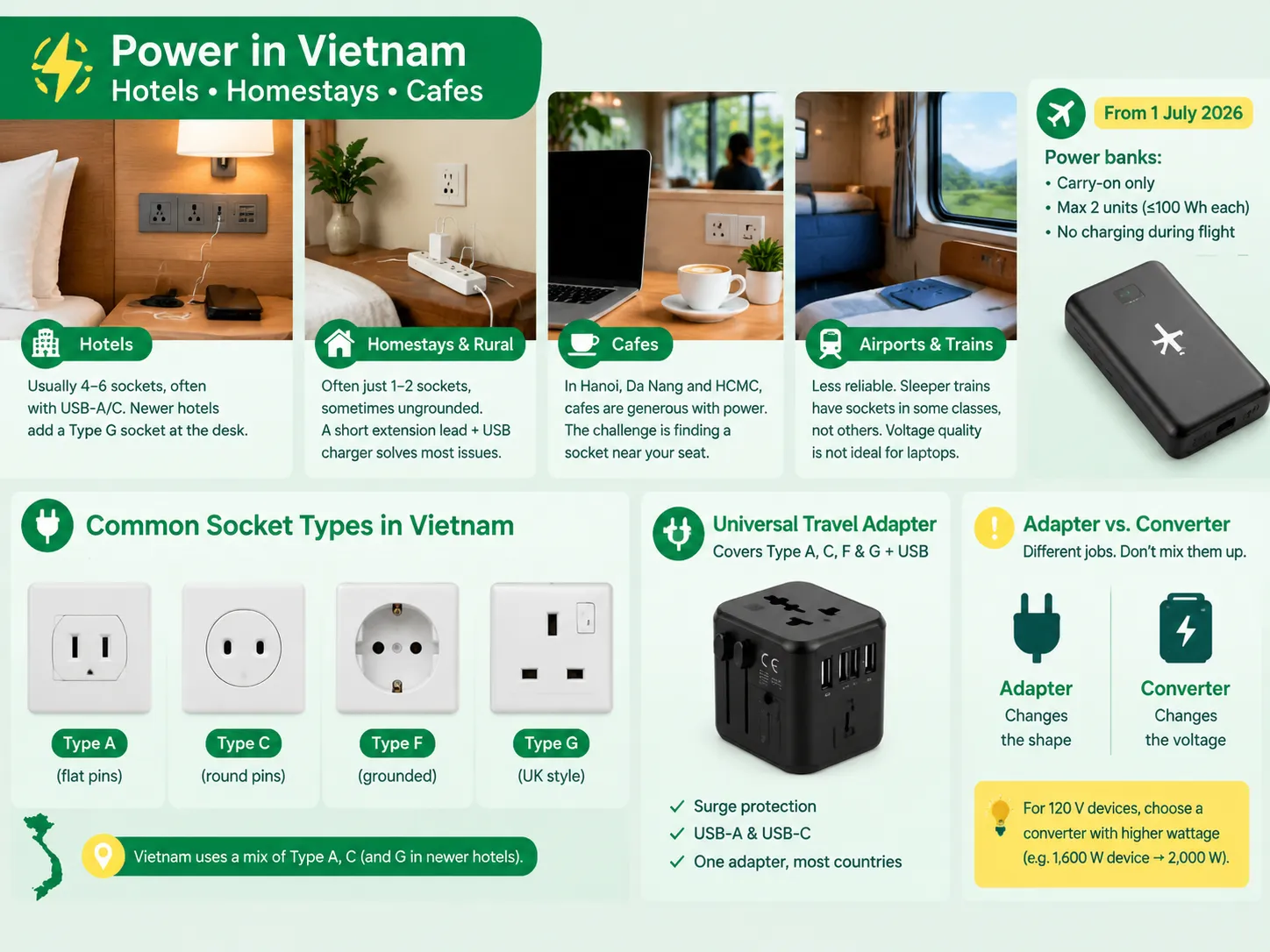
Normally, city hotels may provide four to six sockets in one room, many of which would be hybrid sockets. Two of them might be new types of sockets with USB-A and USB-C ports on the bedside panel. Newer hotels are known to use G-type sockets containing charging facilities on the office desk.
Staying in homestays may provide you with one or two sockets in the entire room, some of which might be A-type but ungrounded sockets. They might share the same electrical circuit with the water heater. But you can always use an extension cable and multiport USB to fulfill your needs.
Hanoi, Da Nang, and Ho Chi Minh City cafes are generous in providing electric power, and it seems that many cafes, designed with working clients in mind, make profit because of the availability of socket outlets. So perhaps you can find plenty of sockets near your seat.
Aviation and train traveling is much less predictable. Reunification Express use electric sockets in some types of cars, but not in others. Also, the quality of voltage might not be performed well enough till the train arrives to its destination.
If you have decided to travel within the country domestically, keep in mind that starting from July 1, 2026, the Civil Aviation Authority of Vietnam permits taking no more than two power banks with capacity not greater than 100 W each in carry-on luggage and the use of power banks for charging devices in flight will be prohibited.
An adapter changes the shape of the connection. A converter changes the voltage. They are different products and confusing them is how devices get destroyed.
| Device input | Plug compatible | Plug not compatible |
|---|---|---|
| 100–240 V dual voltage | Nothing needed | Plug adapter only |
| 220–240 V only | Nothing needed | Plug adapter only |
| 120 V only | Converter needed | Adapter plus converter |
A universal travel adapter is the most effective solution for everybody since it works with types A, C, F, and G together and also comes with USB charging. Make sure to buy one with a surge protector rather than the least expensive option found at the airport; the older buildings have poor earthing, and the extra protection costs only a small amount of money.
When using a converter with a 120 V device, make sure that it has a wattage higher than that of the device. For example, a 1,600 W hairdryer will need a converter rated above 2,000 W, and using an inadequate converter will either blow a fuse or overheat it. However, on a two-week trip, it is easier to carry a cheap dual-voltage hair dryer bought at the destination than bother with a large converter.
While travelling within the region, it becomes even harder to sort out the adapter issue, as countries don’t share the same standards. A guide to the sockets and adapters you need in Bali shows the Indonesian pattern, which accepts Type C and F and is genuinely different from Vietnam’s A-and-C mix. Anyone doing a multi-country Southeast Asia itinerary should buy universal and stop thinking about it.
In preparing to sell into the Vietnamese market, there are four important implications to consider.
Choose the socket, not the adaptor. A dual-standard outlet is a good option for hotels but not for factories; using a specific standard decreases maintenance as well as stops chances to plug in inappropriate devices. The outlet should correspond to the type of equipment that is going to be connected.
Grounding is a problem. Most local sockets are ungrounded two-pin devices and a building, which uses such sockets everywhere, exposes itself to electrocution risks that can’t be eliminated by reliable RCDs. Really grounded sockets of Type F or Type G should be used for the applications that include machines with metallic casings.
Capacity should be sufficient. A 2.5 A Europlug socket is not the same as a 16 A socket with another face-plate. Therefore, kitchens, workshops, and places with heaters need sockets designed according to the electric circuitry of this area.
Voltage is important. A voltage range of 210 V-230 V and an additional drop during the peak moments mean that instruments requiring a precise voltage of 220 V will be faulty. A device should state that it nominal voltage is 220 V, but it is able to work at a voltage from 190 V to 250 V.
This is the layer being supplied by Igoto; these are switches and socket outlets along with power strips operating according to the local standard, and the route of OEM and private label is available for all distributors wanting their branding on the face-plate.
It is most advisable for travelers to buy a universal adapter for Type A, C, F and G plugs, since the types of sockets in Vietnam vary across types of buildings. However, if you’re coming in from America, Canada or Japan, and your appliances work with both low and high voltage, you don’t actually need an adapter. If traveling in from Australia or New Zealand, however, an adapter is indeed necessary.From the UK or Ireland you almost certainly need one, since the rectangular-pin pattern described in this guide to the Ireland outlet type only fits where a hotel has deliberately installed that socket.
In case you are carrying devices that are rated for 100 to 240 volts, you will need a plug adaptor, but not a voltage converter. The types of sockets that you will need to consider are types A and C which represent the types that you will find almost anywhere, plus types F and G if you are staying somewhere new and fancy.
From the perspective of the physique, there are no such requirements. Vietnamese Type A socket can accept US Type A plug directly, while it can also work for hybrid sockets in hotels. The most important point to look at is voltage: looking at the input ratings of every device and leaving everything that is indicated to be operating on 120 volts unless a converter rated for more than its power is in the possession of the traveler.
The two-pin (round or flat) configuration is what’s needed in the sockets; consequently, an adapter that has the correct Type C pins on the wall end will be compatible with most sockets across Vietnam, including those found in older buildings that use the round-only configurations typically installed in the French times. A universal plug that has C, F or G on the wall end will work for every scenario.
Vietnam uses a voltage of 220 V and a frequency of 50 Hz, so its electrical sockets may accommodate devices that run on either of these frequencies. If your device is rated from 100 V to 240 V, you need to be careful only about the shape of the plug, which is usually not an issue.However, if your device is rated 120 V, technology-wise, you should leave it in your suitcase, as it will become incompatible the moment it is plugged in.
Plugging into Vietnam is an easy job compared to most countries in Asia and so is making one of the gadgets go dead. The plugs are globally accepted, but the voltage is not. These two facts are true about each hotel in Vietnam from Hanoi to Can Tho and it is good if you know […]

Il controllo dell'illuminazione commerciale a Minneapolis è ora una necessità piuttosto che un'opzione. Con l'applicazione del nuovo NEC il 1° luglio 2023, il rilevamento dell'occupazione è ora diventato un requisito legale nella maggior parte degli edifici commerciali senza alcuna modifica della legge da parte delle autorità statali. Quindi la discussione è cambiata da “se” […]
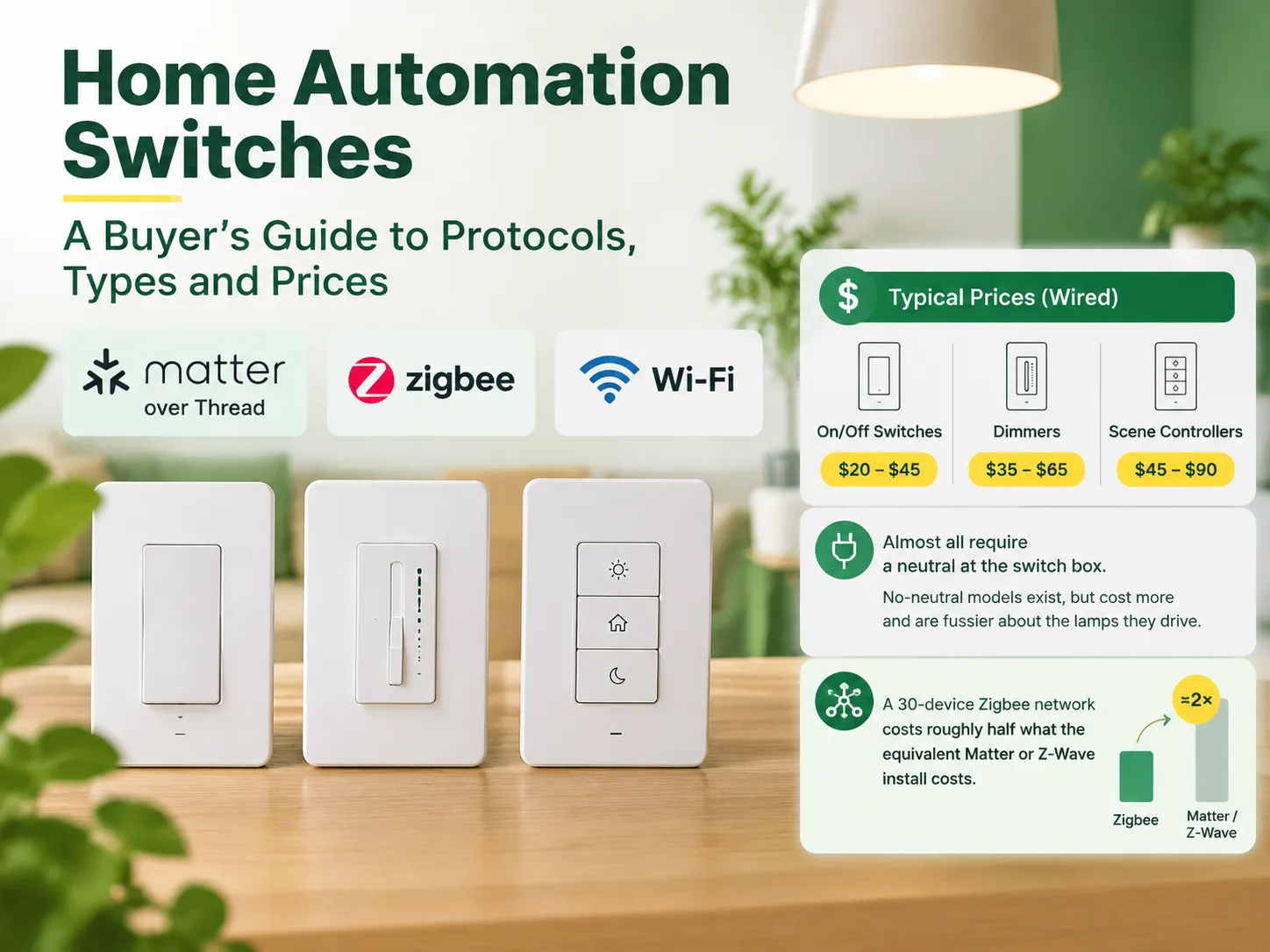
Acquistare un interruttore per automazione domestica non significa semplicemente acquistare un interruttore per la luce. Per un interruttore per la luce, tutto ciò che devi scegliere è il colore e quanti gruppi desideri. Per un interruttore per automazione, quasi nulla è così semplice poiché devi anche selezionare un protocollo, un sistema hub, se il cablaggio presente è […]

 No.6 Tuozhan Road, Leshang Pioneer Park, porto della baia di Yueqingwan, città di Yueqing, provincia di Zhejiang


