

Wanneer iemand de vraag stelt “gaan GFCI-stopcontacten slecht”, vragen ze misschien eigenlijk hoe lang een stopcontact meegaat voordat het faalt. Er is geen definitief of absoluut antwoord op die vraag, aangezien elke situatie uniek is; daarom zou elk GFCI-stopcontact goed moeten functioneren zolang er geen andere factoren zijn die bijdragen aan de storing, zoals blootstelling aan omgevingen die schade kunnen veroorzaken (bijvoorbeeld extreme hitte, vocht of waterschade). Er zijn verschillende soorten GFCI-stopcontacten met verschillende spanningswaarden, die op hun beurt verschillende levensduren zullen hebben als ze worden gebruikt in overeenstemming met hun beoogde doeleinden en de richtlijnen van de fabrikant.
Naast het weten hoe lang GFCI-stopcontacten meestal meegaan, is het noodzakelijk voor iedereen die overweegt een GFCI-stopcontact in hun huis of faciliteit te gebruiken, om de potentiële problemen te begrijpen die gepaard gaan met het gebruik van dergelijke apparaten, evenals welke stappen te nemen als het apparaat niet goed functioneert en is vastgesteld dat het buiten de aanvaardbare grenzen van zijn beoogde doel en de specificaties van de fabrikant valt. Daarom moeten we allemaal de tijd nemen om te leren over GFCI-stopcontacten, zodat we weloverwogen beslissingen kunnen nemen over de duurzaamheid van elektrische circuits en apparaten die in onze huizen en bedrijven worden gebruikt, en om onze familie, vrienden en werknemers te beschermen tegen potentiële gevaren die verband houden met het gebruik van GFCI-stopcontacten.
Het antwoord op uw vraag is ‘ja’, en ja, de GFCI-stopcontact zal na verloop van tijd falen. Over het algemeen is de levensduur van een GFCI-stopcontact ongeveer 10-15 jaar; De levensduur van een GFCI-automaat is 15-25 jaar; Als het is geïnstalleerd in een gebied dat aan vochtigheid is blootgesteld, of buiten, is de verwachte levensduur ongeveer 7-12 jaar vanwege omgevingsfactoren. Vervanging moet onmiddellijk plaatsvinden voor oudere GFCI-modellen die zijn gemaakt vóór de introductie van zelftestapparaten. Stille uitval is de gevaarlijkste situatie waarin de GFCI-eenheid u nog steeds van stroom voorziet en geen aardfoutbescherming heeft. Een functionerend GFCI-stopcontact zal binnen ongeveer één veertigste van een seconde uitschakelen bij een lek van 4-6 milliampère. Maandelijkse tests door de consument kunnen bepalen of de GFCI functioneert; Testen gebeurt door op test te drukken om de stroom uit te schakelen; en opnieuw in te stellen om de stroom weer in te schakelen. Het moet worden begrepen dat de kosten van de GFCI zelf ($15-$40) zeer klein zijn in vergelijking met de kosten van het inhuren van een erkende elektricien ($80-$200) om het GFCI-stopcontact te installeren; De kosten zijn gebaseerd op een aantal factoren, waaronder de geografische locatie en het type elektrische doos dat wordt gebruikt om het GFCI-stopcontact te monteren.
We moeten heel voorzichtig zijn met wat dit zegt, aangezien dit is hoe de uitval optreedt.
Een GFCI-stopcontact gebruikt een kleine stroomtransformator die voortdurend de stroom die door de fasedraad stroomt vergelijkt met de terugkerende stroom door de nuldraad. In een goed functionerende GFCI zijn de stromen in beide draden gelijk. Als er zelfs een kleine lek ergens in de kring is, zullen de metingen verschillen, en het mechanisme zal een mechanische schakelaar activeren om de kring te openen.
Overweeg vervolgens wat er met dit apparaat gebeurt na 15 jaar. Stoten van stormen en wanneer het net schakelt. Herhaalde uitschakelingen. Warmte van apparaten die veel stroom verbruiken. Vochtig weer. En wanneer er water binnenkomt. De elektronica die de detectie uitvoert, verslechtert door alle gevaren van de omgeving. En wanneer het verslechtert, faalt het bijna op een gevaarlijke manier.
De uitval gebeurt op twee manieren. Of het uitschakelmechanisme stopt met goed functioneren, wat duidelijk is omdat je RESET niet kunt vasthouden. Of — wat gevaarlijker is — de sensor stopt met werken terwijl het stopcontact blijft werken. Moderne GFCI's kunnen zelftests uitvoeren waarbij ze interne controles uitvoeren. Oudere GFCI's die zijn gemaakt voordat de zelftesttechnologie werd geïmplementeerd, hebben geen manier om aan te geven dat er iets mis is.
Dit is het hele punt van het advies dat door de experts in het veld wordt gegeven — “test de GFCI eens per maand” is niet alleen een bureaucratische vereiste. Het is de enige manier om de defecte GFCI te detecteren die is gestopt met werken.
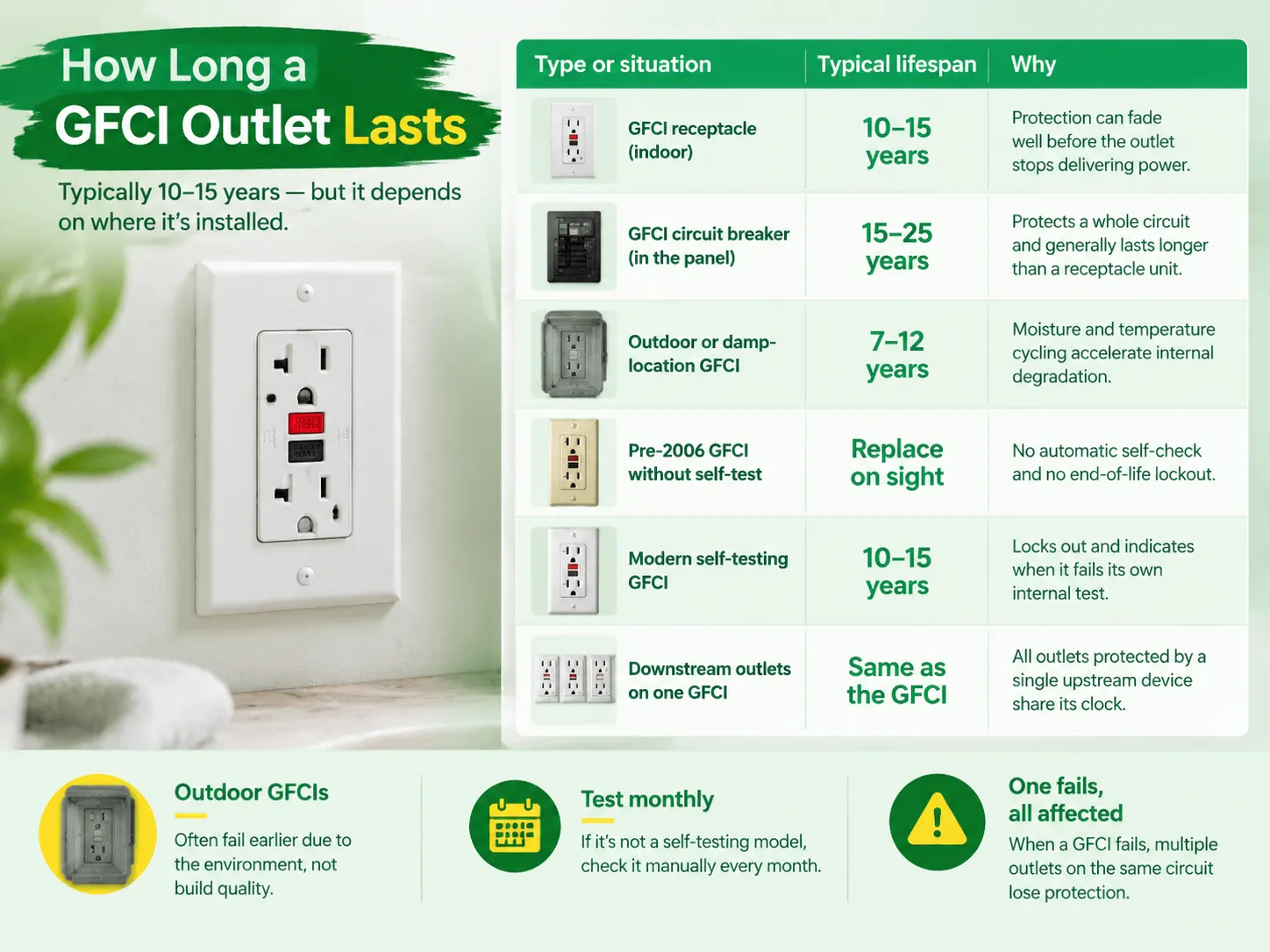
“Tien tot vijftien jaar” is het hoofdcijfer, maar waar het stopcontact is geïnstalleerd verandert het veel.
| Type of situatie | Typische levensduur | Waarom |
|---|---|---|
| GFCI-stopcontact (binnen) | 10–15 jaar | Bescherming kan al vervagen voordat het stopcontact stopt met het leveren van stroom |
| GFCI-automaat (in de kast) | 15–25 jaar | Beschermt een hele circuit en gaat over het algemeen langer mee dan een receptacle-eenheid |
| Buiten- of vochtige locatie GFCI | 7–12 jaar | Vocht en temperatuurcycli versnellen interne degradatie |
| Pre-2006 GFCI zonder zelftest | Vervangen bij zicht | Geen automatische zelfcontrole en geen einde-van-leven uitschakeling |
| Moderne zelf-testende GFCI | 10–15 jaar | Sluit af en geeft aan wanneer het zijn eigen interne test niet doorstaat |
| Downstream outlets op één GFCI | Hetzelfde als de GFCI | Gewone outlets die worden beschermd door een enkele upstream apparaat delen zijn klok |
Twee interessante dingen om op te merken. Ten eerste, een buiten GFCI kan van hetzelfde merk zijn als het binnenmodel, maar zal waarschijnlijk veel eerder defect raken vanwege de installatieomgeving in plaats van de bouwkwaliteit. Ten tweede, wanneer de GFCI het werk van het beschermen van de reeks reguliere outlets achter zich hervat, lijden alle outlets die op die GFCI vertrouwen samen verliezen. Daarom ontdekken mensen meestal het probleem bij een defecte GFCI wanneer ze merken dat verschillende outlets niet goed functioneren in plaats van slechts één.
Het belangrijkste punt van de tabel is de testfactor. Als uw apparaat is geïnstalleerd vóór de verschijning van de zelf-testende varianten van het apparaat, moet u het apparaat elke maand handmatig testen om de werkingstoestand bij te houden.
Niet alle GFCI-fouten zijn hetzelfde probleem, en de oplossing verschilt. Hier zijn de gevallen die de meeste gevallen verklaren.
| Fout | Wat u observeert | Wat er aan de hand is | Bedradingsspecificaties in een normale Amerikaanse installatie zijn als volgt: zwart dat hete (of geschakelde hete) stroom transporteert, rood dat de tweede schakeldraad vertegenwoordigt (in 14-3/12-3 kabel), wit als neutraal (houd er rekening mee dat de witte draden intern zijn verbonden, niet in de schakelaar), en blanke draad/groen voor aarding. In het geval van het VK/EU wordt bruin beschouwd als live, blauw staat voor neutraal (maar als het werkt als schakeldraad/schakelaar live, is het omhuld met bruin), en groen-geel geeft aarde aan; bovendien zijn de gebruikelijke labels die daar in de terminals worden gebruikt COM, L1 en L2 – COM leidt live stroom van de ene schakelaar en geschakelde live stroom van de andere. Het principe achter dit alles blijft min of meer onveranderd; het is echter essentieel om aandacht te besteden aan de kleurspecificaties en labels. Voor een visuele vergelijking van hoe verschillende schakelaartypes zijn opgebouwd, laat onze gids voor |
|---|---|---|---|
| Silent sensing failure | Nothing — outlet works normally | Sensing circuit degraded; device no longer detects ground faults | Replace immediately. TEST button is the only detector |
| Won’t hold on reset | RESET pops straight back out | Mechanism worn out, or an active fault still present | Unplug everything and retry; if it still won’t hold, replace |
| Completely dead outlet | No power, buttons unresponsive | Internal failure, or no supply from the panel | Check the breaker first, then replace the device |
| End-of-life lockout | Fault light on; no power | Self-testing unit detected its own failure and locked out by design | Replace — this is the device working correctly |
| Nuisance tripping | Trips repeatedly with nothing plugged in | Genuine fault, moisture in the box, or a hair-trigger worn unit | Dry and diagnose first; replace if the fault persists with nothing connected |
| Thermal damage | Warm faceplate, discolouration, burning smell | Loose termination or overload creating resistance heat | Stop using it. This is a fire risk, not just a protection failure |
This point really needs reiteration. Warm faceplates or burning odors emanating from a receptacle are not normal — and this isn’t specific to GFCIs but indicates that there may be a loose connection somewhere in your electrical system. Even if the GFCI is still functioning, there is still a danger of fire occurring. Shut off the breaker and have it checked.
Furthermore, there is something to be said about the fact that the device has a life span. Modern self-testing GFCIs are designed to permanently lock out when they can no long guarantee any level of protection, which means that a dead receptacle with a great light is perfectly normal behavior. Look for this feature while shopping for a replacement: a device that indicates it has stopped working is far more useful than one that just leaves you wondering.If you want to see what that looks like as a product category rather than a description, the two formats most commonly used in residential and light commercial work are the standard GFCI receptacle for wall-box installation and the weather-resistant variants built for outdoor and damp locations.
While GFCIs usually start displaying their issues without notifying the user beforehand, there are still common signs to look out for, which are listed below in chronological order, starting from the one that occurs first:
One more sign that is often misdiagnosed: if the GFCI trips every time you plug an appliance into it, that doesn’t mean it’s faulty GFCI. Try plugging in another device in that GFCI. If it successfully works with another device but trips with a hairdryer, you need to discard the hairdryer. In case everything trips, the device or moisture in the circuit may be a reason for that. If the breaker trips but not the GFCI, then it indicates that it’s a problem with circuit capacity.
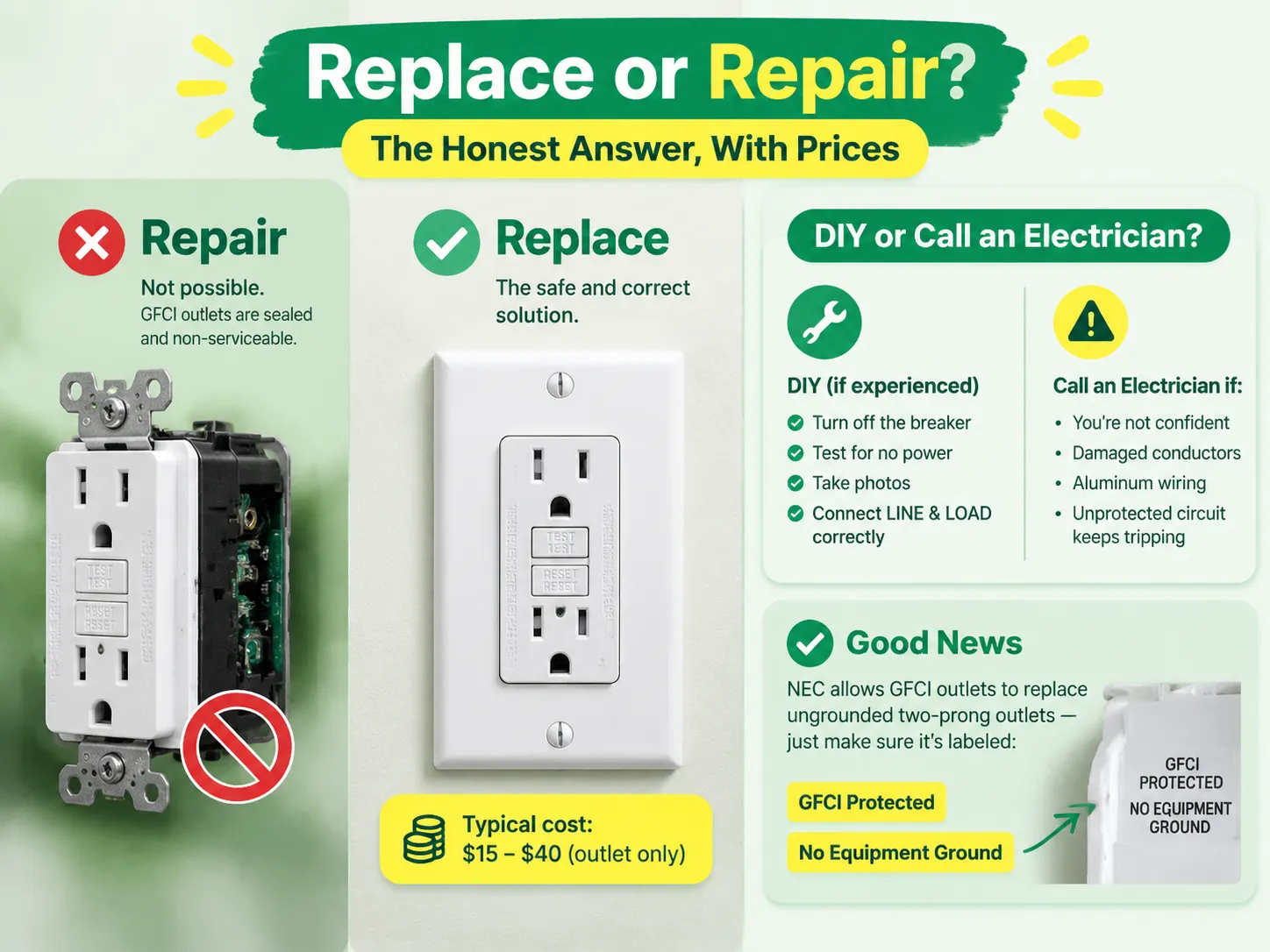
There exist both a version of this inquiry that can be answered and another version that cannot.
The answerable version: Is it possible to repair a GFCI outlet? It cannot be done; a GFCI receptacle comes as a sealed or non-serviceable electronic system. Since it lacks user-replaceable parts, no person is capable of repairing the internal sensing circuit anywhere else apart from the place of fabricating it. In case the protection is compromised, the device shall be replaced with a new one as that is simply what the product’s design implies.
The unanswerable version: Should you perform the substitution independently or call for an electrician? The answer to this question depends a lot on your own skills and also on the requirements imposed by your local jurisdiction. Changing a GFCI is really simple for someone experienced in dealing with live wires: you shut off the breaker, check it with a tester, take photos of the wiring prior to touching it, and connect the LINE and LOAD terminals in a proper manner. The most common error in this operation consists of making the right connection using LINE and LOAD cables in a wrong way.
The steps and the pitfalls are covered in more detail in this walkthrough on replacing a wall socket safely, including the checks worth doing before and after.If you are not sure whether you can perform the repairs yourself — or if there is a risk that the box has damaged conductors, aluminum wiring, or has an unprotected circuit that keeps tripping — stop and call in an electrician. Electrical problems are among the few types of repairs that can kill someone who makes a mistake trying to fix it without any expertise.
Another fact that is interesting to know about is that, according to the straight NEC rules, it is possible to use GFCI receptacles to do away with ungrounded two-prong outlets. As long as the new outlet is marked as “GFCI Protected” and “No Equipment Ground,” you have a great life-safety benefit without having to spend any money on rewiring.
Eilling is a matter of time and money, so be careful and know your options.
| Artikel | Typische kosten | Opmerkingen |
|---|---|---|
| GFCI receptacle, standard | $15–$40 | Weather-resistant and self-testing models sit at the upper end |
| GFCI circuit breaker | $40–$90 | Panel-level protection for a whole circuit |
| Plug-in GFCI tester | $10–$15 | Confirms wiring and lets you test the outlet externally |
| Electrician, residential replacement | $80–$200 per outlet installed | Most of the cost is labour and diagnosis, not the device |
| Bathroom or difficult location | $120–$300 per outlet installed | Higher when the box needs work or the outlet has to move |
| Multiple outlets in one visit | Lower per outlet | The economic case for doing them together rather than one at a time |
Electricians charge different rates depending on the region and the type of work they are doing, but rates remain stable enough to help with planning.What this means in practice is that it is usually cheaper to replace components on your schedule than to wait until something fails.
Electronics can’t be stopped from aging, but they can be kept from aging too fast. Most of the things that shorten the life of a GFCI are issues related to its environment or the electricity it receives.
People tend to overlook the argument regarding the environment point. For instance, if a fixture is rated for fifteen years in a corridor, it will only last half as long in an area that has a defective hose bib. If you’re specifying outlets for damp or outdoor locations, weather resistance isn’t an upgrade — it’s the requirement, which is exactly what separates a general-purpose unit from a weather-resistant GFCI designed for damp and outdoor installation.
It is fully prevention procedure that requires less than a minute for execution in each outlet.
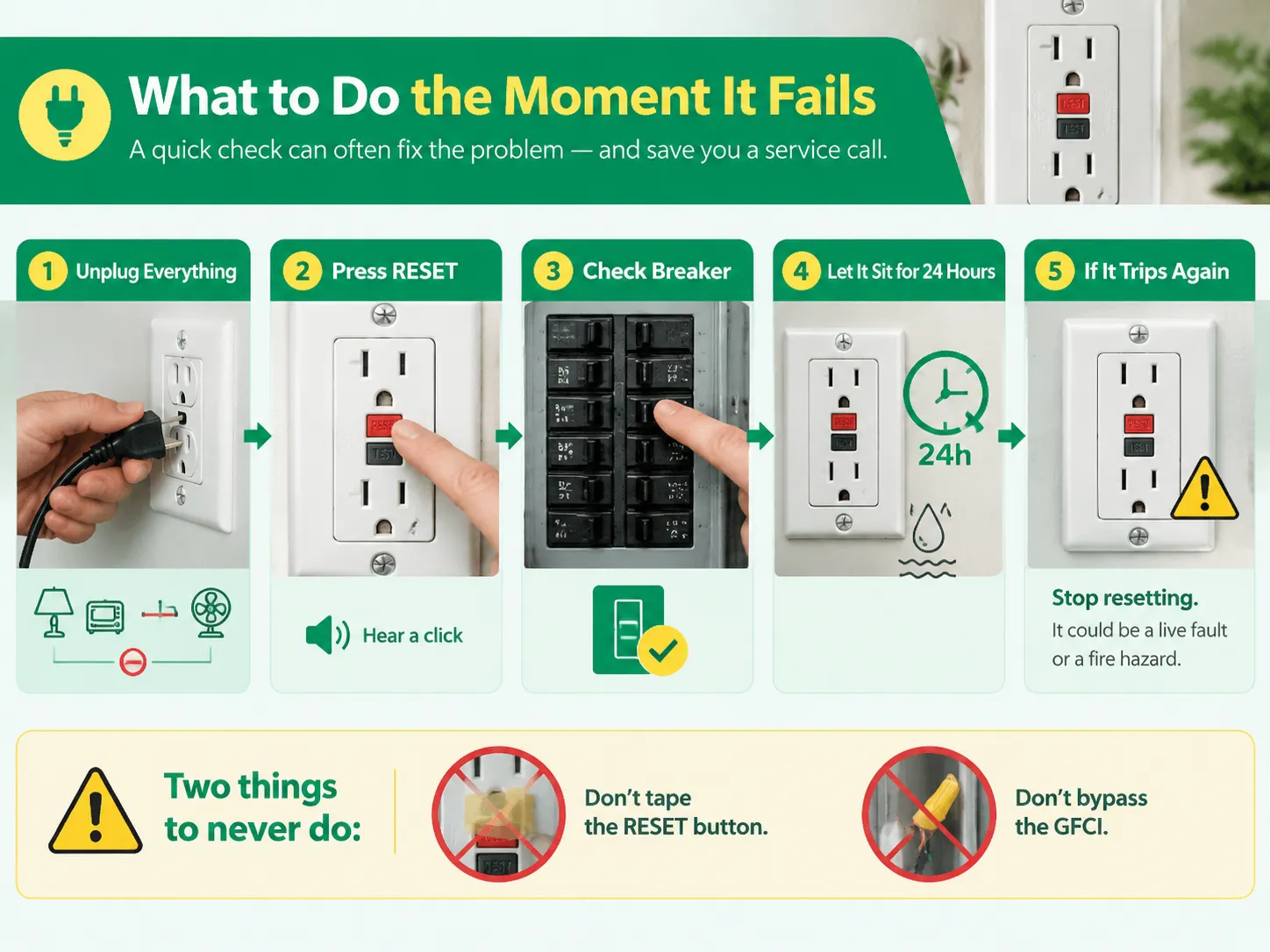
When the outlet is not working or the Ground Fault Circuit Interrupter is not working, there are several steps to follow. It does not take much more than five minutes and it actually helps save money on unnecessary service calls.
There are two things that should never be done: do not tape the RESET button and do not bypass the GFCI because doing one of those things is not a good idea, either. If you want the diagnostic sequence in more detail — what each symptom points to and which ones you can fix yourself — this guide to what to do when a socket or outlet stops working walks through the same logic with the wiring-side checks included.
Requirements vary according to the jurisdiction and age of the property so it is always advisable to check the local code. Despite this, more or less the list designated by the NEC includes locations where water and electricity could meet:
If your house was built before the date the requirement was instituted and the outlet was not updated, the code states that the given element can remain. However, this does not mean that this outlet was safe.
One clarification that is essential to be done is that GFCI and circuit breaker do different jobs, and both are necessary.
| Apparaat | Protects against | Trips at | Where it lives |
|---|---|---|---|
| Stroomonderbreker | Overcurrent — overload and short circuit | Rated amps (15 A, 20 A, etc.) | Distribution panel |
| aardlekschakelaar | Ground faults — current leaking to earth through a person or water | 4–6 milliamps | Receptacle or panel |
| AFCI | Arc faults — dangerous arcing in damaged wiring | Arc signature detection | Panel, or combination devices |
A breaker would allow five milliamps of current to pass through your body without any problem — it won’t trip. That’s where the GFCI comes in, so it should be understood that a GFCI should not be used as a substitute for a breaker and vice versa.If you’re trying to understand how the two layers work together, the relationship between breakers and the outlets they feed is set out in this explanation of circuit breakers and the outlets and switches they protect, and it’s worth five minutes if you’ve ever wondered why a bathroom has two separate devices doing apparently similar jobs.
There’s something we can’t forget about when we discuss GFCIs – their manufacturing process. First and foremost, GFCIs are component-supply products, and the reliability of their sensing circuit boils down to component selection, quality control at the manufacturer’s place, and end-of-line testing. Hence, companies like igoto supply switches, plus sockets, outlets, and power strips, including GFCIs, to their distributors and contractors. This is also the reason why published standards matter when it comes to purchasing – a GFCI that doesn’t meet the applicable UL standard does not become cheaper but is just a different product that looks very similar.
You can check this by using a lamp. Plug the lamp into the protective switch, press TEST, and you should see that the lamp goes out and the RESET button pops out; if you press RESET button afterwards, you should see that the power is restored. If TEST doesn’t work and RESET can’t be pressed down, then it means the protection has failed and the unit needs to be replaced, even if the electrical appliances are powered normally. You may also check for some other indications like warm or discolored faceplate, a fault light blinking or shining continuously, regular tripping when nothing is being plugged into the device or difficulty with pressing down RESET.
Normally, a GFCI outlet remains functional for approximately a decade or a decade and a half whereas a GFCI breaker does its job for slightly longer. Due to the presence of moisture and humidity outdoors, most devices don’t last more than 10 years. Furthermore, devices produced before self-testing systems were introduced should be changed out even if they are not broken because they cannot reveal whether they are malfunctioning or not.
Substitute it when it fails any of such checks: either it doesn’t turn off the electricity, the reset is not persisted or a device has triggered self-test lockout lock, or the unit hasn’t reset itself even after the disconnection and drying of the circuit. In case it’s aged more than 10 to 15 years or is older than self-testing devices, then it can be replaced based on the age alone. It has to be replaced without a delay in case the device is warm, burnt or emits odour.
The primary causes are degradation due to aging of the sensing electronics, the number of times power surges and lightning hits, frequent tripping cycles that have taken a toll on the mechanical latch, moisture ingress into the enclosure and heat stress due to overloaded wires and/or loose terminations. It is significant to differentiate whether the aforementioned problems are due to appliance defects or real ground faults, as a GFCI that trips only when a certain appliance is plugged in is likely discovering an actual current leak in that appliance rather than a GFCI malfunction.
GFCI outlets do fail, and it’s important to note how they fail. GFCI outlets do not give a warning; they keep working like they’re meant to. The light keeps turning on and off, and that vital function — the cutting of power when current is leaking through a person — may fail without any visible sign at all.
The take-home point is 10-15 years lifespan for a receptacle, 7-12 years lifespan in damp places, and a trip time equal to about 1/40 second at 4-6 mA for a working device. In practice, the device costs between $15 and $40 and costs another $80-200 to install, making this simple little device the difference between just getting a shock from a bathroom outlet and getting seriously electrocuted.
For this reason, test every month. Press TEST, see the power goes out, press RESET. If the device does not work just as it should, it must be replaced — it cannot be fixed. If the device has served you for more than 10 years, yes, replace it on your schedule, not in an emergency situation. When buying the replacement, always opt for self-testing devices that can alert a user before breaking down, which is a huge advantage over devices that will stop working without any warning.

When someone asks the question “do GFCI outlets go bad”, they may really be asking how long an outlet will last before failing. There is no definite or absolute answer to that question as every situation is unique; therefore each GFCI outlet should properly work as long as there are no other factors contributing to […]
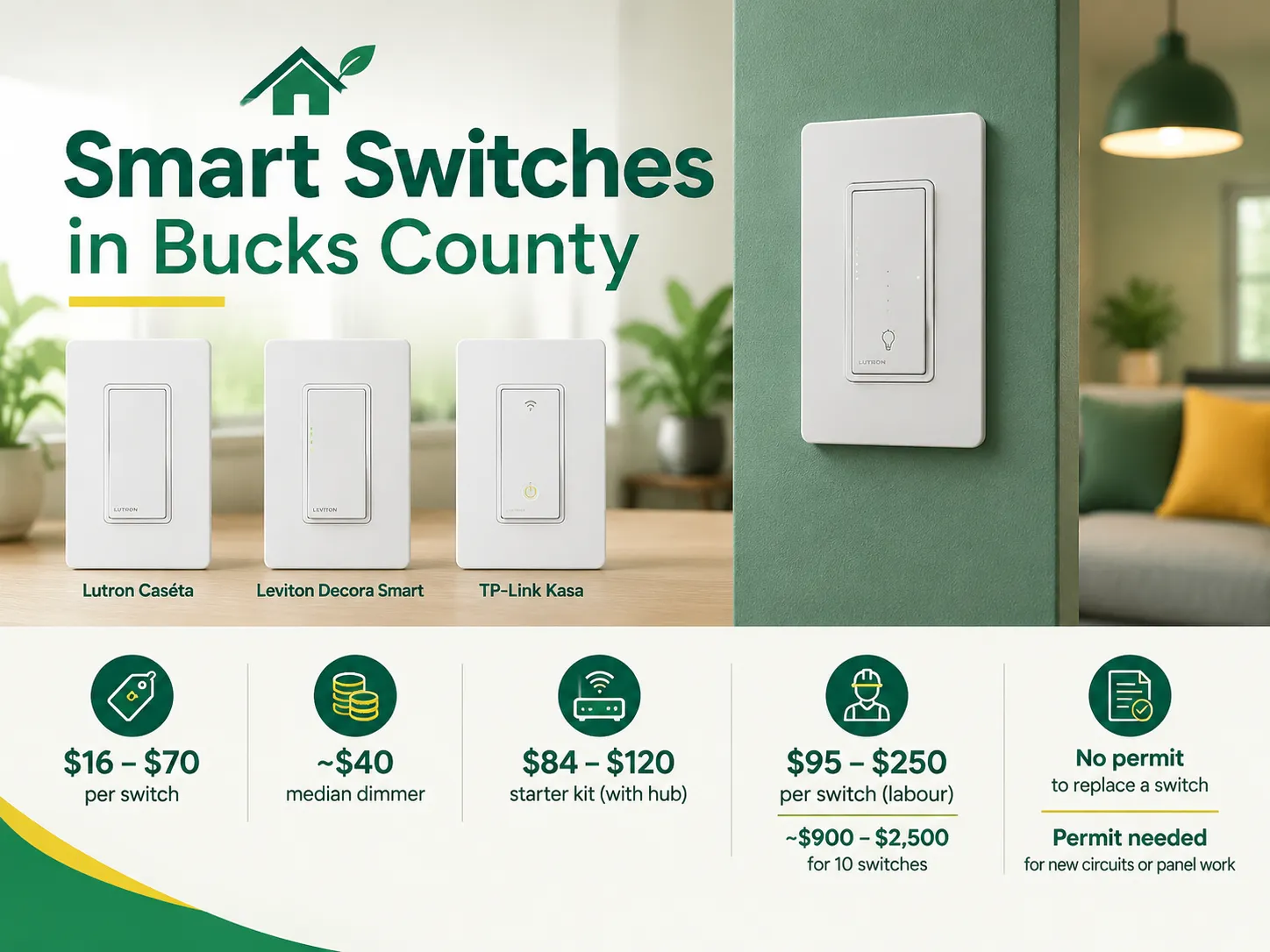
Het kopen van slimme schakelaars in Bucks County is relatief lastig, waarbij de moeilijkheid meer een kwestie is van de kenmerken van het lokale vastgoed dan van de beschikbaarheid van de systemen. Men kan rijden van Solebury, waar sommige huizen teruggaan tot de jaren 1790, naar Warrington, waar enkele nieuwere constructies zijn gebouwd […]

Draadloze lichtregeling heeft een vies klein geheim: terwijl het vaak uitzonderlijk goed werkt in demonstraties, laat het mensen in hun huizen vaak in de steek. De schuldige is zelden de app; in plaats daarvan ligt het achter de muur. Deze gids presenteert de keuzes op een ordelijke manier. Zes manieren om licht draadloos te regelen, vijf protocollen die […]

 No.6 Tuozhan Road, Leshang Pioneer Park, Yueqingwan Bay Harbor, Yueqing stad, provincie Zhejiang


