

Als je vaak reist, weet je waarschijnlijk dat inpakken voor Singapore een van de eenvoudigste dingen is om te doen in Azië, maar ook een van de moeilijkste omdat het UK-type stekkers gebruikt (in plaats van de VS-type). Of je een transformator, een stekkeradapter of beide nodig hebt, hangt af van twee vragen die toeristen meestal verwarren.
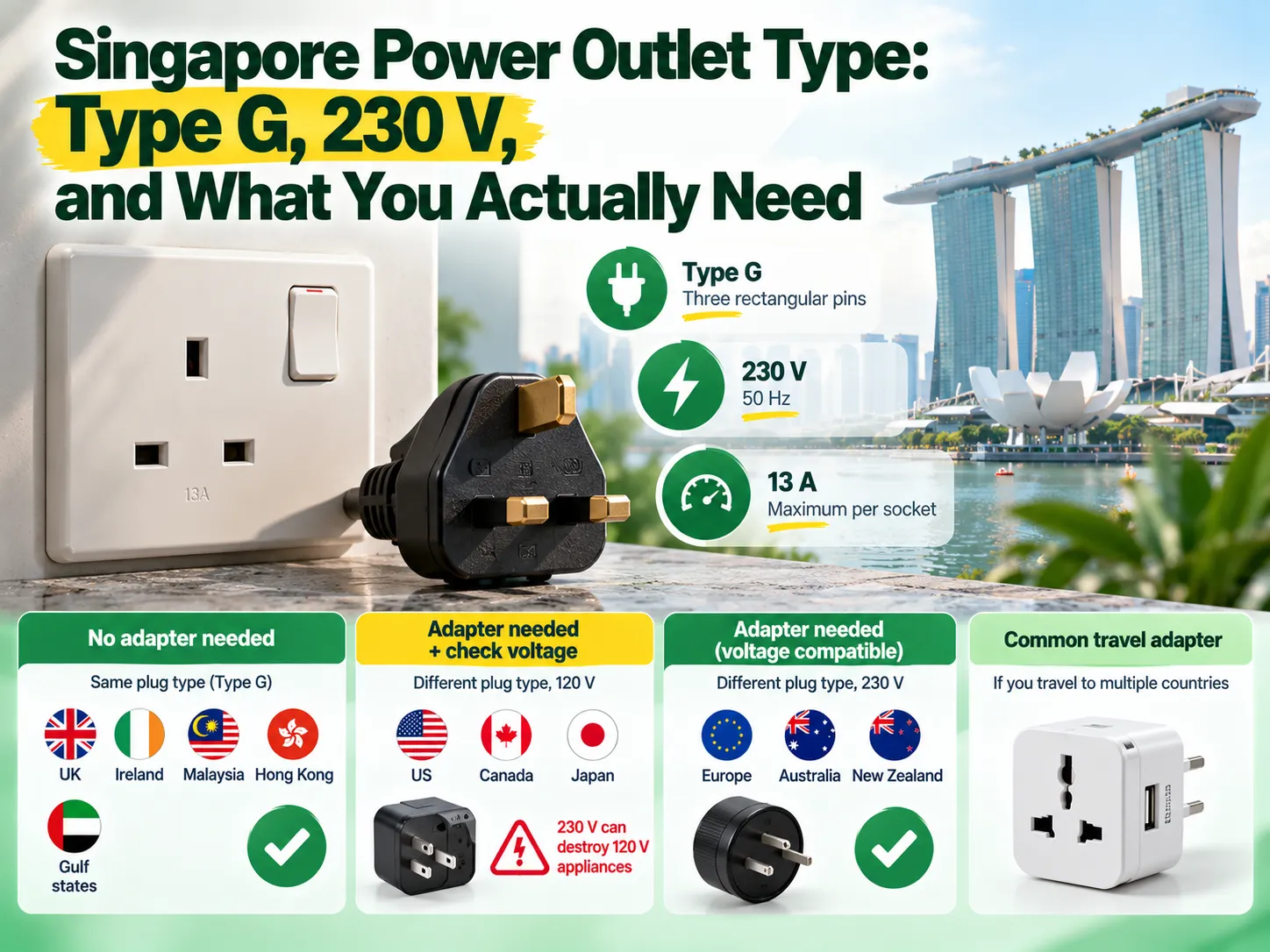
In het kort: In Singapore wordt de Type G stekker gebruikt, die is gebaseerd op de Britse BS 1363 van de SS 145 standaard met dezelfde kenmerken. De netspanning van Singapore en de frequentie zijn 230 V en 50 Hz. Bezoekers uit het VK, Ierland, Maleisië, Hongkong en enkele Golfstaten hebben niets nodig. Bezoekers uit de VS, Canada en Japan moeten een adapter gebruiken en de spanning controleren. Apparaten van de 120 V voeding zullen dus beschadigd raken. Bezoekers uit Europese landen, Australië en Nieuw-Zeeland hebben alleen de adapter nodig, aangezien de spanning hetzelfde is.
De rangschikking van drie rechthoekige pinnen in Type G is uniek. De twee platte pinnen aan de onderkant zijn gepositioneerd om als fase- en neutrale pinnen te dienen, terwijl de langere pin aan de bovenkant als aarding pin dient. De reden voor de langere aarding pin is dat deze de aarding verbinding mogelijk maakt voordat de fase verbinding wordt gemaakt.
Alle stekkers in Singapore voldoen aan dit patroon en bezitten unieke ontwerpeigenschappen die ze tot een van de veiligste stekkers ter wereld maken. De belangrijkste kenmerken zijn:
Het bredere plaatje van hoe stekker vormen wereldwijd variëren — en waarom er vijftien benoemde types zijn in plaats van één — wordt uiteengezet in dit overzicht van de verschillende wandstopcontacttypes en waar elk type wordt gebruikt.
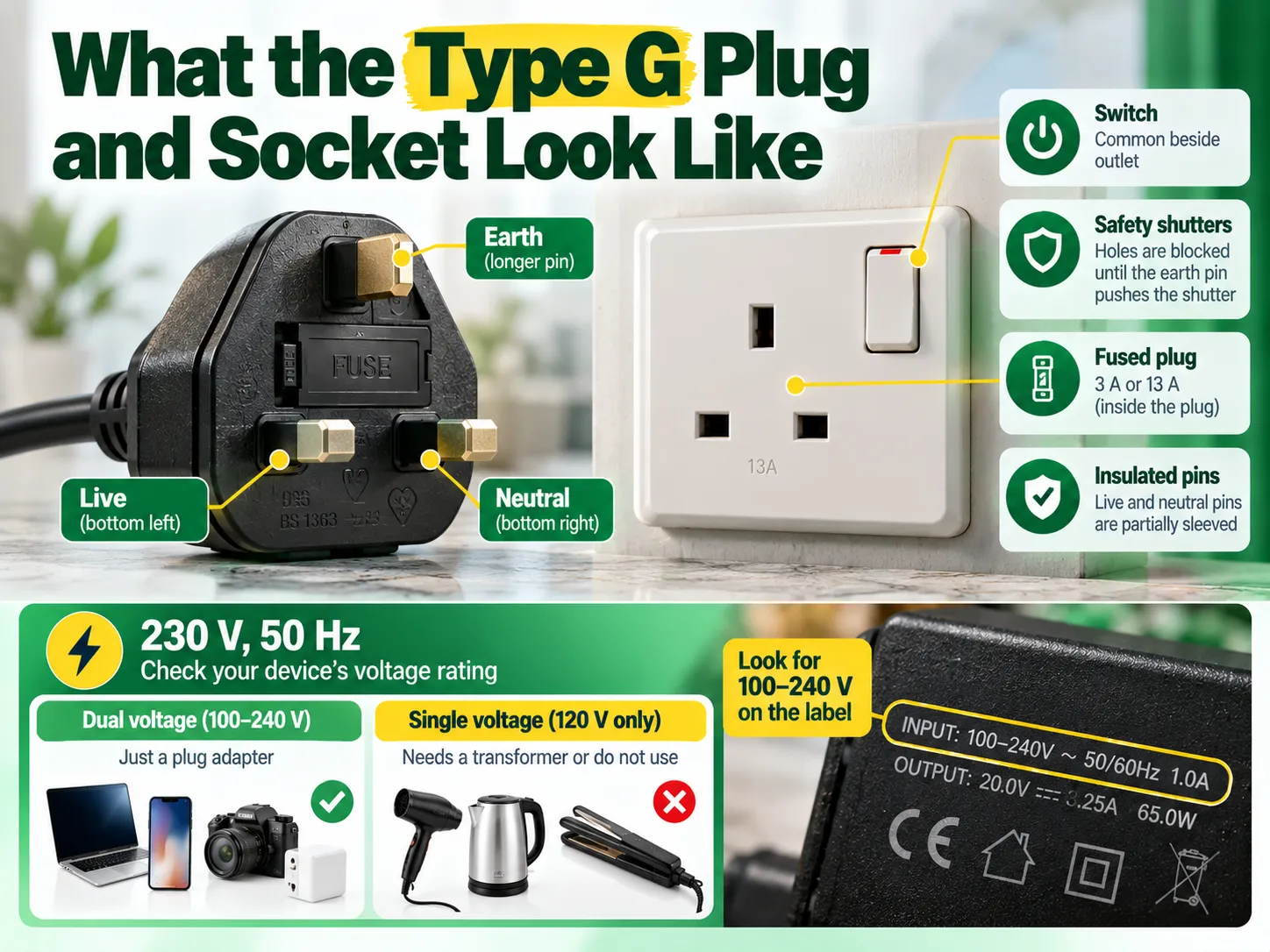
Singapore wordt van elektriciteit voorzien met 230 V, 50 Hz, wat in overeenstemming is met de Europese normen, in tegenstelling tot Noord-Amerika. Het netwerk wordt beheerd door SP Group en staat bekend als een van de meest stabiele netwerken ter wereld. De geleverde spanning ligt bijna altijd binnen enkele procenten van de nominale waarde.
Dit nummer impliceert twee belangrijke dingen:
Om problemen te voorkomen bij het reizen naar Singapore, zorg ervoor dat je zoekt naar het dual-voltage label. De meeste laptops, telefoonladers, cameralaadapparaten, elektrische tandenborstel laders en draagbare luidsprekers van het afgelopen decennium zijn ontworpen om te werken in het bereik van 100 – 240 V, 50/60 Hz en vereisen dus alleen een stekkeradapter wanneer ze in Singapore worden gebruikt. De enige apparaten die een potentieel risico op falen hebben, zijn de apparaten die elektriciteit direct verbruiken (föhn, stijltangen, waterkokers, enz.).
Dit is waar de meeste verwarring verdwijnt, omdat het antwoord volledig afhangt van waar je vandaan komt.
| Komend van | Jouw stekkertype | Adapter nodig? | Spanning |
|---|---|---|---|
| VK, Ierland, Maleisië, Hongkong | Type G | Nee | Past bij 230 V |
| VAE, Qatar, Bahrein, Koeweit, Oman | Type G | Nee | Past bij 230 V |
| Saoedi-Arabië (nieuwere gebouwen) | Type G | Meestal nee | Past |
| Europa (Type C, E, F), Italië, Zwitserland | Ronde pinnen | Ja | Past — alleen adapter |
| Australië, Nieuw-Zeeland | Type I | Ja | Past — alleen adapter |
| VS, Canada | Type A / B | Ja | Mismatch — controleer elk apparaat |
| Japan | Type A / B | Ja | 100 V — converter nodig voor sommige apparaten |
| Indië | Type D / M | Ja | Past — alleen adapter |
Als jouw land Type G gebruikt, moet je jouw opladers meenemen en de adapter thuislaten. Als jouw land geen Type G gebruikt, is er slechts één Type G cover voor je hele reis — Singapore heeft geen regionale variatie zoals sommige grotere landen. De volledige regionale uitsplitsing, inclusief welke delen van de wereld welke standaard delen, wordt behandeld in deze gids voor stekker- en stopcontacttypes per regio.
Nee, en dit is de meest kostbare aanname die een reiziger uit Noord-Amerika maakt. Een Type A stekker uit de Verenigde Staten heeft twee platte en parallelle bladen en past niet in een Type G stopcontact omdat het stopcontact verzonken is en de shutters helemaal niet openen. Bovendien zal een Type B stekker met zijn ronde aardepin ook niet werken.
Spanning is belangrijker dan dit. Als een apparaat uit de VS, dat alleen is gecertificeerd voor 120V, wordt aangesloten op 230V via een goedkope adapter, zal het falen. Daarom is de juiste volgorde van handelingen voor een Amerikaanse reiziger als volgt: gebruik eerst een adapter en controleer vervolgens het label van elk apparaat voordat je het aansluit. De verschillen tussen de Noord-Amerikaanse configuraties en de rest van de wereld worden uiteengezet in deze uitleg van het Noord-Amerikaanse stopcontacttype, which is worth reading if you are deciding whether a device will travel at all.
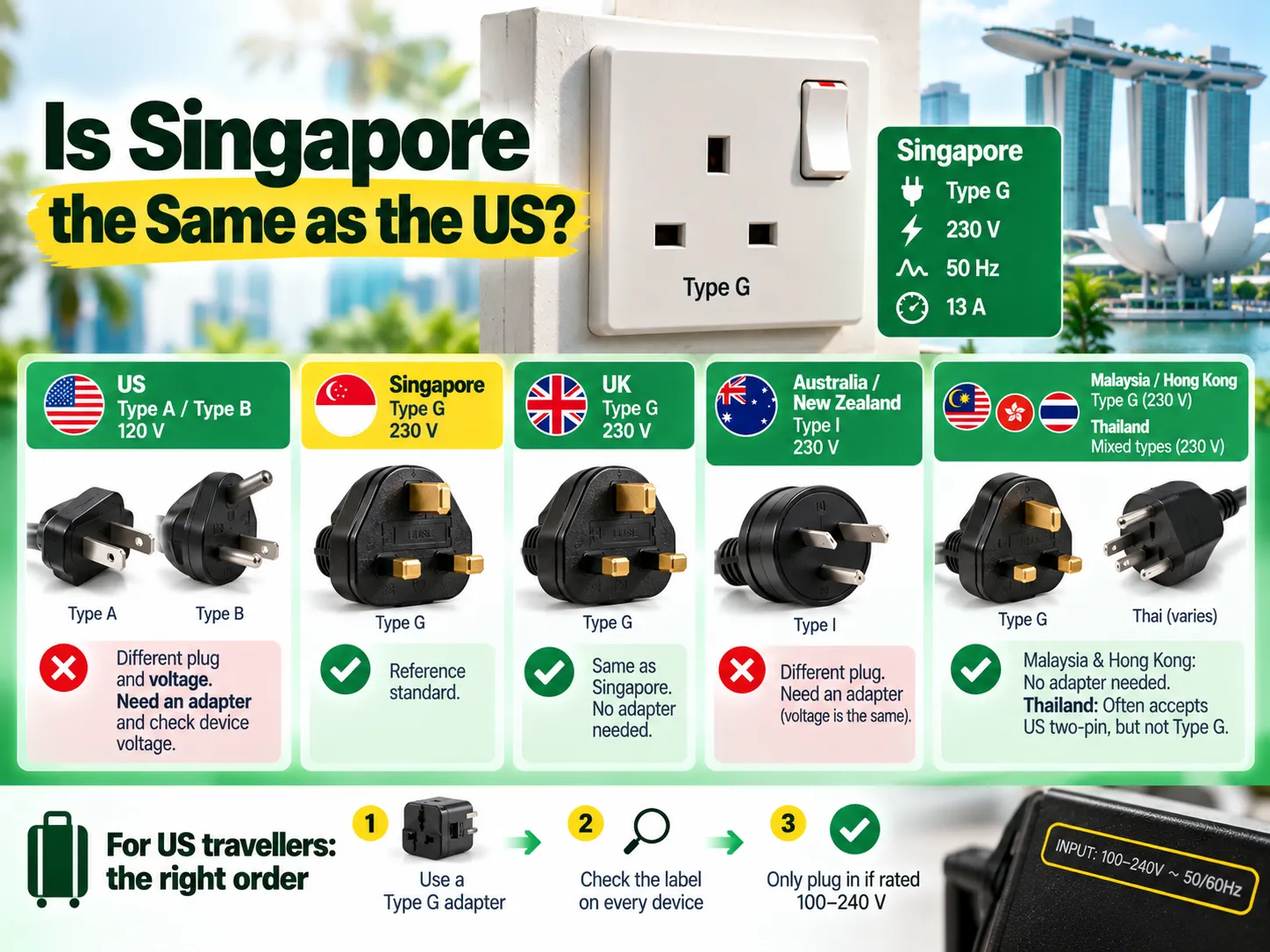
Just like the UK: yes, absolutely. Singapore adopted British standards, meaning that the connectors, sockets, fuses and other power supply infrastructures are the same. So if you have an appliance from the UK, you can use it in Singapore without needing anything else.
Just like Australia: no. Australia and New Zealand use standard I, with three flat pins, and with the exact same voltage and frequency (230 V / 50 Hz) — naturally, the voltage is the same, and you would just need a plug adapter for Type I.
Just like its neighbors: mixed. Malaysia, Hong Kong, and Brunei also use G without needing adapters, while in Thailand, things are different, as there are many different plug types used, depending on the building. Thus, a Thai socket can sometimes accept a US two-prong plug without an adapter, but may not be suitable for G. That kind of regional inconsistency is exactly why travel itineraries through Southeast Asia need more than one adapter even though the voltage stays broadly the same across the region, as set out in this guide to the socket types used in Thailand.
This mistake is the one that can result in a person losing a laptop. A plug adapter only changes the shape of the connector being used; it doesn’t contain any electronics. But a voltage converter changes the voltage from 230V to 120V. If you buy the wrong one, your appliance will fit well only to burn out immediately after.
Cost of appliances in Singapore: plug adapters range from 5-30 SGD while voltage converters and converters for 120V appliances start at 30 SGD onwards (depending on the wattage). If your appliance is a dual-voltage one, it means that it is 10 SGD device, not 100 SGD.
Pay attention to adapters sold in airports. Plug Type G that is sold in the shop for 5-10 SGD will be priced upper 15-30 SGD in Changi, and uncertified plugs will have greater overheat and an electrical short-circuit risks than certified plugs. Opt for certified adapters with a fuse instead of picking the cheapest one on the market. The same logic applies to the European systems, where the differences between Type C, Schuko and the French and Italian variants catch people out — covered in this breakdown of Europese stekkers en stopcontacten if your trip continues onward from Singapore.
Most plug types ensure protection of the wiring behind the wall. However, Type G goes a step further and protects the appliance itself, as it has the fuse in the plug rather than in the panel. This is why you can find both 3 A and 13 A fuses on sale in every supermarket in Singapore, and also why a UK appliance with a 3 A fuse cannot power a 2-kW heater.
For a manufacturer or importer, this means compliance and not travelling. Plugs sold in Singapore need to have an adequate fuse for the load and devices that are to be installed permanently should have appropriate certification and the EMA SAFE mark. The power outlets should have a shutter system as well. Mistakes here lead to customs problems and disruptions related to shipment.
The coverage is acceptable and becoming better but it is still not consistent.
In case you are staying at a hotel that is on the older side or need more devices to be powered by one electrical socket, it is better to go for a power strip rather than buy an additional adapter.
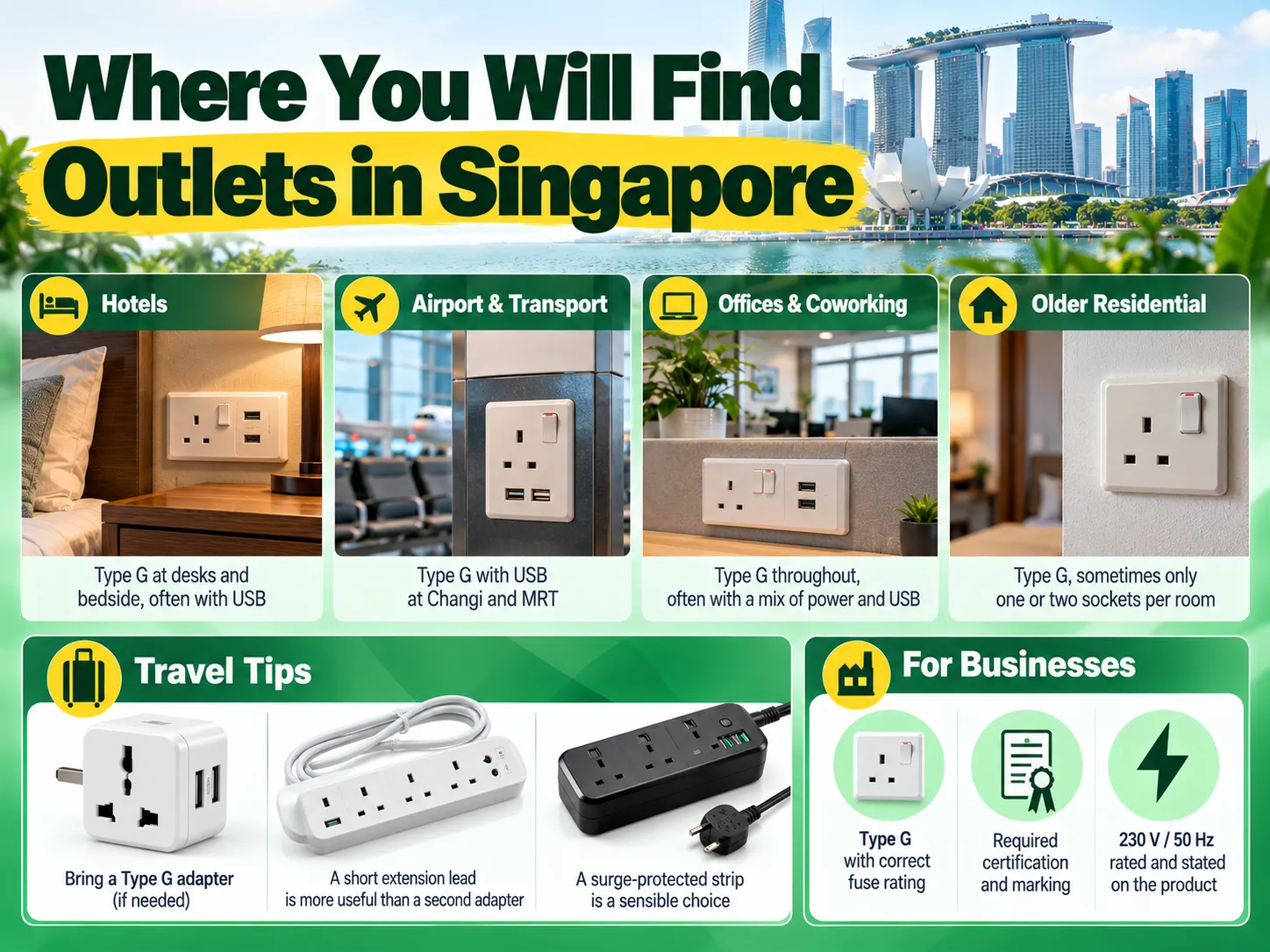
The sale of a product for permanent use depends on three requirements:
A reusable multi-region adapter does not qualify as a travel adapter. A travel adapter is a consumer gadget whereas a shuttered Type G socket rated for 13 A is a different product made under a different standard. The use of one related to another causes the failure of a compliant order at the border.
The type G adapter with three rectangular pins arranged in a triangular shape by itself won’t be needed unless, of course, you are coming from the UK, Ireland, Malaysia, Hong Kong or one of the Gulf states. It would be advisable to get a Type G fused adapter instead of unfused, as not only is it available at a price ranging anywhere between S$5 to 30 but you’re better off buying it in your home country rather than at the airport where it would be two to three times more expensive.
Type G is standardised under SS 145 standards and is largely similar to British BS 1363. Type G has three rectangular pins, the use of an in-plug fuse, sleeved live and neutral pins, and shuttered sockets, with a voltage of 230 V and 50 Hz.
No. The Type A and Type B plugs in the United States will not fit the Type G sockets in Singapore, and their voltages are different – 230 V versus 120 V. American visitors will require a universal plug adapter and must ensure that every device works on voltage ranging from 100 to 240 V. If one-plug appliances are used, they will get destroyed.
No, in Australia, plug type I is used, which has three flat pins arranged in a V shape. Because the voltage and frequency settings in Australia are identical at 230 V / 50 HZ, this means that in Australia, an adapter would be sufficient. However, because the pins are physically different, such as in shape or size, this form of connection will not work in Australia and therefore it must be used.
The voltage and the plug type used in Singapore are Type G 230V 50Hz. Unlike the North American plug which is a different voltage altogether, its shape also varies from that used in Australia. From your travel itinerary, you can deduce what kind of a plug you will need for your appliances. If you are coming from a Type G country, no adapter is necessary. If you are from a 230V country, an adapter will suffice. If your previous destination was a 120V country, you will need an adapter plus careful examination of the appliance tags.
If you travel often, then you probably know that packing for Singapore is one of the simplest things to do in Asia, but also one of the most difficult because it uses UK-type plugs (instead of the US-type ones). Whether you need a transformer, a plug adapter or both depends on two questions that tourists […]
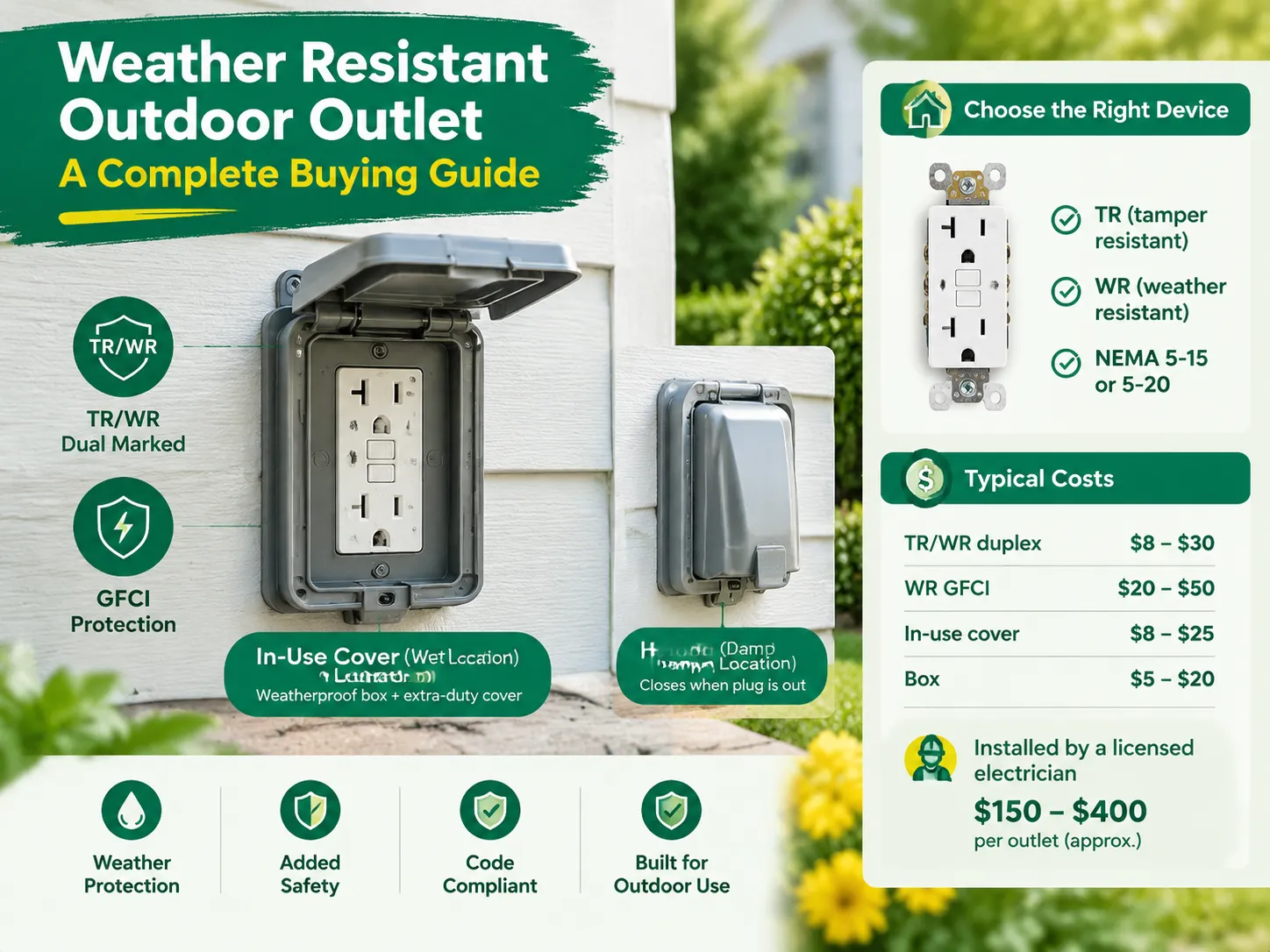
Waterdichte buitenstopcontacten mogen niet verward worden met gewone buitenstopcontacten. Hoewel deze buitenstopcontacten kunnen worden beschouwd als WR-type buitenstopcontacten, worden ze ook geleverd met een behuizing die hun waterdichtheid biedt met of zonder een apparaat. Bovendien moet de buitenstekker vandalismebestendig zijn en een RCD bevatten. Elk weerbestendig stopcontact moet worden geïdentificeerd […]
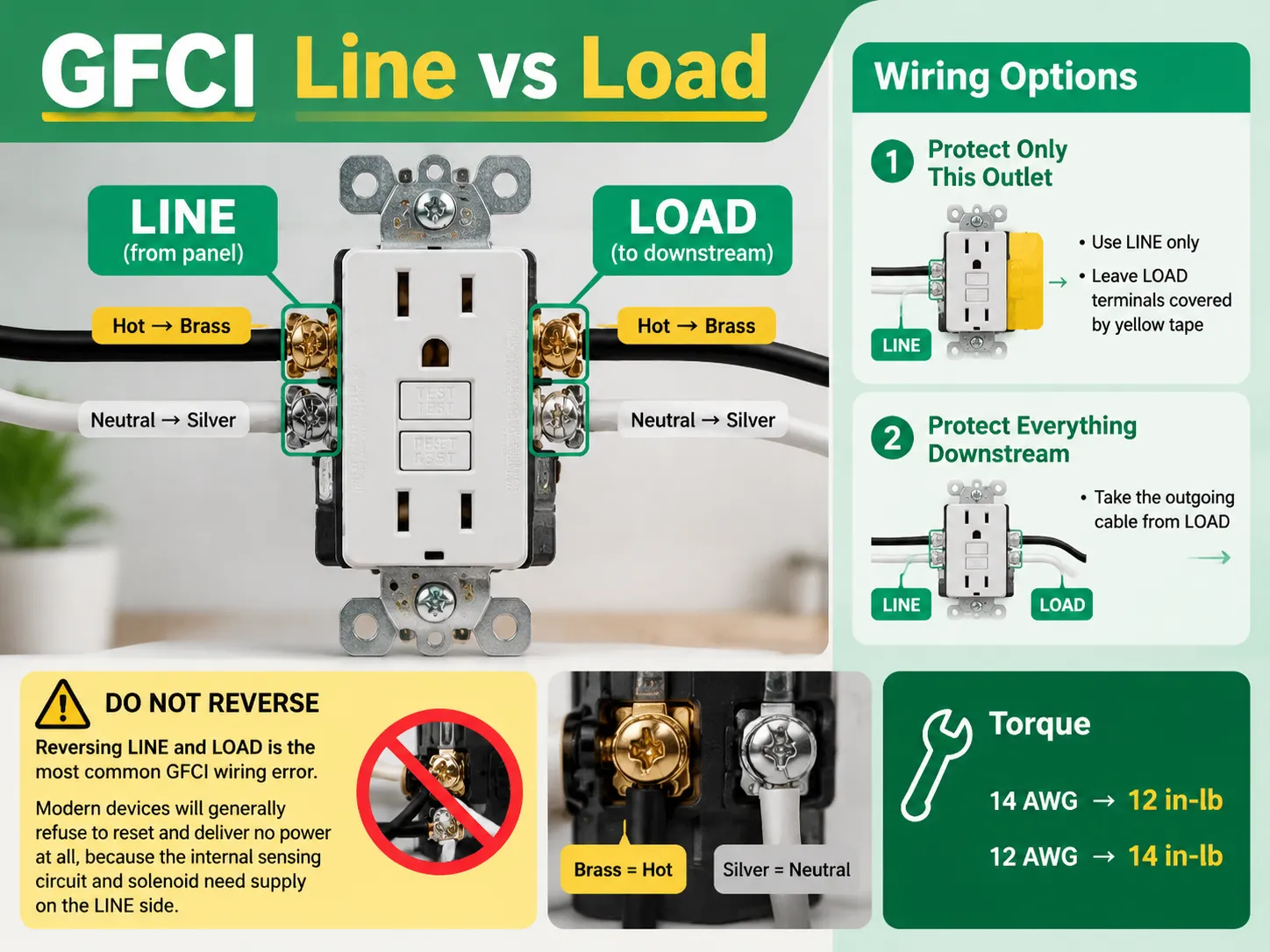
Twee soorten aansluitingen kunnen definiëren hoe een GFCI-stopcontact functioneert: Eén aansluiting is voor een individueel stopcontact en de andere aansluiting kan meerdere stopcontacten beschermen vanuit een enkel GFCI-stopcontact tegen dezelfde kosten. Het gebruik van de juiste aansluiting stelt u in staat om te profiteren van de kostenbesparingen van het gebruik van een enkele GFCI, terwijl het gebruik van […]

 No.6 Tuozhan Road, Leshang Pioneer Park, Yueqingwan Bay Harbor, Yueqing stad, provincie Zhejiang


