

Kiedy ktoś zadaje pytanie “czy gniazdka GFCI się psują”, może naprawdę pytać, jak długo gniazdko będzie działać przed awarią. Nie ma jednoznacznej lub absolutnej odpowiedzi na to pytanie, ponieważ każda sytuacja jest unikalna; dlatego każde gniazdko GFCI powinno działać prawidłowo, o ile nie ma innych czynników przyczyniających się do jego awarii, takich jak narażenie na środowiska, które mogą powodować uszkodzenia (na przykład ekstremalne ciepło, wilgoć lub uszkodzenia wodne). Istnieje kilka różnych typów gniazdek GFCI o różnych napięciach, które z kolei będą miały różne długości życia, jeśli będą używane zgodnie z ich zamierzonymi celami i wytycznymi producenta.
Oprócz wiedzy, jak długo zazwyczaj działają gniazdka GFCI, każdy, kto rozważa użycie gniazdka GFCI w swoim domu lub obiekcie, powinien zrozumieć potencjalne problemy związane z używaniem takich urządzeń, a także jakie kroki podjąć, jeśli urządzenie przestanie działać prawidłowo i zostanie uznane za przekraczające akceptowalne granice jego zamierzonego celu i specyfikacji producenta. W związku z tym wszyscy powinniśmy poświęcić czas na naukę o gniazdkach GFCI, aby podejmować świadome decyzje dotyczące trwałości obwodów elektrycznych i urządzeń używanych w naszych domach i firmach, a także pomóc chronić naszą rodzinę, przyjaciół i pracowników przed potencjalnymi zagrożeniami związanymi z używaniem gniazdek GFCI.
Odpowiedź na twoje pytanie brzmi ‘tak’, a tak, gniazdo GFCI z czasem zawiedzie. Ogólnie rzecz biorąc, żywotność gniazda GFCI wynosi około 10-15 lat; Żywotność wyłącznika obwodowego GFCI to 15-25 lat; Jeśli jest zainstalowane w miejscu narażonym na wilgoć lub na zewnątrz, oczekiwana żywotność wynosi około 7-12 lat z powodu czynników środowiskowych. Wymiana powinna być dokonana natychmiast dla starszych modeli GFCI wyprodukowanych przed wprowadzeniem urządzeń do samodzielnego testowania. Cicha awaria to najniebezpieczniejsza sytuacja, w której jednostka GFCI nadal dostarcza ci energię i nie ma ochrony przed zwarciem. Działające gniazdo GFCI zadziała w czasie około jednej czterdziestej sekundy przy wycieku 4-6 miliamperów. Miesięczne testowanie przez konsumenta może określić, czy GFCI działa; Testowanie odbywa się poprzez naciśnięcie przycisku testowego, aby wyłączyć zasilanie; i zresetowanie go, aby ponownie włączyć zasilanie. Należy zrozumieć, że koszt samego GFCI ($15-$40) jest bardzo mały w porównaniu do kosztu zatrudnienia licencjonowanego elektryka ($80-$200) do zainstalowania gniazda GFCI; Koszt będzie oparty na wielu czynnikach, w tym lokalizacji geograficznej i rodzaju skrzynki elektrycznej używanej do zamontowania gniazda GFCI.
Musimy być bardzo ostrożni w tym, co to mówi, ponieważ w ten sposób dochodzi do awarii.
Gniazdo GFCI wykorzystuje mały transformator prądowy, który nieustannie porównuje prąd płynący przez przewód fazowy z prądem powracającym przez przewód neutralny. W prawidłowo działającym GFCI prądy w obu przewodach są równe. Jeśli gdziekolwiek w obwodzie wystąpi nawet mały wyciek, odczyty będą się różnić, a mechanizm uruchomi przełącznik mechaniczny, aby otworzyć obwód.
Następnie rozważ, co dzieje się z tym urządzeniem przez 15 lat. Przepięcia spowodowane burzami i gdy sieć się przełącza. Powtarzające się wyzwolenia. Ciepło z urządzeń pobierających dużo energii. Wilgotna pogoda. I gdy woda dostaje się do środka. Elektronika odpowiedzialna za wykrywanie ulega degradacji z powodu wszystkich zagrożeń środowiskowych. A gdy ulega degradacji, prawie zawodzi w niebezpieczny sposób.
Awaria występuje na dwa sposoby. Albo mechanizm wyzwalający przestaje działać prawidłowo, co jest oczywiste, ponieważ nie można utrzymać RESET. Lub — co jest bardziej niebezpieczne — czujnik przestaje działać, podczas gdy gniazdo nadal działa. Nowoczesne GFCI mogą przeprowadzać samodzielne testy, w których wykonują wewnętrzne kontrole. Starsze GFCI wyprodukowane przed wprowadzeniem technologii samodzielnego testowania nie mają sposobu, aby wskazać, że coś jest nie tak.
To jest cały sens porady udzielanej przez ekspertów w tej dziedzinie — “testuj GFCI raz w miesiącu” to nie tylko biurokratyczny wymóg. To jedyny sposób na wykrycie uszkodzonego GFCI, które przestało działać.
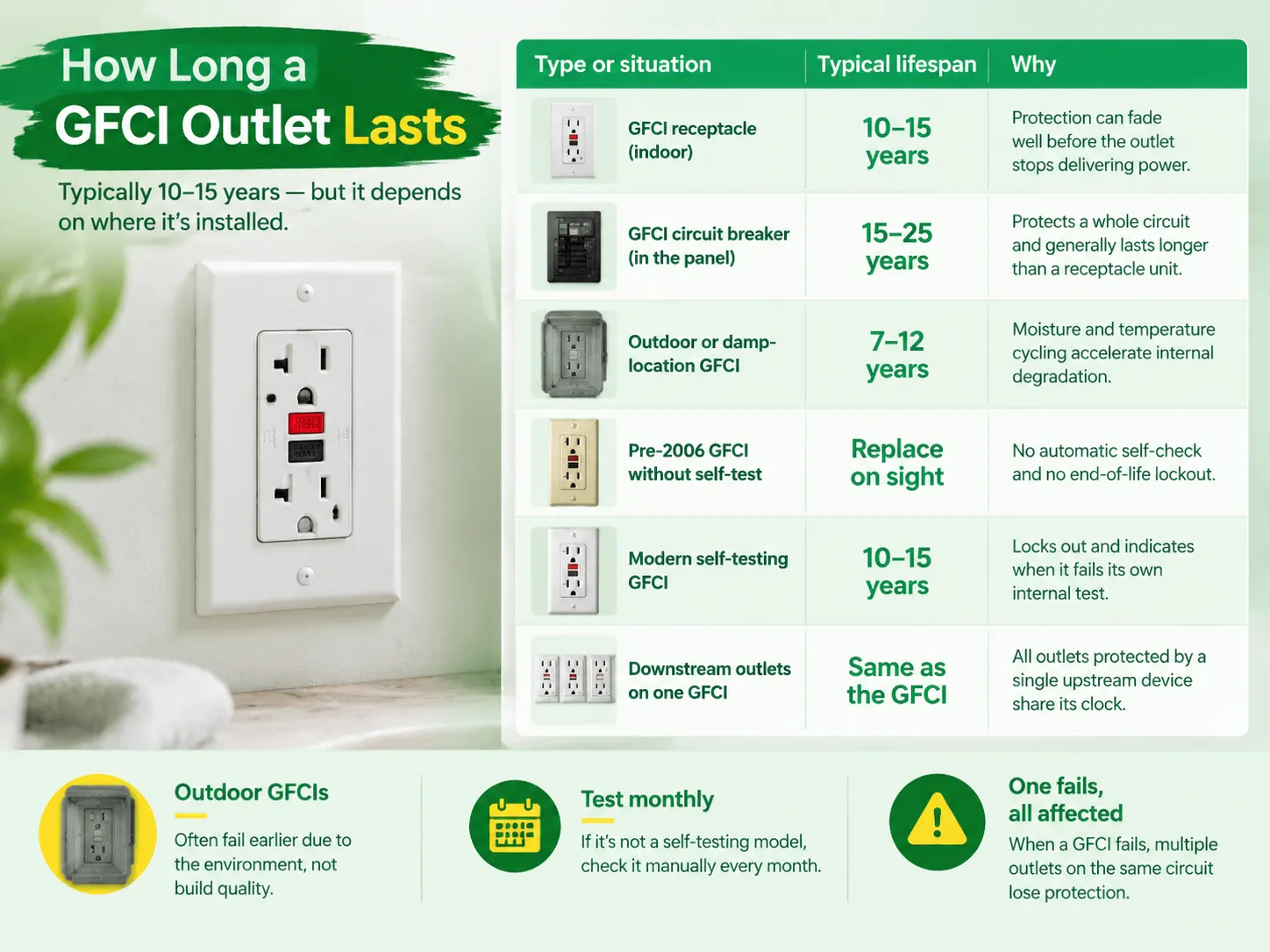
“Dziesięć do piętnastu lat” to główny numer, ale miejsce, w którym gniazdo jest zainstalowane, znacznie to zmienia.
| Typ lub sytuacja | Typowa żywotność | Dlaczego |
|---|---|---|
| Gniazdo GFCI (wewnętrzne) | 10–15 lat | Ochrona może zanikać znacznie wcześniej, zanim gniazdo przestanie dostarczać energię |
| Wyłącznik obwodowy GFCI (w panelu) | 15–25 lat | Chroni cały obwód i zazwyczaj trwa dłużej niż jednostka gniazdowa |
| GFCI do użytku na zewnątrz lub w wilgotnych lokalizacjach | 7–12 lat | Wilgoć i cykle temperatury przyspieszają wewnętrzną degradację |
| GFCI sprzed 2006 roku bez testu automatycznego | Wymień na miejscu | Brak automatycznego samosprawdzania i brak blokady końca życia |
| Nowoczesne GFCI z samodzielnym testowaniem | 10–15 lat | Blokuje i wskazuje, gdy nie przechodzi własnego testu wewnętrznego |
| Gniazda downstream na jednym GFCI | Takie samo jak GFCI | Zwykłe gniazda chronione przez jedno urządzenie upstream dzielą jego zegar |
Dwie interesujące rzeczy do zauważenia. Po pierwsze, GFCI do użytku na zewnątrz może być tej samej marki co model wewnętrzny, ale prawdopodobnie zepsuje się znacznie wcześniej z powodu środowiska instalacji, a nie jakości wykonania. Po drugie, gdy GFCI wznawia pracę chroniąc szereg zwykłych gniazd za nim, wszystkie gniazda polegające na tym GFCI doświadczają strat razem. Dlatego zazwyczaj, gdy chodzi o awarię GFCI, ludzie odkrywają problem, gdy zauważają kilka gniazd działających nieprawidłowo, a nie tylko jedno.
Najważniejszym punktem tabeli jest czynnik testowania. Jeśli twoje urządzenie zostało zainstalowane przed pojawieniem się wersji z samodzielnym testowaniem, będziesz musiał testować urządzenie ręcznie co miesiąc, aby śledzić jego stan pracy.
Nie wszystkie awarie GFCI są tym samym problemem, a naprawa różni się. Oto te, które stanowią większość przypadków.
| Awarie | Co obserwujesz | Co się dzieje | Naprawa |
|---|---|---|---|
| Silent sensing failure | Nothing — outlet works normally | Sensing circuit degraded; device no longer detects ground faults | Replace immediately. TEST button is the only detector |
| Won’t hold on reset | RESET pops straight back out | Mechanism worn out, or an active fault still present | Unplug everything and retry; if it still won’t hold, replace |
| Completely dead outlet | No power, buttons unresponsive | Internal failure, or no supply from the panel | Check the breaker first, then replace the device |
| End-of-life lockout | Fault light on; no power | Self-testing unit detected its own failure and locked out by design | Replace — this is the device working correctly |
| Nuisance tripping | Trips repeatedly with nothing plugged in | Genuine fault, moisture in the box, or a hair-trigger worn unit | Dry and diagnose first; replace if the fault persists with nothing connected |
| Thermal damage | Warm faceplate, discolouration, burning smell | Loose termination or overload creating resistance heat | Stop using it. This is a fire risk, not just a protection failure |
This point really needs reiteration. Warm faceplates or burning odors emanating from a receptacle are not normal — and this isn’t specific to GFCIs but indicates that there may be a loose connection somewhere in your electrical system. Even if the GFCI is still functioning, there is still a danger of fire occurring. Shut off the breaker and have it checked.
Furthermore, there is something to be said about the fact that the device has a life span. Modern self-testing GFCIs are designed to permanently lock out when they can no long guarantee any level of protection, which means that a dead receptacle with a great light is perfectly normal behavior. Look for this feature while shopping for a replacement: a device that indicates it has stopped working is far more useful than one that just leaves you wondering.If you want to see what that looks like as a product category rather than a description, the two formats most commonly used in residential and light commercial work are the standard GFCI receptacle for wall-box installation and the weather-resistant variants built for outdoor and damp locations.
While GFCIs usually start displaying their issues without notifying the user beforehand, there are still common signs to look out for, which are listed below in chronological order, starting from the one that occurs first:
One more sign that is often misdiagnosed: if the GFCI trips every time you plug an appliance into it, that doesn’t mean it’s faulty GFCI. Try plugging in another device in that GFCI. If it successfully works with another device but trips with a hairdryer, you need to discard the hairdryer. In case everything trips, the device or moisture in the circuit may be a reason for that. If the breaker trips but not the GFCI, then it indicates that it’s a problem with circuit capacity.
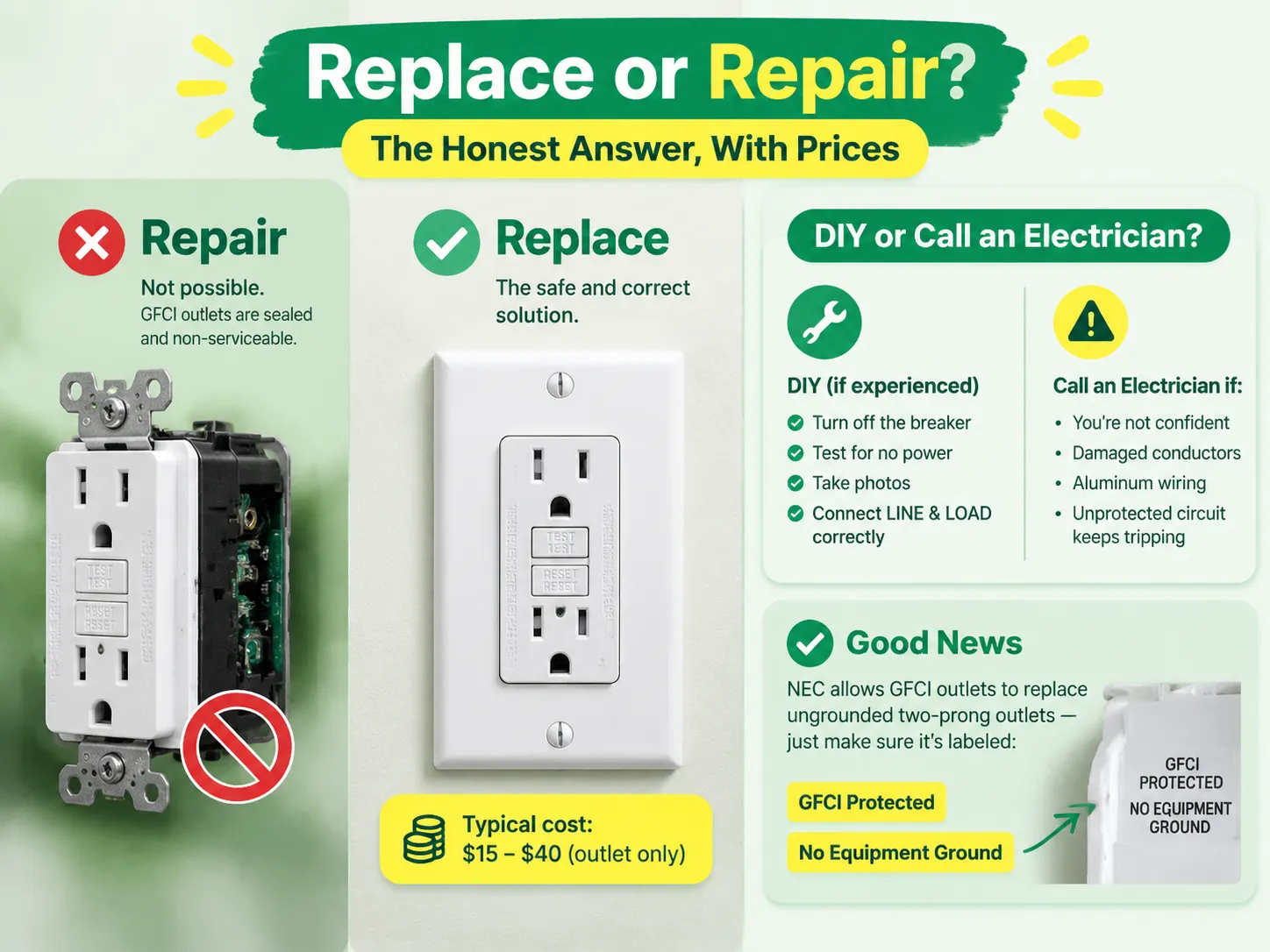
There exist both a version of this inquiry that can be answered and another version that cannot.
The answerable version: Is it possible to repair a GFCI outlet? It cannot be done; a GFCI receptacle comes as a sealed or non-serviceable electronic system. Since it lacks user-replaceable parts, no person is capable of repairing the internal sensing circuit anywhere else apart from the place of fabricating it. In case the protection is compromised, the device shall be replaced with a new one as that is simply what the product’s design implies.
The unanswerable version: Should you perform the substitution independently or call for an electrician? The answer to this question depends a lot on your own skills and also on the requirements imposed by your local jurisdiction. Changing a GFCI is really simple for someone experienced in dealing with live wires: you shut off the breaker, check it with a tester, take photos of the wiring prior to touching it, and connect the LINE and LOAD terminals in a proper manner. The most common error in this operation consists of making the right connection using LINE and LOAD cables in a wrong way.
The steps and the pitfalls are covered in more detail in this walkthrough on replacing a wall socket safely, including the checks worth doing before and after.If you are not sure whether you can perform the repairs yourself — or if there is a risk that the box has damaged conductors, aluminum wiring, or has an unprotected circuit that keeps tripping — stop and call in an electrician. Electrical problems are among the few types of repairs that can kill someone who makes a mistake trying to fix it without any expertise.
Another fact that is interesting to know about is that, according to the straight NEC rules, it is possible to use GFCI receptacles to do away with ungrounded two-prong outlets. As long as the new outlet is marked as “GFCI Protected” and “No Equipment Ground,” you have a great life-safety benefit without having to spend any money on rewiring.
Eilling is a matter of time and money, so be careful and know your options.
| Pozycja | Typowy koszt | Uwagi |
|---|---|---|
| GFCI receptacle, standard | $15–$40 | Weather-resistant and self-testing models sit at the upper end |
| GFCI circuit breaker | $40–$90 | Panel-level protection for a whole circuit |
| Plug-in GFCI tester | $10–$15 | Confirms wiring and lets you test the outlet externally |
| Electrician, residential replacement | $80–$200 per outlet installed | Most of the cost is labour and diagnosis, not the device |
| Bathroom or difficult location | $120–$300 per outlet installed | Higher when the box needs work or the outlet has to move |
| Multiple outlets in one visit | Lower per outlet | The economic case for doing them together rather than one at a time |
Electricians charge different rates depending on the region and the type of work they are doing, but rates remain stable enough to help with planning.What this means in practice is that it is usually cheaper to replace components on your schedule than to wait until something fails.
Electronics can’t be stopped from aging, but they can be kept from aging too fast. Most of the things that shorten the life of a GFCI are issues related to its environment or the electricity it receives.
People tend to overlook the argument regarding the environment point. For instance, if a fixture is rated for fifteen years in a corridor, it will only last half as long in an area that has a defective hose bib. If you’re specifying outlets for damp or outdoor locations, weather resistance isn’t an upgrade — it’s the requirement, which is exactly what separates a general-purpose unit from a weather-resistant GFCI designed for damp and outdoor installation.
It is fully prevention procedure that requires less than a minute for execution in each outlet.
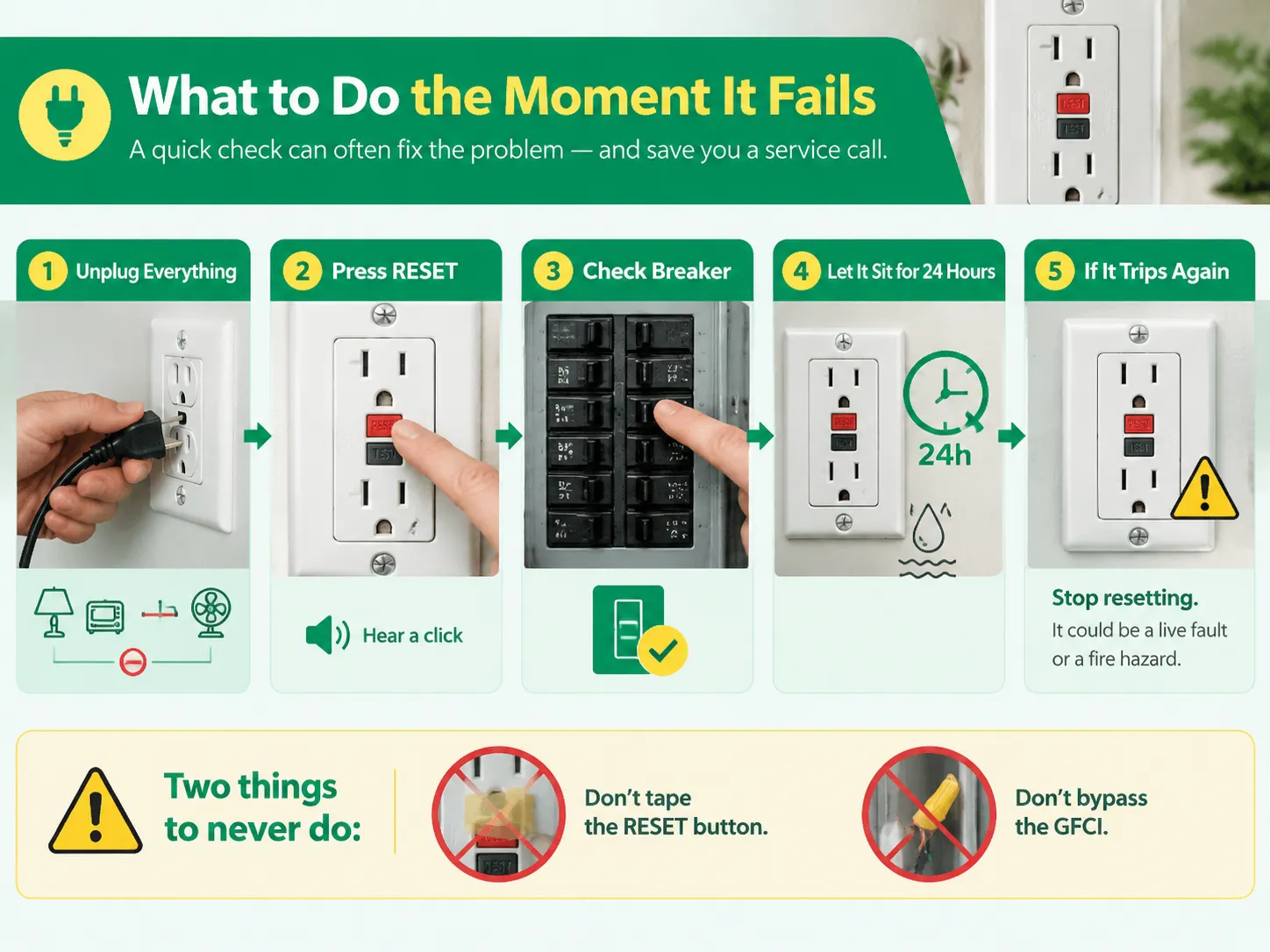
When the outlet is not working or the Ground Fault Circuit Interrupter is not working, there are several steps to follow. It does not take much more than five minutes and it actually helps save money on unnecessary service calls.
There are two things that should never be done: do not tape the RESET button and do not bypass the GFCI because doing one of those things is not a good idea, either. If you want the diagnostic sequence in more detail — what each symptom points to and which ones you can fix yourself — this guide to what to do when a socket or outlet stops working walks through the same logic with the wiring-side checks included.
Requirements vary according to the jurisdiction and age of the property so it is always advisable to check the local code. Despite this, more or less the list designated by the NEC includes locations where water and electricity could meet:
If your house was built before the date the requirement was instituted and the outlet was not updated, the code states that the given element can remain. However, this does not mean that this outlet was safe.
One clarification that is essential to be done is that GFCI and circuit breaker do different jobs, and both are necessary.
| Urządzenie | Protects against | Trips at | Where it lives |
|---|---|---|---|
| Wyłącznik nadprądowy | Overcurrent — overload and short circuit | Rated amps (15 A, 20 A, etc.) | Distribution panel |
| Wyłącznik różnicowoprądowy | Ground faults — current leaking to earth through a person or water | 4–6 milliamps | Receptacle or panel |
| AFCI | Arc faults — dangerous arcing in damaged wiring | Arc signature detection | Panel, or combination devices |
A breaker would allow five milliamps of current to pass through your body without any problem — it won’t trip. That’s where the GFCI comes in, so it should be understood that a GFCI should not be used as a substitute for a breaker and vice versa.If you’re trying to understand how the two layers work together, the relationship between breakers and the outlets they feed is set out in this explanation of circuit breakers and the outlets and switches they protect, and it’s worth five minutes if you’ve ever wondered why a bathroom has two separate devices doing apparently similar jobs.
There’s something we can’t forget about when we discuss GFCIs – their manufacturing process. First and foremost, GFCIs are component-supply products, and the reliability of their sensing circuit boils down to component selection, quality control at the manufacturer’s place, and end-of-line testing. Hence, companies like igoto supply switches, plus sockets, outlets, and power strips, including GFCIs, to their distributors and contractors. This is also the reason why published standards matter when it comes to purchasing – a GFCI that doesn’t meet the applicable UL standard does not become cheaper but is just a different product that looks very similar.
You can check this by using a lamp. Plug the lamp into the protective switch, press TEST, and you should see that the lamp goes out and the RESET button pops out; if you press RESET button afterwards, you should see that the power is restored. If TEST doesn’t work and RESET can’t be pressed down, then it means the protection has failed and the unit needs to be replaced, even if the electrical appliances are powered normally. You may also check for some other indications like warm or discolored faceplate, a fault light blinking or shining continuously, regular tripping when nothing is being plugged into the device or difficulty with pressing down RESET.
Normally, a GFCI outlet remains functional for approximately a decade or a decade and a half whereas a GFCI breaker does its job for slightly longer. Due to the presence of moisture and humidity outdoors, most devices don’t last more than 10 years. Furthermore, devices produced before self-testing systems were introduced should be changed out even if they are not broken because they cannot reveal whether they are malfunctioning or not.
Substitute it when it fails any of such checks: either it doesn’t turn off the electricity, the reset is not persisted or a device has triggered self-test lockout lock, or the unit hasn’t reset itself even after the disconnection and drying of the circuit. In case it’s aged more than 10 to 15 years or is older than self-testing devices, then it can be replaced based on the age alone. It has to be replaced without a delay in case the device is warm, burnt or emits odour.
The primary causes are degradation due to aging of the sensing electronics, the number of times power surges and lightning hits, frequent tripping cycles that have taken a toll on the mechanical latch, moisture ingress into the enclosure and heat stress due to overloaded wires and/or loose terminations. It is significant to differentiate whether the aforementioned problems are due to appliance defects or real ground faults, as a GFCI that trips only when a certain appliance is plugged in is likely discovering an actual current leak in that appliance rather than a GFCI malfunction.
GFCI outlets do fail, and it’s important to note how they fail. GFCI outlets do not give a warning; they keep working like they’re meant to. The light keeps turning on and off, and that vital function — the cutting of power when current is leaking through a person — may fail without any visible sign at all.
The take-home point is 10-15 years lifespan for a receptacle, 7-12 years lifespan in damp places, and a trip time equal to about 1/40 second at 4-6 mA for a working device. In practice, the device costs between $15 and $40 and costs another $80-200 to install, making this simple little device the difference between just getting a shock from a bathroom outlet and getting seriously electrocuted.
For this reason, test every month. Press TEST, see the power goes out, press RESET. If the device does not work just as it should, it must be replaced — it cannot be fixed. If the device has served you for more than 10 years, yes, replace it on your schedule, not in an emergency situation. When buying the replacement, always opt for self-testing devices that can alert a user before breaking down, which is a huge advantage over devices that will stop working without any warning.

When someone asks the question “do GFCI outlets go bad”, they may really be asking how long an outlet will last before failing. There is no definite or absolute answer to that question as every situation is unique; therefore each GFCI outlet should properly work as long as there are no other factors contributing to […]

Zakup inteligentnych przełączników w hrabstwie Bucks jest stosunkowo trudny, a trudności wynikają bardziej z cech lokalnej nieruchomości niż z dostępności systemów. Można przejechać z Solebury, gdzie niektóre domy mogą pochodzić z lat 90. XVIII wieku, do Warrington, gdzie niektóre nowsze budowle zostały wzniesione […]

Bezprzewodowa kontrola oświetlenia ma mały brudny sekret: podczas gdy często działa wyjątkowo dobrze w demonstracjach, zazwyczaj zawodzi ludzi w ich domach. Winowajcą rzadko jest aplikacja; zamiast tego leży za ścianą. Ten przewodnik przedstawia wybory w uporządkowany sposób. Sześć sposobów na bezprzewodowe sterowanie światłem, pięć protokołów, które […]

 Droga Tuozhan nr 6, Leshang Pioneer Park, port Yueqingwan Bay, miasto Yueqing, prowincja Zhejiang


