

San Francisco nie jest przeciętnym rynkiem kontroli oświetlenia. Zasoby mieszkaniowe są stare i gęste, a kodeks elektryczny nie pozwala na tak wiele instalacji elektrycznych, jak to jest dozwolone prawie wszędzie indziej w USA. Większość domów, które chcą skomplikowanego oświetlenia, to budynki wiktoriańskie lub edwardiańskie, w których nikt nie chce zaczynać otwierania ścian. Ta sytuacja sprawia, że większość literatury na ten temat jest bezużyteczna dla tego lokalnego rynku.
Artykuł ten przedstawia szczegóły dotyczące kontroli oświetlenia w domu w San Francisco, cztery typy rozwiązań, systemy oraz lokalnych integratorów, którzy je instalują, lokalne ceny specjalistyczne na rok 2026 oraz przepisy prawne, które są istotne w Kalifornii w momencie podejmowania decyzji.
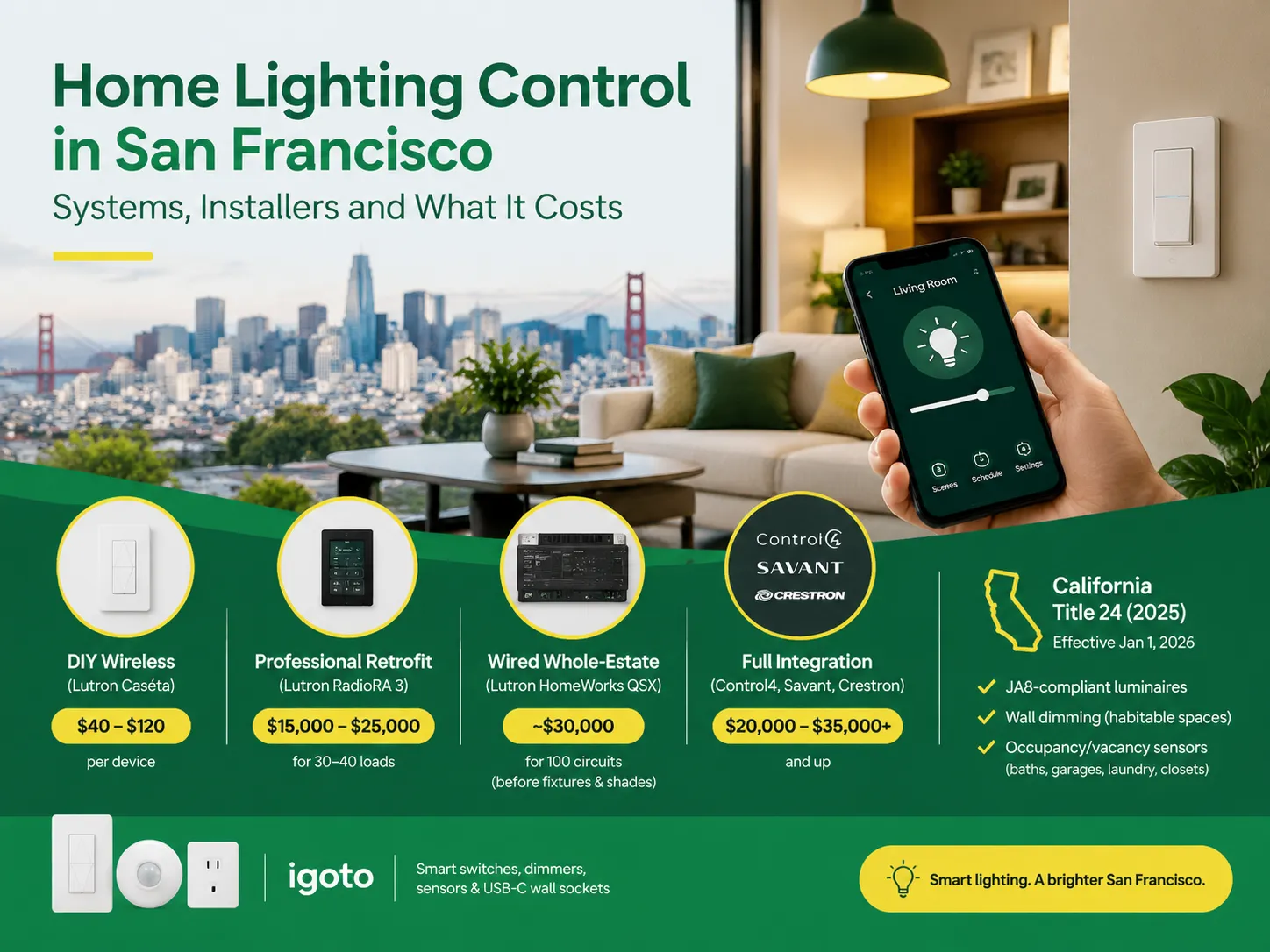
Dostępne rozwiązania można podzielić na cztery kategorie. Pierwszym podejściem empirycznym byłyby bezprzewodowe ściemniacze Lutron Caséta w cenach $40 – $120 za urządzenie. Jeśli chodzi o systemy do modernizacji istniejącej infrastruktury, wiodącym modelem w tej dziedzinie wydaje się być system Lutron RadioRA 3, który kosztowałby około $15,000 – $25,000 za uporządkowanie 30 do 40 obciążeń. Jeśli chodzi o systemy przewodowe dla całej nieruchomości, najdroższą, ale prawdopodobnie najbardziej niezawodną alternatywą byłby system Lutron HomeWorks QSX, który kosztowałby około $30,000 bez żadnych dodatkowych kosztów związanych z oprawami oświetleniowymi i osłonami do projektu. Wreszcie, jeśli pełna integracja w systemie inteligentnego domu jest ważniejsza niż koszt instalacji, należy użyć systemu Control4, Savant lub Crestron. Niezależnie od wybranej opcji, użytkownik musi pamiętać, że będą systemy zgodne z JA8 oraz obecność jakichkolwiek ściemniaczy ściennych w blokach mieszkań w jednostkach, które mogą być używane.
Termin ten obejmuje trzy różne propozycje, które są pakowane razem jako jedna. Pierwsza to komfort: można kontrolować grupę świateł jednocześnie, za pomocą klawiatury, aplikacji na smartfona lub poleceń głosowych. Druga to nastrój: oznacza sceny, które zapewniają określone intensywności światła i temperatury kolorów do gotowania, jedzenia, czytania lub rozrywki. Trzecia to zgodność i efektywność: znana jest z automatycznego wyłączania świateł i ściemniania, tym samym spełniając normy efektywności energetycznej i redukując zużycie energii.
Dla większości kraju trzeci zasada jest uważana za produkt uboczny. Jednak Kalifornia podchodzi do tego zagadnienia z innej strony – skuteczności przepisów Title 24 dotyczących efektywności energetycznej, które weszły w życie 1 stycznia 2026 roku, a które dotyczą dozwolonych nowych budowli i zmian. Każda renowacja, która wiąże się z pracami oświetleniowymi, jest automatycznie traktowana jako projekt kontrolny w Kalifornii, niezależnie od życzeń właściciela. Jest to korzystne dla klientów, ponieważ dodatkowe koszty związane z ulepszonymi urządzeniami kontrolnymi są znacznie zminimalizowane z powodu wymagań przepisów.
Kluczowym czynnikiem, który definiuje wszystko inne, są typy budynków. Wiele domów w San Francisco, szczególnie przed II wojną światową, używało technologii drewnianych ram i tynku, listew oraz przełączników. Wiele współczesnych urządzeń wymaga obecności neutralnego w skrzynce przełącznikowej, ponieważ prąd nie przepływa przez żarówkę podczas wyłączenia. Domy zbudowane przed 1985 rokiem zazwyczaj nie mają przewodów neutralnych w skrzynce przełącznikowej, co zmusza konsumentów do ponownego rozważenia swojego wyboru urządzenia. Sprawdzenie przewodu neutralnego podczas wizyty na miejscu — a nie po podpisaniu oferty — jest najważniejszym krokiem przed sprzedażą w przypadku modernizacji. Mechanika różnic między tymi urządzeniami a zwykłym przełącznikiem jest omówiona w naszym wyjaśnieniu na czym jest inteligentny przełącznik.
Innym regionalnym elementem jest cena pomijania błędów w projekcie. Elementy projektowe wiktoriańskie, takie jak tynki i listwy obrazowe, sprawiają, że źle wykonane prace są łatwo widocznymi błędami, takimi jak klawiatura, która nie znajduje się w odpowiednim miejscu lub duży sprzęt, który jest zmuszony do umieszczenia w przestrzeni płytszej, niż powinien. Na lokalnym rynku jakość planowania jest ważniejszym czynnikiem różnicującym niż przyszła marka procesora.
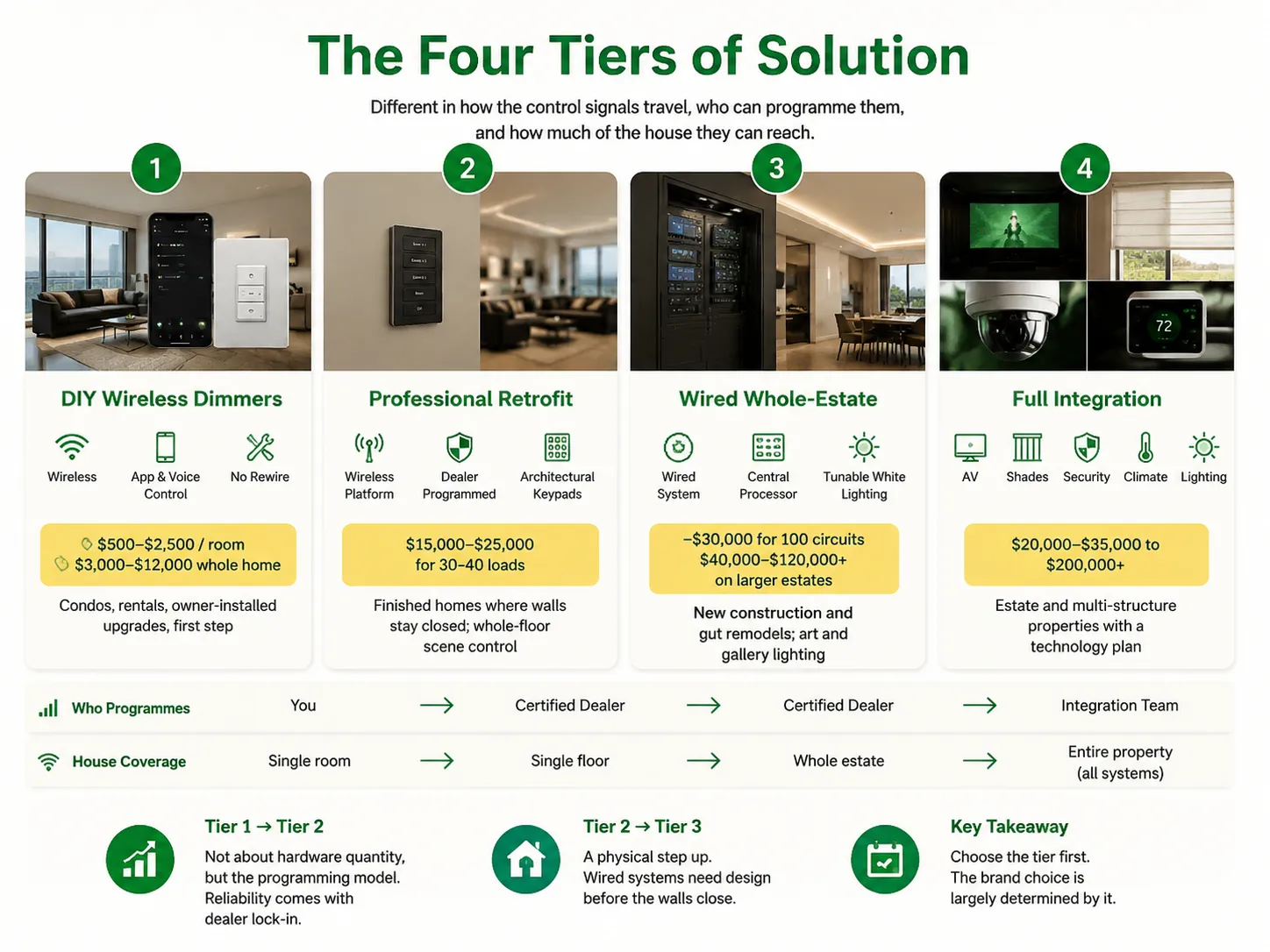
W mieście prawie wszystkie projekty można sklasyfikować w jednej z czterech kategorii. Kategorie różnią się pod względem ścieżek, którymi podążają sygnały kontrolne, a także kto je programuje i jak daleko wpływają na budynek. Ważne jest, aby najpierw określić poziom, zanim wybierze się markę, ponieważ to decyduje o wybranej marce.
| Poziom | Jak to działa | Typowy koszt | Najlepiej dopasowane do |
|---|---|---|---|
| 1 — DIY bezprzewodowe ściemniacze | Inteligentne ściemniacze o napięciu sieciowym plus mostek; brak przewodów; kontrola aplikacją i głosem | $500–$2,500 za pokój; $3,000–$12,000 za cały dom | Mieszkania, wynajmy, ulepszenia instalowane przez właściciela, pierwszy krok |
| 2 — Profesjonalna modernizacja | Platforma bezprzewodowa tylko dla dealerów na istniejącym okablowaniu; klawiatury architektoniczne | $15,000–$25,000 za 30–40 obciążeń | Wykończone domy, w których ściany pozostają zamknięte; kontrola sceny na całym piętrze |
| 3 — Przewodowy cały majątek | System panelowy oparty na procesorze, przewodowe klawiatury, regulowane białe oprawy | ~$30,000 za 100 obwodów; $40,000–$120,000+ na większych majątkach | Nowe budowy i gruntowne remonty; oświetlenie sztuki i galerii |
| 4 — Pełna integracja | Oświetlenie jako jeden podsystem całej platformy domowej z AV, roletami, bezpieczeństwem, klimatem | $20,000–$35,000 do $200,000+ | Nieruchomości rezydencjalne i wielobudynkowe z planem technologicznym |
Różnica między poziomem 1 a poziomem 2 nie polega koniecznie na ilości zaangażowanego sprzętu, lecz raczej na metodzie programowania. W poziomie 1 właściciel dokonuje programowania, podczas gdy w poziomie 2 dealer dokonuje programowania i ma wy exclusive prawo do serwisowania, co można interpretować zarówno jako źródło niezawodności, jak i jako element uzależnienia. Jeśli chodzi o różnicę między poziomem 2 a poziomem 3, ta różnica jest rzeczywista i fizyczna. Jeśli zaangażowane jest określone rozwiązanie przewodowe, przewody i panel sterujący muszą być również ustawione wcześniej. To jest powód, dla którego wybór poziomu 3 dokonany po zakończeniu prac wykończeniowych odpowiada poziomowi 2. W poziomach bezprzewodowych protokół radiowy również decyduje o tym, jak niezawodnie urządzenia pozostają połączone, a błędy w uruchamianiu pojawiają się tam tygodnie później jako sporadyczne przerwy — sekwencja jest przedstawiona w naszym przewodniku na jak skonfigurować inteligentny włącznik światła Zigbee.
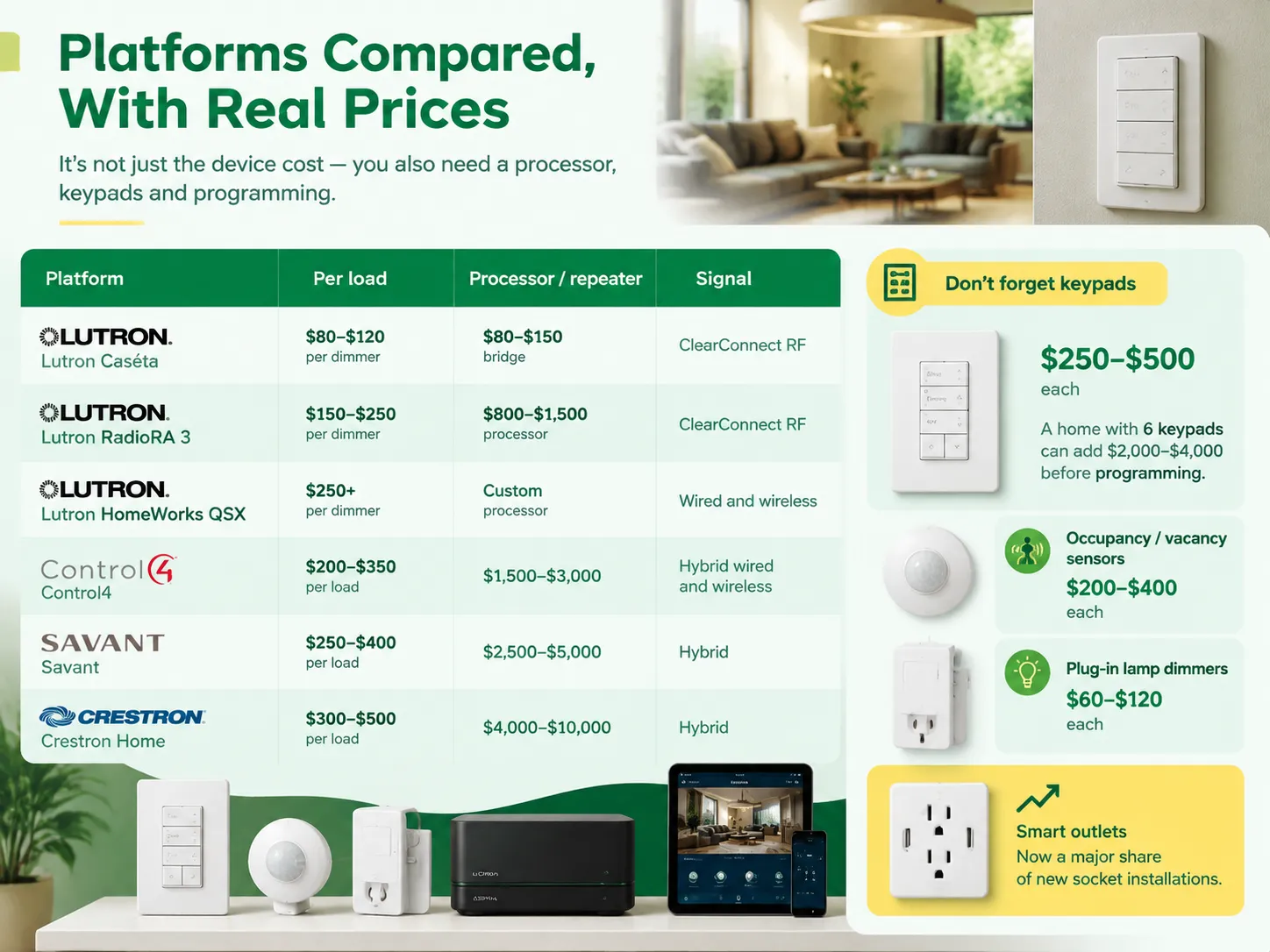
Cena w kontroli oświetlenia obejmuje szereg komponentów. Konkretnie, jest to połączenie kosztu urządzenia na obciążenie plus koszt procesora plus koszt klawiatur i koszt programowania. Klient szukający ceny opierającej się tylko na urządzeniu nie weźmie pod uwagę kosztu procesora, który zazwyczaj staje się najdroższą częścią całego procesu.
| Platforma | Na obciążenie | Procesor / repeater | Sygnał | Uwagi |
|---|---|---|---|---|
| Lutron Caséta | $80–$120 za ściemniacz | $80–$150 mostek | ClearConnect RF | DIY-installable; works with Apple Home, Google, Alexa; limited to around 50 devices |
| Lutron RadioRA 3 | $150–$250 per dimmer | $800–$1,500 processor | ClearConnect RF | Dealer-only programming; retrofit-friendly; up to roughly 200 devices |
| Lutron HomeWorks QSX | $250+ per dimmer | Custom processor | Wired and wireless | Required for the full Ketra tunable-white fixture line; new build and gut remodel |
| Control4 | $200–$350 per load | $1,500–$3,000 | Hybrid wired and wireless | Unified lighting, AV, security and climate in one app |
| Savant | $250–$400 per load | $2,500–$5,000 | Hybrid | Interface quality and scene design; strong in design-led residences |
| Crestron Home | $300–$500 per load | $4,000–$10,000 | Hybrid | Large and multi-structure estates; extensive programming |
Keypads have a greater influence on price than most homeowners assume. Each four to seven button architectural keypad costs around $250 to $500, and if the home has keypads located in the master bedroom, front door, kitchen, living room, master and garage entry closet, the owner pays $2000 to $4000 before programming. This amount spent is worth it, because keypads enable you to feel the system as part of the house rather than an application. Occupancy and vacancy sensors cost about $200 to $400, and plug-in dimmers vary from $60 to $120 in price.
The subsequent hardware component — the actual wall dimmers, switches, sensors and sockets — is the fastest-growing market today as smart sockets are becoming the biggest players in the installation of new sockets, while USB-integrated sockets take about one-third of all socket demand at the moment.Trends and market structure are covered in our industry analysis of the light switch and electrical socket market.
This trade is regulated by some licensing requirements in California. The classification of the license is also important – the low-voltage and lighting control tasks are assigned to contractors with a C-7 license, while the C-10 electricians are in charge of the rough electrical wiring and the line-voltage work. If a contractor has one license but not the other, he can either subcontract or ask you to organize separate services.
| Dostawca | Base and coverage | Platforms | What sets them apart |
|---|---|---|---|
| Regent5 | Bay Area; SF, Peninsula, South Bay, East Bay, Marin, Monterey | Savant, Control4, Crestron, Lutron HomeWorks QSX and RadioRA 3, Ketra | Holds both C-10 and C-7 licences (CSLB 1033103) and runs a San Carlos design centre with working keypads and two Ketra colour-rendering rooms |
| Proava Tech | San Francisco and Marin County, operating since 2015 | Lutron, Control4, Crestron, audio and IP surveillance | C-7 Low Voltage Systems licence (#1122813), $2 m insured, family-operated, with a long record of multi-site commercial rollouts |
| Jewell’s Quality Home Systems | San Francisco through the wider Bay Area | Savant, Crestron, Lutron Diamond dealer | Three generations and over 50 years in Northern California; lighting design and automation under one roof |
| Full Spectrum Technology Group | Concord; East Bay, Napa County, Los Gatos | Savant, Control4 | HTA-certified team with remote monitoring; founded 2020 |
In practice, there are three test questions that set these companies apart, and these questions will never be found on a website. First, ask who programs the system. If the programming belongs to a home and exists strictly on a dealer’s computer, this will create problems for selling and servicing. Then ask what happens when the manufacturer ceases producing the platform, as it often happens: certified dealers have the knowledge of legacy versions which allows them to provide services and transfer data instead of starting from scratch.
Finally, make sure to ask which license is actually covering your needs. Although working with a contractor and a licensed electrician on the high-voltage side is a normative situation, if a company cannot say what license applies to the job it offers, be careful. The local area for servicing should also be taken into account — a truck that has to travel for a long distance will be very slow in the evening on Friday.
The price of a RadioRA 3 system installed in a San Francisco house measuring 4000 square feet and having around 30 to 40 managed loads by professionals would be around $15,000 to $25,000. On a like-for-like basis, the cost for a similar number of circuits for HomeWorks QSX will be around 50% greater, and the two systems also use different wiring, keypad and processor technologies so there is no sensible way of upgrading one to the other, which means that a project that may eventually involve QSX has to begin with the selection of a QSX platform.
Though larger homes might raise the cost even further. The cost of an installation of a HomeWorks QSX lighting system with 100 circuits usually starts at around $30,000 before taking lights, shades, and installing costs into consideration, while for properties with multiple buildings, Ketra products, and motorized shades the total may reach $75,000 to $200,000. All-in-one platforms offer similar prices: a Control4 lighting system with 30-40 loads will cost around $20,000 to $35,000, and property equipment and installation prices do not fall below six figures in case of systems such as Crestron and Savant that combine audiovisual equipment with lighting, shades, security, and climate control systems.
The issue that is typically neglected while budgeting but emerges later arises during installation. When constructing a new building, pre-wired low voltage systems are financially advantageous. Depending on the scope of the project, the overheads may range from $1.50 to $4.00 per sq ft and a project for a 4000-sq-ft house incurs expenses of around $6,000 to $16,000 and the price of the final stage of the installation is much higher. In case of an upgrade, however, failure to install a neutral device may lead to significantly increased installation expenses as the cost of the device might go from $20-35 to $40-80 for the no-neutral version.The device side of that budget — sensors, dimmers, sockets — is where a range like the USB-C wall socket range sits, and specifying devices to match the control platform is cheaper at design stage than reconciling them afterwards.
The standards set forth in Title 24 of 2025 will go into effect on January 1, 2026, pertaining to all new residential buildings built and any renovations with a permit. There are four components making it easier for the lighting design in San Francisco to follow the state standards.
The main requirement of JA8 is that all installed luminaires have to comply with the approved standards on lighting including exceptions for interior lighting of exhaust fans and range hoods as well as other lighting elements under five watts. The concept of JA8 should be applied as it refers not only to efficacy but also to color rendering index, dimming down to 10 per cent, startup time, flicker level, and noise level. Otherwise, a cheap LED and a suitable LED will behave differently on the dimmer unit.
It should be noted that occupancy and vacancy sensor with automatic off must be installed for one of the lights in either bathroom or garage. Also, wall-mounted dimmers should be available for all kinds of lighting in all habitable rooms but there are some exemptions from the rule. While modifying the lighting system in any of the living rooms and kitchens, dimmers that will be used should comply with the standards spelled out in NEMA SSL 7A.
Some fixtures require installation of manual switch and either photo-eye and motion sensor or photo-eye and time switch. Energy management system that meets the requirements for dimming and dimming based on occupancy can become a solution provided that it operates as it is required and does not go around the necessary controls. Some practical comments should be made – “Title 24 Compliant” labeling is prohibited by California legislation and there are no exceptions to this rule.
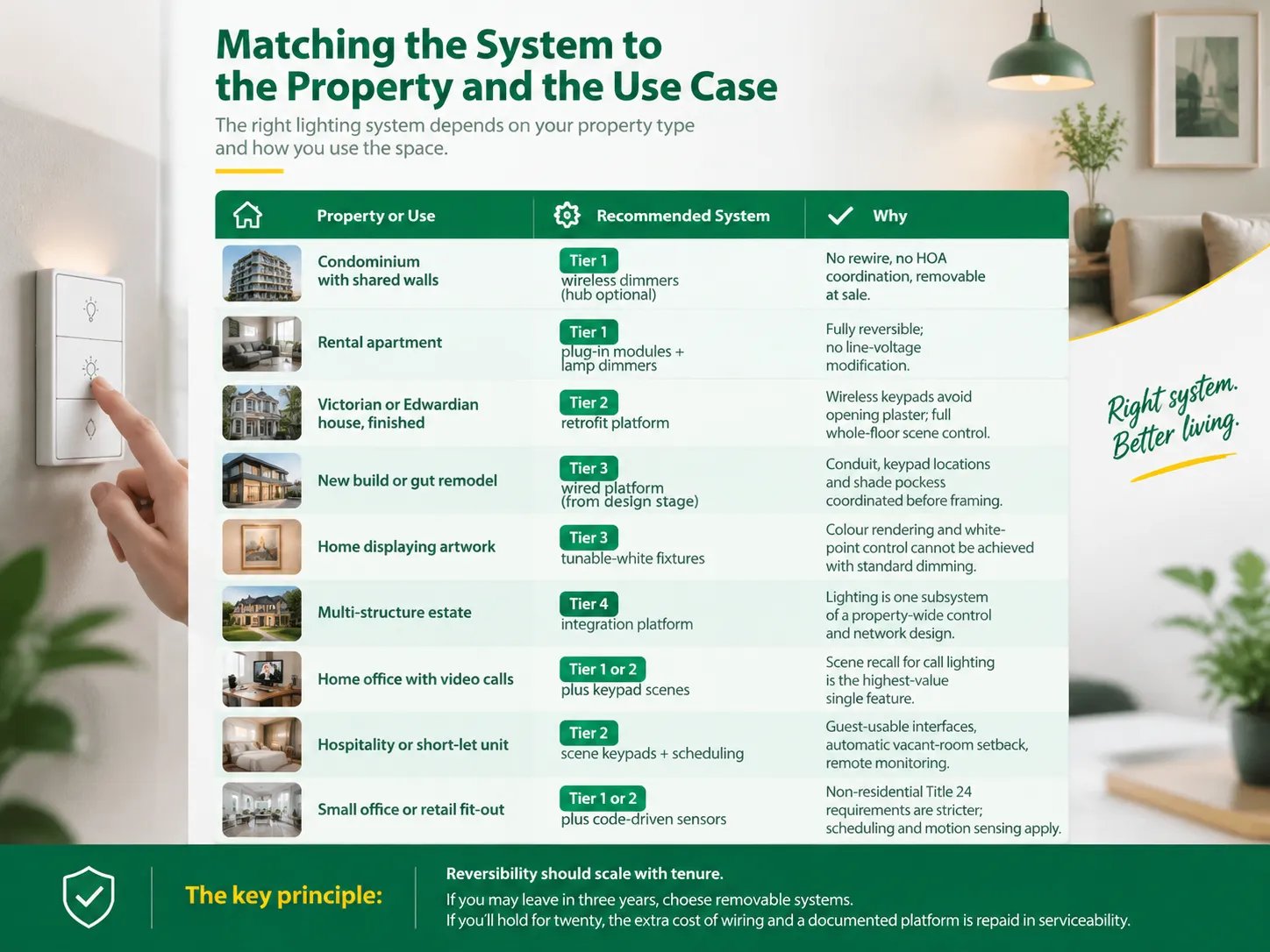
The decision for which tier to choose solves nearly all the projects, but the property type and the application of it affect the decision. The table below shows how these decisions are normally made in the Bay Area.
| Property or use | Practical recommendation | Dlaczego |
|---|---|---|
| Condominium with shared walls | Tier 1 wireless dimmers, hub optional | No rewire, no HOA coordination, removable at sale |
| Rental apartment | Tier 1 with plug-in modules and lamp dimmers | Fully reversible; no line-voltage modification |
| Victorian or Edwardian house, finished | Tier 2 retrofit platform | Wireless keypads avoid opening plaster; full whole-floor scene control |
| New build or gut remodel | Tier 3 wired platform from design stage | Conduit, keypad locations and shade pockets coordinated before framing |
| Home displaying artwork | Tier 3 with tunable-white fixtures | Colour rendering and white-point control cannot be achieved with standard dimming |
| Multi-structure estate | Tier 4 integration platform | Lighting is one subsystem of a property-wide control and network design |
| Home office with video calls | Tier 1 or 2 plus keypad scenes | Scene recall for call lighting is the highest-value single feature |
| Hospitality or short-let unit | Tier 2 with scene keypads and scheduling | Guest-usable interfaces, automatic vacant-room setback, remote monitoring |
| Small office or retail fit-out | Tier 1 or 2 plus code-driven sensors | Non-residential Title 24 requirements are stricter; scheduling and motion sensing apply |
In general, the principle indicates that reversibility should correlate with length of stay. If the tenant is leaving in 3 years, opt for systems that are easily removable. If the property is going to be occupied for 20 years then the cost incurred in the equipment and documentation is justified by the service provided.Owners who want the decision framed around their home rather than a product line will find the trade-offs laid out in our guide to choosing the right smart switch.
Whether it is the tenacity of the walls, the status of the state, or the extent of your control over the house that determines your choice between different systems? For simple rentals/condos and individual room upgradings, Lutron Caseta is the least risky option as it utilizes the pre-installed wiring of the property and could be easily removed later. For finished houses where you want a number of keypad scenes on different floors or just 30-40 loads installed professionally, RadioRA 3 is the best system to choose with an approximate price of $15,000-25,000. In case you want to build a new construction or remodel the entire house or value the effect of art and colors, wired options such as Lutron HomeWorks QSX would suit you best. The main point is to pay attention to whether the walls are closed or not because if the walls are already closed it would no longer be feasible to take advantage of the wired options.
The three options for implementing smart home technology are ranking from the least reliable to the most reliable. Scheduling means programming the home system to switch on and off at certain times regardless of whether there are people inside. Geofencing or an out-of-the-house mode kicks in when the last mobile device leaves the premises. It is very handy but the functioning of geofencing highly depends on GPS accuracy. The best way to access the entire system from anywhere is through the app produced by the company. To guarantee security, the best idea is to implement a randomized evening routine that does not repeat each day and controls the lights in all the rooms. This idea should ideally also combine the work of outdoor lighting that operates on a time clock. Note that smart home devices that rely on cloud technology cannot function properly without the Internet.
By level of sophistication, in the currency of 2026. Caséta is the most basic system used by the homeowners; its starter pack is around $180 to $320, while an extra dimmer costs between $40 and $120. Home installation services cost between $5,000 and $12,000, contingent on how many appliances you install. RadioRA 3 is only available through dealers, with dimmers costing between $150 and $250 plus the processor costing $800 to $1,500. Overall, it makes the installation of a load home with a total of 30 to 40 lasting about $15,000 to $25,000. HomeWorks QSX is a smart luxury home automation system costing about $250 and more per dimmer, plus a custom processor costing about $30,000 without counting fixtures, curtain control and installation services.
Using the platform’s app, on-line or with voice control through Apple Home, Google Home and Alexa where applicable. Remote control is initiated from your phone and involves the vendor’s cloud and the processor being used locally. As a result, three elements are necessary for the remote control function: stable Wi-Fi on the processor, the internet present, and the cloud service being in operation. The important design question is what happens when one of those three fails. It is advisable to store scheduled automation and keypad scenes on the processor so the home can function as supposed even without the cloud and rely on the app as a supplement instead of the fundamental part. In case you leave your property unattended for a long time, create the scenes connected with the security of the house only on the basis of local schedules and remote monitoring, rather than depending on the app that needs manual control from another time zone.
Lighting controls in San Francisco constitute a planning challenge that should take precedence over product issues. The legislation requires lighting systems to automatically adjust and/or turn off in living environments. The manufacturer’s choice is limited to whether walls are open. Once the timing and requirements are established, the company can successfully place the order while overcoming some risks.
There are three points to remember. The neutral must be checked before the quote is accepted, as one survey result will change the list, cost, and the tier. Determine the owner of the programming files before signing a contract — without ownership of this crucial element, it will be impossible to implement the project. The right tier must be established before the manufacturer is chosen — if the wired solution is selected after the installation of carpentry, it will not be affordable. Following these points, the lighting system can do its job effectively and efficiently.
San Francisco is not the average lighting control market. The housing stock is old and dense, and the electrical code does not allow for as many electrical installations as is allowed almost anywhere else in the U.S. Most homes that want complex lighting are Victorian or Edwardian buildings where no one wants to start opening […]
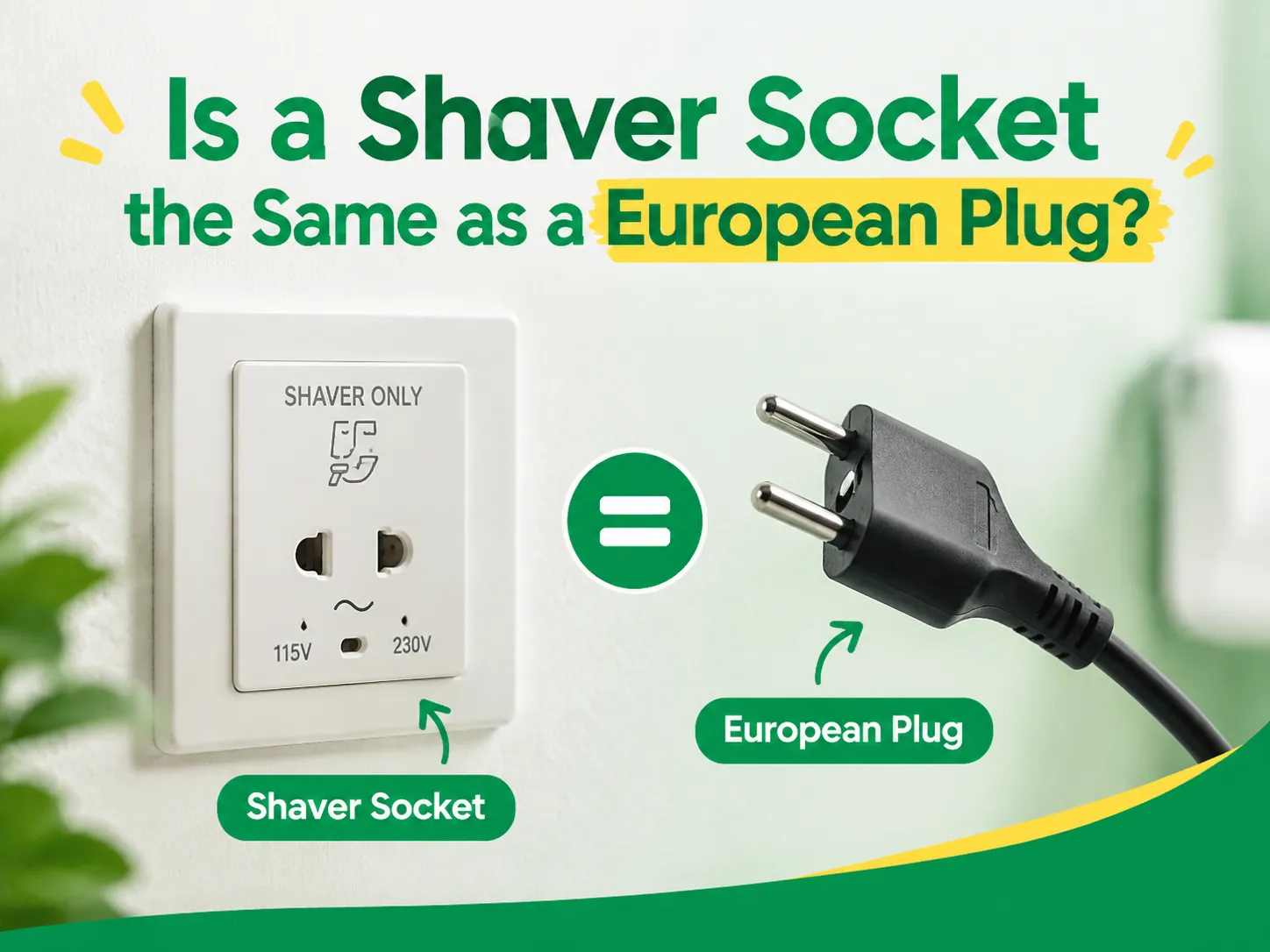
Chociaż wydają się być podobne, obie mają okrągły kształt z dwoma pinami i działają przy napięciu 230V. To wyjaśnia, dlaczego niektórzy turyści używają europejskiej wtyczki z brytyjskim golarką lub zastanawiają się, dlaczego golarka nie może być podłączona do gniazdka Schuko w hiszpańskim hotelu. W rzeczywistości, one […]
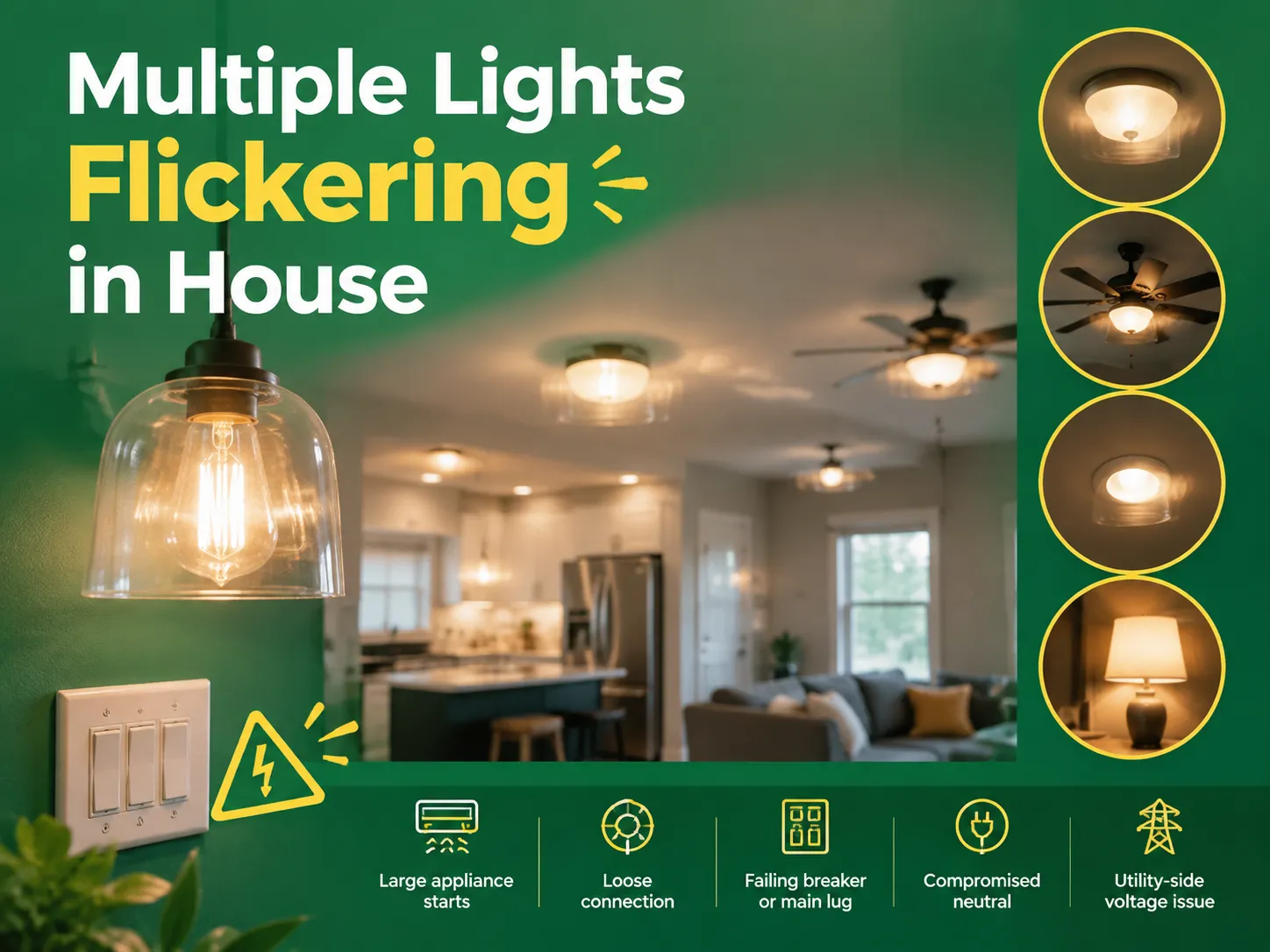
Migocząca żarówka może być interpretowana jako lokalny problem — żarówka się zużyła, oprawa świetlna jest źle podłączona, lub może masz tani ściemniacz. Ale jeśli więcej niż jedna żarówka migocze jednocześnie, w różnych pomieszczeniach, musisz spojrzeć na sytuację inaczej. Wiele migoczących żarówek sygnalizuje […]

 Droga Tuozhan nr 6, Leshang Pioneer Park, port Yueqingwan Bay, miasto Yueqing, prowincja Zhejiang


