

Randolph township i Morris County är kopplad till postnummer 07869 som gränsar till Dover i väster och Denville i öster. Det finns Route 10 som korsar township; tusentals privatägda hus kan hittas i denna township spridda över de gröna kullarna och skogarna. När du angav detta nummer i sökningen efter belysningsproffs, var din förfrågan möjligen enklare än den som gavs av sökresultaten, nämligen: “Vem ska jag ringa och hur mycket skulle det kosta mig?” men det är den huvudsakliga frågan i denna artikel; den kommer inte att beröra teorin om belysningsdesign utan snarare titta närmare på den lokala belysningsmarknaden och de företag som är närvarande på den marknaden.
Randolph township i Morris County tilldelas postnummer 07869, som gränsar till väster av Dover och till öster av Denville. Township korsas av Route 10 och är hem till tusentals privatägda hus som är spridda runt de gröna kullarna och skogsområdet. När du skrev in detta nummer för att söka efter belysningsspecialister, hade du sannolikt en enklare fråga i åtanke än vad som presenteras i sökresultaten, nämligen “Vem ska jag kontakta och hur mycket kommer jag att behöva betala?” Detta är vad denna artikel kommer att handla om, eftersom denna artikel inte kommer att täcka grunderna i belysningsdesign utan kommer att fokusera på de olika aktörerna i belysningsbranschen i denna stad.
ZIP-koden indikerar att du är belägen i Randolph Township. Om du befinner dig i Randolph Township, kommer du att verka i Morris County inom jurisdiktionen av JCP&L, och i en township som har sin egen byggavdelning och egen byggprocess.
Att tala om det leder till många viktiga punkter. Byggnadsreglerna tillhandahålls av New Jersey genom Unified Construction Code under vilket Department of Community Affairs har befogenhet att administrera bygg- och el-koder. Det är dock kommunerna som behandlar tillstånd och gör inspektioner. Således måste ett belysningsprojekt i Randolph Township godkännas av de lokala byggnadsmyndigheterna istället för länskontoren och flödet av pappersarbetet kan skilja sig från det som används av en entreprenör i Denville eller Rockaway.
Om du letar efter belysningskonsulter “i 07869” betyder det vanligtvis att du letar efter en konsult som arbetar inom en viss radie snarare än strikt inom kommunens territorium. Majoriteten av konsulterna för Randolph arbetar också i Dover (07801), Rockaway (07866), Denville (07834), Wharton (07885), Mine Hill (07803), och i några städer längre bort, såsom Chester, Mendham, Morristown, och Florham Park.
Bostadsbeståndet i Randolph förklarar många egenheter i de lokala belysningskraven. En stor mängd hem byggda från omkring 1960 till 1990 var utrustade med bara en taklampa per rum och en strömbrytare placerad vid dörren. Vissa större fastigheter i skogsområdena i Randolph involverar belysning som är mycket nära en liten infrastrukturinstallation: landskapsbelysning, utomhusarkitektonisk belysning, generatorstödda paneler etc. och har inte mycket gemensamt.
Här blir det förvirrande för den lokala marknaden, så det förtjänar att uttryckas tydligt.
När det kommer till bostadsbelysningskonsultation i Randolph, är fokus naturligtvis på renoveringar och ombyggnader. I detta fall kan man göra en köksrenovering, lägga till en huvudsovrums svit, slutföra en källarrenovering, och bygga en tillbyggnad till huset, vilket skulle kräva praktiska råd angående sådana frågor som antalet kretsar, strömbrytning, lager av belysning, lämplighet av en färgtemperatur i förhållande till de använda materialen och, viktigast av allt, hur man undviker en pinsam situation när ett perfekt renoverat utrymme visar fyra infällda armaturer som passar in i en kvadrat. Vad de vanligtvis får är förfärdiga takplaner, armaturscheman med unika delnummer, kontrollplaner, och en installationsspecifikation för elektrikern att ge en offert baserat på det.
När det kommer till kommersiell eller institutionell belysningskonsultation, är situationen ganska annorlunda. Route 10 i Randolph stoltserar med kommersiell aktivitet i form av detaljhandelsbutiker, kontor, medicinska praktiker och restauranger, medan Morris County har rika industri- och kontorsutrymmen. Denna typ av arbete är mer inriktad på efterlevnad av energikoder, berättigande till rabatter och, ibland, fotometriska krav. I detta fall kommer konsulten sannolikt att vara involverad endast i belysningsaspekterna av projektet som upphandlats av ett ingenjörsföretag, design- och byggentreprenör, eller en belysningsbyrå.
| Bostads | Kommersiell / institutionell | |
|---|---|---|
| Typisk utlösare | Renovering, tillbyggnad, nybyggnation | Inredning, ombyggnad, koddriven uppgradering, rabattprojekt |
| Vem anställer konsulten | Husägare, ibland arkitekten eller byggaren | Arkitekt, ingenjör, generalentreprenör, eller ägaren direkt |
| Huvudsakliga begränsningar | Befintlig ledning, takstruktur, budget, smak | Energikod, belysningsmål, bländning, berättigande till rabatt, schema |
| Leveranser | Reflekterad takplan, armaturschema, kontrolllayout | Fullständig fotometrisk studie, efterlevnadsdokumentation, utrustningsscheman |
| Avgiftsgrund | Timpris, fast paket, eller per rum | Procentandel av projektvärdet, eller per-armatur / per-område |
| Återbäringsvinkel | Begränsad; tillfälliga apparat- eller kuvertprogram | Betydande; NJ Clean Energy kommersiella belysningsincitament |
| Varaktighet | Dagar till några veckor | Veckor till månader |
Slutsatsen: Engagera inte en kommersiell belysningskonsult för köksarbete, och be inte en bostadsdesigner att tillhandahålla en fotometrisk design för att uppfylla kraven från en energikodgranskare. Även om deras färdigheter kan överlappa, är de faktiska leveranserna, programvaran som används och avgiftsstrukturen mycket olika.
Termen är inte tydlig, därför bryts arbetet ner i segment. En kompetent konsult gör något eller allt av följande, beroende på kraven.
Om projektet drivs av design, följer konsulten helt enkelt de processer som redan har etablerats av designern. Det arbetssättet har sina egna konventioner och dokumentationsförväntningar, och specifikationerna för hur belysningsomfång passar in i en designprofessionells arbetsflöde anges i denna översikt av hur belysnings- och ledningsapparatsomfång hanteras i designledda projekt.
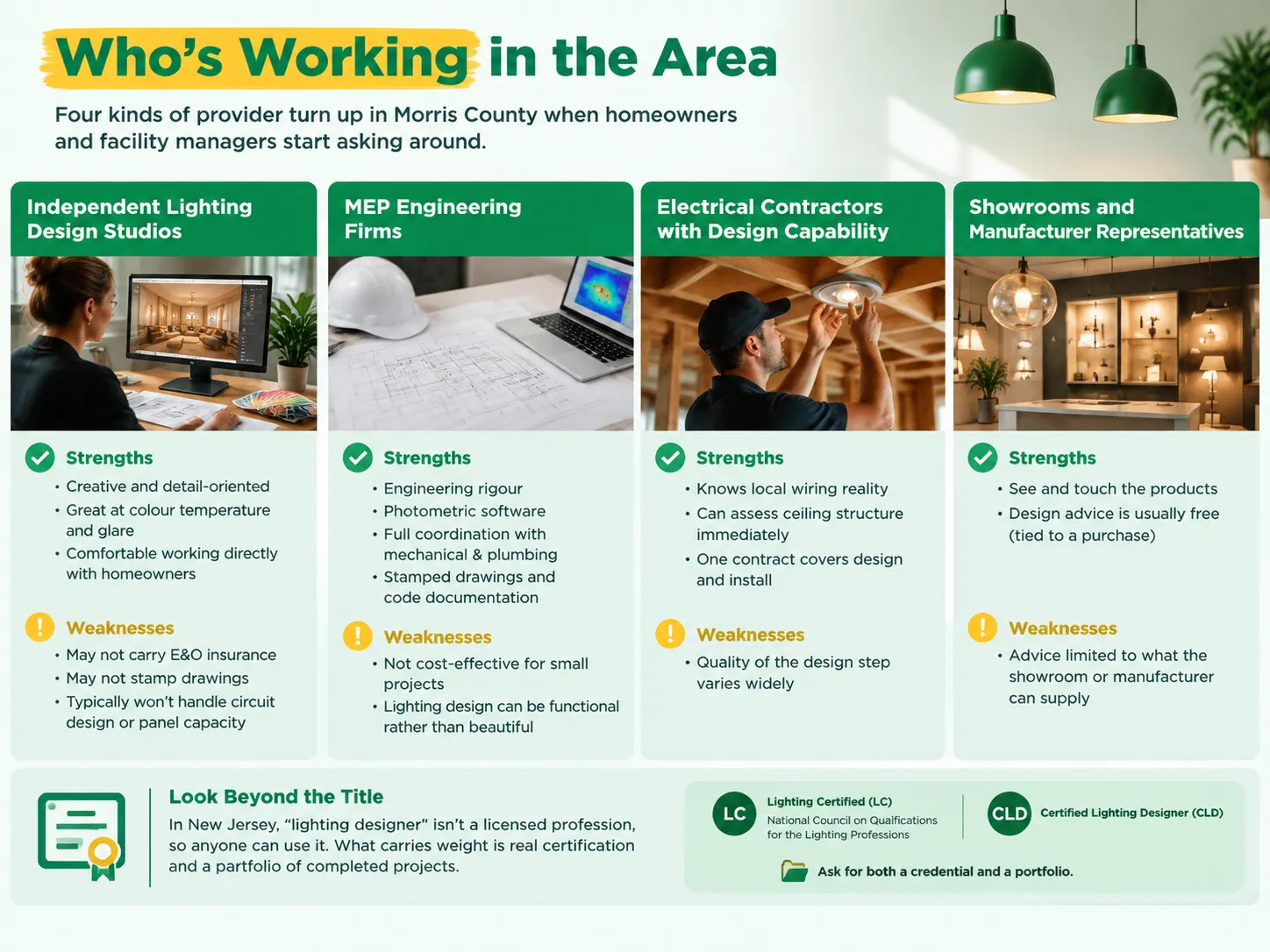
I Morris County finns det fyra typer av belysningsdesigners som yrkesverksamma och husägare konsulterar. Varje typ har sina egna distinkta fördelar och nackdelar.
När du letar efter en designer i New Jersey, kom ihåg att ackreditering inte alltid betyder titel. Yrket som belysningsdesigner är inte reglerat, så det kan användas av vem som helst. Den ackreditering som talar är inte en titel, utan snarare certifiering och en portfölj. Du kan vara säker på att praktik kan väga tyngre än teori.
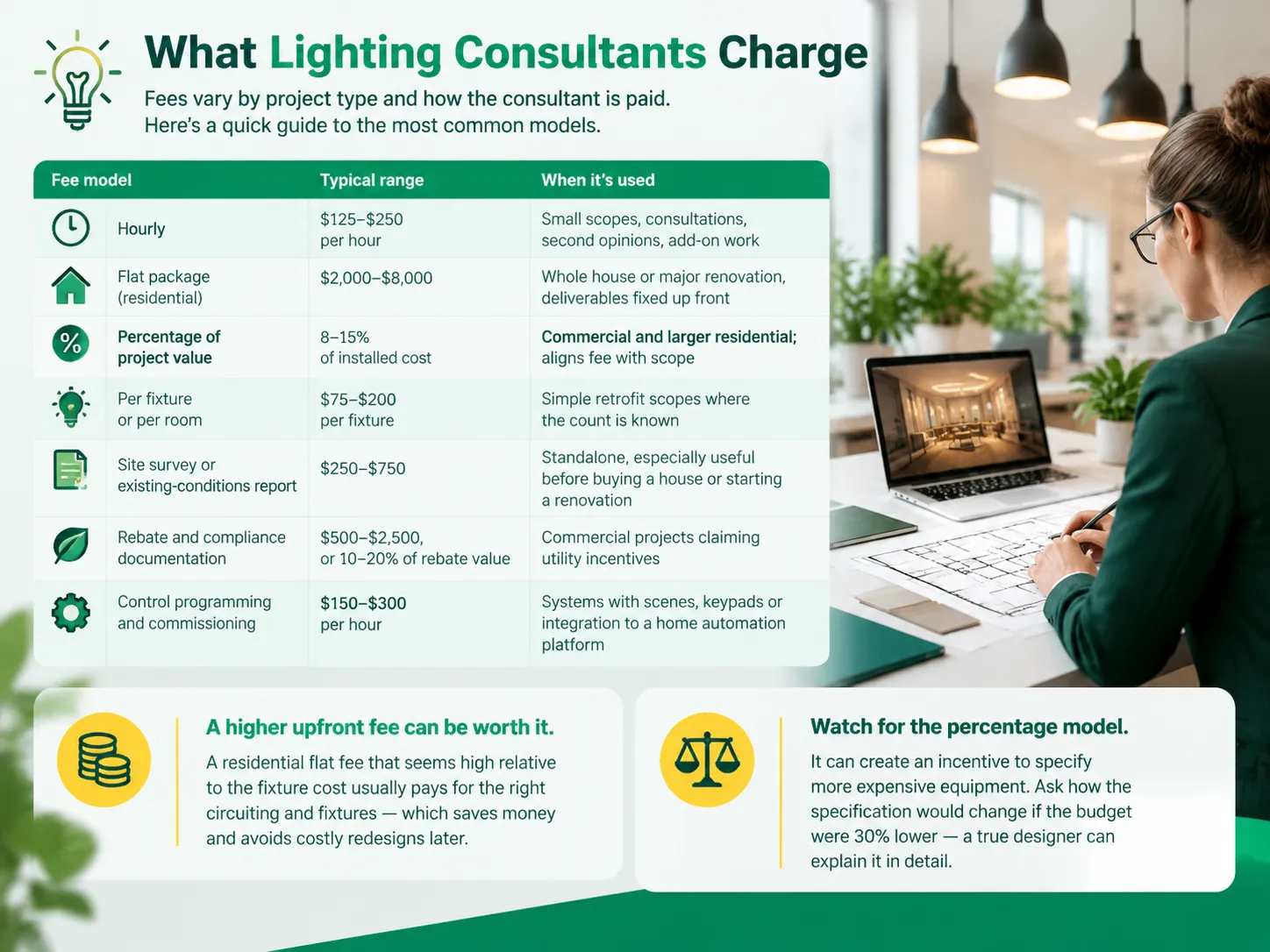
Marknadsprissättningen återspeglas på fyra olika sätt, och det är mycket viktigt att identifiera det som erbjuds dig.
| Avgiftsmodell | Typisk prisklass | När den används |
|---|---|---|
| Timpris | $125–$250 per timme | Små omfattningar, konsultationer, andra åsikter, tilläggsarbete |
| Fast paket (bostad) | $2,000–$8,000 | Ett helt hus eller en större renovering, leveranser fastställda i förväg |
| Procent av projektvärdet | 8–15% av installerad kostnad | Kommersiella och större bostäder; anpassar avgiften efter omfattning |
| Per armatur eller per rum | $75–$200 per specificerad armatur | Enkla retrofittingomfattningar där antalet är känt |
| Platsundersökning eller rapport om befintliga förhållanden | $250–$750 | Fristående, särskilt användbart innan man köper ett hus eller påbörjar en renovering |
| Återbäring och efterlevnadsdokumentation | $500–$2,500, eller 10–20% av återbäringsvärdet | Kommersiella projekt som gör anspråk på nyttjandeincitament |
| Kontrollprogrammering och idrifttagning | $150–$300 per timme | System med scener, knappsatser eller integration till en hemautomationsplattform |
Det finns ett par fakta om dessa siffror. För att börja med, en kostsam fast avgift betyder vanligtvis inte att det inte är fördelaktigt, eftersom det täcker något som gör att du sparar pengar: korrekt kretsdragning och rätt armaturval som utförs en gång. Att omdesigna belysningsprojektet efter att väggarna är byggda gör det mycket kostsamt.
Den andra aspekten av procentmodellen är lätt att förbise. När konsulten betalas som en procent av kostnaden, får han incitament att föreslå dyrare enheter. Detta betyder inte att denna modell är felaktig, men det är definitivt värt att fråga hur designen skulle förändras om budgeten minskades med 30%.
Det finns tre primära orsaker till problem i belysningsprojektdesign som anges av vanliga felpunkter i designen.
Det är osannolikt att de ovan nämnda elementen är särskilt attraktiva. Ändå är det de som kommer att särskilja installationen som fungerar smidigt och korrekt från installationen som behöver modifieras. Om du gör din egen samordning istället för att anlita någon, täcks de praktiska övervägandena kring val av lådor och enhetskompatibilitet i denna guide till val av elektriska lådor för uttag och strömbrytare, och det är värt att läsa innan grovinstallationen snarare än efter.
En belysningsplan är en elektrisk plan, vilket i New Jersey innebär efterlevnad av två regler: Uniform Construction Code och National Electrical Code. Även om din konsult inte nödvändigtvis behöver vara en elektriker, bör den producerade planen vara praktiskt genomförbar.
Här är några vanliga fallgropar i en dålig belysningsplan:
Heights are one of these details that seem insignificant, until you find yourself in the room where either the switches do not line with the door casing or the dimmer appears to have intentional placement in the hallway but should not have been normal. If you want the practical conventions rather than the code citation, this piece on standard light switch height from the floor covers the typical figures and when accessible-design rules change them.
The switching is the aspect of lighting design where the difference between good and bad design is most noticeable in real life.
In the past, lighting control was straightforward: one switch for each grouping of lights and maybe a dimmer. Nowadays, it is common to see a mixture of conventional switches, trailing-edge dimmers, multi-way dimmers, occupancy sensors, and various keypads in a refurbished building and it presents a problem. Each kind of device has its own requirements, such as the kind of wiring used, whether the device is compatible with the others, etc.
The problem of compatibility is what confuses people. The fact that not every LED lamp or fixture can work with dimmers poses no problem as long as the curve of the controlled voltage is compatible between the two devices. Thus, if a phase-cut dimmer is used in tandem with a device meant for 0-10 V control, it may cause problems like flashing, hum, limited dimming capabilities or no minimum light at all. When a dimmer has a minimum load requirement higher than the fixture’s, it may not function at all, which can be a predicament, which can be solved by having the compatibility chart. This is basically a table given by the manufacturer that shows compatibility between certain drivers and lamps.
In addition to compatibility issues, the installation can be a problem too, as a wonky wiring scheme in a three-way or using a dimmer on the wrong leg can make the system behave as if there were faulty devices involved.The wiring arrangement for a straightforward dimmer installation on an existing circuit is set out step by step in this guide to Installera en dimmer, and reading it before you brief a contractor is a good way to spot whether the person quoting you actually understands the circuit.
Scene programming gives you that last step of convenience. A house with eight keypads and no programming set up is worse than one with regular switches because no one knows what anything does. Make sure that you allocate a budget for programming time. It is inexpensive during the commissioning phase, but it becomes costly when the dissatisfied client attempts to fix it after six months of living with it.
We need to clarify the limits of this term because “lighting” refers to various professions and products.
A lighting designer is the one who creates a lighting system, while an electrician carries on the installation work. The manufacturer produces fixtures. There is also the fifth, frequently ignored element, which is the switches, dimmers, sockets, and plates that are operated by the customer during many hours every day long after everything has been arranged and all the designers have left the place. This latter part of the business does not take up much space in any lighting project in terms of money but is the part that allows to define whether the project will please you in five years from now.
IGOTO specializes in this fifth part of the business. We manufacture wall switches, sockets, plugs, and other electrical apparatus and sell them through distributors and contractors. If you are engaged in specifying a project located in New Jersey, your consultant will most likely never mention a certain brand. The difference between a device that makes a smooth dimming effect for fifteen years and one that starts buzzing after three years is made at the plant, with the help of contacts, components, quality control experts, and various tests. That’s the part of the project we look after, and if you want to see what the range covers, the formats used across different regional standards are set out in this overview of wall socket and light switch formats for different markets.

Here are six inquiries that set an effective consultant apart from an enthusiastic one.
Next piece of local advice. Here, the bottleneck is determined by electrician’s schedule, not by design. If you are planning to rebuild, use the lighting consultant at the same time as designer.
A lighting consultant determines how a space will be illuminated and records it adequately to make light fixtures. As the reality is the survey of existing conditions, working on the essential needs of each area, designing the lighting in layers (ambient, general, accent, decorative), choosing specific fixtures giving their specific numbers, calculating the illuminance if necessary, designing the control scheme, coordinating with the electrician and builder and ensuring everything is done correctly. On commercial projects, they have energy code regulation and utility rebate documentation. They do not install anything and do not design the electric systems in most of the residential projects either, as it’s the job for the electrician.
The hourly rates for this industry typically range from $125 to $250. The total cost of a full residential design package ends up being anywhere from $2,000 to $8,000 on average depending on the complexity of the project. Commercial projects are usually charged on the basis of 8 to 15% of the project’s value, or on a per-fixture basis in the range of $75 to $200 per fixture. An independent site assessment or existing site report would cost $250 to $750. Control systems programming and commissioning are billed at around $150 to $300 on an hourly basis.
Not necessarily. If you are merely changing fixtures in an existing room, an electrician and even a showroom may be enough to make it work without spending much money. You may need a consultant in cases where more than one room is involved, when remodeling is taking place, when there is a need for a control system or automation, or even when a room is utilized differently than initially planned. The most obvious scenario is a renovation that has not yet reached the rough-in stage.
Electricians install and sign off the electrical work such as circuits, boxes, wiring, devices, and connection to panel. Lighting designers will determine what needs to be installed and why. There is a crossover, as an electrical contractor with design abilities can do both, but the roles are different and the certification and licensing are also different. Electrical work in the state of New Jersey requires a certified electrical contractor as well as a permit from local construction office. Lighting designer is not a licensed title in the state, thus the qualification to check is the certification such as Lighting Certified (LC), or Certified Lighting Designer (CLD) etc. as well as examples of completed projects.
For a single room home job, one week to two weeks from the first site visit until specification is issued. For a whole house remodel, the amount of time involved will be three to six weeks, with completion time determined by how long it takes to finalise architectural drawings; a design cannot be marked off against a design plan that is still in formative stages. For commercial work, the timeframe can vary from a few weeks for a simple fit-out to several months for a complete building as a result of the coordination with other trades and review cycles. Also include the time for control programming at the end; this is commonly a different visit after the electrician has completed his part.
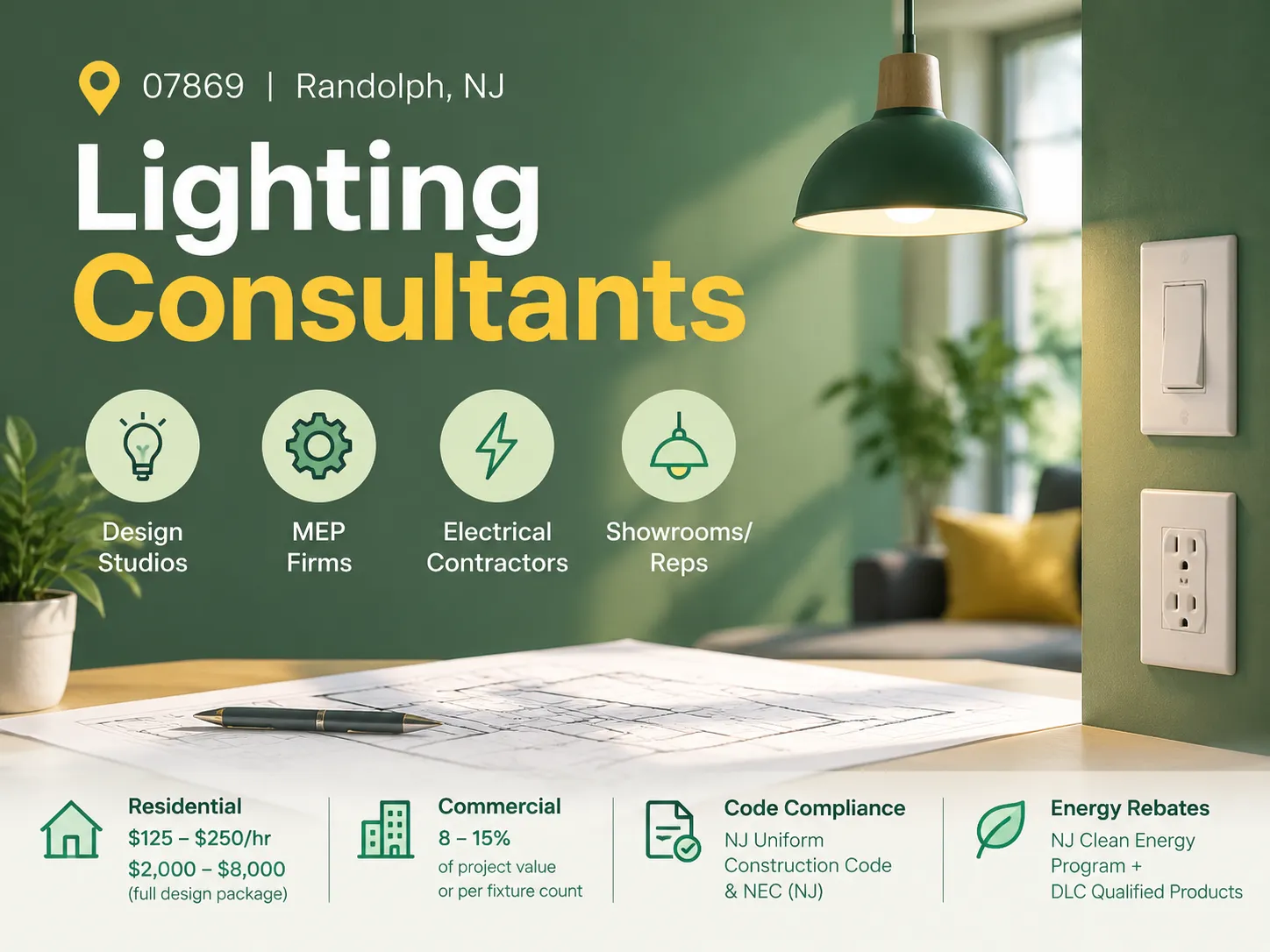
The lighting design industry in Randolph, New Jersey, 07869 is relatively small and consists of four types of companies; independent studios, MEP engineers, electrical contracting companies that specialize in lighting design, and showrooms which combine lighting design with product sales. All companies have good professionals, therefore an error by a customer may be hiring the wrong company type.
Cost calculations are fairly straightforward. Prices start from $125 per hour, then can be up to thousands of dollars for residential assignments and can account for 8%-15% of construction projects. However, this raises the question of how many points if the specifications contain all necessary details like the amount of the installed lighting, compatibility checks, and a visit to the site after installation. If yes then money is not wasted on sketches.
Two pieces of important advice, firstly, it is advisable to hire a lighting design consultant before starting implementation of a project, at this time the consulting services are the cheapest. Secondly, certification does not guarantee anything in this field, therefore it is always better to check the portfolio of the designer.
Randolphs kommun i Morris County är kopplad till postnummer 07869 som gränsar till Dover i väster och Denville i öster. Det finns Route 10 som korsar kommunen; tusentals privatägda hus kan hittas i denna kommun utspridda över de gröna kullarna och skogarna. När du gick in i detta […]

När någon ställer frågan “blir GFCI-uttag dåliga”, kan de egentligen fråga hur länge ett uttag kommer att hålla innan det går sönder. Det finns inget definitivt eller absolut svar på den frågan eftersom varje situation är unik; därför bör varje GFCI-uttag fungera korrekt så länge det inte finns några andra faktorer som bidrar till […]
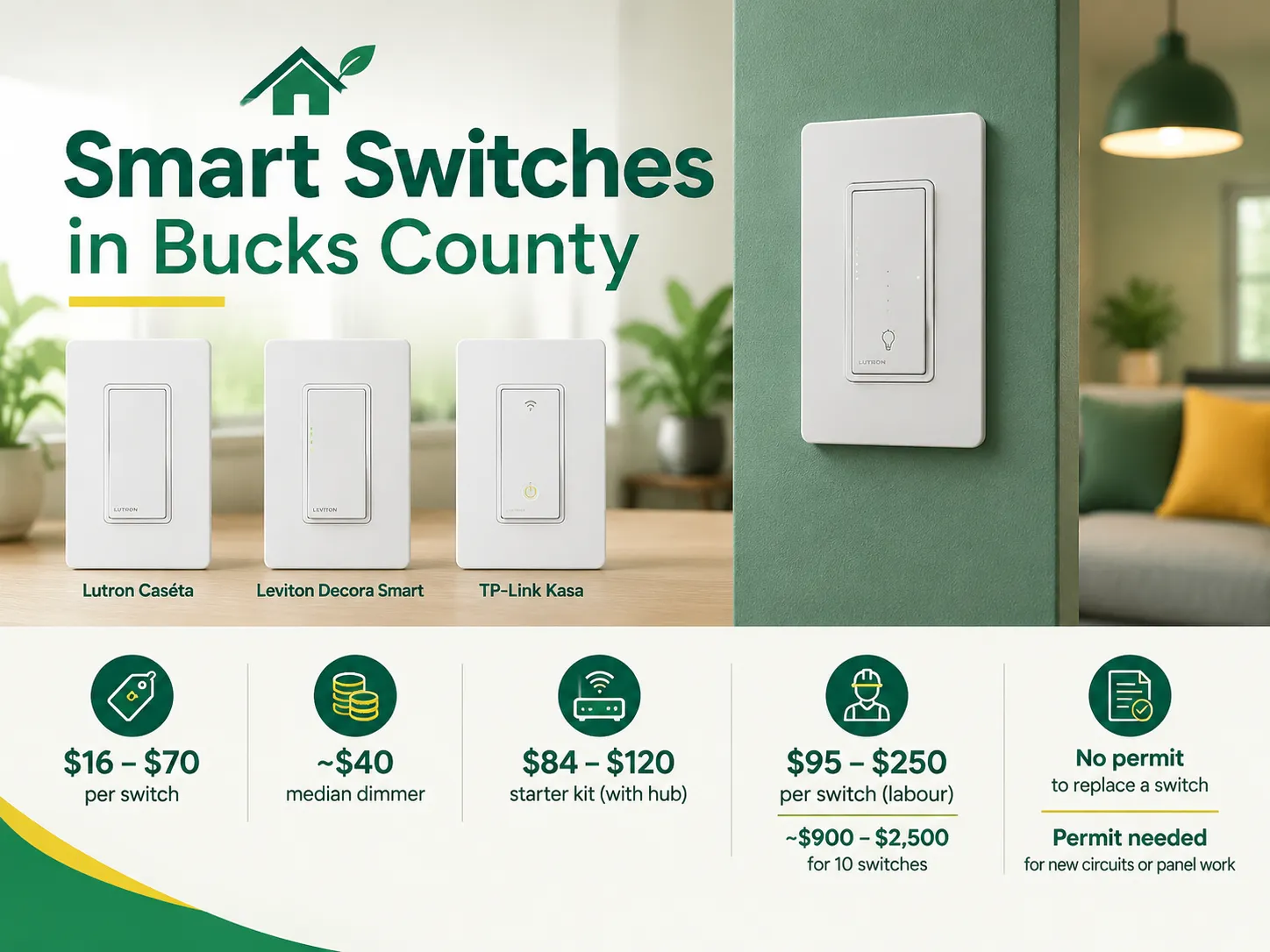
Att köpa smarta strömbrytare i Bucks County är relativt knepigt, där svårigheten mer handlar om egenskaperna hos den lokala fastighetsmarknaden snarare än tillgången på systemen. Man kan köra från Solebury, där några av husen kan dateras tillbaka till 1790-talet, till Warrington, där några nyare konstruktioner byggdes […]

 No.6 Tuozhan Road, Leshang Pioneer Park, Yueqingwan Bay Harbor, Yueqing stad, Zhejiang-provinsen


