

När någon ställer frågan “går GFCI-uttag sönder”, kan de egentligen fråga hur länge ett uttag kommer att hålla innan det misslyckas. Det finns inget definitivt eller absolut svar på den frågan eftersom varje situation är unik; därför bör varje GFCI-uttag fungera korrekt så länge det inte finns några andra faktorer som bidrar till dess misslyckande, såsom exponering för miljöer som kan orsaka skador (till exempel extrem värme, fukt eller vattenskador). Det finns flera olika typer av GFCI-uttag med olika spänningsklassningar, vilket i sin tur kommer att ha olika livslängder om de används i enlighet med deras avsedda syften och tillverkarens riktlinjer.
Förutom att veta hur länge GFCI-uttag vanligtvis varar, är det nödvändigt för alla som överväger att använda ett GFCI-uttag i sitt hem eller anläggning att förstå de potentiella problem som är förknippade med att använda sådana enheter samt vilka steg man ska ta om enheten slutar fungera korrekt och har bedömts vara utanför de acceptabla gränserna för dess avsedda syfte och tillverkarens specifikationer. Därför bör vi alla ta oss tid att lära oss om GFCI-uttag så att vi kan fatta informerade beslut angående hållbarheten hos elektriska kretsar och apparater som används i våra hem och företag, samt hjälpa till att skydda vår familj, vänner och anställda från potentiella faror relaterade till användning av GFCI-uttag.
Svaret på din fråga är ‘ja’, och ja, GFCI-uttaget kommer att misslyckas över tid. I allmänhet är livslängden för ett GFCI-uttag cirka 10-15 år; Livslängden för en GFCI-kretsbrytare är 15-25 år; Om den installeras i ett område som är utsatt för fukt, eller utomhus, är den förväntade livslängden cirka 7-12 år på grund av miljöfaktorer. Byten bör göras omedelbart för äldre typer av GFCI-modeller som tillverkades före introduktionen av självtjänande enheter. Tyst fel är den farligaste situationen där GFCI-enheten fortfarande ger dig ström och har inget jordfelsskydd. Ett fungerande GFCI-uttag kommer att lösa ut inom en tidsram av cirka en fyrtio del av en sekund vid en läcka på 4-6 milliampere. Månatlig testning av konsumenten kan avgöra om GFCI fungerar; Testning görs genom att trycka på test för att stänga av strömmen; och återställa det för att slå på strömmen igen. Det bör förstås att kostnaden för GFCI själv ($15-$40) är mycket liten jämfört med kostnaden för att anlita en licensierad elektriker ($80-$200) för att installera GFCI-uttaget; Kostnaden kommer att baseras på ett antal faktorer inklusive geografisk plats och typ av elektrisk låda som används för att montera GFCI-uttaget.
Vi måste vara mycket försiktiga med vad detta säger, eftersom detta är hur felet inträffar.
Ett GFCI-uttag använder en liten strömtransformator som ständigt jämför strömmen som flyter genom den heta ledningen med återströmmen genom den neutrala ledningen. I ett korrekt fungerande GFCI är strömmarna i båda ledningarna lika. Om det finns även en liten läcka någonstans i kretsen kommer avläsningarna att skilja sig, och mekanismen kommer att utlösa en mekanisk switch för att öppna kretsen.
Tänk sedan på vad som händer med denna enhet över 15 år. Överspänningar från stormar och när nätet växlar. Återkommande utlösningar. Värme från apparater som drar mycket ström. Fuktigt väder. Och när vatten kommer in. Elektroniken som gör avkänningen försämras på grund av alla miljöfarligheter. Och när den försämras, misslyckas den nästan på ett farligt sätt.
Felet inträffar på två sätt. Antingen slutar utlösningsmekanismen att fungera korrekt, vilket är uppenbart eftersom du inte kan få RESET att hålla. Eller — vilket är farligare — sensorn slutar fungera medan uttaget fortsätter att fungera. Moderna GFCI:er kan utföra självtjänande tester där de gör interna kontroller. Äldre GFCI:er som tillverkades före implementeringen av självtjänande teknik har inget sätt att indikera att något är fel.
Detta är hela poängen med råden som ges av experterna inom området — “testa GFCI en gång i månaden” är inte bara ett byråkratiskt krav. Det är det enda sättet att upptäcka den felaktiga GFCI som har slutat fungera.
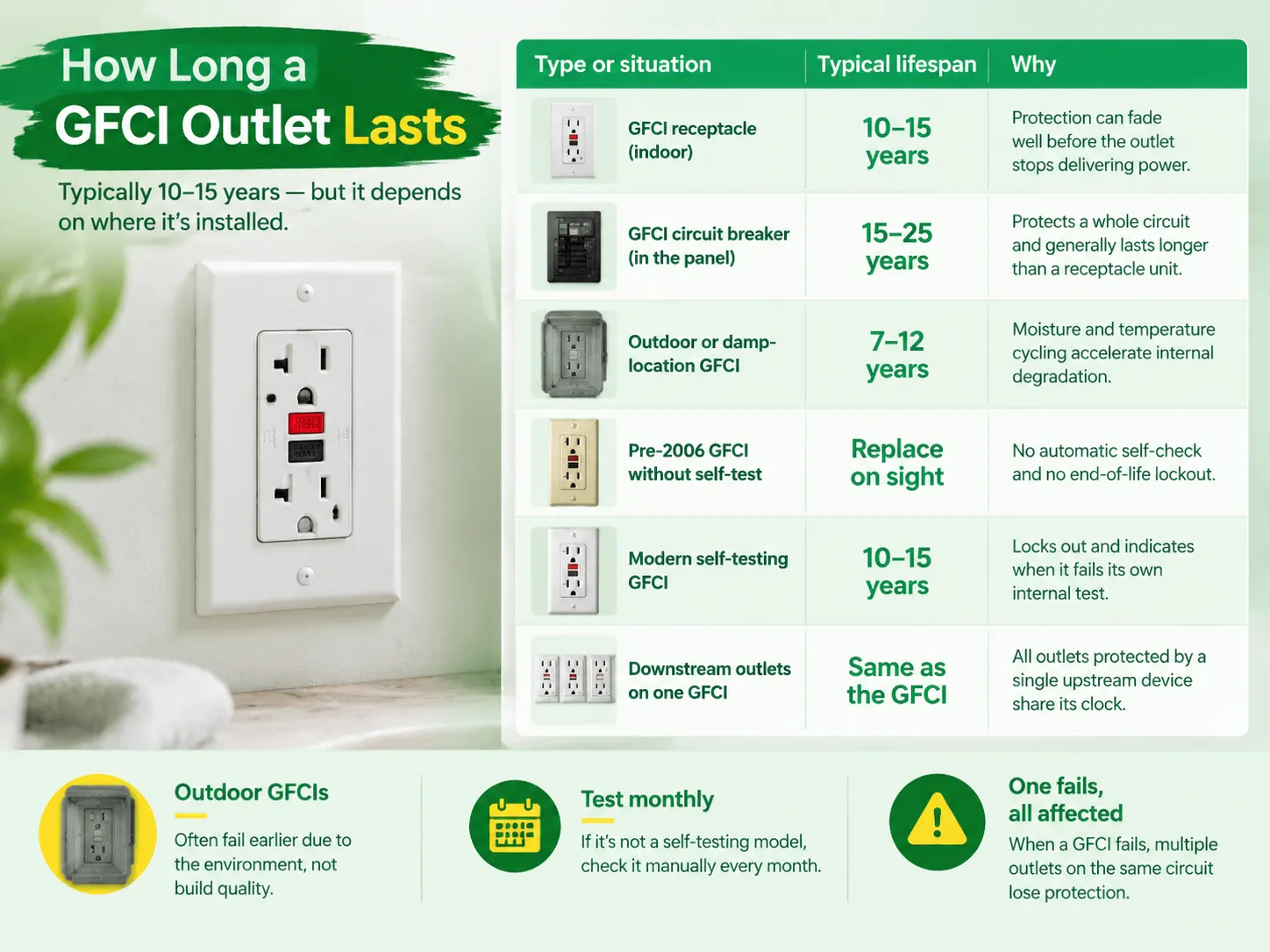
“Tio till femton år” är det huvudnummer, men var uttaget installeras förändrar det mycket.
| Typ eller situation | Typisk livslängd | Varför |
|---|---|---|
| GFCI-uttag (inomhus) | 10–15 år | Skyddet kan blekna långt innan uttaget slutar leverera ström |
| GFCI-kretsbrytare (i panelen) | 15–25 år | Skyddar en hel krets och varar generellt längre än en uttagsenhet |
| Utomhus- eller fuktig plats GFCI | 7–12 år | Fukt och temperaturcykling påskyndar intern nedbrytning |
| GFCI före 2006 utan självkontroll | Byt ut på plats | Ingen automatisk självkontroll och ingen livslängdsavstängning |
| Modern självkontrollerande GFCI | 10–15 år | Låser ut och indikerar när den misslyckas med sitt eget interna test |
| Nedströms uttag på en GFCI | Samma som GFCI | Vanliga uttag skyddade av en enda uppströms enhet delar dess klocka |
Två intressanta saker att notera. För det första kan en utomhus GFCI vara av samma märke som inomhusmodellen, men är troligtvis död mycket tidigare på grund av installationsmiljön snarare än dess byggkvalitet. För det andra, när GFCI återupptar arbetet med att skydda raden av vanliga uttag bakom den, lider alla uttag som är beroende av den GFCI förluster tillsammans. Därför upptäcker människor vanligtvis problemet när de märker att flera uttag fungerar dåligt istället för bara ett.
Den mest betydelsefulla punkten i tabellen är testfaktorn. Om din enhet har installerats före framträdandet av självkontrollerande varianter av enheten, måste du testa enheten manuellt varje månad för att hålla koll på dess arbetsstatus.
Inte alla GFCI-fel är samma problem, och lösningen skiljer sig. Här är de som står för de flesta fallen.
| Fel | Vad du observerar | Vad som händer | Kopplingsspecifikationer i en vanlig USA-installation är som följer: svart som förmedlar strömförande (eller strömförande) ström, röd som representerar den andra fasledaren (i 14-3/12-3 kabel), vit som nollledning (vänligen notera att vita är sammankopplade internt, inte i strömbrytaren), och bar kabel/grön för jord. I fallet med Storbritannien/EU, brun betyder fas (men om den fungerar som fasledare/strömförande, är den märkt brun), och grön-gul indikerar jord; dessutom är de vanliga märkningarna som används i terminalerna där COM, L1 och L2 – COM leder strömförande ström från en strömbrytare och strömförande ström från en annan. Principen bakom allt detta förblir mer eller mindre oförändrad; det är dock viktigt att uppmärksamma färgspecifikationerna och märkningarna. För en visuell jämförelse av hur olika typer av strömbrytare är konstruerade, visar vår guide till |
|---|---|---|---|
| Silent sensing failure | Nothing — outlet works normally | Sensing circuit degraded; device no longer detects ground faults | Replace immediately. TEST button is the only detector |
| Won’t hold on reset | RESET pops straight back out | Mechanism worn out, or an active fault still present | Unplug everything and retry; if it still won’t hold, replace |
| Completely dead outlet | No power, buttons unresponsive | Internal failure, or no supply from the panel | Check the breaker first, then replace the device |
| End-of-life lockout | Fault light on; no power | Self-testing unit detected its own failure and locked out by design | Replace — this is the device working correctly |
| Nuisance tripping | Trips repeatedly with nothing plugged in | Genuine fault, moisture in the box, or a hair-trigger worn unit | Dry and diagnose first; replace if the fault persists with nothing connected |
| Thermal damage | Warm faceplate, discolouration, burning smell | Loose termination or overload creating resistance heat | Stop using it. This is a fire risk, not just a protection failure |
This point really needs reiteration. Warm faceplates or burning odors emanating from a receptacle are not normal — and this isn’t specific to GFCIs but indicates that there may be a loose connection somewhere in your electrical system. Even if the GFCI is still functioning, there is still a danger of fire occurring. Shut off the breaker and have it checked.
Furthermore, there is something to be said about the fact that the device has a life span. Modern self-testing GFCIs are designed to permanently lock out when they can no long guarantee any level of protection, which means that a dead receptacle with a great light is perfectly normal behavior. Look for this feature while shopping for a replacement: a device that indicates it has stopped working is far more useful than one that just leaves you wondering.If you want to see what that looks like as a product category rather than a description, the two formats most commonly used in residential and light commercial work are the standard GFCI receptacle for wall-box installation and the weather-resistant variants built for outdoor and damp locations.
While GFCIs usually start displaying their issues without notifying the user beforehand, there are still common signs to look out for, which are listed below in chronological order, starting from the one that occurs first:
One more sign that is often misdiagnosed: if the GFCI trips every time you plug an appliance into it, that doesn’t mean it’s faulty GFCI. Try plugging in another device in that GFCI. If it successfully works with another device but trips with a hairdryer, you need to discard the hairdryer. In case everything trips, the device or moisture in the circuit may be a reason for that. If the breaker trips but not the GFCI, then it indicates that it’s a problem with circuit capacity.
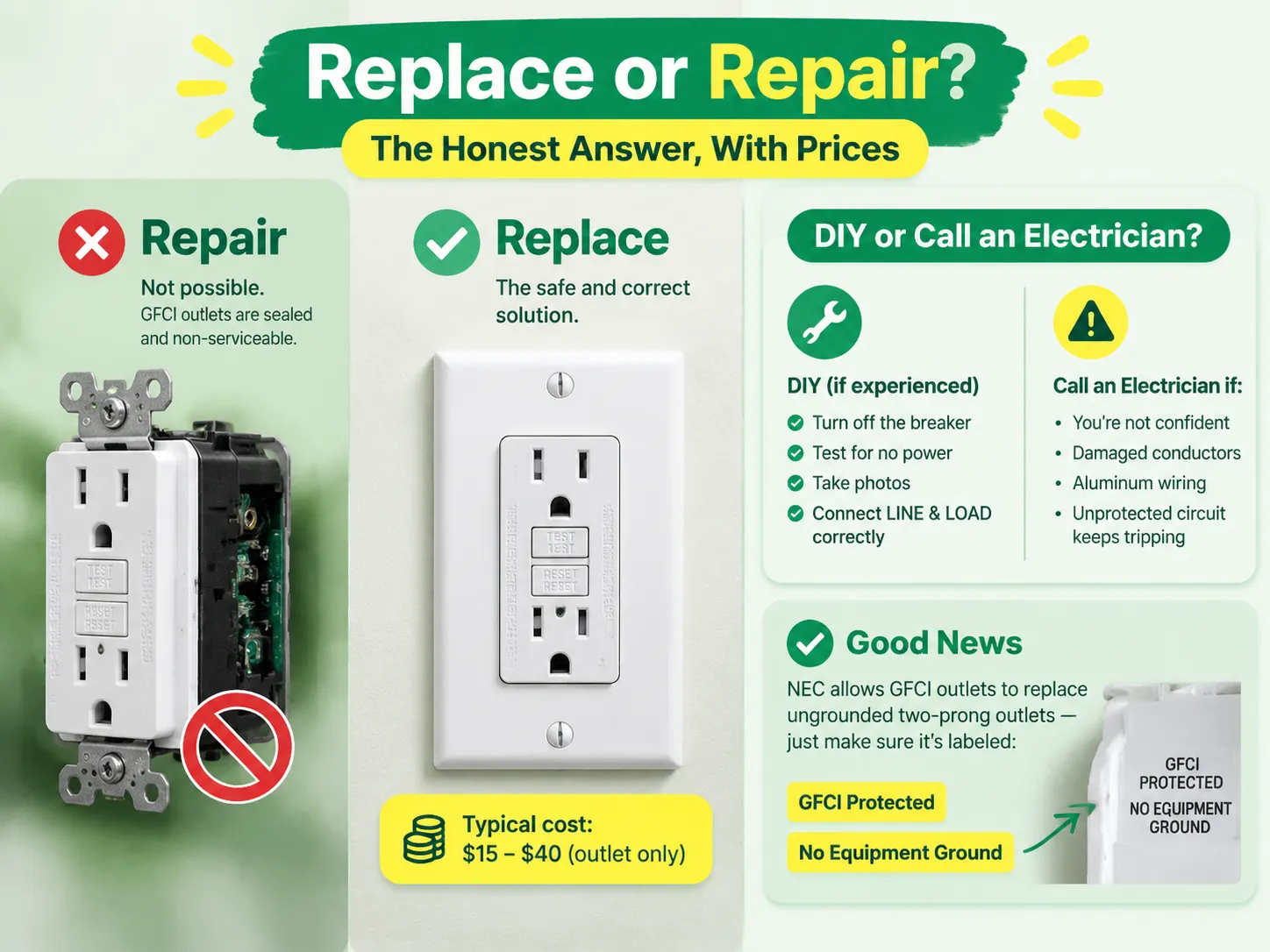
There exist both a version of this inquiry that can be answered and another version that cannot.
The answerable version: Is it possible to repair a GFCI outlet? It cannot be done; a GFCI receptacle comes as a sealed or non-serviceable electronic system. Since it lacks user-replaceable parts, no person is capable of repairing the internal sensing circuit anywhere else apart from the place of fabricating it. In case the protection is compromised, the device shall be replaced with a new one as that is simply what the product’s design implies.
The unanswerable version: Should you perform the substitution independently or call for an electrician? The answer to this question depends a lot on your own skills and also on the requirements imposed by your local jurisdiction. Changing a GFCI is really simple for someone experienced in dealing with live wires: you shut off the breaker, check it with a tester, take photos of the wiring prior to touching it, and connect the LINE and LOAD terminals in a proper manner. The most common error in this operation consists of making the right connection using LINE and LOAD cables in a wrong way.
The steps and the pitfalls are covered in more detail in this walkthrough on replacing a wall socket safely, including the checks worth doing before and after.If you are not sure whether you can perform the repairs yourself — or if there is a risk that the box has damaged conductors, aluminum wiring, or has an unprotected circuit that keeps tripping — stop and call in an electrician. Electrical problems are among the few types of repairs that can kill someone who makes a mistake trying to fix it without any expertise.
Another fact that is interesting to know about is that, according to the straight NEC rules, it is possible to use GFCI receptacles to do away with ungrounded two-prong outlets. As long as the new outlet is marked as “GFCI Protected” and “No Equipment Ground,” you have a great life-safety benefit without having to spend any money on rewiring.
Eilling is a matter of time and money, so be careful and know your options.
| Artikel | Typisk kostnad | Anteckningar |
|---|---|---|
| GFCI receptacle, standard | $15–$40 | Weather-resistant and self-testing models sit at the upper end |
| GFCI circuit breaker | $40–$90 | Panel-level protection for a whole circuit |
| Plug-in GFCI tester | $10–$15 | Confirms wiring and lets you test the outlet externally |
| Electrician, residential replacement | $80–$200 per outlet installed | Most of the cost is labour and diagnosis, not the device |
| Bathroom or difficult location | $120–$300 per outlet installed | Higher when the box needs work or the outlet has to move |
| Multiple outlets in one visit | Lower per outlet | The economic case for doing them together rather than one at a time |
Electricians charge different rates depending on the region and the type of work they are doing, but rates remain stable enough to help with planning.What this means in practice is that it is usually cheaper to replace components on your schedule than to wait until something fails.
Electronics can’t be stopped from aging, but they can be kept from aging too fast. Most of the things that shorten the life of a GFCI are issues related to its environment or the electricity it receives.
People tend to overlook the argument regarding the environment point. For instance, if a fixture is rated for fifteen years in a corridor, it will only last half as long in an area that has a defective hose bib. If you’re specifying outlets for damp or outdoor locations, weather resistance isn’t an upgrade — it’s the requirement, which is exactly what separates a general-purpose unit from a weather-resistant GFCI designed for damp and outdoor installation.
It is fully prevention procedure that requires less than a minute for execution in each outlet.
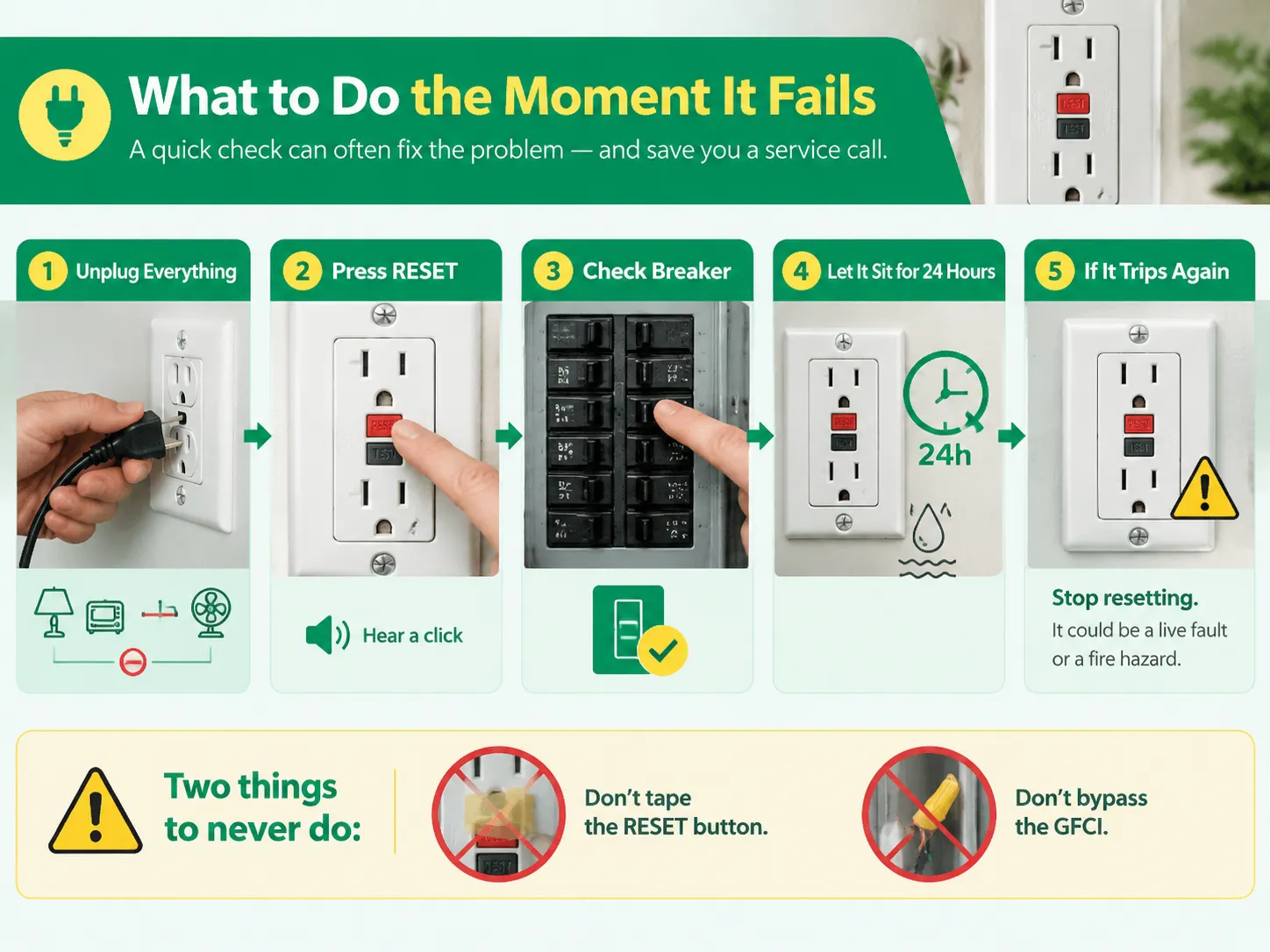
When the outlet is not working or the Ground Fault Circuit Interrupter is not working, there are several steps to follow. It does not take much more than five minutes and it actually helps save money on unnecessary service calls.
There are two things that should never be done: do not tape the RESET button and do not bypass the GFCI because doing one of those things is not a good idea, either. If you want the diagnostic sequence in more detail — what each symptom points to and which ones you can fix yourself — this guide to what to do when a socket or outlet stops working walks through the same logic with the wiring-side checks included.
Requirements vary according to the jurisdiction and age of the property so it is always advisable to check the local code. Despite this, more or less the list designated by the NEC includes locations where water and electricity could meet:
If your house was built before the date the requirement was instituted and the outlet was not updated, the code states that the given element can remain. However, this does not mean that this outlet was safe.
One clarification that is essential to be done is that GFCI and circuit breaker do different jobs, and both are necessary.
| Enhet | Protects against | Trips at | Where it lives |
|---|---|---|---|
| Kretsbrytare | Overcurrent — overload and short circuit | Rated amps (15 A, 20 A, etc.) | Distribution panel |
| Jordfelsbrytare | Ground faults — current leaking to earth through a person or water | 4–6 milliamps | Receptacle or panel |
| AFCI | Arc faults — dangerous arcing in damaged wiring | Arc signature detection | Panel, or combination devices |
A breaker would allow five milliamps of current to pass through your body without any problem — it won’t trip. That’s where the GFCI comes in, so it should be understood that a GFCI should not be used as a substitute for a breaker and vice versa.If you’re trying to understand how the two layers work together, the relationship between breakers and the outlets they feed is set out in this explanation of circuit breakers and the outlets and switches they protect, and it’s worth five minutes if you’ve ever wondered why a bathroom has two separate devices doing apparently similar jobs.
There’s something we can’t forget about when we discuss GFCIs – their manufacturing process. First and foremost, GFCIs are component-supply products, and the reliability of their sensing circuit boils down to component selection, quality control at the manufacturer’s place, and end-of-line testing. Hence, companies like igoto supply switches, plus sockets, outlets, and power strips, including GFCIs, to their distributors and contractors. This is also the reason why published standards matter when it comes to purchasing – a GFCI that doesn’t meet the applicable UL standard does not become cheaper but is just a different product that looks very similar.
You can check this by using a lamp. Plug the lamp into the protective switch, press TEST, and you should see that the lamp goes out and the RESET button pops out; if you press RESET button afterwards, you should see that the power is restored. If TEST doesn’t work and RESET can’t be pressed down, then it means the protection has failed and the unit needs to be replaced, even if the electrical appliances are powered normally. You may also check for some other indications like warm or discolored faceplate, a fault light blinking or shining continuously, regular tripping when nothing is being plugged into the device or difficulty with pressing down RESET.
Normally, a GFCI outlet remains functional for approximately a decade or a decade and a half whereas a GFCI breaker does its job for slightly longer. Due to the presence of moisture and humidity outdoors, most devices don’t last more than 10 years. Furthermore, devices produced before self-testing systems were introduced should be changed out even if they are not broken because they cannot reveal whether they are malfunctioning or not.
Substitute it when it fails any of such checks: either it doesn’t turn off the electricity, the reset is not persisted or a device has triggered self-test lockout lock, or the unit hasn’t reset itself even after the disconnection and drying of the circuit. In case it’s aged more than 10 to 15 years or is older than self-testing devices, then it can be replaced based on the age alone. It has to be replaced without a delay in case the device is warm, burnt or emits odour.
The primary causes are degradation due to aging of the sensing electronics, the number of times power surges and lightning hits, frequent tripping cycles that have taken a toll on the mechanical latch, moisture ingress into the enclosure and heat stress due to overloaded wires and/or loose terminations. It is significant to differentiate whether the aforementioned problems are due to appliance defects or real ground faults, as a GFCI that trips only when a certain appliance is plugged in is likely discovering an actual current leak in that appliance rather than a GFCI malfunction.
GFCI outlets do fail, and it’s important to note how they fail. GFCI outlets do not give a warning; they keep working like they’re meant to. The light keeps turning on and off, and that vital function — the cutting of power when current is leaking through a person — may fail without any visible sign at all.
The take-home point is 10-15 years lifespan for a receptacle, 7-12 years lifespan in damp places, and a trip time equal to about 1/40 second at 4-6 mA for a working device. In practice, the device costs between $15 and $40 and costs another $80-200 to install, making this simple little device the difference between just getting a shock from a bathroom outlet and getting seriously electrocuted.
For this reason, test every month. Press TEST, see the power goes out, press RESET. If the device does not work just as it should, it must be replaced — it cannot be fixed. If the device has served you for more than 10 years, yes, replace it on your schedule, not in an emergency situation. When buying the replacement, always opt for self-testing devices that can alert a user before breaking down, which is a huge advantage over devices that will stop working without any warning.

When someone asks the question “do GFCI outlets go bad”, they may really be asking how long an outlet will last before failing. There is no definite or absolute answer to that question as every situation is unique; therefore each GFCI outlet should properly work as long as there are no other factors contributing to […]
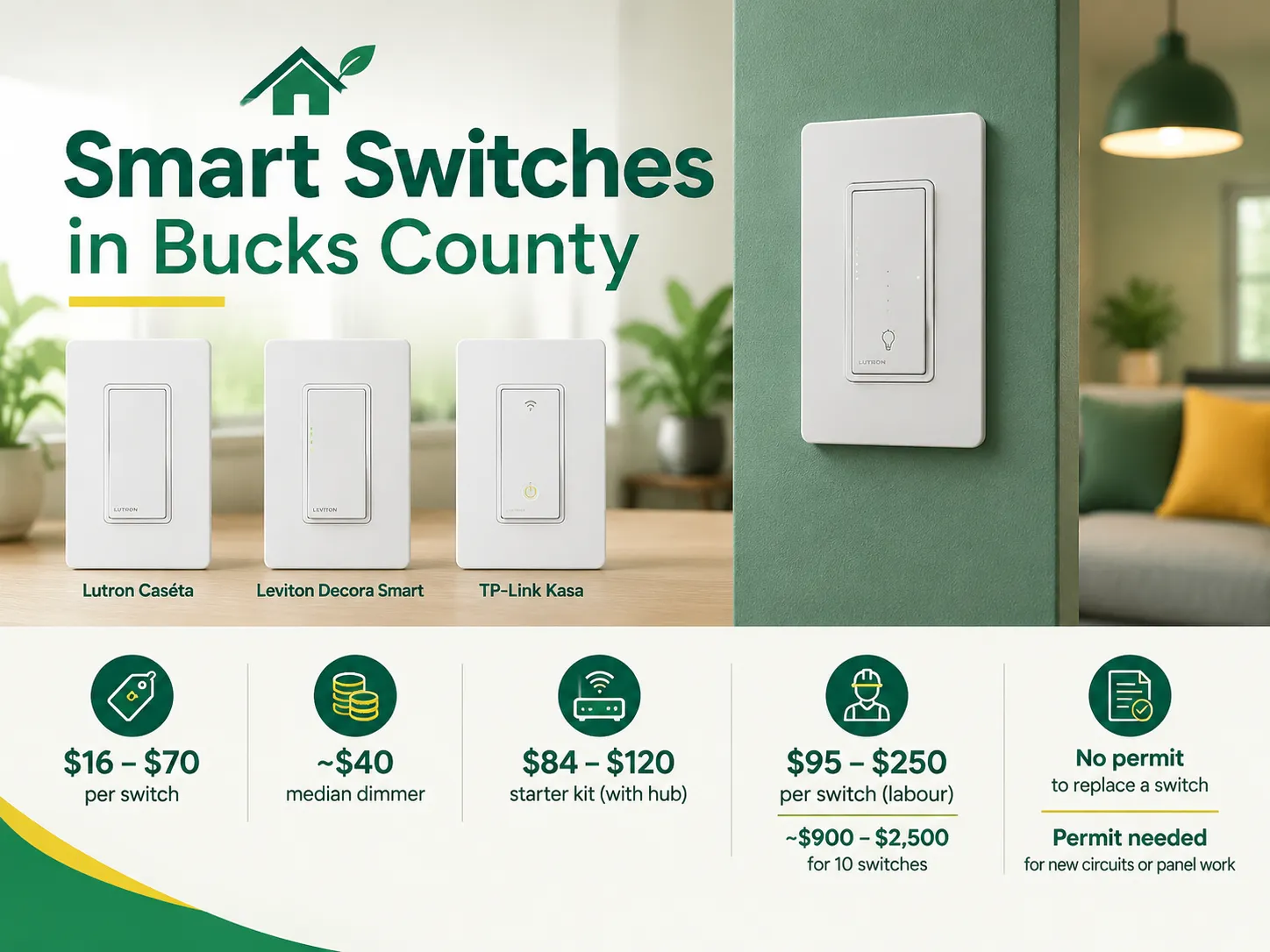
Att köpa smarta strömbrytare i Bucks County är relativt knepigt, där svårigheten mer handlar om egenskaperna hos den lokala fastighetsmarknaden snarare än tillgången på systemen. Man kan köra från Solebury, där några av husen kan dateras tillbaka till 1790-talet, till Warrington, där några nyare konstruktioner byggdes […]

Trådlös belysningskontroll har en smutsig liten hemlighet: medan den ofta fungerar exceptionellt bra i demonstrationer, tenderar den att svika människor i deras hem. Den skyldige är sällan appen; istället ligger den bakom väggen. Denna guide presenterar valen på ett ordnat sätt. Sex sätt att styra ljus trådlöst, fem protokoll som […]

 No.6 Tuozhan Road, Leshang Pioneer Park, Yueqingwan Bay Harbor, Yueqing stad, Zhejiang-provinsen


