

Om du reser ofta vet du förmodligen att packa för Singapore är en av de enklaste sakerna att göra i Asien, men också en av de svåraste eftersom det använder brittiska kontakter (istället för amerikanska). Om du behöver en transformator, en kontaktadapter eller båda beror på två frågor som turister vanligtvis förvirrar.
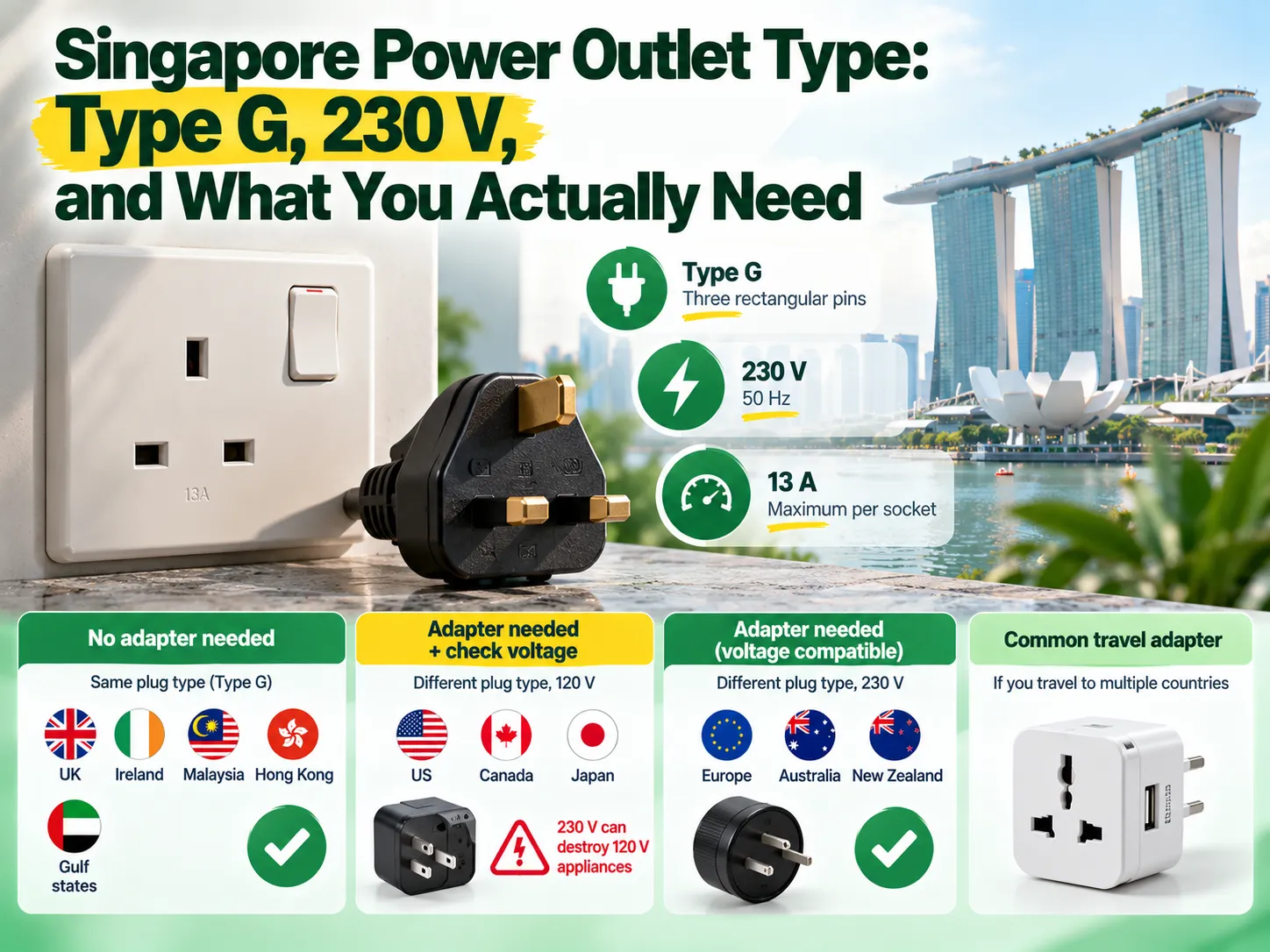
Kort sagt: I Singapore används kontakttypen G, som baseras på den brittiska BS 1363 av SS 145-standarden med samma egenskaper. Matningsspänningen i Singapore och frekvensen är 230 V och 50 Hz. Besökare från Storbritannien, Irland, Malaysia, Hongkong och vissa Gulfstater behöver inget. Besökare från USA, Kanada och Japan bör använda en adapter och kontrollera spänningen. Således kommer apparater från 120 V att skadas. Besökare från europeiska länder, Australien och Nya Zeeland behöver endast adaptern, eftersom spänningen är densamma.
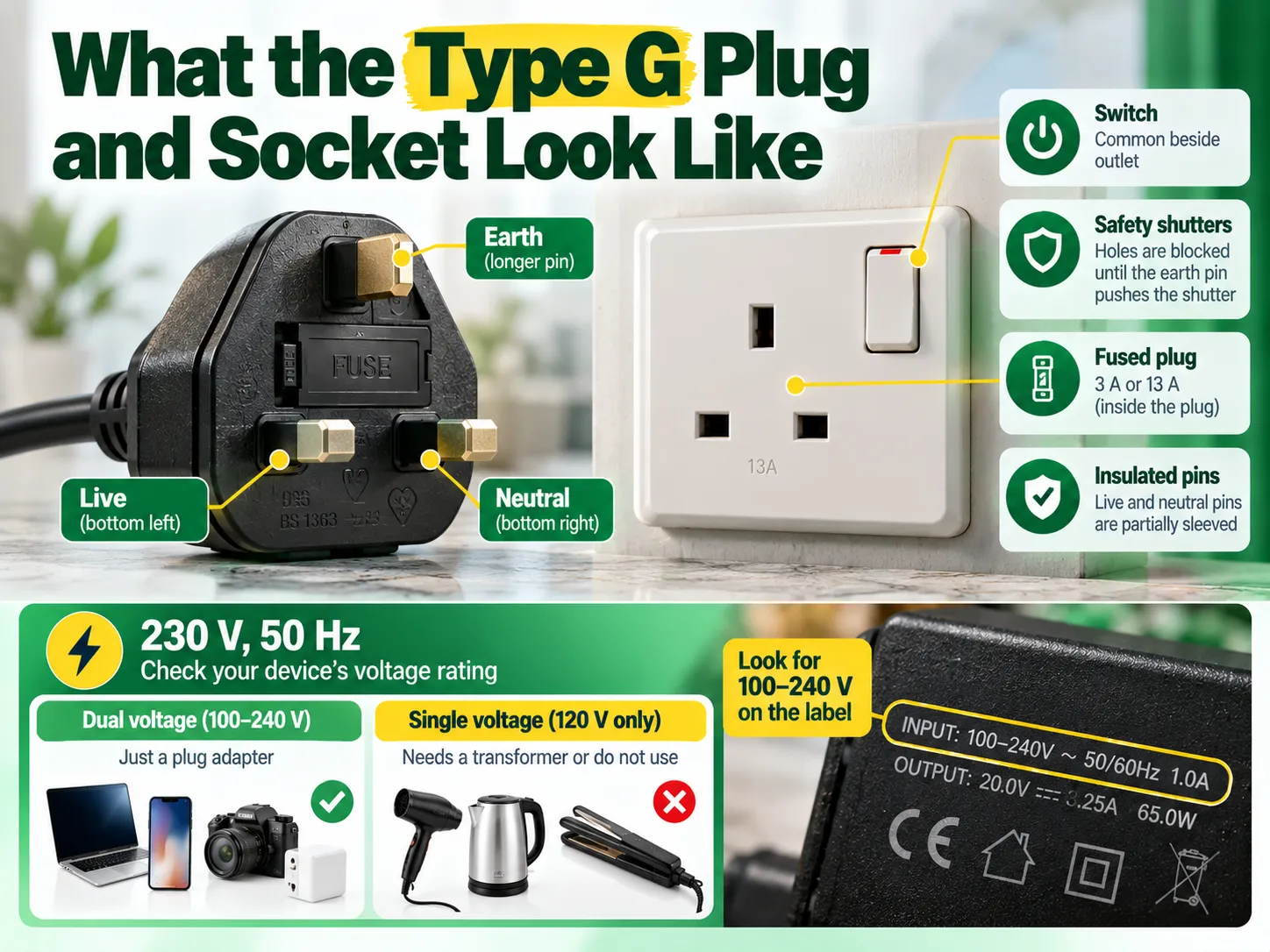
Arrangemanget av tre rektangulära stift i Typ G är unikt. De två platta stiften längst ner är placerade för att fungera som levande och neutrala stift medan det längre stiftet högst upp fungerar som jordstift. Anledningen till det längre jordstiftet är att det möjliggör att jordanslutningen görs före den levande anslutningen.
Alla kontakter i Singapore följer detta mönster och har unika designfunktioner som gör dem till en av de säkraste kontakterna i världen. De viktigaste funktionerna inkluderar:
Den bredare bilden av hur kontaktformer varierar globalt — och varför det finns femton namngivna typer istället för en — presenteras i denna översikt av de olika vägguttagstyperna och var varje typ används.
Singapore får elektricitet vid 230 V, 50 Hz, vilket är i enlighet med europeiska standarder, till skillnad från Nordamerika. Nätet drivs av SP Group och är känt för att vara ett av de mest stabila näten i världen. Den levererade spänningen ligger nästan alltid inom flera procent av det nominella värdet.
Detta nummer innebär två viktiga saker:
För att undvika problem när du reser till Singapore, se till att leta efter etiketten för dubbelspänning. De flesta bärbara datorer, telefonladdare, kameraladdare, elektriska tandborstar och bärbara högtalare från det senaste decenniet är designade för att fungera inom intervallet 100 – 240 V, 50/60 Hz och kommer därför endast att kräva en pluggadapter när de används i Singapore. De enda enheterna som har en potentiell risk för fel är de som förbrukar elektricitet direkt (hårtorkar, plattänger, vattenkokare etc).
Här försvinner den mesta förvirringen, eftersom svaret helt beror på varifrån du kommer.
| Kommer från | Din plugtyp | Adapter behövs? | Spänning |
|---|---|---|---|
| Storbritannien, Irland, Malaysia, Hongkong | Typ G | Inga | Matchar vid 230 V |
| Förenade Arabemiraten, Qatar, Bahrain, Kuwait, Oman | Typ G | Inga | Matchar vid 230 V |
| Saudiarabien (nyare byggnader) | Typ G | Vanligtvis nej | Matchar |
| Europa (Typ C, E, F), Italien, Schweiz | Runda stift | Ja | Matchar — endast adapter |
| Australien, Nya Zeeland | Typ I | Ja | Matchar — endast adapter |
| USA, Kanada | Typ A / B | Ja | Mismatch — kontrollera varje enhet |
| Japan | Typ A / B | Ja | 100 V — omvandlare behövs för vissa enheter |
| Indien | Typ D / M | Ja | Matchar — endast adapter |
Om ditt land använder Typ G, måste du ta med dina laddare och lämna adaptern hemma. Om ditt land inte använder Typ G, finns det bara ett Typ G-skydd för hela din resa — Singapore har ingen regional variation som vissa större länder. Den fullständiga regionala uppdelningen, inklusive vilka delar av världen som delar vilken standard, täcks i denna guide till pluggar och uttags typer efter region.
Nej, och detta är den mest kostsamma antagandet som görs av en resenär från Nordamerika. En Typ A-kontakt från USA har två platta och parallella blad och passar inte i en Typ G-kontakt eftersom kontakten är nedsänkt och dess luckor inte öppnas alls. Dessutom kommer en Typ B-kontakt med sin runda jordstift också att fungera.
Spänning är viktigare än detta. Om en enhet från USA, som endast är klassad för 120V, kopplas till 230V genom en billig adapter, kommer den att gå sönder. Därför är den korrekta ordningen för en amerikansk resenär som följer: använd en adapter först, och kontrollera sedan etiketten på varje enhet innan du kopplar in den. Skillnaderna mellan de nordamerikanska konfigurationerna och resten av världen anges i denna förklaring av den nordamerikanska uttags-typen, which is worth reading if you are deciding whether a device will travel at all.
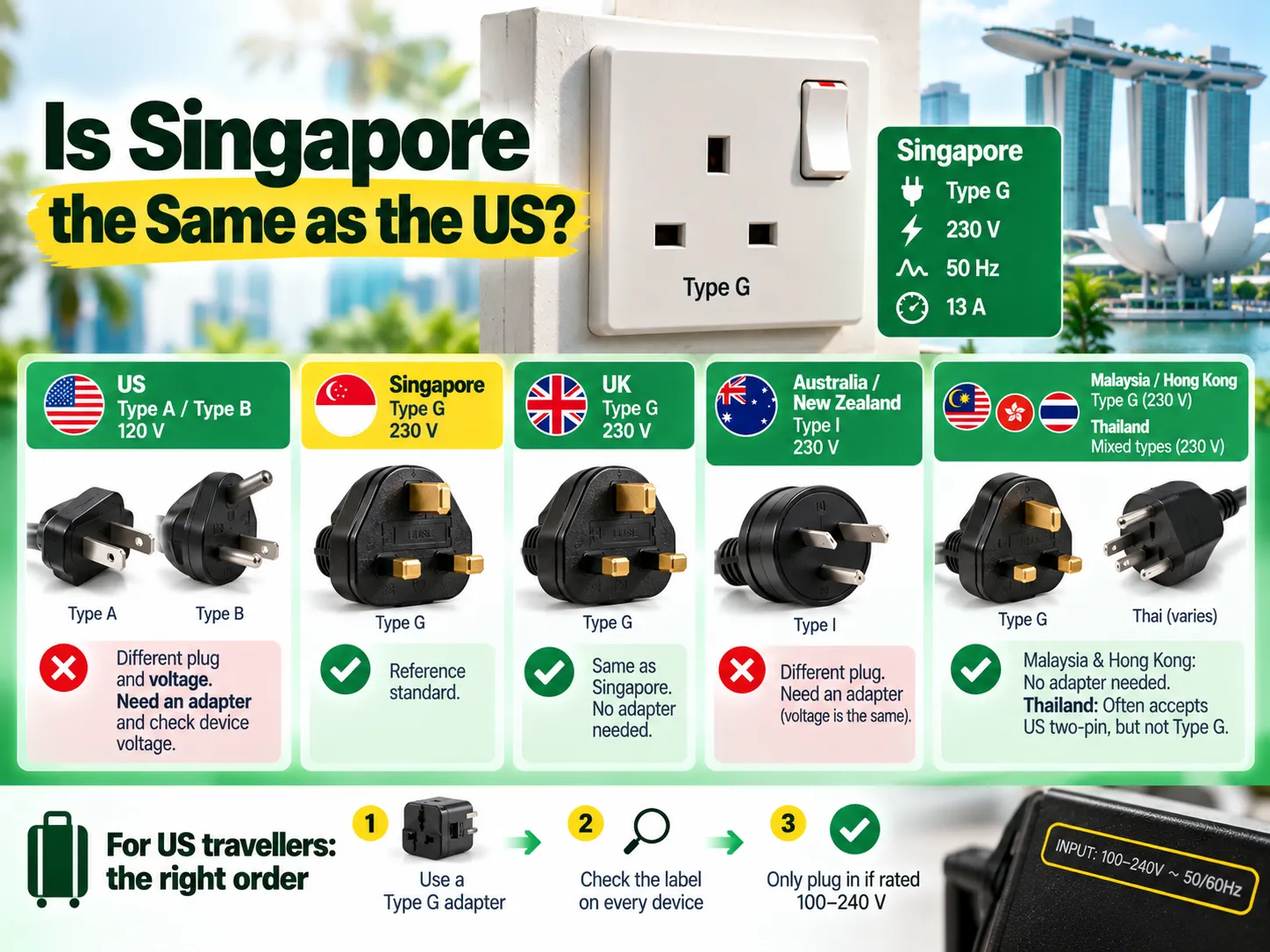
Just like the UK: yes, absolutely. Singapore adopted British standards, meaning that the connectors, sockets, fuses and other power supply infrastructures are the same. So if you have an appliance from the UK, you can use it in Singapore without needing anything else.
Just like Australia: no. Australia and New Zealand use standard I, with three flat pins, and with the exact same voltage and frequency (230 V / 50 Hz) — naturally, the voltage is the same, and you would just need a plug adapter for Type I.
Just like its neighbors: mixed. Malaysia, Hong Kong, and Brunei also use G without needing adapters, while in Thailand, things are different, as there are many different plug types used, depending on the building. Thus, a Thai socket can sometimes accept a US two-prong plug without an adapter, but may not be suitable for G. That kind of regional inconsistency is exactly why travel itineraries through Southeast Asia need more than one adapter even though the voltage stays broadly the same across the region, as set out in this guide to the socket types used in Thailand.
This mistake is the one that can result in a person losing a laptop. A plug adapter only changes the shape of the connector being used; it doesn’t contain any electronics. But a voltage converter changes the voltage from 230V to 120V. If you buy the wrong one, your appliance will fit well only to burn out immediately after.
Cost of appliances in Singapore: plug adapters range from 5-30 SGD while voltage converters and converters for 120V appliances start at 30 SGD onwards (depending on the wattage). If your appliance is a dual-voltage one, it means that it is 10 SGD device, not 100 SGD.
Pay attention to adapters sold in airports. Plug Type G that is sold in the shop for 5-10 SGD will be priced upper 15-30 SGD in Changi, and uncertified plugs will have greater overheat and an electrical short-circuit risks than certified plugs. Opt for certified adapters with a fuse instead of picking the cheapest one on the market. The same logic applies to the European systems, where the differences between Type C, Schuko and the French and Italian variants catch people out — covered in this breakdown of Europeiska elektriska kontakter och uttag if your trip continues onward from Singapore.
Most plug types ensure protection of the wiring behind the wall. However, Type G goes a step further and protects the appliance itself, as it has the fuse in the plug rather than in the panel. This is why you can find both 3 A and 13 A fuses on sale in every supermarket in Singapore, and also why a UK appliance with a 3 A fuse cannot power a 2-kW heater.
For a manufacturer or importer, this means compliance and not travelling. Plugs sold in Singapore need to have an adequate fuse for the load and devices that are to be installed permanently should have appropriate certification and the EMA SAFE mark. The power outlets should have a shutter system as well. Mistakes here lead to customs problems and disruptions related to shipment.
The coverage is acceptable and becoming better but it is still not consistent.
In case you are staying at a hotel that is on the older side or need more devices to be powered by one electrical socket, it is better to go for a power strip rather than buy an additional adapter.
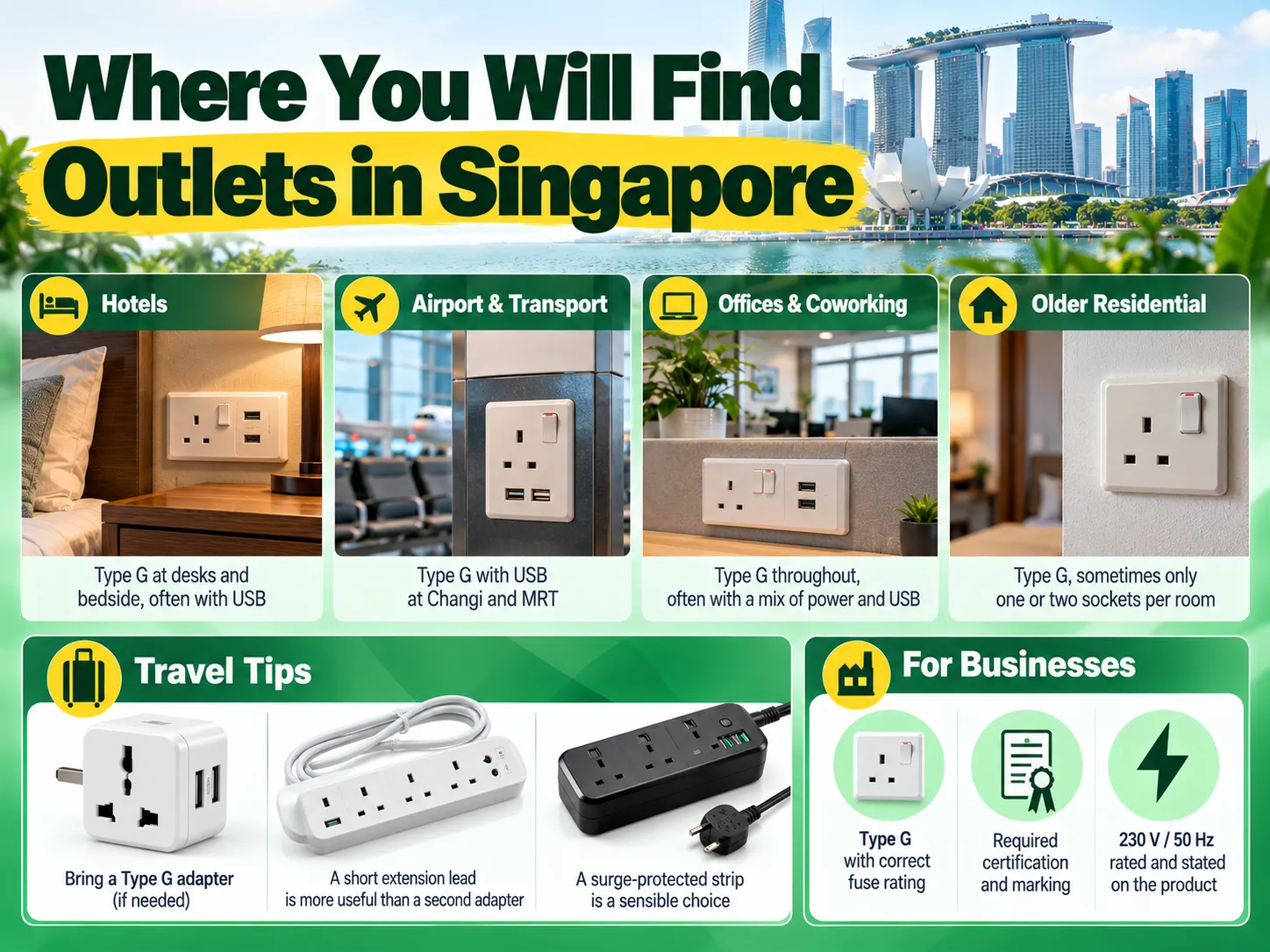
The sale of a product for permanent use depends on three requirements:
A reusable multi-region adapter does not qualify as a travel adapter. A travel adapter is a consumer gadget whereas a shuttered Type G socket rated for 13 A is a different product made under a different standard. The use of one related to another causes the failure of a compliant order at the border.
The type G adapter with three rectangular pins arranged in a triangular shape by itself won’t be needed unless, of course, you are coming from the UK, Ireland, Malaysia, Hong Kong or one of the Gulf states. It would be advisable to get a Type G fused adapter instead of unfused, as not only is it available at a price ranging anywhere between S$5 to 30 but you’re better off buying it in your home country rather than at the airport where it would be two to three times more expensive.
Type G is standardised under SS 145 standards and is largely similar to British BS 1363. Type G has three rectangular pins, the use of an in-plug fuse, sleeved live and neutral pins, and shuttered sockets, with a voltage of 230 V and 50 Hz.
No. The Type A and Type B plugs in the United States will not fit the Type G sockets in Singapore, and their voltages are different – 230 V versus 120 V. American visitors will require a universal plug adapter and must ensure that every device works on voltage ranging from 100 to 240 V. If one-plug appliances are used, they will get destroyed.
No, in Australia, plug type I is used, which has three flat pins arranged in a V shape. Because the voltage and frequency settings in Australia are identical at 230 V / 50 HZ, this means that in Australia, an adapter would be sufficient. However, because the pins are physically different, such as in shape or size, this form of connection will not work in Australia and therefore it must be used.
The voltage and the plug type used in Singapore are Type G 230V 50Hz. Unlike the North American plug which is a different voltage altogether, its shape also varies from that used in Australia. From your travel itinerary, you can deduce what kind of a plug you will need for your appliances. If you are coming from a Type G country, no adapter is necessary. If you are from a 230V country, an adapter will suffice. If your previous destination was a 120V country, you will need an adapter plus careful examination of the appliance tags.
If you travel often, then you probably know that packing for Singapore is one of the simplest things to do in Asia, but also one of the most difficult because it uses UK-type plugs (instead of the US-type ones). Whether you need a transformer, a plug adapter or both depends on two questions that tourists […]
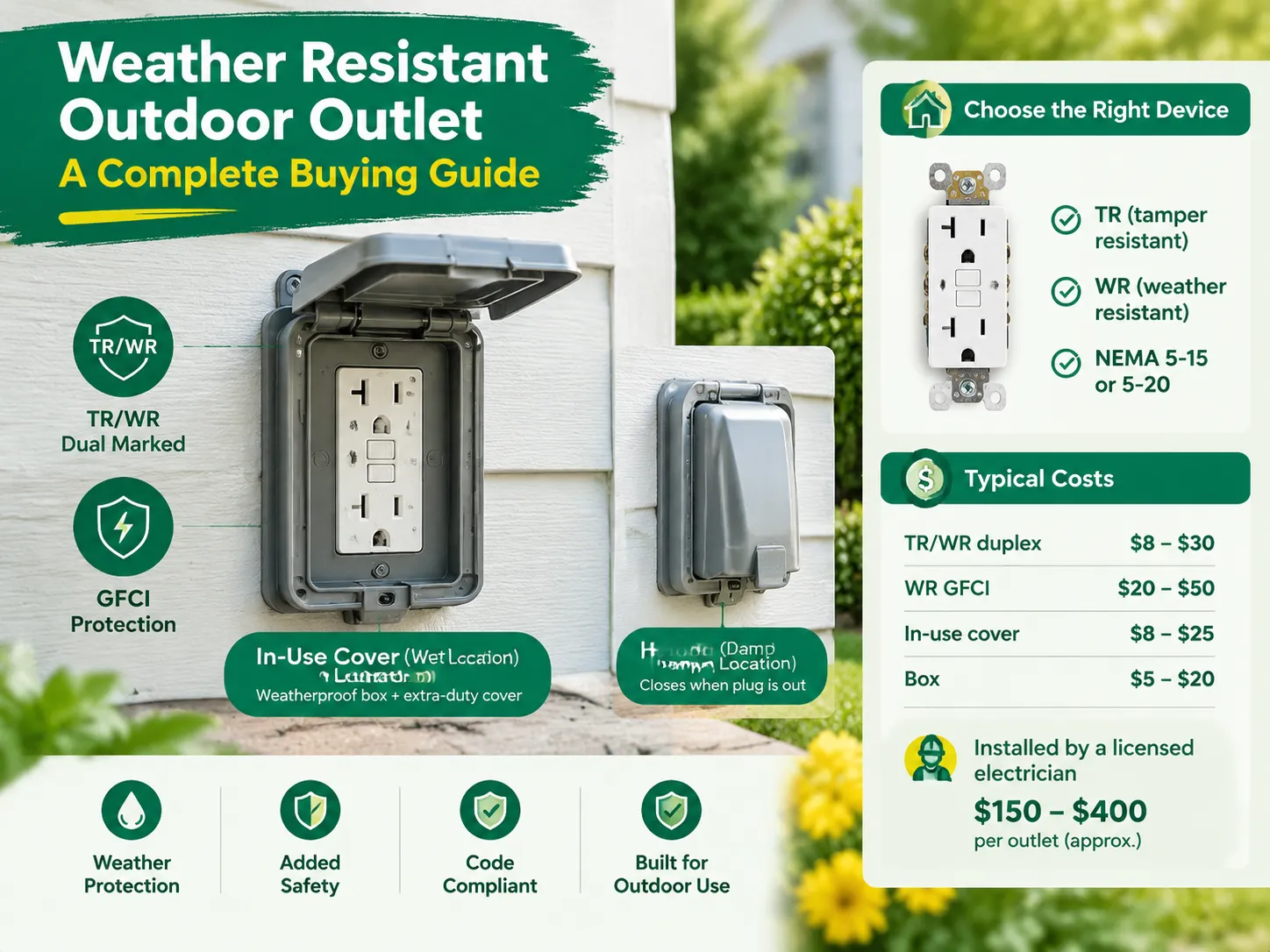
Vattentäta utomhusuttags ska inte förväxlas med vanliga utomhusuttags. Även om dessa utomhusuttags kan betraktas som WR-typ utomhusuttags, kommer de också med ett hölje som ger deras vattentålighet med eller utan en enhet. Dessutom måste utomhuspluggen vara vandalresistent och inkludera en RCD. Varje vädertåligt uttag bör identifieras […]
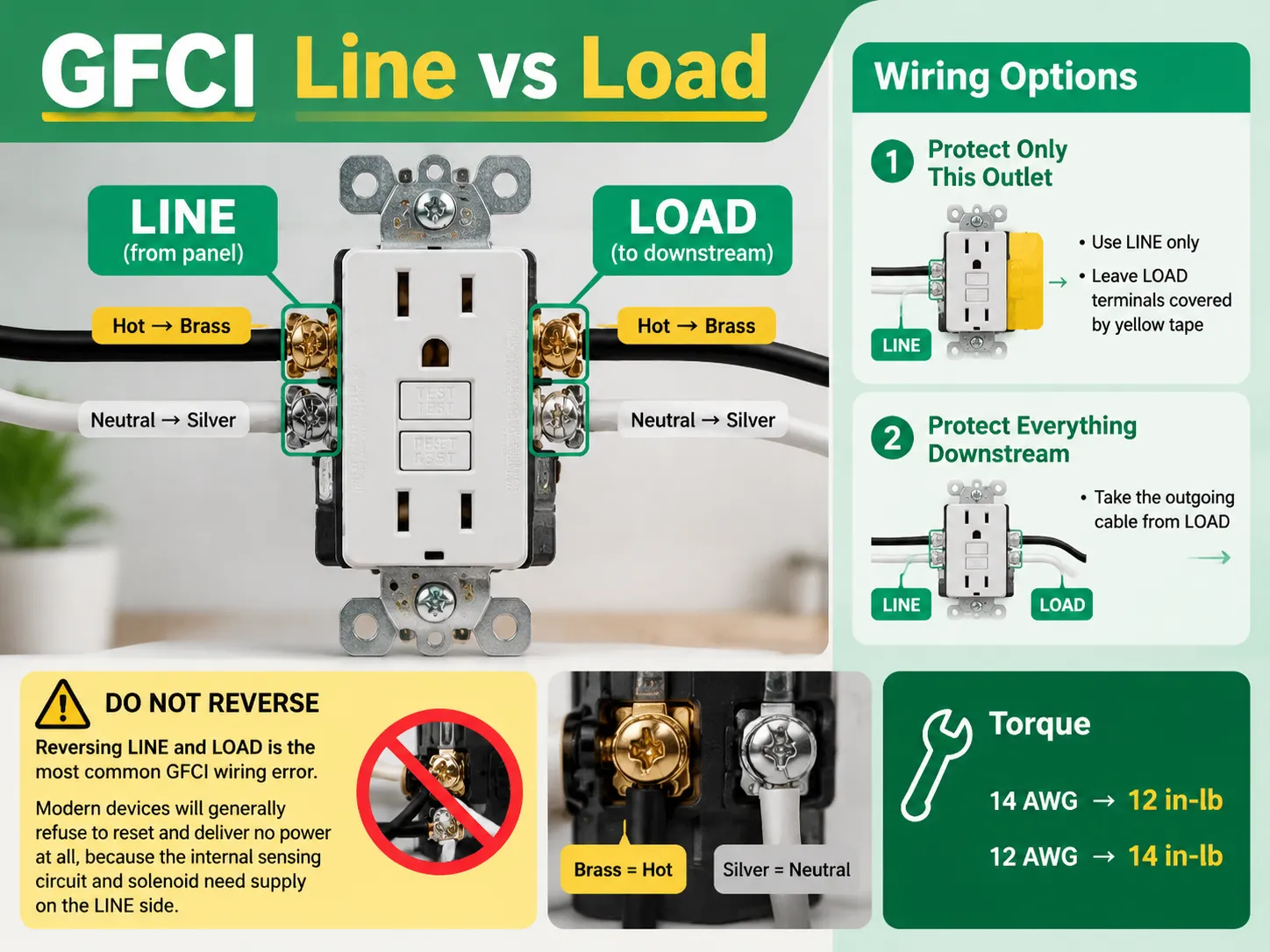
Två typer av terminaler kan definiera hur ett GFCI-uttag fungerar: En terminal är för ett individuellt uttag och den andra terminalen kan skydda flera uttag från ett enda GFCI-uttag till samma kostnad. Att använda den lämpliga terminalen gör att du kan dra nytta av kostnadsbesparingarna med att använda ett enda GFCI, medan du använder […]

 No.6 Tuozhan Road, Leshang Pioneer Park, Yueqingwan Bay Harbor, Yueqing stad, Zhejiang-provinsen


