

Vattentäta utomhuspluggar bör inte förväxlas med vanliga utomhuspluggar. Även om dessa utomhuspluggar kan betraktas som WR-typ utomhuspluggar, kommer de också med ett hölje som ger deras vattentålighet med eller utan en enhet. Dessutom måste utomhuspluggen vara vandalresistent och inkludera en RCD. Varje väderbeständigt uttag bör identifieras med sin märkning som anger de standarder det uppfyller.
Vattentäta utomhuspluggar och vanliga utomhuspluggar bör inte ses som liknande. Även om vattentäta utomhuspluggar klassificeras som WR-typ utomhuspluggar, har de ytterligare lock som säkerställer deras vattentålighet. Dessutom bör pluggen vara motståndskraftig mot vandalism och utrustad med en RCD. Alla väderbeständiga pluggar måste ha etiketter som visar vilka standarder som har upprätthållits.
Tre etiketter motsvarar tre olika specifikationer, men det händer ofta att de förväxlas.
Den praktiska slutsatsen är att det finns ett utomhusuttag som måste ha alla tre funktioner, och det mest ekonomiska sättet att lösa detta problem är att använda en kombination av tre enheter — listade tamperproof-weatherproof GFCI-uttag. Att ta reda på vilka krav som gäller på en viss plats är den första uppgiften i varje utomhusuttagprojekt, och denna guide till att välja rätt utomhusströmuttag för en plats går igenom det position för position istället för att anta att varje utomhusuttag är detsamma.
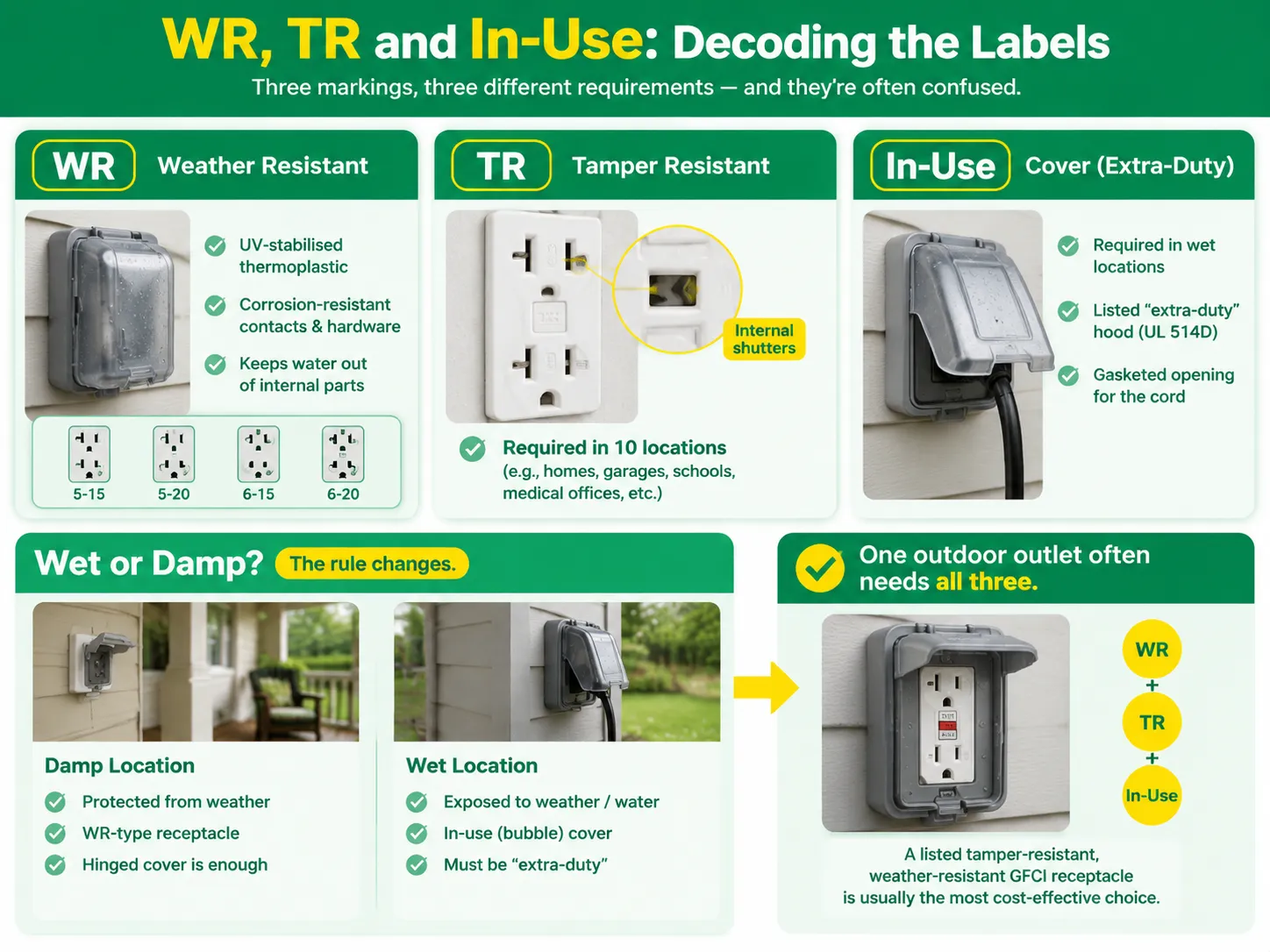
Skillnaden mellan fuktiga och våta platser är avgörande för inköp, eftersom det inte är lätt att lista ut.
Det finns några detaljer angående 406.9 som man behöver veta innan man går vidare med installationen. I synnerhet måste gångjärnslock kunna öppnas minst i en 90-graders vinkel när uttagsboxen är installerad; annars måste de omarrangeras. Dessutom gäller termen extra-duty specifikt för uttagsboxlock, medan de som är avsedda för våta platser eller bra för utomhusbruk inte behöver ha extra-duty märkning.
En annan situation bör nämnas eftersom den har blivit en vanlig praxis inom kommersiellt jordbruk — 15A och 20A uttag som ligger i våta platser har särskilda tillstånd som tillåter deras isolatorer att förbli väderbeständiga endast under den tid de inte är anslutna. Ett sådant tillstånd är inte allmänt och gäller inte för ett vanligt patio-uttag i ett privat hus.
De flesta utomhusjobb på bostadshus eller småföretag kräver endast några få olika enheter.
Konfigurationen måste matcha landets marknad från vilken du köper utrustningen. Amerikanska marknader fokuserar på NEMA 5-15 och 5-20 och GFCI-skydd, medan europeiska och brittiska utomhusinstallationer har olika konfigurationer och IP-betyg samt en annan lista över enheter. Om du skaffar snarare än installerar, sträcker sig Amerikanska konfigurationsbrytare och uttag som tillhandahålls för grossist- och OEM-program är en användbar referens för hur dessa konfigurationer ser ut i en produktkatalog.
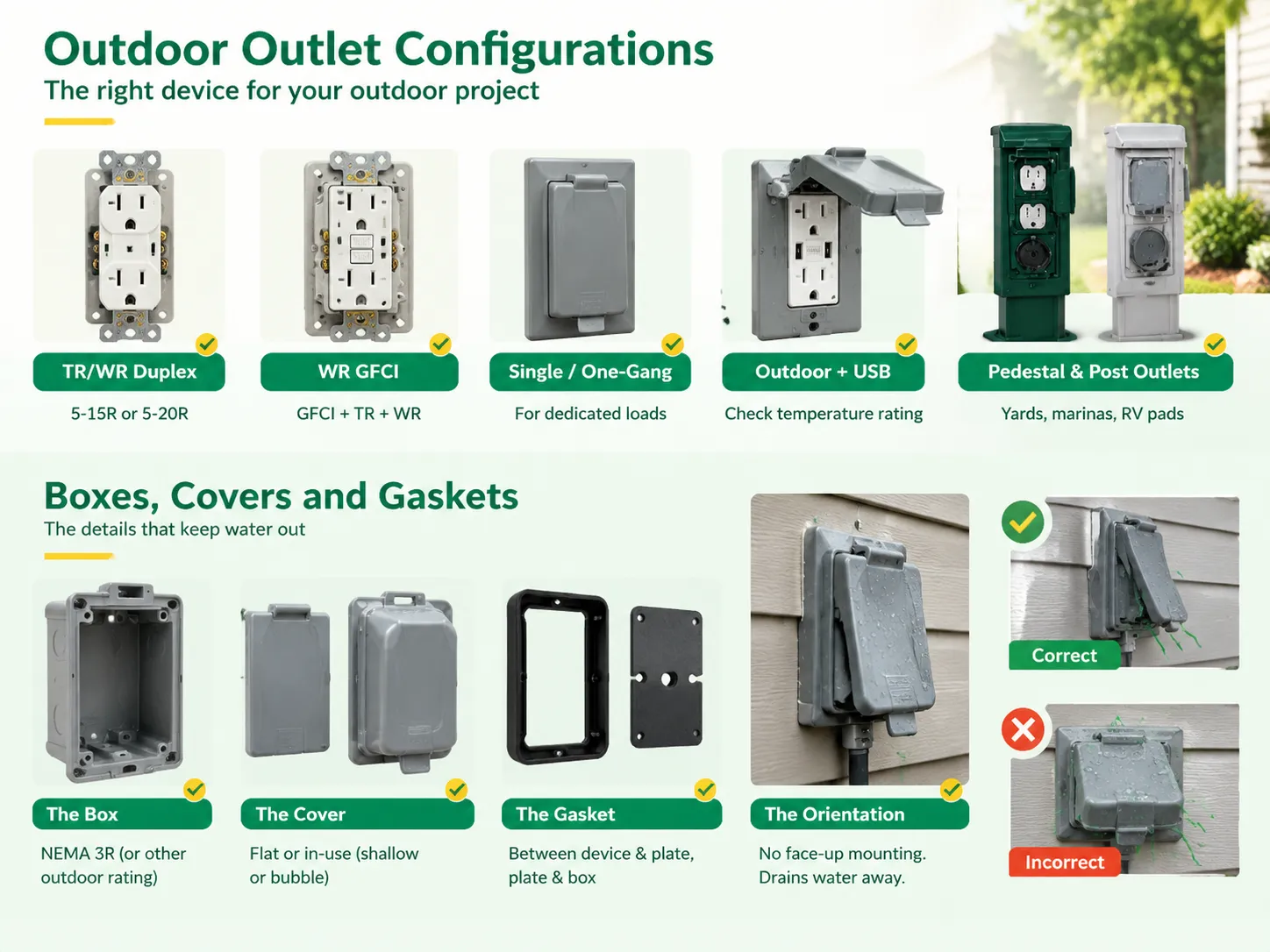
Utomhus är området där dessa funktioner troligen saknas, vilket är en anledning till varför många är så förvirrade över hemförbättringsfakturan.
Att få rätt kombination av låda och lock handlar mest om att veta vilken kapsling som passar vilken väggkonstruktion och exponering, och denna guide till val av elektriska lådor för uttag och strömbrytare täcker kapslingssidan av problemet, inklusive monterings- och väderbeständighetsbeslut som kommer före valet av enhet.
Installationsprocessen utgör inga utmaningar för en kvalificerad elektriker men kan vara förrädisk för den genomsnittliga personen eftersom ett utomhusuttag är strömförande och utomhus gör det mer riskabelt och farligare än inomhus. Den ordning i vilken installationsprocessen ska utföras måste följas.
Utöver detta är underhållet minimalt: inspektera locket efter stormar, kontrollera för fukt i behållaren, byt ut eventuella trasiga kontaktlock och se till att enheten själv är stationär eftersom all rörelse komprometterar den vattentäta packningen. När användningen är låg kommer felet att vara antingen att locket sitter fast eller att packningen är sliten snarare än något elektriskt. Steg-för-steg-versionen av ledningsdragningen anges i denna genomgång av hur man installerar ett strömuttag, som täcker ledartillkopplingarna och dosmontaget i den ordning de måste ske.
It offers indicative prices for planning purposes instead of providing quotes:
Certain brands are known in America about which you should be aware like Leviton, Eaton, and Hubbell with Bell and TayMac enclosures. Other brands worth mentioning are Legrand with Pass & Seymour, Bryant, and Arlington and Red Dot for the enclosure purpose.
When making a purchase, six questions must be asked:
The ideal solution for nearly all outdoor residential applications is a GFCI/TR/WR receptacle, which incorporates tamper resistance, weather resistance, and shock protection in one item. It should be utilized in a NEMA 3R waterproof box with a suitable extra-duty in-use cover, and one that is deep enough to allow the use cord to cover the box fully. This combination meets NEC regulations for ground-fault protection, wet location, and tamper resistance, which gives the total cost around $30-80 in materials for an uncomplicated installation. An alternative receptacle can be used in case of a covered porch.
Four key points to remember: At first, get WR outlet receptacles used instead of ordinary ones that may get damaged and quit to work properly. Buying proper weatherproof enclosure and installing it for outdoor usage, you should leave its lower part of the wall entry of the weatherproof box open for water to run freely. Obtain a proper cover: the cover should be hooded and fit any wet location to seal properly with an attached plug. Make sure the hood can open about 90 degrees after installation in order to be sure it will be functional. Finally, make sure to properly service all the gasket seals since they are the components that enable the weatherproof capacity of the construction.
As per the rules, receptacles must be money to connect in weather for the circuits rated at 15 Amps and 20 Amps. The NEC 406.9 states that all types of nonlocking-rated receptacles utilized must be weather-resistant when applied in wet and damp locations. Various types of adaptations include 5-15, 5-20, 6-15, and 6-20. Putting an ordinary receptacle outside is always against the code and leads to failure due to UV exposure along with corrosion, regardless of the cover used. The WR requirement is totally different from the requirements for tamper resistance (406.12) and GFCI (210.8).
Choose the proper NEMA TR/WR receptacle to match with the load in your area. In North America, select either the 5-15 receptacle for 15A service or the 5-20 receptacle when 20A service at 125V is used. For 250V equipment, make sure the 6-15 and 6-20 receptacles are utilized. Using any receptacle requires the outlet to be tamper-resistant so that there is no access for the household or public. Make sure GFCI protection is included in all cases. In case of single load, you can use single output receptacle while you can use the duplex receptacle when working with multi-purpose applications. Also if the device does not come with GFCI, then make sure to install the WR GFCI device on top of that. Finally, if the outlet is for 30A and 50A RV or connection, make sure to follow the specifications and not just the connector type.
The distinction separating an outdoor outlet with a longevity of 15 years from one that breaks within just two years has little to do with the manufacturer of the outlet, but widely pertains to the characteristics of the outlet as being weatherproof, the design of the outlet for the environment it will be used in, the presence of the lid that keeps the wires protected and the state of the gaskets. By addressing these four points, the installation of outdoor outlets won’t be too pricey, while failing to address them leads to a need to replace the outlet every two years (due to humid conditions).
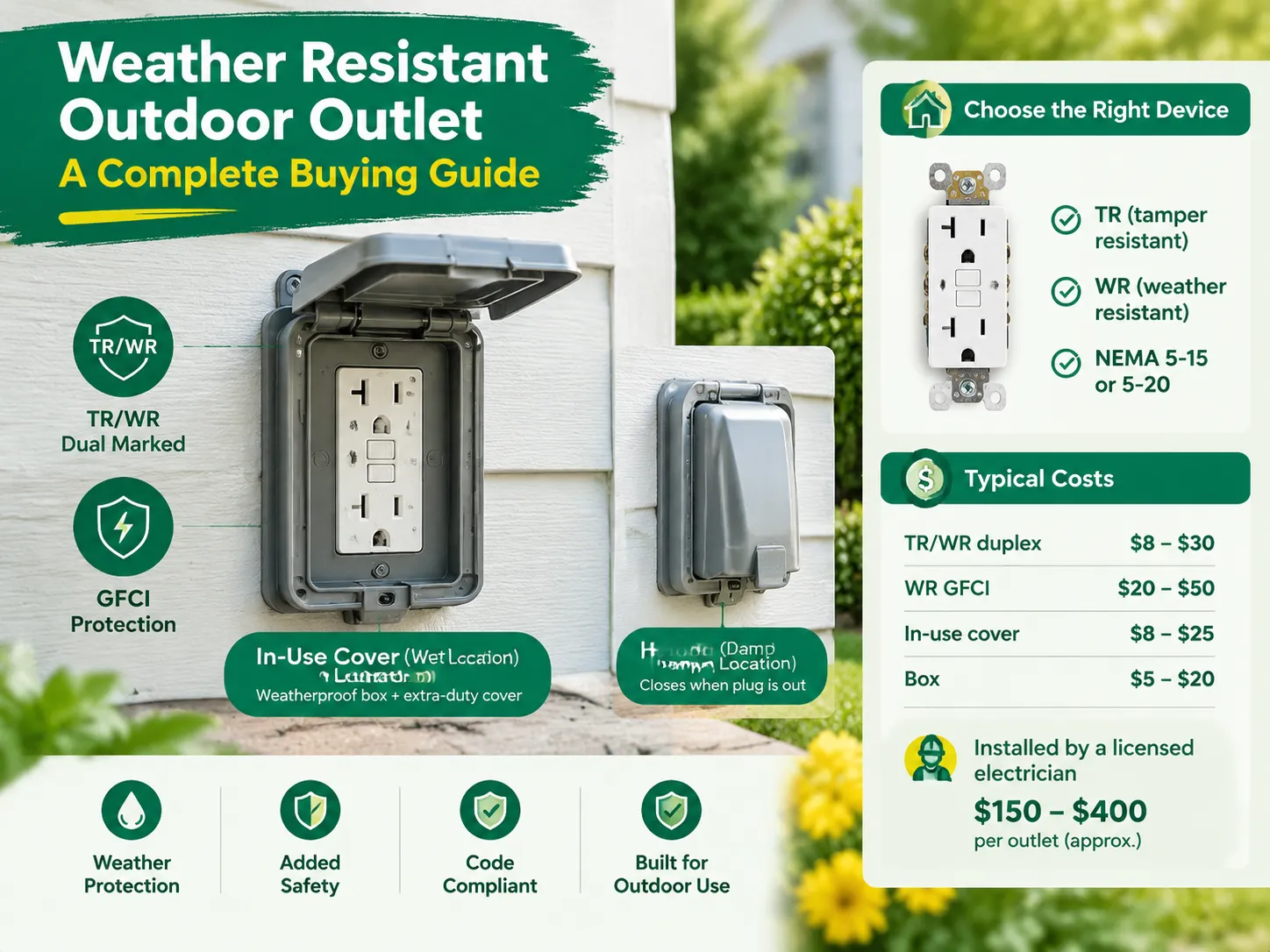
Waterproof outdoor sockets should not to be confused with ordinary outdoor sockets. Although these outdoor sockets can be considered WR-type outdoor sockets, they also come with an enclosure that provides their waterproofness with or without a device. Additionally, the outdoor plug needs to be vandal-resistant and include an RCD. Every weatherproof socket should be identified […]
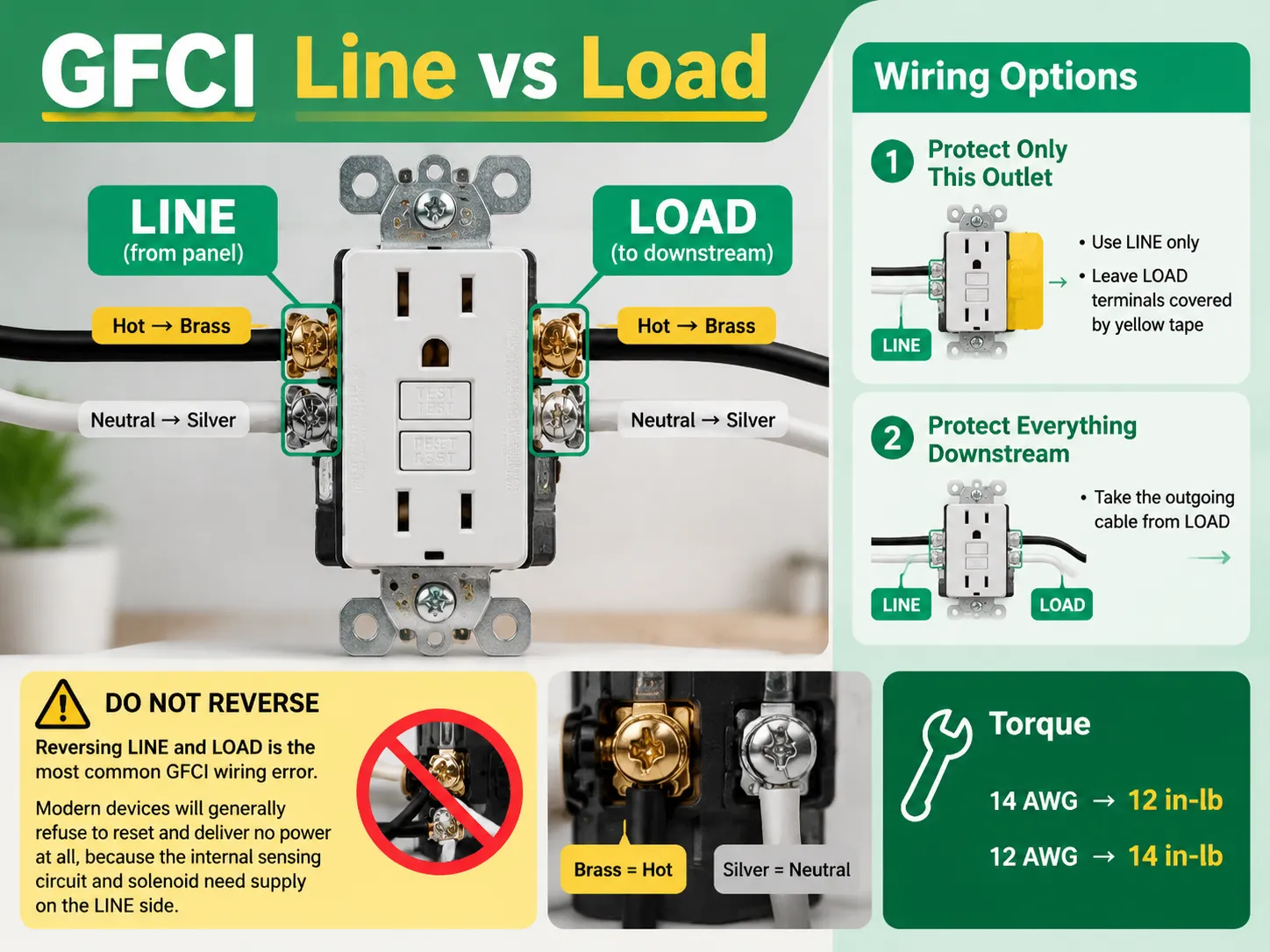
Två typer av terminaler kan definiera hur ett GFCI-uttag fungerar: En terminal är för ett individuellt uttag och den andra terminalen kan skydda flera uttag från ett enda GFCI-uttag till samma kostnad. Att använda den lämpliga terminalen gör att du kan dra nytta av kostnadsbesparingarna med att använda ett enda GFCI, medan du använder […]
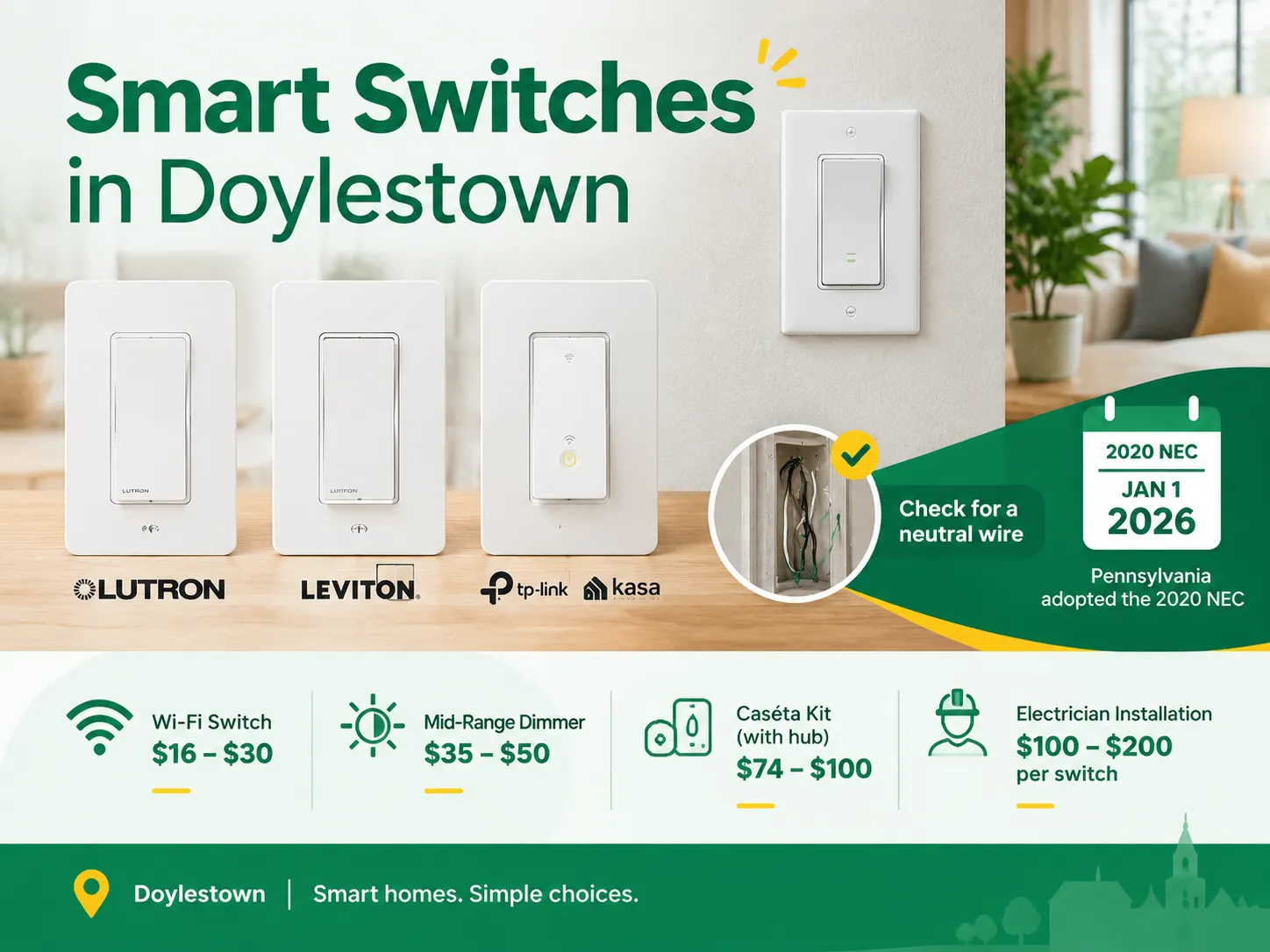
De bostadstyper som finns tillgängliga i Doylestown går tillbaka till 1800-talet, och detta är också den största utmaningen du står inför när du försöker köpa en smart strömbrytare här. Vad du kan använda beror på vad som finns inuti din vägglåda och inte vilken märke du kan lita mest på. Guiden visar dig vilken […]

 No.6 Tuozhan Road, Leshang Pioneer Park, Yueqingwan Bay Harbor, Yueqing stad, Zhejiang-provinsen


