

Nếu bạn thường xuyên đi du lịch, thì bạn có thể biết rằng việc chuẩn bị cho Singapore là một trong những điều đơn giản nhất để làm ở Châu Á, nhưng cũng là một trong những điều khó khăn nhất vì nó sử dụng phích cắm loại UK (thay vì loại US). Bạn có cần một bộ biến đổi, một bộ chuyển đổi phích cắm hay cả hai phụ thuộc vào hai câu hỏi mà du khách thường nhầm lẫn.
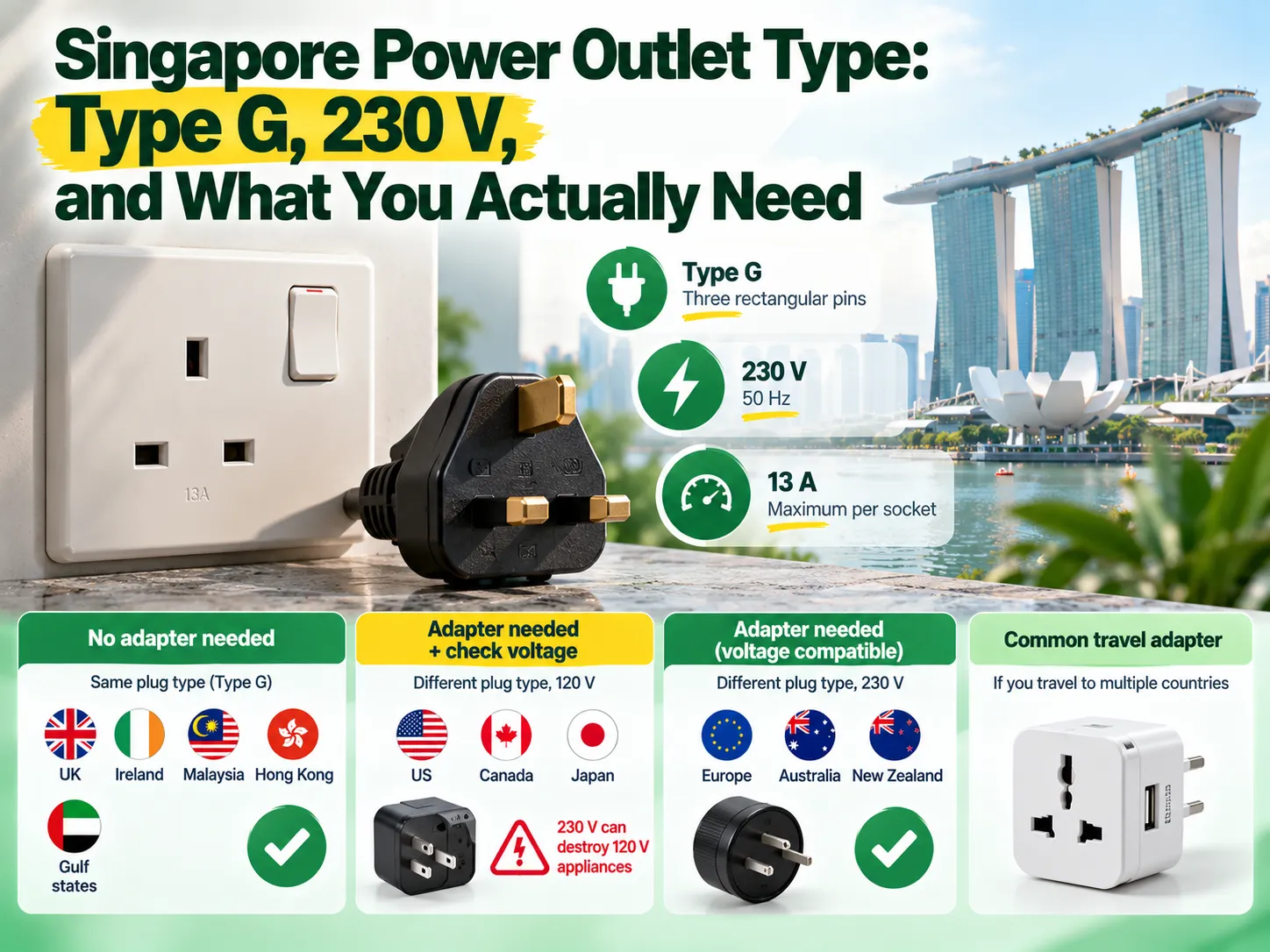
Tóm lại: Ở Singapore, phích cắm được sử dụng là Loại G, dựa trên tiêu chuẩn BS 1363 của Anh với các tính năng tương tự. Điện áp cung cấp của Singapore và tần số là 230 V và 50 Hz. Du khách từ Vương quốc Anh, Ireland, Malaysia, Hồng Kông và một số quốc gia Vùng Vịnh sẽ không cần gì cả. Du khách từ Mỹ, Canada và Nhật Bản nên sử dụng bộ chuyển đổi và kiểm tra điện áp. Do đó, các thiết bị từ nguồn 120 V sẽ bị hư hại. Du khách từ các quốc gia châu Âu, Úc và New Zealand chỉ cần bộ chuyển đổi, vì điện áp là giống nhau.
Sự sắp xếp của ba chân hình chữ nhật trong Loại G là độc đáo. Hai chân phẳng ở dưới được định vị để phục vụ như chân sống và chân trung tính trong khi chân dài hơn ở trên phục vụ như chân đất. Lý do cho chân đất dài hơn là nó cho phép kết nối đất được thực hiện trước khi kết nối sống.
Tất cả các phích cắm ở Singapore đều tuân theo mẫu này và có các tính năng thiết kế độc đáo khiến chúng trở thành một trong những phích cắm an toàn nhất trên thế giới. Các tính năng chính bao gồm:
Bức tranh rộng hơn về cách hình dạng phích cắm thay đổi trên toàn cầu — và tại sao có mười lăm loại được đặt tên thay vì một — được trình bày trong cái nhìn tổng quan này về các loại ổ cắm tường khác nhau và nơi mỗi loại được sử dụng.
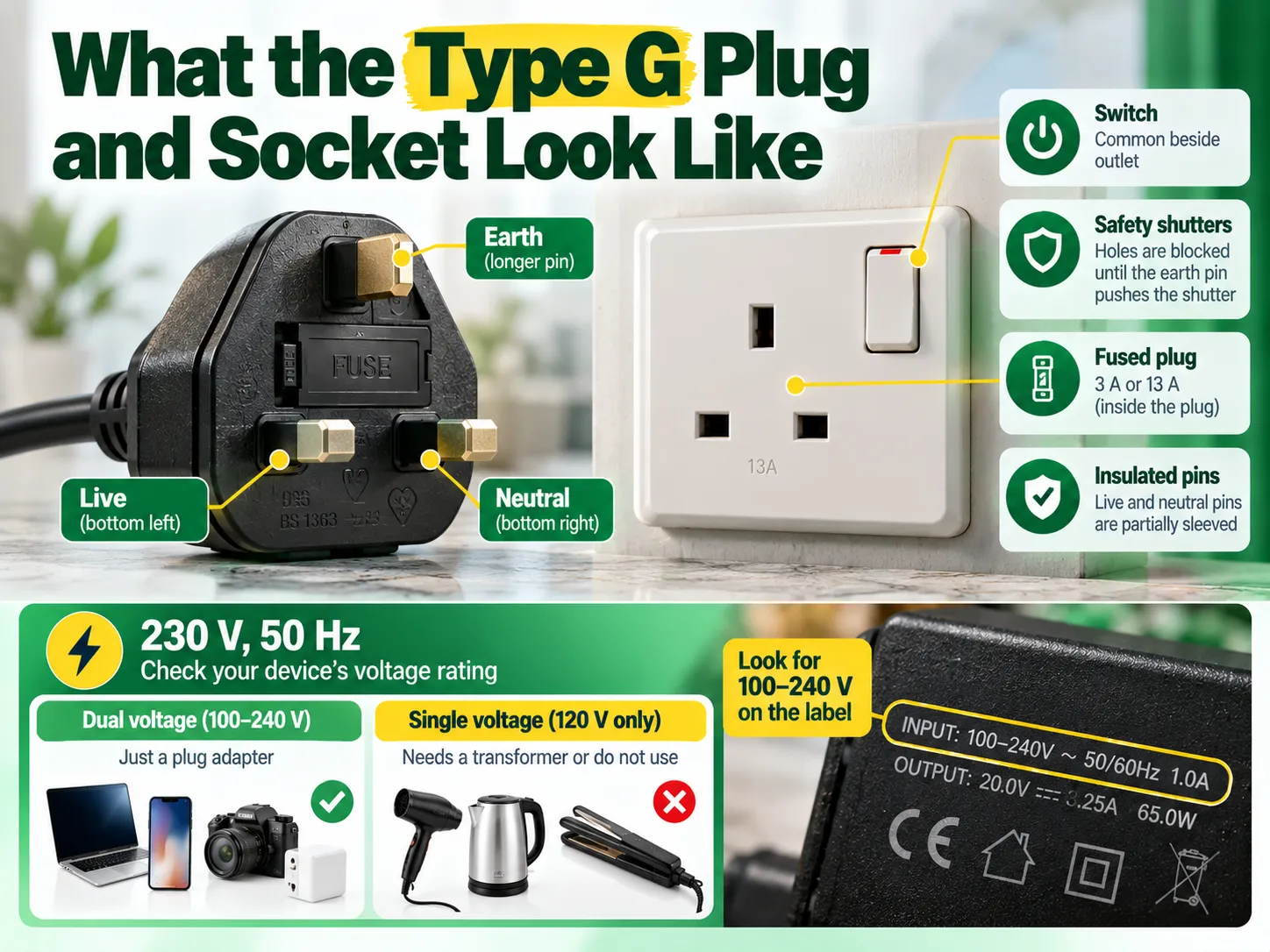
Singapore được cung cấp điện với điện áp 230 V, tần số 50 Hz, phù hợp với tiêu chuẩn châu Âu, khác với Bắc Mỹ. Lưới điện được vận hành bởi SP Group và được biết đến là một trong những lưới điện ổn định nhất thế giới. Điện áp được cung cấp gần như luôn nằm trong vài phần trăm của giá trị danh nghĩa.
Số này ngụ ý hai điều quan trọng:
Để tránh gặp vấn đề khi du lịch đến Singapore, hãy chắc chắn tìm kiếm nhãn hiệu điện áp kép. Hầu hết các máy tính xách tay, bộ sạc điện thoại, bộ sạc máy ảnh, bộ sạc bàn chải điện và loa di động trong thập kỷ qua được thiết kế để hoạt động trong khoảng 100 – 240 V, 50/60 Hz và do đó chỉ cần một bộ chuyển đổi phích cắm khi sử dụng ở Singapore. Các thiết bị duy nhất có nguy cơ thất bại là những thiết bị tiêu thụ điện trực tiếp (máy sấy tóc, bàn là, ấm đun nước, v.v.).
Đây là nơi hầu hết sự nhầm lẫn biến mất, vì câu trả lời hoàn toàn phụ thuộc vào nơi bạn đến.
| Đến từ | Loại phích cắm của bạn | Cần bộ chuyển đổi không? | Điện áp |
|---|---|---|---|
| Vương quốc Anh, Ireland, Malaysia, Hồng Kông | Loại G | KHÔNG | Phù hợp với 230 V |
| Các Tiểu vương quốc Ả Rập Thống nhất, Qatar, Bahrain, Kuwait, Oman | Loại G | KHÔNG | Phù hợp với 230 V |
| Ả Rập Saudi (các tòa nhà mới hơn) | Loại G | Thường là không | Phù hợp |
| Châu Âu (Loại C, E, F), Ý, Thụy Sĩ | Chân tròn | Đúng | Phù hợp — chỉ cần bộ chuyển đổi |
| Úc, New Zealand | Loại I | Đúng | Phù hợp — chỉ cần bộ chuyển đổi |
| Mỹ, Canada | Loại A / B | Đúng | Không phù hợp — kiểm tra từng thiết bị |
| Nhật Bản | Loại A / B | Đúng | 100 V — cần bộ chuyển đổi cho một số thiết bị |
| Ấn Độ | Loại D / M | Đúng | Phù hợp — chỉ cần bộ chuyển đổi |
Nếu quốc gia của bạn sử dụng Loại G, bạn sẽ cần mang theo bộ sạc của mình và để bộ chuyển đổi ở nhà. Nếu quốc gia của bạn không sử dụng Loại G, chỉ có một bộ vỏ Loại G cho toàn bộ chuyến đi của bạn — Singapore không có sự biến thể khu vực như một số quốc gia lớn hơn. Phân tích khu vực đầy đủ, bao gồm các phần của thế giới chia sẻ tiêu chuẩn nào, được đề cập trong hướng dẫn này về các loại phích cắm và ổ cắm theo khu vực.
Không, và đây là giả định tốn kém nhất mà một du khách từ Bắc Mỹ đưa ra. Một phích cắm Loại A từ Hoa Kỳ có hai lưỡi phẳng và song song và không vừa vào một ổ cắm Loại G vì ổ cắm bị lún và các cửa chớp của nó sẽ không mở ra. Hơn nữa, một phích cắm Loại B với chân đất tròn của nó cũng sẽ không hoạt động.
Điện áp quan trọng hơn điều này. Nếu một thiết bị từ Mỹ, chỉ được định mức cho 120V, được kết nối với 230V thông qua một bộ chuyển đổi rẻ tiền, nó sẽ hỏng. Do đó, thứ tự hoạt động đúng cho một du khách từ Mỹ như sau: sử dụng bộ chuyển đổi trước, và sau đó kiểm tra nhãn của mọi thiết bị trước khi cắm vào. Những sự khác biệt giữa các cấu hình Bắc Mỹ và phần còn lại của thế giới được trình bày trong giải thích này về loại ổ cắm Bắc Mỹ, which is worth reading if you are deciding whether a device will travel at all.
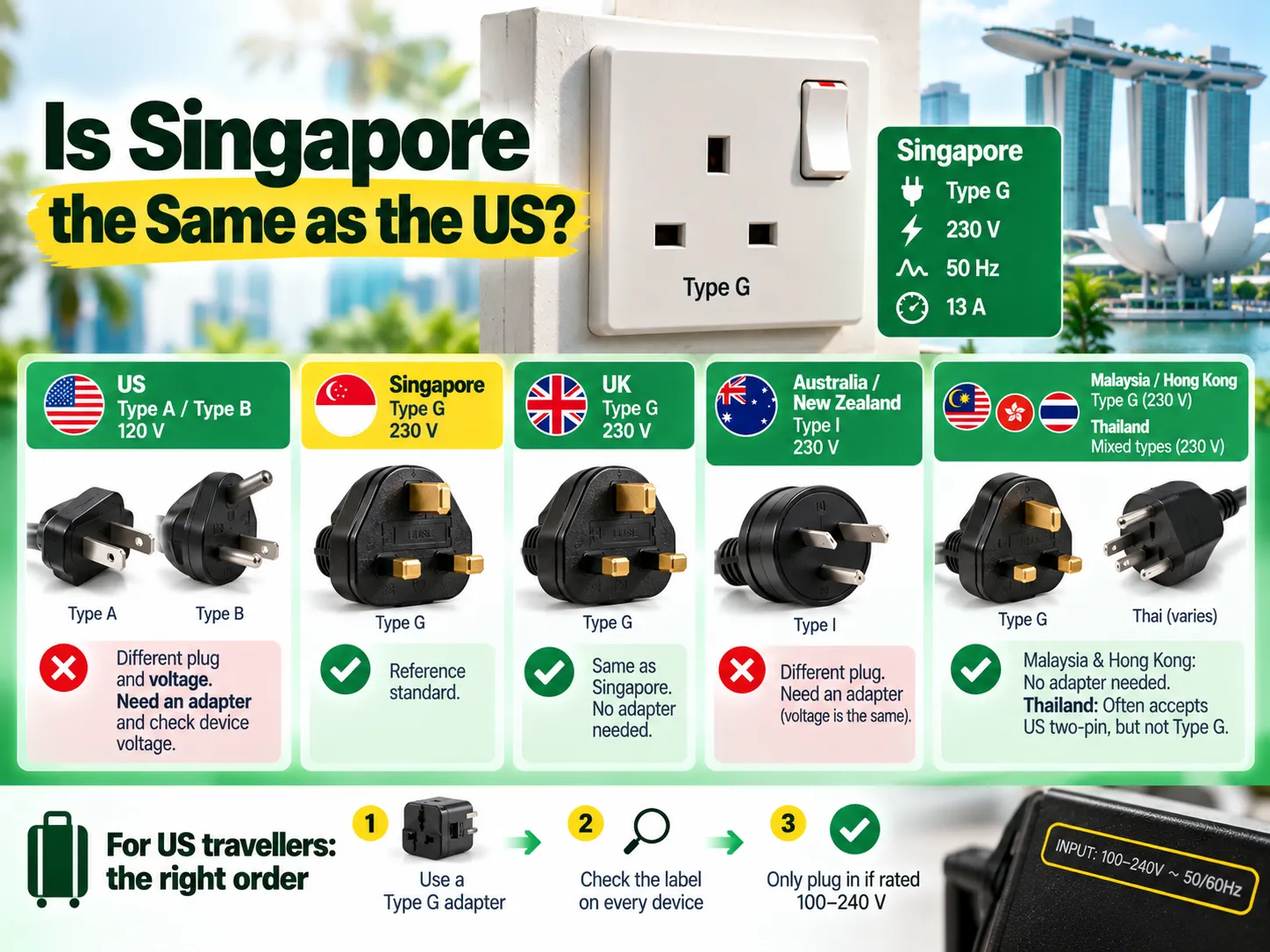
Just like the UK: yes, absolutely. Singapore adopted British standards, meaning that the connectors, sockets, fuses and other power supply infrastructures are the same. So if you have an appliance from the UK, you can use it in Singapore without needing anything else.
Just like Australia: no. Australia and New Zealand use standard I, with three flat pins, and with the exact same voltage and frequency (230 V / 50 Hz) — naturally, the voltage is the same, and you would just need a plug adapter for Type I.
Just like its neighbors: mixed. Malaysia, Hong Kong, and Brunei also use G without needing adapters, while in Thailand, things are different, as there are many different plug types used, depending on the building. Thus, a Thai socket can sometimes accept a US two-prong plug without an adapter, but may not be suitable for G. That kind of regional inconsistency is exactly why travel itineraries through Southeast Asia need more than one adapter even though the voltage stays broadly the same across the region, as set out in this guide to the socket types used in Thailand.
This mistake is the one that can result in a person losing a laptop. A plug adapter only changes the shape of the connector being used; it doesn’t contain any electronics. But a voltage converter changes the voltage from 230V to 120V. If you buy the wrong one, your appliance will fit well only to burn out immediately after.
Cost of appliances in Singapore: plug adapters range from 5-30 SGD while voltage converters and converters for 120V appliances start at 30 SGD onwards (depending on the wattage). If your appliance is a dual-voltage one, it means that it is 10 SGD device, not 100 SGD.
Pay attention to adapters sold in airports. Plug Type G that is sold in the shop for 5-10 SGD will be priced upper 15-30 SGD in Changi, and uncertified plugs will have greater overheat and an electrical short-circuit risks than certified plugs. Opt for certified adapters with a fuse instead of picking the cheapest one on the market. The same logic applies to the European systems, where the differences between Type C, Schuko and the French and Italian variants catch people out — covered in this breakdown of Phích cắm và ổ cắm điện Châu Âu if your trip continues onward from Singapore.
Most plug types ensure protection of the wiring behind the wall. However, Type G goes a step further and protects the appliance itself, as it has the fuse in the plug rather than in the panel. This is why you can find both 3 A and 13 A fuses on sale in every supermarket in Singapore, and also why a UK appliance with a 3 A fuse cannot power a 2-kW heater.
For a manufacturer or importer, this means compliance and not travelling. Plugs sold in Singapore need to have an adequate fuse for the load and devices that are to be installed permanently should have appropriate certification and the EMA SAFE mark. The power outlets should have a shutter system as well. Mistakes here lead to customs problems and disruptions related to shipment.
The coverage is acceptable and becoming better but it is still not consistent.
In case you are staying at a hotel that is on the older side or need more devices to be powered by one electrical socket, it is better to go for a power strip rather than buy an additional adapter.
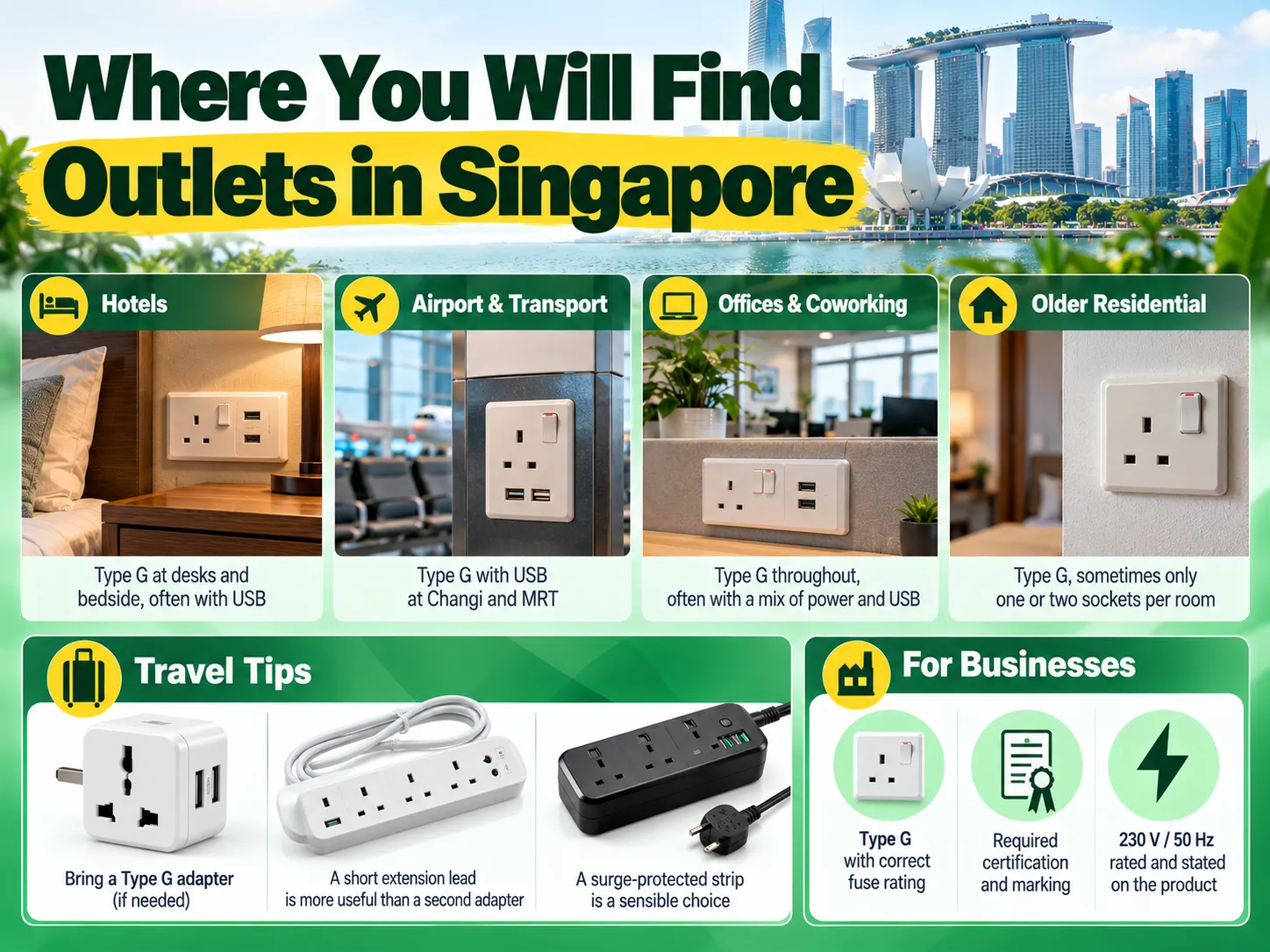
The sale of a product for permanent use depends on three requirements:
A reusable multi-region adapter does not qualify as a travel adapter. A travel adapter is a consumer gadget whereas a shuttered Type G socket rated for 13 A is a different product made under a different standard. The use of one related to another causes the failure of a compliant order at the border.
The type G adapter with three rectangular pins arranged in a triangular shape by itself won’t be needed unless, of course, you are coming from the UK, Ireland, Malaysia, Hong Kong or one of the Gulf states. It would be advisable to get a Type G fused adapter instead of unfused, as not only is it available at a price ranging anywhere between S$5 to 30 but you’re better off buying it in your home country rather than at the airport where it would be two to three times more expensive.
Type G is standardised under SS 145 standards and is largely similar to British BS 1363. Type G has three rectangular pins, the use of an in-plug fuse, sleeved live and neutral pins, and shuttered sockets, with a voltage of 230 V and 50 Hz.
No. The Type A and Type B plugs in the United States will not fit the Type G sockets in Singapore, and their voltages are different – 230 V versus 120 V. American visitors will require a universal plug adapter and must ensure that every device works on voltage ranging from 100 to 240 V. If one-plug appliances are used, they will get destroyed.
No, in Australia, plug type I is used, which has three flat pins arranged in a V shape. Because the voltage and frequency settings in Australia are identical at 230 V / 50 HZ, this means that in Australia, an adapter would be sufficient. However, because the pins are physically different, such as in shape or size, this form of connection will not work in Australia and therefore it must be used.
The voltage and the plug type used in Singapore are Type G 230V 50Hz. Unlike the North American plug which is a different voltage altogether, its shape also varies from that used in Australia. From your travel itinerary, you can deduce what kind of a plug you will need for your appliances. If you are coming from a Type G country, no adapter is necessary. If you are from a 230V country, an adapter will suffice. If your previous destination was a 120V country, you will need an adapter plus careful examination of the appliance tags.
If you travel often, then you probably know that packing for Singapore is one of the simplest things to do in Asia, but also one of the most difficult because it uses UK-type plugs (instead of the US-type ones). Whether you need a transformer, a plug adapter or both depends on two questions that tourists […]
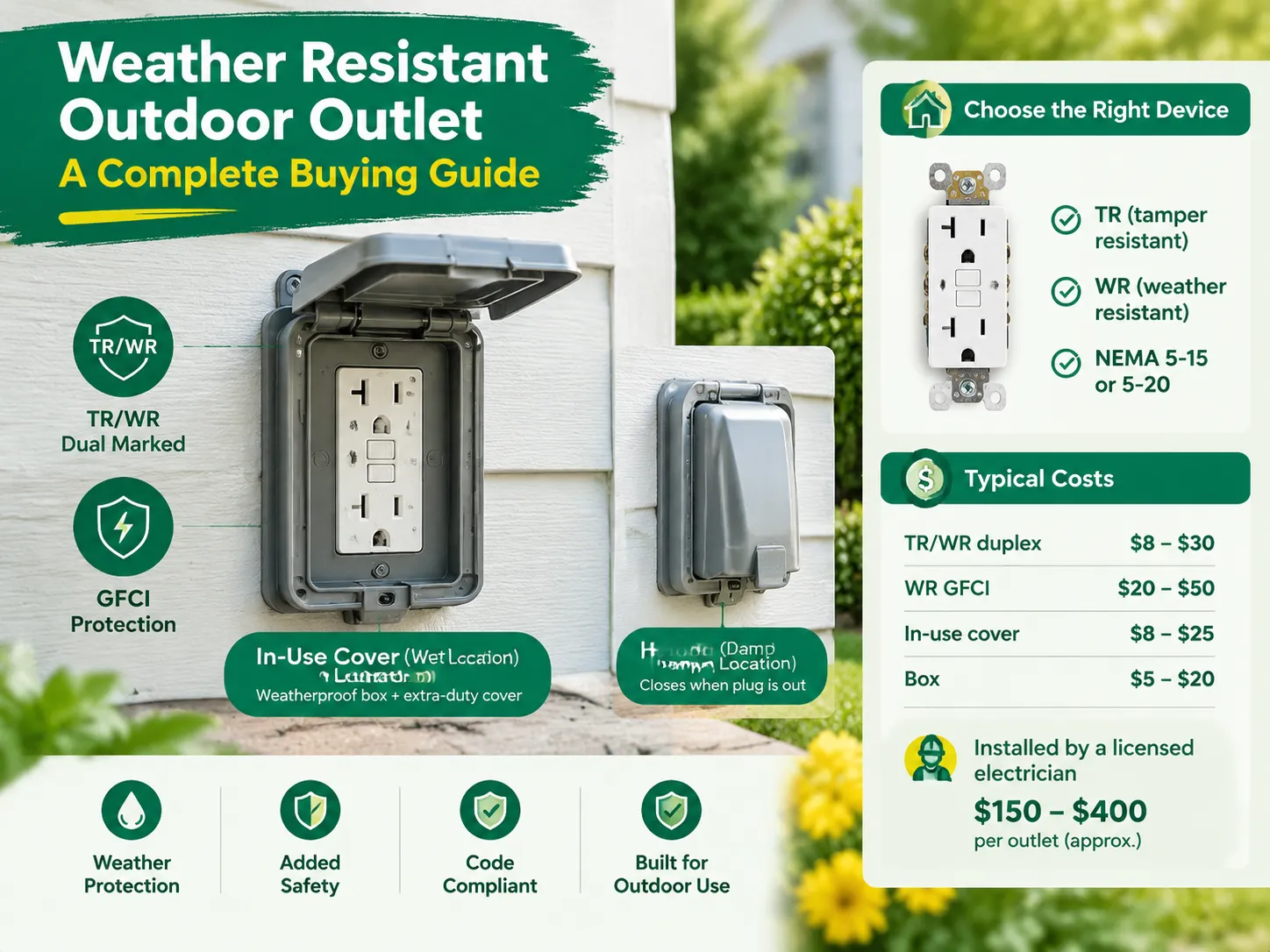
Ổ cắm ngoài trời chống nước không nên bị nhầm lẫn với ổ cắm ngoài trời thông thường. Mặc dù những ổ cắm ngoài trời này có thể được coi là ổ cắm ngoài trời loại WR, nhưng chúng cũng đi kèm với một vỏ bọc cung cấp khả năng chống nước cho chúng với hoặc không có thiết bị. Thêm vào đó, phích cắm ngoài trời cần phải chống phá hoại và bao gồm một RCD. Mỗi ổ cắm chống thời tiết nên được xác định […]
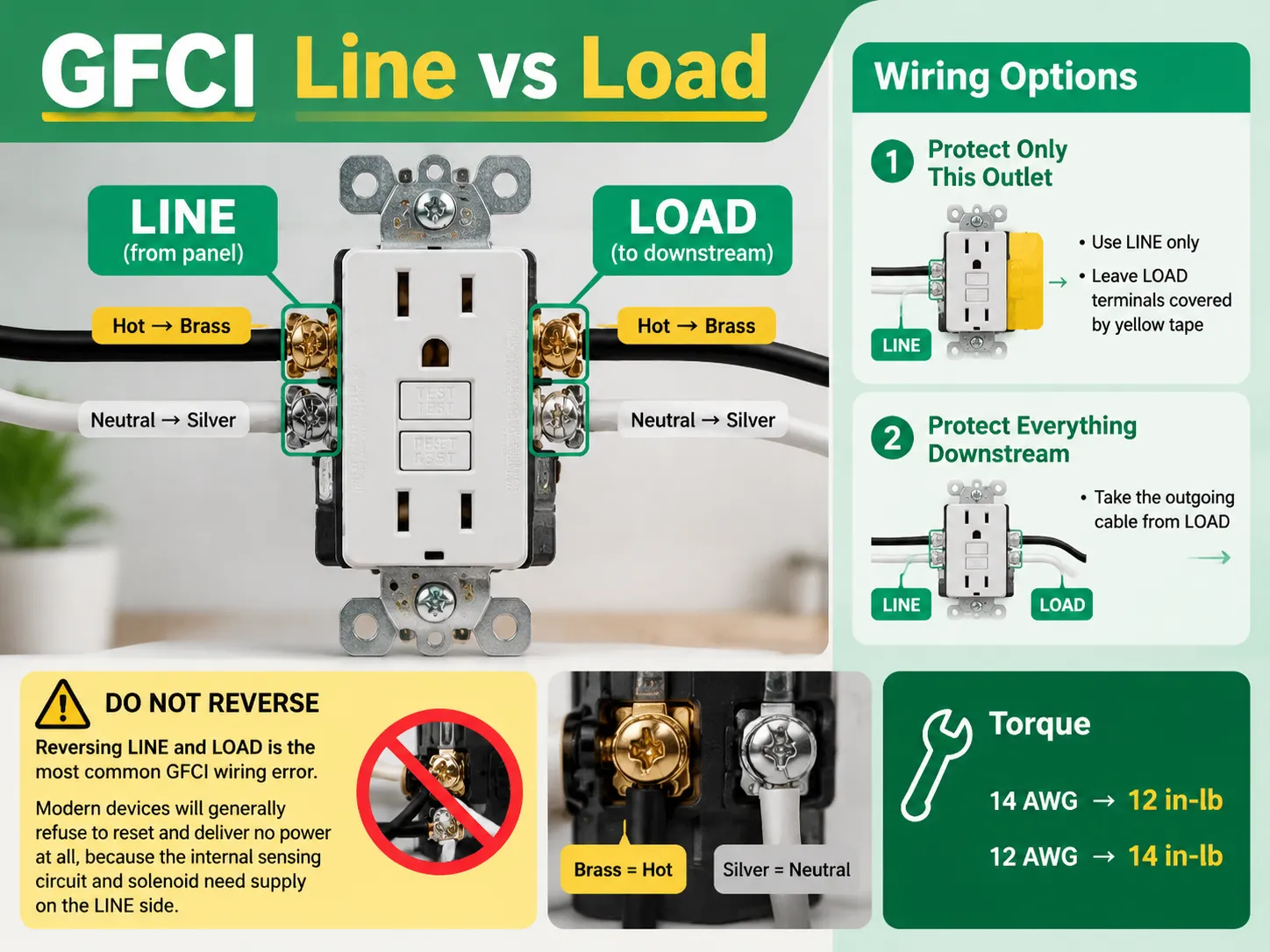
Hai loại đầu nối có thể xác định cách mà một ổ cắm GFCI hoạt động: Một đầu nối dành cho một ổ cắm riêng lẻ và đầu nối còn lại có thể bảo vệ nhiều ổ cắm từ một ổ cắm GFCI duy nhất với cùng một chi phí. Sử dụng đầu nối phù hợp cho phép bạn tận dụng lợi ích tiết kiệm chi phí khi sử dụng một GFCI duy nhất, trong khi sử dụng […]

 Số 6 Đường Tuozhan, Công viên Tiên phong Leshang, Cảng Vịnh Yue Khánhwan, thành phố Nhạc Thanh, Tỉnh Chiết Giang


