

Mỗi quy tắc này được xem xét chi tiết hơn bên dưới. Hình học của vị trí ổ cắm, yêu cầu mạch nhánh chuyên dụng, các loại ổ cắm đáp ứng mã, câu hỏi về 15A và 20A, sự khác biệt giữa các quốc gia về các quy tắc, chi tiết lắp đặt không đạt kiểm tra, những điều cần cân nhắc khi mua sản phẩm, yêu cầu về chiếu sáng và quạt trong cùng phòng, và việc cải tạo.
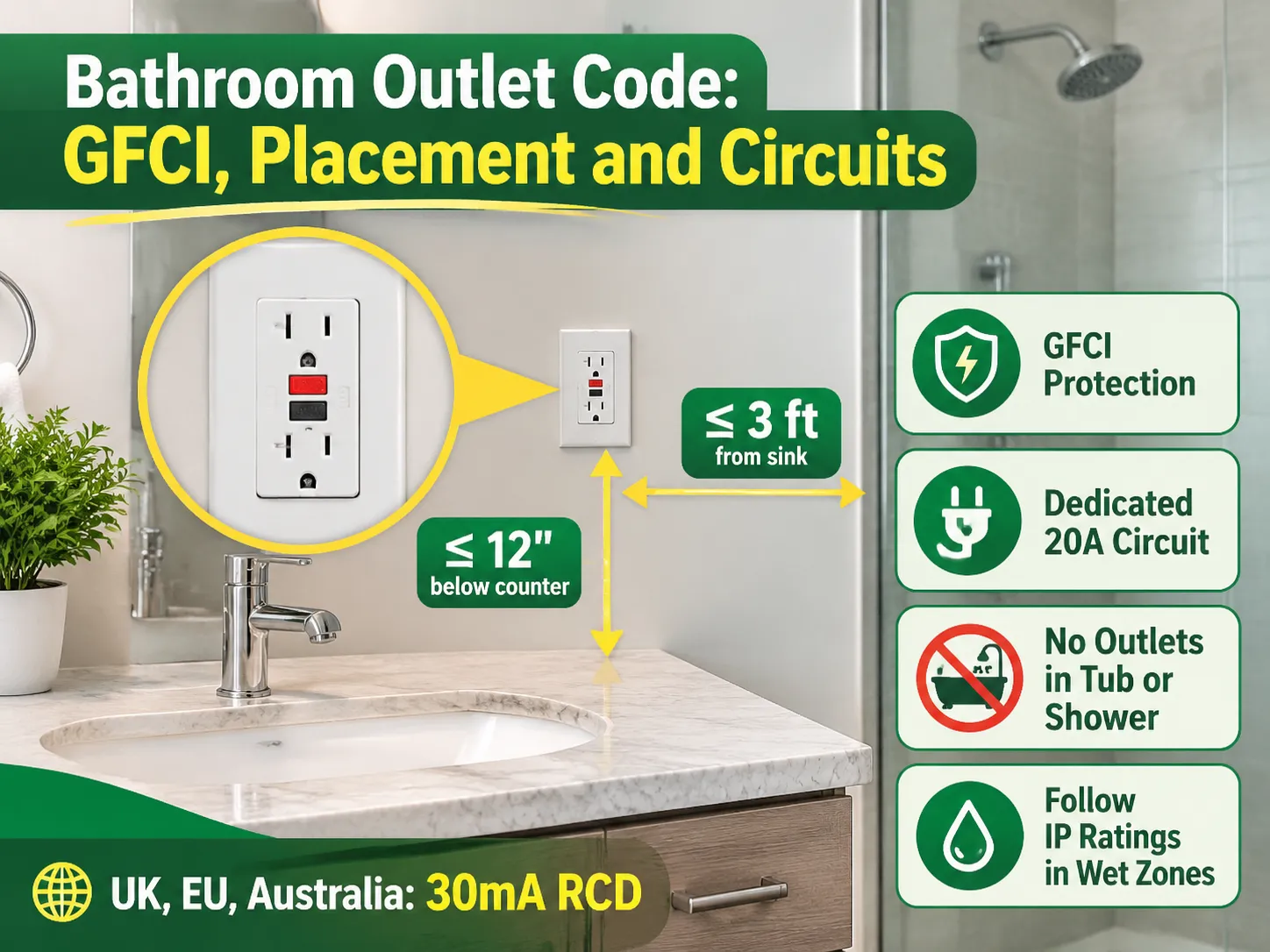
Câu trả lời nhanh: Ở Hoa Kỳ, mọi ổ cắm sử dụng cho phòng tắm phải có bảo vệ GFCI (Ground Fault Circuit Interrupter), và ít nhất một ổ cắm phải nằm trong phạm vi 3 feet từ mép bồn rửa/bồn chứa, và không quá 12 inch dưới chiều cao mặt bàn. Các ổ cắm phòng tắm phải được đặt trên các mạch nhánh chuyên dụng 20 Amp (20A) chỉ dùng riêng cho phòng tắm. Không được lắp đặt ổ cắm phòng tắm trong khu vực bồn tắm hoặc vòi sen. Thiết bị tương đương với GFCI của Bắc Mỹ là bảo vệ 30mA RCD (Residual Current Device) ở Vương quốc Anh, Ireland, Úc và EU. Khi các ổ cắm thông thường được lắp đặt trong các khu vực ẩm ướt, chúng có các hạn chế và phải đáp ứng cấp độ bảo vệ IP phù hợp với khu vực lắp đặt.
Mục đích của GFCI là giám sát sự khác biệt dòng điện giữa dây nóng và dây trung tính. Khi sự khác biệt giữa chúng nằm trong khoảng 4 đến 6mA, điều này cho thấy một phần dòng điện đã bị rò rỉ. Thông thường trong phòng tắm, điều này có nghĩa dòng điện đã rò rỉ qua người đang đứng chân trần trên sàn ướt. GFCI sẽ cắt nguồn điện cung cấp cho người đó (ví dụ, người đứng trên sàn ướt với chân tiếp xúc mặt đất) trong vòng vài mili giây sau khi phát hiện dòng điện rò rỉ từ ổ cắm.
Có ba thiết bị có thể được sử dụng để đáp ứng yêu cầu này. Thiết bị đầu tiên là ổ cắm GFCI, sẽ bảo vệ cả chính nó và bất kỳ thiết bị nào khác được kết nối với ổ cắm và được cấp điện từ phía hạ lưu. Thiết bị thứ hai là bộ ngắt mạch GFCI, bảo vệ toàn bộ mạch, và là lựa chọn duy nhất có thể sử dụng trong các tình huống bạn không có ổ cắm GFCI để đặt lại dòng điện của GFCI về không hoặc nếu mạch được cấp điện bởi nguồn không cho phép bạn sử dụng ổ cắm (ví dụ, bồn tắm whirlpool). Thiết bị thứ ba là GFCI “dead front”, là thiết bị được lắp đặt trên một thiết bị mà điện được cung cấp nhưng người sử dụng thiết bị không tiếp xúc hoặc không ở gần (ví dụ, khi thiết bị được đặt trên kệ).
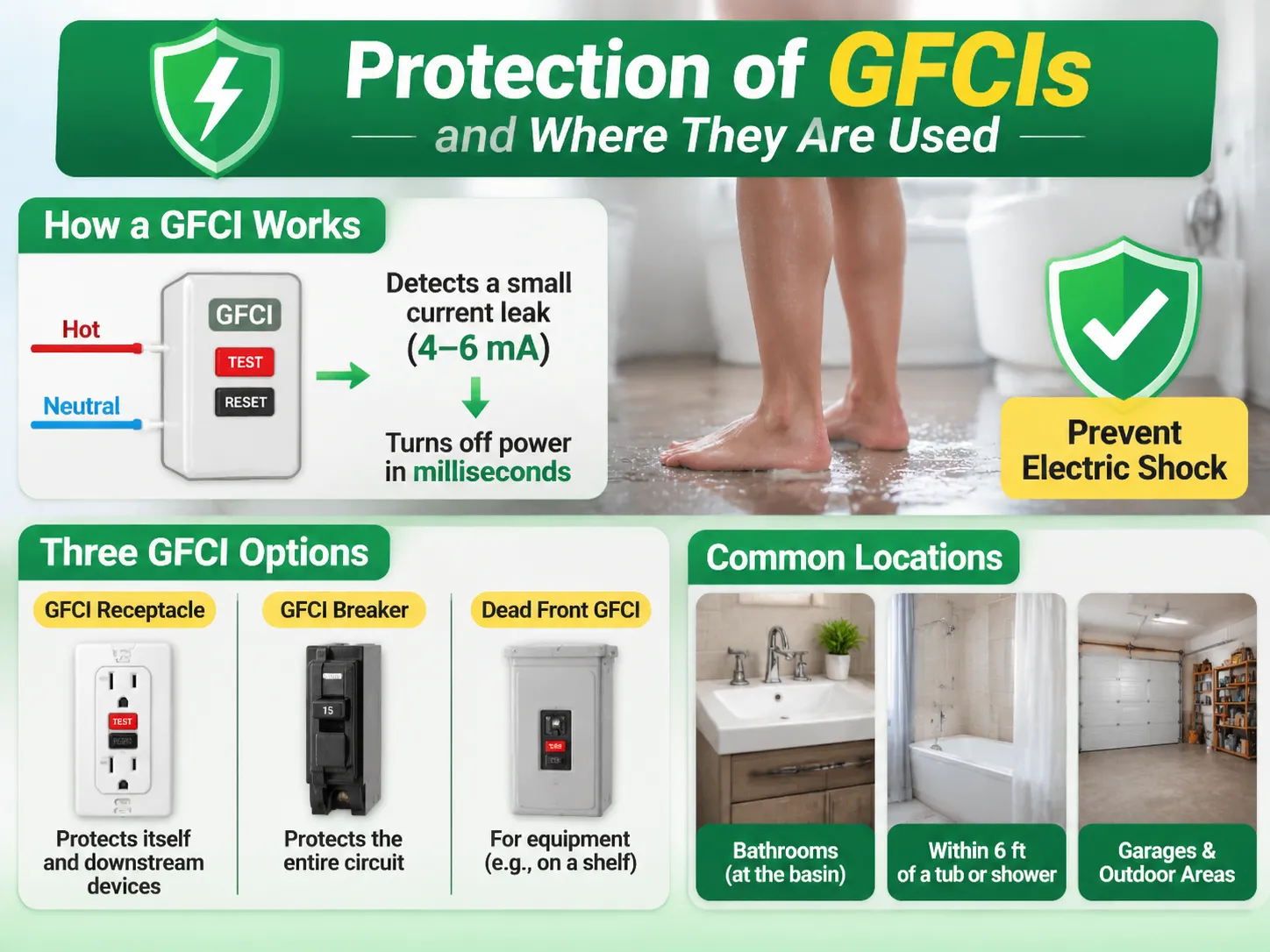
Việc lựa chọn này quan trọng vì một lý do, đó là nơi GFCI sẽ được đặt lại. Một ổ cắm GFCI đặt tại bồn rửa rất dễ dàng để đặt lại và dễ dàng cho chủ nhà kiểm tra chức năng hàng tháng, đó là lý do nó trở thành thiết bị GFCI chủ đạo được sử dụng trong công trình dân dụng.
Bộ ngắt mạch GFCI (ground fault circuit interrupter) là một thiết bị an toàn quan trọng ngăn ngừa quá tải mạch xảy ra trong trường hợp sự cố điện. GFCI được đặt trong gara hoặc các vị trí khác nơi có thể không đủ không gian để đặt ổ cắm GFCI trực tiếp trước thiết bị được bảo vệ. Thông thường, bộ ngắt mạch GFCI sẽ ngắt khi có sự cố điện trên ổ cắm GFCI bảo vệ cùng mạch đó. Bộ ngắt mạch ngắt và hướng người sử dụng ra ngoài khi GFCI ngắt, đó là lý do bạn sẽ thấy hầu hết các lắp đặt bộ ngắt mạch xảy ra ở khu vực có bồn tắm hoặc dọc theo mạch ngoài trời, cũng như các trường hợp ổ cắm được đặt phía sau bảng điều khiển cố định.
Yêu cầu bảo vệ GFCI mở rộng vượt ra ngoài phòng thực tế nơi thiết bị được đặt. Ví dụ, bất kỳ ổ cắm nào được lắp đặt trong phạm vi sáu feet từ mép ngoài của bồn tắm hoặc vòi sen đều phải được bảo vệ bởi GFCI, ngay cả khi ổ cắm đó nằm trong khu vực không thuộc định nghĩa “phòng tắm”, như thường thấy trong các phòng ngủ có ổ cắm gần tường ống nước chung; trong những trường hợp này, ổ cắm thực tế nằm trên mạch phòng tắm.
Hiểu cách hoạt động của ổ cắm GFCI và lý do ngưỡng ngắt 5 mA được đặt ở vị trí đó sẽ giúp người tiêu dùng chọn phiên bản ổ cắm GFCI hoặc bộ ngắt mạch GFCI phù hợp nhất với nhu cầu của họ. Một giải thích đầy đủ về cách các thiết bị GFCI hoạt động có sẵn và là tài liệu bắt buộc phải đọc trước khi chọn phiên bản ổ cắm GFCI hoặc bộ ngắt mạch GFCI của các thiết bị này.
Các Quy tắc 3-foot basin liên quan đến khoảng cách từ mép ngoài của bồn rửa đến ổ cắm điện gần nhất theo chiều ngang. Do đó, điều quan trọng là bạn phải cung cấp một ổ cắm cho tất cả các bồn rửa. Nếu bạn có một bàn trang điểm đôi với hai bồn rửa, thì bạn phải cung cấp một ổ cắm cho mỗi bồn rửa, và thường có thể đáp ứng yêu cầu về bồn rửa bằng cách cung cấp một ổ cắm duy nhất đặt giữa hai bồn rửa miễn là nó nằm trong cả hai yêu cầu về khoảng cách. Tuy nhiên, cần lưu ý rằng một ổ cắm đặt trong tủ thuốc không được tính vì nó không được coi là có thể tiếp cận theo nghĩa được quy định trong mã.
Một chi tiết thường bị các thợ lắp đặt bỏ qua là giới hạn chiều cao liên quan đến việc lắp đặt ổ cắm.
Một ổ cắm gắn trên mặt hoặc ngang trên tủ bồn rửa không được thấp hơn 300mm so với đỉnh bồn rửa. Chiều cao trên mặt bàn có thể là mức trung bình cho một ổ cắm thường khoảng 1.100mm và cùng mức trung tâm với các phụ kiện khác, nhưng hầu hết mọi người có xu hướng đặt ổ cắm phòng tắm của họ trên mức rốn để dễ dàng tiếp cận từ sàn nhà.
Ví dụ, không có phép đo cho khu vực bồn tắm và vòi sen, mà thay vào đó là hạn chế hoặc cấm lắp đặt bất kỳ ổ cắm nào trong khu vực này. Bất kỳ ổ cắm nào cũng không được lắp đặt bên trong bồn tắm hoặc buồng tắm vòi sen, nhưng sẽ được đánh giá dựa trên khu vực đo 3 feet theo chiều ngang và 8 feet theo chiều dọc từ mép trên của bồn tắm hoặc ngưỡng vòi sen.
Ngoại lệ duy nhất cho quy tắc này là với một phòng tắm nhỏ không có nhiều không gian tường. Trong trường hợp này, ngoại lệ giới hạn ở một ổ cắm có thể được lắp đặt trên tường đối diện trực tiếp với bồn tắm (và do đó gần với vùng ẩm ướt).
Cũng liên quan đến hình học này là các thiết bị chiếu sáng. Tương tự như quy tắc ổ cắm, cấu hình của các thiết bị chiếu sáng thường bị nhầm lẫn với các hạn chế về vị trí của ổ cắm. Cụ thể, một thiết bị lắp đặt trên bồn tắm cũng có các hạn chế vị trí giống như ổ cắm (3 feet theo chiều ngang và 8 feet theo chiều dọc) và cũng phải được đánh dấu cho các vị trí ẩm ướt và ướt.
Đối với công tắc, chúng phải được lắp đặt ở nơi mà người dùng không thể chạm đồng thời vào thiết bị cấp nước và công tắc.
Tôi thích nghĩ về Quy tắc Mạch 20A (và lý do tại sao ổ cắm phòng tắm khác biệt) như một phản ánh trực tiếp của máy sấy tóc.
Một thiết bị thông thường sử dụng từ 1.500 đến 1.800 watt, tương đương với 12,5 đến 15 amp trên 120 volt; do đó, một mạch có kích thước này (15 amp) sẽ quá tải nếu ai đó đồng thời sấy tóc và xem tivi, gây ra ngắt mạch ngay lập tức. Mạch chuyên dụng 20 amp cho phép mức sử dụng này xảy ra mà không gây ngắt mạch không cần thiết.
Đối với mạch 20 amp, có hai điều cần lưu ý để tránh tình trạng quá tải: thứ nhất, mạch cần được đấu dây bằng cáp 12 AWG; và thứ hai, bạn có thể đấu nối nhiều ổ cắm cùng nhau cho một phòng tắm, với điều kiện mạch không phục vụ bất kỳ thiết bị nào bên ngoài phòng tắm. Nếu bạn chỉ có một phòng tắm, theo ngoại lệ, đèn chiếu sáng và quạt hút sẽ được phép hoạt động trên cùng mạch này do phòng tắm đơn là tải nhỏ; do đó, không có lý do để chạy thêm các mạch khác.
Điểm thứ hai này dẫn đến ba cân nhắc thực tế về cách các mạch này hoạt động. Nếu bạn lắp một ổ cắm 20 A trên mạch 15 A, ổ cắm sẽ không hoạt động. Điều này có nghĩa là mạch phải được định mức bằng với ổ cắm. Ngoài ra, dây trung tính cho mạch phải được định mức 20 A; điều này quan trọng trong trường hợp bạn đã sử dụng dây trung tính chung trong một lắp đặt cũ. Cuối cùng, trong trường hợp nhiều phòng tắm, mạch không bao giờ nên được kết nối với mạch chiếu sáng; nếu không, khi mạch ổ cắm bị ngắt, tất cả các phòng tắm sẽ bị tối, điều này trái ngược với mục đích của mạch chuyên dụng.
Khi làm việc với phòng tắm, bạn sẽ thấy năm loại thiết bị. Loại mà hầu hết mọi người nghĩ đến là ổ cắm đôi tiêu chuẩn.
Ổ cắm đôi GFCI bảo vệ chống dòng rò đất tại ổ cắm; các cửa chớp của nó mở ra khi cả hai chấu được cắm vào ổ. Giá của ổ cắm đôi GFCI dao động từ $18 đến $30, và chúng thường được tìm thấy trong các phòng tắm gần bồn rửa.
Ổ cắm đôi tiêu chuẩn không cung cấp bảo vệ chống dòng rò đất; nó nên được kết nối phía sau một ổ cắm GFCI hoặc một cầu dao GFCI. Giá của ổ cắm đôi tiêu chuẩn nằm trong khoảng từ $3 đến $8.
Ổ cắm GFCI có bộ sạc USB tích hợp bảo vệ chống dòng rò đất cũng như khả năng sạc. Chúng thường được sử dụng trên bàn trang điểm để sạc dao cạo điện và bàn chải đánh răng. Ổ cắm GFCI có bộ sạc USB thường có giá từ $25 đến $45.
Trong các phòng tắm châu Âu và Úc, bộ cấp nguồn cho dao cạo cung cấp điện cho dao cạo thông qua các biến áp cách ly (như ở Vương quốc Anh/ Ireland). Chúng phù hợp với Vùng 2 trong các phòng tắm Anh và Ireland và thường có giá từ $25 đến $60.
Ổ cắm Schuko hoặc BS IP44 được định mức sử dụng quanh nước và cung cấp khả năng chống thấm nước (tức là chúng kín chống bắn nước), do đó thường được tìm thấy trong các phòng tắm châu Âu và Úc ngoài các vùng ướt. Một ổ cắm IP44 thường có giá từ $10 đến $25.
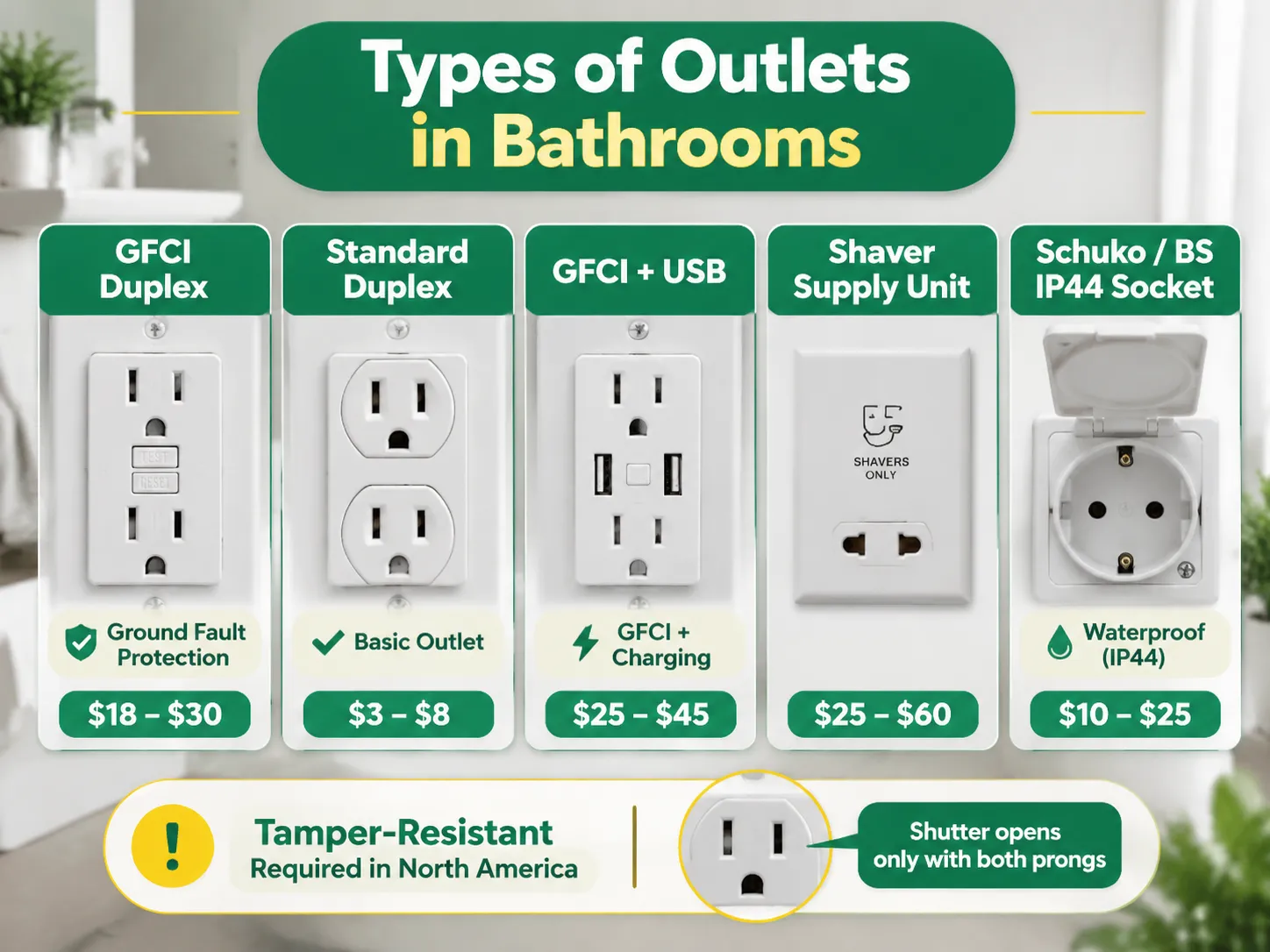
In North America, the code requires that if you replace or install any receptacles, they must include the tamper-resistant shutter. The shutter is spring-loaded and opens only if both prongs are inserted into it; you can expect to pay one or two dollars more for a tamper-resist receptacle over a normal receptacle.
| Outlet type | Giá cả điển hình |
|---|---|
| GFCI duplex receptacle | $18 to $30 |
| Standard duplex receptacle | $3 to $8 |
| GFCI receptacle with USB chargers | $25 to $45 |
| Shaver supply unit | $25-$60 |
| Schuko or BS IP44 socket | $10 to $25 |
| Tamper-resistant receptacle | one or two dollars more |
The last two rows of this comparison chart reflect what an average European (or Australian) consumer may see when shopping for receptacles. Most bathroom socket outlets in the UK do not have a general-purpose socket outlet at all; instead, UK bathrooms are equipped with shaver supply units that contain isolated transformers located in a zone designated as Zone 2. This is why a UK visitor searching for an electric hair dryer will look for a two-prong receptacle capable of accepting an electric shaver plug, rather than a hair dryer plug.
For orders by the thousand of projects using the American format switch and socket configuration and plate systems associated with NEMA, the first row is where you’ll find the countries of North America. A project order uses the NEMA configuration, and corresponds with the plate systems.
A device rated at 15A or 20A, must match the circuit being used. The relationship only goes one way. A 20A receptacle can be used on a circuit rated at 20A. A 15A receptacle will work too, because the 15A device is protected by the circuit rating and the load it will see. However, using a 20A receptacle on a 15A rated circuit is a defective installation because that device is rated for more load than the circuit can handle.
For bathrooms, the result is that using a 15A GFCI receptacle on a 20A rated circuit is both code compliant and very common. In fact, many 15A GFCI receptacles are rated for 20A feed-through configurations in any case; therefore the 15A designation is for the configuration of the receptacle only, and does not denote how much current can be passed to downstream receptacles.
The exception to this rule is if a dedicated appliance with a 20A plug is to be used, such as a large whirlpool heater, or a commercial hand dryer. In this instance, a 20A receptacle and a dedicated circuit are required. These installations should be specified separately, rather than assumed to be general bathroom outlets.
Every developed country mandates that all bathrooms use residual current protection, but they specify how this requirement will apply based on a variety of factors including device type, zone geometry, and how much residual current protection each will provide. Each developed market has a specific residual current protection for a bathroom but not all developed markets have the same residual current protection devices. In this case, the two differences are represented by the methods used to provide residual current protection.
| Quốc gia | Protection method | Socket rule | Zone requirement |
|---|---|---|---|
| Hoa Kỳ | (a) 4 or 6 mA GFCI | (b) all bathroom outlets are standard duplex, (c) TR is mandatory | Receptacles are not allowed in the tub or shower area. |
| Ireland & UK | 30 mA RCD on circuit | ordinary socket limited; wall-mounted shaver unit in zone 2 | BS 7671 defines zones 0, 1, and 2 by distance from water. |
| EU | 30 mA RCD, with some circuits limited to 10 mA | IP44 socket is allowed outside of the risks of water | IEC 60364-7-701, IPX4 in zones 1 and 2. |
| Australia & NZ | 30 mA RCD | any socket outlets must have IP rating | AS/NZS 3000 zone geometry and IP rated accessories. |
| Gulf States & Middle East | 30 mA RCD | BS or Schuko minimum IP44 socket outlet | IEC zone geometry; frequently enforced by consultant. |
The primary differences between the North American and European approaches to residual current protection are (1) North America protects a low number of areas at risk due to proximity to a sink, whereas (2) Europe protects the entire entire installation at 30 mA and relies on the IP rating of the equipment at the risk area.
This may clarify why a European bathroom can include an electrical socket while a North American bathroom uses a device that must be specifically designed for use in North America due to their differing country codes and standards related to the required or acceptable product used in each of these regions.
The plug types also work under the same rationale. In North America, an electrical socket in a bathroom is typically a NEMA 5-15 or 5-20, while in the UK it may be a shavers socket, in Germany it may be the Schuko style with a hinged cover, and in Australia it would be a Type I with a weatherproof cover. The reason the various types of plugs in North America require separate electrical sockets is because of electrical requirements and code restrictions for each style of plug.
Most bathroom installations fail to pass inspection for six reasons related to something other than the device itself. A GFCI outlet must be the first receptacle in a circuit so that all of the downstream receptacles on the circuit are also protected. If installed in a location that cannot be accessed by an electrical plug tester (such as in a cabinet), a GFCI will be unable to provide a test signal. If a GFCI outlet is installed without an equipment ground, a plug tester will not be able to test the GFCI. A GFCI outlet installed on a 15 A circuit would not meet the minimum requirement of being a dedicated 20 A outlet. A GFCI outlet located within the bathtub zone is prohibited, and therefore may not count toward the total number of receptacles required for a bathroom. Finally, a GFCI that has been painted over is considered a defect and indicates that no testing has been performed on the device since it was installed.
A seventh reason, which is not necessarily a code violation, but is also a practical issue, is the insufficient depth of the outlet box for the specific type of GFCI being installed.
GFCI receptacles are designed to be deeper than standard duplex receptacles; therefore, If the electrical box installed in the wall during the tile installation is too shallow to allow for proper installation without excessive protrusion of the plaster ring, it will be more expensive to fix than simply checking the depth of the box prior to the installation of tile.
Another consideration is the cable used. To supply a 20-amp circuit in a bathroom, 12 AWG cable must be utilized, and this presents an issue to home builders as the 12-3 cable contains three conductors instead of the normal two. Additionally, extra unused conductors within a box must be properly terminated, rather than leaving them cut off at the back of the box.

What separates a bathroom-rated product from a non-bathroom rated product? Four main things must be considered when selecting a bathroom rated product’s listing to the appropriate standard, counterfeiting is an actual issue on some internet-based sales sites. The shutter mechanism of the tamper resistant outlet must be installed if required by the local electricity code. The terminals’ design must provide better torque retention than backstab connections, as a bathroom outlet sees more plug/unplug activity than any other outlet. Lastly, the plate of the bathroom outlet should be stainless steel or brass. Plated metal will show watermarks as compared to moulded plastic.
When selecting a brand in this category, it is generally less about performance and more about having the correct product available. For example, the larger brands in the United States, such as Leviton, Legrand, and Hubbell, have a complete selection of the many variations of GFCI, TR, and USB products available.
Due to lower cost, manufacturers in China will typically provide the same products as manufacturers in the USA but with one key difference: the product must be listed for the specific market into which the item is being supplied.
Our manufacturing is on the “wholesale project” side of the equation. We produce receptacles and switches for wholesale and project supply, also producing tamper-resistant duplex and GFCI configurations to accommodate both European plate configurations and North American plate configurations, and we are a component manufacturer, not a lighting manufacturer, so our catalogue is organised by device and plate configuration rather than room.
When we tell potential customers what to check prior to purchasing a device, we advise to check the listing, the plate type, and the type of GFCI (self-test vs. non-self-test). A Self-Test GFCI performs an internal check every few seconds (on the power supplied to it) to confirm that it is functioning correctly, and if the device fails, it will lock out. This is the only way to know that your GFCI installed in a bathroom for 8 years will still work when it is needed.
When it comes to compliant lighting, fans, and switches, all three of these devices share the same room, but they have different requirements. The luminaire must be approved for use in a damp location over the bathtub, and any surface that may receive water spray of any kind also needs to be compliant. The fan must be vented to the exterior of the building and never to the roof structure, and on the circuit for the bathroom, it will consume its 20-A of power; therefore, it shares the circuit with the two other devices in the same room.
In the North America, bathrooms require GFCI receptacles. These outlets must also meet any Tamper Resistant requirements set forth by the local jurisdiction. They must be installed on a dedicated 20-amp circuit, with at least one GFCI protected receptacle located no more than 3 feet from each sink or washbasin. In the United Kingdom and Ireland, bathrooms generally require Shaver Supply Units, which should be located in Zone 2, and should not be regarded as General Socket Outlets (unless an extension lead is permitted), and should be connected to a 30mA RCD.
For North America, the typical designation of the protective device is GFCI receptacle or duplex GFCI/TR; the equivalent in the United Kingdom is known as shaver socket or electric shaving supply unit; the common name in Europe and Australia is IP44 socket outlet with RCD upstream protection; so essentially the names are indicative of the method of protection and the type of enclosure in which they are housed but all products perform the same functions regardless of geography.
The circuit must be rated at 20 amps; this means a 15 amp GFCI receptacle (the receptacle outlet listed here) on the 20 amp circuit is allowed and is the standard. A 20 amp receptacle outlet will only be used to receive power from a device that has a 20 amp plug, i.e., large hot tub heaters. A 20 amp receptacle must not be installed on a 15 amp circuit.
The three requirements for bathroom receptacle outlets are: (1) GFCI; (2) at least one receptacle within three feet of the outside edge of each basin and no more than twelve inches below the counter; (3) all receptacle outlets must be installed on a dedicated 20 amp bathroom circuit. No receptacle outlet is permitted to be installed inside a bathtub or shower stall.
The only exception to this is where the dedicated 20 amp circuit serves only a single bathroom. If that is the case, both the lighting and fan may be installed on the same dedicated 20 amp circuit for that bathroom. A dedicated 20 amp circuit may not serve any other room(s).
According to the base National Electrical Code, AFCI protection is not required for bathrooms; instead, the requirement for GFCI protection specifically addresses risks of electrical shock. However, some states have amended the National Electrical Code to require AFCI protection on all dwelling circuits, therefore; a dual-function breaker will provide both protections.
There are three requirements which govern the installation of bathroom receptacle outlets, and there is one prohibition. These requirements are GFCI protection, a receptacle outlet located within 3 feet of the outside edge of each basin, all receptacle outlets shall be connected to a dedicated 20 amp circuit, and no receptacle outlet shall be allowed to be installed within a bathtub or shower stall. All other information in this article is additional detail supporting the four requirements above.
The detail that ultimately determines whether the installation will remain successful is located at the location of GFCI protection. Locate GFCI protection where it is easily accessible; routinely test the GFCI protection monthly and consider purchasing a self-testing GFCI if your budget allows; keep in mind that the failure of GFCI protection systems typically occurs without any audible or visible indications; therefore the room generally has no indications of danger present.
Each of these rules is reviewed in more detail below. The geometry of receptacle placement, the dedicated branch circuit requirement, receptacle types that meet the code, 15A and 20A questions, differences among countries with regard to the rules, installation details that do not pass inspection, what to consider when buying a product, lighting and fan […]

Dubai – Thị trường dễ dàng để mua thiết bị đi dây và thị trường khó khăn để chọn thiết bị đi dây chính xác để sử dụng cho bất kỳ dự án nào. Tất cả các thương hiệu quốc tế đều có sự đại diện rộng rãi tại Dubai; giao hàng sản phẩm có thể diễn ra trong vòng một tuần kể từ khi đặt hàng; và tất cả các nhà cung cấp đều đạt được chứng nhận để vượt qua kiểm tra DEWA dựa trên DEWA […]
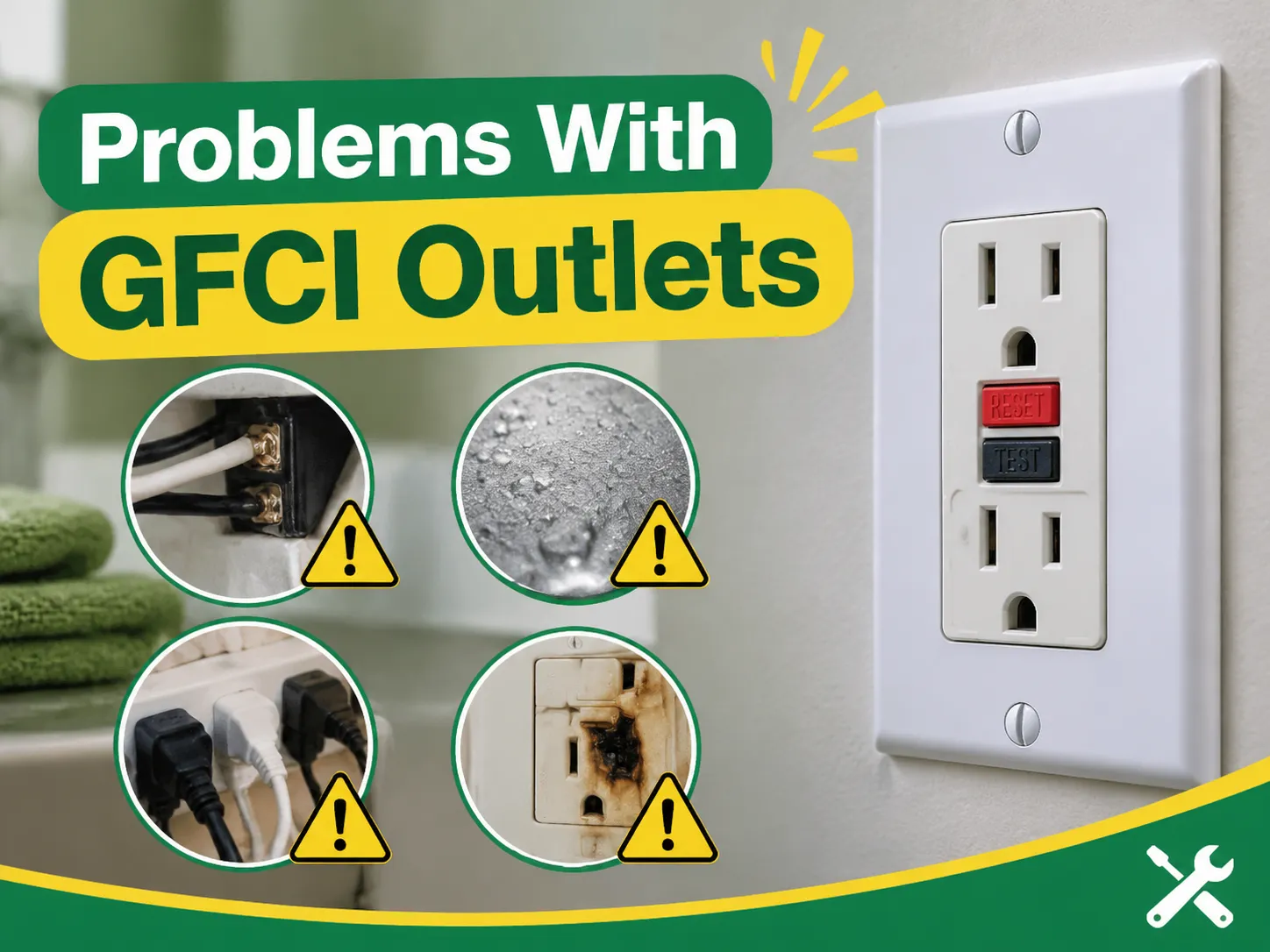
A ground fault circuit interrupter is the only appliance in the house that it is failed in a visible manner. It disconnects at an unexpected time, does not initiate re-setting, or give up after years in the service leaving an illusively safe circuit. Most issues searched by the customers fall into four categories of buyer’s […]

 Số 6 Đường Tuozhan, Công viên Tiên phong Leshang, Cảng Vịnh Yue Khánhwan, thành phố Nhạc Thanh, Tỉnh Chiết Giang


