

Jede dieser Regeln wird im Folgenden detaillierter erläutert. Die Geometrie der Steckdosenplatzierung, die Anforderung eines dedizierten Zweigdrahtstromkreises, Steckdosentypen, die den Vorschriften entsprechen, Fragen zu 15A und 20A, Unterschiede zwischen Ländern bezüglich der Regeln, Installationsdetails, die die Prüfung nicht bestehen, was beim Kauf eines Produkts zu beachten ist, Anforderungen an Beleuchtung und Lüfter im selben Raum sowie Nachrüstungen.
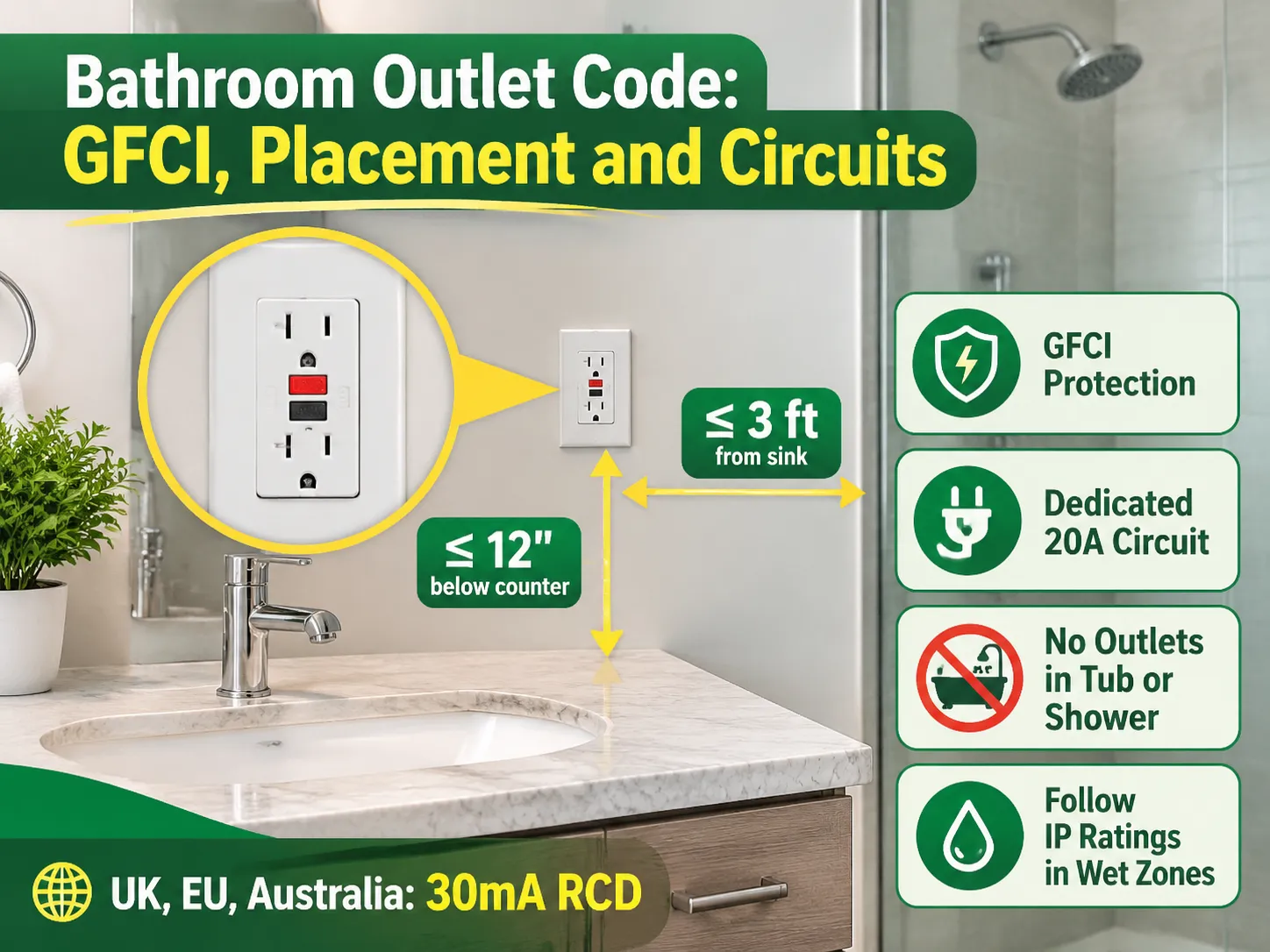
Kurze Antwort: In den Vereinigten Staaten muss jede Steckdose, die in einem Badezimmer verwendet wird, über einen GFCI-Schutz (Ground Fault Circuit Interrupter) verfügen, und mindestens eine Steckdose muss sich innerhalb von 3 Fuß vom Rand des Waschbeckens befinden und nicht mehr als 12 Zoll unterhalb der Arbeitsplattenhöhe. Die Badezimmersteckdosen müssen an dedizierten 20-Ampere-(20A)-Zweigdrahtstromkreisen angeschlossen sein, die ausschließlich für Badezimmer verwendet werden. Keine Badezimmersteckdose darf in der Badewannen- oder Duschzone installiert werden. Das Äquivalent zum nordamerikanischen GFCI ist der 30mA RCD (Residual Current Device) Schutz im Vereinigten Königreich, Irland, Australien und der EU. Wo gewöhnliche Steckdosen in Feuchtzonen installiert werden, gelten Einschränkungen, und die Steckdosen müssen die IP-Schutzart für die Zone erfüllen, in der sie installiert sind.
Der Zweck des GFCI besteht darin, die Differenz im Stromfluss zwischen dem Außenleiter und dem Neutralleiter zu überwachen. Wenn die Differenz zwischen 4 und 6 mA liegt, zeigt dies an, dass ein Teil des Stroms entweicht. Typischerweise bedeutet dies in Badezimmern, dass Strom durch eine Person entweicht, die barfuß auf einem nassen Boden steht. Der GFCI schaltet die Stromzufuhr zu einer Person (d.h. einer Person, die mit den Füßen den nassen Boden berührt) innerhalb weniger Millisekunden ab, nachdem ein Stromverlust an der Steckdose erkannt wurde.
Es gibt drei Geräte, die verwendet werden können, um diese Anforderung zu erfüllen. Das erste ist eine GFCI-Steckdose, die sowohl sich selbst als auch alles andere schützt, das an die Steckdose angeschlossen ist und stromabwärts gespeist wird. Das zweite ist ein GFCI-Leistungsschalter, der den gesamten Stromkreis schützt und die einzige Option ist, die in Situationen verwendet werden kann, in denen keine GFCI-Steckdose vorhanden ist, um den GFCI-Strom auf Null zurückzusetzen, oder wenn der Stromkreis von einer Quelle gespeist wird, die keine Verwendung einer Steckdose ermöglicht (z. B. Whirlpool-Badewannen). Das dritte ist ein “dead front” GFCI, ein Gerät, das an einem Gerät installiert ist, an dem Strom geliefert wird, aber der Benutzer des Geräts keinen Kontakt hat oder sich nicht in der Nähe befindet (z. B. wenn das Gerät auf einem Regal steht).
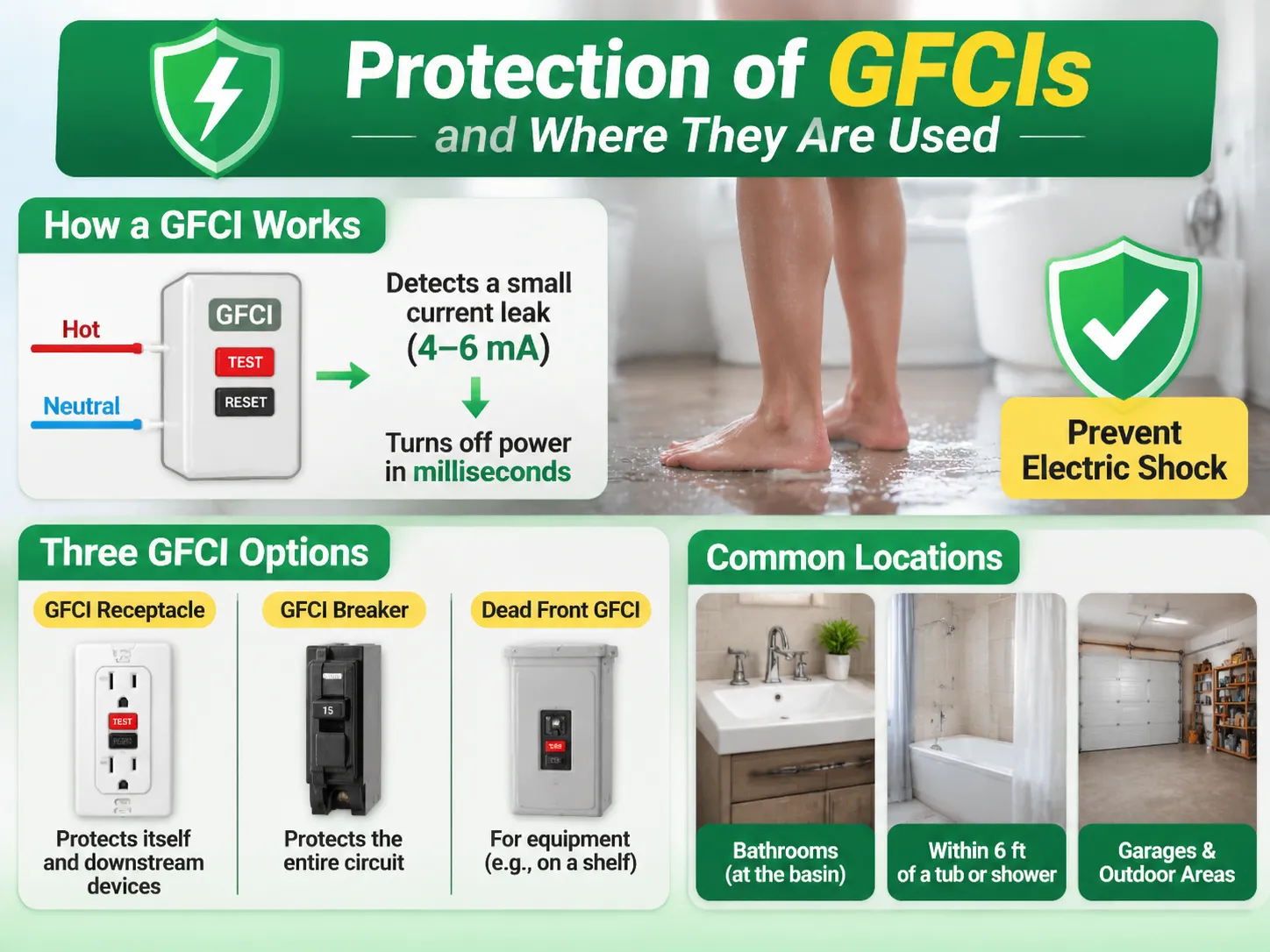
Die Wahl ist aus einem Grund wichtig, nämlich wo der GFCI zurückgesetzt wird. Eine GFCI-Steckdose, die am Waschbecken angebracht ist, ist sehr einfach zurückzusetzen und für den Hausbesitzer leicht monatlich auf Funktion zu überprüfen, was der Grund dafür ist, dass sie das vorherrschende GFCI-Gerät in der Wohnungsinstallation ist.
Ein GFCI-Leistungsschalter (Fehlerstromschutzschalter) ist ein wichtiges Sicherheitsgerät, das verhindert, dass es bei einem elektrischen Fehler zu Überlastungen im Stromkreis kommt. GFCIs befinden sich in Garagen oder anderen Orten, an denen möglicherweise nicht genügend Platz vorhanden ist, um eine GFCI-Steckdose direkt vor dem zu schützenden Gerät zu platzieren. Im Allgemeinen löst ein GFCI-Leistungsschalter aus, wenn ein elektrischer Fehler an der GFCI-Steckdose auftritt, die denselben Stromkreis schützt. Der Leistungsschalter löst aus und weist den Bewohner, der ein Handtuch trägt, nach draußen, wenn der GFCI auslöst, weshalb die meisten Leistungsschalterinstallationen in Bereichen mit Badewanne oder an einem Außenstromkreis erfolgen, sowie in Fällen, in denen eine Steckdose hinter einer fest montierten Abdeckung installiert ist.
Die Anforderung für GFCI-Schutz erstreckt sich über den eigentlichen Raum hinaus, in dem sich das Gerät befindet. Zum Beispiel muss jede Steckdose, die sich innerhalb von sechs Fuß vom äußeren Rand einer Badewanne oder Dusche befindet, durch einen GFCI geschützt sein, selbst wenn sich die Steckdose in einem Bereich befindet, der nicht unter die Definition “Badezimmer” fällt, wie es häufig in Schlafzimmern der Fall ist, in denen sich eine Steckdose in der Nähe einer gemeinsamen Sanitärwand befindet; in diesen Fällen befindet sich die Steckdose tatsächlich auf einem Badezimmerstromkreis.
Das Verständnis, wie eine GFCI-Steckdose funktioniert und warum die Auslöseschwelle von 5 mA dort liegt, wo sie ist, hilft dem Verbraucher, die Version entweder der GFCI-Steckdose oder des GFCI-Leistungsschalters auszuwählen, die am besten zu seinen Bedürfnissen passt. Eine vollständige Erklärung von wie GFCI-Geräte funktionieren ist verfügbar und muss vor der Auswahl der Version entweder der GFCI-Steckdose oder des GFCI-Leistungsschalters dieser Geräte gelesen werden.
Der 3-Fuß-Waschbecken-Regel bezieht sich auf den Abstand von der Außenkante eines Beckens bis zur nächstgelegenen Steckdose horizontal. Daher ist es wichtig, dass Sie für alle Becken eine Steckdose bereitstellen. Wenn Sie ein Doppelwaschbecken mit zwei Becken haben, müssen Sie für jedes Becken eine Steckdose bereitstellen, und es ist normalerweise möglich, die Beckenanforderung zu erfüllen, indem Sie eine einzelne Steckdose zwischen den beiden Becken anbringen, solange sie innerhalb beider Abstandsvorgaben liegt. Es ist jedoch wichtig zu beachten, dass eine Steckdose, die sich in einem Medikamentenschrank befindet, nicht zählt, da sie nicht als zugänglich im Sinne des Codes betrachtet wird.
Ein Detail, das von Installateuren oft vernachlässigt wird, ist die Höhenbegrenzung in Bezug auf Steckdoseninstallationen.
Eine Steckdose, die an der Vorderseite oder horizontal am Beckenschrank montiert ist, darf nicht mehr als 300 mm unter der Oberkante des Beckens liegen. Die Höhe über der Arbeitsplatte kann durchschnittlich für eine Steckdose sein, die oft etwa 1.100 mm hoch und auf derselben Mittellinie wie andere Zubehörteile angebracht ist, aber die meisten Menschen neigen dazu, ihre Badezimmersteckdosen über Bauchnabelhöhe zu platzieren, damit sie vom Boden aus leicht erreichbar sind.
Zum Beispiel, gibt es keine Messung für den Bereich der Badewanne und Dusche, sondern eine Einschränkung oder ein Verbot, Steckdosen in diesem Bereich zu installieren.. Es darf keine Steckdose innerhalb einer Badewanne oder Duschkabine installiert werden, aber es wird der Bereich bewertet, der 3 Fuß horizontal und 8 Fuß vertikal von der Oberkante der Badewanne oder der Duschschwelle gemessen wird.
Die einzige Ausnahme von dieser Regel gilt für ein kleines Badezimmer, das nicht viel Wandfläche hat. In diesem Fall ist die Ausnahme auf eine Steckdose beschränkt, die an der Wand direkt gegenüber der Badewanne installiert werden kann (und somit nahe der Nasszone).
Ebenfalls in Bezug auf diese Geometrie stehen die Leuchten. Ähnlich wie bei der Steckdosenregel wird die Anordnung der Leuchten oft mit den Platzierungsbeschränkungen für Steckdosen verwechselt. Insbesondere hat eine über einer Badewanne installierte Leuchte dieselben Platzierungsbeschränkungen wie eine Steckdose (3 Fuß horizontal und 8 Fuß vertikal) und muss ebenfalls für feuchte und nasse Bereiche gekennzeichnet sein.
Was Schalter betrifft, so müssen diese so installiert werden, dass niemand gleichzeitig ein Sanitärarmatur und den Schalter berühren kann.
Ich denke gerne an die 20A-Schaltkreisregel (und den Grund, warum Badezimmersteckdosen anders sind) als direkte Reflexion des Haartrockners.
Ein normales Gerät verwendet zwischen 1.500 und 1.800 Watt, was 12,5 bis 15 Ampere bei 120 Volt entspricht; daher wird ein Schaltkreis dieser Größe (15 Ampere) überlastet, wenn jemand gleichzeitig seine Haare trocknet und fern sieht, was zu einem sofortigen Auslösen führt. Der dedizierte 20-Ampere-Schaltkreis ermöglicht diese Nutzung, ohne dass etwas unnötig auslöst.
Für einen 20-Ampere-Stromkreis sind zwei Dinge zu beachten, um eine Überlastung zu vermeiden: Erstens muss der Stromkreis mit 12 AWG Kabel verdrahtet sein; und zweitens können mehrere Steckdosen für ein Badezimmer zusammen geschaltet werden, vorausgesetzt, der Stromkreis versorgt nichts außerhalb des Badezimmers. Wenn Sie ein einzelnes Badezimmer haben, sind gemäß der Ausnahme die Beleuchtung und der Abluftventilator auf demselben Stromkreis zulässig, da ein einzelnes Badezimmer eine geringe Last darstellt; daher gibt es keine Rechtfertigung für zusätzliche Stromkreise.
Dieser zweite Punkt führt zu drei praktischen Überlegungen, wie diese Stromkreise funktionieren. Wenn Sie eine 20-A-Steckdose an einem 15-A-Stromkreis installieren, kann die Steckdose nicht betrieben werden. Das bedeutet, dass der Stromkreis die gleiche Nennleistung wie die Steckdose haben muss. Außerdem muss der Neutralleiter für den Stromkreis auf 20 A ausgelegt sein; das ist wichtig, falls in einer älteren Installation ein gemeinsamer Neutralleiter verwendet wurde. Schließlich sollte in einer Mehrbadezimmer-Situation der Stromkreis niemals mit dem Beleuchtungsstromkreis verbunden werden; andernfalls führt ein Auslösen des Steckdosenstromkreises dazu, dass alle Badezimmer dunkel sind, was dem Zweck des dedizierten Stromkreises widerspricht.
Bei der Arbeit mit Badezimmern finden Sie fünf Gerätetypen. Derjenige, an den die meisten denken, ist die Standard-Doppelsteckdose.
Eine GFCI-Doppelsteckdose schützt vor Fehlerströmen am Anschluss; ihre Verschlüsse öffnen sich, wenn beide Stifte in die Steckdose gesteckt werden. Die Kosten für GFCI-Doppelsteckdosen liegen zwischen $18 und $30, und sie sind am häufigsten in Badezimmern in der Nähe von Waschbecken zu finden.
Eine Standard-Doppelsteckdose bietet keinen Fehlerstromschutz; sie sollte stromabwärts entweder einer GFCI-Steckdose oder eines GFCI-Schutzschalters angeschlossen werden. Der Preisbereich für eine Standard-Doppelsteckdose liegt zwischen $3 und $8.
Eine GFCI-Steckdose mit USB-Ladegeräten verfügt über integrierten Fehlerstromschutz sowie Ladefunktionen. Sie werden typischerweise an Waschtischen verwendet, um elektrische Rasierer und Zahnbürsten zu laden. GFCI-Steckdosen mit USB-Ladegeräten kosten in der Regel zwischen $25 und $45.
In europäischen und australischen Badezimmern versorgt eine Rasiererspeiseeinheit Rasierer über isolierte Transformatoren (wie in Großbritannien/Irland). Sie sind in Zone 2 in britischen und irischen Badezimmern installiert und kosten typischerweise $25-$60.
Schuko- oder BS IP44-Steckdosen sind für den Einsatz in Wassernähe ausgelegt und bieten Wasserdichtigkeit (d.h. sie sind spritzwassergeschützt) und sind daher typischerweise in europäischen und australischen Badezimmern außerhalb der Nasszonen zu finden. Eine IP44-Steckdose kostet in der Regel zwischen $10 und $25.
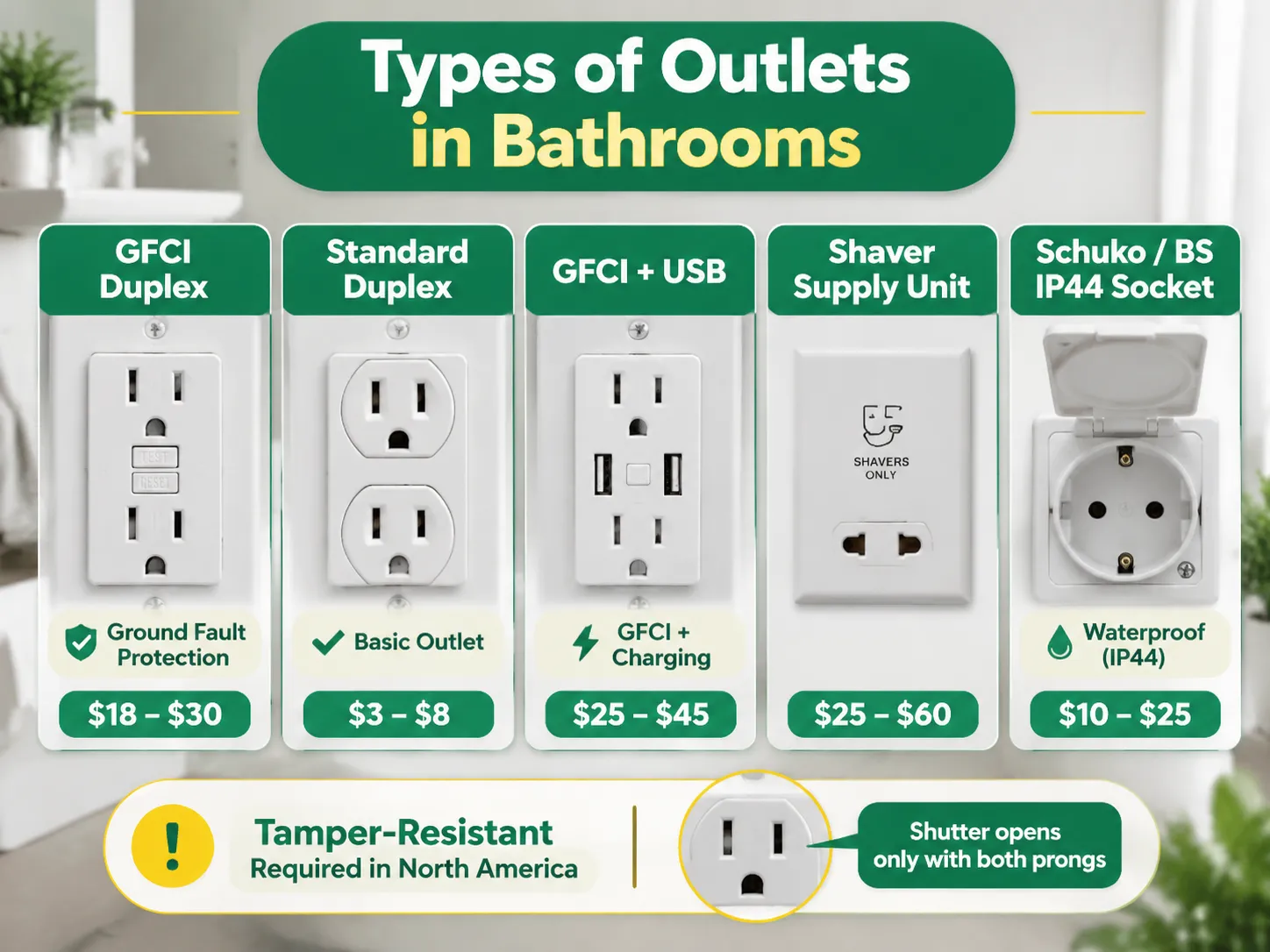
In North America, the code requires that if you replace or install any receptacles, they must include the tamper-resistant shutter. The shutter is spring-loaded and opens only if both prongs are inserted into it; you can expect to pay one or two dollars more for a tamper-resist receptacle over a normal receptacle.
| Outlet type | Typischer Preis |
|---|---|
| GFCI duplex receptacle | $18 to $30 |
| Standard duplex receptacle | $3 to $8 |
| GFCI receptacle with USB chargers | $25 to $45 |
| Shaver supply unit | $25-$60 |
| Schuko or BS IP44 socket | $10 to $25 |
| Tamper-resistant receptacle | one or two dollars more |
The last two rows of this comparison chart reflect what an average European (or Australian) consumer may see when shopping for receptacles. Most bathroom socket outlets in the UK do not have a general-purpose socket outlet at all; instead, UK bathrooms are equipped with shaver supply units that contain isolated transformers located in a zone designated as Zone 2. This is why a UK visitor searching for an electric hair dryer will look for a two-prong receptacle capable of accepting an electric shaver plug, rather than a hair dryer plug.
For orders by the thousand of projects using the American format switch and socket configuration and plate systems associated with NEMA, the first row is where you’ll find the countries of North America. A project order uses the NEMA configuration, and corresponds with the plate systems.
A device rated at 15A or 20A, must match the circuit being used. The relationship only goes one way. A 20A receptacle can be used on a circuit rated at 20A. A 15A receptacle will work too, because the 15A device is protected by the circuit rating and the load it will see. However, using a 20A receptacle on a 15A rated circuit is a defective installation because that device is rated for more load than the circuit can handle.
For bathrooms, the result is that using a 15A GFCI receptacle on a 20A rated circuit is both code compliant and very common. In fact, many 15A GFCI receptacles are rated for 20A feed-through configurations in any case; therefore the 15A designation is for the configuration of the receptacle only, and does not denote how much current can be passed to downstream receptacles.
The exception to this rule is if a dedicated appliance with a 20A plug is to be used, such as a large whirlpool heater, or a commercial hand dryer. In this instance, a 20A receptacle and a dedicated circuit are required. These installations should be specified separately, rather than assumed to be general bathroom outlets.
Every developed country mandates that all bathrooms use residual current protection, but they specify how this requirement will apply based on a variety of factors including device type, zone geometry, and how much residual current protection each will provide. Each developed market has a specific residual current protection for a bathroom but not all developed markets have the same residual current protection devices. In this case, the two differences are represented by the methods used to provide residual current protection.
| Land | Protection method | Socket rule | Zone requirement |
|---|---|---|---|
| Vereinigte Staaten | (a) 4 or 6 mA GFCI | (b) all bathroom outlets are standard duplex, (c) TR is mandatory | Receptacles are not allowed in the tub or shower area. |
| Ireland & UK | 30 mA RCD on circuit | ordinary socket limited; wall-mounted shaver unit in zone 2 | BS 7671 defines zones 0, 1, and 2 by distance from water. |
| EU | 30 mA RCD, with some circuits limited to 10 mA | IP44 socket is allowed outside of the risks of water | IEC 60364-7-701, IPX4 in zones 1 and 2. |
| Australia & NZ | 30 mA RCD | any socket outlets must have IP rating | AS/NZS 3000 zone geometry and IP rated accessories. |
| Gulf States & Middle East | 30 mA RCD | BS or Schuko minimum IP44 socket outlet | IEC zone geometry; frequently enforced by consultant. |
The primary differences between the North American and European approaches to residual current protection are (1) North America protects a low number of areas at risk due to proximity to a sink, whereas (2) Europe protects the entire entire installation at 30 mA and relies on the IP rating of the equipment at the risk area.
This may clarify why a European bathroom can include an electrical socket while a North American bathroom uses a device that must be specifically designed for use in North America due to their differing country codes and standards related to the required or acceptable product used in each of these regions.
The plug types also work under the same rationale. In North America, an electrical socket in a bathroom is typically a NEMA 5-15 or 5-20, while in the UK it may be a shavers socket, in Germany it may be the Schuko style with a hinged cover, and in Australia it would be a Type I with a weatherproof cover. The reason the various types of plugs in North America require separate electrical sockets is because of electrical requirements and code restrictions for each style of plug.
Most bathroom installations fail to pass inspection for six reasons related to something other than the device itself. A GFCI outlet must be the first receptacle in a circuit so that all of the downstream receptacles on the circuit are also protected. If installed in a location that cannot be accessed by an electrical plug tester (such as in a cabinet), a GFCI will be unable to provide a test signal. If a GFCI outlet is installed without an equipment ground, a plug tester will not be able to test the GFCI. A GFCI outlet installed on a 15 A circuit would not meet the minimum requirement of being a dedicated 20 A outlet. A GFCI outlet located within the bathtub zone is prohibited, and therefore may not count toward the total number of receptacles required for a bathroom. Finally, a GFCI that has been painted over is considered a defect and indicates that no testing has been performed on the device since it was installed.
A seventh reason, which is not necessarily a code violation, but is also a practical issue, is the insufficient depth of the outlet box for the specific type of GFCI being installed.
GFCI receptacles are designed to be deeper than standard duplex receptacles; therefore, If the electrical box installed in the wall during the tile installation is too shallow to allow for proper installation without excessive protrusion of the plaster ring, it will be more expensive to fix than simply checking the depth of the box prior to the installation of tile.
Another consideration is the cable used. To supply a 20-amp circuit in a bathroom, 12 AWG cable must be utilized, and this presents an issue to home builders as the 12-3 cable contains three conductors instead of the normal two. Additionally, extra unused conductors within a box must be properly terminated, rather than leaving them cut off at the back of the box.

What separates a bathroom-rated product from a non-bathroom rated product? Four main things must be considered when selecting a bathroom rated product’s listing to the appropriate standard, counterfeiting is an actual issue on some internet-based sales sites. The shutter mechanism of the tamper resistant outlet must be installed if required by the local electricity code. The terminals’ design must provide better torque retention than backstab connections, as a bathroom outlet sees more plug/unplug activity than any other outlet. Lastly, the plate of the bathroom outlet should be stainless steel or brass. Plated metal will show watermarks as compared to moulded plastic.
When selecting a brand in this category, it is generally less about performance and more about having the correct product available. For example, the larger brands in the United States, such as Leviton, Legrand, and Hubbell, have a complete selection of the many variations of GFCI, TR, and USB products available.
Due to lower cost, manufacturers in China will typically provide the same products as manufacturers in the USA but with one key difference: the product must be listed for the specific market into which the item is being supplied.
Our manufacturing is on the “wholesale project” side of the equation. We produce receptacles and switches for wholesale and project supply, also producing tamper-resistant duplex and GFCI configurations to accommodate both European plate configurations and North American plate configurations, and we are a component manufacturer, not a lighting manufacturer, so our catalogue is organised by device and plate configuration rather than room.
When we tell potential customers what to check prior to purchasing a device, we advise to check the listing, the plate type, and the type of GFCI (self-test vs. non-self-test). A Self-Test GFCI performs an internal check every few seconds (on the power supplied to it) to confirm that it is functioning correctly, and if the device fails, it will lock out. This is the only way to know that your GFCI installed in a bathroom for 8 years will still work when it is needed.
When it comes to compliant lighting, fans, and switches, all three of these devices share the same room, but they have different requirements. The luminaire must be approved for use in a damp location over the bathtub, and any surface that may receive water spray of any kind also needs to be compliant. The fan must be vented to the exterior of the building and never to the roof structure, and on the circuit for the bathroom, it will consume its 20-A of power; therefore, it shares the circuit with the two other devices in the same room.
In the North America, bathrooms require GFCI receptacles. These outlets must also meet any Tamper Resistant requirements set forth by the local jurisdiction. They must be installed on a dedicated 20-amp circuit, with at least one GFCI protected receptacle located no more than 3 feet from each sink or washbasin. In the United Kingdom and Ireland, bathrooms generally require Shaver Supply Units, which should be located in Zone 2, and should not be regarded as General Socket Outlets (unless an extension lead is permitted), and should be connected to a 30mA RCD.
For North America, the typical designation of the protective device is GFCI receptacle or duplex GFCI/TR; the equivalent in the United Kingdom is known as shaver socket or electric shaving supply unit; the common name in Europe and Australia is IP44 socket outlet with RCD upstream protection; so essentially the names are indicative of the method of protection and the type of enclosure in which they are housed but all products perform the same functions regardless of geography.
The circuit must be rated at 20 amps; this means a 15 amp GFCI receptacle (the receptacle outlet listed here) on the 20 amp circuit is allowed and is the standard. A 20 amp receptacle outlet will only be used to receive power from a device that has a 20 amp plug, i.e., large hot tub heaters. A 20 amp receptacle must not be installed on a 15 amp circuit.
The three requirements for bathroom receptacle outlets are: (1) GFCI; (2) at least one receptacle within three feet of the outside edge of each basin and no more than twelve inches below the counter; (3) all receptacle outlets must be installed on a dedicated 20 amp bathroom circuit. No receptacle outlet is permitted to be installed inside a bathtub or shower stall.
The only exception to this is where the dedicated 20 amp circuit serves only a single bathroom. If that is the case, both the lighting and fan may be installed on the same dedicated 20 amp circuit for that bathroom. A dedicated 20 amp circuit may not serve any other room(s).
According to the base National Electrical Code, AFCI protection is not required for bathrooms; instead, the requirement for GFCI protection specifically addresses risks of electrical shock. However, some states have amended the National Electrical Code to require AFCI protection on all dwelling circuits, therefore; a dual-function breaker will provide both protections.
There are three requirements which govern the installation of bathroom receptacle outlets, and there is one prohibition. These requirements are GFCI protection, a receptacle outlet located within 3 feet of the outside edge of each basin, all receptacle outlets shall be connected to a dedicated 20 amp circuit, and no receptacle outlet shall be allowed to be installed within a bathtub or shower stall. All other information in this article is additional detail supporting the four requirements above.
The detail that ultimately determines whether the installation will remain successful is located at the location of GFCI protection. Locate GFCI protection where it is easily accessible; routinely test the GFCI protection monthly and consider purchasing a self-testing GFCI if your budget allows; keep in mind that the failure of GFCI protection systems typically occurs without any audible or visible indications; therefore the room generally has no indications of danger present.
Each of these rules is reviewed in more detail below. The geometry of receptacle placement, the dedicated branch circuit requirement, receptacle types that meet the code, 15A and 20A questions, differences among countries with regard to the rules, installation details that do not pass inspection, what to consider when buying a product, lighting and fan […]

Dubai – Einfacher Markt zum Kauf von Verdrahtungsgeräten und schwieriger Markt zur Auswahl des richtigen Verdrahtungsgeräts für den Einsatz in jedem Projekt. Alle internationalen Marken sind in Dubai breit vertreten; die Lieferung der Produkte kann innerhalb einer Woche nach Auftragserteilung erfolgen; und die Qualifikation zur bestandenen DEWA-Inspektion wird von allen Lieferanten basierend auf der DEWA […]
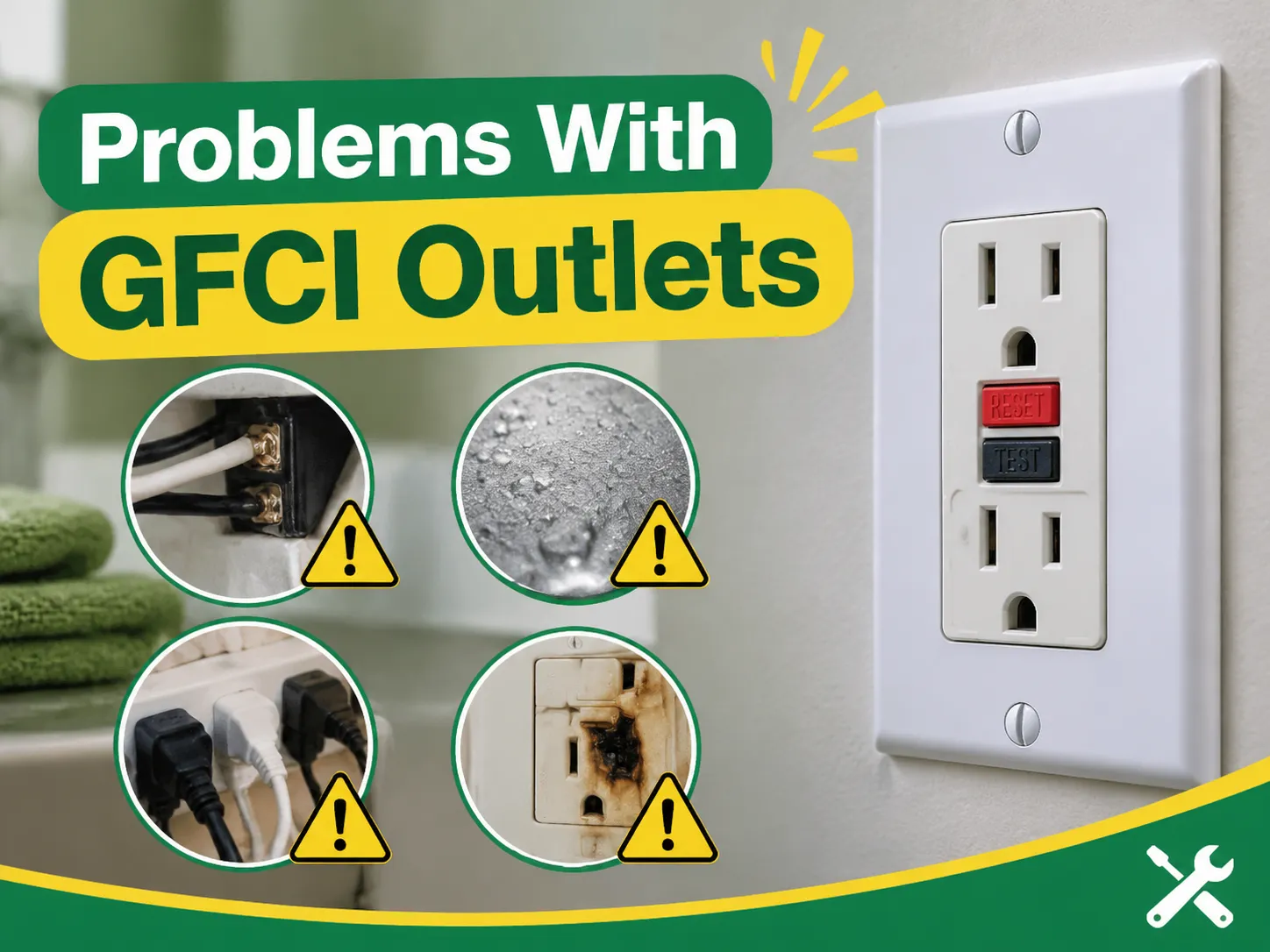
A ground fault circuit interrupter is the only appliance in the house that it is failed in a visible manner. It disconnects at an unexpected time, does not initiate re-setting, or give up after years in the service leaving an illusively safe circuit. Most issues searched by the customers fall into four categories of buyer’s […]

 Nr. 6 Tuozhan Road, Leshang Pioneer Park, Yueqingwan Bay Harbor, Stadt Yueqing, Provinz Zhejiang


