

Per i viaggiatori nordamericani, Porto Rico è un'isola attraente poiché utilizza la stessa presa elettrica, tensione e frequenza degli Stati Uniti, rendendo facile collegare i propri dispositivi. Tuttavia, se avete acquistato i vostri dispositivi elettronici in Europa, Australia o Asia, la vostra spina non può essere inserita nelle prese portoricane.
Risposta rapida: Porto Rico utilizza prese nordamericane di Tipo A e Tipo B che operano a 120 volt e 60 Hertz. Chi viaggia a Porto Rico con spine nordamericane non avrà bisogno di un adattatore, ma le spine giapponesi con tensione nominale di 100 volt non potranno essere collegate alle prese portoricane perché la tensione di progetto è superiore a 100 volt. Chi viaggia con dispositivi elettrici provenienti da Regno Unito, Irlanda, Australia, Nuova Zelanda, India e gran parte dell'Asia avrà bisogno di un adattatore per la spina, e i dispositivi con tensione nominale di 230 volt richiederanno anche un convertitore di tensione per funzionare a Porto Rico. Le spine di Tipo C e Tipo F non possono essere usate in modo intercambiabile con le spine di Tipo A e Tipo B, né possono essere usate in modo intercambiabile tra loro in ogni tipo di presa.
Questo articolo approfondirà i tipi di spine utilizzate a Porto Rico, la questione della tensione, chi necessita di un adattatore per la spina, la confusione tra i tipi di spina C e F, gli apparecchi a doppia tensione, la qualità dell'elettricità sull'isola, la fragilità della rete e le sue conseguenze nella selezione delle apparecchiature, la nostra offerta di prodotti e cosa consigliamo ai viaggiatori di portare con sé a Porto Rico.
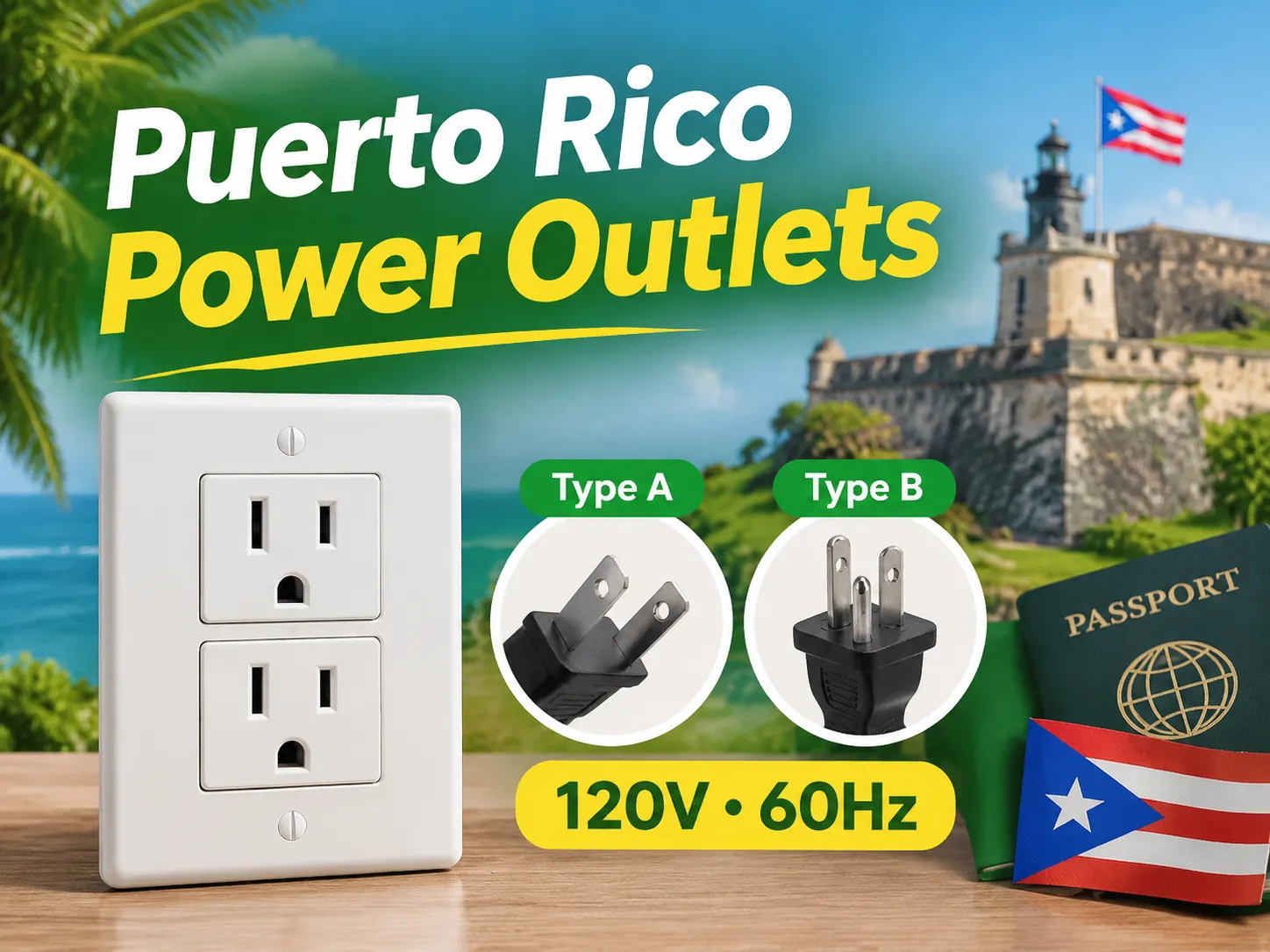
L'isola di Porto Rico è un territorio degli Stati Uniti soggetto alle normative del sistema elettrico statunitense. A Porto Rico, tutte le prese sono Tipo A con due lamelle piatte parallele e Tipo B con un perno di terra circolare aggiunto, e funzionano a una tensione di 120 V e frequenza di 60 Hz, proprio come avviene negli Stati Uniti continentali. Tutti i tipi di spina si inseriscono in queste stesse prese, il che rende la determinazione del tipo di adattatore da viaggio da utilizzare quando si viaggia a Porto Rico basata sul paese di origine piuttosto che su una caratteristica unica di Porto Rico. Ad esempio, se si viaggia dagli USA a Porto Rico, la spina si inserirà senza problemi, mentre non si inserirà se si viaggia dal Regno Unito o dall’Europa. Porto Rico non ha inoltre alcuna variante locale dei tipi di spina né alcuno standard misto residuo dal suo periodo coloniale, cosa che non è vera per molte altre isole dei Caraibi.
Molti hotel e edifici più recenti forniscono anche una presa universale per l’uso con vari tipi di spina, e alcuni aggiungono prese USB, ma i viaggiatori non dovrebbero fare affidamento su di esse poiché non sono uno standard.
Le prese classificate come Tipo A hanno due lamelle piatte distanziate di circa 12 mm. Sono non polarizzate e rappresentano lo stile originale di presa. Le prese Tipo A si trovano ancora comunemente in molti edifici vecchi e su apparecchi di illuminazione e piccoli elettrodomestici. Poiché le prese Tipo A non hanno un perno di terra, i dispositivi che le utilizzano non dovrebbero richiedere la messa a terra. Tutte le nuove installazioni, secondo i codici elettrici attuali, utilizzano ora prese con messa a terra (cioè Tipo B) come standard.
Le prese Tipo B includono un perno di terra rotondo centrato sotto le due lamelle piatte che si collegano alla presa. Negli USA e in Nord America, il Tipo B è sempre utilizzato nelle costruzioni residenziali e commerciali. Le prese Tipo B accettano sia spine Tipo A che Tipo B, motivo per cui la maggior parte delle persone non si rende conto di utilizzare forme diverse di spina.
Il perno di terra fornisce completa sicurezza agli apparecchi o dispositivi che hanno un involucro metallico; pertanto, oltre all’aspetto degli apparecchi, deve essere considerata la posizione del perno neutro per garantire una corretta messa a terra.
IL Tipo di presa da 15 A ha un’opzione da 15 A e una da 20 A. La presa da 20 A accetta la spina da 15 A e ha la stessa configurazione della 15 A ma aggiunge una posizione a forma di T per il perno neutro, cosa importante quando si specificano apparecchiature piuttosto che per il viaggio. Se si acquista un apparecchio da 20 A, non si inserirà in una presa da 15 A, e la descrizione completa della presa nordamericana include l’intercambiabilità geometrica e le classificazioni.
L’alimentazione elettrica di tutta la parte centrale del Nord America è monofase a 120 volt e 60 Hz. Per apparecchi più grandi come cucine e asciugatrici, esiste anche un circuito bipolare che fornisce 240 volt. Questo tipo di alimentazione è esattamente lo stesso di quello degli Stati Uniti continentali, il che significa che è possibile acquistare apparecchi dagli Stati Uniti continentali e collegarli alle proprie prese senza effettuare modifiche.
Ci sono due gruppi di dispositivi che richiedono attenzione: il primo gruppo è costituito da apparecchi giapponesi con tensione nominale di 100 volt e funzioneranno a 120 volt; nella maggior parte dei casi, gli alimentatori switching supportano 120 volt. Al contrario, motori e elementi riscaldanti a 100 volt si surriscalderanno se alimentati a 120 volt e potrebbero guastarsi prematuramente. Il secondo gruppo è costituito da apparecchi europei con tensione nominale di 230 volt; sebbene siano disponibili adattatori per spine, questi adattatori non modificano la tensione a 120 volt e quindi non consentono all'apparecchio europeo di funzionare a 120 volt..
La frequenza può essere trascurata, ma è altrettanto importante quanto la tensione. Un apparecchio a 50 Hz come un motore sincrono, un orologio o un timer funzionerà circa il 20 percento più velocemente su un'alimentazione a 60 Hz.
Un apparecchio elettronico con alimentatore switching è indifferente al modo in cui viene fornita l'elettricità. Per questo motivo sia i caricabatterie per laptop che per telefoni possono essere utilizzati su fonti di alimentazione a 50 Hz, mentre ventilatori a 50 Hz e timer meccanici non possono.
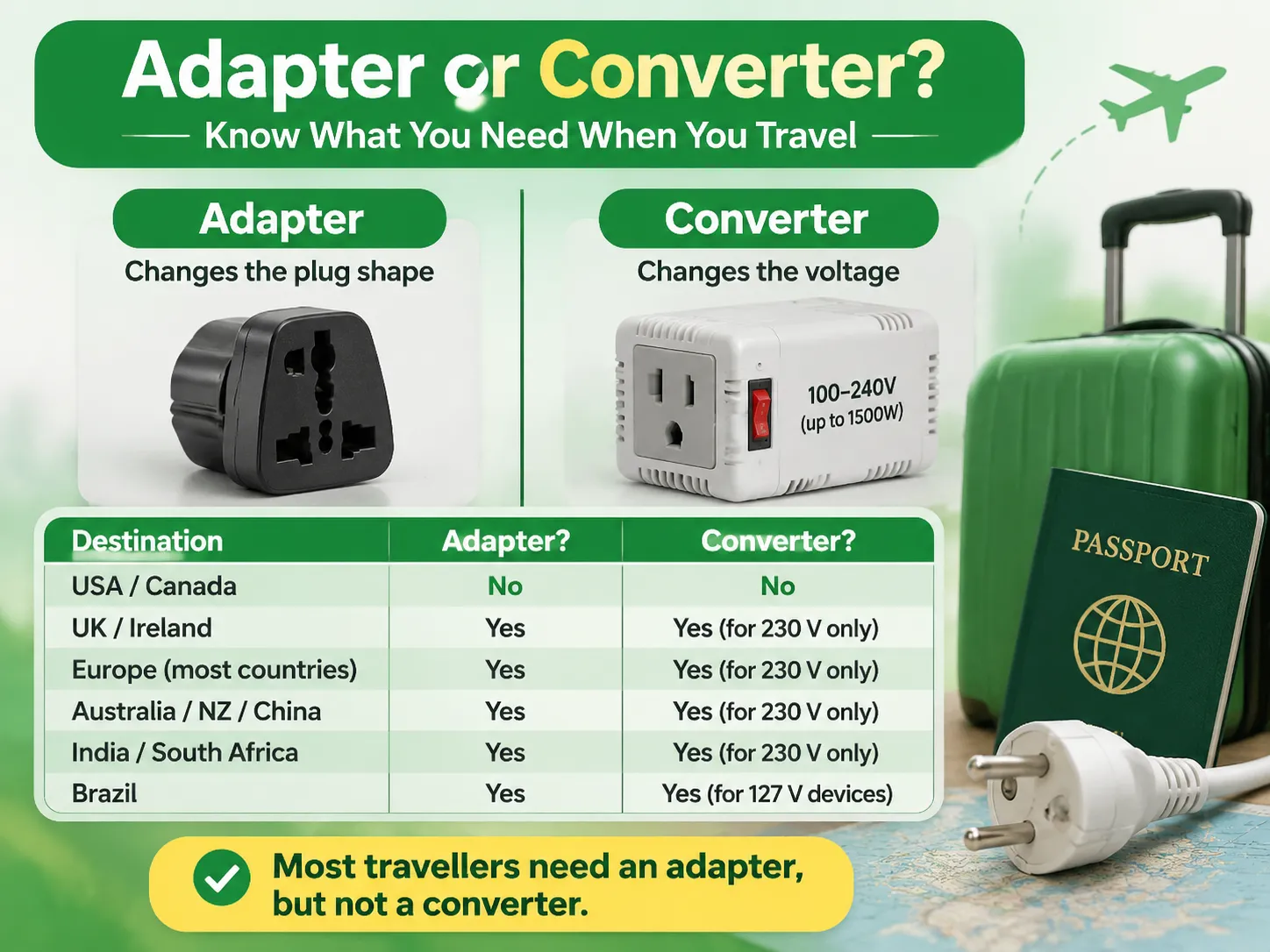
Le informazioni nella tabella sottostante forniscono una risposta immediata alla domanda sopra. Un adattatore viene utilizzato per convertire la forma della spina, mentre un convertitore serve a modificare la tensione dell'alimentazione elettrica. La maggior parte dei viaggiatori necessita di un adattatore, ma non di un convertitore.
| Provenendo da | Tappo | Adattatore | Convertitore di tensione |
|---|---|---|---|
| USA / Canada | A, B | NO | NO |
| Giappone | A, B | NO | Di solito no, verificare l'etichetta |
| Messico / America Centrale | A, B | NO | NO |
| Regno Unito / Irlanda | G | SÌ | Sì solo per dispositivi a 230 V |
| Europa (la maggior parte dei paesi) | C, E, F | SÌ | Sì solo per dispositivi a 230 V |
| Australia / Nuova Zelanda / Cina | IO | SÌ | Sì solo per dispositivi a 230 V |
| India / South Africa | D, M | SÌ | Sì solo per dispositivi a 230 V |
| Brasile | N | SÌ | Sì per dispositivi a 127 V, no per 220 V |
La riga per il Brasile è la più curiosa poiché il paese utilizza due tensioni diverse (127V e 220V) e ha una spina di Tipo N. Pertanto, un individuo che viaggia dal Brasile potrebbe avere dispositivi che funzionano con una tensione ma non con l'altra. Un comparison of all plug and socket standards by region provides the quickest method of answering this question. If you’re in another country, the most common assumption is that having a plug adapter and plugging in a device labelled 100 to 240 volts will work; and for devices labelled 230 volts, you also need a converter. The reason for the converter’s size and expense is because you are limited to 1,500 watts; so if you need to use a hair dryer in a foreign country, you will need to locate a converter that has the appropriate wattage rating, which is different from the small travel converters sold at most airports.
Type C refers to the Europlug, which consists of two pins with 4 mm pin diameters and a spacing of 19 mm between the pins, while it has a non-tapered (flat) body. The Schuko type F plug is made of 4.8 mm diameter pins and is generally round and has clips on the sides for the earth connection. Both types of plugs are related but have differences that determine compatibility with certain types of sockets.
A Type C plug will fit into Type F, Type E and Type L sockets as the pins on the Type C plug are thin enough and the spacing of the two pin holes on all three sockets are the same. However, a Type F plug will not fit into a Type C socket due to the fact that Type C sockets are not found on wall outlets in most countries (Type C is designed to fit into sockets created for larger sized plugs).
Neither Type C nor Type F plugs will fit a socket in Puerto Rico (NEMA 5-15) that has flat blades, and regardless of the attempts to bend the pins of either Type C or Type F plug into flat blades, they cannot convert 4 mm round pins into flat blades.
This is why an adapter is needed by European travellers, and a universal adaptor purchased in Europe prior to leaving is a good idea to prevent potential confusion regarding plug types.
When considering the installation of electrical sockets and switches for a project rather than a person, you will need to decide which family of electrical sockets and switches will be specified for the project. This will vary depending on the family of sockets and switches we supply. Therefore, a project in San Juan or a project in Madrid has identical specifications in one catalogue for each city.
The label on the power supply is the only definitive answer to the question of voltage. The device label that reads 100 to 240 V is a “dual voltage” device. It is compatible with both voltage systems and both plug types. Therefore, the device can be used in any country when equipped with the correct plug adapter. Examples of items typically categorized as dual voltage devices include laptops, phone chargers, camera chargers, electric shavers and a variety of personal electronics.
If a device is labeled as 120 V, it may be operated in a 230 V country, but only with a voltage converter. It may be operated normally in Puerto Rico. A 230 V device may operate in Puerto Rico with a converter, but the converter must contain an appropriate rating for the wattage of the motor as it will draw numerous times its running current at start-up.
Products and devices that are classified as “Single Voltage Only” and that tend to be less expensive when purchased locally are generally the following: hair dryers, curling irons, and electric kettles. These three examples of single voltage devices are typically high wattages and, unless otherwise noted in the packaging, are not dual voltage devices.
The voltage supplied to Island-dwelling residents is the same nominally as the mainland’s but the Power Quality differs markedly.
For a long time Puerto Rico has had numerous power quality (frequency/voltage excursions, brownouts & outages) as well as many instances where equipment that may survive well in Ohio fail quickly at buildings that rely on an unreliable voltage source.
When contemplating using valuable equipment on the island, three considerations should be made:
Overall, the risk pattern of the installation is significantly different than that of installations found in the continental U.S. An example of this would be that voltage sags occur more frequently on the island compared to voltage spikes and that voltage sagging can put more stress on a motor than voltage spikes can put on a power supply. The refrigeration compressor at the installation will fail more frequently than the same type of compressor operating in a temperate zone, therefore, it is essential that voltage protection is a required specification to be included with the refrigerator compressor’s purchase order rather than an option for consideration.
The island’s electrical grid system is small, isolated and old. Together, these characteristics make it an extremely fragile electrical system. Therefore, if a power generating unit fails on the island, there is no longer a source of electricity to draw electricity from a neighbouring community until a neighbouring community’s electric generating unit can recover from tripping.Additionally, Puerto Rico’s transmission system experiences the additional danger of being highly susceptible to damage from hurricanes.Finally, many of the electric generating facilities are operated with equipment that has exceeded its manufacturer’s expected life cycle.
The Distribution Network was virtually destroyed by Hurricane Maria in 2017, and the Distribution Network suffered another complete loss across the island due to Hurricane Fiona in 2022, with widespread outages still occurring throughout the system since then.
Operational Methodology has also changed. In 2021, the Transmission and Distribution sectors were transferred to a private, contracted operator, while Generation remains with the government-owned utility. This split causes confusion about whose responsibility it is for an outage because it may not always be clear to customers who is responsible.
As such, building owners must manage their relationship with the utility instead of assuming the utility provides services.
From an Equipment Specification perspective, there are three key points to remember:
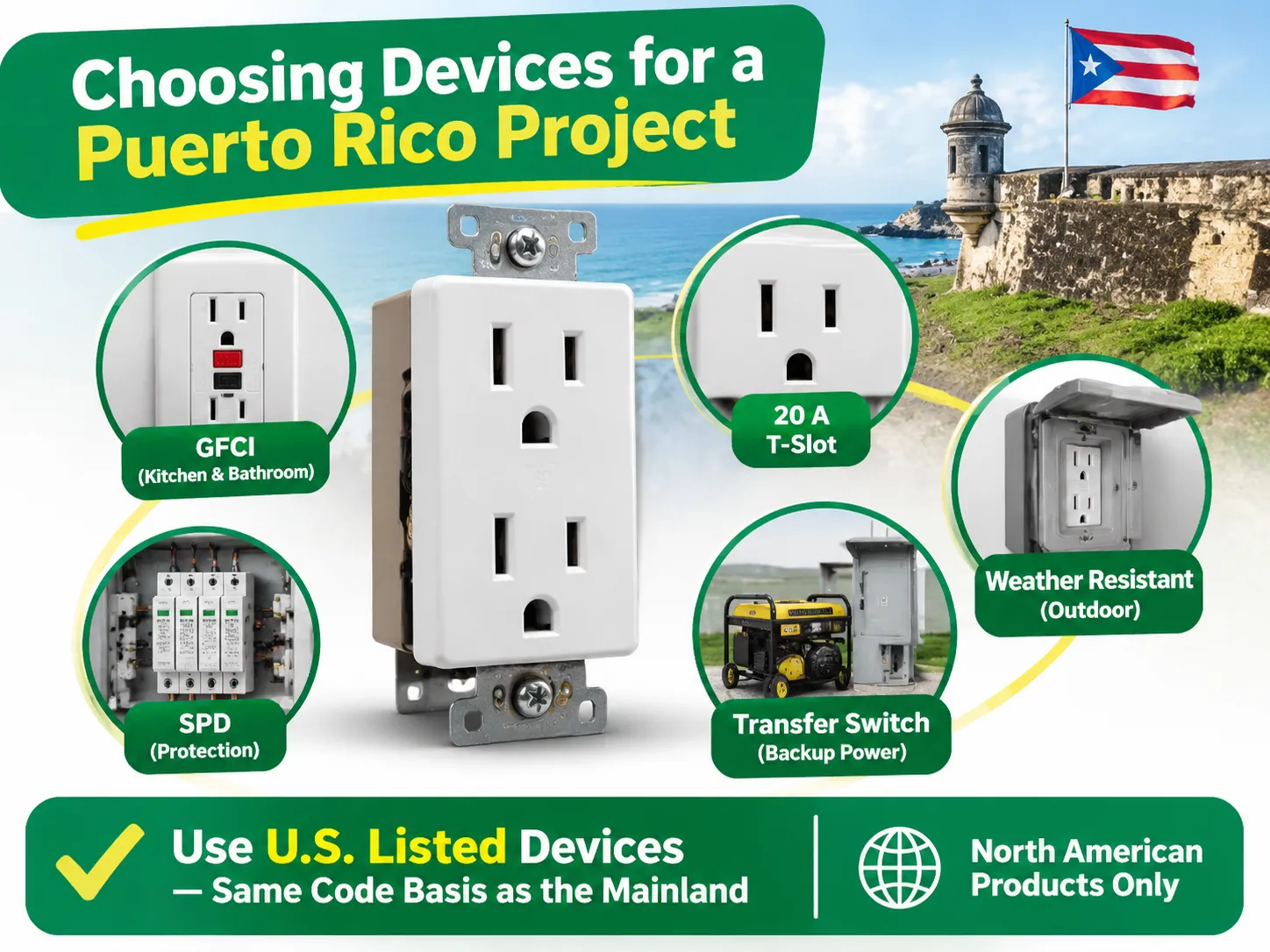
When you select the Devices you are going to use for your project in Puerto Rico, think in terms of products you are going to purchase, and location where you will purchase them from. The following Table contains an example of how you can structure this data.
| Situazione | Dispositivi | Consideration |
|---|---|---|
| Residential new construction | NEMA 5-15R duplex, tamper resistant | Uses the equivalent code basis as the mainland; UL listings anticipated |
| Kitchen and bathroom | GFCI receptacles or GFCI breakers | Must be installed in the locations required on the mainland |
| Commercial fit-out | 20 A receptacles, T-slot | Accepts both 15 A and 20 A plugs |
| Hotel renovations | NEMA outlets plus USB modules | Guests arriving with dual voltage electronic devices |
| Outdoor or coastal | Weather resistant, IP rated covers | Salt air and driving rain |
| Backup power | Transfer switch and generator inlet | Interlocked, not a suicide cord |
| Equipment protection | SPD at the panel and at points of use | Lightning and switching transients |
The row concerning the Equivalent Code Base when comparing Puerto Rico to the Mainland is the most straightforward and should be applied to every project. A device that is listed for the United States is accepted in Puerto Rico while European devices will not, thus simplifying the sourcing of products from only the North American product catalogue. This is the same direction used in most Caribbean islands, where the installations can follow either a European or British style. If you were to compare the USA and Panama regarding outlets, you would find that Panama uses the same flat-blade style of socket as Puerto Rico, but its installation practice and import routes are entirely different.
Because we produce both the North American and European family of switches and outlets, a distributor who serves Puerto Rico and the Caribbean can build one complete product line using US configurations for all the islands, and a separate line using European configurations for the French and Dutch territories.
For Puerto Rico, the American format switch and socket range is applicable. This includes the NEMA configurations as well as the plate systems associated with them.
The most important piece of information for this market is the listing, and not the price. When a product is offered in Puerto Rico, it must have a UL Listing for the configuration; therefore, if a distributor is unable to provide a UL Listing for the configuration, he or she will be selling into a market that will reject the product when it is inspected. We provide the test documentation with our product offerings, and our plate systems are manufactured to correspond with the boxes that are currently on the island.
Where we provide no answer is for a project that requires a proprietary building automation system, as this will be a sale of a system and not a sale of a device. Where there is a need for a NEMA duplex, GFCI, USB module or a plate with an existing installation, this is where we focus our attention.
For a traveller, the list is relatively short; you should consider carrying the following items: if you are travelling from outside of North America, you should carry a universal adapter; you should check every power supply label for the 100 to 240 V range; carry a small surge strip, since hotel rooms seldom have adequate outlets and the power is not adequate; and you should decide to purchase a hair dryer or kettle locally and not convert one. For someone who will be staying for a longer period of time or renting a property, two products are recommended for purchase on the island.
A surge protector with the right clamping voltage, as well as a small UPS for your router and desktop computer is essential. Any momentary loss in electrical service of 1 second can cause corruption of a file and reset all the clocks in your entire home.
What is not acceptable to purchase locally is a low-priced universal adapter purchased at a souvenir shop. These universal adapters typically have no UL certification, overheat due to excessive current draw, and cause numerous incidents in hotel rooms due to their unregulated nature.
Yes, Type A and Type B outlets are used in Puerto Rico, at 120V and 60Hz. All outlets follow the same configuration and voltages as seen throughout the mainland US. Therefore, devices using standard US plugs will work without any additional adapters and devices approved for the US will work in Puerto Rico.
Yes, but only one way. The Type C Europlug fits into the Type F Schuko outlet, as both the thickness of the pins and the distance between them agree. However, a Type F plug will not fit into a Type C outlet nor will a Type C plug fit into the Flat Blade NEMA receptacle used in Puerto Rico. Therefore, a European traveler should take an adapter with him/her.
With Hurricane Maria’s destruction of a significant portion of the distribution system in 2017, the loss of power island-wide caused by Hurricane Fiona in 2022 and ongoing widespread departure from the grid since then, an island’s grid is incapable of supplying power when one unit trips or when the grid system is subjected to hurricane conditions. The transmission and distribution systems were sold to a private operator in 2021, while generation remains under the control of the local public utility.
Puerto Rico uses the standard North American plug configurations — Type A (which has two flat blades) and Type B (which has two flat blades plus a round grounding pin). The most common receptacle used in Puerto Rico is a Type B with 15 A at 125 V rating. The 20 A version of the Type B includes a T-shaped neutral slot. The electricity that is supplied throughout Puerto Rico is at 120 V and 60 Hz.
Voltage converters are required for 230 V single voltage devices; all devices marked between 100 to 240 V can be used in Puerto Rico requiring nothing other than a plug adapter. Any device that operates on only 230 V will require a converter equal to or greater than the device’s rated wattage; for high wattage appliances (such as a hair dryer or kettle), the replacement costs may be cheaper than a conversion.
All general circuits in Puerto Rico operate on 120 V at 60 Hz; higher voltage (240 V) for larger appliances can be obtained through two-pole circuits. The North American voltage standard (for general use, appliances) has been established in Puerto Rico therefore Europe appliances will not function correctly even if you use an adapter.
Puerto Rico is a North American electrical market within the Caribbean region, therefore all devices that plug into Type A and Type B outlets will work on 120 V at 60 Hz and all appliances approved by US standards. For all travelers from the mainland will not require any type of converter, however, travelers from Europe or Australia will require a plug adapter and, if using higher wattage appliances will need to purchase a converter as well.
Mentre molte persone pensano che le prese elettriche a Puerto Rico siano la parte più sorprendente della loro visita a Puerto Rico, il fatto che la rete di generazione e distribuzione sia fallita più di una volta a livello dell'intera isola nell'ultimo decennio è una buona ragione per portare una ciabatta multipresa con protezione da sovratensioni e un backup a batteria per dispositivi importanti.
For North American travelers, Puerto Rico is an attractive island since it uses the same electrical outlet, voltage and frequency as the United States, making it easy to plug in your devices. However, if you purchased any of your electronics in Europe, Australia or Asia, your plug cannot fit into Puerto Rican outlets. Quick answer: […]
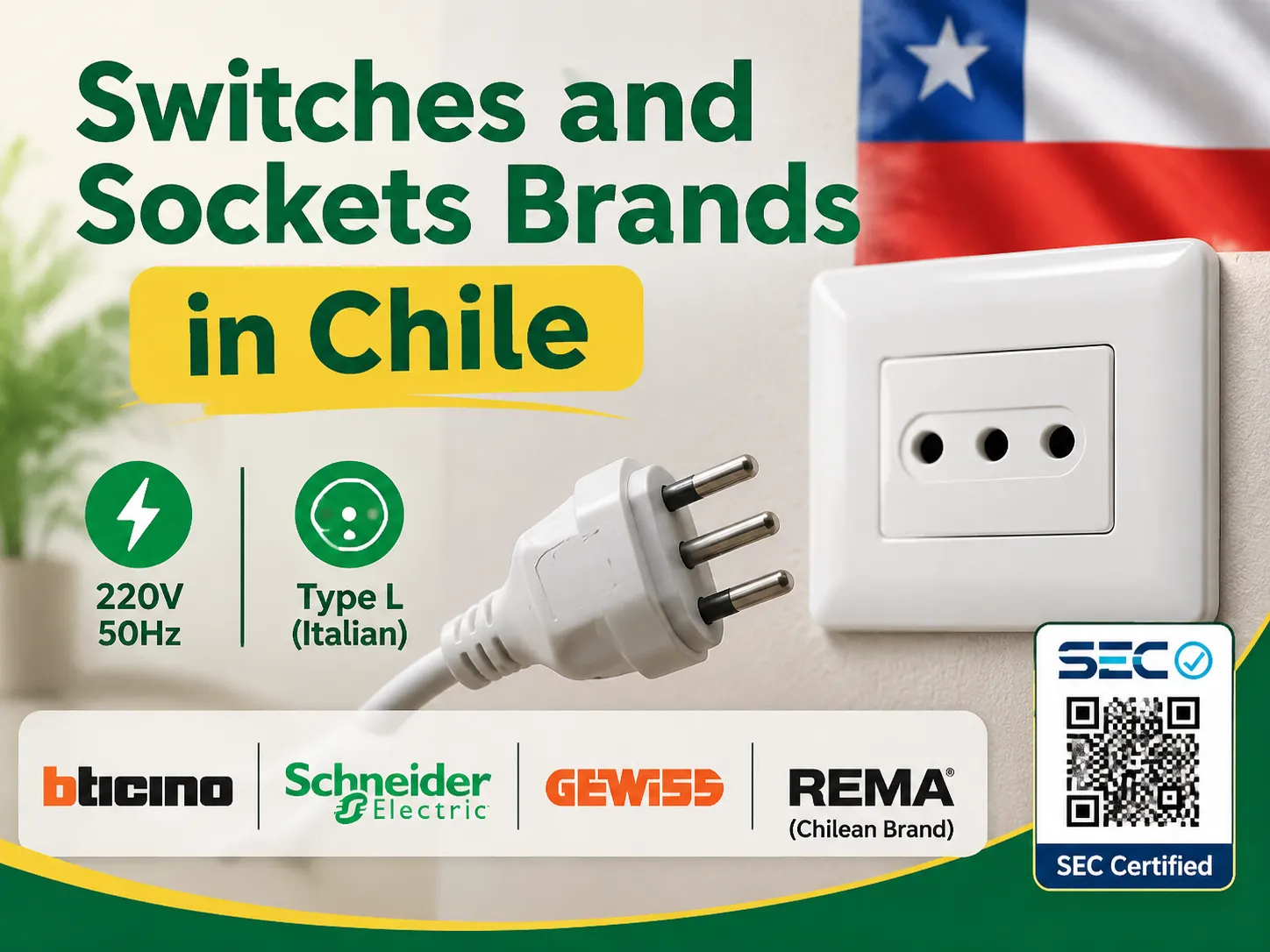
Il Cile è il paese più facile del Sud America per scegliere l'attrezzatura di cablaggio, ma è anche uno dei più difficili da penetrare a causa di ciò. Tutte le spine elettriche conformano a un unico tipo che è denominato come spina “Tipo L” o “Italian CEI 23-50”. L'unica certificazione per l'attrezzatura elettrica […]
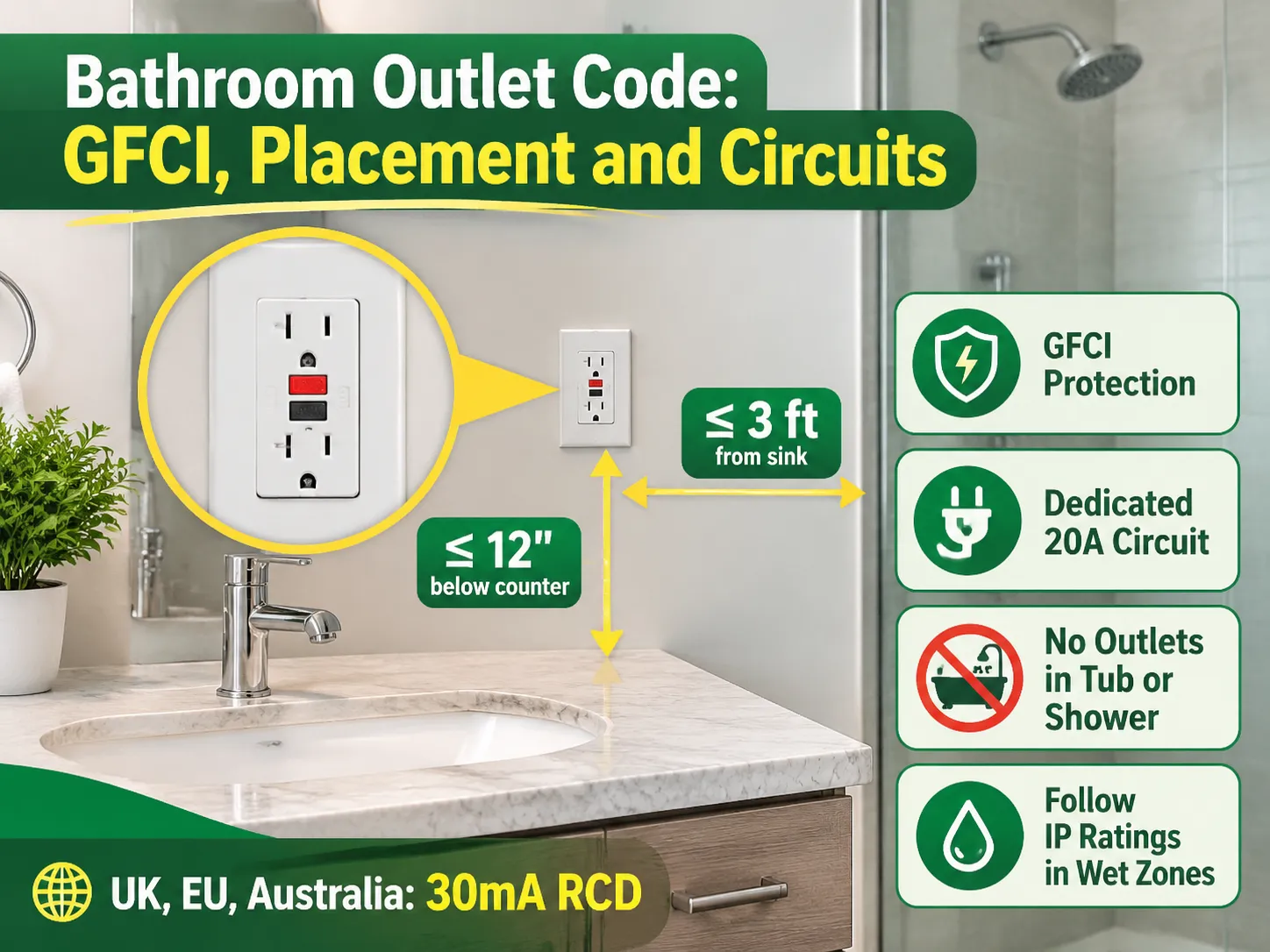
Ognuna di queste regole viene esaminata in dettaglio di seguito. La geometria del posizionamento delle prese, il requisito del circuito di derivazione dedicato, i tipi di prese conformi al codice, le questioni relative a 15A e 20A, le differenze tra i paesi riguardo alle regole, i dettagli di installazione che non superano l'ispezione, cosa considerare quando si acquista un prodotto, illuminazione e ventilatore […]

 No.6 Tuozhan Road, Leshang Pioneer Park, porto della baia di Yueqingwan, città di Yueqing, provincia di Zhejiang


