

Podłączenie do Wietnamu jest łatwym zadaniem w porównaniu do większości krajów w Azji, a także sprawienie, że jedno z urządzeń przestanie działać. Wtyczki są globalnie akceptowane, ale napięcie już nie. Te dwa fakty są prawdziwe dla każdego hotelu w Wietnamie, od Hanoi po Can Tho, i dobrze jest je znać, aby uniknąć wielu problemów. W tym przewodniku dowiesz się, co znajduje się w ścianie, jakie typy wtyczek pasują gdzie oraz jakie typy podróżnych będą potrzebować adaptera w swoich walizkach. Zostaniesz również poinformowany o różnicach w wymaganiach dotyczących gniazdek elektrycznych dla budynków i pokoi hotelowych.
Krótka odpowiedź: Wietnam używa napięcia 220 V przy 50 Hz oraz typów wtyczek A i C – wtyczka płaska i okrągła odpowiednio, z wtyczkami typu F również używanymi w nowoczesnych budynkach oraz typu G używanymi w niektórych hotelach wyższej klasy. Głównie używane gniazdka są hybrydowe i mogą akceptować różne typy wtyczek. Turyści przyjeżdżający z USA, Kanady, Japonii i większości Europy kontynentalnej zazwyczaj nie będą potrzebować adaptera, w przeciwieństwie do tych przyjeżdżających z UK, Irlandii, Australii, Nowej Zelandii, Indii i RPA. Podróżny zabierający ze sobą urządzenie o napięciu 120 V będzie musiał zabrać konwerter.
| Przyjeżdżając z | Typ wtyczki | Potrzebny adapter | Problem z napięciem |
|---|---|---|---|
| Stany Zjednoczone, Kanada, Meksyk | A, B | Nie, A pasuje | Tak, jeśli urządzenie jest tylko 120 V |
| Japonia | A, B | NIE | Tak, urządzenia 100 V |
| Wielka Brytania, Irlandia | G | Zazwyczaj tak | NIE |
| Niemcy, Francja, Holandia, Hiszpania | C, E, F | Rzadko; Schuko potrzebuje hybrydowego gniazdka | NIE |
| Australia, Nowa Zelandia, Argentyna | I | Tak | NIE |
| Indie, Sri Lanka | C, D, M | Często tak | NIE |
| Afryka Południowa | M, N | Tak | NIE |
| Chiny | A, C, I | Zazwyczaj nie | NIE |
W tych tabelach są dwie niespodzianki dla podróżnych z Australii i Stanów Zjednoczonych. Zgromadzone informacje wskazują, że Australijczycy myślą, że ich urządzenia będą działać wszędzie w Azji, opierając się na tym, że działały doskonale w Bali i Tajlandii, podczas gdy w Wietnamie nie działają. Tymczasem Amerykanie myślą, że do podróży do Wietnamu, który ma 220 woltów, będzie potrzebny adapter, podczas gdy nie ma takiej potrzeby, ponieważ fizyczne kształty pinów są takie same.
Typ A to jeden z dwóch płaskich równoległych pinów używanych w USA i Japonii. Jest nieuziemiony i ma pojemność napięcia 15 A i 125 V odpowiednio. Chociaż jest to najstarszy typ w Wietnamie, nadal dominuje poza obszarami miejskimi.
Typ C to Europlug, mający dwa okrągłe piny o średnicy 4 mm. Jest nieuziemiony, a jego ocena wynosi 2,5 A. Był używany w czasach, gdy Francuzi byli w Wietnamie.
Typ F to wtyczka Schuko. Wtyczka Schuko ma dwa okrągłe piny, z których każdy ma 4,8 mm, oraz dwa boczne klipsy uziemiające o nominalnym prądzie 16 A. Wtyczka Schuko występuje w nowszych budynkach i nowoczesnych hotelach, często w tych samych gniazdach co wtyczki typu A i C.
Typ G to wtyczka prostokątna z bezpiecznikiem z Wielkiej Brytanii. Wtyczka z Wielkiej Brytanii ma nominalny prąd 13 A. Wtyczka ta jest głównie używana w nowoczesnych hotelach i apartamentach serwisowanych.
Typ D to indyjska wtyczka z trzema okrągłymi pinami. Jest nadal używana w niektórych starych budynkach w północnych Indiach.
Pełna taksonomia, w tym wymiary pinów i wartości prądowe, które odpowiadają każdemu kształtowi, jest przedstawiona w tym odniesieniu do typów gniazdek ściennych używanych na całym świecie, co warto sprawdzić przed zakupem adaptera na podróż do wielu krajów.
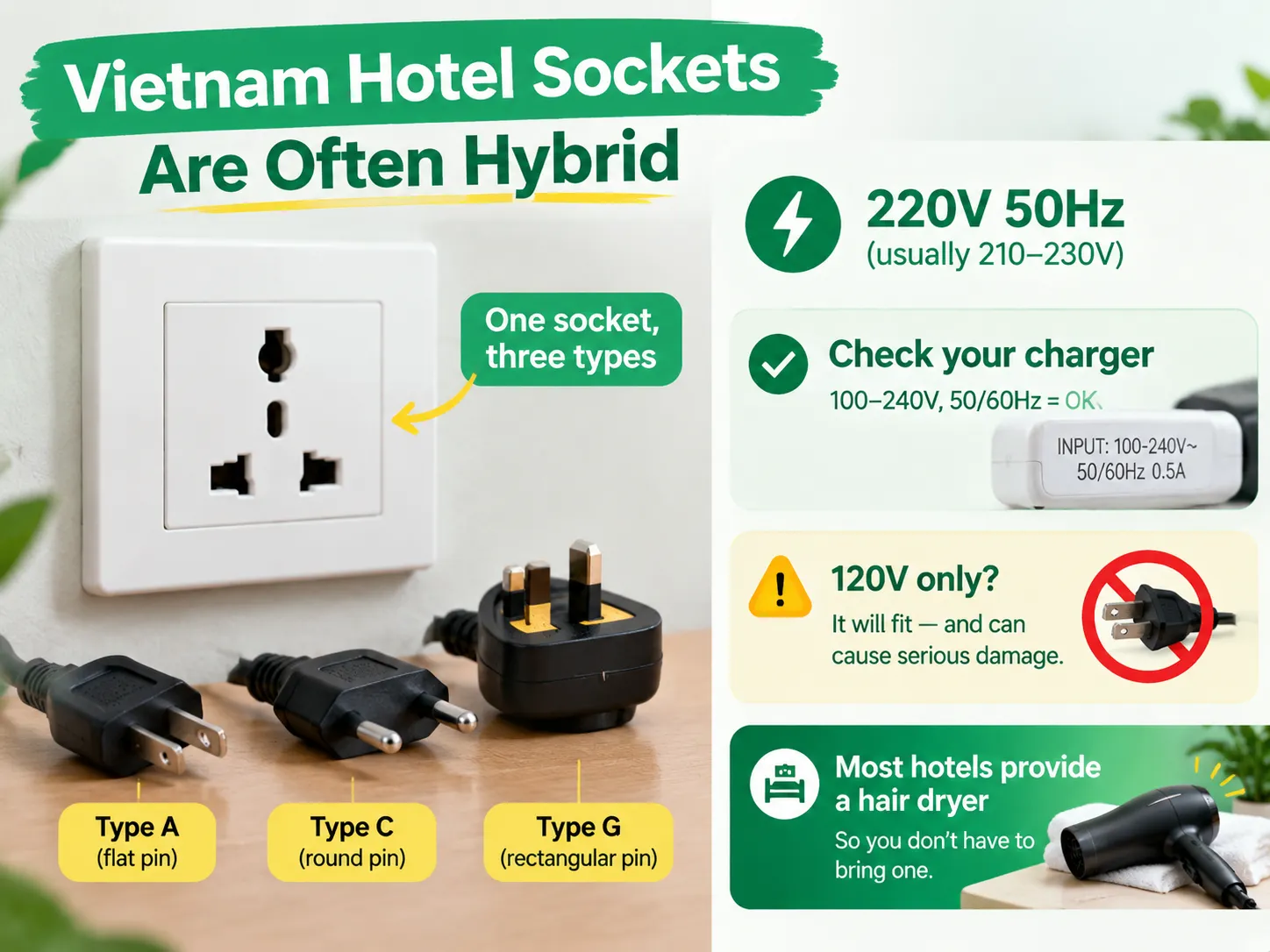
Wiele gniazdek znajdujących się w Wietnamie nazywa się “trzy w jednym”, ponieważ mogą pomieścić trzy różne typy pinów w jednym gniazdku. Wiele innych miejsc na świecie używało podobnych wzorów, ale różnica polega na tym, że gniazdka w Wietnamie różnią się od gniazdek uniwersalnych, które akceptują wszystkie typy urządzeń, ale nie służą jako punkty uziemiające. Zamiast tego gniazdka w Wietnamie są zaprojektowane tak, aby pomieścić różne napięcia i są sprzedawane jako produkty praktyczne.
Powodem tego jest dziedzictwo budynków w tym kraju: sięgające czasów kolonialnych Francji i Związku Radzieckiego, aż po dekadę szybkiego rozwoju oraz najnowszą falę budownictwa skoncentrowanego na luksusowych hotelach. Właściciele hoteli odnawiający hotele zbudowane w latach 90-tych wolą używać tych gniazdek “trzy w jednym”, aby ich goście mogli podłączyć swoje urządzenia niezależnie od lokalnych standardów napięcia. Tajlandia rozwiązała ten sam problem w ten sam sposób, a efektem tam jest równie zróżnicowany zestaw gniazdek opisany w tym przewodniku po typie gniazdka elektrycznego w Tajlandii.
Dla podróżnika kluczowe pytanie “czy moja wtyczka pasuje?” całkowicie zależy od tego, w jakim budynku się znajduje, i dlatego tabela powyżej użyła terminu “zwykle”, aby zdefiniować zasilacze w każdym kraju. Brytyjski turysta zatrzymujący się w czterogwiazdkowym hotelu w Ho Chi Minh City odkryje, że w biurku znajduje się gniazdko typu G. W pensjonacie w Dalat, nie!
Wietnam ma docelowe napięcie nominalne 220 V i częstotliwość 50 Hz, które dostarcza EVN lub Elektryczność Wietnamu. Rzeczywiste napięcie energii elektrycznej płynącej z gniazdka może wynosić od 210 V do 230 V, ale latem spada jeszcze bardziej w godzinach szczytu, co może być problemem dla wrażliwych urządzeń, takich jak klimatyzatory.
Zasada ogólna dotyczy akcesoriów do ładowania, które posiadasz. Po prostu sprawdź każde urządzenie ładujące, a zobaczysz wskazane napięcie “100-240 V, 50/60 Hz”, co oznacza, że większość ładowarek, w tym te do telefonów, laptopów, aparatów, power banków i szczoteczek do zębów, które były produkowane w ciągu ostatnich 15 lat, mogą działać w Wietnamie tylko przy użyciu adaptera do wtyczek. Jedynym systemem, w którym ta kontrola zawodzi, jest północnoamerykański wzór 120 V, co jest powodem, dla którego typ gniazdka północnoamerykańskiego powoduje więcej szkód za granicą niż jakikolwiek inny, wyłącznie dlatego, że wtyki pasują do tak wielu zagranicznych gniazdek.
A simple “$120” means that the machine is going to fail immediately, and most likely also burn. What’s dangerous is that it will fit. An American hair dryer will perfectly plug into Vietnamese Type A socket and will give double voltage. Hair dryers, curling irons, straighteners, old electric razors, and cheap kitchen appliances are the most frequent victims.
Most mid-class and good hotels provide hair dryers, which single-handedly eliminates the most common failure from your packing.
In North America and Japan, devices make use of a frequency of 60 Hz while most countries operate at a frequency of 50 Hz. Dual-voltage devices are indifferent to the frequency as they rectify AC supply to DC in their circuits. However, devices that have an AC motor or clock have to take the frequency into account.
If an induction motor made for 60 Hz is run on 50 Hz, it will operate about 17% slower. It will also consume more energy in performing the same task. An AC clock will lag 10 minutes an hour. Old stereos can create hum due to magnetic interference from transformers. However, none of the devices will break down entirely, but will give faulty performance that will be blamed on the devices rather than supply.
For the short term, such variation may be of no consequence; however, those importing machinery to Vietnam or installing electrical fittings in factories where such machines are used should take the frequency into account when designing the specifications.
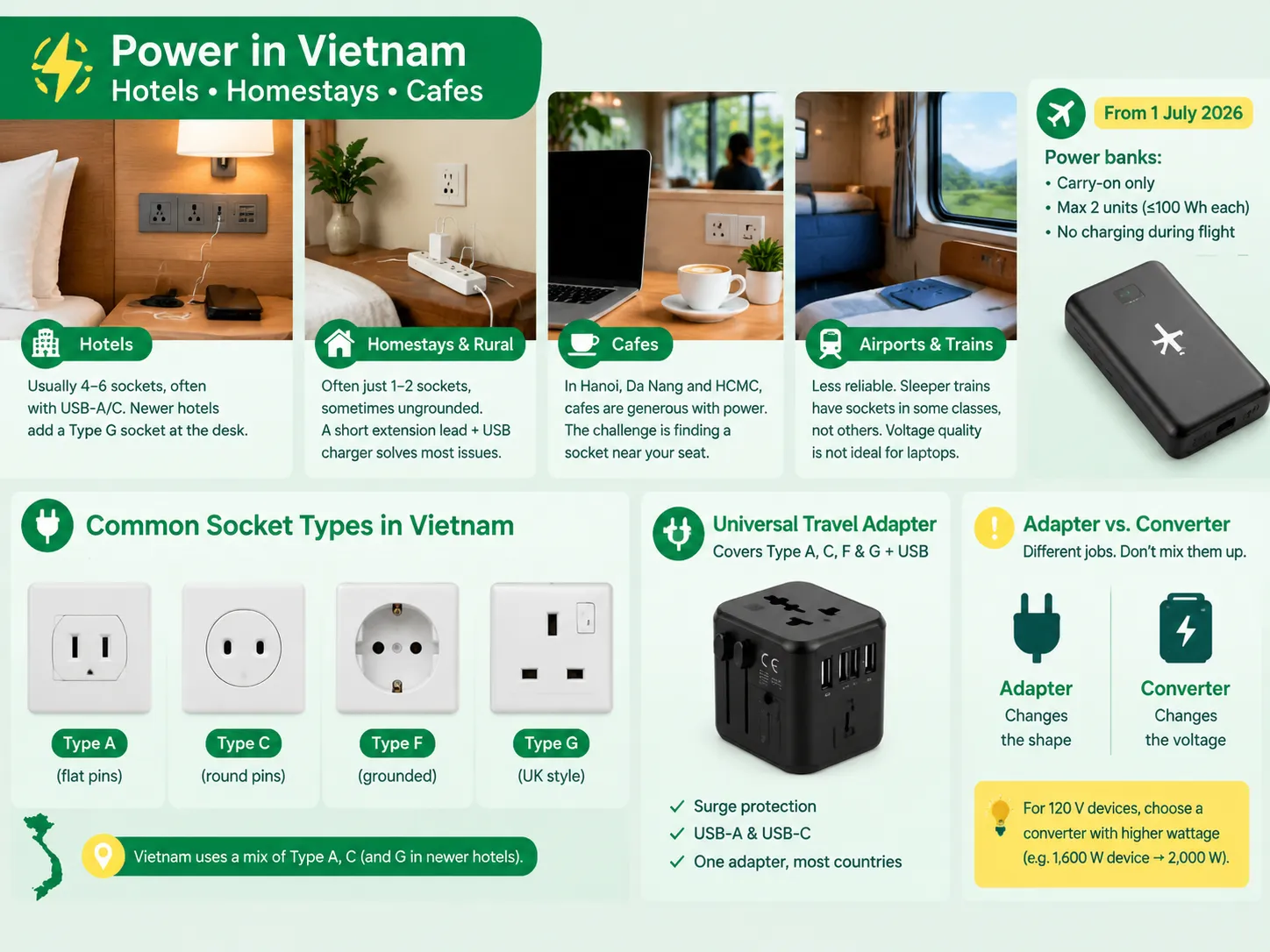
Normally, city hotels may provide four to six sockets in one room, many of which would be hybrid sockets. Two of them might be new types of sockets with USB-A and USB-C ports on the bedside panel. Newer hotels are known to use G-type sockets containing charging facilities on the office desk.
Staying in homestays may provide you with one or two sockets in the entire room, some of which might be A-type but ungrounded sockets. They might share the same electrical circuit with the water heater. But you can always use an extension cable and multiport USB to fulfill your needs.
Hanoi, Da Nang, and Ho Chi Minh City cafes are generous in providing electric power, and it seems that many cafes, designed with working clients in mind, make profit because of the availability of socket outlets. So perhaps you can find plenty of sockets near your seat.
Aviation and train traveling is much less predictable. Reunification Express use electric sockets in some types of cars, but not in others. Also, the quality of voltage might not be performed well enough till the train arrives to its destination.
If you have decided to travel within the country domestically, keep in mind that starting from July 1, 2026, the Civil Aviation Authority of Vietnam permits taking no more than two power banks with capacity not greater than 100 W each in carry-on luggage and the use of power banks for charging devices in flight will be prohibited.
An adapter changes the shape of the connection. A converter changes the voltage. They are different products and confusing them is how devices get destroyed.
| Device input | Plug compatible | Plug not compatible |
|---|---|---|
| 100–240 V dual voltage | Nothing needed | Plug adapter only |
| 220–240 V only | Nothing needed | Plug adapter only |
| 120 V only | Converter needed | Adapter plus converter |
A universal travel adapter is the most effective solution for everybody since it works with types A, C, F, and G together and also comes with USB charging. Make sure to buy one with a surge protector rather than the least expensive option found at the airport; the older buildings have poor earthing, and the extra protection costs only a small amount of money.
When using a converter with a 120 V device, make sure that it has a wattage higher than that of the device. For example, a 1,600 W hairdryer will need a converter rated above 2,000 W, and using an inadequate converter will either blow a fuse or overheat it. However, on a two-week trip, it is easier to carry a cheap dual-voltage hair dryer bought at the destination than bother with a large converter.
While travelling within the region, it becomes even harder to sort out the adapter issue, as countries don’t share the same standards. A guide to the sockets and adapters you need in Bali shows the Indonesian pattern, which accepts Type C and F and is genuinely different from Vietnam’s A-and-C mix. Anyone doing a multi-country Southeast Asia itinerary should buy universal and stop thinking about it.
In preparing to sell into the Vietnamese market, there are four important implications to consider.
Choose the socket, not the adaptor. A dual-standard outlet is a good option for hotels but not for factories; using a specific standard decreases maintenance as well as stops chances to plug in inappropriate devices. The outlet should correspond to the type of equipment that is going to be connected.
Grounding is a problem. Most local sockets are ungrounded two-pin devices and a building, which uses such sockets everywhere, exposes itself to electrocution risks that can’t be eliminated by reliable RCDs. Really grounded sockets of Type F or Type G should be used for the applications that include machines with metallic casings.
Capacity should be sufficient. A 2.5 A Europlug socket is not the same as a 16 A socket with another face-plate. Therefore, kitchens, workshops, and places with heaters need sockets designed according to the electric circuitry of this area.
Voltage is important. A voltage range of 210 V-230 V and an additional drop during the peak moments mean that instruments requiring a precise voltage of 220 V will be faulty. A device should state that it nominal voltage is 220 V, but it is able to work at a voltage from 190 V to 250 V.
This is the layer being supplied by Igoto; these are switches and socket outlets along with power strips operating according to the local standard, and the route of OEM and private label is available for all distributors wanting their branding on the face-plate.
It is most advisable for travelers to buy a universal adapter for Type A, C, F and G plugs, since the types of sockets in Vietnam vary across types of buildings. However, if you’re coming in from America, Canada or Japan, and your appliances work with both low and high voltage, you don’t actually need an adapter. If traveling in from Australia or New Zealand, however, an adapter is indeed necessary.From the UK or Ireland you almost certainly need one, since the rectangular-pin pattern described in this guide to the Ireland outlet type only fits where a hotel has deliberately installed that socket.
In case you are carrying devices that are rated for 100 to 240 volts, you will need a plug adaptor, but not a voltage converter. The types of sockets that you will need to consider are types A and C which represent the types that you will find almost anywhere, plus types F and G if you are staying somewhere new and fancy.
From the perspective of the physique, there are no such requirements. Vietnamese Type A socket can accept US Type A plug directly, while it can also work for hybrid sockets in hotels. The most important point to look at is voltage: looking at the input ratings of every device and leaving everything that is indicated to be operating on 120 volts unless a converter rated for more than its power is in the possession of the traveler.
The two-pin (round or flat) configuration is what’s needed in the sockets; consequently, an adapter that has the correct Type C pins on the wall end will be compatible with most sockets across Vietnam, including those found in older buildings that use the round-only configurations typically installed in the French times. A universal plug that has C, F or G on the wall end will work for every scenario.
Vietnam uses a voltage of 220 V and a frequency of 50 Hz, so its electrical sockets may accommodate devices that run on either of these frequencies. If your device is rated from 100 V to 240 V, you need to be careful only about the shape of the plug, which is usually not an issue.However, if your device is rated 120 V, technology-wise, you should leave it in your suitcase, as it will become incompatible the moment it is plugged in.
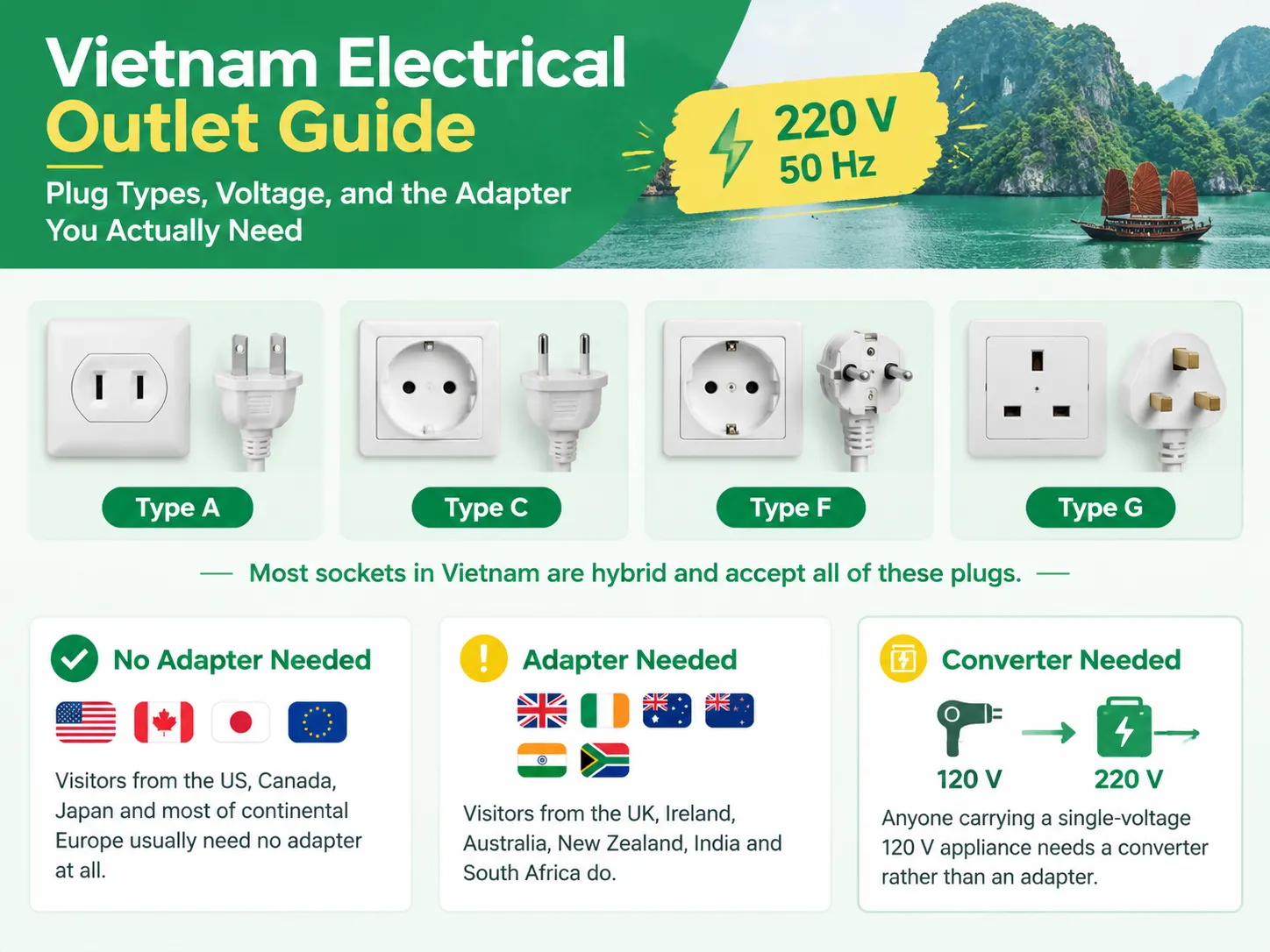
Plugging into Vietnam is an easy job compared to most countries in Asia and so is making one of the gadgets go dead. The plugs are globally accepted, but the voltage is not. These two facts are true about each hotel in Vietnam from Hanoi to Can Tho and it is good if you know […]

Kontrola oświetlenia komercyjnego w Minneapolis jest teraz koniecznością, a nie opcją. Wraz z zastosowaniem nowego NEC od 1 lipca 2023 roku, wykrywanie obecności stało się teraz wymogiem prawnym w większości budynków komercyjnych bez jakiejkolwiek modyfikacji prawa ze strony władz stanowych. Tak więc dyskusja zmieniła się z “czy” […]
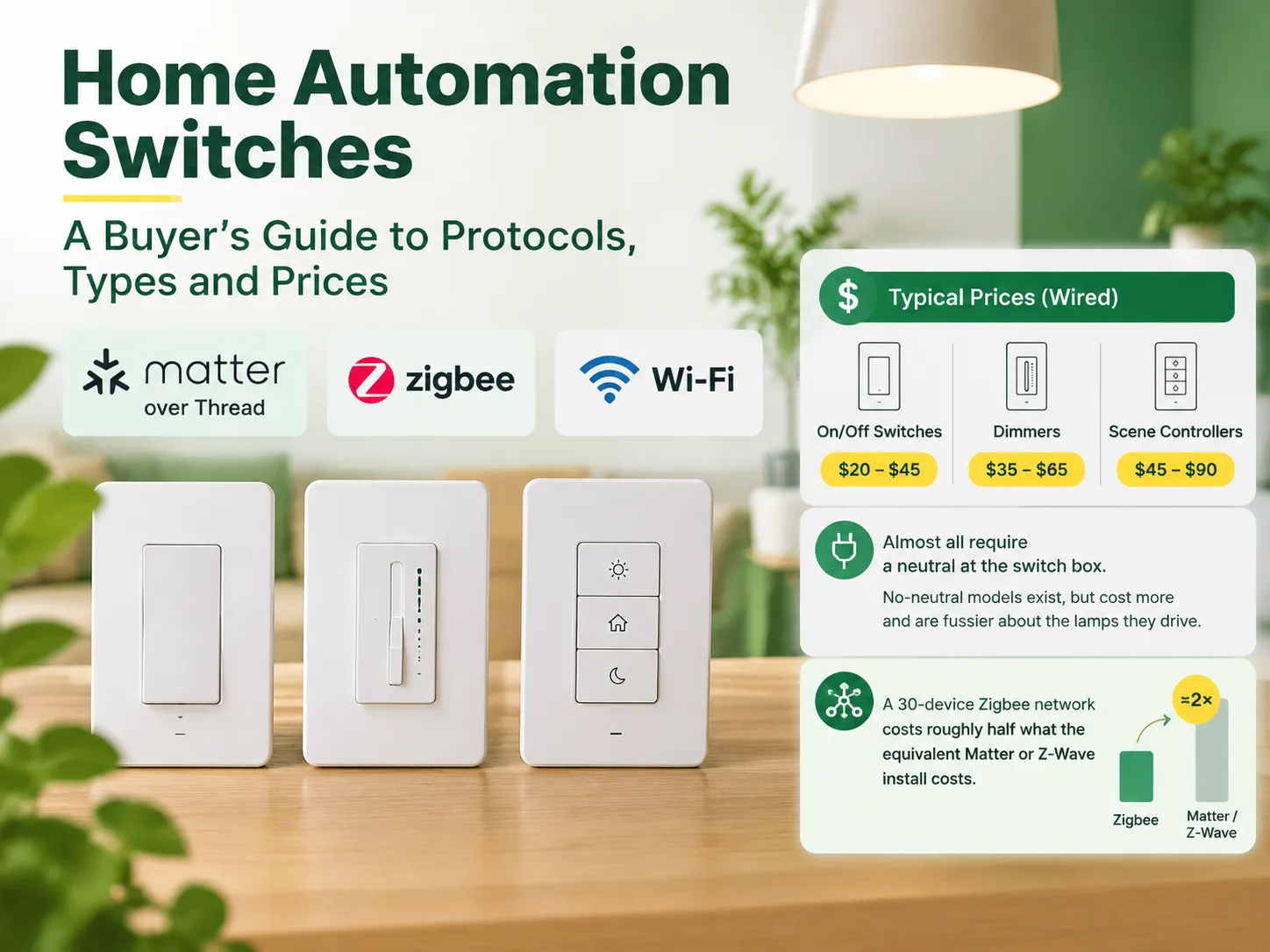
Zakup przełącznika automatyki domowej to nie tylko zakup przełącznika światła. W przypadku przełącznika światła wystarczy wybrać kolor i ile gangów chcesz. W przypadku przełącznika automatyki prawie nic nie jest tak proste, ponieważ musisz również wybrać protokół, system hubów, czy obecny przewód jest […]

 Droga Tuozhan nr 6, Leshang Pioneer Park, port Yueqingwan Bay, miasto Yueqing, prowincja Zhejiang


