

Каждое из этих правил рассмотрено более подробно ниже. Геометрия расположения розеток, требование выделенной ответвительной цепи, типы розеток, соответствующие нормам, вопросы по 15A и 20A, различия между странами в отношении правил, детали установки, не прошедшие проверку, что учитывать при покупке продукта, требования к освещению и вентиляторам в одной комнате, а также модернизация.
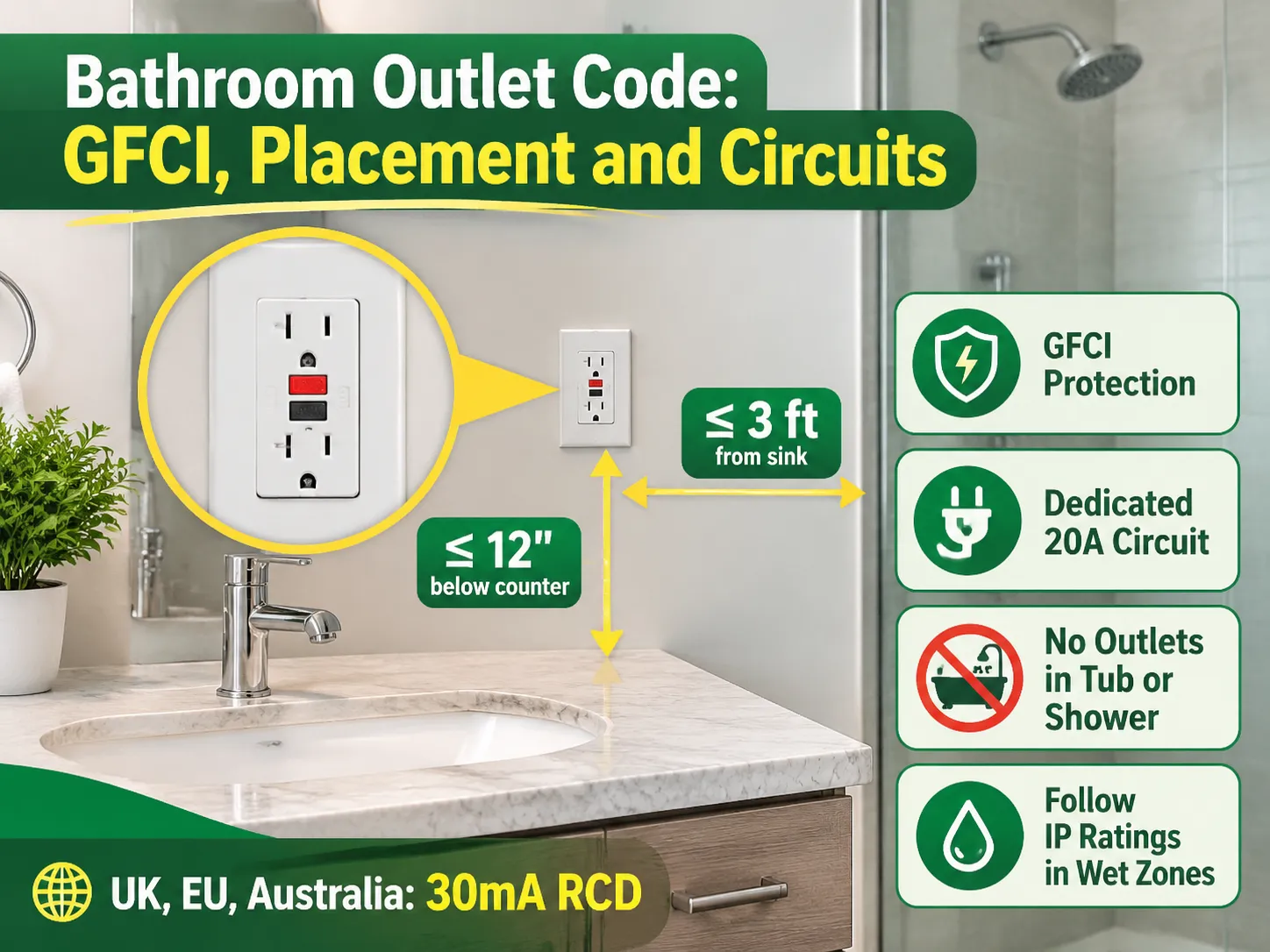
Краткий ответ: В Соединенных Штатах каждая розетка, используемая в ванной комнате, должна иметь защиту GFCI (устройство защитного отключения при утечке тока), и как минимум одна розетка должна находиться в пределах 3 футов от края раковины/умывальника и не более чем в 12 дюймах ниже уровня столешницы. Розетки в ванной должны располагаться на выделенных ответвительных цепях на 20 Ампер (20A), используемых исключительно для ванных комнат. Ни одна розетка в ванной не может быть установлена в зоне ванны или душа. Эквивалентом GFCI Северной Америки является защита 30mA RCD (устройство остаточного тока) в Великобритании, Ирландии, Австралии и ЕС. Там, где обычные розетки устанавливаются во влажных зонах, существуют ограничения, и розетки должны соответствовать классу защиты IP для зоны, в которой они установлены.
Назначение GFCI — контролировать разницу в токе между фазным и нейтральным проводами. Когда разница составляет от 4 до 6 мА, это указывает на утечку тока. Обычно в ванных комнатах это означает, что ток утекал через человека, стоящего босиком на влажном полу. GFCI отключит питание, подаваемое на человека (то есть человека, стоящего на влажном полу с ногами, контактирующими с землей), в течение нескольких миллисекунд после обнаружения утечки тока из розетки.
Существует три устройства, которые можно использовать для выполнения этого требования. Первое — это розетка с GFCI, которая защитит как себя, так и все, что подключено к розетке и питается по нисходящей линии. Второе — это автоматический выключатель с GFCI, который защищает всю цепь и является единственным вариантом, который можно использовать в ситуациях, когда нет розетки с GFCI для сброса тока GFCI до нуля или если цепь питается от источника, который не позволяет использовать розетку (например, гидромассажные ванны). Третье — это “мертвая передняя панель” GFCI, устройство, установленное на оборудовании, где подается электричество, но пользователь оборудования не контактирует с ним и не находится вблизи (например, когда оборудование находится на полке).
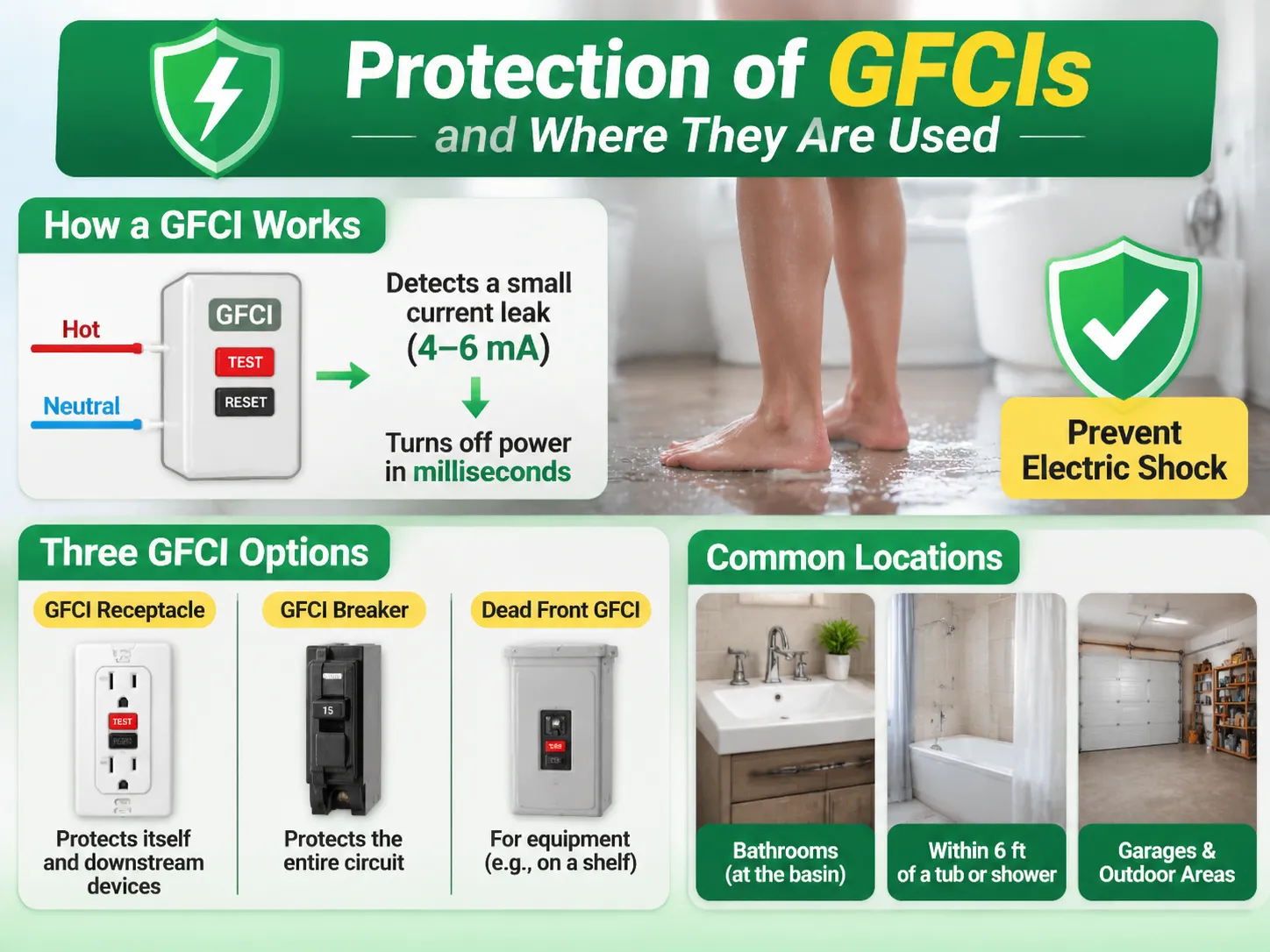
Выбор важен по одной причине — где будет сбрасываться GFCI. Розетка с GFCI, расположенная у раковины, очень легко сбрасывается и удобно для домовладельца проверять ее работу ежемесячно, что и является причиной того, что это устройство является преобладающим в жилых помещениях.
Автоматический выключатель с GFCI — это важное устройство безопасности, которое предотвращает перегрузки цепи в случае электрического сбоя. GFCI устанавливаются в гаражах или других местах, где может не хватать места для установки розетки с GFCI непосредственно перед защищаемым прибором. Обычно автоматический выключатель с GFCI срабатывает при электрическом сбое на розетке с GFCI, защищающей ту же цепь. Выключатель срабатывает и направляет жильца наружу, завернутого в полотенце, когда срабатывает GFCI, поэтому большинство установок автоматических выключателей происходит в зонах с ванной или на наружных цепях, а также в случаях, когда розетка расположена за стационарно установленной панелью.
Требование к защите GFCI распространяется за пределы самой комнаты, в которой находится прибор. Например, любая розетка, установленная в пределах шести футов от внешнего края ванны или душа, должна быть защищена GFCI, даже если розетка находится в зоне, которая не подпадает под определение “ванная комната”, как часто бывает в спальнях, где розетка расположена рядом с общей сантехнической стеной; в таких случаях розетка фактически находится на цепи ванной комнаты.
Понимание того, как работает розетка с GFCI и почему порог срабатывания 5 мА установлен именно там, поможет потребителю выбрать версию либо розетки с GFCI, либо автоматического выключателя с GFCI, которая лучше всего соответствует их потребностям. Полное объяснение того, как работают устройства GFCI доступно и является обязательным к прочтению перед выбором версии устройства — розетки с GFCI или автоматического выключателя с GFCI.
The Правило 3-футового расстояния от раковины относится к расстоянию от внешнего края раковины до ближайшей электрической розетки по горизонтали. Поэтому важно обеспечить розетку для всех раковин. Если у вас двойная тумба с двумя раковинами, то необходимо обеспечить одну розетку для каждой раковины, и обычно можно удовлетворить требование по раковине, установив одну розетку между двумя раковинами, если она находится в пределах обоих расстояний. Однако важно отметить, что розетка, расположенная внутри аптечки, не учитывается, так как она не считается доступной в смысле, предусмотренном кодексом.
Один из деталей, который часто игнорируют установщики, — это ограничение по высоте относительно установки розеток.
Розетка, установленная на лицевой стороне или горизонтально на шкафу под раковиной, не может находиться более чем на 300 мм ниже верхней части раковины. Высота над столешницей может быть средней для розетки, обычно около 1100 мм, и на том же уровне по центру, что и другие аксессуары, но большинство людей склонны размещать розетки в ванной выше уровня пупка, чтобы их было легко достать с пола.
Например, нет измерения для зоны ванны и душа, а есть ограничение или запрет на установку любых розеток в этой зоне. Розетка не может быть установлена внутри ванны или душевой кабины, но будет оцениваться по площади, измеряемой 3 фута по горизонтали и 8 футов по вертикали от верхнего края ванны или порога душа.
Единственным исключением из этого правила является маленькая ванная комната с ограниченным пространством на стенах. В этом случае исключение ограничивается розеткой, которую можно установить на стене прямо напротив ванны (и, таким образом, близко к влажной зоне).
Также к этой геометрии относятся светильники. Аналогично правилу для розеток, конфигурация светильников часто путается с ограничениями по размещению розеток. В частности, светильник, установленный над ванной, имеет те же ограничения по размещению, что и розетка (3 фута по горизонтали и 8 футов по вертикали), и должен быть маркирован для влажных и сырых помещений.
Что касается выключателей, они должны устанавливаться так, чтобы человек не мог одновременно коснуться сантехнического прибора и выключателя.
Мне нравится думать о Правиле цепи 20A (и причине, почему розетки в ванной отличаются) как прямом отражении фена для волос.
Обычный фен потребляет от 1500 до 1800 ватт, что соответствует 12,5–15 амперам при 120 вольтах; следовательно, цепь такого размера (15 ампер) перегрузится, если кто-то одновременно сушит волосы и смотрит телевизор, что вызовет немедленное срабатывание защиты. Выделенная цепь на 20 ампер позволяет использовать такое количество энергии без ненужных срабатываний.
Для цепи на 20 ампер необходимо учитывать два момента, чтобы избежать перегрузки: во-первых, цепь должна быть проложена кабелем 12 AWG; во-вторых, можно подключать несколько розеток в одной ванной комнате, при условии, что цепь не обслуживает ничего за пределами ванной комнаты. Если у вас одна ванная комната, согласно исключению, освещение и вытяжной вентилятор могут работать на той же цепи, поскольку одна ванная комната — это небольшая нагрузка; следовательно, нет необходимости прокладывать дополнительные цепи.
Второй пункт порождает три практических соображения относительно работы этих цепей. Если вы устанавливаете розетку на 20 А на цепь на 15 А, розетка не будет работать. Это означает, что цепь должна иметь номинал, соответствующий розетке. Также нейтраль цепи должна быть рассчитана на 20 А; это важно в случае, если в старой установке использовалась общая нейтраль. Наконец, в случае нескольких ванных комнат цепь никогда не должна быть подключена к цепи освещения; иначе при срабатывании цепи розеток все ванные комнаты останутся без света, что противоречит назначению выделенной цепи.
При работе с ванными комнатами вы встретите пять типов устройств. Самое распространённое — стандартная двойная розетка.
Двойная розетка с защитой GFCI защищает от токов утечки на землю на уровне розетки; её шторки открываются при вставке обеих вилок в розетку. Стоимость двойных розеток с GFCI варьируется от $18 до $30, и они чаще всего устанавливаются в ванных комнатах рядом с раковинами.
Стандартная двойная розетка не обеспечивает защиту от токов утечки на землю; её следует подключать после розетки с GFCI или автоматического выключателя с GFCI. Диапазон цен на стандартные двойные розетки составляет от $3 до $8.
Розетка с GFCI и USB-зарядками имеет встроенную защиту от токов утечки на землю, а также функции зарядки. Обычно они используются на туалетных столиках для зарядки электробритв и зубных щёток. Розетки с GFCI и USB-зарядками обычно стоят от $25 до $45.
В европейских и австралийских ванных комнатах блок питания для бритв обеспечивает электропитание бритв через изолированные трансформаторы (как в Великобритании и Ирландии). Они устанавливаются в Зоне 2 в британских и ирландских ванных комнатах и обычно стоят от $25 до $60.
Розетки Schuko или BS IP44 рассчитаны для использования вблизи воды и обеспечивают защиту от влаги (то есть герметичны против брызг), поэтому обычно устанавливаются в европейских и австралийских ванных комнатах вне влажных зон. Розетка IP44 обычно стоит от $10 до $25.
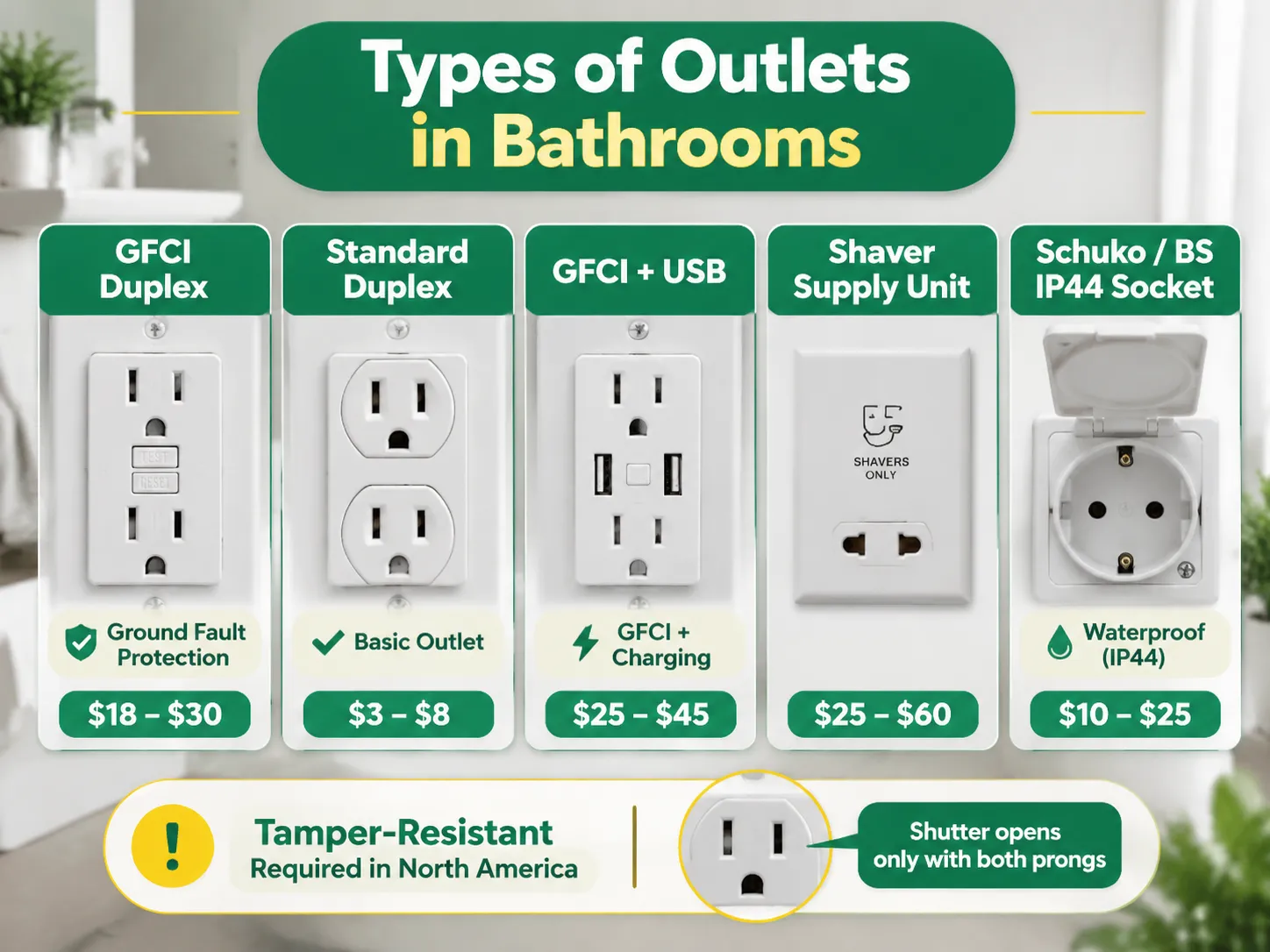
In North America, the code requires that if you replace or install any receptacles, they must include the tamper-resistant shutter. The shutter is spring-loaded and opens only if both prongs are inserted into it; you can expect to pay one or two dollars more for a tamper-resist receptacle over a normal receptacle.
| Outlet type | Типичная цена |
|---|---|
| GFCI duplex receptacle | $18 to $30 |
| Standard duplex receptacle | $3 to $8 |
| GFCI receptacle with USB chargers | $25 to $45 |
| Shaver supply unit | $25-$60 |
| Schuko or BS IP44 socket | $10 to $25 |
| Tamper-resistant receptacle | one or two dollars more |
The last two rows of this comparison chart reflect what an average European (or Australian) consumer may see when shopping for receptacles. Most bathroom socket outlets in the UK do not have a general-purpose socket outlet at all; instead, UK bathrooms are equipped with shaver supply units that contain isolated transformers located in a zone designated as Zone 2. This is why a UK visitor searching for an electric hair dryer will look for a two-prong receptacle capable of accepting an electric shaver plug, rather than a hair dryer plug.
For orders by the thousand of projects using the American format switch and socket configuration and plate systems associated with NEMA, the first row is where you’ll find the countries of North America. A project order uses the NEMA configuration, and corresponds with the plate systems.
A device rated at 15A or 20A, must match the circuit being used. The relationship only goes one way. A 20A receptacle can be used on a circuit rated at 20A. A 15A receptacle will work too, because the 15A device is protected by the circuit rating and the load it will see. However, using a 20A receptacle on a 15A rated circuit is a defective installation because that device is rated for more load than the circuit can handle.
For bathrooms, the result is that using a 15A GFCI receptacle on a 20A rated circuit is both code compliant and very common. In fact, many 15A GFCI receptacles are rated for 20A feed-through configurations in any case; therefore the 15A designation is for the configuration of the receptacle only, and does not denote how much current can be passed to downstream receptacles.
The exception to this rule is if a dedicated appliance with a 20A plug is to be used, such as a large whirlpool heater, or a commercial hand dryer. In this instance, a 20A receptacle and a dedicated circuit are required. These installations should be specified separately, rather than assumed to be general bathroom outlets.
Every developed country mandates that all bathrooms use residual current protection, but they specify how this requirement will apply based on a variety of factors including device type, zone geometry, and how much residual current protection each will provide. Each developed market has a specific residual current protection for a bathroom but not all developed markets have the same residual current protection devices. In this case, the two differences are represented by the methods used to provide residual current protection.
| Страна | Protection method | Socket rule | Zone requirement |
|---|---|---|---|
| Соединенные Штаты | (a) 4 or 6 mA GFCI | (b) all bathroom outlets are standard duplex, (c) TR is mandatory | Receptacles are not allowed in the tub or shower area. |
| Ireland & UK | 30 mA RCD on circuit | ordinary socket limited; wall-mounted shaver unit in zone 2 | BS 7671 defines zones 0, 1, and 2 by distance from water. |
| EU | 30 mA RCD, with some circuits limited to 10 mA | IP44 socket is allowed outside of the risks of water | IEC 60364-7-701, IPX4 in zones 1 and 2. |
| Australia & NZ | 30 mA RCD | any socket outlets must have IP rating | AS/NZS 3000 zone geometry and IP rated accessories. |
| Gulf States & Middle East | 30 mA RCD | BS or Schuko minimum IP44 socket outlet | IEC zone geometry; frequently enforced by consultant. |
The primary differences between the North American and European approaches to residual current protection are (1) North America protects a low number of areas at risk due to proximity to a sink, whereas (2) Europe protects the entire entire installation at 30 mA and relies on the IP rating of the equipment at the risk area.
This may clarify why a European bathroom can include an electrical socket while a North American bathroom uses a device that must be specifically designed for use in North America due to their differing country codes and standards related to the required or acceptable product used in each of these regions.
The plug types also work under the same rationale. In North America, an electrical socket in a bathroom is typically a NEMA 5-15 or 5-20, while in the UK it may be a shavers socket, in Germany it may be the Schuko style with a hinged cover, and in Australia it would be a Type I with a weatherproof cover. The reason the various types of plugs in North America require separate electrical sockets is because of electrical requirements and code restrictions for each style of plug.
Most bathroom installations fail to pass inspection for six reasons related to something other than the device itself. A GFCI outlet must be the first receptacle in a circuit so that all of the downstream receptacles on the circuit are also protected. If installed in a location that cannot be accessed by an electrical plug tester (such as in a cabinet), a GFCI will be unable to provide a test signal. If a GFCI outlet is installed without an equipment ground, a plug tester will not be able to test the GFCI. A GFCI outlet installed on a 15 A circuit would not meet the minimum requirement of being a dedicated 20 A outlet. A GFCI outlet located within the bathtub zone is prohibited, and therefore may not count toward the total number of receptacles required for a bathroom. Finally, a GFCI that has been painted over is considered a defect and indicates that no testing has been performed on the device since it was installed.
A seventh reason, which is not necessarily a code violation, but is also a practical issue, is the insufficient depth of the outlet box for the specific type of GFCI being installed.
GFCI receptacles are designed to be deeper than standard duplex receptacles; therefore, If the electrical box installed in the wall during the tile installation is too shallow to allow for proper installation without excessive protrusion of the plaster ring, it will be more expensive to fix than simply checking the depth of the box prior to the installation of tile.
Another consideration is the cable used. To supply a 20-amp circuit in a bathroom, 12 AWG cable must be utilized, and this presents an issue to home builders as the 12-3 cable contains three conductors instead of the normal two. Additionally, extra unused conductors within a box must be properly terminated, rather than leaving them cut off at the back of the box.

What separates a bathroom-rated product from a non-bathroom rated product? Four main things must be considered when selecting a bathroom rated product’s listing to the appropriate standard, counterfeiting is an actual issue on some internet-based sales sites. The shutter mechanism of the tamper resistant outlet must be installed if required by the local electricity code. The terminals’ design must provide better torque retention than backstab connections, as a bathroom outlet sees more plug/unplug activity than any other outlet. Lastly, the plate of the bathroom outlet should be stainless steel or brass. Plated metal will show watermarks as compared to moulded plastic.
When selecting a brand in this category, it is generally less about performance and more about having the correct product available. For example, the larger brands in the United States, such as Leviton, Legrand, and Hubbell, have a complete selection of the many variations of GFCI, TR, and USB products available.
Due to lower cost, manufacturers in China will typically provide the same products as manufacturers in the USA but with one key difference: the product must be listed for the specific market into which the item is being supplied.
Our manufacturing is on the “wholesale project” side of the equation. We produce receptacles and switches for wholesale and project supply, also producing tamper-resistant duplex and GFCI configurations to accommodate both European plate configurations and North American plate configurations, and we are a component manufacturer, not a lighting manufacturer, so our catalogue is organised by device and plate configuration rather than room.
When we tell potential customers what to check prior to purchasing a device, we advise to check the listing, the plate type, and the type of GFCI (self-test vs. non-self-test). A Self-Test GFCI performs an internal check every few seconds (on the power supplied to it) to confirm that it is functioning correctly, and if the device fails, it will lock out. This is the only way to know that your GFCI installed in a bathroom for 8 years will still work when it is needed.
When it comes to compliant lighting, fans, and switches, all three of these devices share the same room, but they have different requirements. The luminaire must be approved for use in a damp location over the bathtub, and any surface that may receive water spray of any kind also needs to be compliant. The fan must be vented to the exterior of the building and never to the roof structure, and on the circuit for the bathroom, it will consume its 20-A of power; therefore, it shares the circuit with the two other devices in the same room.
In the North America, bathrooms require GFCI receptacles. These outlets must also meet any Tamper Resistant requirements set forth by the local jurisdiction. They must be installed on a dedicated 20-amp circuit, with at least one GFCI protected receptacle located no more than 3 feet from each sink or washbasin. In the United Kingdom and Ireland, bathrooms generally require Shaver Supply Units, which should be located in Zone 2, and should not be regarded as General Socket Outlets (unless an extension lead is permitted), and should be connected to a 30mA RCD.
For North America, the typical designation of the protective device is GFCI receptacle or duplex GFCI/TR; the equivalent in the United Kingdom is known as shaver socket or electric shaving supply unit; the common name in Europe and Australia is IP44 socket outlet with RCD upstream protection; so essentially the names are indicative of the method of protection and the type of enclosure in which they are housed but all products perform the same functions regardless of geography.
The circuit must be rated at 20 amps; this means a 15 amp GFCI receptacle (the receptacle outlet listed here) on the 20 amp circuit is allowed and is the standard. A 20 amp receptacle outlet will only be used to receive power from a device that has a 20 amp plug, i.e., large hot tub heaters. A 20 amp receptacle must not be installed on a 15 amp circuit.
The three requirements for bathroom receptacle outlets are: (1) GFCI; (2) at least one receptacle within three feet of the outside edge of each basin and no more than twelve inches below the counter; (3) all receptacle outlets must be installed on a dedicated 20 amp bathroom circuit. No receptacle outlet is permitted to be installed inside a bathtub or shower stall.
The only exception to this is where the dedicated 20 amp circuit serves only a single bathroom. If that is the case, both the lighting and fan may be installed on the same dedicated 20 amp circuit for that bathroom. A dedicated 20 amp circuit may not serve any other room(s).
According to the base National Electrical Code, AFCI protection is not required for bathrooms; instead, the requirement for GFCI protection specifically addresses risks of electrical shock. However, some states have amended the National Electrical Code to require AFCI protection on all dwelling circuits, therefore; a dual-function breaker will provide both protections.
There are three requirements which govern the installation of bathroom receptacle outlets, and there is one prohibition. These requirements are GFCI protection, a receptacle outlet located within 3 feet of the outside edge of each basin, all receptacle outlets shall be connected to a dedicated 20 amp circuit, and no receptacle outlet shall be allowed to be installed within a bathtub or shower stall. All other information in this article is additional detail supporting the four requirements above.
The detail that ultimately determines whether the installation will remain successful is located at the location of GFCI protection. Locate GFCI protection where it is easily accessible; routinely test the GFCI protection monthly and consider purchasing a self-testing GFCI if your budget allows; keep in mind that the failure of GFCI protection systems typically occurs without any audible or visible indications; therefore the room generally has no indications of danger present.
Each of these rules is reviewed in more detail below. The geometry of receptacle placement, the dedicated branch circuit requirement, receptacle types that meet the code, 15A and 20A questions, differences among countries with regard to the rules, installation details that do not pass inspection, what to consider when buying a product, lighting and fan […]

Дубай – простой рынок для покупки электромонтажных устройств и сложный рынок для выбора правильного электромонтажного устройства(устройств) для использования в любом проекте. Все международные бренды широко представлены в Дубае; доставка продукции может осуществляться в течение одной недели с момента размещения заказа; и квалификация для прохождения инспекции DEWA обеспечивается всеми поставщиками на основе DEWA […]
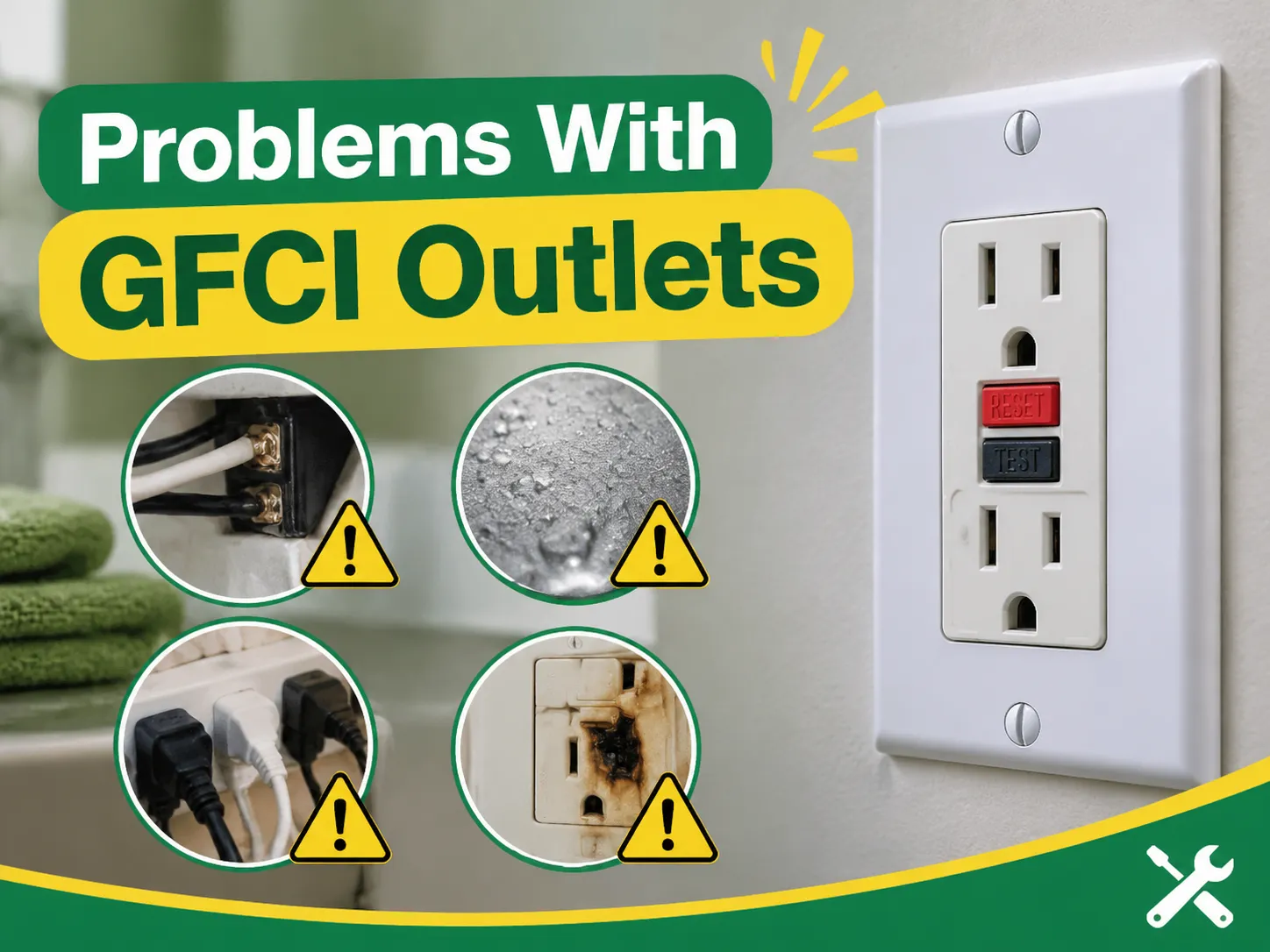
A ground fault circuit interrupter is the only appliance in the house that it is failed in a visible manner. It disconnects at an unexpected time, does not initiate re-setting, or give up after years in the service leaving an illusively safe circuit. Most issues searched by the customers fall into four categories of buyer’s […]


 Дорога Туочжан №6, пионерский парк Лэшанг, гавань залива Юэцинвань, город Юэцин, провинция Чжэцзян


