

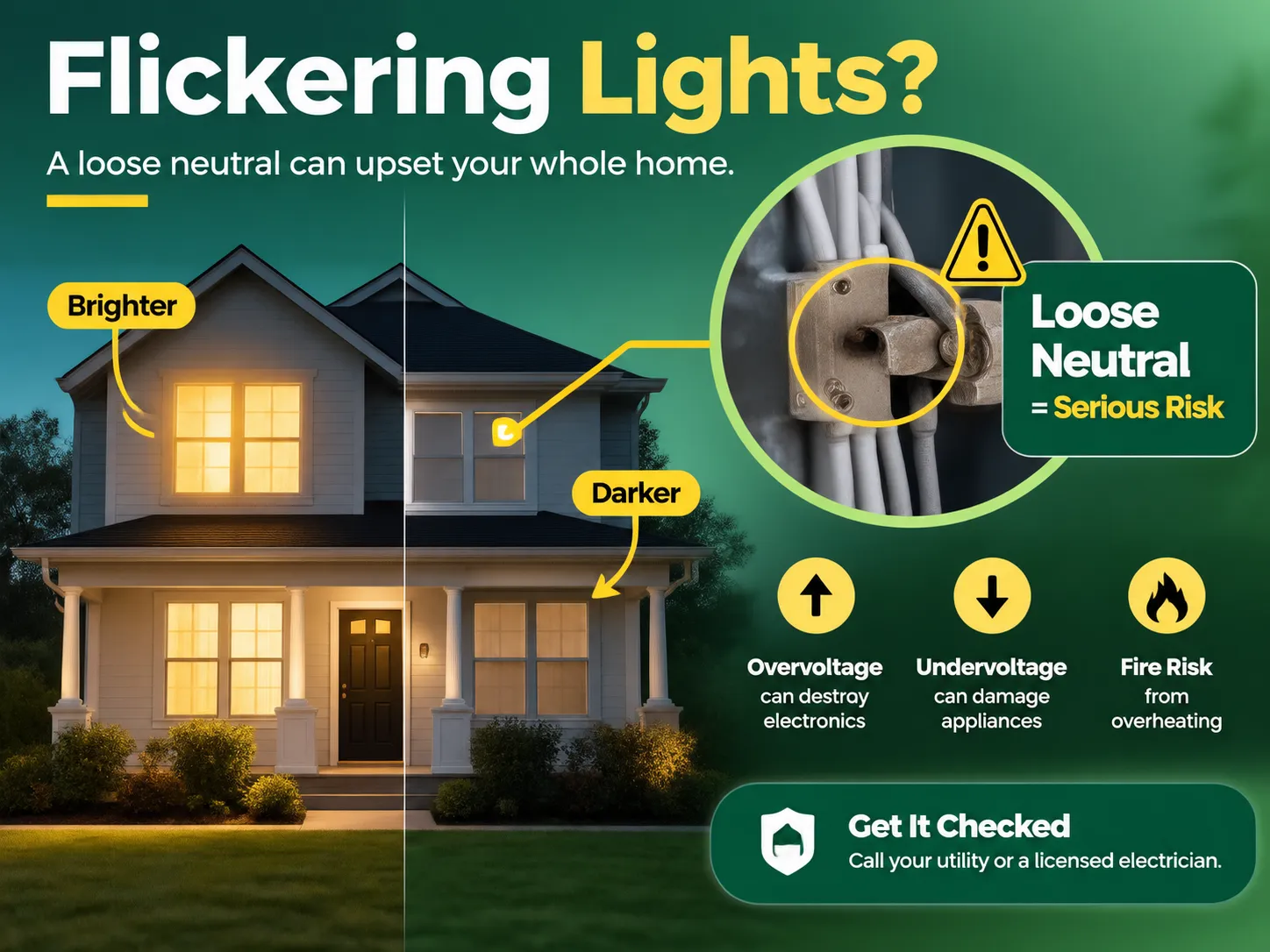
Trepćuća sijalica može se tumačiti kao lokalni problem — sijalica je istrošena, svetlosna instalacija je loše povezana, ili može biti da imate jeftin dimmer. Ali ako više od jedne sijalice trepće istovremeno, u različitim sobama, treba da sagledate situaciju drugačije. Mnoge trepćuće sijalice signaliziraju problem uzvodno: zajednička električna veza, zajednički krug, ili napajanje. Ovo je bitna informacija, jer neki problemi mogu biti rešeni promenom sijalice, dok drugi predstavljaju pravu opasnost i zahtevaju hitnu intervenciju od strane elektrodistributivne kompanije ili licenciranog električara.
Odgovor na ovo je jednostavan: ako svetla trepću u različitim sobama u isto vreme, to je najverovatnije rezultat problema u uzvodnom krugu, npr. labave veze u jednom ili više delova kruga, neispravan osigurač i/ili priključci, prekinut neutralni ili neujednačen napon na strani elektrodistributivne kompanije. Najvažnija stvar koju treba utvrditi prilikom odgovaranja na ovo pitanje je kada se treptanje dešava. Ako svetla nestaju svaki put kada neki veliki uređaj poput klima uređaja, frižidera, pumpe za vodu ili sušilice počne da radi, to često ukazuje na pad napona kao rezultat labave ili nedovoljne veze. Ako se treptanje dešava bez obzira na to da li su uključeni neki veliki uređaji, treba sumnjati na oštećenje u neutralnom provodniku ili napojnoj liniji što potencijalno može biti najgori scenario. Ako se treptanje dešava samo u jednom krugu, problem leži u tom specifičnom krugu. Samo treptanje ne znači opasnost od požara, ali ako se treptanje dešava zajedno sa mirisom paljenja, zujanjem, toplim prednjim panelima ili trepćućim svetlima, to zapravo znači hitnu situaciju – isključite sve i pozovite električara/elektrodistributivnu kompaniju!
Broj svetiljki u analizi je prvi kritični aspekt koji treba ispitati, što dovodi do podele analize na tri dela.
Ako samo jedna svetiljka trepće, problem je lokalno ograničen na ili prekidač, ili drajver, ili lampu, ili utičnicu. Ožičenje je u redu.
Ako više svetiljki trepće, problem se čini negde duž ožičenja, što može ukazivati na vezu u razvodnoj kutiji, osigurač, ili na dimmer ili prekidač odgovoran za napajanje više svetiljki.
U slučaju da svetla trepću povremeno u različitim krugovima i sobama, problem leži uzvodno od grana u razvodnoj kutiji, glavnoj vezi, neutralnom provodniku, ili kod pružaoca usluga. Ovaj slučaj predstavlja najveću opasnost.
Postoji još jedna dimenzija koja se mora uzeti u obzir pored broja trepćućih svetala: da li treptanje odgovara određenom događaju u vremenu. Trepćuće svetlo koje se dešava zajedno sa uključivanjem određenih uređaja sugeriše da postoji problem sa naponom i generacijom opterećenja. Trepćuće svetlo koje je nasumično, kontinuirano, ili se dešava kada nijedan uređaj nije uključen sugeriše kvar napajanja ili kvar veze u instalaciji. Trepćuće svetlo koje se dešava u određenim periodima dana i je gore tokom vršnih sati ukazuje na opterećenje od strane komunalnog preduzeća i kvar na termalnoj vezi. Uspostavljanje tih veza je glavni deo dijagnostike i neće potrajati dugo.
| Узрок | Šablon | Ozbiljnost | Ko to popravlja |
|---|---|---|---|
| Otvorena ili labava neutralna veza | Kontinuirano ili opterećenjem povezano trepćuće svetlo kroz celu kuću; neka svetla su svetla dok su druga prigušena u istom trenutku | Hitno — rizik od prenapona koji uništava opremu i od požara | Komunalno preduzeće i licencirani električar |
| Labava glavna veza ili veza glavnog prekidača | Trepćuće svetlo kroz celu kuću, često praćeno zujanjem ili toplinom na panelu | Hitno — iskrenje pri visokom strujnom opterećenju | Лиценцирани електричар |
| Labava veza u zajedničkoj spojnoj kutiji | Trepćuće svetlo na krugovima napajanih kroz tu kutiju; može se pogoršati kada uređaji na tim krugovima rade | Visoko — otpornog grejanja na spoju | Лиценцирани електричар |
| Kvar na prekidaču | Trepćuće svetlo na jednom krugu; prekidač topao, zuji ili se često isključuje | Високо | Лиценцирани електричар |
| Fluktuacija napona komunalnog preduzeća ili kvar na transformatoru distribucije | Trepćuće svetlo kroz celu kuću, u celoj četvrti, često povezano sa vremenom ili opterećenjem | Umereno do visoko, u zavisnosti od magnitude | Komunalno preduzeće |
| Nedovoljno dimenzionisane žice ili prekomerni pad napona na dugom spoju | Trepćuće svetlo kada opterećenja na tom spoju povlače struju | Umereno — stres na opremu, tokom vremena | Лиценцирани електричар |
| Dimmer koji nije kompatibilan sa LED lampama | Trepćuće ili sjaj na prigušenom krugu, često na niskim nivoima; može uticati na nekoliko svetala na jednom dimmeru | Nisko — neprijatnost umesto opasnosti | Vlasnik kuće ili električar |
| Kvar na LED drajveru ili elektronici lampe | Pojedinačno svetlo ili serija istog modela | Ниско | Vlasnik kuće |
| Zajednička neutralna veza na višekružnom granu | Flicker or equipment misbehaviour when loads on the paired circuits run | Moderate — often a wiring error | Лиценцирани електричар |
| Aluminium branch conductors with poor terminations | Flicker with load, particularly in older properties | High — known fire risk | Лиценцирани електричар |
The table gives importance to neutral connection in modern split-phase service systems. It is the neutral connection that helps stabilize 480 volts in the two hot wires. When loose or high-resistance problems occur, the reference of the neutral changes. This causes the two hot wires to become unequal in voltage. If this happens one hot wire may have a voltage above what it is supposed to carry while the other hot wire may get a voltage lower than the standard voltage. Therefore loads connected to the two wires would behave as if they are connected in series. The outcome of this phenomenon is not just mere flickering of lights; it may result in high voltage on one side of the house and low voltage on the other.
Some of this process can be done safely while some not. The instructions which appear below stop where the panel becomes loose and might pass.
The discipline of testing before touching is the same as for any electrical work, and the sequence for a fixture-level job is set out in our guide to zamenu svetlosnog prekidača, which covers isolation, proving dead, and safe termination.

The required repairs will depend on which layer is causing the issue.
Where a dimmer cannot be made to work with a given fitting — usually because the lamp electronics and the dimmer’s output stage are fundamentally incompatible — the alternatives are covered in our article on dimming LED lights without a dimmer switch.
A number of identical light fittings failing shows that there is a common issue with such fixtures; that is the driver electronics. The warranty can come into play here, and it is likely that replacing these fittings will be more affordable than repairing them.
Flickering lights do not necessarily represent a danger. For many years, a low-quality LED bulb connected to an incompatible dimmer will flicker without any threat to safety. The only query that one could have in such a case is if the flickering is a result of a hot joint.
A problem should be taken as a proper hazard and action should be taken if any of the following indicators appear:
What happens is that the loose connection has a higher resistance than that of copper. Therefore, when current passes through the faulty connection, it produces heat. The resulting heat burns the surface of the wire and increases resistance, which leads to even more heating. The process repeats herself. Therefore, the faulty connection is more dangerous than light bulb failure.
Several devices in the system can be at fault for flicker, while knowing who to blame can help save time.
| Уређај | Flicker symptom it causes | Akcija |
|---|---|---|
| LED lamp | Individual fixture flickers or shimmers; often a batch from the same production run | Swap for a known-good lamp to test |
| LED driver | Flicker that worsens over time or appears at certain brightness levels | Replace the fitting or driver |
| Диммер прекидач | Flicker or buzz on the dimmed circuit, particularly at low output | Match the dimmer to the load, or replace it |
| Standard switch | Flicker when the switch is touched or wiggled; warm plate | Replace, and check the terminations behind it |
| Lamp holder or socket | Flicker that changes when the lamp is moved | Replace the holder |
| Прекидач кола | Flicker on one circuit with warmth or buzzing | Replace with a device listed for the panel |
| Outlet or receptacle | Flicker correlated with a load plugged into that outlet | Replace; back-stabbed connections are a common culprit |
When it comes to changing light switches and plugs, quality of the product comes in play. Instead of the most economical product, specification-grade technology with screw terminals and excellent contact components ensure high performance of the devices in the circuit already experiencing problems. The selection criteria — certification, contact material, terminal design, and documented ratings — are the same ones set out in our guide to choosing an electric switch and socket manufacturer, and they matter most where the installation has a history of heat or intermittent faults.
Understanding which switch type is appropriate for the circuit also prevents the mismatches that cause an installation to be reopened later, and the families are described in our overview of različitih vrsta prekidača koji se koriste u električnim instalacijama.
The majority of flickering issues occur due to connections that either have never been properly done or have been slowly but surely failing for years.
The answer is negative. Temporary dimming caused by a major motor start-up is a standard phenomenon due to inrush current, and a low-cost LED bulb used with an incompatible dimmer may flicker for an indefinite time without a technical problem. The most important indicator of a problem is the pattern: continuous flickering, flickering that appears independently from the load, flickering accompanied by heating, smell, or noise, and flickering that results in brightening in some parts of a house and dimming in the other parts of it. All of these patterns are indicative of the connection or supply fault rather than a characteristic of a lamp driver and should be investigated.
If a number of bulbs connected to one fixture flicker together, it could be caused by a driver/ballast issue, especially if the bulbs were replaced at the same time and all of them are flickering. If several different fixtures connected to one switch or dimmer flicker, then the switch/dimmer becomes the common point, and its compatibility with the load should be checked. If the lights powered from different circuits flicker together, then check the shared connections upstream and the power source, as it is impossible to have a common fixture problem in this case.
This is totally dependent on the symptoms and the flickering pattern.Such flickering on an LED circuit (which has no heat, smell, or sound) is simply a nuisance instead of a risk, and its resolution involves either compatibility with a proper dimmer or an improvement in the lamp quality. Flicker that is accompanied by warmth, buzzing sounds, a burning odor, or alternating bright and dim light in multiple rooms can be viewed as a risk to safety, and thus needs urgent attention. In case of doubt, the simplest thing to do is to turn off all devices in the affected circuit and turn off the main switch; the actual repair is less expensive than potential damage taken.
The flicker itself does not create danger as the cause of flickering (the loose or high-resistance connection) has to do with it. Current passing through a poor joint generates heat at that very point, thus causing the oxidation of a conductor, which raises resistance and generates even more heat. Eventually, steady functioning of the whole above-mentioned cycle leads to arcing, which can ignite the surrounding material. Various warning signals that flicker has transformed from a nuisance into a danger include smell of burning stuff, warm faceplates with changed colors, buzzing or crackling sounds, burnt marks, and frequent failures of the devices on the same circuit. All of these need immediate shutting down of electronics and the assistant of an electrician to be summoned.
Yes, it can and is the worst common cause of the whole house flicker. In a split-phase supply system, neutral serves as a reference point, maintaining equal parameters of both 120V phases. When it is loose and has high resistance, it can cause the two phases to be divided as one of them will become more powerful, while the other one will require supply of energy. The appearance of lights appearing in some part of the house while they are fading in another part indicates that there can be damaged electronics and even burned engines instead of ordinary flickering bulbs. It is better to hurry up and turn off the power from the main switch and call either utility or an electrician.
The presence of several flickering lights is a sign rather than a diagnosis. In order to determine the cause of multiple flickers, two questions must be answered: the number of affected circuits and simultaneous events. Flickering lights in one fixture indicate a lamp or driver malfunction. Flickering lights in one circuit indicate a shared connection problem or malfunctioning circuit breaker. Flickering lights occurring in the whole house, especially in case of some lights glowing brighter while some dimming in different rooms, indicate a neutral problem or supply issue — this situation is the one that can cause equipment damage or fires. Learn the symptoms of nuisance flickering and dangerous flickering — heat, smell, buzz, burn marks, bright and dim lights, and turn off the power at the main switch instead of simply watching the lights. Fix the problem yourself by replacing dimmer, lamp, or improperly connected device. Leave panel, lugs, and connections to an electrician and report your flickering issues to the utility company instead of waiting for something to break down. There are usually normal explanations of flickering; in case of unusual ones, it’s better to pay attention to them immediately.
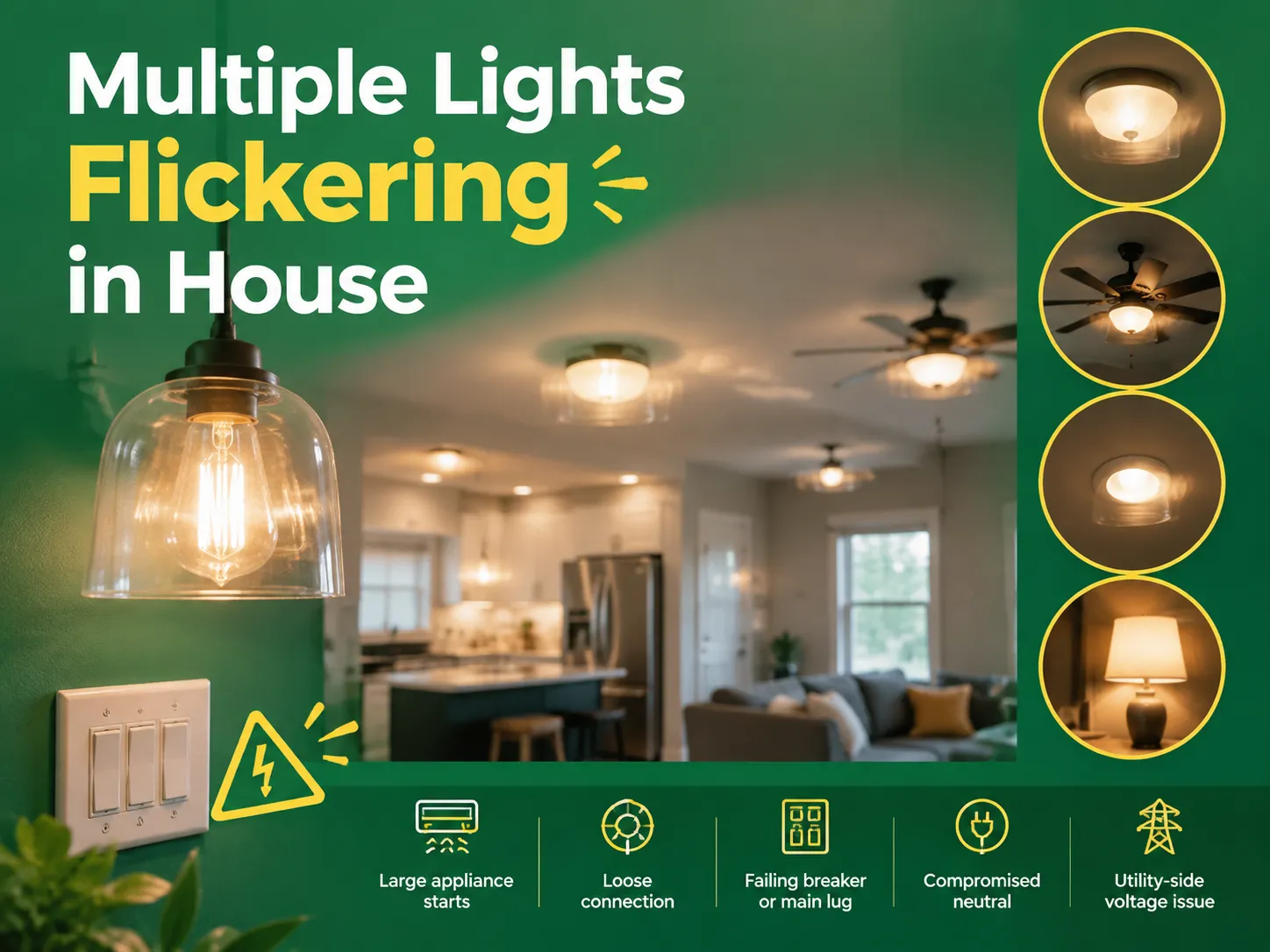
A flickering bulb can be interpreted as a local problem — the bulb worn out, the light fixture connected poorly, or it could be that you have a cheap dimmer. But if there is more than one bulb flickering simultaneously, in different rooms, you need to see the situation differently. Many flickering bulbs signal a […]
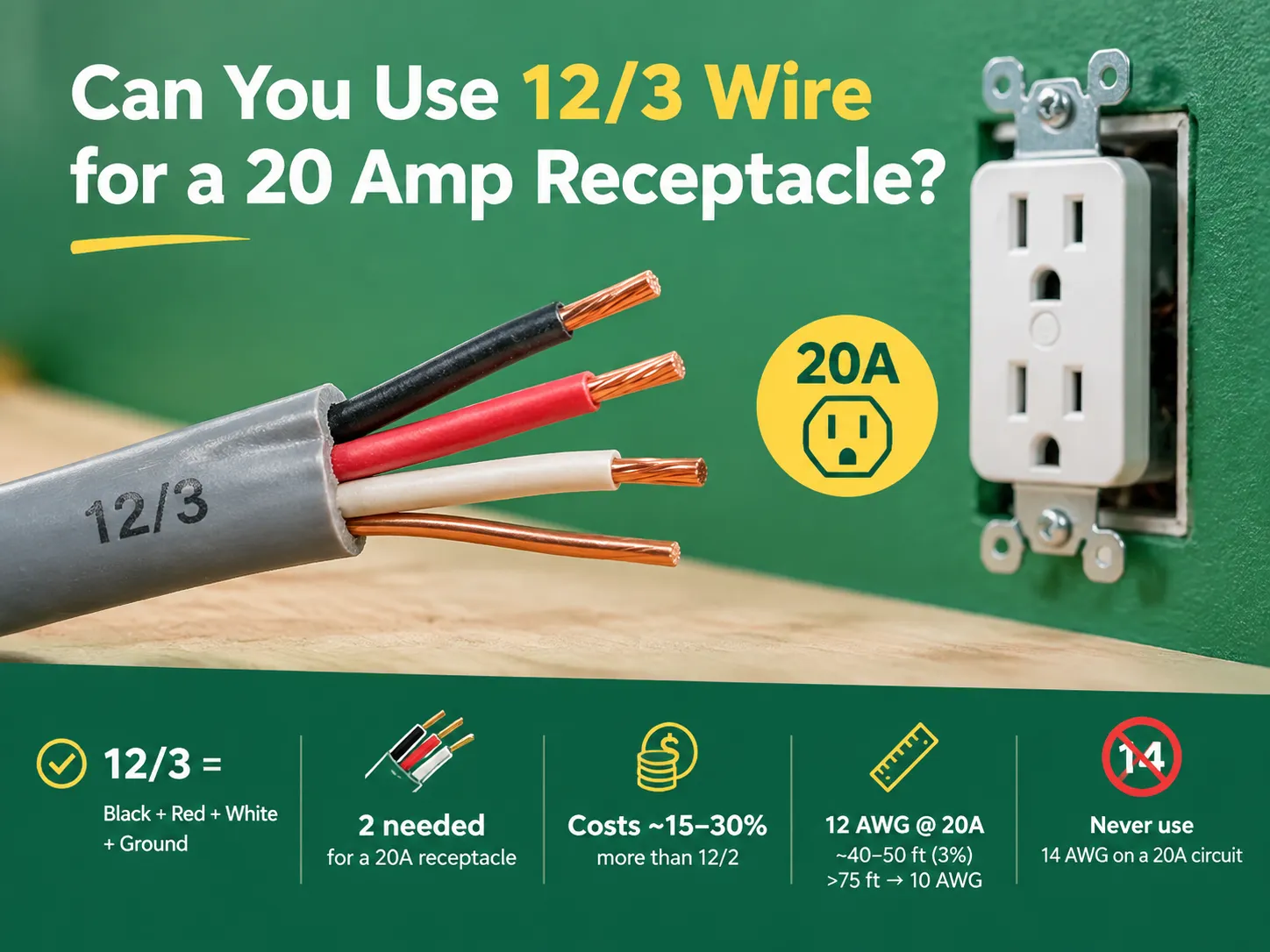
Žica od dvanaest žica i dvadeset-amperni krugovi se tako dobro uklapaju da pitanja obično dolaze iz drugog izvora. Može biti da instalater ima komad 12/3 preostao od ranijeg projekta ožičenja ili možda dobavljač ima samo 12/3 kablove na skladištu. Pitanje se postavlja da li […]

Izuzetna situacija u sektoru električnih uređaja u Dubaiju, koja kombinuje uređaje prema britanskim standardima sa propisima iz javnog preduzeća, kao i nacionalnom agencijom koja nadgleda sprovođenje nacionalnih propisa, zahteva da uređaji budu sposobni da izdrže visoke temperature i vlažnost koje se javljaju u regionu zbog njegove obalne lokacije, kao i […]

 Но.6 Туозхан Роад, Пионирски парк Лесханг, лука у заливу Иуекингван, град Иуекинг, провинција Зхејианг


