

The world of electrical procurement has been transformed by the advent of smart lighting. In the instance of cables or pipes, the cheapest option is easily identifiable and free from risks. Yet when it comes to smart plugs or other connected lighting devices, the product could vary from x1 times to x4 in cost from the cheapest item. The reason for that is that the poor-quality lighting equipment may become twice as expensive later when the product arrives without proper inspection reports and without the spare parts.
In the following, lessons will be learned about what are the four ways of getting the product, what landed cost means, and how the manufacturers and wholesalers present themselves.
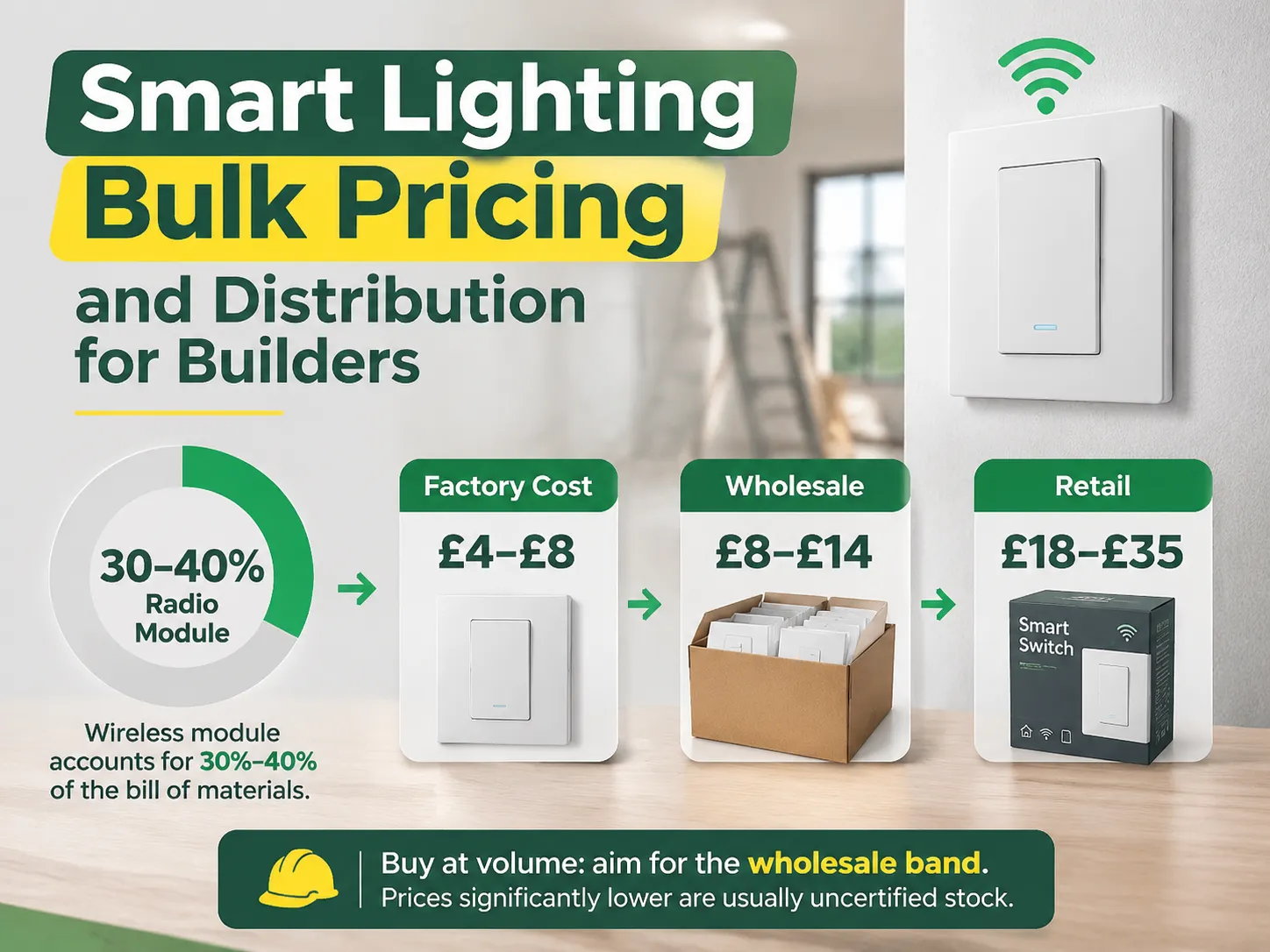
Concise response: Wireless communication technology greatly affects the prices of bulk lighting products as this technology contributes to a considerable share of the total cost of materials. A basic Wi-Fi switch costs around £4 to £8 at the production facility and its wholesale pricing ranges from £8 to £14. In retail stores prices for these products vary from £18 to £35. In the construction industry, while purchasing lighting equipment, lighting companies usually get it at wholesale prices, lower prices could mean that the products are not certified or connected with some kind of other technology.
Three major structural differences set connected lighting apart from traditional electrical devices and are contributing to increased costs.
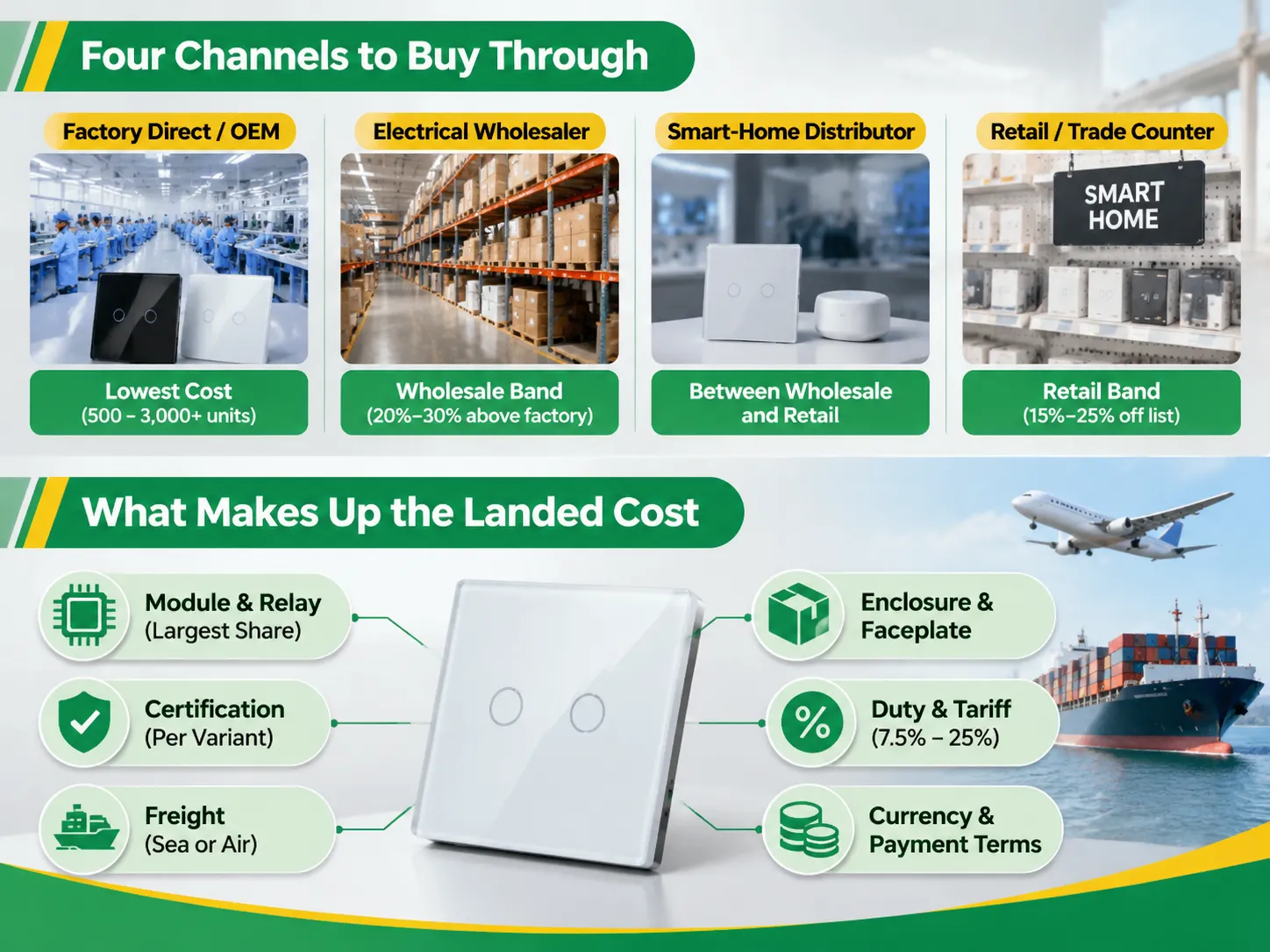
Each channel has a distinct cost structure, and the right one depends on phase size rather than on headline price.
| Channel | Typical price position | Minimum order | Best for |
|---|---|---|---|
| Factory direct / OEM | Lowest, close to bill of materials | 500 to 3,000 units or a tooling commitment | Repeatable range across multiple phases, own branding |
| National electrical wholesaler | Wholesale band, 20% to 30% above factory cost | By the box, no commitment | Phase one, mixed brands, site-by-site call-off |
| Specialist smart-home distributor | Between wholesale and retail | Low, but range is narrow | One ecosystem, technical support, integrator channel |
| Retail or trade counter | Retail band, 15% to 25% off list in promotions | None | Emergencies, samples, single-unit replacements |
The error in the approach of a builder is that he considers the fourth channel as the price reference. The retail price has already taken into account the margin structure built for a single sale, and using this when negotiating for a project creates an illusion of a good deal. Actually, the cost reference point should be in the wholesale range, far lower than retail, and able to include all the stocks, returns and technical support structure.
The wholesaler adds way more than logistics as an additional service. He should provide a credit account for the builder, returns structure, breaker for a box and tech desk, and all of it is supposed to be operational at the time of commissioning.On a two-hundred-unit phase it is a line item worth questioning, and the wholesale programme structure is what a wholesaler supply arrangement is meant to formalise.
Six entries, and the only two that fall short are the two that follow the initial delivery.
Customers are looking for advice on which brand to purchase from and in response, it is possible to create a simple chronological flowchart that separates wholesalers from brand manufacturers as both types of purchasing are completely different.
We are a manufacturer of smart switches, and not a distributor, which makes a difference for the builder since it changes how we can be used. We do not have a warehouse in your area or accept a single-unit order. We manufacture a series of the product to specification and sell it in bulk under your brand or ours.
That makes us the right talking point in three cases. In the case of a large development where the difference between wholesale and direct manufacturing matches the costs involved. In the case of a project where the required quality has to be consistent from stage to stage and where no distributor has chosen the right range.And when a builder or a wholesaler wants their own name on the product, which is what OEM and ODM switch production exists to deliver, including the certification work that has to accompany it.
We cannot replace a local wholesaler for one property. A builder putting together fourteen units will be better off going to a store and using a factory when the quantity comes to a container.
One cannot consider a plan to be the same as a discount due to the fact that plans mainly summarize aspects regarding the amount, timing, consistency and the actions of the parties in case something goes wrong. Hence, each step of the planning process has its own expenses associated with it.
Generally speaking, the volume must be quoted instead of just assumed. It is vital to ask about the three price level when asking for volume prices. The curve which shows that the factory knows the breakpoints certainly helps with that. If a seller is giving you the same price for 500 pieces and for 5000 parts it happens either because he has not really thought about it or he did not include the price for the smaller order.
The stock is also very important to consider. Direct production causes a situation when the phase which has changed its mind becomes the one which has to wait. Thus it is necessary to analyze whether savings per item are higher than costs for maintaining stocks locally. This is not worth it for the majority builders who order under 500 items.
Keep in mind that the spare parts must be bought in the amount of 5-10%. It is advisable to order them together with the first shipment since the smart switch might not work for some reasons that the ordinary one does not. One of those could be the failure of firmware, or the radio module losing connection or stuck relay. In such cases it would be impossible to replace it with a new piece from the next order.
It is worth asking how long the manufacturer guarantees that the product will stay in production and how much advance notice is needed for the changes. The distributor who knows the answers to such questions might be less reliable than the factory that puts those dates in writing.
All in all, they show that this approach can be used successfully on a large scale.A distributor expansion programme in Brazil is a useful case because it shows the actual mechanics: local stock held by the distributor, range depth negotiated against expected sell-through, and the manufacturer supporting with certification and lead-time commitment, not with price alone.
The first three items lead to most mistakes. It is because a builder who provides proof of certification, neutrality, and protocol for the installation of a product will be saved from both failures: a shipment of switches that cannot be installed legally and a house that has lights on due to smart switches but does not work properly.
The cost for a smart switch is very close to wholesale prices, being anywhere between 20% and 30% above factory expense. An ordinary Wi-Fi model will cost roughly between £8 and £14 in the UK, as much in US dollars as comparable products cause great concern when their value is very far from aforementioned figures and prove to be worth investigating for verification and reliability.
The radio transmitter and electricity provide 30% to 40% of the costs of building materials. Certification of smart switches also causes additional costs that standard switches do not face, while the plastic used for production of the switches as well as their mechanism makes a minuscule contribution to the production overall price.
Generally speaking, yes, however, this statement is true only when the order consists of several hundred units. In all other cases net costs reasons prompt a construction professional to buy goods from a wholesaler.
A constructor must always choose Matter, in case he does not want to stick to any particular ecosystem; Zigbee protocol is perfect when reliability of the whole operational hub system is required; Wi-Fi may be used for the installed units to operate without a hub.
One should count on 8 to 14 weeks for certified wireless modules and up to 16 weeks for customized faceplates to be manufactured and delivered; do not forget to add 4-6 weeks for sea transport as well as customs clearance.
The majority of smart switches need neutral wire since the radio must be powered even when the light is off. Although some two-wire models exist, which function due to a little current coming via the light bulb, they do not work properly with LED lamps. It is necessary to verify that before starting the installation process, not after.
Choosing and ordering smart lighting should be done similarly to the process you would use to select any other electrical product. When it comes to smart lighting, it is all about cost placement, not a price list of products and services. The module, the certification, and the transportation show how much product you can afford, while the market defines how much you will pay for using someone else’s storage.
If you work with a small building, use a branch. If you need to complete a large project, get in touch with the manufacturer directly. Expecting to pay prices from a factory but buying goods from a branch is a mistake that costs you four additional weeks of waiting for the missing parts.
The world of electrical procurement has been transformed by the advent of smart lighting. In the instance of cables or pipes, the cheapest option is easily identifiable and free from risks. Yet when it comes to smart plugs or other connected lighting devices, the product could vary from x1 times to x4 in cost from […]

From July 1st, 2023, the city of Minneapolis, Minnesota has implemented the corporate switch control policy due to the law of 2023 NEC being effective in that state without any amendments. Since installation of occupancy sensors in most commercial facilities is now mandatory, the critical question is not whether to install them but what type […]
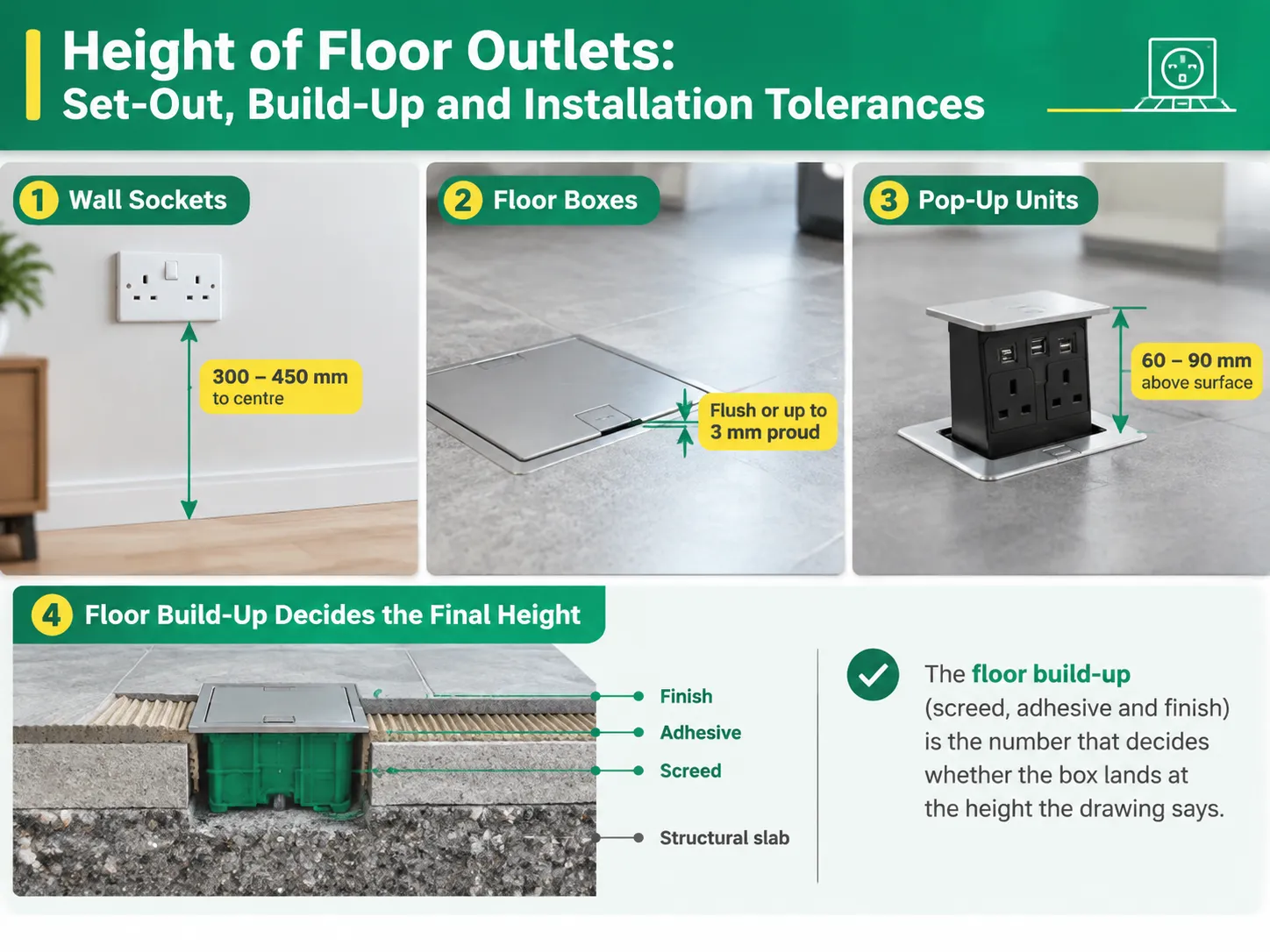
The first measurement of the height takes place on a blueprint whereas the second establishes the height on-site after it turns out the thickness of the constructions is 20 mm thicker than indicated in the drawing because it is the second option that matters the most. As for the practical aspect of the issue, it […]

 No.6 Tuozhan Road, Leshang Pioneer Park,Yueqingwan Bay Harbor,Yueqing city,Zhejiang Province


