

Commercial lighting control in Minneapolis is now a necessity rather than an option. With the application of the new NEC on July 1, 2023, occupancy sensing has now become a legal requirement in most commercial buildings without any modification of the law on the part of the state authorities.So the discussion has changed from “if” to “which,” and lighting control has become one of very few energy-efficiency initiatives where the code and economics are in complete alignment.
In short, Minnesota has adopted the National Electrical Code of 2023 as the Minnesota Electrical Code. According to clause NEC 210.62(B)(1), there must be occupancy sensors in non-habitable areas. The most prominent brands marketing their products comprise Lutron, Leviton, Hubbell, Legrand (Pass & Seymour), Eaton, and Signify. The price of devices may vary considerably, starting from $25 occupancy switch and up to $300 machine for a room. In addition, most products need to be installed directly next to the wall switch, thus making it crucial to choose the right switch and dimmer supply.
Minnesota has a very clear situation. No local deviations from the national code or amendments to it. The Minnesota Electrical Code document is the Minnesota Rules chapter 1315 document, and as per part 1315.0200 subpart 1a, all new electrical installations need to follow the 2023 NEC document, ANSI/NFPA 70-2023 version. There are no amendments to the edition. It has been applicable since 1 July 2023, which makes it part of the Minnesota State Building Code. The legislation behind this is the Minnesota Electrical Act, sections 326B.31 to 326B.399, and the rule is issued by the Department of Labor and Industry and Board of Electricity.
The necessary paragraph for the lighting is NEC 210.62(B)(1). According to the new edition for 2023 or NEC code, there is a definition for the concept of “non-dwelling space” which means it is a place in commercial buildings, different from a separate apartment, however as an exception for egress. This is the one that should be verified first. In simple words: an open-office space in Minneapolis downtown, the corridor in a Minneapolis school, the aisle between the shelves in a warehouse, and exam room of a hospital are in need of occupancy sensing. The corridor or stairs used for exit are an exception from this definition.
Two conclusions can be drawn from this text, and the second one is what people are not aware of. First, the situation with the licenses in Minnesota is that there are no state licenses; the Board of Electricity locates electricians and the state administers the code, while the local inspections are still performed by local city inspectors. The second conclusion is that the code does not change with every new building so the 2015 office tower installed according to the regulations of the 2014 code is already compliant but only in terms of the control system, while there are still many requirements from recent period which have not been fulfilled.

There are four different layers. They get mixed up by the buyers all the time.They end up spending money because of it.Mixing them up costs money.
The first layer is the local controls, which is basically the light switch or a dimmer switch on the wall. This layer is typically where the project begins and comes to a halt. Also, this is the only layer that a tenant can handle without getting the facilities department involved. It is also where the hardware decision gets made, and the choice is narrower than it looks: a 400 W dimmer-and-switch combination such as the CS328 dimmer switch handles a meeting room by itself, and whether the box has a neutral decides which of the two variants you order.
The second is scheduling: the timekeeper that switches off the lights at 6 pm, regardless of whether there is occupancy. The third is sensing, which is what codes require: occupancy sensors that turn on or adjust the brightness when a space gets occupied or vacated. The fourth is networked control, whereby the lighting fixtures report information and receive commands from a central server, consequently providing an immense amount of savings in a building with multiple zones.
Putting a correct sequence together is more important than the brand. A networked building using ordinary switches will waste most of the intelligence; a building employing a smart sensor without a scheduling capability will keep its lights on for 18 hours a day full blast.
Lutron is the name when it comes to dimmers and shades. Its modular systems are used by architects whenever they need to deal with lighting design to ensure quality rather than to save money. Lutron is the most expensive choice but is worth it for its excellent dimming capabilities and great functionality when compared to LED drivers.Leviton is a more widespread option: occupancy sensors, dimmers, timers and controllers that can be bought at a low price. Hubbell operates in the same business field providing more solid variants with better ability to withstand vandalism. Legrand has achieved success in the multifamily and hospitality fields via Pass & Seymour and its wiring devices. Eaton deals with industrial installation. Signify (philips lighting) is known for its great lights and control systems.
Average installed pricing for Minneapolis commercial work 2026. Basic occupancy sensor switch for small office/corridor: $60-$150. 0-10V dimmer with sensor for meeting room: $250-$600. Wireless scene controller plus sensor and dimmer for a zone: $400-$900. Networked small office with 8 zones: $6,000-$18,000 in hardware plus commissioning.
For the underlying behaviour of dimmers and where they fail in practice, how LED dimming behaves without the right dimmer is the useful read, because the majority of callback calls on a retrofit come down to that one mismatch.

The math changes for three local reasons.None of those is the weather exactly.
Occupancy systems used in general offices or schools are effective at saving energy in terms of lighting consumption, as they cut energy use down by approximately 20 to 40%. The figures depend on how much of the area is occupied after office hours and during weekends. While daylight dimming systems reduce energy use by less than the average for the country, the role of scheduling is more efficient (5 to 15%) if there is no use of additional sensors involved in reducing energy costs.
The correct payback calculations show that the payback period for office building systems in Minneapolis during regular office hours does not exceed three years. Implementing networking systems increases energy savings but lengthens the payback period, which could rise up to four to six years unless some networking is already in place.
The cost of installation is affected by local factors; however, the variation in figures is not noticeable in different cities, as the costs directly depend on the type of building being experimented on.Real-world installer pricing for a comparable market is covered in smart lighting control installation costs and what drives them.
Nearly all of the non-labour expenses total in three components within the overall costs: the sensor, the dimmer and the controller. The sensor is just a small electronic device with a front lens. The shape of the room is more crucial than the brand name. The dimmer is another commodity but it has compatibility issues. The controller is where brand choice is taken.
Thus we have the wall switch which has become the place of competition between different manufacturers and for that reason igoto’s range of controllers and dimmers is highly relevant and important in this particular market, rather than just being incidental. The company builds wall switches and dimmers as a component supplier, including the 400 W dimmer-and-switch combinations of the kind a contractor fits in a meeting room, with the neutral-wire and no-neutral variants both available. and the manufacturing and material options are in the stainless steel, PC, acrylic and glass panel range.
In commercial terms, the key points are availability and specification rather than brand recognition. The contractor fitting out forty rooms has one part number and datasheet that he needs, along with a delivery date. This is something that a component manufacturer can supply, while a dealer channel dealing in consumer brands will not be able to do.

Create an initial zone schematic and zone advisor to help your understanding and use of the concepts; so that all you do downstream relies on this.
Before using any curve ball methods, weigh things by measuring them. Open office space with 40 occupants behaves differently from a similar space with just 8 people, and the number of sensors varies based on the geometric complements of the work area and also the structural system (ceiling height, partitions, dividers and furniture). The first problem occurs when high ceilings prevent the light from reaching the sensor, the second is connected with the construction of walls stopping before hitting the ceiling. The last issue comes with bright lights or fluorescent lamps lighting up the sensor.
Once you know the answers to the previous part you can safely choose a dimming scheme and a device without any pitfalls; why? Because you will know what kind of dimmer you should look for depending on the type of a light installed into the system; either leading edge or trailing edge dimming for cost or 0-10 V for certain LED drivers, through mixing different dimming approaches in the same space you will create the most common flickering issue after the retrofit.
Then agree how the fittings get installed and commissioned, because that is where a retrofit quietly loses its schedule. Neutral-wire and no-neutral dimmers behave differently at the box, and the fitting rules are in our dimmer installation guide. Next, make sure to prepare the schedule properly by making sure that you have taken into account critical parameters such as the part number, quantity, finish, type of sensor, timeout, set points, and who is setting them. It is also important to state properly the code compliance path. This is very important because of the fact that in Minnesota inspector demands to see the sensor on the plan as well as in the room, while arguing that the sensor that has been previously installed is meeting the requirements of 210.62(B)(1) is far easier to do on paper rather than in the field.
Overall, yes, in new nonhabitable areas. The state of Minnesota follows the 2023 National Electrical Code (NEC) without making any changes. Article 210.62(B)(1) mandates the presence of occupancy sensors where new construction takes place outside of dwelling units, with the exception of places of egress. Existing buildings will be covered by relevant code edition as per the electrical installation done at that time, so make sure to get confirmation from the authority that regulates this field.
Sensors with two types of technology that utilize both passive infrared and ultrasonic. In a typical case of a large area, passive sensors can only notice the floor while a person standing still gives off very little infrared radiations from a height of four meters. Ultrasonic sensors, however, pick up all the minimal movements that a mounted device cannot detect.
The installed cost of one occupancy sensor switch can be between $60 and $150. A meeting room with a dimming sensor can cost between $250 and $600. As for a small eight-zone modernized office, its cost is around $6,000 to $18,000 (including hardware and contractor services). The most important factor affecting the costs of building modifications is whether the work can be done during business hours.
In general, the answer is yes. LED drivers are different from the resistive loads dimmers were designed for, thus a leading-edge dimmer will cause flicker or humming when used with an LED load. Either use an LED-rated dimmer with a matching load range or change to the more expensive but superior 0-10 V control.
Minneapolis has implemented the 2023 NEC as is, which means there is no room for discussion about the occupancy sensor requirements and they must be installed according to specification right away.Selecting the appropriate sensing and scheduling layer by merit, being upfront about daylight harvesting at latitude 45, and concentrating specifically on the zone names and sensor locations are crucial since they are the only things that affect the success of the retrofit and have nothing to do with which switch brand is being used.

Commercial lighting control in Minneapolis is now a necessity rather than an option. With the application of the new NEC on July 1, 2023, occupancy sensing has now become a legal requirement in most commercial buildings without any modification of the law on the part of the state authorities.So the discussion has changed from “if” […]
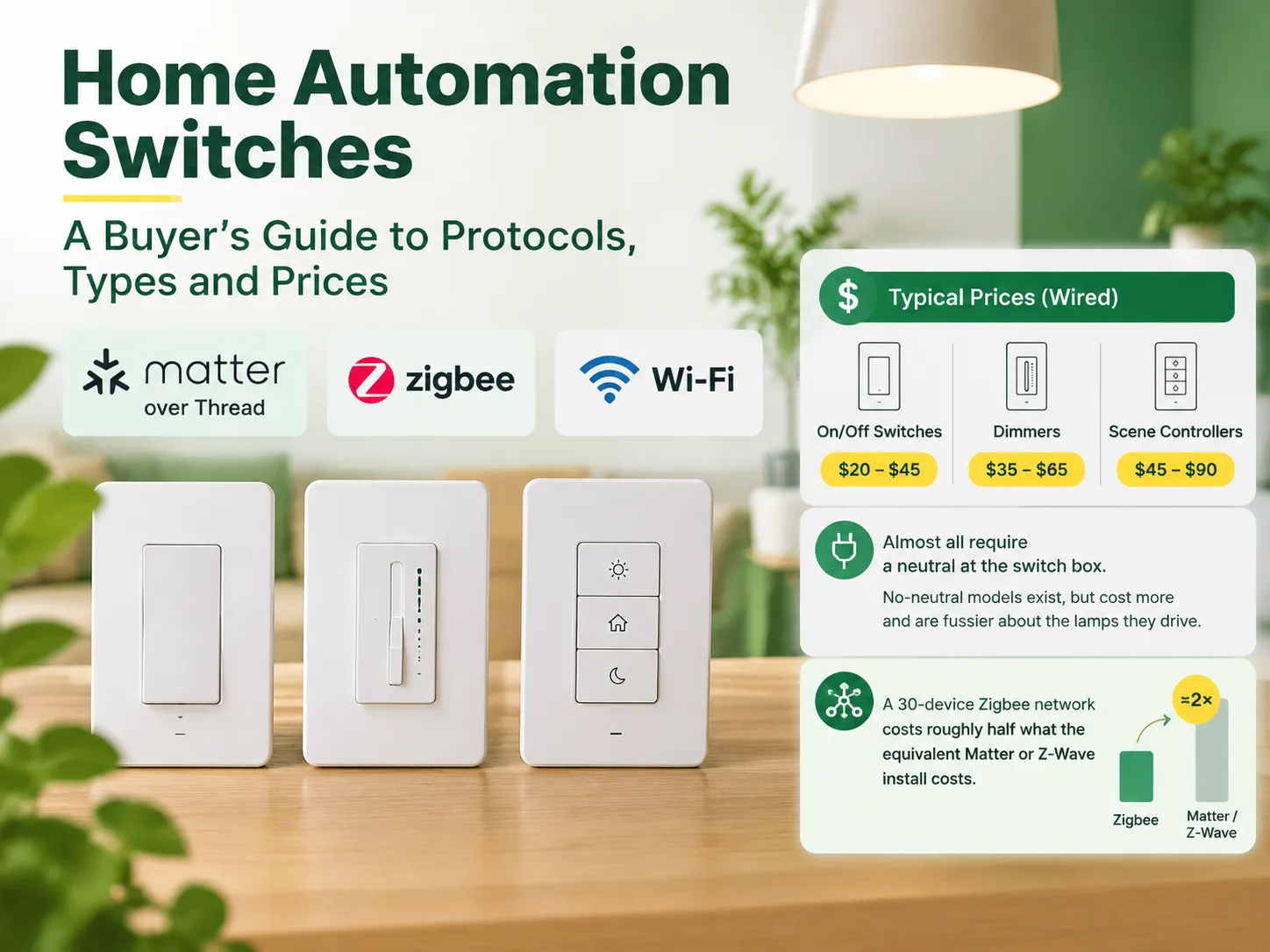
Purchasing a home automation switch is not simply purchasing a light switch. For a light switch, all you need to choose is the color and how many gangs you would like. For an automation switch, barely anything is that simple as you also have to select a protocol, a hub system, whether present wire is […]

If you travel often, then you probably know that packing for Singapore is one of the simplest things to do in Asia, but also one of the most difficult because it uses UK-type plugs (instead of the US-type ones). Whether you need a transformer, a plug adapter or both depends on two questions that tourists […]

 No.6 Tuozhan Road, Leshang Pioneer Park,Yueqingwan Bay Harbor,Yueqing city,Zhejiang Province


