

Für nordamerikanische Reisende ist Puerto Rico eine attraktive Insel, da sie dieselbe Steckdose, Spannung und Frequenz wie die Vereinigten Staaten verwendet, was das Anschließen Ihrer Geräte erleichtert. Wenn Sie jedoch Elektronik aus Europa, Australien oder Asien gekauft haben, passt Ihr Stecker nicht in die Steckdosen in Puerto Rico.
Kurze Antwort: Puerto Rico verwendet nordamerikanische Steckdosen vom Typ A und Typ B, die mit 120 Volt und 60 Hertz betrieben werden. Reisende mit nordamerikanischen Steckern benötigen keinen Adapter, aber japanische Stecker, die für 100 Volt ausgelegt sind, können nicht in puerto-ricanische Steckdosen eingesteckt werden, da die Nennspannung höher als 100 Volt ist. Reisende mit elektrischen Geräten aus Großbritannien, Irland, Australien, Neuseeland, Indien und den meisten Teilen Asiens benötigen einen Steckdosenadapter, und Geräte mit 230 Volt benötigen zusätzlich einen Spannungswandler, um in Puerto Rico betrieben werden zu können. Typ C und Typ F Stecker sind nicht austauschbar mit Typ A und Typ B Steckern, und sie sind auch nicht untereinander in allen Steckdosentypen austauschbar.
Dieser Artikel erläutert die in Puerto Rico verwendeten Steckertypen, die Spannungsthematik, wer einen Steckdosenadapter benötigt, die Verwirrung zwischen den Steckertypen C & F, Geräte mit Doppelspannung, die Stromqualität auf der Insel, die Netzinstabilität und deren Folgen für die Geräteauswahl, unser Produktangebot sowie unsere Empfehlungen, was Reisende nach Puerto Rico mitnehmen sollten.
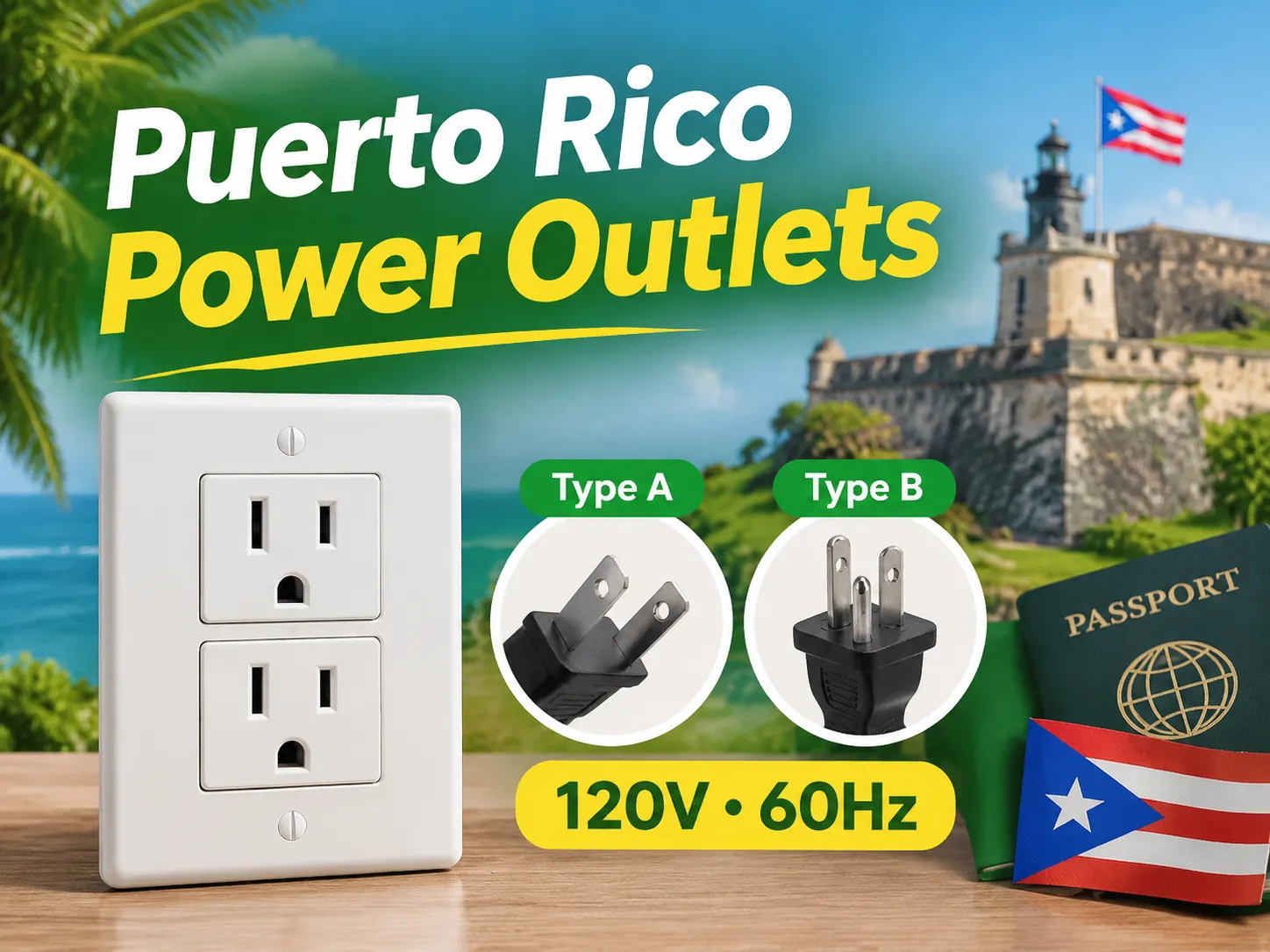
Die Insel Puerto Rico ist ein US-Territorium und unterliegt den Vorschriften des US-amerikanischen Stromsystems. In Puerto Rico sind alle Steckdosen Typ A mit zwei flachen parallelen Kontakten und Typ B mit einem zusätzlichen runden Erdungsstift und arbeiten bei einer Spannung von 120 V und einer Frequenz von 60 Hz, genau wie auf dem US-Festland. Alle Steckertypen passen in diese gleichen Steckdosen, was die Bestimmung des zu verwendenden Reiseadapters bei Reisen nach Puerto Rico eher auf das Herkunftsland als auf ein einzigartiges Merkmal von Puerto Rico stützt. Wenn Sie beispielsweise aus den USA nach Puerto Rico reisen, passt Ihr Stecker problemlos, während er nicht passt, wenn Sie aus Großbritannien oder Europa anreisen. Puerto Rico hat auch keine lokale Variante von Steckertypen und keinen gemischten Standard aus der Kolonialzeit, was bei vielen anderen karibischen Inseln nicht der Fall ist.
Viele Hotels und neuere Gebäude bieten auch eine universelle Steckdose für verschiedene Steckertypen an, und einige fügen USB-Steckdosen hinzu, aber Reisende sollten sich nicht darauf verlassen, da diese keine Norm sind.
Steckdosen, die als Typ A klassifiziert sind, haben zwei flache Klingen mit einem Abstand von etwa 12 mm. Sie sind ungeerdet und der ursprüngliche Steckdosentyp. Typ A Steckdosen sind noch häufig in vielen alten Gebäuden sowie bei Beleuchtung und kleinen Geräten zu finden. Da Typ A Steckdosen keinen Erdungsstift haben, sollten Geräte, die sie verwenden, keine Erdung benötigen. Alle neuen Installationen gemäß den aktuellen elektrischen Vorschriften verwenden jetzt geerdete Steckdosen (d. h. Typ B) als Standard.
Typ B Steckdosen enthalten einen runden Erdungsstift, der zentriert unter den zwei flachen Klingen angebracht ist, die mit der Steckdose verbunden sind. In den USA und Nordamerika wird Typ B immer im Wohn- und Geschäftsbereich verwendet. Typ B Steckdosen nehmen sowohl Typ A als auch Typ B Stecker auf, weshalb die meisten Menschen nicht bemerken, dass sie unterschiedliche Steckerformen verwenden.
Der Erdungs- oder Schutzleiterstift sorgt für vollständige Sicherheit von Geräten oder Vorrichtungen mit Metallgehäuse; daher muss neben dem Aussehen der Geräte auch die Position des Neutralstifts berücksichtigt werden, um eine ordnungsgemäße Erdung sicherzustellen.
Der 15-A-Steckdosentyp hat eine 15-A- und eine 20-A-Option. Die 20-A-Steckdose akzeptiert den 15-A-Stecker und hat die gleiche Konfiguration wie die 15-A-Steckdose, fügt jedoch eine T-förmige Position für den Neutralstift hinzu, was bei der Spezifikation von Geräten wichtiger ist als beim Reisen. Wenn Sie ein 20-A-Gerät kaufen, passt es nicht in eine 15-A-Steckdose, und die vollständige Beschreibung der nordamerikanischen Steckdose umfasst geometrische Austauschbarkeit und Nennwerte.
Die Stromversorgung für ganz Zentral-Nordamerika ist einphasig mit 120 Volt bei 60 Hz. Für größere Geräte wie Herde und Trockner gibt es auch einen Zweipolkreis, der 240 Volt liefert. Diese Art der Versorgung ist genau dieselbe wie in den kontinentalen Vereinigten Staaten, was bedeutet, dass Sie Geräte aus den kontinentalen USA kaufen und ohne Modifikationen in Ihre Steckdosen einstecken können.
Es gibt zwei Gerätegruppen, die Beachtung erfordern: Die erste Gruppe besteht aus japanischen Geräten, die für 100 Volt ausgelegt sind und mit 120 Volt betrieben werden können; in den meisten Fällen passen Schaltnetzteile 120 Volt an. Im Gegensatz dazu überhitzen 100-Volt-Motoren und Heizelemente bei Betrieb mit 120 Volt und können vorzeitig ausfallen. Die zweite Gruppe besteht aus europäischen Geräten, die für 230 Volt ausgelegt sind; obwohl Steckdosenadapter verfügbar sind, ändern diese Adapter die Spannung nicht auf 120 Volt und erlauben daher nicht den Betrieb des europäischen Geräts mit 120 Volt..
Die Frequenz wird oft übersehen, ist aber ebenso wichtig wie die Spannung. Ein 50-Hz-Gerät wie ein Synchronmotor, eine Uhr oder ein Timer läuft ungefähr 20 Prozent schneller bei einer 60-Hz-Versorgung.
Ein elektronisches Gerät mit Schaltnetzteil ist gleichgültig, wie der Strom geliefert wird. Deshalb können sowohl Laptop- als auch Telefonladegeräte an Stromquellen mit 50 Hz verwendet werden, während 50-Hz-Ventilatoren und mechanische Timer dies nicht können.
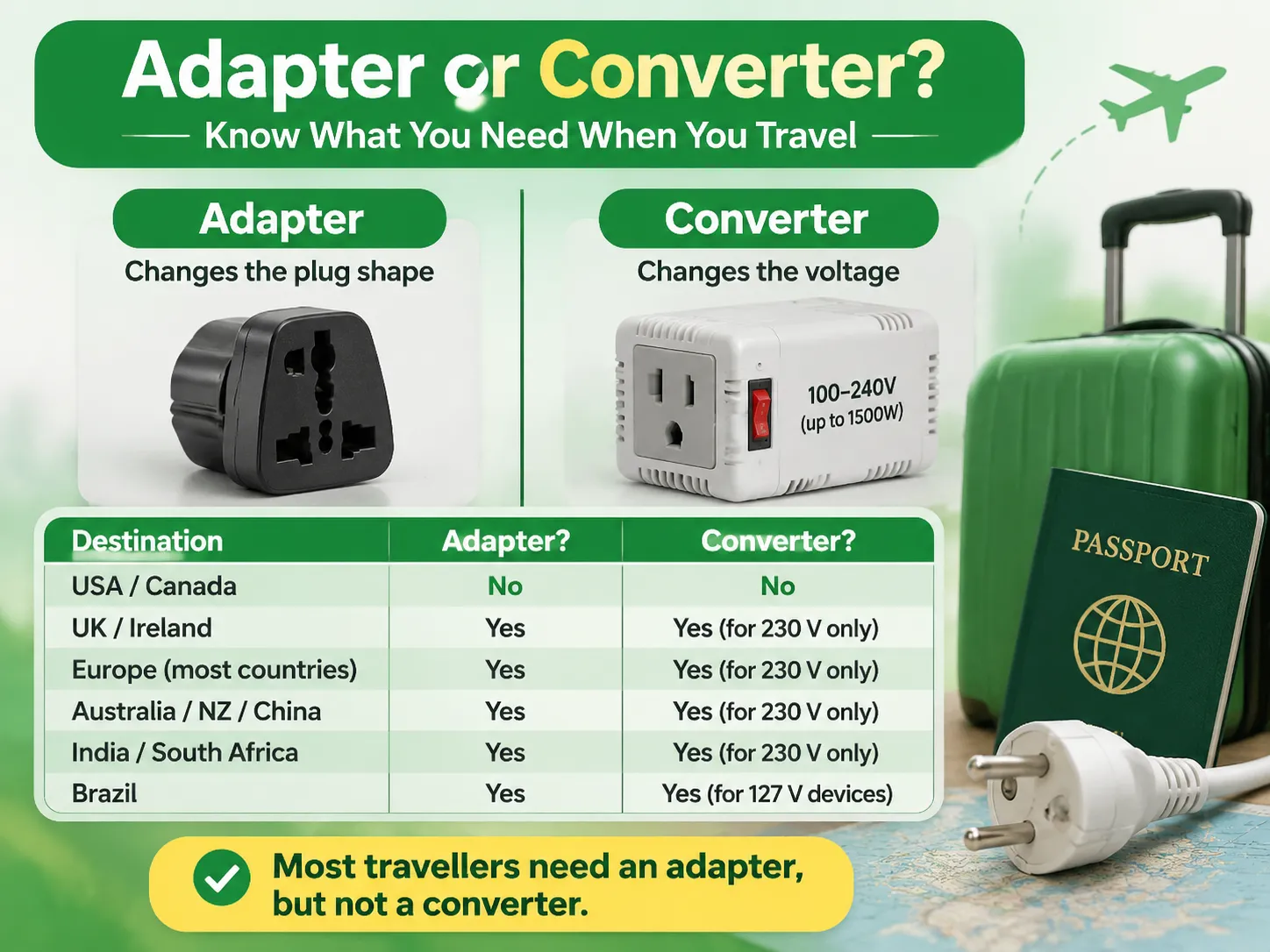
Die Informationen in der untenstehenden Tabelle geben eine sofortige Antwort auf die obige Frage. Ein Adapter wird verwendet, um die Form des Steckers anzupassen, während ein Spannungswandler die Spannung der Stromversorgung umwandelt. Die meisten Reisenden benötigen einen Adapter, aber keinen Spannungswandler.
| Kommen von | Stecker | Adapter | Spannungswandler |
|---|---|---|---|
| USA / Canada | A, B | NEIN | NEIN |
| Japan | A, B | NEIN | Meist nein, Etikett prüfen |
| Mexiko / Mittelamerika | A, B | NEIN | NEIN |
| Vereinigtes Königreich / Irland | G | Ja | Ja, nur für 230 V |
| Europa (die meisten Länder) | C, E, F | Ja | Ja, nur für 230 V |
| Australien / Neuseeland / China | ICH | Ja | Ja, nur für 230 V |
| India / South Africa | D, M | Ja | Ja, nur für 230 V |
| Brasilien | N | Ja | Ja für 127 V Geräte, nein für 220 V |
Die Zeile für Brasilien ist am interessantesten, da das Land zwei verschiedene Spannungen verwendet (127 V und 220 V) und einen Typ-N-Stecker hat. Daher könnte eine Person, die aus Brasilien reist, Geräte haben, die mit einer Spannung funktionieren, aber nicht mit der anderen. Ein comparison of all plug and socket standards by region provides the quickest method of answering this question. If you’re in another country, the most common assumption is that having a plug adapter and plugging in a device labelled 100 to 240 volts will work; and for devices labelled 230 volts, you also need a converter. The reason for the converter’s size and expense is because you are limited to 1,500 watts; so if you need to use a hair dryer in a foreign country, you will need to locate a converter that has the appropriate wattage rating, which is different from the small travel converters sold at most airports.
Type C refers to the Europlug, which consists of two pins with 4 mm pin diameters and a spacing of 19 mm between the pins, while it has a non-tapered (flat) body. The Schuko type F plug is made of 4.8 mm diameter pins and is generally round and has clips on the sides for the earth connection. Both types of plugs are related but have differences that determine compatibility with certain types of sockets.
A Type C plug will fit into Type F, Type E and Type L sockets as the pins on the Type C plug are thin enough and the spacing of the two pin holes on all three sockets are the same. However, a Type F plug will not fit into a Type C socket due to the fact that Type C sockets are not found on wall outlets in most countries (Type C is designed to fit into sockets created for larger sized plugs).
Neither Type C nor Type F plugs will fit a socket in Puerto Rico (NEMA 5-15) that has flat blades, and regardless of the attempts to bend the pins of either Type C or Type F plug into flat blades, they cannot convert 4 mm round pins into flat blades.
This is why an adapter is needed by European travellers, and a universal adaptor purchased in Europe prior to leaving is a good idea to prevent potential confusion regarding plug types.
When considering the installation of electrical sockets and switches for a project rather than a person, you will need to decide which family of electrical sockets and switches will be specified for the project. This will vary depending on the family of sockets and switches we supply. Therefore, a project in San Juan or a project in Madrid has identical specifications in one catalogue for each city.
The label on the power supply is the only definitive answer to the question of voltage. The device label that reads 100 to 240 V is a “dual voltage” device. It is compatible with both voltage systems and both plug types. Therefore, the device can be used in any country when equipped with the correct plug adapter. Examples of items typically categorized as dual voltage devices include laptops, phone chargers, camera chargers, electric shavers and a variety of personal electronics.
If a device is labeled as 120 V, it may be operated in a 230 V country, but only with a voltage converter. It may be operated normally in Puerto Rico. A 230 V device may operate in Puerto Rico with a converter, but the converter must contain an appropriate rating for the wattage of the motor as it will draw numerous times its running current at start-up.
Products and devices that are classified as “Single Voltage Only” and that tend to be less expensive when purchased locally are generally the following: hair dryers, curling irons, and electric kettles. These three examples of single voltage devices are typically high wattages and, unless otherwise noted in the packaging, are not dual voltage devices.
The voltage supplied to Island-dwelling residents is the same nominally as the mainland’s but the Power Quality differs markedly.
For a long time Puerto Rico has had numerous power quality (frequency/voltage excursions, brownouts & outages) as well as many instances where equipment that may survive well in Ohio fail quickly at buildings that rely on an unreliable voltage source.
When contemplating using valuable equipment on the island, three considerations should be made:
Overall, the risk pattern of the installation is significantly different than that of installations found in the continental U.S. An example of this would be that voltage sags occur more frequently on the island compared to voltage spikes and that voltage sagging can put more stress on a motor than voltage spikes can put on a power supply. The refrigeration compressor at the installation will fail more frequently than the same type of compressor operating in a temperate zone, therefore, it is essential that voltage protection is a required specification to be included with the refrigerator compressor’s purchase order rather than an option for consideration.
The island’s electrical grid system is small, isolated and old. Together, these characteristics make it an extremely fragile electrical system. Therefore, if a power generating unit fails on the island, there is no longer a source of electricity to draw electricity from a neighbouring community until a neighbouring community’s electric generating unit can recover from tripping.Additionally, Puerto Rico’s transmission system experiences the additional danger of being highly susceptible to damage from hurricanes.Finally, many of the electric generating facilities are operated with equipment that has exceeded its manufacturer’s expected life cycle.
The Distribution Network was virtually destroyed by Hurricane Maria in 2017, and the Distribution Network suffered another complete loss across the island due to Hurricane Fiona in 2022, with widespread outages still occurring throughout the system since then.
Operational Methodology has also changed. In 2021, the Transmission and Distribution sectors were transferred to a private, contracted operator, while Generation remains with the government-owned utility. This split causes confusion about whose responsibility it is for an outage because it may not always be clear to customers who is responsible.
As such, building owners must manage their relationship with the utility instead of assuming the utility provides services.
From an Equipment Specification perspective, there are three key points to remember:
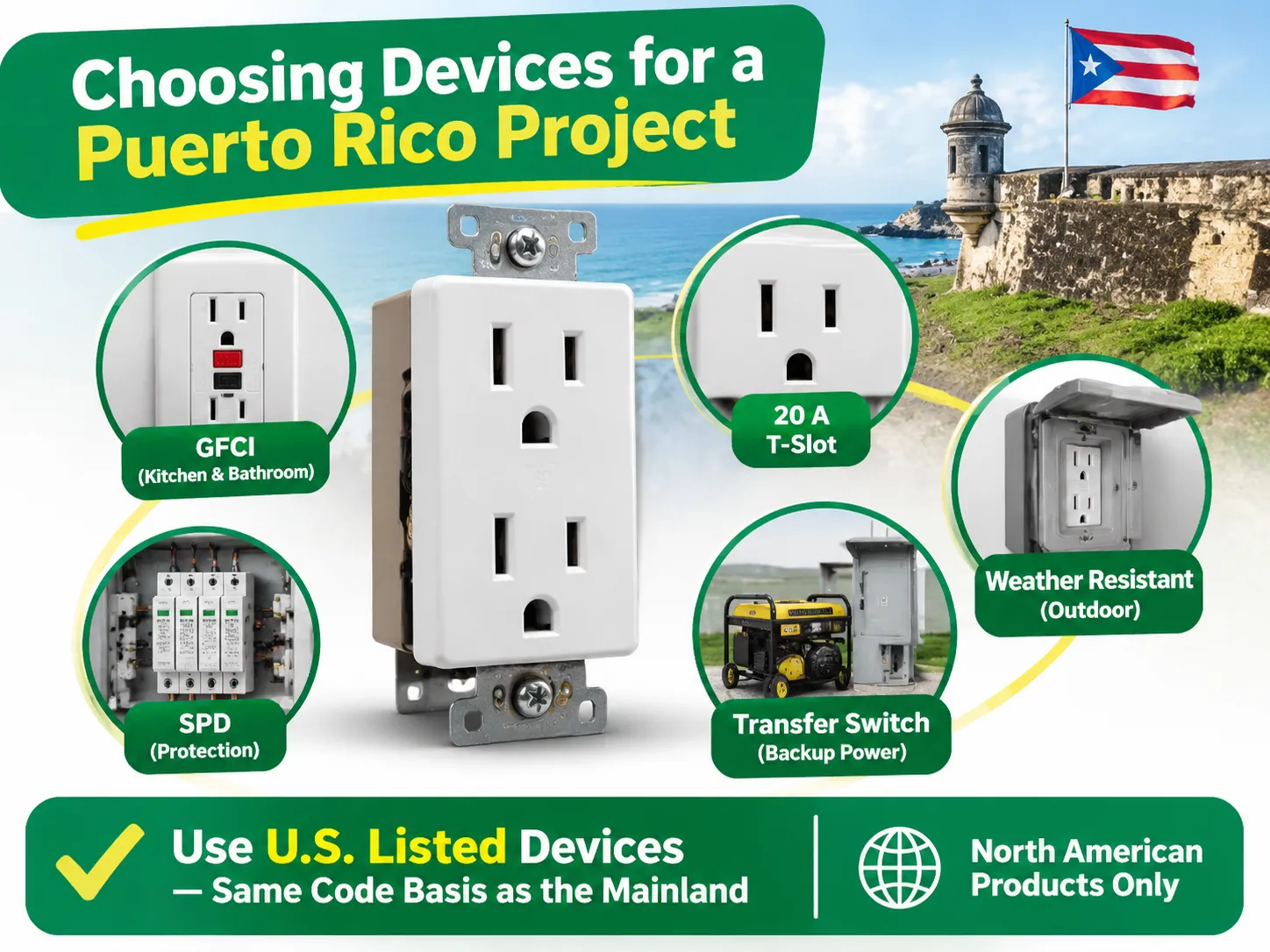
When you select the Devices you are going to use for your project in Puerto Rico, think in terms of products you are going to purchase, and location where you will purchase them from. The following Table contains an example of how you can structure this data.
| Situation | Geräte | Consideration |
|---|---|---|
| Residential new construction | NEMA 5-15R duplex, tamper resistant | Uses the equivalent code basis as the mainland; UL listings anticipated |
| Kitchen and bathroom | GFCI receptacles or GFCI breakers | Must be installed in the locations required on the mainland |
| Commercial fit-out | 20 A receptacles, T-slot | Accepts both 15 A and 20 A plugs |
| Hotel renovations | NEMA outlets plus USB modules | Guests arriving with dual voltage electronic devices |
| Outdoor or coastal | Weather resistant, IP rated covers | Salt air and driving rain |
| Backup power | Transfer switch and generator inlet | Interlocked, not a suicide cord |
| Equipment protection | SPD at the panel and at points of use | Lightning and switching transients |
The row concerning the Equivalent Code Base when comparing Puerto Rico to the Mainland is the most straightforward and should be applied to every project. A device that is listed for the United States is accepted in Puerto Rico while European devices will not, thus simplifying the sourcing of products from only the North American product catalogue. This is the same direction used in most Caribbean islands, where the installations can follow either a European or British style. If you were to compare the USA and Panama regarding outlets, you would find that Panama uses the same flat-blade style of socket as Puerto Rico, but its installation practice and import routes are entirely different.
Because we produce both the North American and European family of switches and outlets, a distributor who serves Puerto Rico and the Caribbean can build one complete product line using US configurations for all the islands, and a separate line using European configurations for the French and Dutch territories.
For Puerto Rico, the American format switch and socket range is applicable. This includes the NEMA configurations as well as the plate systems associated with them.
The most important piece of information for this market is the listing, and not the price. When a product is offered in Puerto Rico, it must have a UL Listing for the configuration; therefore, if a distributor is unable to provide a UL Listing for the configuration, he or she will be selling into a market that will reject the product when it is inspected. We provide the test documentation with our product offerings, and our plate systems are manufactured to correspond with the boxes that are currently on the island.
Where we provide no answer is for a project that requires a proprietary building automation system, as this will be a sale of a system and not a sale of a device. Where there is a need for a NEMA duplex, GFCI, USB module or a plate with an existing installation, this is where we focus our attention.
For a traveller, the list is relatively short; you should consider carrying the following items: if you are travelling from outside of North America, you should carry a universal adapter; you should check every power supply label for the 100 to 240 V range; carry a small surge strip, since hotel rooms seldom have adequate outlets and the power is not adequate; and you should decide to purchase a hair dryer or kettle locally and not convert one. For someone who will be staying for a longer period of time or renting a property, two products are recommended for purchase on the island.
A surge protector with the right clamping voltage, as well as a small UPS for your router and desktop computer is essential. Any momentary loss in electrical service of 1 second can cause corruption of a file and reset all the clocks in your entire home.
What is not acceptable to purchase locally is a low-priced universal adapter purchased at a souvenir shop. These universal adapters typically have no UL certification, overheat due to excessive current draw, and cause numerous incidents in hotel rooms due to their unregulated nature.
Yes, Type A and Type B outlets are used in Puerto Rico, at 120V and 60Hz. All outlets follow the same configuration and voltages as seen throughout the mainland US. Therefore, devices using standard US plugs will work without any additional adapters and devices approved for the US will work in Puerto Rico.
Yes, but only one way. The Type C Europlug fits into the Type F Schuko outlet, as both the thickness of the pins and the distance between them agree. However, a Type F plug will not fit into a Type C outlet nor will a Type C plug fit into the Flat Blade NEMA receptacle used in Puerto Rico. Therefore, a European traveler should take an adapter with him/her.
With Hurricane Maria’s destruction of a significant portion of the distribution system in 2017, the loss of power island-wide caused by Hurricane Fiona in 2022 and ongoing widespread departure from the grid since then, an island’s grid is incapable of supplying power when one unit trips or when the grid system is subjected to hurricane conditions. The transmission and distribution systems were sold to a private operator in 2021, while generation remains under the control of the local public utility.
Puerto Rico uses the standard North American plug configurations — Type A (which has two flat blades) and Type B (which has two flat blades plus a round grounding pin). The most common receptacle used in Puerto Rico is a Type B with 15 A at 125 V rating. The 20 A version of the Type B includes a T-shaped neutral slot. The electricity that is supplied throughout Puerto Rico is at 120 V and 60 Hz.
Voltage converters are required for 230 V single voltage devices; all devices marked between 100 to 240 V can be used in Puerto Rico requiring nothing other than a plug adapter. Any device that operates on only 230 V will require a converter equal to or greater than the device’s rated wattage; for high wattage appliances (such as a hair dryer or kettle), the replacement costs may be cheaper than a conversion.
All general circuits in Puerto Rico operate on 120 V at 60 Hz; higher voltage (240 V) for larger appliances can be obtained through two-pole circuits. The North American voltage standard (for general use, appliances) has been established in Puerto Rico therefore Europe appliances will not function correctly even if you use an adapter.
Puerto Rico is a North American electrical market within the Caribbean region, therefore all devices that plug into Type A and Type B outlets will work on 120 V at 60 Hz and all appliances approved by US standards. For all travelers from the mainland will not require any type of converter, however, travelers from Europe or Australia will require a plug adapter and, if using higher wattage appliances will need to purchase a converter as well.
Während viele Menschen denken, dass die Steckdosen in Puerto Rico der überraschendste Teil ihres Besuchs in Puerto Rico sind, ist die Tatsache, dass das Erzeugungs- und Verteilnetz in den letzten zehn Jahren mehr als einmal auf der gesamten Insel ausgefallen ist, ein guter Grund, eine Überspannungsschutzleiste und eine Batterie-Backup für wichtige Geräte mitzuführen.
For North American travelers, Puerto Rico is an attractive island since it uses the same electrical outlet, voltage and frequency as the United States, making it easy to plug in your devices. However, if you purchased any of your electronics in Europe, Australia or Asia, your plug cannot fit into Puerto Rican outlets. Quick answer: […]
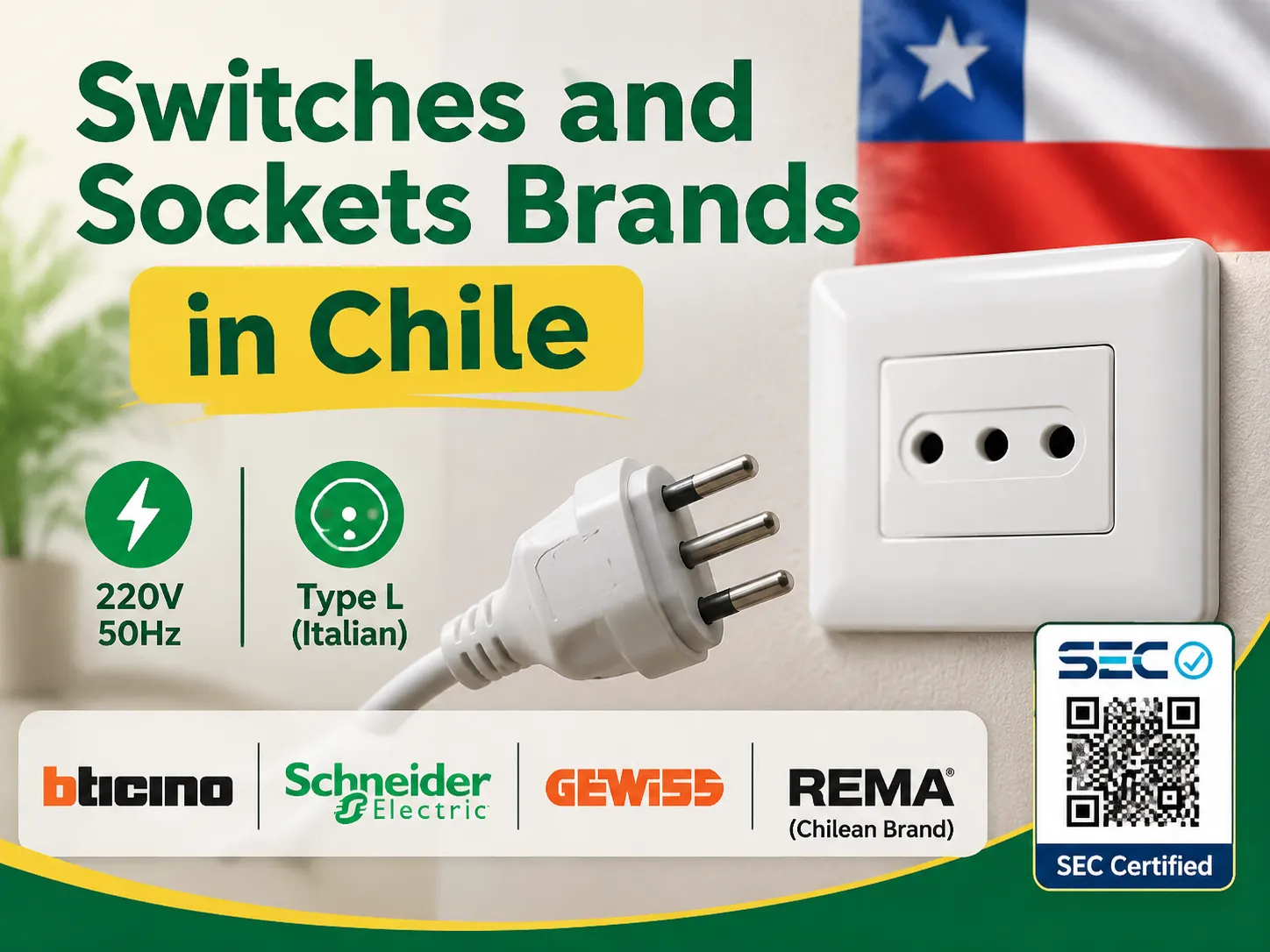
Chile ist das einfachste Land in Südamerika, um Verdrahtungsausrüstung auszuwählen, aber es ist auch eines der schwierigsten, in den Markt einzutreten. Alle elektrischen Stecker entsprechen einem einzigen Typ, der als “Typ L” oder “Italian CEI 23-50” Stecker bezeichnet wird. Die einzige Zertifizierung für elektrische Ausrüstung […]
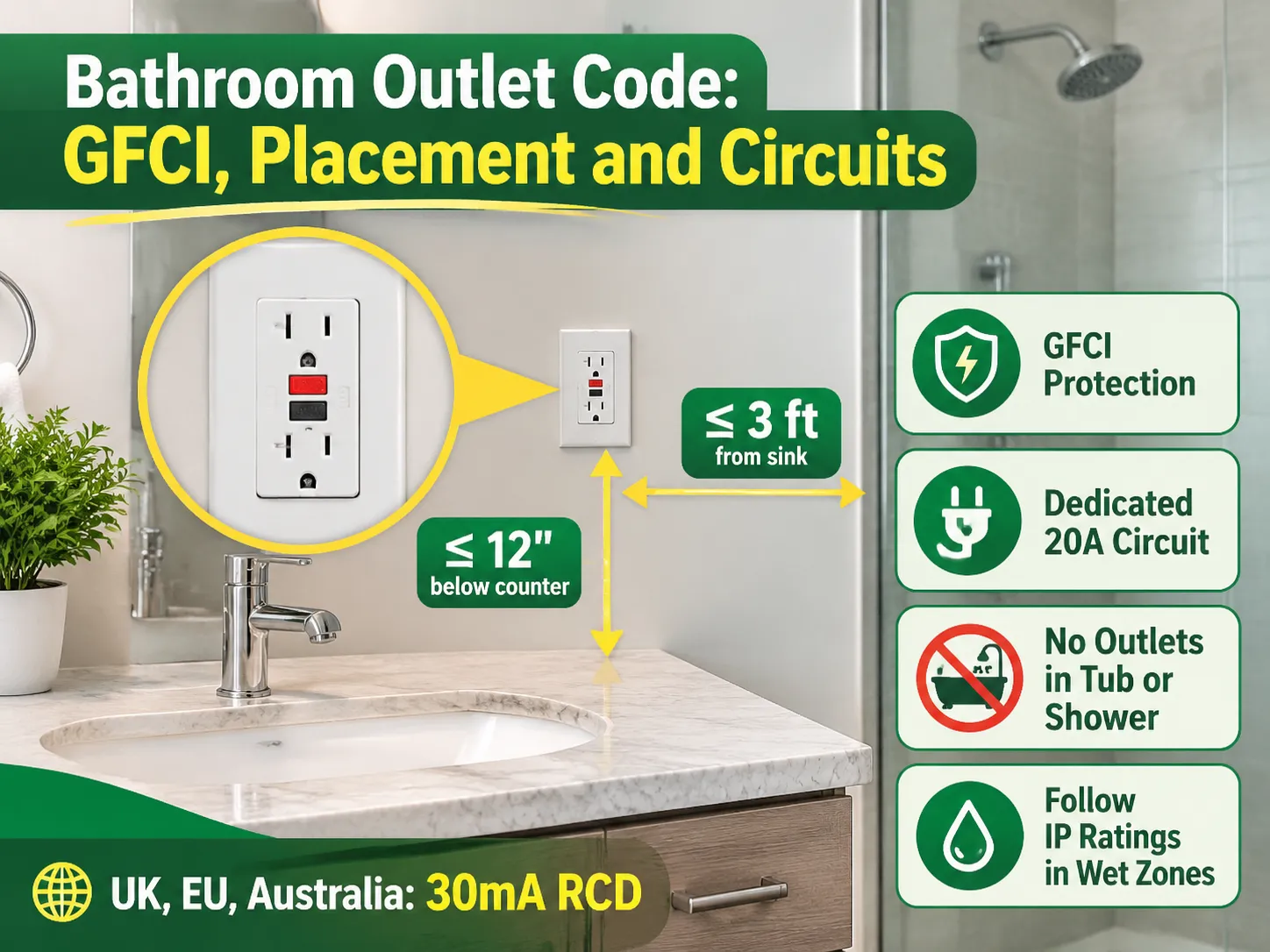
Jede dieser Regeln wird im Folgenden ausführlicher erläutert. Die Geometrie der Steckdosenplatzierung, die Anforderungen an den dedizierten Stromkreis, Steckdosentypen, die den Vorschriften entsprechen, Fragen zu 15A und 20A, Unterschiede zwischen Ländern hinsichtlich der Vorschriften, Installationsdetails, die die Prüfung nicht bestehen, was beim Kauf eines Produkts zu beachten ist, Beleuchtung und Ventilator […]

 Nr. 6 Tuozhan Road, Leshang Pioneer Park, Yueqingwan Bay Harbor, Stadt Yueqing, Provinz Zhejiang


