

Cada uma dessas regras é revisada com mais detalhes abaixo. A geometria da colocação das tomadas, o requisito de circuito ramal dedicado, tipos de tomadas que atendem ao código, questões de 15A e 20A, diferenças entre países em relação às regras, detalhes de instalação que não passam na inspeção, o que considerar ao comprar um produto, requisitos de iluminação e ventilação no mesmo ambiente, e retrofit.
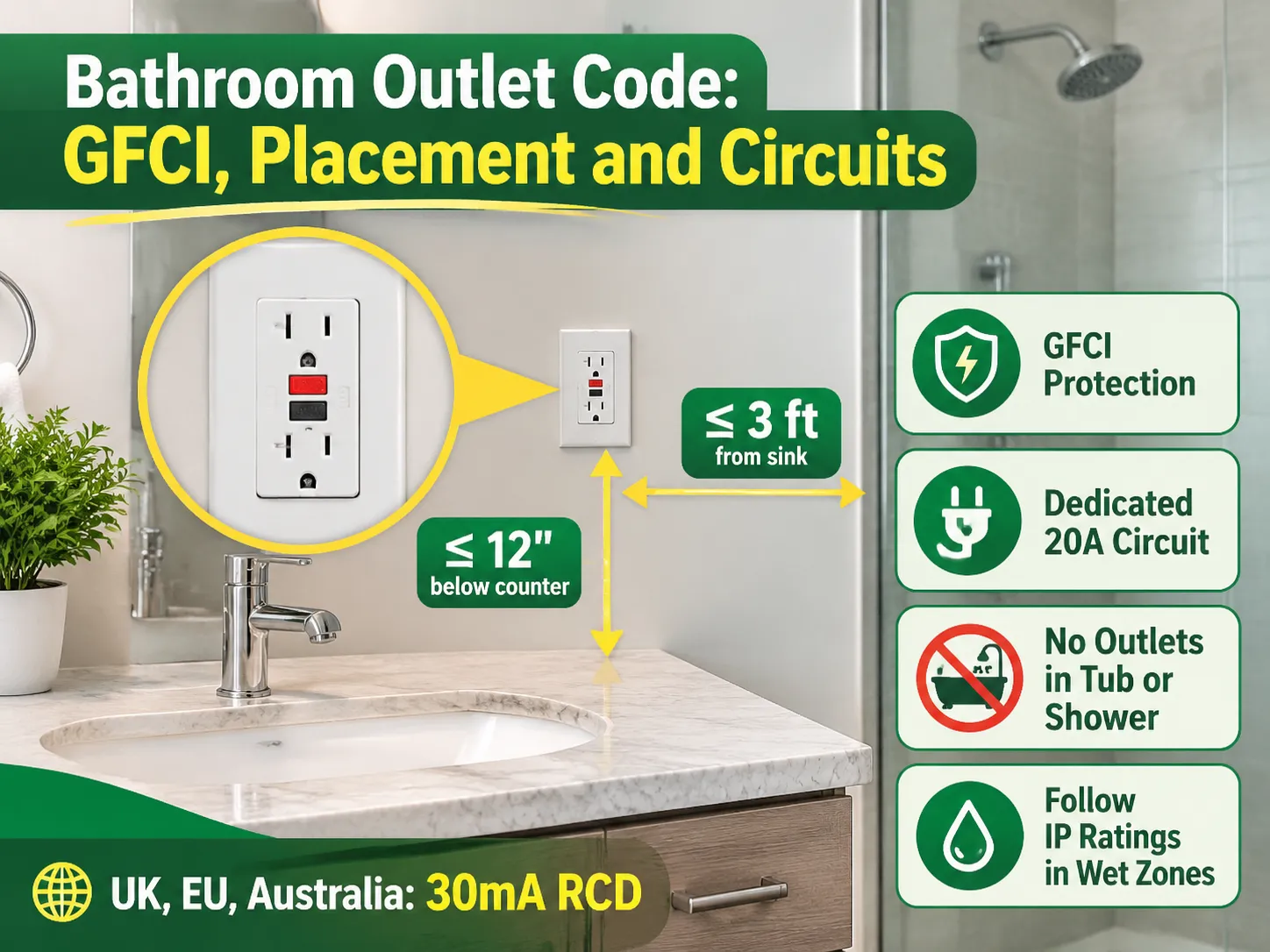
Resposta rápida: Nos Estados Unidos, toda tomada usada em um banheiro deve ter proteção GFCI (Interruptor de Circuito por Falha à Terra), e pelo menos uma tomada deve estar a até 3 pés da borda da pia/bacia, e não mais de 12 polegadas abaixo da altura da bancada. As tomadas do banheiro devem estar localizadas em circuitos ramais dedicados de 20 Amp (20A) usados exclusivamente para banheiros. Nenhuma tomada de banheiro pode ser instalada nas áreas da banheira ou do chuveiro. O equivalente ao GFCI da América do Norte é a proteção RCD de 30mA (Dispositivo de Corrente Residual) no Reino Unido, Irlanda, Austrália e UE. Onde tomadas comuns são instaladas em zonas úmidas, elas têm restrições, e as tomadas devem atender à classificação IP para a zona em que são instaladas.
O propósito do GFCI é monitorar a diferença no fluxo de eletricidade entre o fio quente e o fio neutro. Quando a diferença entre eles está entre 4 e 6mA, isso indica que parte da corrente escapou. Tipicamente em banheiros, isso significa que a corrente estava escapando através de uma pessoa que estava descalça em um piso molhado. O GFCI cortará a energia que flui para a pessoa (ou seja, uma pessoa em um piso molhado com os pés em contato com o chão) em questão de alguns milissegundos após detectar uma corrente elétrica escapando da tomada.
Existem três dispositivos que podem ser usados para cumprir este requisito. O primeiro é um receptáculo GFCI, que protegerá tanto a si mesmo quanto qualquer outro dispositivo conectado ao receptáculo e que será alimentado a jusante. O segundo é um disjuntor GFCI, que protege todo o circuito, e é a única opção que pode ser usada em situações onde não há um receptáculo GFCI para redefinir a corrente do GFCI para zero ou se o circuito é alimentado por uma fonte que não oferece a opção de usar um receptáculo (por exemplo, banheiras de hidromassagem). O terceiro é um GFCI “dead front”, que é um dispositivo instalado em um equipamento onde a eletricidade está sendo fornecida, mas o usuário do equipamento não está em contato ou em proximidade (por exemplo, quando o equipamento está em uma prateleira).
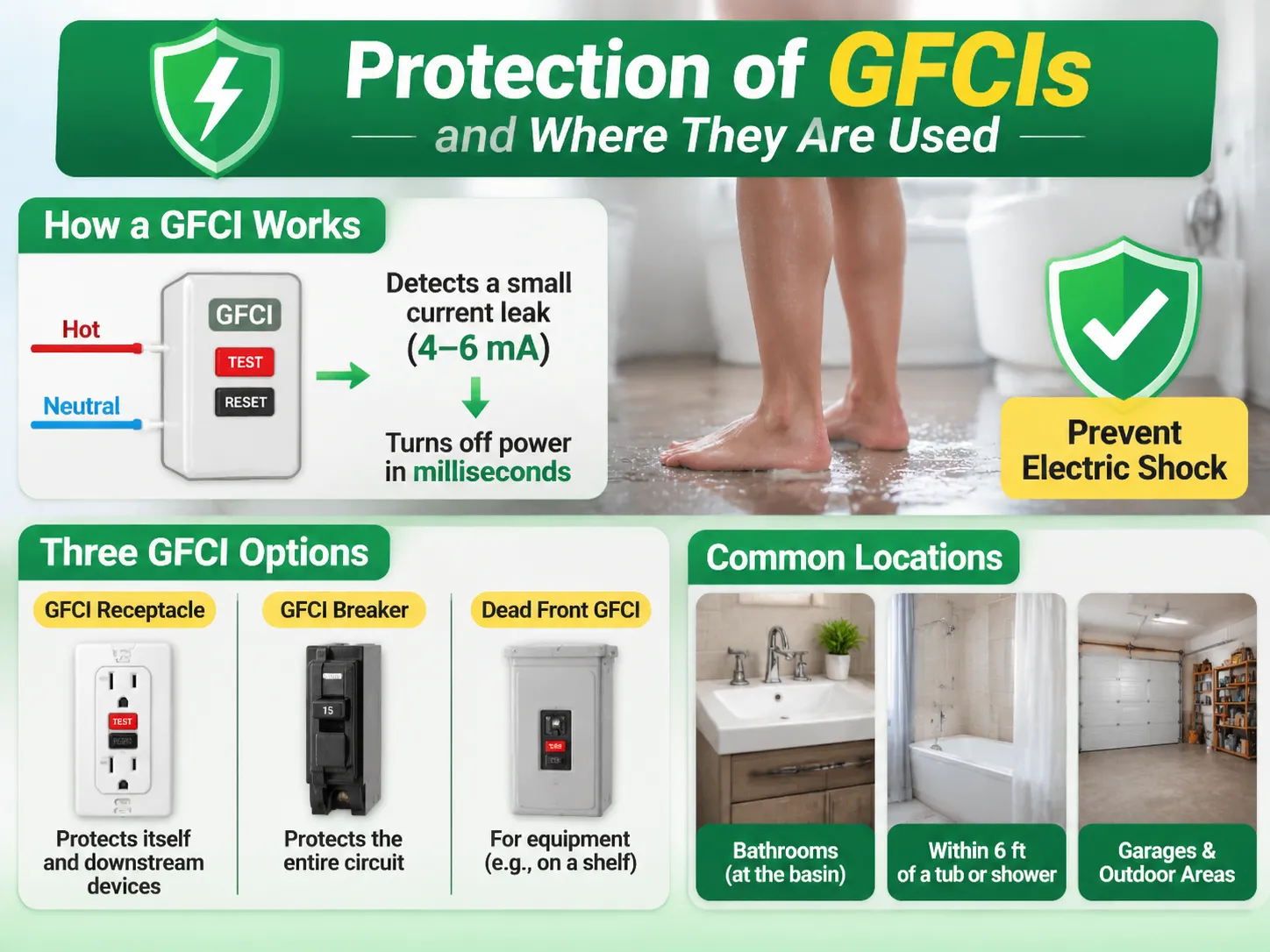
A escolha é importante por uma razão, que é onde o GFCI será redefinido. Um receptáculo GFCI localizado na pia é muito fácil de redefinir e fácil para o proprietário verificar mensalmente seu funcionamento, o que é a razão para ser o dispositivo GFCI predominante usado em trabalhos residenciais.
Um disjuntor GFCI (interruptor de circuito por falha à terra) é um dispositivo de segurança importante que previne sobrecargas de circuito no caso de uma falha elétrica. Os GFCIs estão localizados em garagens ou outros locais onde pode não haver espaço suficiente para colocar um receptáculo GFCI diretamente em frente ao aparelho protegido. Geralmente, um disjuntor GFCI desarma quando há uma falha elétrica no receptáculo GFCI que protege o mesmo circuito. O disjuntor desarma e direciona o ocupante para fora usando uma toalha quando o GFCI desarma, por isso você encontrará que a maioria das instalações de disjuntores ocorre em áreas com banheira ou ao longo de um circuito externo, bem como em casos onde um receptáculo está localizado atrás de um painel montado permanentemente.
O requisito para proteção GFCI se estende além da sala onde o aparelho está localizado. Por exemplo, qualquer receptáculo instalado a menos de seis pés da borda externa de uma banheira ou chuveiro deve ser protegido por GFCI, mesmo que o receptáculo esteja localizado em uma área que não se enquadra na definição de “banheiro”, como frequentemente ocorre em quartos onde há um receptáculo próximo a uma parede de encanamento compartilhada; nesses casos, o receptáculo está realmente localizado em um circuito de banheiro.
Entender como um receptáculo GFCI opera e por que o limiar de disparo de 5 mA está localizado onde está ajudará o consumidor a escolher a versão do receptáculo GFCI ou do disjuntor GFCI que melhor atende às suas necessidades. Uma explicação completa de como os dispositivos GFCI funcionam está disponível e é leitura obrigatória antes de selecionar a versão do receptáculo GFCI ou do disjuntor GFCI desses dispositivos.
O Regra dos 3 pés para pia relaciona-se com a distância da borda externa de uma pia até a tomada elétrica mais próxima horizontalmente. Portanto, é importante que você forneça uma tomada para todas as pias. Se você tiver uma bancada dupla com duas pias, então deve fornecer uma tomada para cada pia, e geralmente é possível satisfazer o requisito da pia fornecendo uma única tomada localizada entre as duas pias, desde que esteja dentro dos dois requisitos de distância. É importante notar, no entanto, que uma tomada localizada dentro de um armário de remédios não conta, pois não é considerada acessível no sentido pretendido pelo código.
Um detalhe que frequentemente é negligenciado pelos instaladores é a limitação de altura relativa às instalações de tomadas.
Uma tomada montada na face ou horizontalmente no gabinete da pia não pode estar a mais de 300mm abaixo do topo da pia. A altura acima da bancada pode ser média para uma tomada, que geralmente fica em torno de 1.100mm de altura e no mesmo nível central que outros acessórios, mas a maioria das pessoas tende a colocar suas tomadas de banheiro acima do nível do umbigo para que sejam fáceis de alcançar do chão.
Por exemplo, não há medição para a área da banheira e do chuveiro, mas sim uma restrição ou proibição para instalar quaisquer tomadas nessa área. Nenhuma tomada pode ser instalada dentro de uma banheira ou box de chuveiro, mas será avaliada pela área medida a 3 pés horizontalmente e 8 pés verticalmente a partir da borda superior da banheira ou do limiar do chuveiro.
A única exceção a esta regra é em um banheiro pequeno que não tenha muito espaço na parede. Neste caso, a exceção é limitada a uma tomada que pode ser instalada na parede diretamente em frente à banheira (e, portanto, próxima à zona úmida).
Também relacionado a essa geometria estão as luminárias. Semelhante à regra das tomadas, a configuração das luminárias é frequentemente confundida com as restrições de posicionamento das tomadas. Especificamente, uma luminária instalada sobre uma banheira também tem as mesmas restrições de posicionamento que uma tomada (3 pés horizontalmente e 8 pés verticalmente) e deve ser marcada para locais úmidos e molhados.
Quanto aos interruptores, eles devem ser instalados onde alguém não possa tocar simultaneamente em um acessório hidráulico e no interruptor.
Gosto de pensar na Regra do Circuito de 20A (e razão pela qual as tomadas de banheiro são diferentes) como um reflexo direto do secador de cabelo.
Uma unidade comum usa entre 1.500 e 1.800 watts, o que se traduz em 12,5 a 15 amperes em 120 volts; portanto, um circuito desse tamanho (15 amperes) sobrecarregará se alguém estiver secando o cabelo e assistindo televisão ao mesmo tempo, causando um desligamento imediato. O circuito dedicado de 20 amperes permite esse nível de uso sem que nada desarme desnecessariamente.
Para um circuito de 20 ampères, há duas coisas a ter em mente para evitar uma situação de sobrecarga: primeiro, o circuito precisa ser cabeado com cabo 12 AWG; e segundo, você pode ligar múltiplas tomadas juntas para um banheiro, desde que o circuito não sirva a nada fora do banheiro. Se você tem um único banheiro, de acordo com a exceção, a iluminação e o ventilador de exaustão poderão operar neste mesmo circuito devido ao fato de que um único banheiro é uma carga pequena; portanto, não há justificativa para executar circuitos adicionais.
Este segundo ponto dá origem a três considerações práticas sobre como esses circuitos operam. Se você instalar uma tomada de 20 A em um circuito de 15 A, a tomada não poderá operar. Isso significa que o circuito deve ser classificado da mesma forma que a tomada. Além disso, o neutro do circuito deve ser classificado para 20 A; isso é importante no caso de você ter usado um neutro compartilhado em uma instalação mais antiga. Finalmente, em uma situação com múltiplos banheiros, o circuito nunca deve ser conectado ao circuito de iluminação; caso contrário, se o circuito da tomada disparar, isso causará a escuridão em todos os banheiros, o que é o oposto do que o circuito dedicado pretende.
Ao trabalhar com banheiros, você encontrará cinco tipos de dispositivos. O que a maioria das pessoas pensa é a tomada duplex padrão.
Uma tomada duplex GFCI protege contra correntes de falha à terra na tomada; suas persianas se abrem quando ambos os pinos são inseridos na tomada. O custo das tomadas duplex GFCI varia de $18 a $30, e elas são mais comumente encontradas em banheiros localizados perto de pias.
Uma tomada duplex padrão não fornece proteção contra falha à terra; ela deve ser conectada a jusante de uma tomada GFCI ou de um disjuntor GFCI. A faixa de preço para uma tomada duplex padrão está entre $3 e $8.
Uma tomada GFCI com carregadores USB possui proteção contra falha à terra embutida, bem como capacidades de carregamento. Elas são tipicamente usadas em pias para carregar barbeadores elétricos e escovas de dente. As tomadas GFCI com carregadores USB geralmente custam entre $25 e $45.
Em banheiros europeus e australianos, uma unidade de alimentação para barbeadores fornece energia elétrica para barbeadores via transformadores isolados (como encontrado no Reino Unido/Irlanda). Elas se encaixam na Zona 2 em banheiros britânicos e irlandeses e normalmente custam entre $25 e $60.
Tomadas Schuko ou BS IP44 são classificadas para uso próximo à água e fornecem impermeabilização (ou seja, selam contra respingos), e portanto são tipicamente encontradas em banheiros europeus e australianos fora das zonas molhadas. Uma tomada IP44 geralmente custa entre $10 e $25.
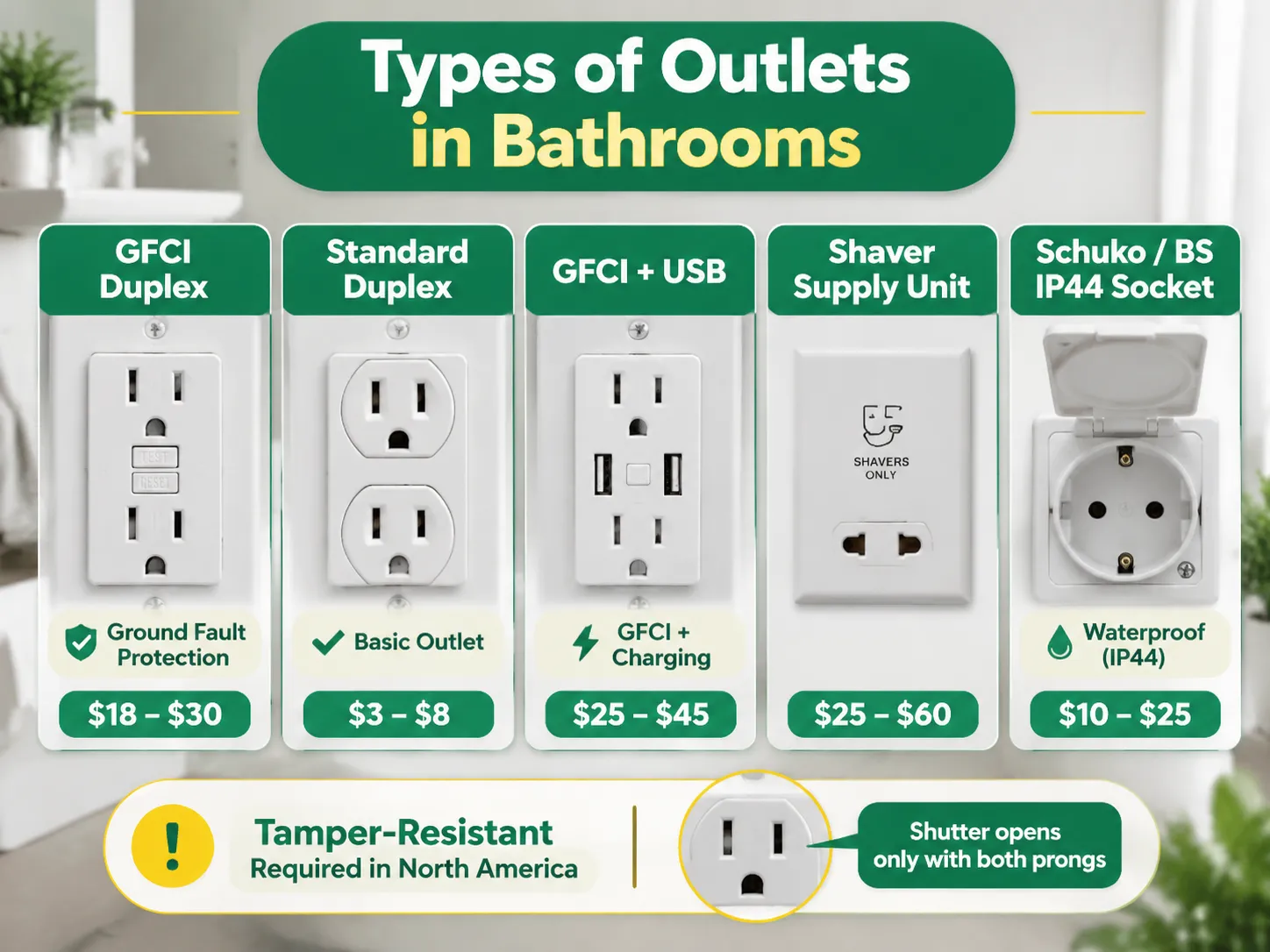
In North America, the code requires that if you replace or install any receptacles, they must include the tamper-resistant shutter. The shutter is spring-loaded and opens only if both prongs are inserted into it; you can expect to pay one or two dollars more for a tamper-resist receptacle over a normal receptacle.
| Outlet type | Preço típico |
|---|---|
| GFCI duplex receptacle | $18 to $30 |
| Standard duplex receptacle | $3 to $8 |
| GFCI receptacle with USB chargers | $25 to $45 |
| Shaver supply unit | $25-$60 |
| Schuko or BS IP44 socket | $10 to $25 |
| Tamper-resistant receptacle | one or two dollars more |
The last two rows of this comparison chart reflect what an average European (or Australian) consumer may see when shopping for receptacles. Most bathroom socket outlets in the UK do not have a general-purpose socket outlet at all; instead, UK bathrooms are equipped with shaver supply units that contain isolated transformers located in a zone designated as Zone 2. This is why a UK visitor searching for an electric hair dryer will look for a two-prong receptacle capable of accepting an electric shaver plug, rather than a hair dryer plug.
For orders by the thousand of projects using the American format switch and socket configuration and plate systems associated with NEMA, the first row is where you’ll find the countries of North America. A project order uses the NEMA configuration, and corresponds with the plate systems.
A device rated at 15A or 20A, must match the circuit being used. The relationship only goes one way. A 20A receptacle can be used on a circuit rated at 20A. A 15A receptacle will work too, because the 15A device is protected by the circuit rating and the load it will see. However, using a 20A receptacle on a 15A rated circuit is a defective installation because that device is rated for more load than the circuit can handle.
For bathrooms, the result is that using a 15A GFCI receptacle on a 20A rated circuit is both code compliant and very common. In fact, many 15A GFCI receptacles are rated for 20A feed-through configurations in any case; therefore the 15A designation is for the configuration of the receptacle only, and does not denote how much current can be passed to downstream receptacles.
The exception to this rule is if a dedicated appliance with a 20A plug is to be used, such as a large whirlpool heater, or a commercial hand dryer. In this instance, a 20A receptacle and a dedicated circuit are required. These installations should be specified separately, rather than assumed to be general bathroom outlets.
Every developed country mandates that all bathrooms use residual current protection, but they specify how this requirement will apply based on a variety of factors including device type, zone geometry, and how much residual current protection each will provide. Each developed market has a specific residual current protection for a bathroom but not all developed markets have the same residual current protection devices. In this case, the two differences are represented by the methods used to provide residual current protection.
| País | Protection method | Socket rule | Zone requirement |
|---|---|---|---|
| Estados Unidos | (a) 4 or 6 mA GFCI | (b) all bathroom outlets are standard duplex, (c) TR is mandatory | Receptacles are not allowed in the tub or shower area. |
| Ireland & UK | 30 mA RCD on circuit | ordinary socket limited; wall-mounted shaver unit in zone 2 | BS 7671 defines zones 0, 1, and 2 by distance from water. |
| UE | 30 mA RCD, with some circuits limited to 10 mA | IP44 socket is allowed outside of the risks of water | IEC 60364-7-701, IPX4 in zones 1 and 2. |
| Australia & NZ | 30 mA RCD | any socket outlets must have IP rating | AS/NZS 3000 zone geometry and IP rated accessories. |
| Gulf States & Middle East | 30 mA RCD | BS or Schuko minimum IP44 socket outlet | IEC zone geometry; frequently enforced by consultant. |
The primary differences between the North American and European approaches to residual current protection are (1) North America protects a low number of areas at risk due to proximity to a sink, whereas (2) Europe protects the entire entire installation at 30 mA and relies on the IP rating of the equipment at the risk area.
This may clarify why a European bathroom can include an electrical socket while a North American bathroom uses a device that must be specifically designed for use in North America due to their differing country codes and standards related to the required or acceptable product used in each of these regions.
The plug types also work under the same rationale. In North America, an electrical socket in a bathroom is typically a NEMA 5-15 or 5-20, while in the UK it may be a shavers socket, in Germany it may be the Schuko style with a hinged cover, and in Australia it would be a Type I with a weatherproof cover. The reason the various types of plugs in North America require separate electrical sockets is because of electrical requirements and code restrictions for each style of plug.
Most bathroom installations fail to pass inspection for six reasons related to something other than the device itself. A GFCI outlet must be the first receptacle in a circuit so that all of the downstream receptacles on the circuit are also protected. If installed in a location that cannot be accessed by an electrical plug tester (such as in a cabinet), a GFCI will be unable to provide a test signal. If a GFCI outlet is installed without an equipment ground, a plug tester will not be able to test the GFCI. A GFCI outlet installed on a 15 A circuit would not meet the minimum requirement of being a dedicated 20 A outlet. A GFCI outlet located within the bathtub zone is prohibited, and therefore may not count toward the total number of receptacles required for a bathroom. Finally, a GFCI that has been painted over is considered a defect and indicates that no testing has been performed on the device since it was installed.
A seventh reason, which is not necessarily a code violation, but is also a practical issue, is the insufficient depth of the outlet box for the specific type of GFCI being installed.
GFCI receptacles are designed to be deeper than standard duplex receptacles; therefore, If the electrical box installed in the wall during the tile installation is too shallow to allow for proper installation without excessive protrusion of the plaster ring, it will be more expensive to fix than simply checking the depth of the box prior to the installation of tile.
Another consideration is the cable used. To supply a 20-amp circuit in a bathroom, 12 AWG cable must be utilized, and this presents an issue to home builders as the 12-3 cable contains three conductors instead of the normal two. Additionally, extra unused conductors within a box must be properly terminated, rather than leaving them cut off at the back of the box.

What separates a bathroom-rated product from a non-bathroom rated product? Four main things must be considered when selecting a bathroom rated product’s listing to the appropriate standard, counterfeiting is an actual issue on some internet-based sales sites. The shutter mechanism of the tamper resistant outlet must be installed if required by the local electricity code. The terminals’ design must provide better torque retention than backstab connections, as a bathroom outlet sees more plug/unplug activity than any other outlet. Lastly, the plate of the bathroom outlet should be stainless steel or brass. Plated metal will show watermarks as compared to moulded plastic.
When selecting a brand in this category, it is generally less about performance and more about having the correct product available. For example, the larger brands in the United States, such as Leviton, Legrand, and Hubbell, have a complete selection of the many variations of GFCI, TR, and USB products available.
Due to lower cost, manufacturers in China will typically provide the same products as manufacturers in the USA but with one key difference: the product must be listed for the specific market into which the item is being supplied.
Our manufacturing is on the “wholesale project” side of the equation. We produce receptacles and switches for wholesale and project supply, also producing tamper-resistant duplex and GFCI configurations to accommodate both European plate configurations and North American plate configurations, and we are a component manufacturer, not a lighting manufacturer, so our catalogue is organised by device and plate configuration rather than room.
When we tell potential customers what to check prior to purchasing a device, we advise to check the listing, the plate type, and the type of GFCI (self-test vs. non-self-test). A Self-Test GFCI performs an internal check every few seconds (on the power supplied to it) to confirm that it is functioning correctly, and if the device fails, it will lock out. This is the only way to know that your GFCI installed in a bathroom for 8 years will still work when it is needed.
When it comes to compliant lighting, fans, and switches, all three of these devices share the same room, but they have different requirements. The luminaire must be approved for use in a damp location over the bathtub, and any surface that may receive water spray of any kind also needs to be compliant. The fan must be vented to the exterior of the building and never to the roof structure, and on the circuit for the bathroom, it will consume its 20-A of power; therefore, it shares the circuit with the two other devices in the same room.
In the North America, bathrooms require GFCI receptacles. These outlets must also meet any Tamper Resistant requirements set forth by the local jurisdiction. They must be installed on a dedicated 20-amp circuit, with at least one GFCI protected receptacle located no more than 3 feet from each sink or washbasin. In the United Kingdom and Ireland, bathrooms generally require Shaver Supply Units, which should be located in Zone 2, and should not be regarded as General Socket Outlets (unless an extension lead is permitted), and should be connected to a 30mA RCD.
For North America, the typical designation of the protective device is GFCI receptacle or duplex GFCI/TR; the equivalent in the United Kingdom is known as shaver socket or electric shaving supply unit; the common name in Europe and Australia is IP44 socket outlet with RCD upstream protection; so essentially the names are indicative of the method of protection and the type of enclosure in which they are housed but all products perform the same functions regardless of geography.
The circuit must be rated at 20 amps; this means a 15 amp GFCI receptacle (the receptacle outlet listed here) on the 20 amp circuit is allowed and is the standard. A 20 amp receptacle outlet will only be used to receive power from a device that has a 20 amp plug, i.e., large hot tub heaters. A 20 amp receptacle must not be installed on a 15 amp circuit.
The three requirements for bathroom receptacle outlets are: (1) GFCI; (2) at least one receptacle within three feet of the outside edge of each basin and no more than twelve inches below the counter; (3) all receptacle outlets must be installed on a dedicated 20 amp bathroom circuit. No receptacle outlet is permitted to be installed inside a bathtub or shower stall.
The only exception to this is where the dedicated 20 amp circuit serves only a single bathroom. If that is the case, both the lighting and fan may be installed on the same dedicated 20 amp circuit for that bathroom. A dedicated 20 amp circuit may not serve any other room(s).
According to the base National Electrical Code, AFCI protection is not required for bathrooms; instead, the requirement for GFCI protection specifically addresses risks of electrical shock. However, some states have amended the National Electrical Code to require AFCI protection on all dwelling circuits, therefore; a dual-function breaker will provide both protections.
There are three requirements which govern the installation of bathroom receptacle outlets, and there is one prohibition. These requirements are GFCI protection, a receptacle outlet located within 3 feet of the outside edge of each basin, all receptacle outlets shall be connected to a dedicated 20 amp circuit, and no receptacle outlet shall be allowed to be installed within a bathtub or shower stall. All other information in this article is additional detail supporting the four requirements above.
The detail that ultimately determines whether the installation will remain successful is located at the location of GFCI protection. Locate GFCI protection where it is easily accessible; routinely test the GFCI protection monthly and consider purchasing a self-testing GFCI if your budget allows; keep in mind that the failure of GFCI protection systems typically occurs without any audible or visible indications; therefore the room generally has no indications of danger present.
Each of these rules is reviewed in more detail below. The geometry of receptacle placement, the dedicated branch circuit requirement, receptacle types that meet the code, 15A and 20A questions, differences among countries with regard to the rules, installation details that do not pass inspection, what to consider when buying a product, lighting and fan […]

Dubai – Mercado fácil para comprar dispositivos de fiação e mercado difícil para selecionar o(s) dispositivo(s) de fiação correto(s) para uso em qualquer projeto. Todas as marcas internacionais têm ampla representação em Dubai; a entrega dos produtos pode ocorrer dentro de uma semana após a realização do pedido; e a qualificação para passar na inspeção da DEWA é obtida por todos os fornecedores com base na DEWA […]

A ground fault circuit interrupter is the only appliance in the house that it is failed in a visible manner. It disconnects at an unexpected time, does not initiate re-setting, or give up after years in the service leaving an illusively safe circuit. Most issues searched by the customers fall into four categories of buyer’s […]

 No.6 Tuozhan Road, Leshang Pioneer Park, Yueqingwan Bay Harbor, cidade de Yueqing, província de Zhejiang


