

If you know the two round-pin rules, you will find Spain is one of the simplest places in Europe to keep your devices charged and connected, as countries across the mainland have the same plug sockets. Those travelling to Spain from the UK, USA, and Asia require just a single adaptor. This article explains all you need to know about Spain’s plug types and the 230V/50Hz power supply, which countries are compatible and which aren’t, and what you should take with you to Madrid, Barcelona, Seville, or the Costa del Sol.
Spain has a standard of Type F sockets (Schuko), which have two rounded pins and ground contacts on them. In addition, Spain allows Type C plugs (Europlugs), which are also the same rounded two-pin plugs, which makes it unnecessary for most European travelers to use an adapter. The power supply in Spain is at 230 volts and 50Hz, which is the regulation throughout Europe. British and Irish travelers using Type G must use adapters, as do US and Canadian tourists (Type A and B), those coming from Australia and New Zealand (Type I), as well as Japanese tourists (Type A and B).
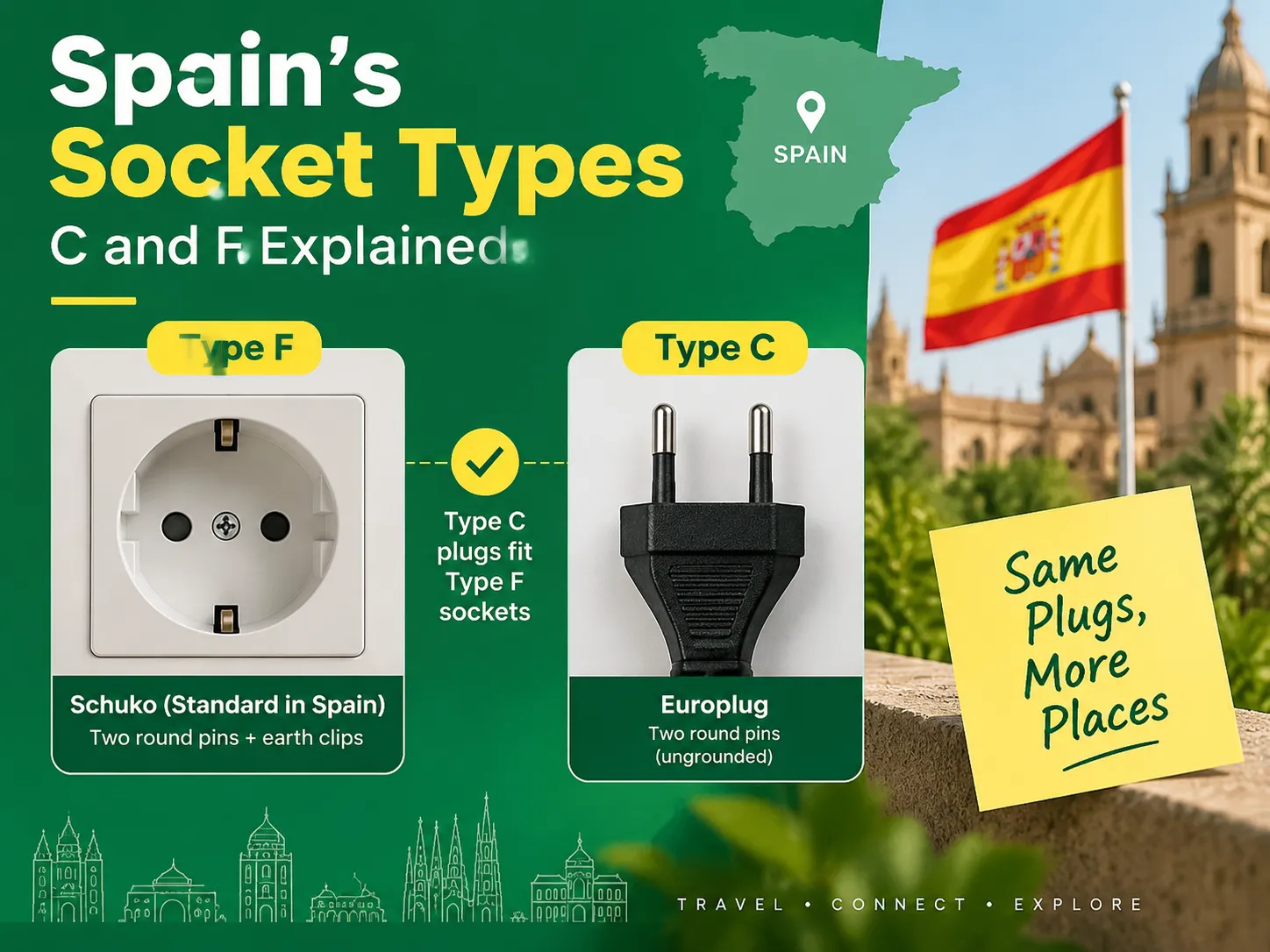
Two types of electrical sockets are utilized in Spain, and here’s the connection between them:
Most sockets in the country are the recessed type of Schuko socket and practically all the latest Spanish sockets support both types of plugs.The socket-family logic — why continental Europe standardized on round pins while the UK chose rectangular — parallels the way the different kinds of switches evolved for the same systems.
Spain uses 230 volts at 50 hertz, which is the same voltage and frequency as the rest of Europe and Great Britain. The power grid is stable and well-established, with Red Eléctrica being in charge of its operation.
The voltage is more significant than the shape of the plug. All devices from the UK and Europe work in Spain right away since they only need an adapter for their plug type. Devices from the United States or Canada need to deal with a voltage of almost double their home voltage. Each plug should have its own label on it stating its input voltage.
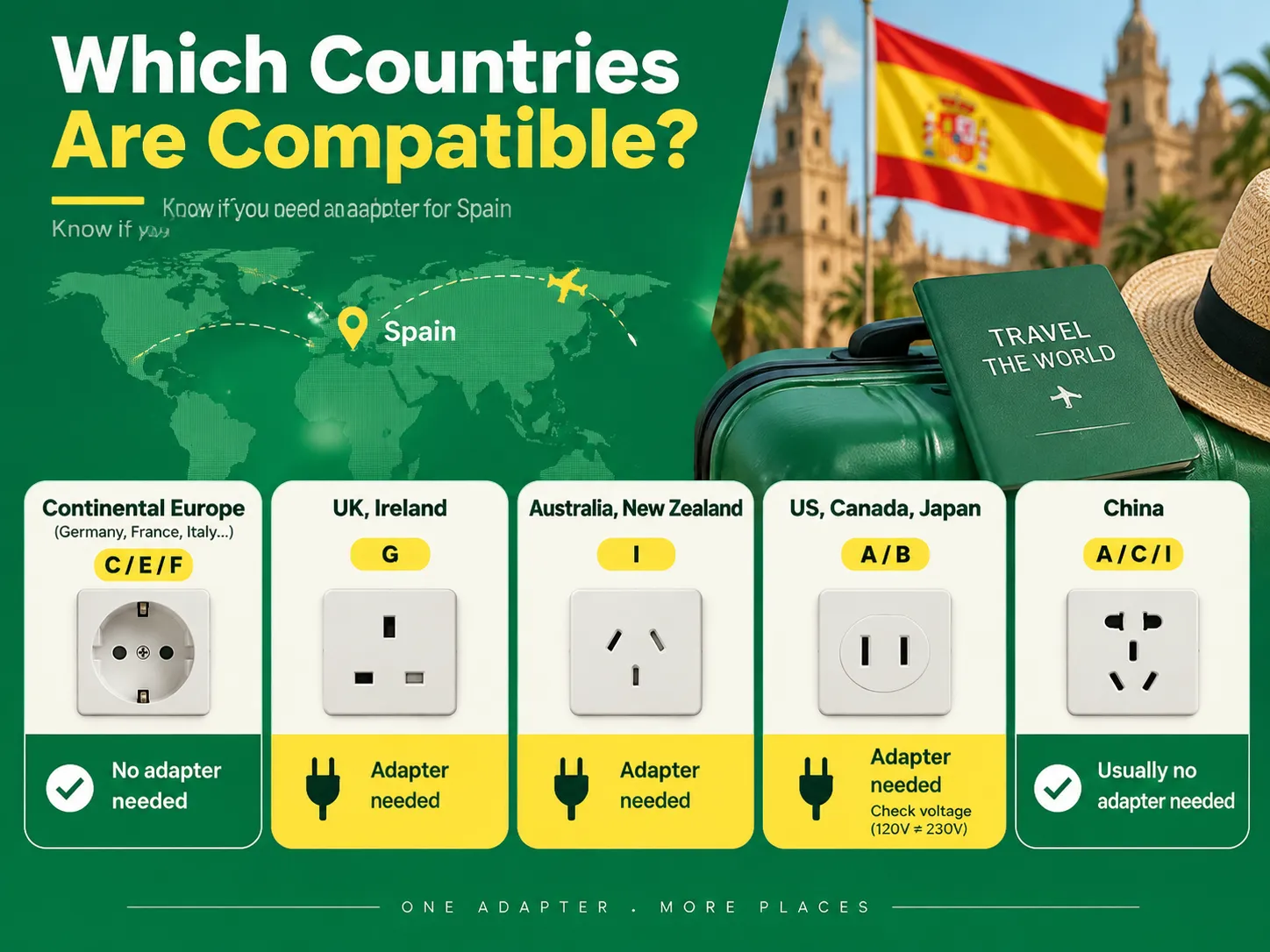
| Traveler From | Plug Type | Adapter Needed? | Voltage Safe? |
|---|---|---|---|
| Continental Europe (Germany, France, Italy…) | C / E / F | No — plugs fit directly | Yes (230V) |
| UK, Ireland | G | Yes — Type C/F adapter | Yes (230V) |
| Australia, New Zealand | I | Yes — Type C/F adapter | Yes (230V) |
| US, Canada, Japan | A / B | Yes — Type C/F adapter | Check label — 120V-only devices need a converter |
| China | A / C / I | Usually no (C plugs fit) | Yes (220-230V) |
Spain is located in the center of the best electrical compatibility region in the world: the European type of two-pin plug works in Spain, and a universal adapter configured for the European position can be used in Spain, Portugal, France, Germany, Italy, and almost all of the continent. Watch out for the exceptions: the UK rectangular Type G pins (always need an adapter) and the US double flat pins (need the adapter and a voltage check).
The issue involving the Type C versus Type F plug is the most common source of confusion. The answer, though, is quite simple:
In Spain, this means that if you use a charger fitted with a widely used slim European two-pin plug (the vast majority of chargers for phones, laptops, or cameras sold in Europe), it will fit into any Spanish wall socket. If your device is fitted with a grounded Type F plug (most large appliances, some power bricks), you need a Type F socket. And if your device works on a UK Type G or US Type A/B, you need an adapter to convert it to the European shape. If you are traveling onward to the UK as well, the socket and voltage picture changes completely — the hardware family differences are exactly what the light switch replacement guide and socket guides cover when you are working with these systems at home.
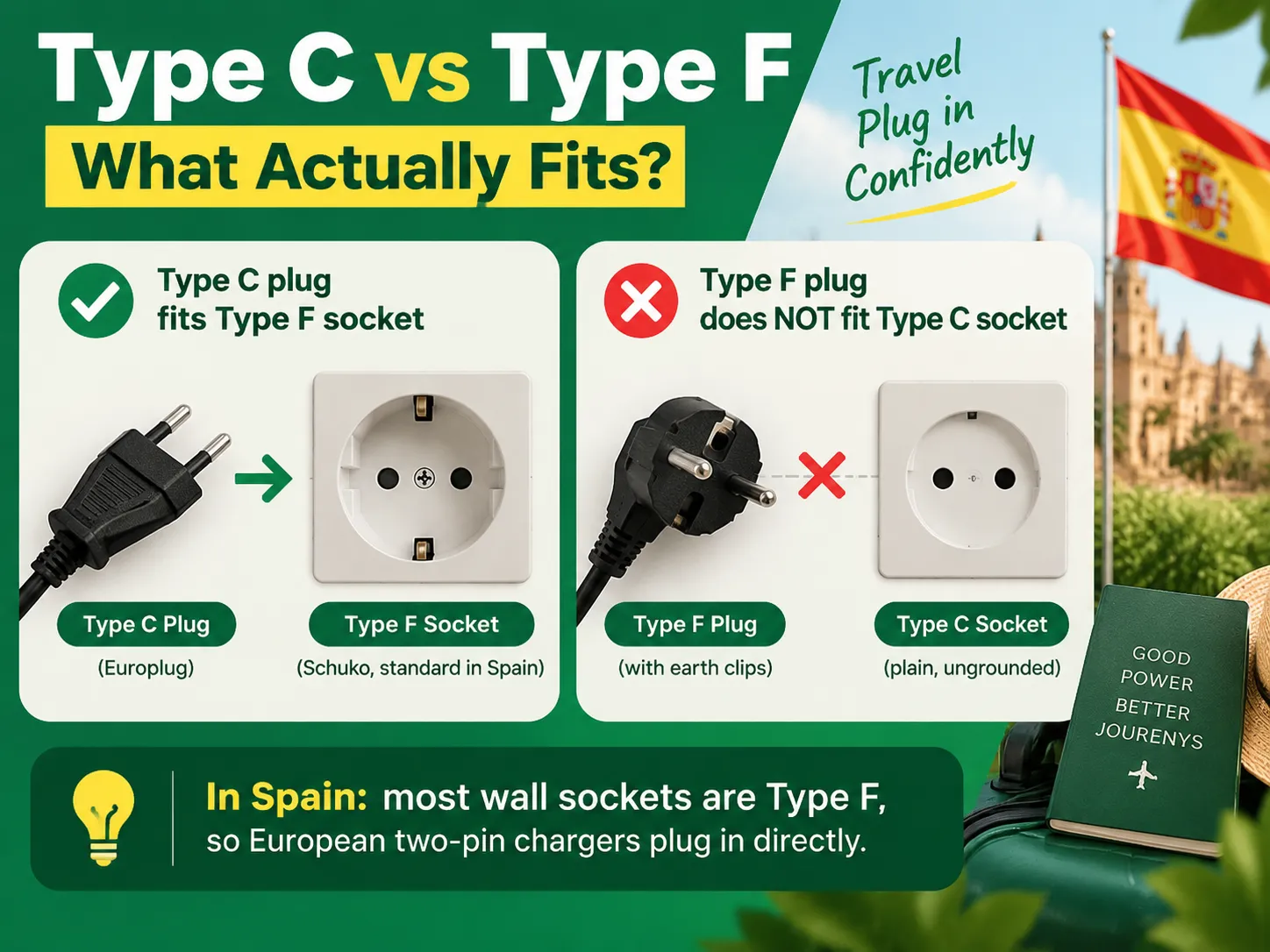
Gadgets differences highlight the importance of the electrical system:
In compliance with the mentioned rules regarding the devices used in Spain, dual-voltage device would work fine with a euro plug converter while single voltage heating device should not be transported to the country. However, the best solution for a lot of tourists is an all-purpose converter with the appropriate Euro (types C and F) plugs and several USB ports included — it ensures compatibility with the electrical system in Spain and travels throughout Europe. If you are coming from a country whose sockets you find limiting at home too, the modern hardware answer is the same family — USB wall outlets and fast-charging sockets are now standard upgrades, and the USB wall outlet fast-charging guide explains the options for your next renovation.
And if you are the kind of traveler who notices how much smoother life is with modern sockets, the same standard applies at home: replacing an aging wall plate with a USB-equipped outlet is a straightforward job, and the why upgrade to USB outlets article makes the case for it — the hardware on your walls should be as modern as the phone you carry.
Those visiting from Ireland, the United States, Canada, Australia, or New Zealand will need to carry an adapter with European outlets — the Type C adapter for the charger or an all-in-one adapter with an option for the European outlets. People traveling from continental Europe won’t need any adapter since their plugs will be suited for the Spanish Type F sockets.
The plug for the wall sockets in Spain is known as the Type F plug which has two round holes with side ears that latch on. This plug also accepts the type C plug. Practically, however, Type C plugs will fit perfectly fine in a Type F socket since both can take the same plugs.
Yes, the Type C plug can fit into the Type F socket — this is why many types of European chargers are widely used all over the continent. The reverse, however, is not the case — the Type F plugs won’t fit in the Type C sockets because of the built-in ear at the sides of the plug.
No, the Spanish ones have Type F/C round shape sockets that work with 230 volts and 50 Hertz and the UK has Type G square shape sockets that work with the same voltage. The sockets are similar in voltage, but they do differ in shape — this means that British travelers in Spain or vice-versa will need to get the other type of adapter.
Spain’s power system is the most universal among those of the countries on the continent: it uses the type F socket which accepts the type C plug, the voltage of 230 volts and the frequency of 50 hertz that conform to the rest of Europe and to the average UK voltage and its voltage compatibility chart that allows travelers from Europe to travel without any electrical devices at all. The rule can be summarized like this: to travel from Europe you don’t have to take anything with you; British and Australian tourists need only type C/F adaptor, while American, Canadian or Japanese passengers need an adaptor and check all their chargers for the label “100-240 V.” The only thing that can get travelers in trouble is the voltage, because it is not the shape that destroys the US hair dryer, but rather the 230V used at the socket. If you understand the connection between type C and type F and know how to read the labels, you will not encounter any problems in Spain. In fact the power system of Spain was designed for travelers from all over the world with more than 85 million people annually visiting Spain.

The term “07984 lighting consultants” gives people the impression that the five digits represent a postal code of some sort that indicates the place where lighting consultants provide services. This is, however, incorrect: there is no postal area coded 07984, which is only a code of mobile telecommunications in Great Britain. This means that the […]
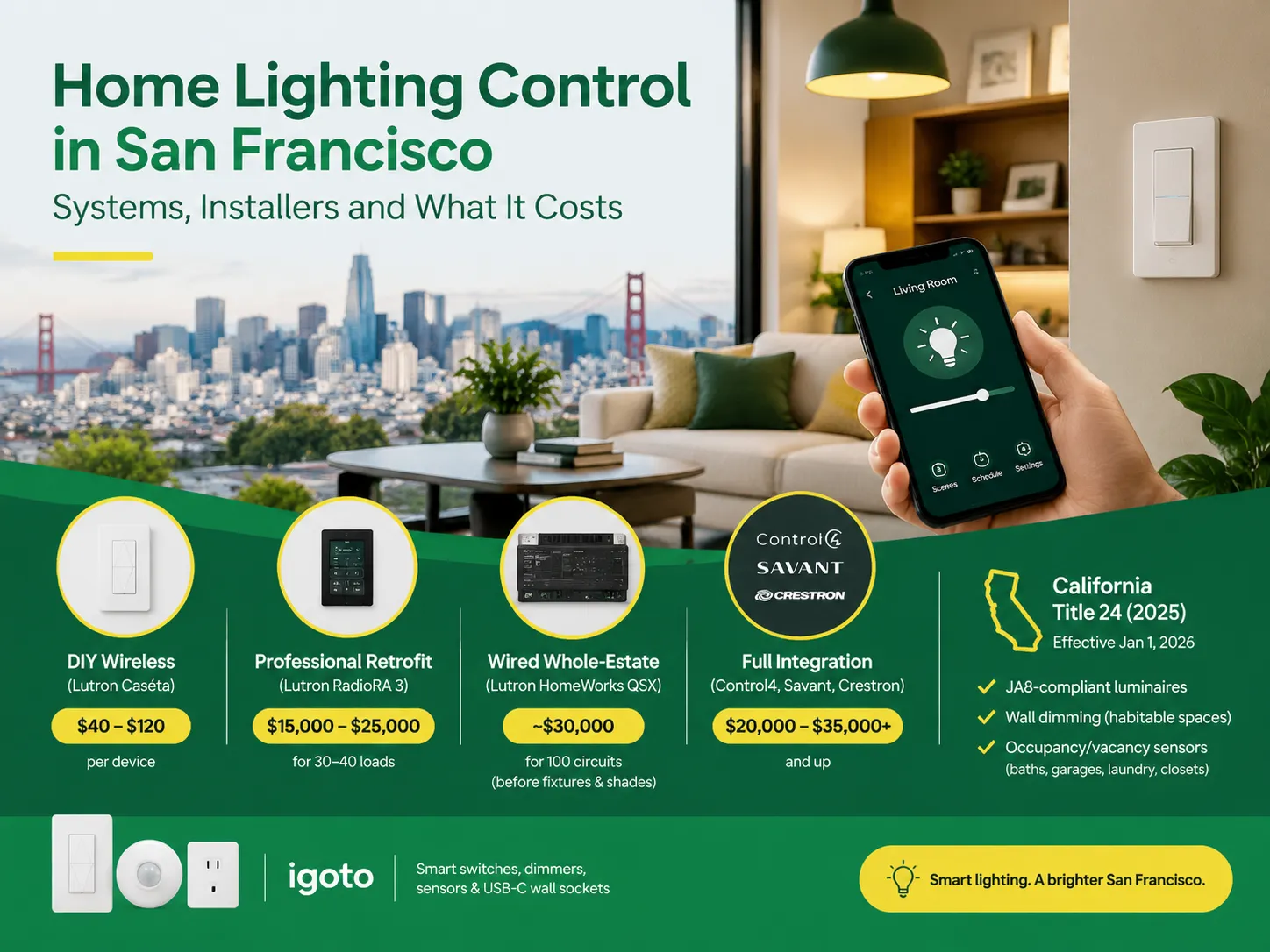
San Francisco is not the average lighting control market. The housing stock is old and dense, and the electrical code does not allow for as many electrical installations as is allowed almost anywhere else in the U.S. Most homes that want complex lighting are Victorian or Edwardian buildings where no one wants to start opening […]
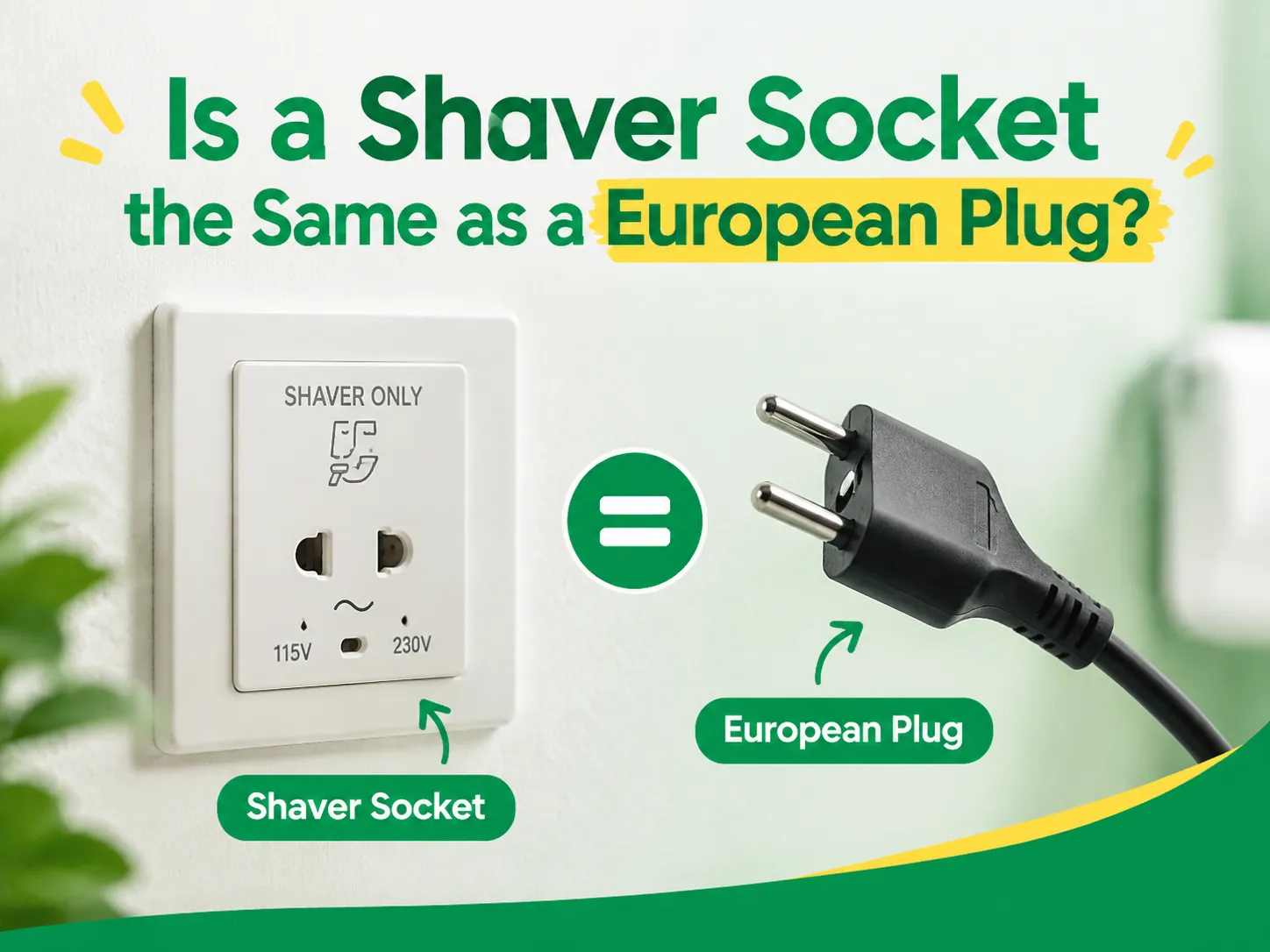
Although they seem to be alike, they both have a round shape with two pins, and they function at a voltage of 230V. This explains why some tourists use a European plug with a British shaver or wonder why a shaver cannot be plugged into a Schuko socket in a Spanish hotel. In reality, they […]

 No.6 Tuozhan Road, Leshang Pioneer Park,Yueqingwan Bay Harbor,Yueqing city,Zhejiang Province


