

The term “07984 lighting consultants” gives people the impression that the five digits represent a postal code of some sort that indicates the place where lighting consultants provide services. This is, however, incorrect: there is no postal area coded 07984, which is only a code of mobile telecommunications in Great Britain. This means that the request is in fact about lighting consultants whose services are provided using mobile telecommunications. These services consist of self-employed lighting consultants, small firms and individuals doing this work on a freelance basis, which cover approximately 75% of the UK lighting market. The guide specifies the meaning of 07984 and defines the UK lighting consultancy market, providing a list of five companies in the area, indicating what lighting consultants offer, how much they charge, what control layer of design and lighting fixtures consists of, and how it can be proven.
In brief, the digits 07984 are not a postal code, but actually signify the prefix of mobile phones in the UK. The numbers starting with 07 do not indicate the particular location of a business. Among the companies usually advertising contact numbers are independent designers, small design studios, and private companies involved in lighting design in the UK. The lighting design market consists of four main groups: lighting design agencies, engineering companies having their own lighting departments, electrical contractors also engaged in design and build activities, and companies specializing in lighting installation. Also, a great importance should be attached to the experience of lighting designers one might be interested in.
The communications regulator Ofcom in the UK takes care of allotting the ranges of numbers to various communication providers. The prefix 07984 happens to be one of the prefixes of mobile numbers. All numbers in this block belong to EE Limited and remain being a mobile number whichever network they belong to, as porting of UK mobile numbers is allowed, and the origin of a number does not indicate who the holder of the number is today.
It is necessary to highlight the practical implications of this situation clearly. The number starting with 07984 is not an area code; area codes for landlines start with 01 and 02 and can be traced back to the location of the line. It costs to call an 07984 number at mobile rates as it is considered to be mobile number which is why tradespeople and small companies use mobile phones for business purposes. Consequently, the businesses with the number 07984 are small businesses, often consisting of one designer working on freelance basis or a small studio employing two or three people.
This may seem like a limitation, but in fact, it is quite a convenience. For instance, in UK lighting a designer owning a mobile phone will work on the project personally, while in bigger companies the work will be carried out by a less experienced team. A more important aspect is the professional background of a designer and his or her portfolio.
There is not a single career in lighting in the United Kingdom and identifying the proper kind of supplier required for a given project avoids a wasteful expenditure or a project that flops in commissioning.
| Provider type | What they do | Best suited to |
|---|---|---|
| Lighting design consultancy | Concept design, photometric calculations, fixture specification, drawings, site supervision | New build, refurbishment, hospitality, high-end residential, retail and public projects |
| M&E engineering practice with lighting team | Lighting as part of a coordinated building services design, including power, ventilation and compliance | Commercial, education, healthcare and any project with a full consultant team |
| Electrical contractor offering design-and-build | Combined design and installation, usually with in-house or supplier-supported specification | Domestic refurbishments and small commercial work with modest design ambition |
| Independent designer or sole practitioner | Direct involvement from concept to commissioning, working alongside the client’s electrician | Houses, apartments, small restaurants and clients who want the designer on site personally |
| Control systems integrator | KNX, DALI, Casambi and proprietary control programming and commissioning | Any project with scene control, central management or building management integration |
| Wiring device manufacturer | Supply of switches, sockets, dimmers and plates, with load ratings and certification documentation | Every project — and often the source of the compatibility data that makes the scheme work |
In domestic work, the device layer is more important than it looks according to the calendar. Light is experienced through the elements that the user comes into contact with, and if the room is filled with dimmer switches or a plate range does not follow the style, the effect made by the lighting will be ruined.Choosing the right family of switches and sockets is therefore part of the lighting specification, not separate from it — a point developed in the discussion of the categories of electrical switches used in installations.
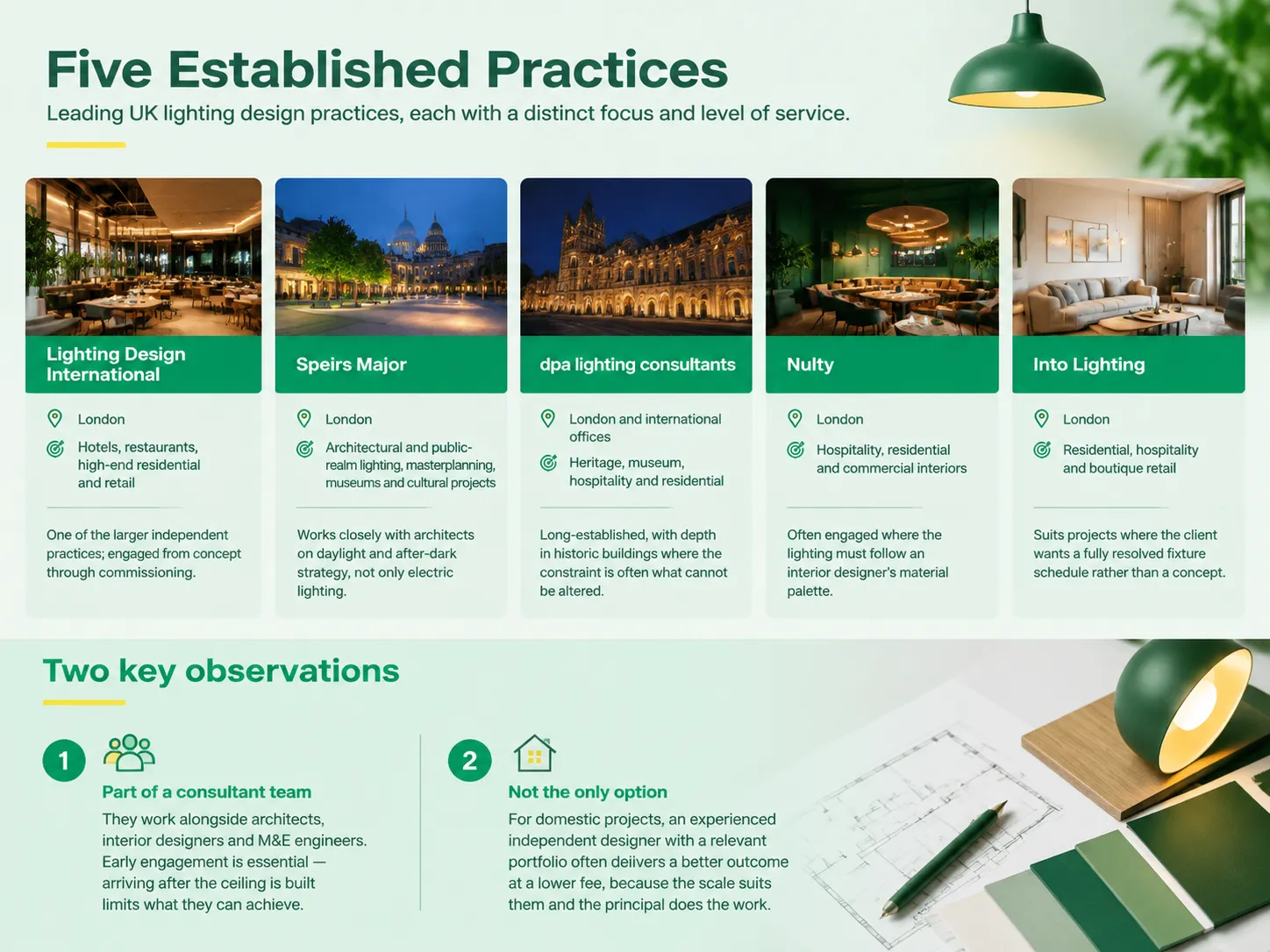
The UK contains few recognised lighting design firms, as well as many independent designers. The five companies you will see below have been in existence for a long time, and they represent different fields and pricing. Neither of these firms is connected to 07984.
| Practice | Base | Characteristic focus | Notes |
|---|---|---|---|
| Lighting Design International | London | Hotels, restaurants, high-end residential and retail, with substantial international work | One of the larger independent practices; typically engaged at concept stage and retained through commissioning |
| Speirs Major | London | Architectural and public-realm lighting, masterplanning, museums and cultural projects | Works closely with architects on daylight and after-dark strategy, not only electric lighting |
| dpa lighting consultants | London and international offices | Heritage, museum, hospitality and residential work; one of the longest-established practices in the field | Depth in historic buildings, where the constraint is often what cannot be altered |
| Nulty | London | Hospitality, residential and commercial interiors, with a strong interior-design collaboration model | Often engaged where the lighting must follow an interior designer’s material palette |
| Into Lighting | London | Residential, hospitality and boutique retail, with a detailed, specification-heavy approach | Suits projects where the client wants a fully resolved fixture schedule rather than a concept |
There are a couple of points to make regarding this tier. First, practices typically function within a team of specialist consultants including architects, interior designers, and M&E engineers, and in this case, the fee structure reflects the fact that they are engaged at a relatively early stage — once ceilings have been constructed, there isn’t much of interest they can offer. Second, alternatives exist. In a domestic project, an experienced independent designer with a portfolio in the same category will often produce better results for a lesser fee, because the scale of the project is within their control and the principal does the work.
The deliverables of a lighting consultant include a written document just as importantly as a design.
It is undoubtedly the commissioning stage that is most likely to be overlooked at the beginning and that will also be sorely missed when it does not come about. Whether it is a dimming curve that needs adjusting, a light fixture aimed at the wall instead of at a table, or a scheme that is too bright for evening use, all of these factors can distinguish a good design concept from that which has been lit according to some general assumptions.Getting the control layer commissioned properly is a technical exercise in its own right, and the practical sequence is described in the account of installing and setting up a dimmer switch.
Lighting design is charged in four ways, and which one applies depends on the practice and the project size.
| Basis | Indicative range | When it is used |
|---|---|---|
| Hourly | £75-150 per hour | Small commissions, consultancy, second opinions, additional site attendance |
| Day rate | £400-900 per day | Short engagements with an undefined scope |
| Fixed project fee | £2,000-15,000 for a substantial house; more for hospitality | Standard for domestic and small commercial work |
| Percentage of construction cost | Roughly 1-3% of the lighting or electrical contract value | Larger commercial, hospitality and public projects |
There are four factors underpinning this case. The distinction between types of spaces and lightings can serve as an element that is instrumented to arrive at the design fee. When it comes to the level of involvement of the practice in the delivery of the services to the client, one can find the practice either involved in supervision and commissioning of installation or having handed the project over after issuing the specs. The design fee also depends on the building type: listed buildings and kitchens with strict hygiene regulations take a longer time to design than open-plan living rooms. And finally, the complexity of the control system also plays a critical role: KNX or DALI installations require thorough programming and commissioning, while a basic switching system doesn’t.
Finally, there’s also a cost that is rarely anticipated. The wiring devices that are to be used in the system can often be lost to oversight. For instance, having several dozen control points in a design means the same number of switches and/or dimmers, with delivery of required finishing, and a great deal of time needed for the delivery of the elements.Documenting load ratings, finishes and certification for these devices before ordering is a small discipline that prevents a large problem, and the criteria involved are set out in the approach to selecting an electrical switch and socket manufacturer.
The occupant utilizes the switches to control the lighting of their space, despite what the design may indicate. This implies that the control aspect will be reflected at the specification stage of the project and will produce its effect on the perception of the completed result.
There are three technical questions covering most of the aspects related to the control layer. What is the overall load of each circuit in terms of the output power, and whether it fits into the dimmer LED rating, rather than the incandescent? How many circuits should each plate support, and whether the gang count corresponds to the plate range? Is there a neutral in every switch position since it is decisive in terms of the type of the dimmer used (two- or three-wire) as well as impacting the operation of the lights? Answering these questions at the specification stage technically costs nothing; however, finding the answers at the second fix may require additional charges.
The fixture and dimmer should also be viewed as a single system rather than a pair of physical items. There is a significant difference between the LED drivers in terms of their performance with a chopped power supply, and the dimmer working well with one type of downlight of one company may fail to operate with the product of another company the same good way. In a situation when both are specified in the schedule, compatibility should be checked using the available information or by testing the sample before placing an order.
Acceptance is the stage when it is determined whether delivered installation met design requirements, so it has to be planned and not improvised stage.
Where devices are found to be defective or mismatched at handover, replacing a switch or socket is a short job provided it is done properly, and the safe working sequence for any wiring device is the same one described in the guide to replacing a light switch. At this level of sophistication, we should remember that installation is complete not with the switch of any light. It is complete with the predictable functioning of all control mechanisms as well as reliable documentation provided to other personnel for the maintenance of installed devices.
Lighting is seldom the only electrical parameter used in any project, and new designs incorporate socket arrangements alongside the lighting, as decisions regarding sockets also depend on the furniture arrangement. In particular, if the lighting was designed around the arrangement of seating, then power sources will probably need to occupy the same position, and specifying sockets only after establishing the furniture plan may result in unsightly trailing wires on the floor.
Technical capabilities of devices have also evolved. Sockets with built-in USB charging have become common in house and hospitality specifications, and so they behave differently than regular sockets, which can be important during circuit sizing. Charging capacity, port types and standby consumption vary considerably between devices, and it is worth checking the specification rather than assuming equivalence, as covered in the assessment of USB wall outlets and fast charging performance. The same principle is applied in the project with a long fixture schedule: specify a requirement, demand a document, and verify the completion before ordering, instead of doing it at the final handover.

The next consultant is miles away from the one who gives up once the design is finished and leaves the client high and dry.
07984 is a mobile telephone prefix used in the UK, which is one of the 07 prefixes allocated to mobile services by Ofcom; initially the block was allocated to the mobile operator EE Limited. UK postal codes have both letters and numbers and refer to geographical locations while mobile operators using 07 are not referred to any particular geographic area whatsoever. Therefore, looking for lighting designers under the mobile phone number 07984 will not help find a town; instead, it will find people working independently in this field and the small studios that operate in it.
Independent designers normally charge up to £150 an hour or £900 a day with set prices by project, approximately £2,000-15,000 for bigger residences, with even higher amounts for hospitality projects. In bigger public/commercial buildings, charges are also often simply given as a percentage of the contract price, around 1-3% of the construction or electrical contract value. The most important factor is whether it involves site supervision and commissioning, or stops at the specification stage, which makes them incomparable merely in terms of cost.
It is not entirely true, however, the statement gets stronger as the task of the project becomes more complicated. A simple revamping of the room that keeps the same arrangement can usually be done by almost any qualified electrical contractor working on a sufficient specification from a reliable supplier. The reasoning for employing a designer becomes convincing where the project involves several lighting levels, elements of decor taking up space, a control system with scenes, heritage buildings, tight restrictions on energy consumption, or a client who wants the project to have the ambiance they are looking for at night and not only enough light. In these situations, hiring a designer will cost a small amount in comparison with the price of making a mistake in the lighting design and going back to fix the ceilings.
Their areas of concern intersect; however, they have different focal points. An M&E engineer will design building services by creating a unified system that covers both power, lighting and ventilation. Lighting will usually be one of the components in the overall design. A lighting consultant will specialize only in lighting, focusing on visual aesthetics and photometric performance of lighting equipment. In commercial projects both professionals will be involved in the projects, with the lighting consultant developing the project and the engineer making sure that the design works with the other services. In residential contracts, the lighting consultant works independently from the electrician who works for the client.
Being a member of the Society of Light and Lighting, which is a part of CIBSE, or of the Institution of Lighting Professionals means a professional pathway with certain qualifications; following these memberships are important professional designations like MSLL. Membership in the International Association of Lighting Designers serves a similar purpose when it comes to international projects. Besides being a member of an institution, inquire about examples of projects in the respective building type and make sure who is going on-site, as in lighting the person doing the detailing is more important than the membership трав.
07984 is a prefix for mobile phones, not a postcode, which makes the whole difference in searching. There is no town called 07984 that has lighting consulting companies. The lighting consulting firms in the UK are known for publishing their mobile phone numbers; they are independent lighting designers working with clients, electricians, and suppliers. It is a market with different categories of contractors and developers, such as lighting design consultancies in hospitality and lighting tasks based on projects. The fees can be charged hourly or daily for an independent designer, while only the percentage of the total cost of construction is charged if it is a big project, and the most important question in any contract is whether the design is being ordered. A good lighting designer should be chosen according to his/her qualifications, the kind of building, and whether the person who is going for the visit has relevant skills.

The term “07984 lighting consultants” gives people the impression that the five digits represent a postal code of some sort that indicates the place where lighting consultants provide services. This is, however, incorrect: there is no postal area coded 07984, which is only a code of mobile telecommunications in Great Britain. This means that the […]

San Francisco is not the average lighting control market. The housing stock is old and dense, and the electrical code does not allow for as many electrical installations as is allowed almost anywhere else in the U.S. Most homes that want complex lighting are Victorian or Edwardian buildings where no one wants to start opening […]

Although they seem to be alike, they both have a round shape with two pins, and they function at a voltage of 230V. This explains why some tourists use a European plug with a British shaver or wonder why a shaver cannot be plugged into a Schuko socket in a Spanish hotel. In reality, they […]

 No.6 Tuozhan Road, Leshang Pioneer Park,Yueqingwan Bay Harbor,Yueqing city,Zhejiang Province


