

Although they seem to be alike, they both have a round shape with two pins, and they function at a voltage of 230V. This explains why some tourists use a European plug with a British shaver or wonder why a shaver cannot be plugged into a Schuko socket in a Spanish hotel. In reality, they are different as the pin diameter and spacing are not identical because the two standards were invented for different purposes. It does not matter whether you require some information about these plugs for your trip or know how to wire a bathroom. This tutorial explains what each standard consists of, what are the differences, and how to tell them apart in visual terms.
No, because while shaver socket and European plug are two different entities, the two are not directly interchangeable with each other. British shaver standard BS 4573 is committed to using two pieces of cylindrical wires that are 5.1 mm thick with spacing of 16.7 mm and has a power rating of 0.2 A. In contrast, the Europlug standard of Europe utilizes two pieces of cylindrical lines that are 4 cm thick and have their spacing changing from about 18.6 mm – 17.5 mm and have a rating of 2.5 A. The pins of shaver plug are much wider than those of Euro plug, which means that the first won’t fit the C, E or F type socket. Also, it should be mentioned that there are certain technical features for these plugs. Actually, all British shaver sockets have transformer, have regulations about current flow of the plugs and their ratings.
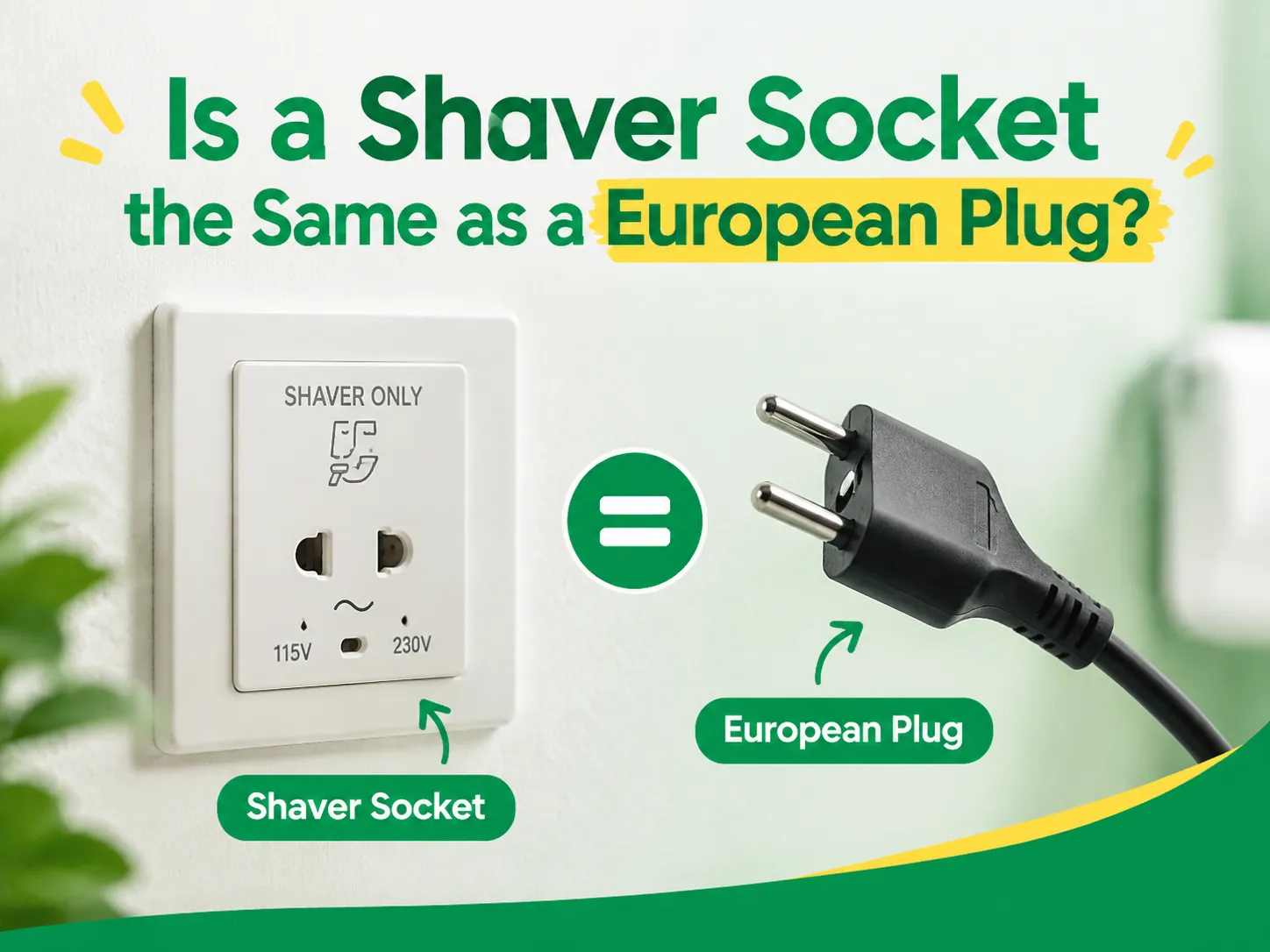
This impression is completely justified given that the two plugs came from a single ancestor and have a common appearance. British shaver plug is a plug with two round pins and is uncovered and small. Europlug is also a plug with two round pins and is uncovered and small. At first glance they seem to be the same.
In reality they are incompatible in three situations. First, their pin sizes are different, therefore the shaver plug cannot be inserted into the Europlug socket. Secondly, the pin distance is different so even if they had the same diameter the shaver plug of British design would not join the Europlug socket. Thirdly, due to the fact that the British shaver socket has insulation transformer it has different electric characteristics than Europlug socket.
One clarification should be made: there are some shaver sockets that have longer contacts developed specially for the purpose of using both plug types. Many multifunctional shaver systems work with different types of plugs like US Type A and Australian two-pin too. So if we talk about standards, the statement that plugs are not compatible and that the plug does not fit the socket is true, while in reality there are special sockets that allow not to experience this misunderstanding.
The British shaver plug and socket is defined in BS 4573, first published in 1970. The plug has two round pins with a diameter of 5.1 mm, also commonly referred to as 0.2 inch. The distance between the pins is 16.7 mm, which is approximately five eighths. The socket is rated and limited to 200mA. Although BS 4573 does not set a rating for the plug, the applicable IEC schedule assigns it 0.2 A.
The design was inherited rather than invented. The dimensions of the pins match the design of the 5 A two-pin plug introduced in the obsolete BS 372 from 1930. The only functional difference between the modern shaver and its ancestor is the presence of insulated sleeves on the pins of the new version and a different cord grip design allowing the cord to enter the socket from the top instead of sideways.
What distinguishes a shaver socket from any other socket is not the pin arrangement but rather what is inside the socket itself. A shaver supply unit employs an isolating transformer, which explains the safety of using such socket in places where all other sockets are banned. The important function of the isolating transformer is to separate the shaver circuit from earth, which means that a malfunction of the appliance does not cause any problems for the user. The unit also limits the electric current: according to IEC 61558-2-5, the unit must have a minimum power of 20 VA and a maximum of 50 VA.
The above facts define the three practical features derived from this design. The power output is low, so using shaver socket will not allow one to power a hairdryer regardless of the use of adapters. The unit is marked with a shaver sign according to IEC 60417-5225 and sometimes even has the words “shavers only” marked on it, although the latter is not required. And the design usually has two sockets, which normally supply 230 V and 115 V, thus allowing visitors from North America to use their appliances without voltage converters.
Due to the limitation of electric current, the socket is safe for its intended use: to connect electric razors or electric toothbrushes next to a washbasin. UK electric toothbrushes also have BS 4573 plug, thus proving that both devices are subject to the same standard. In case of a shaver adaptor instead of a shaver socket, BS 1363-3 requires it to have a 1 A fuse, safety shutters, insulated pin sleeves and “FOR SHAVERS ONLY” marking.
The wider family of wiring devices, and how a specialist socket like this fits among the more common types, is surveyed in our overview of the different kinds of electrical switches and devices.
The Europlug, which is also known as Type C and CEE 7/16, is a flat plug with two pins used especially for Class II equipment throughout Europe. The main difference of Europlug from other plugs lies in its insulation rather than in its physical characteristics. Because the plug is ungrounded, it can be utilized in any European sockets, provided that it has insulated pins. The construction of the plug makes it impossible for the user to reach live components while using the plug in sockets of different designs.
The size of the Europlug is 4 mm for the pins with reduced spacing. Initially, the distance between the pins is about 18.6 mm and becomes shorter than 17.5 mm at the ends of the pins. It is done intentionally, as the pins are made a little slanted for bending, which enables them to touch the contacts made for sockets of 4.8 mm size, thus making it possible to use Europlug in the French or Belgian sockets.
Europlug can be marked by 2.5 A and 250 V. However, a low rate is due to the use of Europlug in lamps, chargers, and electronics rather than limitations of the sockets. Any European socket can manage up to 16 A thanks to the protection provided in the electrical installation.
It is essential to distinguish between Europlug and another type of Euro plug CEE 7/17 or contour plug, which has round pins of 4.8 mm inside the round body and is widely used for equipment that is consuming bigger power. Although they look somewhat alike in photos, CEE 7/17 plug will not be fitting into Europlug sockets.
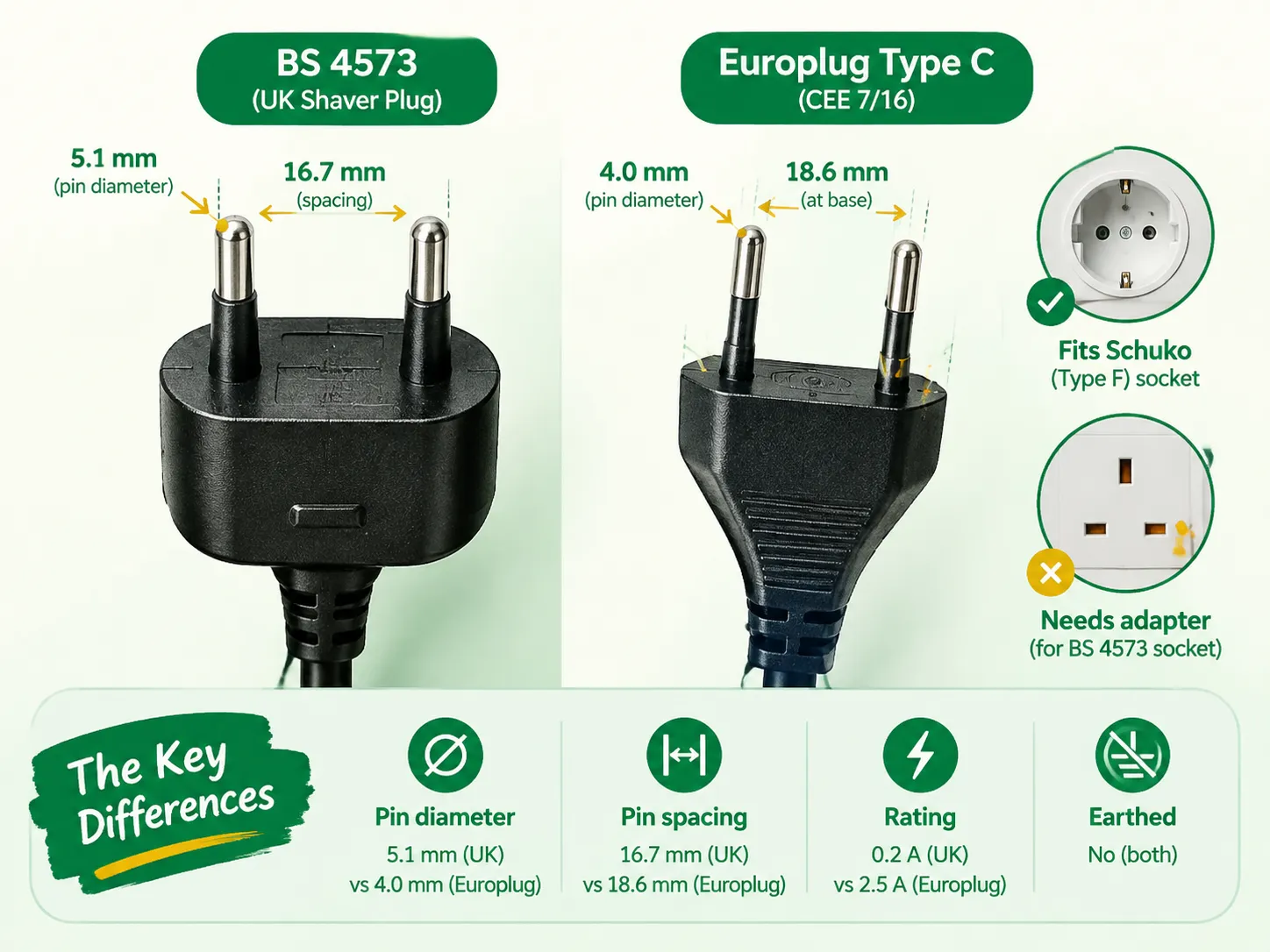
| Parameter | BS 4573 shaver plug (UK) | Europlug Type C (CEE 7/16) |
|---|---|---|
| Pin diameter | 5.1 mm (0.2 in) | 4.0 mm |
| Pin spacing | 16.7 mm (5/8 in), parallel | 18.6 mm at base tapering to 17.5 mm at tip |
| Pin arrangement | Parallel, insulated sleeves | Slightly converging, somewhat flexible |
| Rating | 0.2 A per the applicable IEC schedule | 2.5 A |
| Earthed | No | No |
| Origin | Derived from the obsolete BS 372 Part I 5 A plug (1930) | Developed for Class II appliances across continental Europe |
| Fits a Schuko (Type F) socket | No — requires an adapter | Yes |
| Fits a BS 4573 socket | Yes | Only in sockets with elongated contacts; otherwise needs an adapter |
The two pieces of information to keep in mind are 5.1- and 4.0-mm diameter and 16.7- and 18.6-mm spacing. This also means that the 5.1-mm pin is too thick for a connector designed for 4 mm and that the 16.7 mm distance is too small for a connector having the contacts at 18.6 mm apart at the inlet.
This is where the two diverge most sharply, and it explains why they exist as separate standards rather than as variants of one.
| UK shaver socket | European wall socket | |
|---|---|---|
| Isolating transformer | Yes — the defining feature | No |
| Current limit | 200 mA | Typically 16 A, limited by circuit protection |
| Power rating | 20-50 VA per IEC/EN 61558-2-5 | Up to 3,680 W at 230 V and 16 A |
| Outputs | Usually 230 V and 115 V | 230 V single phase |
| Permitted in a bathroom | Yes — the only socket type allowed | Generally restricted; regulation varies by country |
| What it can run | Shaver, electric toothbrush, low-power charger | Any appliance up to the circuit rating |
| Why it exists | To make a socket safe in a wet location | To supply general-purpose power |
The effect of the transformer must be clearly outlined: shaver sockets are not power sockets because they have a low power rating, but because the isolation that makes them safe means that they cannot pass much power. Trying to draw more than their rating will not damage the system but it will stop working instead, and quite often a safety device will operate.
Another effect is that a shaver socket cannot act as a replacement of an ordinary socket in the bathroom. The shaver is assigned a particular function just like that, and installation of a general-purpose socket there is a different matter altogether.Where a project needs a socket with modern charging capability as well as compliant safety, the options are a separate discussion, and the features and ratings involved are covered in our article on USB wall outlets and fast charging.
The geographical span indicates most of the practical confusion.
BS 4573 shaver sockets can be found in Great Britain and Ireland and are used in bathrooms in peoples’ homes and hotels around the world.In several locations in Asia, the Middle East and Africa, several hotels use the shaver socket in combination with various other types of sockets to cater to the various types of traveling guests including the guests traveling with their shavers. The fact of the matter is that shaver sockets are nowadays widely used in many countries because of the high demand for their use together with other types of sockets even though BS 4573 standard is officially British.
Europlugs are available in a large number of countries in Europe that adopted the European socket standards, including Germany, Italy, France, Spain, Greece and others. Europlug is used mainly for low-power devices to be connected to the wall socket of Type F or E.
However, that is where the conflict comes from. As a British traveler comes to Spain, they discover that the socket there accepts a different type of plug. As a Europlug traveler comes to the UK, they also find out that their device cannot be plugged into the socket in the bathroom.
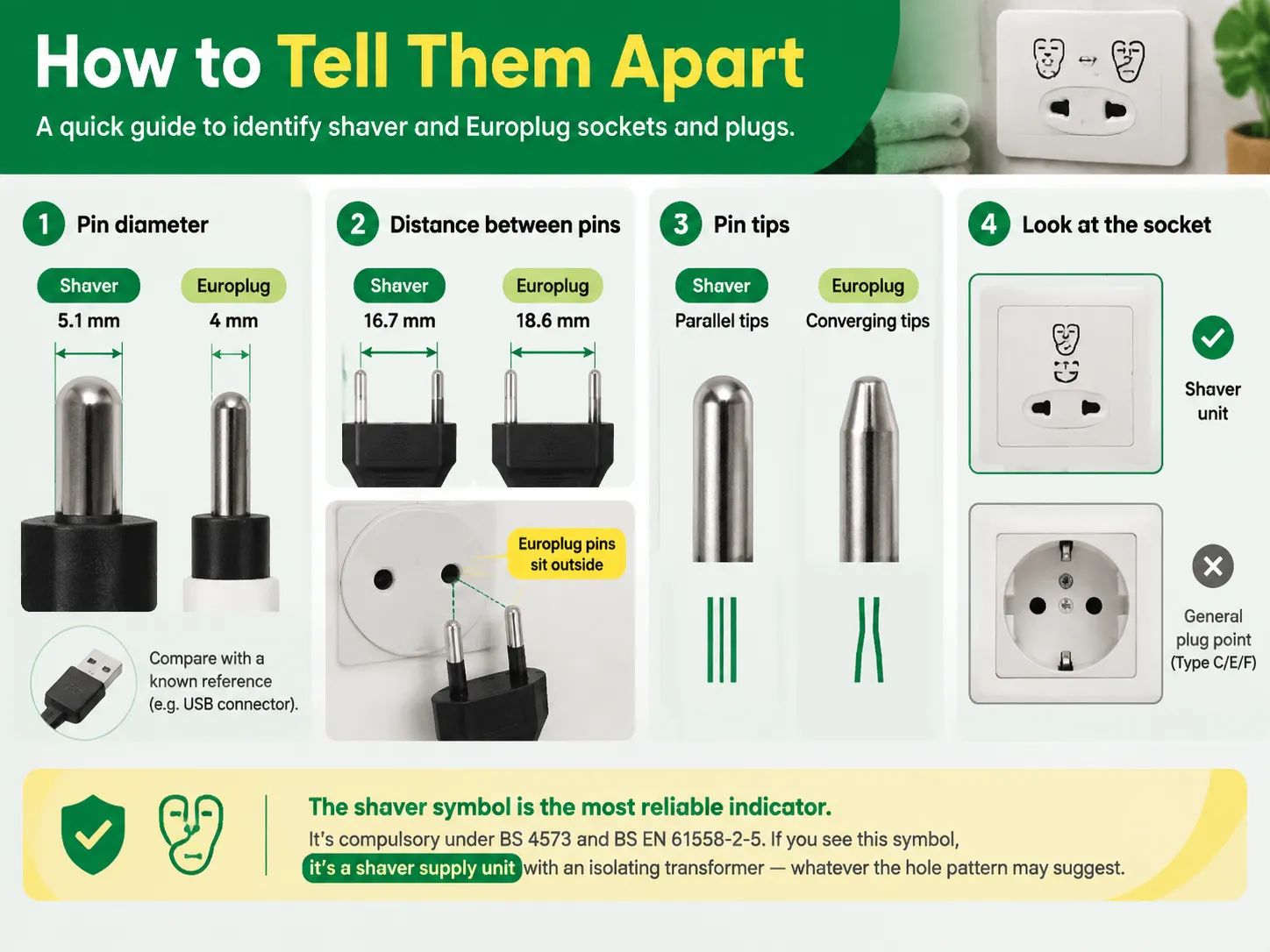
A plug or socket can easily be identified by four simple checks, and only the first one requires a little bit of effort.
The shaver symbol is the single most reliable indicator on a socket, because it is compulsory under both BS 4573 and BS EN 61558-2-5. A socket marked with that symbol is a shaver supply unit with an isolating transformer, whatever the physical hole pattern may suggest.
With adapters, the situation can be more complicated than with many other socket types, which is worth understanding.
A BS4573 shaver plug has its own socket type that will not match any other countries’ sockets and so needs an appropriate shaver plug adapter to work abroad. Such adapters do exist and can even accommodate a European Type C or a US Type A plug and, on rare occasions, even an Australian Type I plug. The unfortunate aspect of a shaver plug is that the large dimension of its pins as well as their distance from each other make it impossible to use it with most universal travel adapters – cheaper versions can slightly stretch to allow the plug go through, but in general, the rule is that the better-made the universal adapter is, the less likely it is to accept a British shaver plug or toothbrush plug.
For a person traveling abroad the easier solution is to buy a local electric appliance. A razor bought in Europe and from a European supplier you can be sure will have a standard Type C Europlug that allows it to be used both with local sockets and British shaver sockets, which means that no adapter is needed.
The same principle of reverse application is true for projects involving electrically driven devices. If it comes to having a shaver socket in a bathroom, this socket shall be considered a special shaver equipment that has a transforming energy device and is marked properly, and not just a regular socket with a shaver plate applied to it. The necessity of having the unit compatible with a Europlug or not is the issue of design; usually elongated contacts that allow for accepting both socket varieties shall be used.The specification detail that separates a compliant device from a lookalike is the same discipline that applies to any wiring device, and it is set out in our guide to choosing an electric switch and socket manufacturer.
Where a socket is being replaced rather than newly specified, the safe working sequence is the one used for any wiring device, covered in our article on replacing a light switch.
And where the installation includes dimming or other controlled loads on the same circuit group, matching the device to the load follows the principles in our guide to installing a dimmer switch.
Not in a straightforward way. The British BS 4573 electric shaver plug features 5.1-mm pins set 16.7 mm apart, whereas in a European socket the design is with 4-mm pins approximately 18.6 mm apart, which means that the shaver plug’s pins are too thick and too close for the socket. A separate plug adapter must be used because of this. The only exception is shaver supply units with long pin contacts that are designed specifically to accept both Euro plugs and BS 4573 plugs, however this is a characteristic of type of sockets but not of the standard.
The plug needed for low power devices like chargers, lamps and small gadgets is the Europlug (Type C, CEE 7/16), designed to work with Types C, E and F sockets in the rest of Europe. However, for appliances requiring more electricity — hair dryers, travel kettles, etc. — it is necessary to use either a Schuko (Type F) plug or the French (Type E) plug, since the Euro plug can only take 2.5 A. Travellers from the UK, Ireland, USA, Canada, Australia and New Zealand must use a travel adapter, as their plugs cannot fit the European plugs directly.
It is correct; and it is the same way in the United Kingdom. In order to allow them to be charged using the bathroom shaver outlet, British electric toothbrushes are shipped with the same BS 4573 two-pin plug as electric shavers. The current limit of the outlet is 200 mA, and it has a power rating between 20 VA and 50 VA, which is enough for it to be used as a toothbrush charger, but it is the use of the isolating transformer in the system that makes it safe to use near the sink. It is typical for European electric toothbrushes to come with a Europlug that may allow the appliance to be used with a shaver socket only if this socket is fitted with the dual elongated contacts.
From a physical point of view, it is possible to cut off the two-pronged plug in order to replace it with a domestic plug. However, there are two warning to take into account. First, appliances that come with a shaver plug are made to function with the unique supply of a shaver socket. That means that if it happens to get connected to a socket of a different type, its isolation will be removed. The importance of this issue largely depends on the type of the appliance, so the manufacturer should be consulted with prior to making any modifications. Second, whatever the new plug is, it’s essential for it to conform to standards and to be fused correctly.
Due to the characteristic of being dual voltage shaver supply units that provide 230 V and 115 V outputs. The 230 V output usually includes the use of BS 4573 shaver plugs, Europlugs, and Australian plugs on occasion, while the 115 V output would use a two pin NEMA type A plug for guests who might bring their equipment with them and do not require an extra transformer. The two outputs are available because of the design of the isolating transformer that can provide one of the two required voltages, which is the reason hotels use these devices.
A shaver socket differs from a European plug in several ways, which are very likely to deceive consumers. For instance, British shaver standards accept 5.1 mm of pin dimensions with 16.7 mm distance, thus limiting electricity usage up to 200 mA due to an isolating transformer. On the contrary, the Euro plug supports different pin size that is roughly 4 mm with the distance of 18.6 mm and electricity rating of up to 2.5 A. These two aforementioned aspects (one pertaining to dimensional differences while the second concerns electrical differences) account for many issues: shaver socket cannot run a hair dryer, while European devices that were bought locally operate in British sockets while British shaver sockets cannot fit Spanish wall plugs. Thus, the next piece of advice for travelers from engineers is to purchase their devices on the territory they intend to use them.
Although they seem to be alike, they both have a round shape with two pins, and they function at a voltage of 230V. This explains why some tourists use a European plug with a British shaver or wonder why a shaver cannot be plugged into a Schuko socket in a Spanish hotel. In reality, they […]
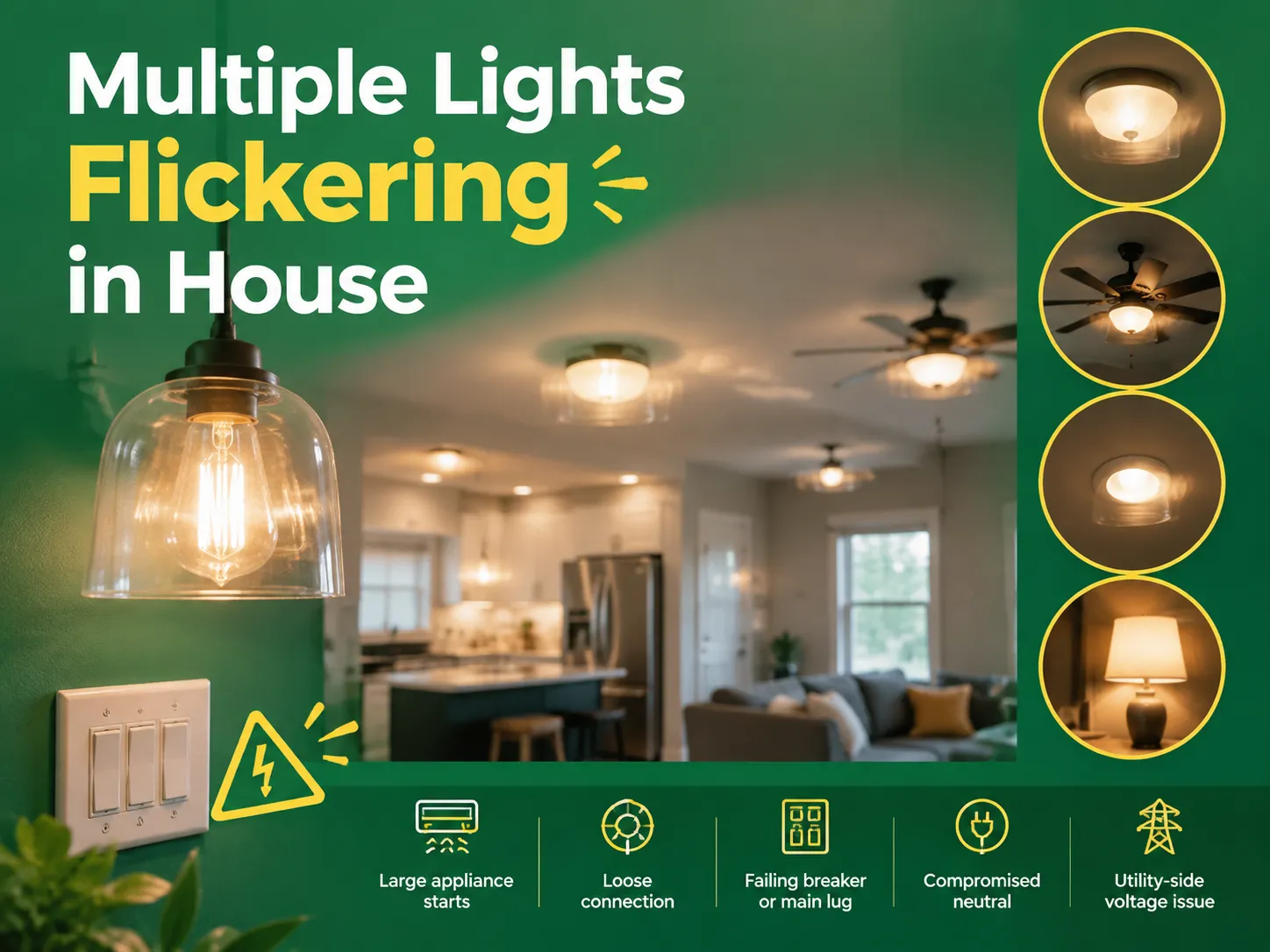
A flickering bulb can be interpreted as a local problem — the bulb worn out, the light fixture connected poorly, or it could be that you have a cheap dimmer. But if there is more than one bulb flickering simultaneously, in different rooms, you need to see the situation differently. Many flickering bulbs signal a […]
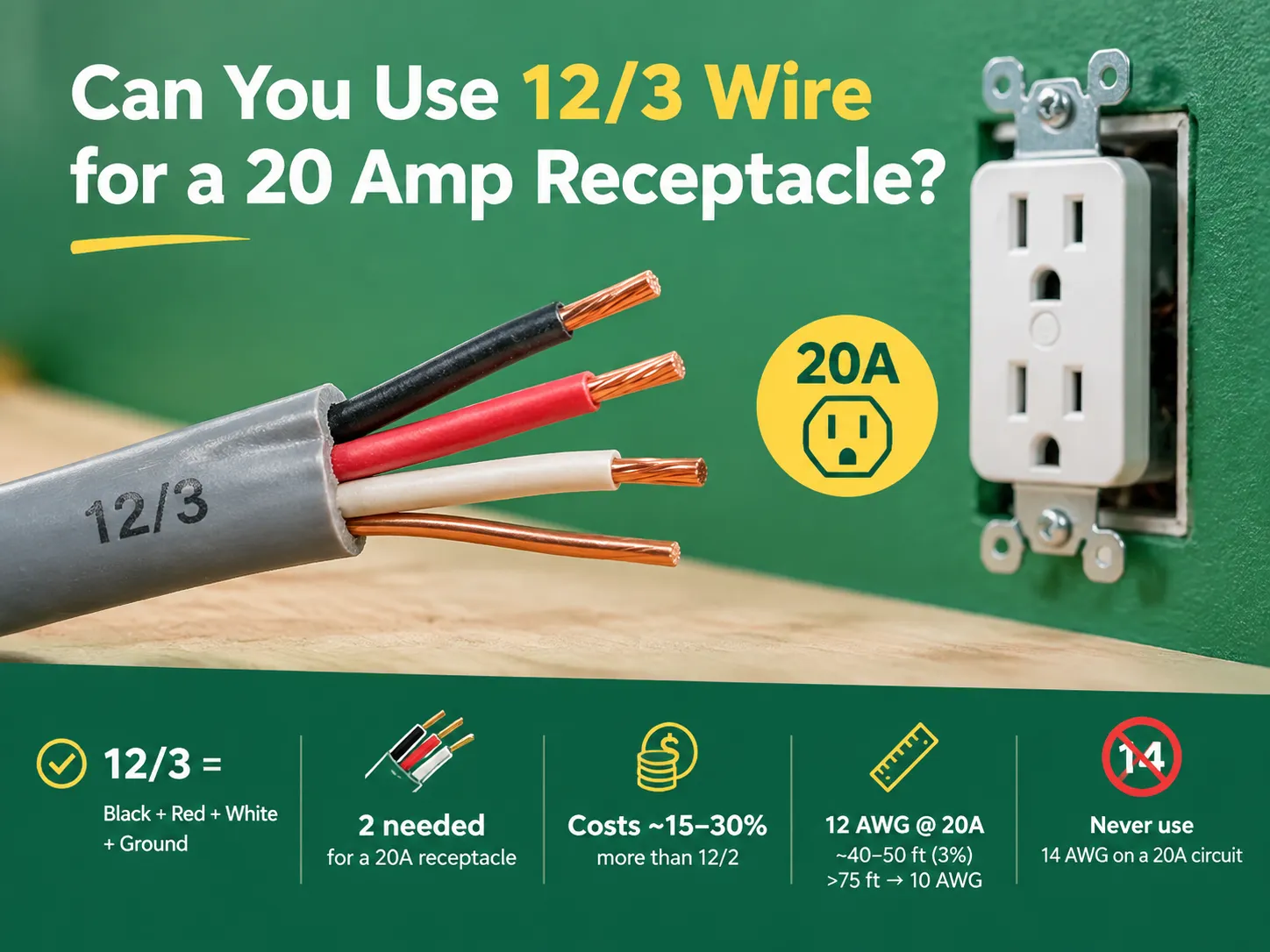
Twelve-gauge wire and twenty-amp circuits go together so well that the questions generally arise from a different source. It may be the case that the installer has a piece of 12/3 left over from an earlier wiring project or perhaps the supplier only has 12/3 cables in stock. The question comes up as to whether […]

 No.6 Tuozhan Road, Leshang Pioneer Park,Yueqingwan Bay Harbor,Yueqing city,Zhejiang Province


