

When it comes to brass dimmers, people’s decisions are based on their appearance and whether they fit. Both of these things represent different sets of decisions, most of which cause problems when placing an order: the plate does not go with the box, the module cannot darken the lamps, or the gang overheats because no one derated it.
This article describes the sequence of decisions that would allow customers to save money. First, the standard, next the gang, after that – the way, load, finish, brand, and price.
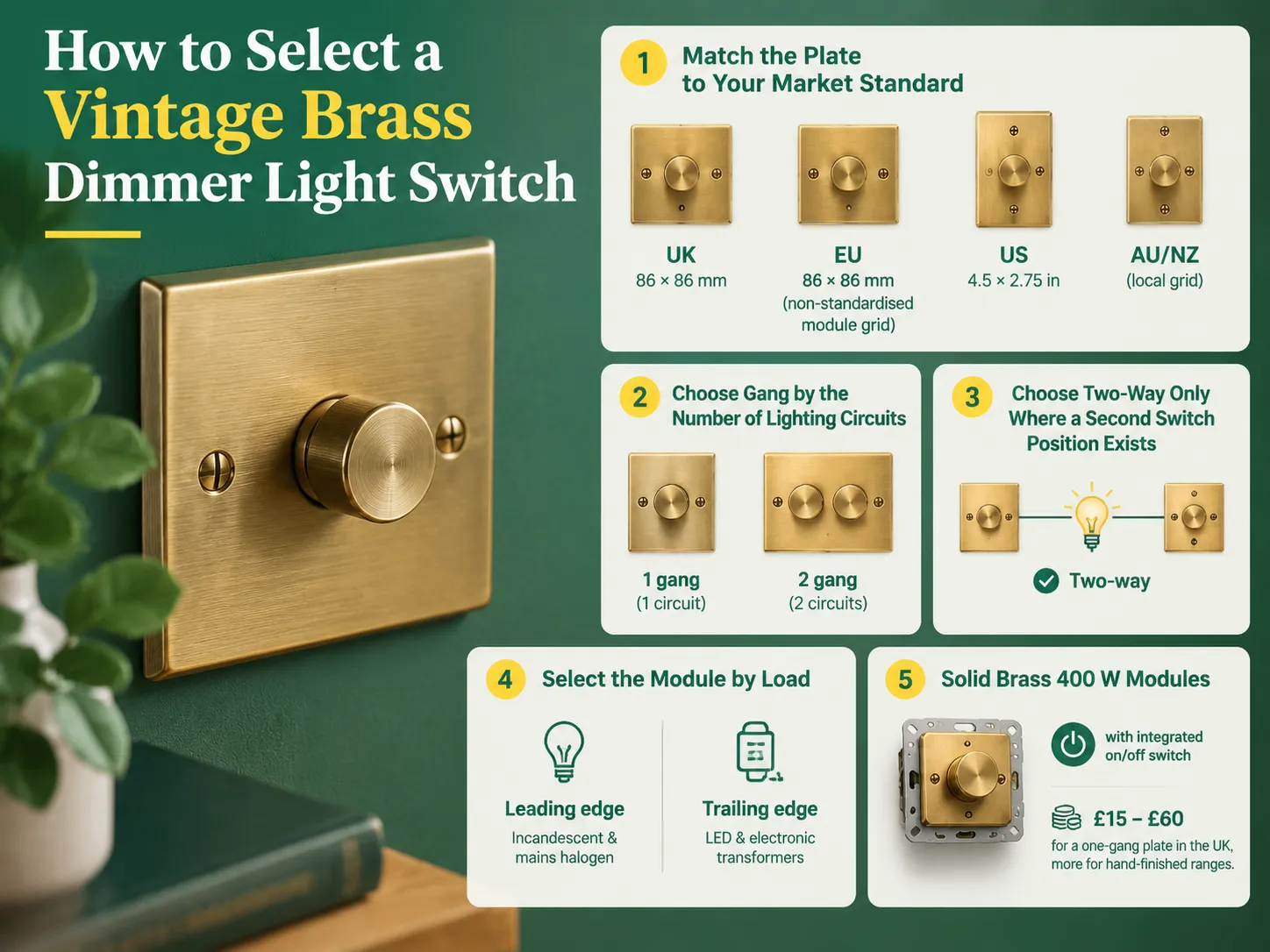
In short, the first thing you need to do is to adjust your plate to your country standards (e.g., UK 86 x 86 mm, EU 86 x 86 mm on a non-standard module grid, US 4.5 x 2.75 inches, AU/NZ on a local grid). Then pick the gang type of your plate according to how many lighting circuits you have in your electrical setup. Select two ways only if you have a second switch, and technician by load: leading edge for traditional incandescent lamps and mains halogen units or trailing edge for LED and electronic transformers. 400W solid brass modules with their on/off switch will do most of the job; the plate will cost you around £15-60 in the UK, even more for artisan handmade series.
A plastic plate may be trimmed, installed with shim or replaced by an ordinary blank. A solid brass plate cannot. It is fixed by screws at fixed points and is placed in a certain box and if the standard is incorrect the plate will either not cover the box or be unable to reach the screw holes.
| Market | Single plate | Multi-gang plate | What else to confirm |
|---|---|---|---|
| UK | 86 × 86 mm, screw centres 60.3 mm | 146 × 86 mm typical | 25 mm or 35 mm back box, BS 4662 plate size |
| Europe | 86 × 86 mm common | Varies by country | Module grid is not uniform: 45 mm and 55 mm systems both exist |
| US / Canada | 4.5 × 2.75 in wallplate | Multi-gang plates on 3.281 in device spacing | 120 V 60 Hz devices, not 230 V modules |
| Australia / NZ | Local grid plate | Local grid plate | AS/NZS 3133 switch approval, 230 V 50 Hz |
This leads us to the following conclusion—brass dimmers manufactured overseas often serve as decorative pieces rather than as electrical fixtures. In particular, a 120V device designed for the USA will fail straight away if put into a circuit designed for 230V, while a 230V device will not fit into a box made for the US market. Therefore, if you are specifying for more than one country at the same time, it is better to buy installation equipment locally—modules can be acquired in every country, and only the finishing can be brought from one country to another. The differences between European plate and module systems are set out in this look at European standard switch and socket manufacturers.
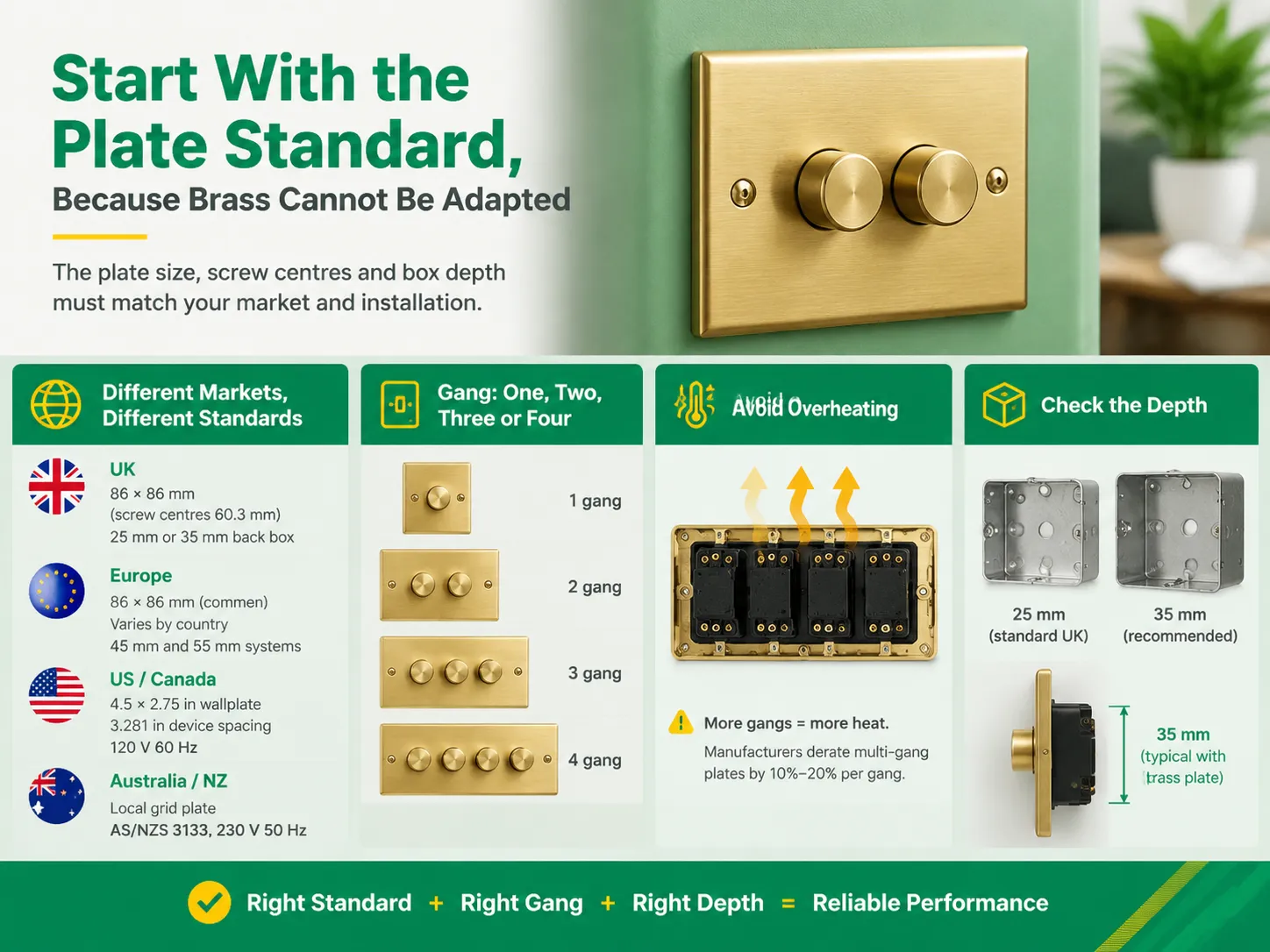
A gang refers to the amount of switches in a plate. One gang will operate one lighting circuit, two gangs will operate two circuits, etc. This is a simple mathematical matter; to determine the gangs required, simply count the lighting circuits that are present in a space and add nothing.
One of the factors that need to be considered is the heat generation, as each dimmer module generates heat. Having four dimmers in one brass plate will create more heat than if those dimmers were to be installed in separate plates. That is, manufacturers normally reduce the amount of gangs that could be used in a plate, which translates to a potential loss in terms of efficiency of around 10-20%, for a 4-module plate.
The other question is the depth of the installation. The standard UK back box is 25 mm, whilst a dimmer module with a brass plate might take as much as 35 mm. When installing multi-gang switches, the problem becomes even more apparent, as those switches will be installed in a space that is not that deep – meaning the installation will require more space than it would normally do.The difference between plate types is covered in this explanation of what a 3 gang plate switch is.
Way refers to the number of switch controls available to operate the same light. One-way indicates a single switch being utilized at a single door. Two-way implies two switches being used at both ends of a corridor, both ends of the staircase or either side of a kitchen.
Vintage brass dimmers are mainly available in both one-way and two-way versions; however, the two-way version is costlier as it has an extra terminal and a traveling contact. Although buying a two-way dimmer may be a good option when you are using only one switch position, it is unnecessary and introduces a potential failure when a two-way dimmer wired as one-way makes the second terminal floating.
The requirement is quite simple: If you walk through a room and wish to dim at the other end, the two-way is required and the wiring has to support it, which mandates a three-core strap between the two positions. In case the wall is already done, the answer is to use a smart module or a second one-way dimmer.
This is the decision that determines if the installation works, flickering, or humming. There are two technologies for dimming, and they serve different types of lamps.
The leading-edge modules chop the first part of the cycle. They are cheaper, more durable, and suitable for incandescent and halogen lamps operating on the mains. However, they are not suitable for most LED lamps. Therefore, a brass dimmer with a 400W leading-edge module and some cheap LEDs will produce something flickering and buzzing faintly.
The trailing-edge modules chop the end part of the cycle. They are quieter, more gentle on the LED drivers and electronic transformers, but more expensive than the previous technology. For LED lamps, this module is what to look for.
The wattage is the second part of the trick and works in both ways. The module rated at 400 W has the maximum as well as minimum load. Generally, leading-edge modules of 250 W, 400 W, 600 W, and 1000 W require loads of about 25W, 40W, 100W, and 150W respectively. If you use a 1000 W module with a single 9 W LED, it may not function at all.
The rules to abide by include the following:
The mechanism behind this is explained in this note on how a dimmer switch works, which is worth five minutes if the lamp specification is still open.
Brass types are categorized into two kinds, and this choice influences the maintenance more than the look of the surface.
Lacquered brass gets its clear coating which ensures that the color remains unchanged over years. It has the same look in five years as it does in five weeks and requires only wiping on a regular basis. However, one should be careful when it comes to the edges of the surface. A scratch which penetrated the lacquer coating will appear as a shiny area that will eventually oxidate and attract attention.
Unlacquered brass stands for a natural metal that oxidizes with time in contact with air. Its color changes to brown and uneven gold which is usually referred to as patina. The surface can be polished and this is the type of finish that is commonly used for historical buildings as it looks as if it has always been there.
Satin and polished brass are different in ways of how they show prints of fingers and scratches on the surface. Satin can hide all of them while polished brass will look perfect only for some time.
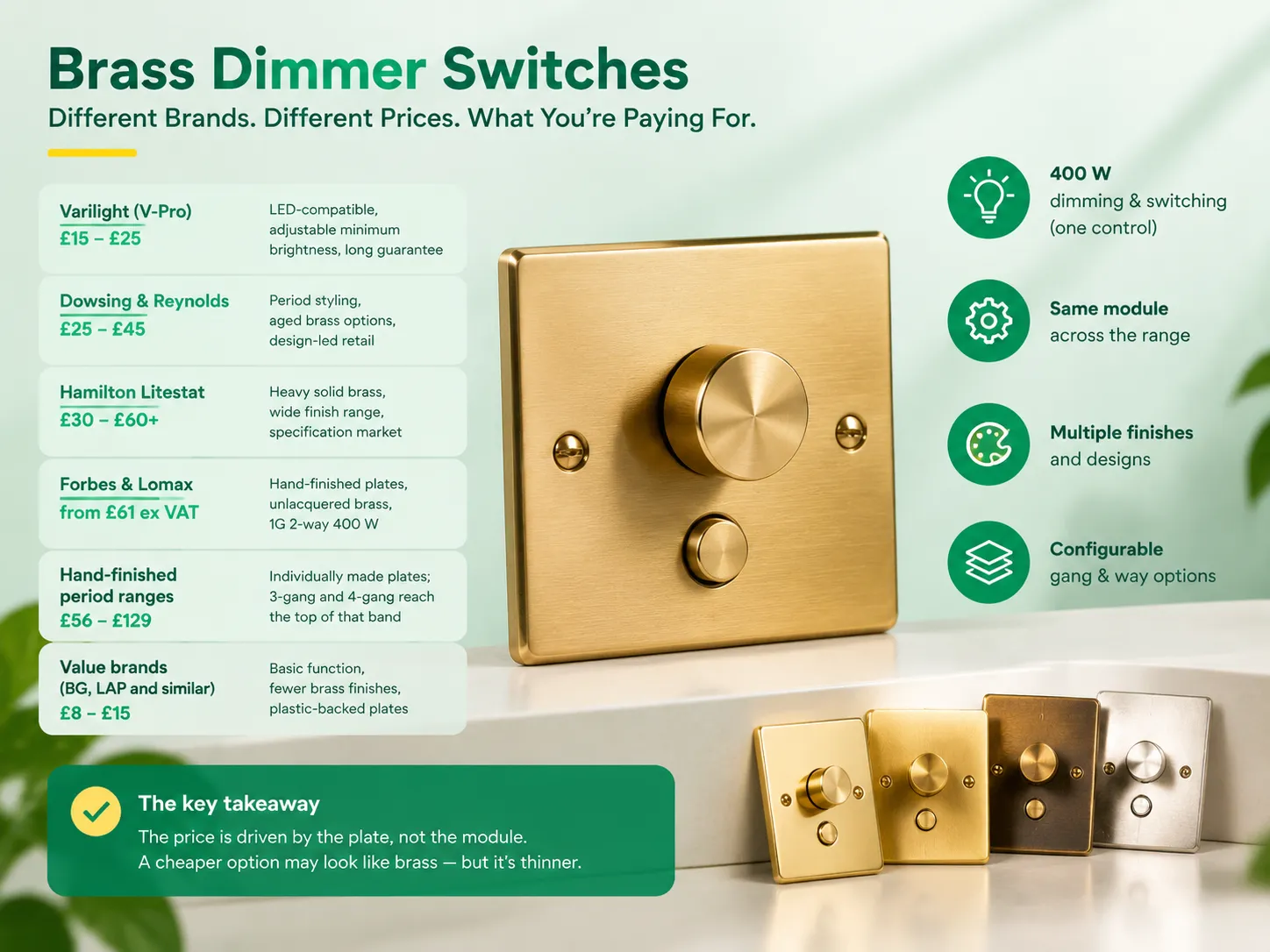
Prices below are for one-gang brass dimmers in the UK market at the time of writing, and they move with the brass price and with the finish.
| Brand | Typical price, 1 gang | What you are paying for |
|---|---|---|
| Varilight (V-Pro) | £15 to £25 | LED-compatible dimming with adjustable minimum brightness, long guarantee |
| Dowsing & Reynolds | £25 to £45 | Period styling, aged brass options, design-led retail |
| Hamilton Litestat | £30 to £60+ | Heavy solid brass, wide finish range, specification market |
| Forbes & Lomax | from about £61 ex VAT | Hand-finished plates, unlacquered brass designed to patina, 1G 2-way 400 W |
| Hand-finished period ranges | £56 to £129 | Individually made plates; 3-gang and 4-gang reach the top of that band |
| Value brands (BG, LAP and similar) | £8 to £15 | Basic function, fewer brass finishes, plastic-backed plates |
Two conclusions can be drawn from the length of that chart that may prove useful in making a purchase. First, convenience is a matter of the plate, and not of the module: thus, a £15 lighting dimmer and a £60 dimmer have the same electronic components, and differ in terms of their plating, and finish. Second, the cheap alternative is not unsafe; it is simply thinner. A £10 plated steel steel plate does look like brass for a couple of years.
The design incorporates a 400 W dimmer switch with an on/off switch in 6 ranges (AS328, CS328, ES328, FS328, JS328 & KS328). This allows the same electrical platform to be installed with different plates. The dimmer switches from one knob, which is usually what is needed in an old-fashioned room: one knob and no independent switch next to it.
The design is intended for the specification and OEM market and not for retail. Projects can be supplied with plates with the specified finish (which makes sense), gang combinations and ways are adjustable, and the same model can be used across the ranges so that one can mix and match one-gang and three-gang plates without introducing different dimming characteristics in one hallway. The AS328 400 W dimmer switch is the starting point for most enquiries.
Where we cannot be of service: if you desire a precise British heritage finish on a 30-day sale guarantee, a supplier from the UK will do a better job. Where our services come in: in a project that requires modular consistency between 100 plates with the finish specified by the designer and the respective documents in place.
There are four main reasons for callbacks, and they all happen before the tool is used.
Absolutely, if the module is rated for LED load or trailing edge and if the lamps are dimmable. Pay attention to the minimum load just as much as the maximum load, as a 400 W rated module with a minimum load of 40 W, will not work with a pair of 5 W lamps.
No. Regular two-wire dimmers operate with the original switch cabling, including the light bulb in the circuit. Smart dimmers and some devices with a standby light do need a neutral, which you should check before making an order if the wall has only live and switched.
It is true, with a 2-gang plate: two separate modules, two circuits. Check 1) the box is deep enough and 2) the total load from the two modules is at or below the derated capacity of the plate and also verify that the two circuits are not combining loads because a dimmer cannot control two different circuits with different loads.
The metal is secure, while the sheet is grounded and the system as a whole is certified as functional. What transforms is service: unpainted brass gets dirty and needs to be polished from time to time.
First pick the standard and then the gang and way combination, followed by the module for the load. The last step will be checking the finish. This process helps avoid an expensive mistake of buying unnecessary dimmers.
Please provide us the plate standard, the gang and way combination, the lamp load per circuit and the finish, and we will get back with the module specification and a plate drawing.
When it comes to brass dimmers, people’s decisions are based on their appearance and whether they fit. Both of these things represent different sets of decisions, most of which cause problems when placing an order: the plate does not go with the box, the module cannot darken the lamps, or the gang overheats because no […]
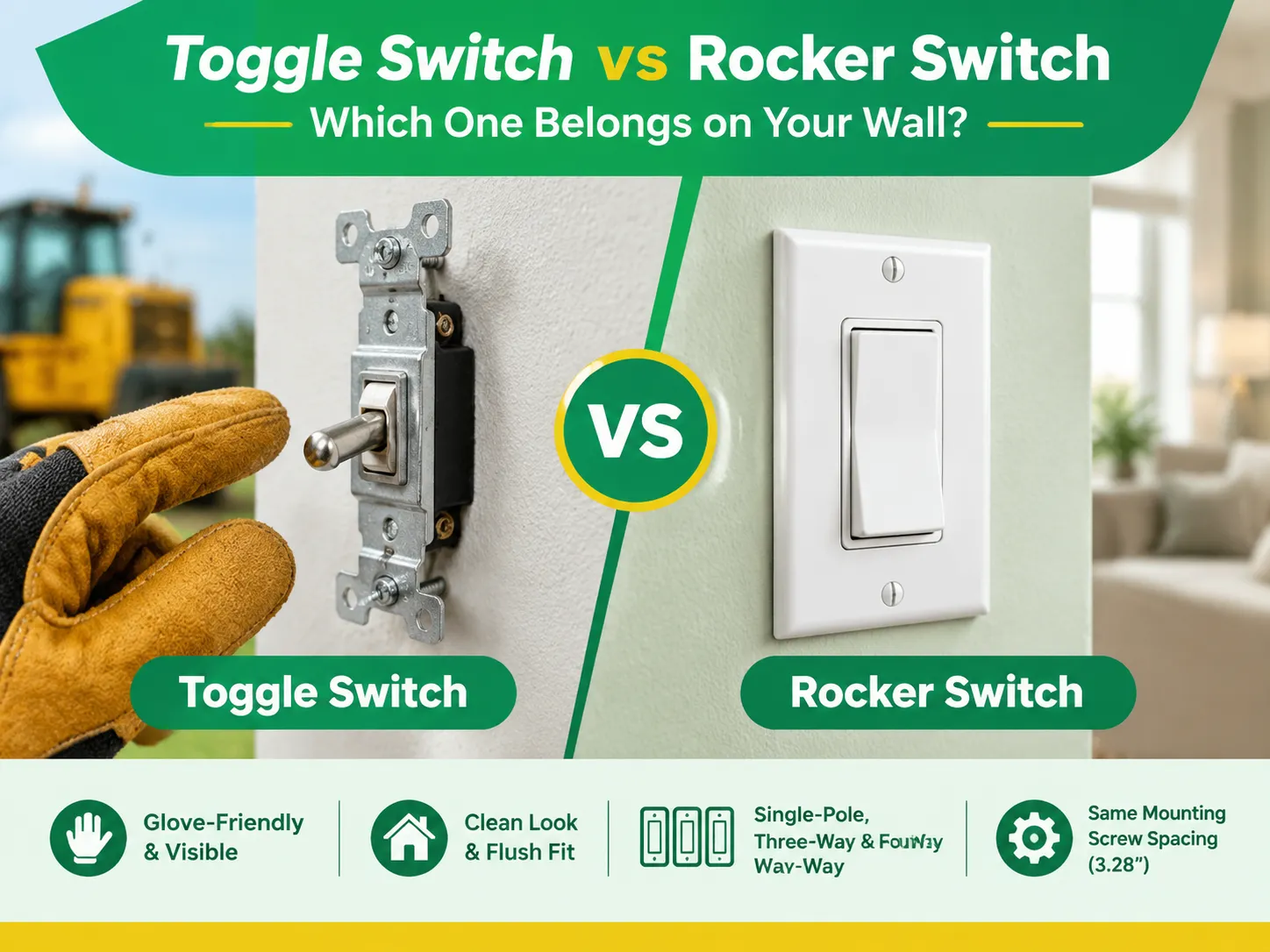
Both switches utilize the same circuitry, both of them fit into the same enclosure and both of them can be found in the same store aisle. However, in the end, all depends on three considerations which are not electricity-related: the look of the room, who uses it, and whether one wants a switch which can […]
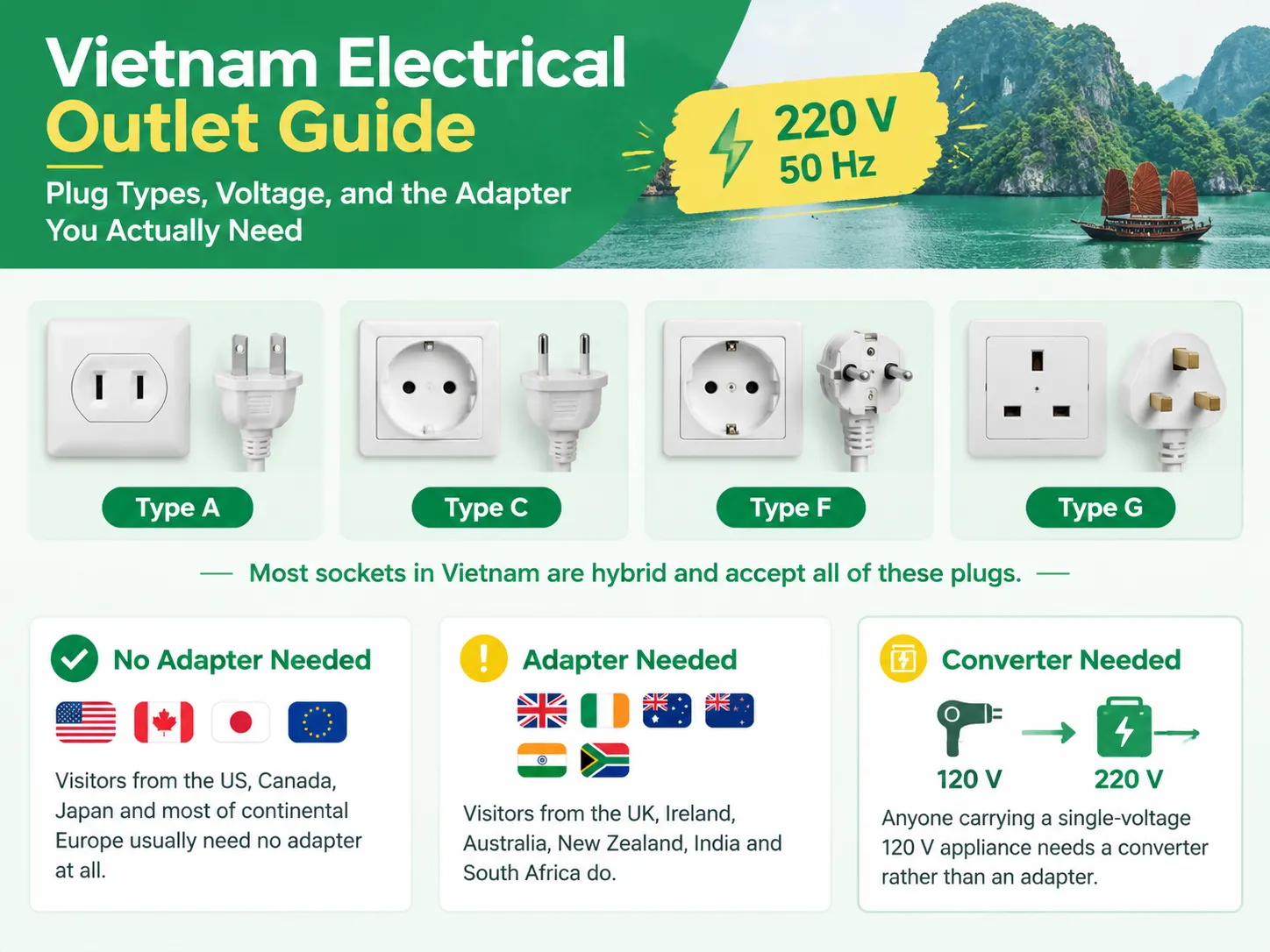
Plugging into Vietnam is an easy job compared to most countries in Asia and so is making one of the gadgets go dead. The plugs are globally accepted, but the voltage is not. These two facts are true about each hotel in Vietnam from Hanoi to Can Tho and it is good if you know […]

 No.6 Tuozhan Road, Leshang Pioneer Park,Yueqingwan Bay Harbor,Yueqing city,Zhejiang Province


