

When an electrician based in Chicago retrieved a Leviton Decora plug from its package and gave it to one of his assistants, he was asked, “Why Leviton? What’s wrong with the cheap one?” The electrician had been working with Leviton products for twenty years and experienced multiple problems with cheap brands—the connection problems of backstabbing, cracks on the faceplate due to too much tightening, or GFCI outlets malfunctioning after thunderstorms if they did not reset on their own. The electrician also witnessed some Leviton devices that were still in perfect operating condition decades later. The answer was simple: “I avoid coming back.” Is Leviton a good brand? The question has been asked by homeowners buying electrical devices, contractors quoting prices, or purchasing department managers. The answer is affirmative; Leviton is one of the most recognized manufacturers of electrical devices in North America.
Summary: Leviton is an American electrical device manufacturer founded in 1906 and based in Melville, New York. It is the largest manufacturer of home electronics in North America and offers more than 200 different types of electrical devices that are widely used in residential, commercial and industrial settings. Its strength lies in having a very wide variety of products available in North America, being able to supply all devices that may be required by a residential or commercial electrician, being very successful in providing high quality devices throughout its lines, having an efficient distribution system (Leviton products are available in almost every electrical supply store and home improvement store in the U.S. and Canada) and focusing on the introduction of innovative products related to smart home management.
Leviton Manufacturing Company began operating in New York City in 1906, starting a four-generation tradition of ownership in one family. Its length of existence and family ownership are relevant to the customer since the company is neither a conglomerate subsidiary nor a large firm purchased and assimilated into one of its brands in order to sell different product lines. The main business of the company is wiring devices, which have been produced by the company for about a century. The production of the company is international, with factories in the USA, Mexico, and China, and sales in more than 80 countries. Leviton holds leading positions in the wiring device industry as the market share is similar to that of the chief competitors (Eaton, which includes Cooper Wiring Devices and Arrow Hart, and Legrand, which includes Pass & Seymour) in North America. The range of products produced by the company is extensive and includes the following: standard and decorator outlets, GFCI and AFCI outlets, USB outlets, switches (single-pole and three-way), dimmers (mechanical, slide, and smart), smart home control and comprehensive accessibility of electric meters, electric appliance chargers (EV), data centers.For a broader look at how Leviton compares with other global wiring device manufacturers, our guide on the top wiring devices brands in the world provides a detailed comparison of the major players and their respective strengths.
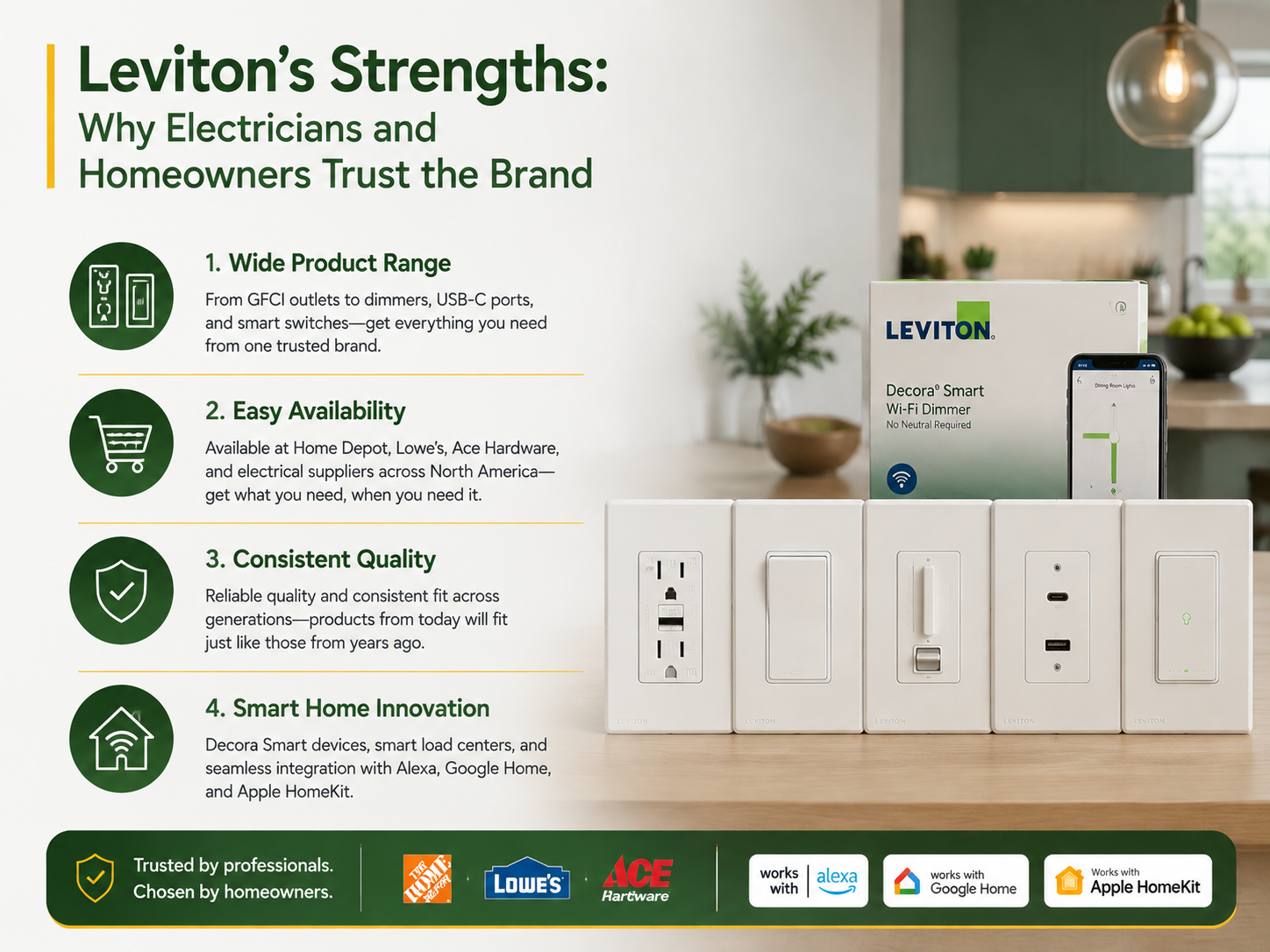 Leviton’s Strengths Why Electricians and Homeowners Trust the Brand
The foundation of Leviton’s good name is several strengths that can be proven by buyers prior to the purchase.
The first is the range of products. For example, if someone has to remodel their kitchen and needs, for instance, a tamper-resistant GFCI outlet, matching designer rocker switch, dimmer for dining room lights, USB-C port for a countertop, and smart switch for pendant lamp, Leviton provides all products from a single supplier. Therefore, the customer’s advantage is the convenience of searching and ordering.
The second strong point is availability. Leviton’s products can be bought at Home Depot, Lowe’s, Ace Hardware and any independent supplier of electric materials across North America. For instance, if a contractor is in search of a specific Leviton product on Friday afternoon, there is no need to wait for the online order arrival.
The third strength is the guarantee of product quality. The new Decora product by Leviton will have the same terminal arrangement, mounting sizes and fit as the product bought five years ago. Such consistency helps an electrician replace the failed product without a fear the new product may not fit the wall panel.
The fourth strength is innovations in the sphere of smart homes appliances. The Decora Smart product line, Load Center with smart switches and compatibility with Amazon Alexa, Google Home and Apple HomeKit specify Leviton as a serious competitor in the industry growing rapidly.
While Leviton is a well-known supplier of electrical fittings, not every application is served well by this brand, and there are some drawbacks that should be considered before purchasing a big batch of their products. Firstly, one of the drawbacks is their price. Their items would not be listed among the most expensive ones available on the market (this record belongs to premium design brands and specialty industrial producers, which make even pricier products) but generally, their pricing is higher than the price of builder-grade imports and other premium products. For instance, a regular Leviton Decora tamper-resistant duplex receptacle costs from $3 to $6, while the cost of the no-name or store brand equivalent device starts from $1 and ends with $3. The difference is small for one device, but a serious amount of money can be saved while buying a bulk batch, for example, thousands of devices for a hotel, or an apartment complex. In this case, certified mid-range alternatives with the same UL listing and compliance with the codes would be more rational choices for builders with limited budgets.
Some producers like IGOTO Electric manufacture tamper-resistant, GFCI, and USB-payload receptacles at prices reflecting their efficiency and simplicity of their supply schemes.
On the opposite side, for the end-user who wants to have an associated traditional brand and guarantee of accessibility of their products, Leviton might be attractive, as it costs more than competitors’ solutions.
Secondly, there is a limitation connected with smart home systems. The Decora Smart platform is advanced, and it integrates with all popular voice assistants and some other smart home controllers available on the market. However, it is not as efficient as Lutron’s Caséta and RadioRA 3 platforms. Lutron’s specialized equipment is the one that should be considered when designing an automated lighting control system for any house. So, a user who just needs a simple one-room dimmer will be satisfied with Leviton, while a customer who wants to control multiple lighting scenarios beyond just one room will most probably choose Lutron’s products. So, Leviton is successful in selling its devices, yet it cannot compete in terms of integration with its rival.
The third disadvantage is the possibility of installing the latest devices into older houses. All new Leviton smart breakers and a whole-house energy monitoring system require installing Leviton’s Load Center, which is quite a special panel that needs to be included into the system. A person who has a good quality Square D, Siemens, or Eaton panel would not be able to use a Leviton smart breaker. This fact limits Leviton’s market potential for selling its innovations and it prevents new customers from using all innovative technologies.
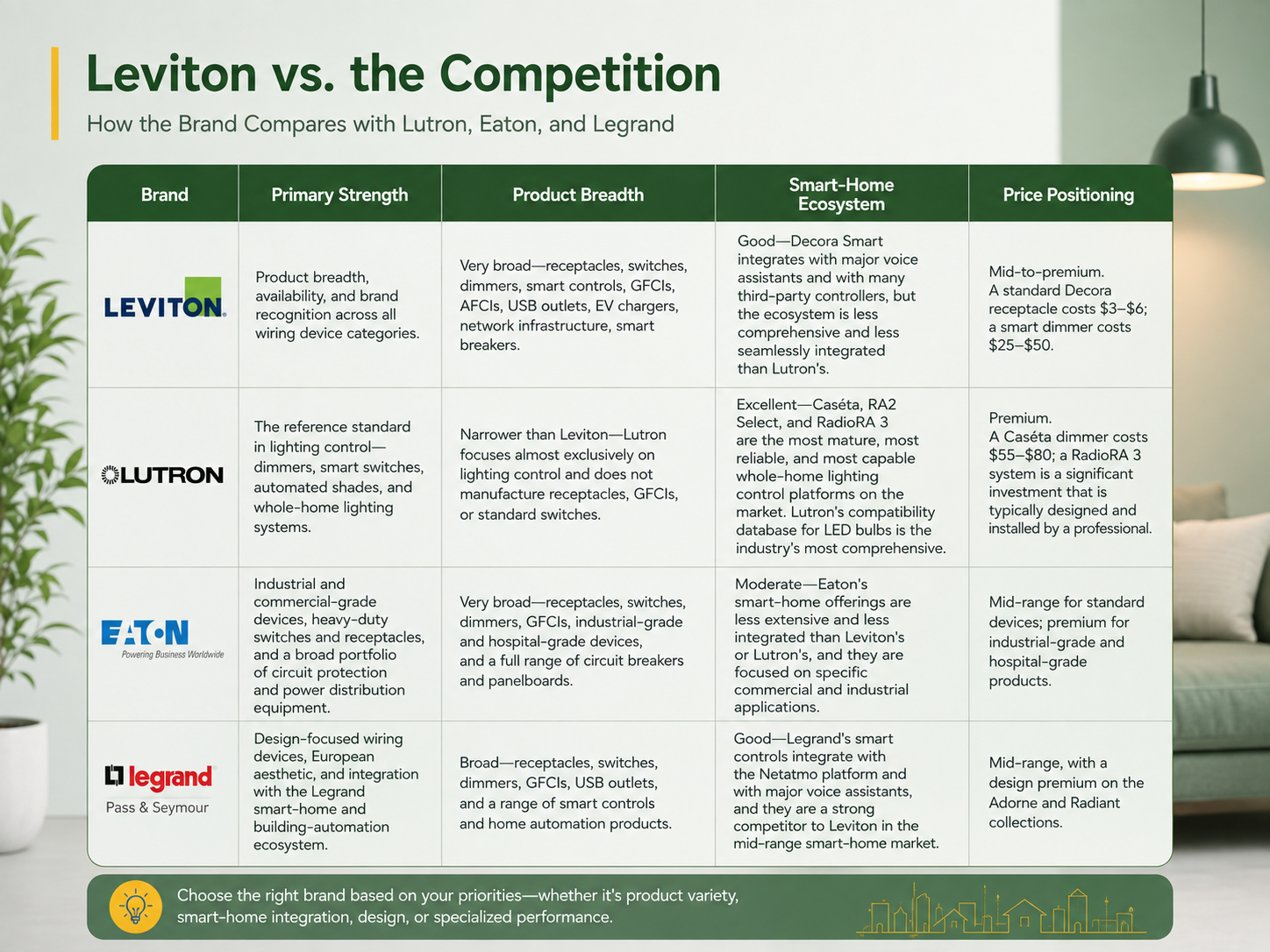 Leviton vs the Competition
The table below provides a direct comparison of Leviton with its three largest North American competitors across the criteria that matter most in a real‑world purchase decision.
| Brand | Primary Strength | Product Breadth | Smart‑Home Ecosystem | Price Positioning |
|---|---|---|---|---|
| Leviton | Product breadth, availability, and brand recognition across all wiring device categories | Very broad—receptacles, switches, dimmers, smart controls, GFCIs, AFCIs, USB outlets, EV chargers, network infrastructure, smart breakers | Good—Decora Smart integrates with major voice assistants and with many third‑party controllers, but the ecosystem is less comprehensive and less seamlessly integrated than Lutron’s for whole‑home lighting control | Mid‑to‑premium. A standard Decora receptacle costs $3–$6; a smart dimmer costs $25–$50. |
| Lutron | The reference standard in lighting control—dimmers, smart switches, automated shades, and whole‑home lighting systems | Narrower than Leviton—Lutron focuses almost exclusively on lighting control and does not manufacture receptacles, GFCIs, or standard switches | Excellent—Caséta, RA2 Select, and RadioRA 3 are the most mature, most reliable, and most capable whole‑home lighting control platforms on the market. Lutron’s compatibility database for LED bulbs is the industry’s most comprehensive. | Premium. A Caséta dimmer costs $55–$80; a RadioRA 3 system is a significant investment that is typically designed and installed by a professional. |
| Eaton (Arrow Hart / Cooper) | Industrial and commercial‑grade devices, heavy‑duty switches and receptacles, and a broad portfolio of circuit protection and power distribution equipment | Very broad—receptacles, switches, dimmers, GFCIs, industrial‑grade and hospital‑grade devices, and a full range of circuit breakers and panelboards | Moderate—Eaton’s smart‑home offerings are less extensive and less integrated than Leviton’s or Lutron’s, and they are focused on specific commercial and industrial applications | Mid‑range for standard devices; premium for industrial‑grade and hospital‑grade products. |
| Legrand (Pass & Seymour) | Design‑focused wiring devices, European aesthetic, and integration with the Legrand smart‑home and building‑automation ecosystem | Broad—receptacles, switches, dimmers, GFCIs, USB outlets, and a range of smart controls and home automation products | Good—Legrand’s smart controls integrate with the Netatmo platform and with major voice assistants, and they are a strong competitor to Leviton in the mid‑range smart‑home market | Mid‑range, with a design premium on the Adorne and Radiant collections. |
The extensive product range provided by Leviton means that the choice of product line for a particular customer depends on factors like the intended use of the product, budget, and desired features. The Decora standard line of switches and outlets is a valued component of the Leviton product range. This line is offered in different colors like ivory and white and is used in many residential and light commercial applications. The Decora Edge line features a snap-on plate that results in a modern and stylish appearance of the product. The Decora Smart line is also Wi-Fi-enabled and can be controlled through application-based software, thus allowing compatibility with the system for energy usage measurement and monitoring in the house. The Decora line simplifies the choice of switches for those customers who are interested in replacing the old switches with something more reliable without incurring additional expenses. Meanwhile, for those people who would prefer to invest in smart technology in some particular areas of the house (such as the kitchen, the living room, or the bedroom), Decora Smart is a feasible option. All contractors creating wiring for new buildings value the diversity of the Leviton catalogue that provides an opportunity to purchase all the needed products from a single supplier. At the same time, builders that have to make bulk purchases appreciate the fact that Leviton is one of a few options that provide code-compliant switches at competitive prices.
Indeed, Leviton is among the brands of outlets that provide good quality. Their receptacles, which include standard, tamper-resistant, GFCI, AFCI, and USB integrated types have been shown to be very good, UL listed, and also come with a warranty from the manufacturer. Many residential electricians rely on Leviton receptacles thanks to their quality, availability, and compatibility with electrical boxes and standard wall plates.
Leviton Manufacturing Company is an independent company that is privately owned in America. It was established in 1906 and is still owned by the same family that founded it. The company makes its products in plants located in America, Mexico, and China and is not affiliated with any other major corporations.
The choice between the two brands depends on the area of application. Leviton is the better choice for general applications such as general-purpose receptacles, standard switches, GFCIs and USB outlets, as it has a far wider range of products in these categories than Lutron. However, Lutron has better lighting control systems, especially in regard to whole house dimming systems, smart lighting scenes and automated shades. The Caséta and RadioRA platforms of Lutron are more advanced and more reliable than Leviton’s smart lighting products. Many houses are equipped with both brands, using Leviton receptacles and switches throughout, and Lutron dimmers and lighting controls.
Leviton and Eaton (Arrow Hart) have similar quality, pricing and availability when considering regular residential receptacles and switches. However, it seems that Eaton enjoys a bigger reputation and better range of products when compared to Leviton in industrial and hospital applications. In the smart home area, Leviton’s Decora smart line is apparently more user-friendly to homeowners than Eaton’s smart home solutions. In terms of circuit breakers and panelboards, the Use of the Leviton Load center is relatively new compared to Eaton’s long history in this category. The decision on which brand to choose is usually influenced by the contractor’s preferences, or the particular type of a product needed, rather than more quality-oriented preferences of the brands.
Is Leviton a reputable brand? Yes—for the homeowner who is putting in a few electrical fittings, for the contractor who considers availability and consistency important, and for the builder who is looking for a prominent name, Leviton is a trustworthy brand that is well-supported and technically advanced. The brand has become established in the market thanks to over hundred years of business experience, vast product offering, and distribution system that makes the products available everywhere in North America. The choice between Leviton and another company should depend on the requirements of the particular project considering its budget, required home automation level, availability of the devices with regard to aesthetics, and any support needed in the course of the project.
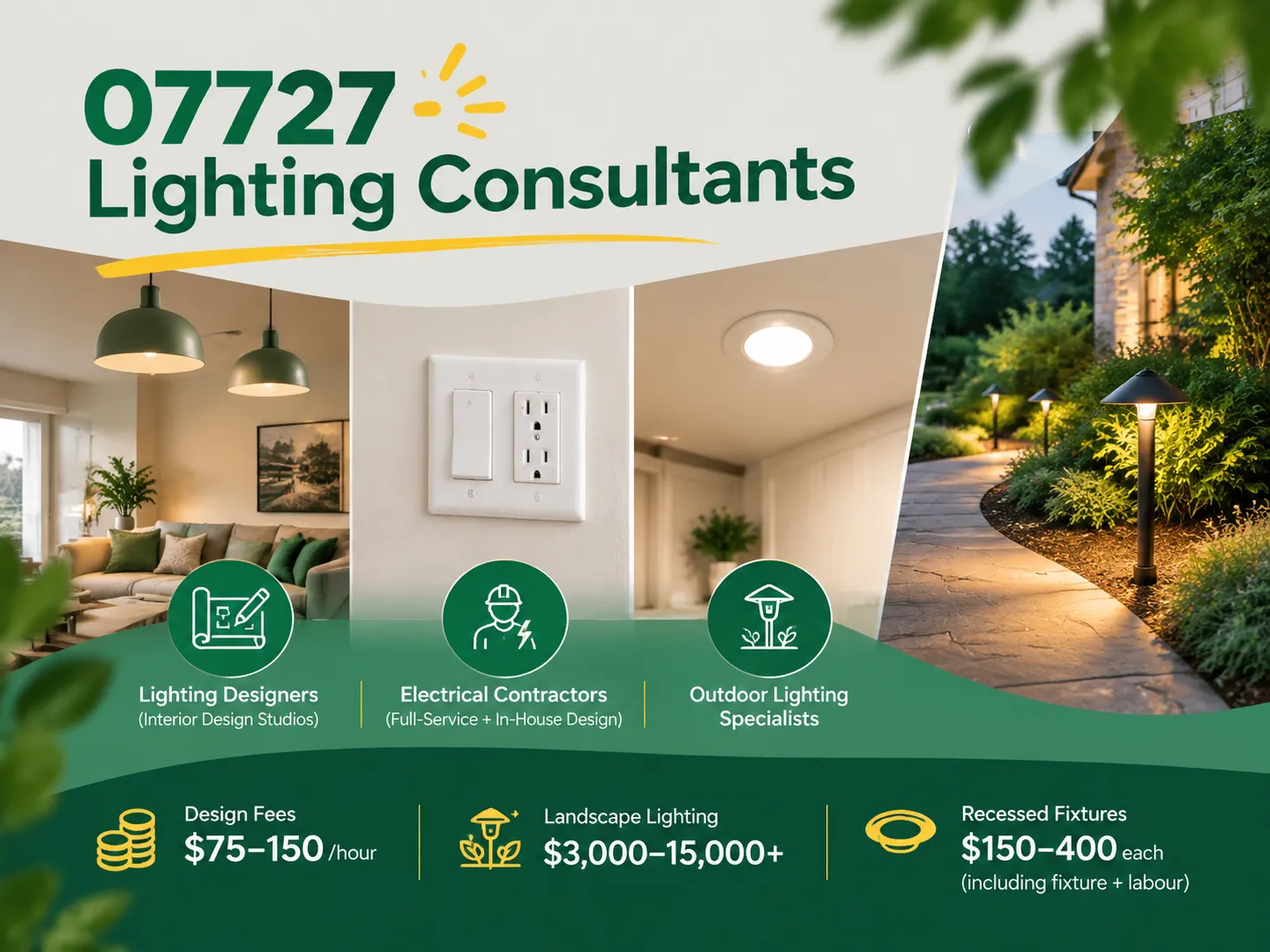
Farmingdale, along with parts of Wall Township and Tinton Falls, New Jersey, share the same zip code of 07727. Most of the houses built from the 1950s to the 1990s still exist today. Most of the homeowners are renovating their houses as opposed to building new homes. Homeowners tend to spend a lot more on […]

The term “07984 lighting consultants” gives people the impression that the five digits represent a postal code of some sort that indicates the place where lighting consultants provide services. This is, however, incorrect: there is no postal area coded 07984, which is only a code of mobile telecommunications in Great Britain. This means that the […]

San Francisco is not the average lighting control market. The housing stock is old and dense, and the electrical code does not allow for as many electrical installations as is allowed almost anywhere else in the U.S. Most homes that want complex lighting are Victorian or Edwardian buildings where no one wants to start opening […]

 No.6 Tuozhan Road, Leshang Pioneer Park,Yueqingwan Bay Harbor,Yueqing city,Zhejiang Province


