

Thailand is known as a place where tourists are often puzzled about sockets. This is not due to the emergence of a new type of plug but because Thailand has established its own set of rules about the type of socket which is rare in the whole world. At the same time, it should be pointed out that in most hotels, travelers can find sockets compatible with devices from different countries. The article describes sockets in Thailand, the specifics of electricity supply in the country (230V/50 Hz), tells which countries can do without adapters, and gives recommendations on gadgets that can help one avoid wasting time searching for an adapter in Bangkok.
There are four types of plugs in Thailand, namely, Type A, Type B, Type C, and Type O. The Thai standard sets the features of Type O to have three round pins shaped in a triangle, as per TIS 166-2549. Type O plugs came into service in 2008, but as there are many buildings still built before that date, there are various places in Thailand using plugs Type A and Type B with flat pins. Hotels normally have sockets of all types. No matter what part of the world travelers come from, they should note if the sockets from their home countries are compatible with the sockets used in Thailand.
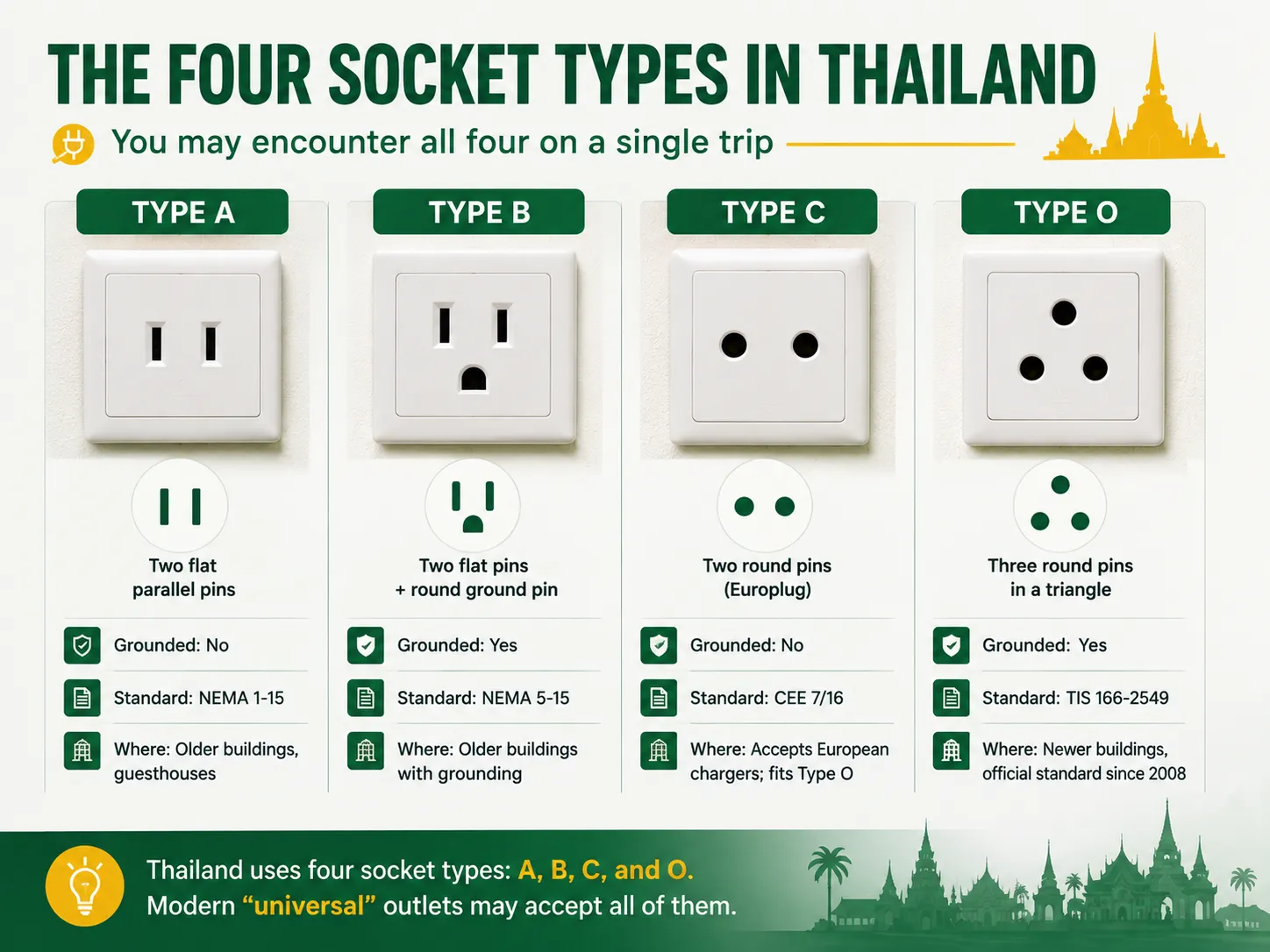
The electrical situation in Thailand is characterized by a combination of both traditional and modern technologies, and it is quite possible to come across some of these in one journey:
| Type | Pins | Grounded | Standard | Where You’ll Find It |
|---|---|---|---|---|
| Type A | Two flat parallel pins | No | NEMA 1-15 | Older buildings, guesthouses |
| Type B | Two flat pins + round ground pin | Yes | NEMA 5-15 | Older buildings with grounding |
| Type C | Two round pins (Europlug) | No | CEE 7/16 | Accepts European chargers; fits Type O |
| Type O | Three round pins in a triangle | Yes | TIS 166-2549 | Newer buildings, official standard since 2008 |
There are many sockets in Thailand that are of “universal” type, and this means that they can fit both flat (plug from the US) and round (plug from Europe) types of plug, as well as the Type O plug that is specific to Thailand. Such sockets can be found in some hotels and newer apartment complexes, but just because it fits, it does not mean it will be able to provide the appropriate voltage. For the hardware side of this world — the sockets and switches you install at home rather than plug into on holiday — the socket product range shows how the modern versions are built.
EGAT manages Thailand’s mains supply, providing electricity at 230 volts and 50 Hz. The electricity supply in cities such as Bangkok and other regions frequented by tourists is dependable. However, there may be outages in some rural areas and islands during the rainy season, making a power bank useful.
In Thailand, voltage is more important than the shape of the plug. If your devices have been made for a country where the voltage is between 220-240V, the only requirement would be the plug adapter. On the contrary, if the devices were made for a 100-127V country, such as the US, Japan, and Canada, the voltage is doubled, and the devices can be damaged if they get plugged into an outlet in Thailand.
Type O is noteworthy, as it is all but exclusive to Thailand. It was introduced in 2008 as per TIS 166-2549, having a design featuring two round pins of 4.8 mm for power and a grounding pin of 4 mm arranged in a triangular fashion and rated 16 Amperes at voltages between 220 and 240 Volts. It aims to close the gap in safety created by the flat pin sockets which were often left ungrounded and increased risk for high-power devices like large home appliances, power tools, or anything that has a metallic body.
This last point mentioned before is important for travelers: Type O sockets accept plugs following the Type C (Europlug) standard. Thus, travelers could just plug their European chargers into Thai wall sockets without the need for any adapter. But anyways, the connection does not work the other way: the Type F (Schuko) plug and three-prong British plugs cannot be fitted into Type O sockets without using some adapter.
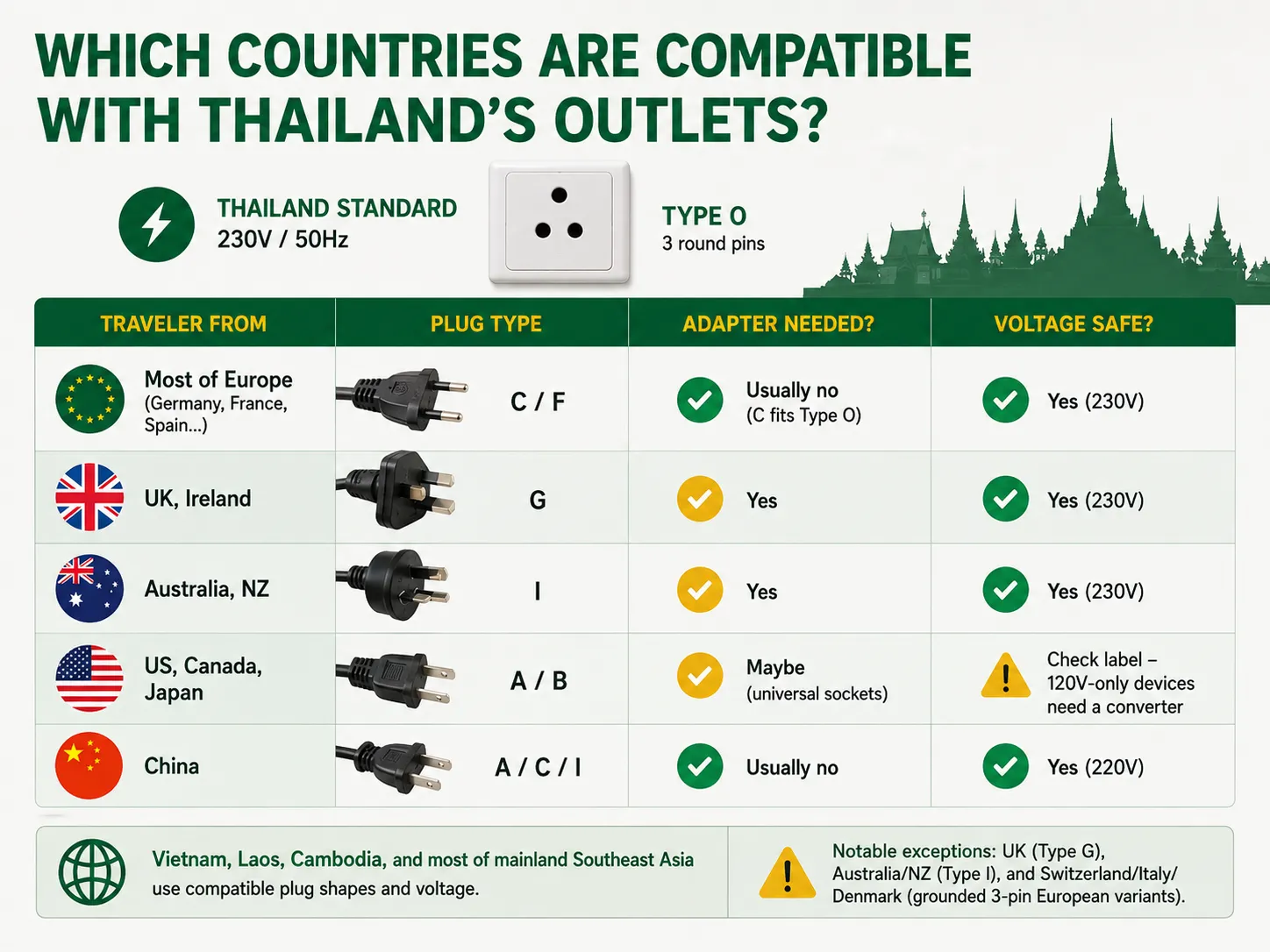
| Traveler From | Plug Type | Adapter Needed? | Voltage Safe? |
|---|---|---|---|
| Most of Europe (Germany, France, Spain…) | C / F | Usually no (C fits Type O) | Yes (230V) |
| UK, Ireland | G | Yes | Yes (230V) |
| Australia, NZ | I | Yes | Yes (230V) |
| US, Canada, Japan | A / B | Maybe (universal sockets) | Check label — 120V-only devices need a converter |
| China | A / C / I | Usually no | Yes (220V) |
Vietnam, Laos, Cambodia, and most of mainland Southeast Asia use compatible plug shapes and voltage, which is why travelers moving between them rarely notice the difference. The notable incompatible cases are the UK’s Type G (three rectangular pins), Australia/NZ’s Type I (angled flat pins), and Switzerland/Italy/Denmark’s grounded three-pin European variants — the same socket-family logic that governs the different kinds of switches used with these systems.
Gadgets differ in this respect:
The rule of thumb for Thailand is that if the machine is dual-voltage equipment, you only need an adapter, and if it is a single-voltage machine, it is better to leave it behind. The best buy for the trip to Thailand would be a universal travel adapter with USB and USB-C.And if a faulty socket or switch at home is what made you look up plug types in the first place, the light switch replacement guide is the safe way to handle that job yourself.
And if you are the kind of traveler who ends up wishing your own home had more flexible sockets, the modern hardware exists — USB wall outlets and fast-charging sockets are now standard upgrades, and the USB wall outlet fast-charging guide explains the options.
It is true that they are similarly built but they have different voltage levels. Thai sockets from the past used to accept flat-pin plugs just like they are used in the USA while the sockets typically used now have been upgraded to work with voltage of 230V as opposed to 120V used in America. This means that any electrical equipment designed to only work on 120V will burn down if used with the type of electrical socket available in Thailand. Adapters are used with electrical appliances capable of operating at different voltage levels.
To choose the one that would meet the purpose, travelers should look for a universal adapter that covers all four socket types. If the users can travel with the Type C charger, they will not even need to use an adapter. However, visitors from the UK and Australia should definitely take one.
Thailand employs Type O plug which has three round sockets placed in a triangular shape with the voltage of 16A.
Most probably yes, especially if you are not traveling from Europe.
Thailand’s electricity system might be thought of as being complicated; however, using 230V/50Hz power means that you can use your devices practically anywhere in the world. Actually, the Type O socket works with euro plugs and in hotels there are sockets that are universal and suitable for the USA as well. The only thing that must be remembered is that only appliances compatible with the voltage range of from 100V to 240V have to be used.

The term “07984 lighting consultants” gives people the impression that the five digits represent a postal code of some sort that indicates the place where lighting consultants provide services. This is, however, incorrect: there is no postal area coded 07984, which is only a code of mobile telecommunications in Great Britain. This means that the […]
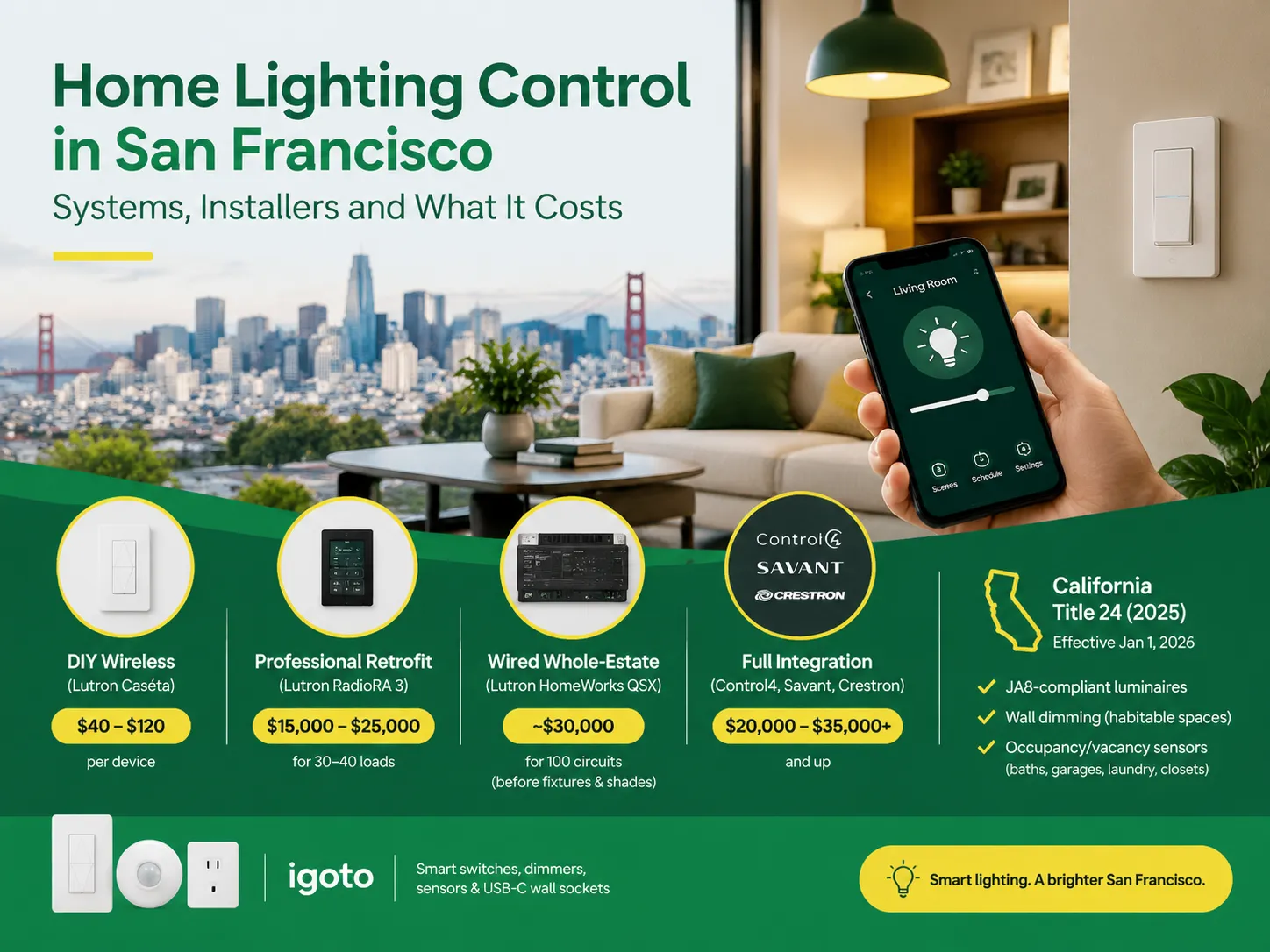
San Francisco is not the average lighting control market. The housing stock is old and dense, and the electrical code does not allow for as many electrical installations as is allowed almost anywhere else in the U.S. Most homes that want complex lighting are Victorian or Edwardian buildings where no one wants to start opening […]
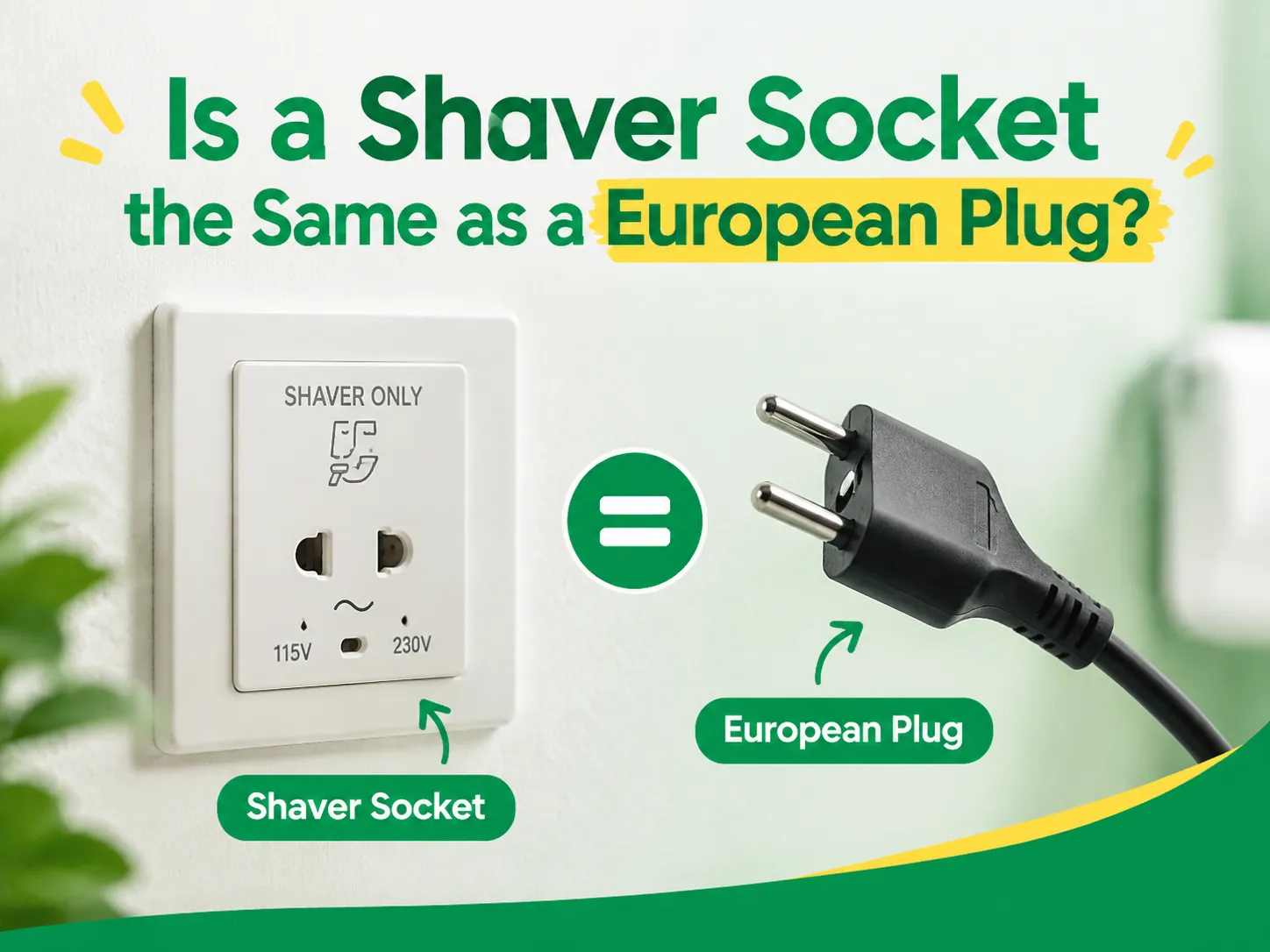
Although they seem to be alike, they both have a round shape with two pins, and they function at a voltage of 230V. This explains why some tourists use a European plug with a British shaver or wonder why a shaver cannot be plugged into a Schuko socket in a Spanish hotel. In reality, they […]

 No.6 Tuozhan Road, Leshang Pioneer Park,Yueqingwan Bay Harbor,Yueqing city,Zhejiang Province


