

When a business traveler from Miami reached Panama City for a week of meetings, he took out his laptop, plugged in its charger, and instantly discovered something unusual. While the plug went easily into the socket and looked the same as the sockets in his home in Florida, he decided to check the voltage with a meter, which he would do after years of experiences with traveling. As it turned out, the voltage was OK, as well as the frequency. He expected to face complicated situation with adapters, instead he found out that Panama and The USA have the same systems of electrical outlets, voltage and plug configuration. As a result, the basic answer to the question of electrical outlets in Panama and the USA is that one’s devices can be plugged into the sockets in Panama lack of any additional adapters. Nevertheless, the complete answer consists of the information about voltage, surge protection and the rare situations when the difference really matters.
Summary: Both the NEMA 1-15 (two-prong, ungrounded) and the NEMA 5-15 (three-prong, grounded) plug and socket standards are utilized by Panama in the same manner as the United States. The nominal residential voltage of Panama is also 120 volts at 60 hertz, the same as that of the USA. No plug adapters or voltage transformers are typically required for American equipment, which can be directly attached to Panamanian electrical outlets.
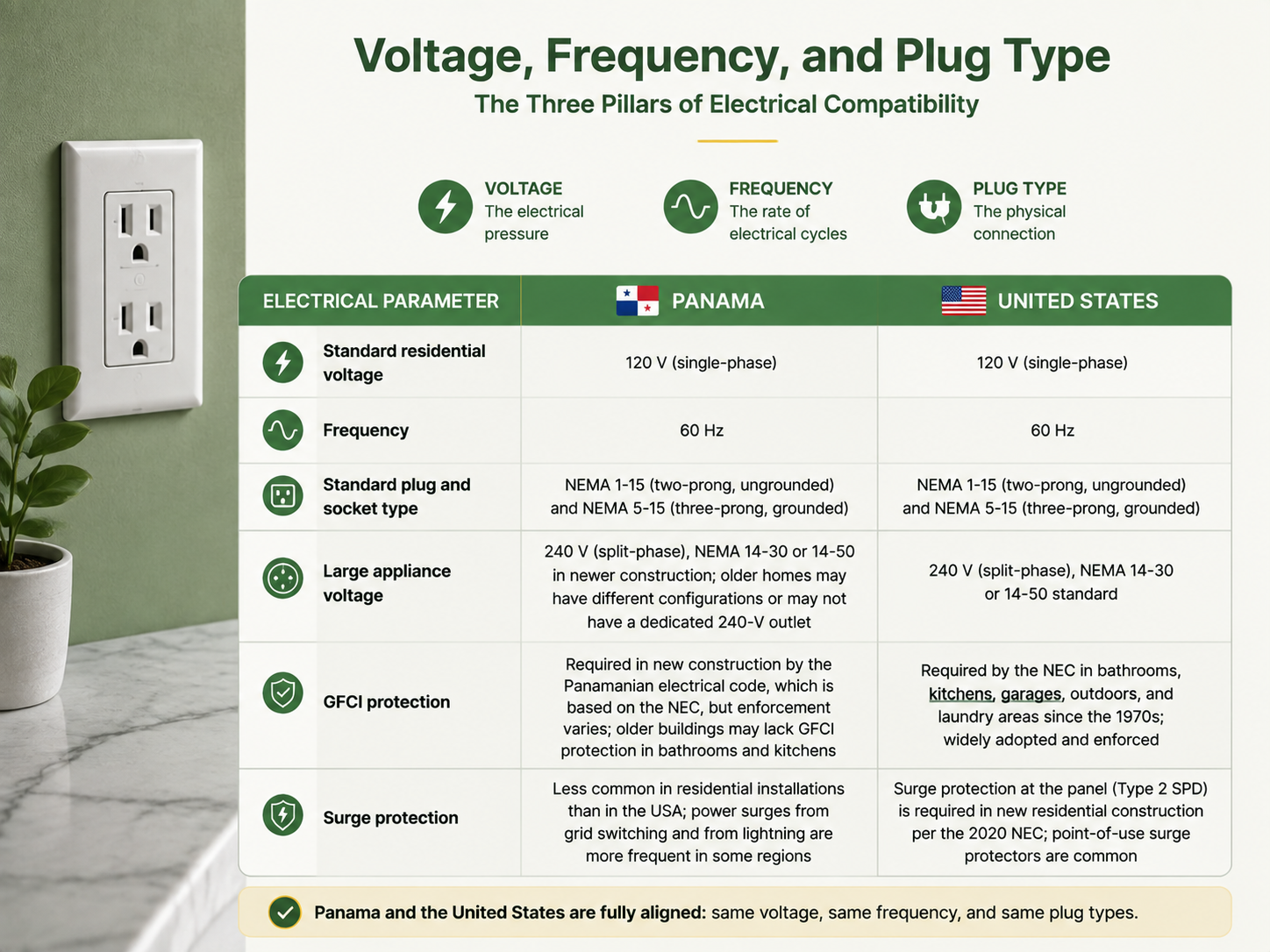
The compatibility of an electrical device with a foreign outlet depends on three factors: the voltage, the frequency, and the physical plug configuration. For Panama and the United States, all three factors are aligned. The table below provides a side‑by‑side comparison of the two countries’ electrical systems, with the key parameters that determine whether a device will work safely and correctly.
| Electrical Parameter | Panama | United States |
|---|---|---|
| Standard residential voltage | 120 V (single‑phase) | 120 V (single‑phase) |
| Frequency | 60 Hz | 60 Hz |
| Standard plug and socket type | NEMA 1‑15 (two‑prong, ungrounded) and NEMA 5‑15 (three‑prong, grounded) | NEMA 1‑15 (two‑prong, ungrounded) and NEMA 5‑15 (three‑prong, grounded) |
| Large appliance voltage | 240 V (split‑phase), NEMA 14‑30 or 14‑50 in newer construction; older homes may have different configurations or may not have a dedicated 240‑V outlet | 240 V (split‑phase), NEMA 14‑30 or 14‑50 standard |
| GFCI protection | Required in new construction by the Panamanian electrical code, which is based on the NEC, but enforcement varies; older buildings may lack GFCI protection in bathrooms and kitchens | Required by the NEC in bathrooms, kitchens, garages, outdoors, and laundry areas since the 1970s; widely adopted and enforced |
| Surge protection | Less common in residential installations than in the USA; power surges from grid switching and from lightning are more frequent in some regions | Surge protection at the panel (Type 2 SPD) is required in new residential construction per the 2020 NEC; point‑of‑use surge protectors are common |
The truth is that for most Americans traveling to Panama, there is no reason to even consider the issue of adapters: your NEMA 5-15 plug works perfectly with the Panamanian electrical outlets, just as it does with standard three-prong plugs of your laptop charger, your phone charger, and your electric hair dryer. The voltage and the frequency are identical to those at home. There is only one situation when the traveler may need to use an adapter—when the device has a three-prong (grounded) plug, and an older building has just two-prong (ungrounded) outlets. The solution: a simple three-prong-to-two-prong adapter that will allow for the use of the device. However, it is very dangerous to use this adapter without making sure that its grounding tab (which must be connected to the outlet’s cover screw, which in turn must be connected to a grounded metal box) is properly grounded. When there is an ungrounded outlet, it is better not to charge the device, to find a grounded outlet somewhere in the building, or to use a portable GFCI adapter with ground-fault protection that does not require a building ground. Those who want to be ready for any case will do well to get a universal travel adapter with a NEMA 5-15 input and USB power ports. The International Electrotechnical Commission (IEC) maintains the global standards for plug and socket configurations, and the NEMA 1‑15 and NEMA 5‑15 configurations that Panama uses are the same as the USA’s, with the same voltage, the same frequency, and the same safety requirements.
Voltage and plug configuration are usually quite similar in Panama and in the USA, the issue of power supply is quite different. In fact, the power supply may vary significantly depending on a place, especially that you go far away from the business centers in Panama City. Power surges, which usually occur on a short time basis but which can damage or destroy the electronic devices are more widespread in Panama than in the majority of areas in USA due to a number of reasons. First of all, the power grid in Panama, especially in remote areas and small towns needs to be regulated much more strictly when compared to the one in North America. Second, it is important to point out that the incidence of power surges increases during thunderstorms, as well as when some elements of the grid switch and when big engines are being activated. Third, Panama has too many often-coming tropical storms, which creates instability in power supply. If you use the American surge protectors, they will work fine in Panama, and it is highly suggested for anyone using computers, cameras or medical equipment. A portable surge protector is a good investment. Also, someone going to stay in Panama or to open a business in Panama should consider going for a whole-house surge protective device installed at the main electrical panel. The Electrical Safety Foundation International (ESFI) provides guidance on surge protection for residential and commercial installations that applies equally to the USA and to Panama.
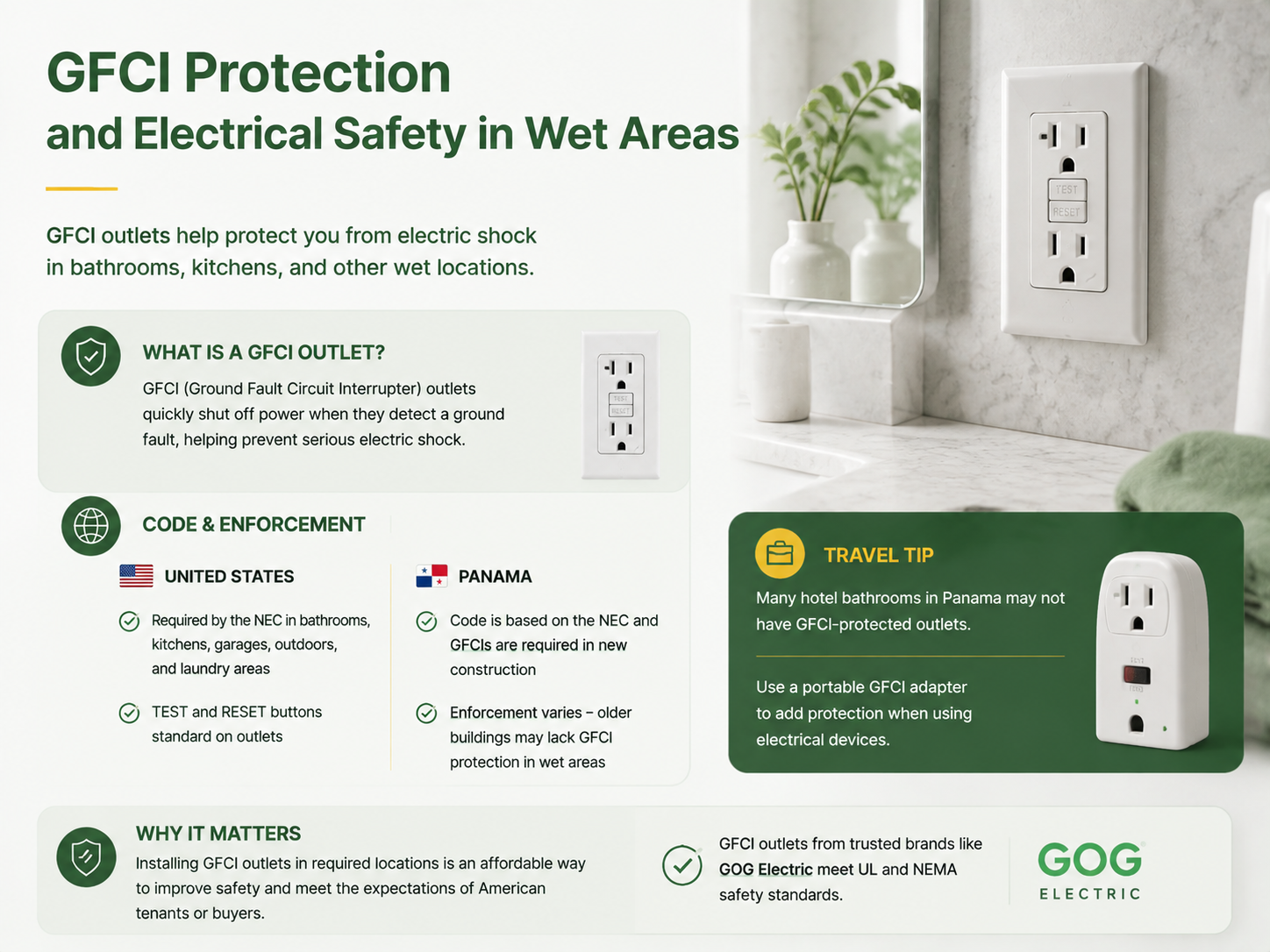
In decades, the Americans have required by the National Electrical Code to install GFCI (Ground Fault Circuit Interrupter) protection in bathrooms, kitchens, garages, outdoors, and laundry areas, as well as have the TEST and RESET buttons on the GFCI outlet installed in every American home. In Panama, the code is based on the NEC, and according to current legislation, the new buildings have to abide by the GFCI requirement just like in the USA, however, different regions of the country might have different levels of enforcement, therefore many old structures as well as some newly constructed buildings might not have GFCI outlets installed where they should be according to the American standards. Therefore, when traveling abroad it is advisable to keep this fact in mind: should a traveler stay in a hotel room that has a standard outlet in the bathroom either near or close to the sink, the outlet is not likely to have GFCI protection installed. Another thing worth mentioning is that having a portable GFCI adapter can be a good advice: a small cheap gadget that can be plugged into an outlet and provides GFCI capability. In general, implementing GFCI outlets at the locations required by the NEC is about a low-cost but good investment for a homeowner in Panama. For a broader look at the different outlet types and their safety functions, our guide on the four types of electrical outlets covers GFCI, AFCI, tamper‑resistant, and USB‑charging devices in detail.
The 120-volt, NEMA 5-15 outlet that is used to power a laptop, television, and toaster is similar in both Panama and the USA. In the case of large appliances like electric range, clothes dryer, central air conditioning system, etc. the matter is more complicated. Both countries have 120/240-volt split-phase residential electric supply, and the 240-volt outlet that supplies power to large appliances has two types—NEMA 14-30 and NEMA 14-50. However, in many older Panamanian homes, you may not find a 240-volt outlet at all. In the past, it was more common to have gas range and a gas dryer, and if you do have a 240-volt outlet in the older property, most probably, this was done using older equipment that was in place before the regulations changed. If an American moves to Panama to live and he or she takes large electrical appliances, it is important to check whether 240-volt outlet, with a dedicated circuit and the necessary amperage rating is present in the house. If it is not, a qualified electrician can easily install this type of outlet as all needed NEMA outlets, breakers and cables are available in Panama and the installation process follows NEC rules used in the USA. For a deeper understanding of the voltage differences that govern all of these applications, our guide on UK voltage vs US voltage explains the split‑phase system and how it compares with the 230‑volt single‑phase supply used in the UK and Europe.
The list of electrical items that Americans need to bring to Panama is pretty short. For starters, you’ll simply need your phone, laptop, camera, and electric shaver. Don’t forget to take your regular American charger and cables. If you have a valuable or delicate electronic device, such as a laptop or camera, consider packing a portable power strip, especially if you’ll be sleeping outside Panama City or in an older building. Remember to take along a GFCI adapter if you plan to use appliances in kitchens or bathrooms. Consider bringing a three-prong-to-two-prong adapter for the case of an outlet that doesn’t have a grounding wire, but be sure to use it with care and recognize its limitations. If you need to avoid excess weight in your bag, do not pack a voltage converter. You definitely don’t need it! And do not pack a plug adapter because American plugs can be plugged straight into Panamanian outlets. Finally, you don’t need to take big American appliances that require 240 volts unless you are sure that there will be suitable outlets at your destination. Resources from the WorldStandards.eu website provide additional detail on voltage, frequency, and plug types by country, and the Panamanian electrical utility (ENSA, Elektra Noreste, or the specific regional provider) can provide local information on supply reliability and surge protection in a specific area.
Indeed. Panama has the same NEMA 1‑15 (two‑prong, ungrounded) and NEMA 5‑15 (three‑prong, grounded) plugs and sockets as the United States. An American device with a standard American plug will go into a Panamanian outlet without needing an adapter. The voltage (120V) and frequency (60Hz) are also the same.
Most travelers from the USA won’t need any plug adapters when traveling to Panama. Visitors can directly connect American appliances with Panamanian electrical sockets. In fact, for any older building equipped with ungrounded sockets, the only device that may help would be a two-prong-to-three-prong plug converter and possibly a portable power surge protector for delicate electronic devices.
There aren’t any specific banned electrical devices when traveling to Panama, but do not bring large 240-volt appliances like electric ranges and large Electric dryers from the U.S.A. before confirming that your destination has the right 240-volt outlet. The devices can work depending on whether there is an appropriate outlet, but installing a new 240-volt circuit in Panamanian homes can only be done by a licensed electrician at a substantial cost.
Although this question isn’t about electrical outlets, tourists should be aware that credit cards and debit cards can be used in Panama City and in big towns with hotels, restaurants and shopping stores. For small purchases in rural locations, as well as when dealing with street vendors, it is better to use cash (the Panamanian Balboa, which is tied to the US Dollar with the exchange rate of 1:1, and the US Dollar that has the status of legal tender in Panama). It is highly recommended to get a major credit card and moderate cash amount in the infrastructure.
The electrical outlets in Panama vs. the USA are, for the vast majority of practical purposes, the same. The plug fits in the socket. The volts match. The frequency is the same. An American tourist who unpacks a charger for a laptop and puts it into a socket in Panama will have the same kind of electrical connection and the same kind of results as in the USA. The differences that exist – the occasional outlet not being grounded if the building is old, great chances of an electric surge happening, and perhaps the lack of GFCI protection in wet zones – are not a big deal and can be dealt with easily by making some small and cheap preparations. If the traveler takes a portable surge protector and GFCI adapter, and knows the electrical age and condition of the building, it is enough for a successful trip. When it comes to purchasing electric equipment, Panama is the NEMA market of 120 volts and 60 Hz when goods that were produced for the US can be sold and installed with minor changes.
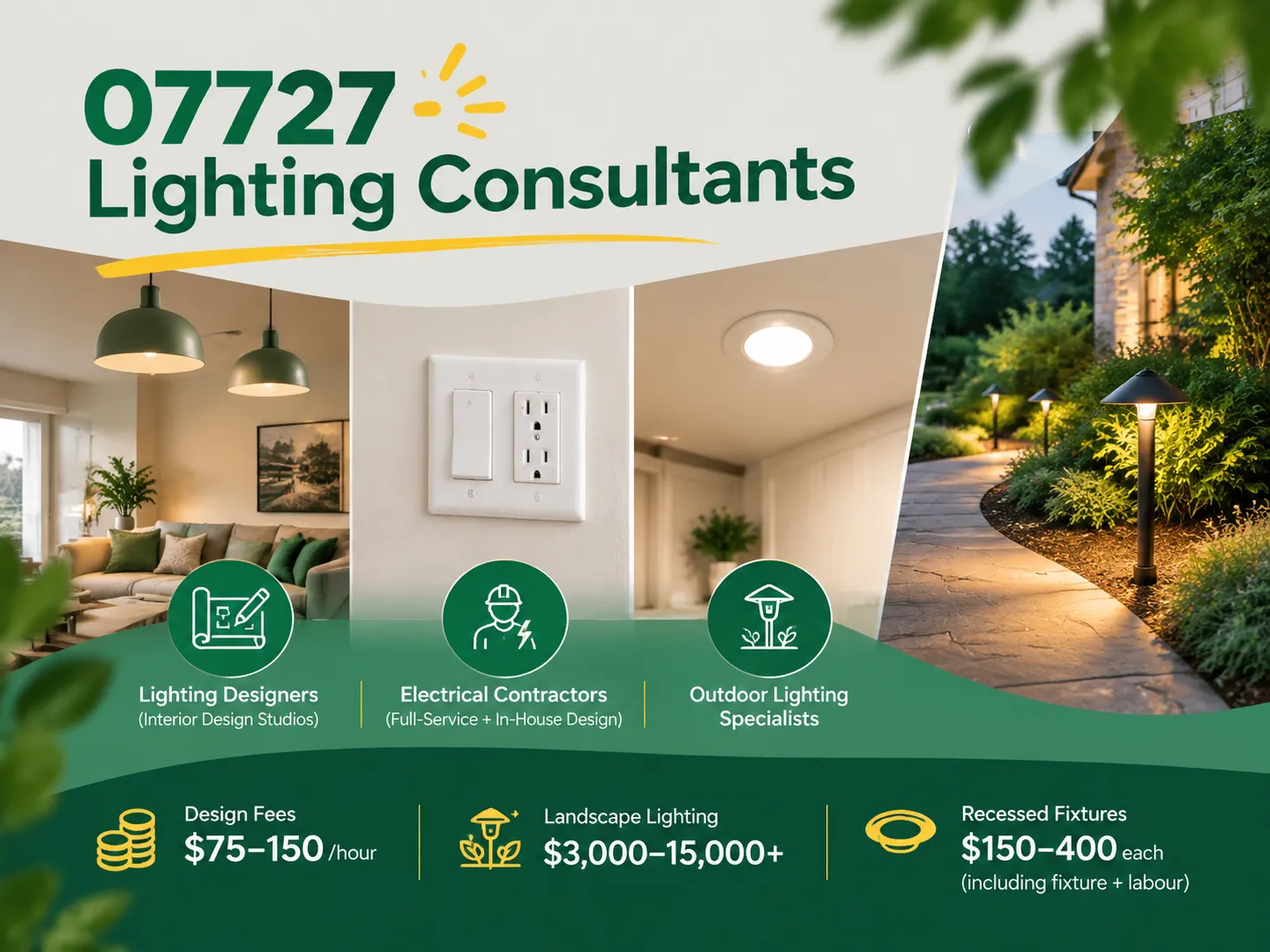
Farmingdale, along with parts of Wall Township and Tinton Falls, New Jersey, share the same zip code of 07727. Most of the houses built from the 1950s to the 1990s still exist today. Most of the homeowners are renovating their houses as opposed to building new homes. Homeowners tend to spend a lot more on […]

The term “07984 lighting consultants” gives people the impression that the five digits represent a postal code of some sort that indicates the place where lighting consultants provide services. This is, however, incorrect: there is no postal area coded 07984, which is only a code of mobile telecommunications in Great Britain. This means that the […]
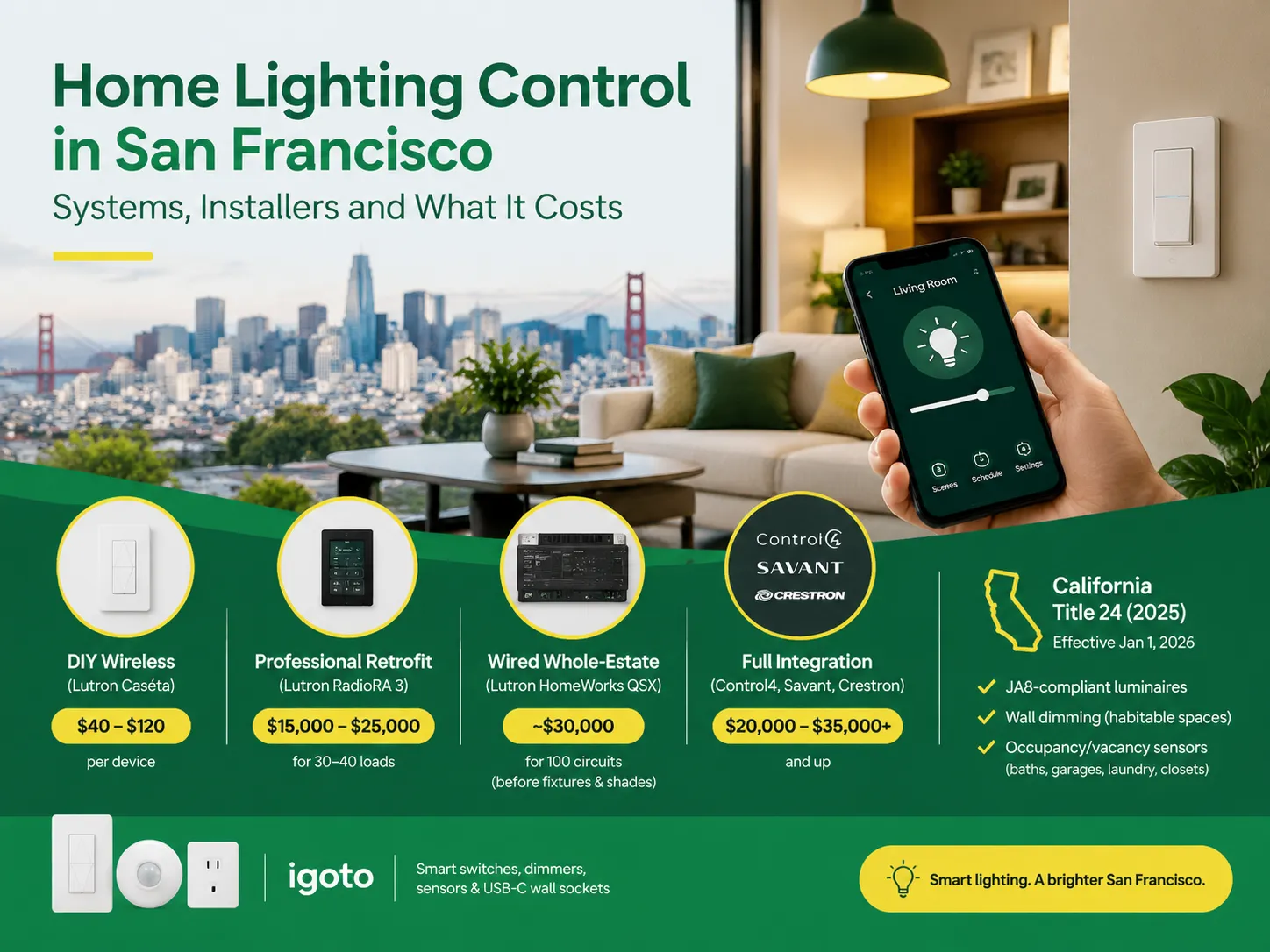
San Francisco is not the average lighting control market. The housing stock is old and dense, and the electrical code does not allow for as many electrical installations as is allowed almost anywhere else in the U.S. Most homes that want complex lighting are Victorian or Edwardian buildings where no one wants to start opening […]

 No.6 Tuozhan Road, Leshang Pioneer Park,Yueqingwan Bay Harbor,Yueqing city,Zhejiang Province


