

Farmingdale, along with parts of Wall Township and Tinton Falls, New Jersey, share the same zip code of 07727. Most of the houses built from the 1950s to the 1990s still exist today. Most of the homeowners are renovating their houses as opposed to building new homes. Homeowners tend to spend a lot more on the design of their homes than on the fixtures. In this article, we discuss types of local lighting consultants and the types of lighting-capable contractors present in this area, as well as how to assess a contracting engagement between the homeowner and the lighting expert, what the fee for such an engagement is in this market, and how to tell apart the lighting designer from the electrician by means of a catalog.
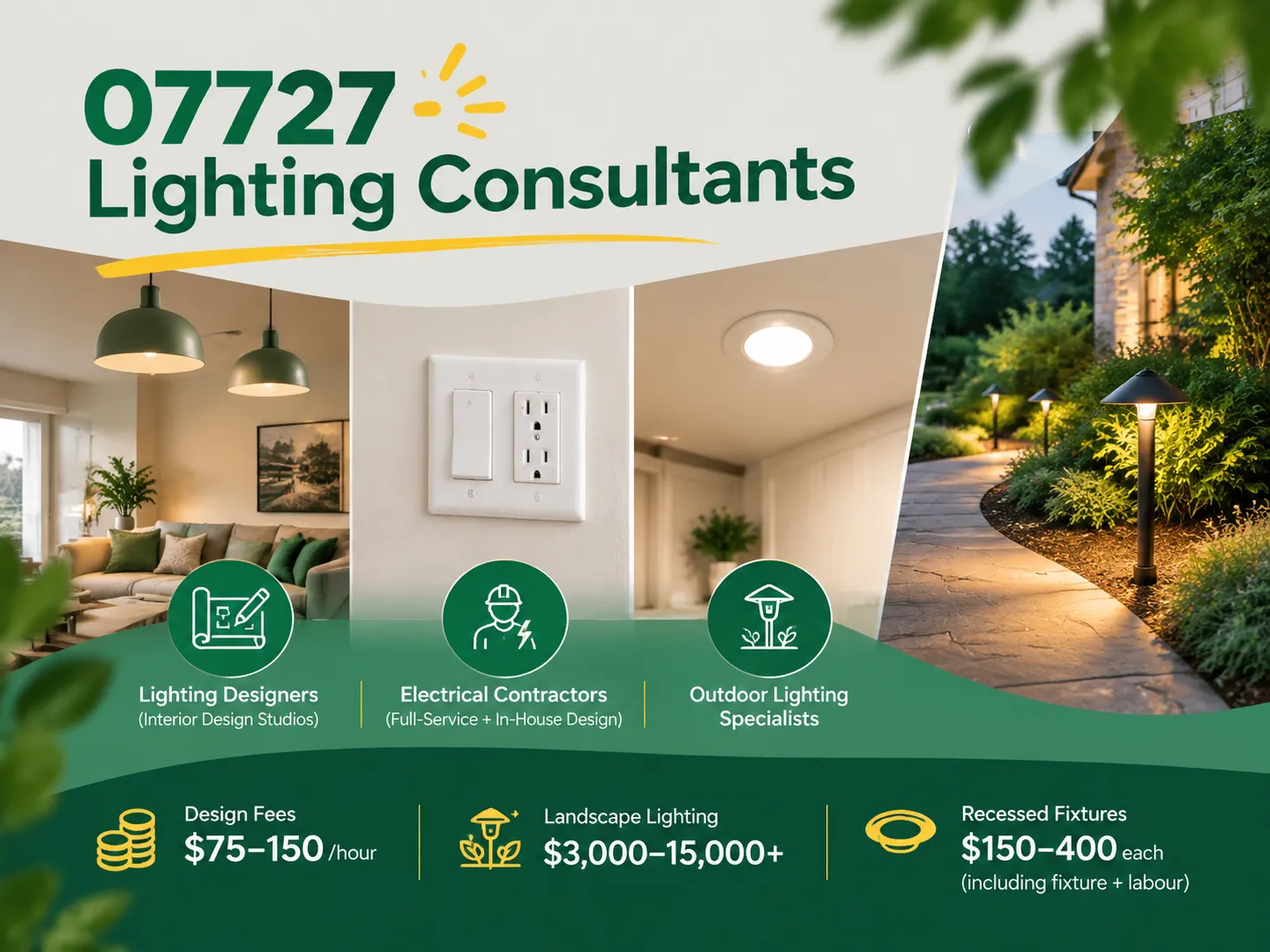
When looking for lighting installation services in the New Jersey area with postal code 07727, there are three types of companies to choose from. The first is a lighting designer working under an interior design company. The second type is a full-service electrical contractor specializing in all electrical works and lighting design and the last type of company is any outdoor lighting specialist. Lighting design services usually come with design fees ranging from $75-$150 per hour or 1%-3% of the total project cost. Under landscape lighting, systems cost from $3,000 to $15,000 or more while for installed recessed light fixtures, the cost is around $150-$400 per fixture including installation.
The term Lighting Consultant is often misused, as it refers to three different but related roles within the lighting industry, each providing different types of services. The Lighting Designer produces a specification and layout and creates drawings typical to a specification, which includes selecting fixtures, establishing lumen and colour temperature targets, determining beam angles, and creating control zoning and reflected ceiling plans. The Lighting Designer typically uses Architectural Drawings or Site Surveys to produce the specification and layouts.The Licensed Electrical Contractor installs and tests the system, and in many areas, the local Electrical Contractor will have the capability to design the system. As a result, Local Electrical Contractors are often the first place a homeowner will look for assistance with a renovation of their kitchen or entire floor.A Lighting Showroom or Wholesale Supplier sells fixture products and may provide guidance for choosing the best-fitting product, however, generally do not take responsibility for the overall lighting design of the project.
Understanding the roll of the Lighting Designer, Electrical Contractor, and Wholesale Supplier helps determine who is responsible for the design risk. If the Electrical Contractor selects the fixture products, they are responsible for the outcome of the project. If the Designer selects the product and the Electrical Contractor is unable to source it, the process of designing, reviewing, and installing has to be done with great care and control. For a project where only one or maybe a few rooms are renovated, it is generally best to use a full service Electrical Contractor. For a Complete House Renovation or Commercial Fit-out, a Designer in front of an Electrical Contractor provides value in the process.
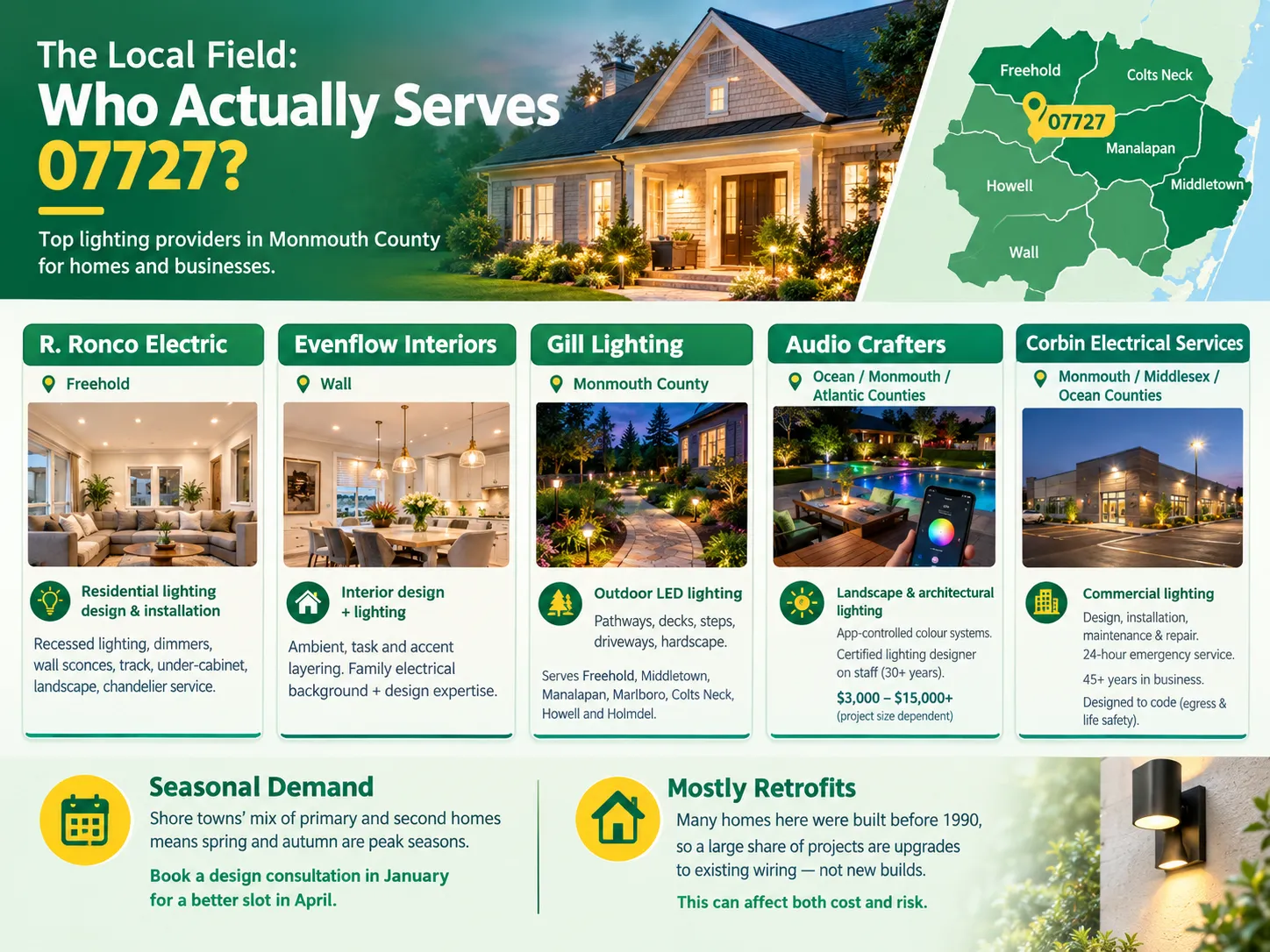
There are Five consistent companies completing residential and commercial lighting work, as Farmingdale’s local community is made up of Monmouth County businesses that serve primarily Wall, Howell, Freehold, Colts Neck, Manalapan and Middletown.
| Provider | Based in | What they do | Notable detail |
|---|---|---|---|
| R. Ronco Electric | Freehold | Residential lighting design and installation: recessed lighting, dimmers, wall sconces, track, under-cabinet, landscape, chandelier service | Full-service design-and-install under one contractor; explicitly highlights dimmer integration and recessed lighting in existing structures |
| Evenflow Interiors | Wall | Interior design with an integrated lighting service; ambient, task and accent layering | Born from a multigenerational family of electrical contractors — rare combination of interior design and trade background |
| Gill Lighting | Monmouth County | Outdoor LED lighting design, installation and wholesale supply: pathways, decks, steps, driveways, hardscape | Confirms service across Freehold, Middletown, Manalapan, Marlboro, Colts Neck, Howell and Holmdel |
| Audio Crafters | Ocean / Monmouth / Atlantic Counties | Landscape and architectural lighting with app-controlled colour systems | Certified lighting designer on staff with 30+ years of experience; quotes $3,000 for basic pathway and accent work up to $15,000+ for whole-property designs |
| Corbin Electrical Services | Monmouth / Middlesex / Ocean Counties | Commercial lighting design and installation, maintenance and repair; 24-hour emergency service | 45+ years in business; commercial lighting designed to code requirements such as egress and life safety |
There are two structural characteristics regarding this market that need to be highlighted. First, due to the combination of primary residences and vacation properties in Shore Towns, there will be an abundance of seasonal light installation in both the spring and fall. If you secure your design appointment in January, you are likely to receive a better time slot in April. Secondly, as many of the homes in Shore Towns were constructed prior to 1990 and, therefore, there will be a considerable proportion of projects that will be retrofitted into existing wiring as opposed to installing completely new wire systems, thus creating a different cost structure and risk profile.
A professional consultation will facilitate the creation of documentation rather than just relying on verbal recommendations. When consulting an electrical consulting firm for the above items, you can find those items listed as part of the proposed project documentation (for example). A firm with experience performing this type of work will have the necessary information available during the initial consultation. An inexperienced firm will be required to create or “wing it.”Documents prepared by an electrical consulting firm will include:
That last point is where the ordinary hardware makes or breaks a designed scheme. The most carefully drawn lighting plan still ends up as a wall plate and a dimmer, and a device that is not certified for the load will buzz, flicker or fail within a season — a risk that is managed by verifying the component specification rather than by trusting a catalogue photograph, exactly as buyers would when selecting an electric switch and socket manufacturer for a project of any size.
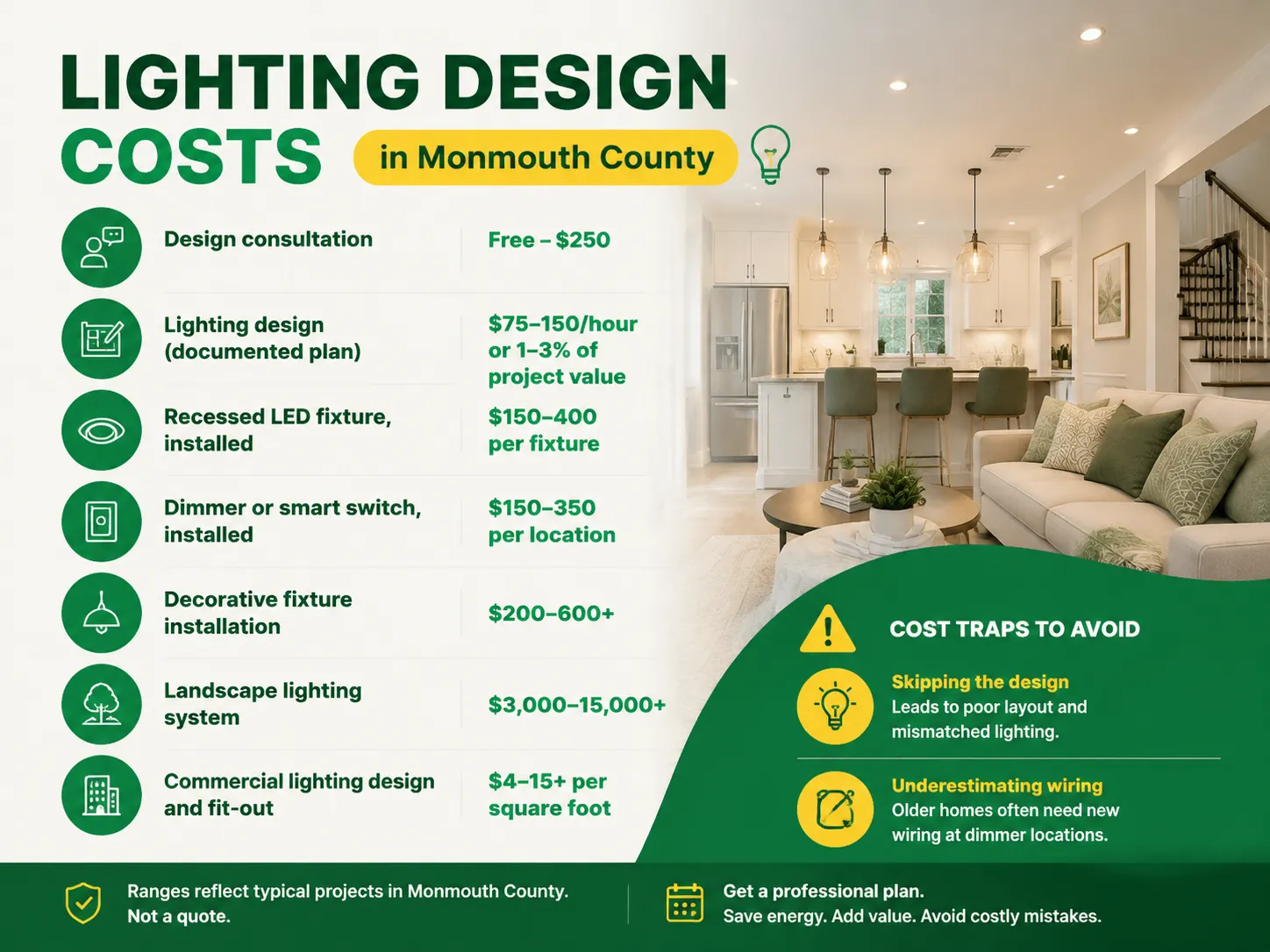
Because of the high cost of doing business in Monmouth County, the workforce is above the average and a lot of the work is done retrofitted; that is why prices for the same services fall into the highest ranges of prices nationally. The pricing below is intended for use in estimating what it may cost to perform the same work; it is not a firm quote but an example of price ranges that are commonly encountered between the two markets.
| Item | Typical range | Notes |
|---|---|---|
| Design consultation | Free to $250 | Many local firms offer a free initial consult; complex or multi-zone designs are charged as a fee and often credited against the installation |
| Lighting design (documented plan) | $75-150/hour, or 1-3% of project value | A single room is often a few hours; a whole-house plan is a multi-week deliverable |
| Recessed LED fixture, installed | $150-400 per fixture | Depends on ceiling access, insulation contact rating, trim quality and whether new cable runs are needed |
| Dimmer or smart switch, installed | $150-350 per location | Higher where a neutral conductor must be pulled or a box replaced |
| Decorative fixture installation | $200-600+ | Chandeliers and multi-tier fixtures in two-storey spaces cost more, and often need two technicians |
| Landscape lighting system | $3,000-15,000+ | Low end is pathway and accent lighting; the upper end is a full-property design with transformer, zones and app control |
| Commercial lighting design and fit-out | Quoted per project; often $4-15+ per square foot | Egress, emergency and life-safety requirements drive scope more than aesthetics |
Two traps in this section of the industry appear frequently. The first trap is to treat the design fee as optional instead of having the installer pick out fixtures on the same day; in many instances, this leads to (1) fewer than required light points, or (2) a significant colour temperature mismatch through the various areas of the home. The second trap, for homes built prior to 1980, is underestimating the wiring costs for the control systems. Often, the switch loops do not have a neutral at the box; therefore, any switch that has dimmers installed will require additional wiring runs to the panel box.
The Retrofit Case has a different set of challenges than New Construction, which are caused by three factors: 1) Access – The use of recessed luminaires that are located within an existing finished ceiling must be accessed using some sort of cutting, pulling (or fishing) cables, and repairing/patching these surfaces. The cost associated with accessing these above-ceiling areas is determined by what is located in or above them (an attic, a second story, or a fire-rated ceiling assembly). 2) Insulated Contact – When recessed luminaires are installed adjacent to or in contact with insulated materials (i.e., roof insulation, wall/ceiling insulation, and so on), it becomes necessary to use fixtures with “IC” (Insulated Contact) rated fixtures/housings. Therefore, by allowing the designer to specify the use of a non-IC rated fixture in a conditioned ceiling, the designer creates not only a code violation but also a heat issue as well. 3) The Switch Loop – Many homes built prior to the current code revision were wired with switch loops that did not include a neutral conductor.
By utilising a “Practical Sequence” method of defining the lighting zones/functions before beginning the install (i.e., defining lighting zones after opening the ceiling), verifying the condition of the switch box before closing up the wall(s) (this is the best time to pull a neutral conductor), and finally, taking photographs of all open wiring in the switch box prior to closing up the wall(s)/ceiling(s). Where the work is a straightforward replacement of a failed or outdated control rather than a new scheme, the working sequence is the same one used for any wiring device, and it is worth following it precisely — replacing a light switch looks trivial right up to the point where the circuit is misidentified.
In terms of control selection, current advancements within the area of lighting design have been dramatically different from what was standard practice 20 years ago. Instead of the standard one switch per room providing illumination, the industry has transformed towards zoning (perimeter, task, accent), scene-based controls, and an increasing reliance on time-based scheduling tied to occupancy. The greatest drawback for homeowners is ensuring the compatibility of LED fixtures with their dimmer switches due to variations between different dimmers and the driver components built into LED fixtures. Symptoms include flickering at low level, buzzing at mid-range, or complete inability for a fixture to dim lower than a specified amount.
There are two simple rules beginning to resolve many of these problems. When using LED lighting in conjunction with a dimmer, always specify either a trailing-edge (reverse-phase) dimmer or a leading-edge; also confirm via the manufacturer’s compatibility chart that the dimmer you’re considering has been tested and is compatible with both your LED fixture and the intended dimming method. For situations that do not require dimming, a standard switch will provide better reliability than using a dimmer.The installation sequence, conductor identification and box requirements for a dimmer differ from a plain switch more than most homeowners expect, which is why the dimmer switch installation guide is worth reading before the ceiling is opened rather than after.
There is a third consideration regarding Smart Controls, more of a structural one than an electronic one, and that consideration is whether you have a “neutral” (i.e. a neutral conductor) for the Smart Switch. A Smart Switch requires a “neutral” in the switch box, and in homes built in 1955 (or before), the neutral conductor is often not installed. Unfortunately, no matter how you configure the Smart Switch, the lack of a neutral conductor means that you cannot use it. This one fact will help you determine whether your Lighting Project is going to be as simple as swapping out the switches or as complicated as totally rewiring your home.
Many of the homes in Monmouth County have light bulbs combined with a ceiling fan, and these types of combination fixtures create a different type of control issue. The fan motor is an inductive load; therefore, using a dimmer for a resistive or LED load will not work correctly with the fan motor, plus the use of such a switch could ultimately damage both the switch and the fan motor.Fans need a fan-speed controller — a physically similar but electrically different device from the dimmer it sits next to on the wall plate — and the light kit on the same fixture needs its own dimmer channel if it is to be dimmed at all. In this market, a very prevalent mistake many homeowners make is assuming they can simply reuse the existing, older-style wall controls for their brand-new electric water heaters. The only way to avoid this problem is to purchase new controls specifically designed for electric water heaters and install them on a dedicated circuit.
While the general lighting scheme receives most of the design attention, there are three common hardware upgrades listed in almost all renovation project proposals within this zip code: USB charging devices in kitchens/bedrooms/mudrooms, dimmable LED replacements for all fixtures, and an exterior outlet designed for holiday and landscaping lighting transformers. The rapid evolution of USB technology means that the older version of USB-A is considered obsolete, whereas today’s standard is to use USB-C ports with enough power for fast-charging modern mobile devices.
These upgrades are small line items in a renovation budget, but they have far-reaching effects on daily life for homeowners who see them every single day. The USB wall outlet and fast-charging specification guide covers the output ratings and wiring requirements worth insisting on. The majority of devices used within Monmouth County renovations, such as dimmers, plugs, USB adapters and smart switches, originate from manufacturers who specialize in this type of product. igoto is one of the many OEM suppliers who produce modular switches and sockets utilized by American renovation companies through distributors and private label programs. Although it might seem like an unremarkable component to an overall lighting design, it is essential to the functionality of a homeowner’s living space.
The State of New Jersey has specific regulations regarding the installation of electrical work that require an electrical contractor licensed by the State to also provide a lighting design. Before signing any contracts or agreements with a company, there are three things to check: 1) the New Jersey Electrical Contractor’s License, 2) the registration of the contractor with the New Jersey Home Improvement Contractor Program as it pertains to residential work; and 3) the contractor has general liability and workers’ compensation insurance. When working on commercial projects, the contractor should have experience with the life-safety aspects of lighting, including egress, emergency and exit illumination, because these components are subject to an inspection for compliance with code and not merely an aesthetic assessment.
On the design side of things, credentials are not required but do provide you with additional information about the designer. A designer with an LC (Lighting Certified, through the National Council on Qualifications for the Lighting Professions), CLC (Certified Lighting Consultant, through the American Lighting Association) or is a member of the IALD (International Association of Lighting Designers) has proven competency outside of just being familiar with products. If your project has significant control componentry, a designer with CEDIA membership is an indication the designer is experienced in integrated design. None of these provide you with more confidence than the designer’s portfolio, however, they can help you reduce the time spent on initial screening.
The mindset of the residents of Farmingdale, a village in Long Island, has an overall positive view toward home improvement projects. This is because the majority of their homes are owned by the owners (84.5%) and the average value of a home is approximately $586,000, which provides an opportunity for high-quality renovations. Furthermore, the average income for residents of Farmingdale is around $131,000 and therefore provides the opportunity for quality renovations, rather than emergency-type repairs. Since most renovation projects will be retrofits to existing wiring, it is critical that the design and documentation of the project are given special consideration as opposed to using the standard designs and documentation that are often found in new construction.
First consultations are provided at no charge by many local electrical contractors, and some landscape lighting professionals. If an electrical contractor prepares a plan or design, they may charge $75-150/hour, typically amounting to 1-3% of the cost of the overall project, or may quote a flat fee for a complete job based on time spent designing each room. Many residential lighting projects consist of “single-zone” rooms (e.g., family rooms, dining rooms), which take only a few hours to design; however, the complexity of the design may result in multiple-zone outputs, and, in many cases, the price of designing multiple-zone designs is expressed as a “flat fee.” A detailed price quote for installing multiple-zone designs is frequently provided in advance of the installation.
In many cases, an electrician can easily and cost-effectively replace a failed fixture or install simple recessed lighting in a single room. Also, for complex renovation or industrial fit-out projects which require multiple levels of code compliance and have involved for example; overlaying multiple rooms with light and layering to create specific, carefully arranged light zones, it’s always advisable to employ a designer(s) to oversee the installation in the field. The best way to find out if you are working with a design firm or an electrician is to ask if the company offers a written design plan or not, it will clear up any confusion about the differences between the two roles.
In most cases, a dimmer will not be compatible with an LED fixture and, thus, the dimmer cannot provide a signal to turn up the voltage for an LED fixture. LED fixtures are often designed with a driver that has an electrical output of between a low and a high range, and when using an incompatible dimmer on an LED fixture, the result is a misreading of load by the dimmer, particularly if the fixture is set to operate at a low output level.If you experience flicker in multiple LED fixtures all connected to the same circuit, check to see if they have an incompatible dimmer and if so, this should be your first suspect.
This segment goes into the topic of the lighting business in the 07727 locality, which predominantly consists of three categories of enterprises: electrical contractor firms that offer light design and installation, electric design studios that are derived from the previous field, and certified exterior lighting specialists. What differentiates a good lighting project from one that is expensive is the previous work done prior to purchasing the lighting products, which work includes coming up with a written design, a schedule for the relevant devices, coming up with a method for controlling the lights, and checking that all devices used in the project can support the loads they are supposed to carry. The usual hourly rate for a project design is anywhere between $75 and $150, while unit costs of ordinary recessed lighting are between $150 and $400 and landscape lighting comes as a fully-blown system instead of just a collection of separate lighting devices with project budget set at the range of $3,000-$15,000. Always follow the sequence of design-verify-install to not only provide normally lit rooms but also ensure a stable house performance for the next twenty years.
Farmingdale, along with parts of Wall Township and Tinton Falls, New Jersey, share the same zip code of 07727. Most of the houses built from the 1950s to the 1990s still exist today. Most of the homeowners are renovating their houses as opposed to building new homes. Homeowners tend to spend a lot more on […]

The term “07984 lighting consultants” gives people the impression that the five digits represent a postal code of some sort that indicates the place where lighting consultants provide services. This is, however, incorrect: there is no postal area coded 07984, which is only a code of mobile telecommunications in Great Britain. This means that the […]

San Francisco is not the average lighting control market. The housing stock is old and dense, and the electrical code does not allow for as many electrical installations as is allowed almost anywhere else in the U.S. Most homes that want complex lighting are Victorian or Edwardian buildings where no one wants to start opening […]

 No.6 Tuozhan Road, Leshang Pioneer Park,Yueqingwan Bay Harbor,Yueqing city,Zhejiang Province


