

Ireland is one of the easiest destinations in the world to stay connected in — as long as you remember the same rule: it uses the exact three pin sockets as the UK! If you are a UK traveler, you can simply take your usual traveler electronics with you without having to worry about adapters or converting power, but if you are traveling from elsewhere, you will either need to confirm that the voltage is compatible, or have to purchase an adapter. This guide contains all necessary information about sockets used in Ireland, as well as the voltage supplied by Ireland.
Abbreviated answer: The plug type of Ireland is Type G — three rectangular pins that are arranged in a triangle and have a built-in fuse. This is the same as those used in the UK and defined by IS 401 in Ireland. The voltage of the supply is 230V and the frequency is 50Hz. EirGrid is responsible for operating the electricity supply in both Ireland and Northern Ireland. The Type G socket is considered one of the safest plugs available since it has live holes protected by a shutter and fused plugs rated at either 3A or 13A.
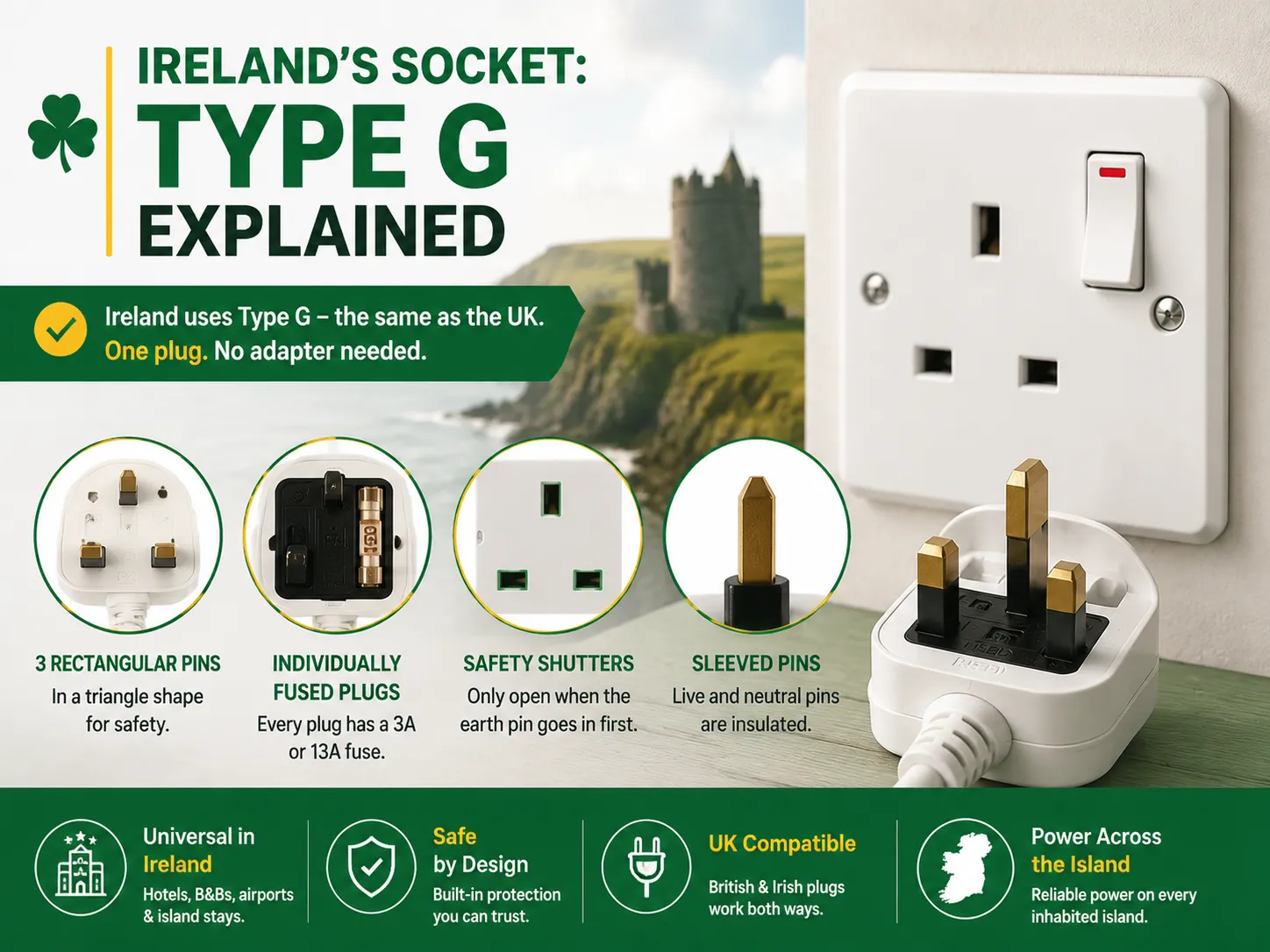
Ireland employs just one type of universal plug socket, which is Type G Plug. Thus, if you already packed for London, you are safe packing for Dublin. Indeed, the Irish regulation IS 401 is almost a verbatim copy of the British specification BS 1363. That means a British plug can be used with an Irish socket and vice versa without any problems or need for adapters.Type G plug is unique and deserves a description. Its design features:
Type G sockets can be found in all corners of the beautiful Ireland: they are used in all hotels, guesthouses, holiday cottages, airports and other places. The socket-family logic — why different regions standardized on such different designs — parallels the way the different kinds of switches evolved for the same systems.
Electrical appliances have to be adjusted according to national electrical standards when traveling around the world. The main purpose of national electrical standards is to ensure the safe use of electricity in homes. The same voltage is supplied to Ireland’s electrical consumers as in the UK (230 volts at 50 Hz), thus supporting appliance compatibility with no loss of safety or functionality in the user countries.
What really matters is the voltage used, more than the shape of the plug. As a general rule, electrical apparatus from the UK, Europe, Australia, and most countries in Asia will be compatible with Ireland without any need for modification apart from a plug connector (if required), while devices from the USA, Canada, and Japan will be exposed to double voltage higher than they are accustomed to and damage will occur if they are used in Ireland as they are rated to work on “120V only”. The only thing to remember is that labels on chargers help distinguish between the devices safe and unsafe for use in Ireland; as you can see, most chargers come with labels saying either “100-240V” or “not to be used with an electrical voltage exceeding 240V”.
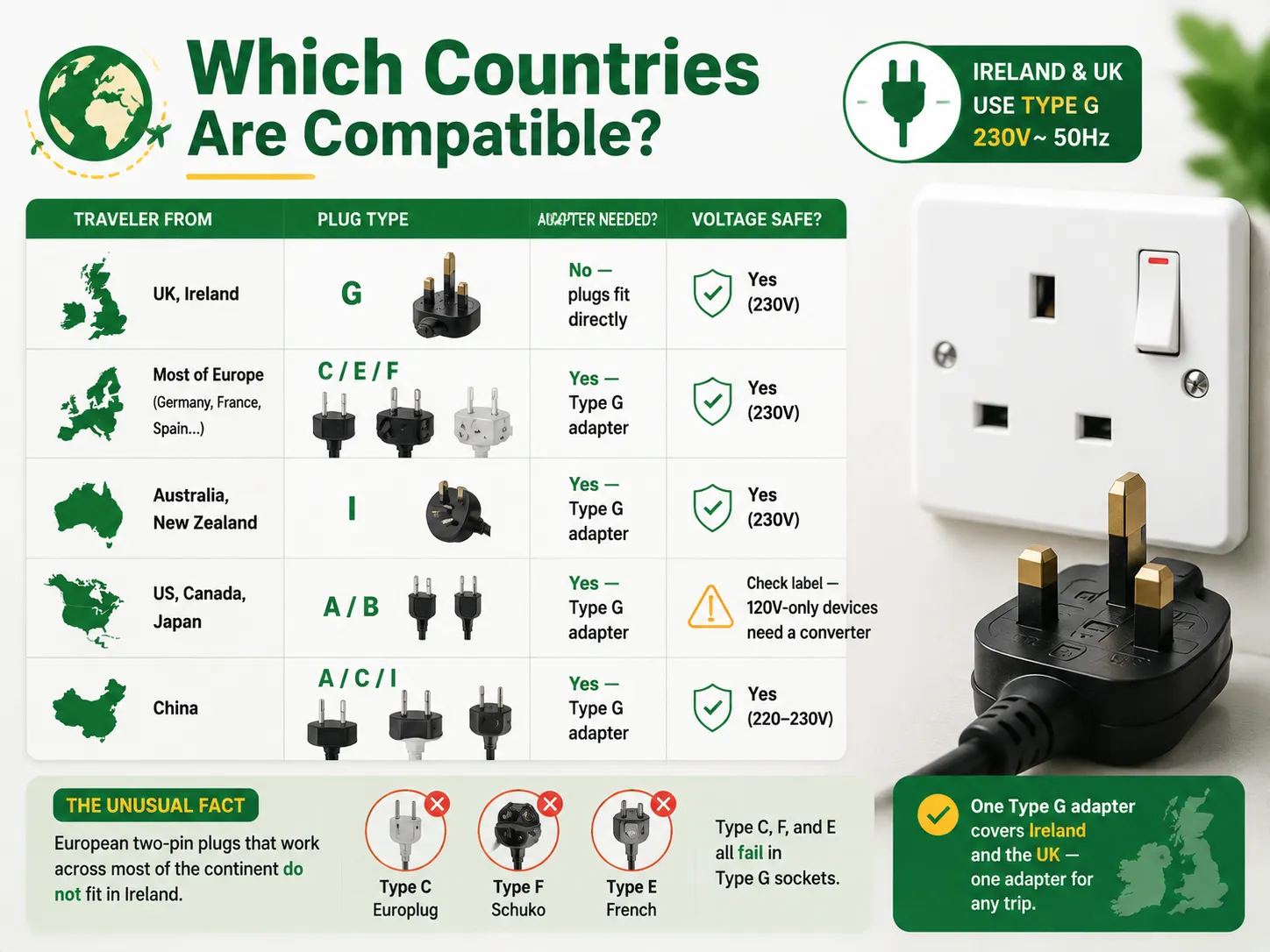
| Traveler From | Plug Type | Adapter Needed? | Voltage Safe? |
|---|---|---|---|
| UK, Ireland | G | No — plugs fit directly | Yes (230V) |
| Most of Europe (Germany, France, Spain…) | C / E / F | Yes — Type G adapter | Yes (230V) |
| Australia, New Zealand | I | Yes — Type G adapter | Yes (230V) |
| US, Canada, Japan | A / B | Yes — Type G adapter | Check label — 120V-only devices need a converter |
| China | A / C / I | Yes — Type G adapter | Yes (220-230V) |
An interesting peculiarity regarding Ireland is that the European two-pin plugs which can be utilized throughout the remainder of Europe cannot function in Ireland. Type C Europlugs, Type F German plugs and Type E French plugs are all incompatible with Irish sockets which means any traveler from continental Europe to Ireland will require an adapter. However, the opposite is also true; if a traveler already has a Type G adapter, he can also use this adapter in the UK.
The difference between gadgets:
One rule for Ireland: when using a dual-voltage device, all you need is an adapter with a Type G plug. For single-voltage heat-generating devices, either leave them at home or buy the required items there. If you are coming from a country whose sockets you already find limiting at home, the modern answer is the same hardware family — USB wall outlets and fast-charging sockets are now standard upgrades, and the USB wall outlet fast-charging guide explains the options for your next renovation.
And if you are the kind of traveler who notices how much smoother life is with modern sockets, the same standard applies at home: replacing an aging wall plate with a USB-equipped outlet is a straightforward job, and the why upgrade to USB outlets article makes the case for it.
Yes — it absolutely is. Ireland uses Type G; their outlet is as per IS 401, which matches the British BS 1363 standard. Therefore, Ireland and the UK plugs are interchangeable as far as voltage (230V) and frequency (50Hz) is concerned, and thus there is no need for any adapters or converters for British travelers in Ireland.
Type C (Euro plug, two round pins) can fit the socket of Type F (Schuko); however, only Type F has the earthing clips that can fit into the plain Type C socket. In Ireland, both Type C and Type F cannot fit into Type G socket, so the whole question does not arise. European visitors must have a Type G adapter irrespective of whether their plug is Type C or Type F.
Only if you do not travel from the UK. Dublin uses Type G outlet, and travelers from Europe, US, Canada, Australia, and New Zealand need Type G (UK-like) adapters. US and Canadian travelers need to check the dual voltage compatibility of their devices before they can plug into the socket.
An Irish plug is just like the familiar UK-type Type G plug. It has three rectangular pins arranged in a triangular fashion with a longer earth pin on the top along with two live/neutral pins. The live and neutral pins have sleeve insulation in order to ensure safety.
Travelers heading to Ireland should find the country’s electrical system easy to navigate if they are coming from England, as the system is the same: type G sockets, IS 401 standard, 230 volts, with 50 cycle current frequency. Therefore there should be no need for specialized equipment, as you will use the same adapter. If you are not a traveler from England, all you need is a type G universal adapter, which can be found in USB ports or no. Thus, you pack your type G adapter and move on to the next step, which is checking the electrical requirements regarding your laptop and phone before plugging them in. The type G socket is also one of the safest sockets in the world (fused plugs, shuttered holes, sleeves), but that does not matter when you are charging your computer at an ancient pub in Galway. As long as you recognize the use of one socket type and voltage throughout the whole of Ireland, you should have no worries from the Cliffs of Moher to the streets of Dublin.

The term “07984 lighting consultants” gives people the impression that the five digits represent a postal code of some sort that indicates the place where lighting consultants provide services. This is, however, incorrect: there is no postal area coded 07984, which is only a code of mobile telecommunications in Great Britain. This means that the […]

San Francisco is not the average lighting control market. The housing stock is old and dense, and the electrical code does not allow for as many electrical installations as is allowed almost anywhere else in the U.S. Most homes that want complex lighting are Victorian or Edwardian buildings where no one wants to start opening […]
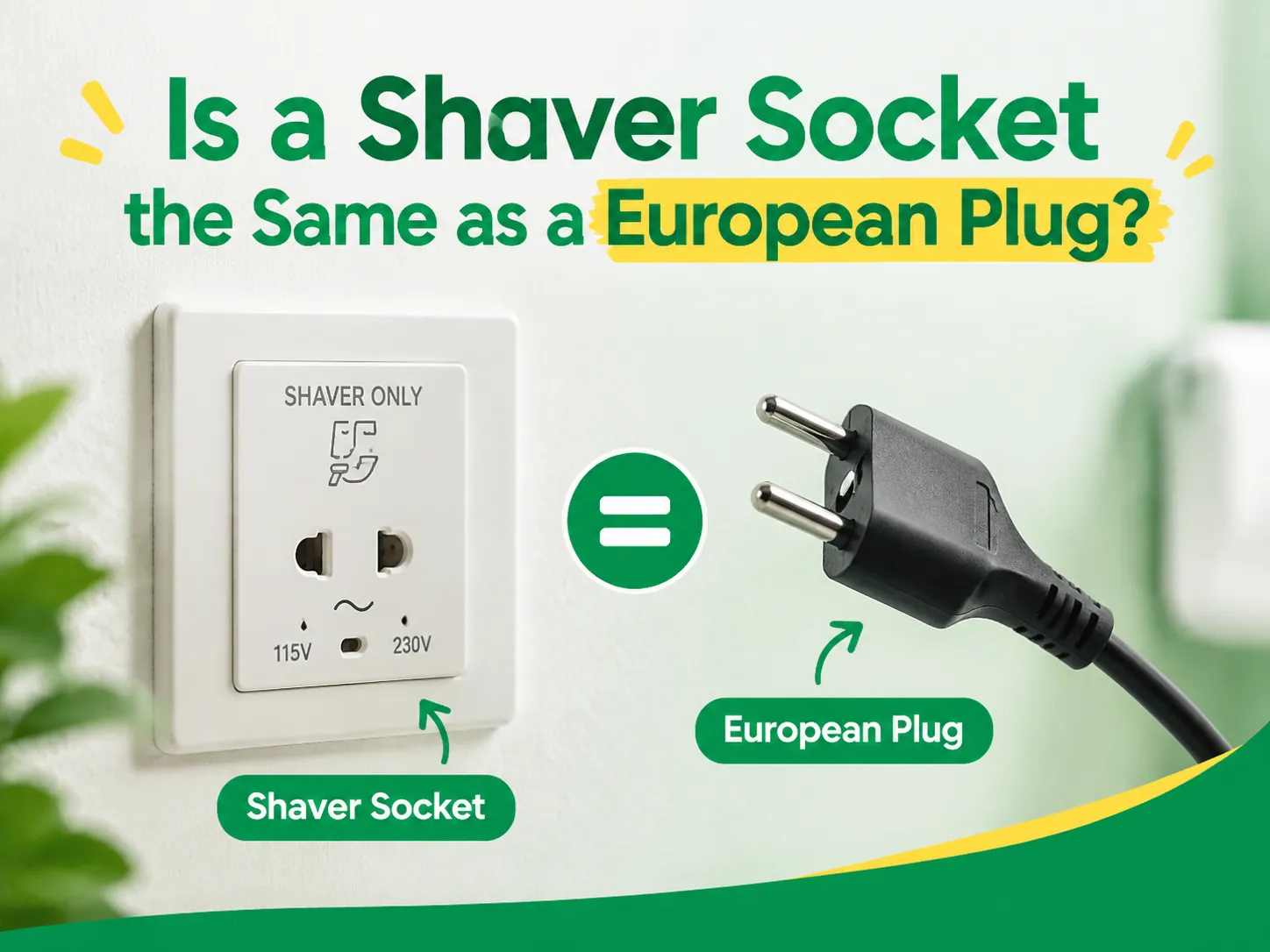
Although they seem to be alike, they both have a round shape with two pins, and they function at a voltage of 230V. This explains why some tourists use a European plug with a British shaver or wonder why a shaver cannot be plugged into a Schuko socket in a Spanish hotel. In reality, they […]

 No.6 Tuozhan Road, Leshang Pioneer Park,Yueqingwan Bay Harbor,Yueqing city,Zhejiang Province


