

Each of these rules is reviewed in more detail below. The geometry of receptacle placement, the dedicated branch circuit requirement, receptacle types that meet the code, 15A and 20A questions, differences among countries with regard to the rules, installation details that do not pass inspection, what to consider when buying a product, lighting and fan requirements in the same room, and retrofitting.
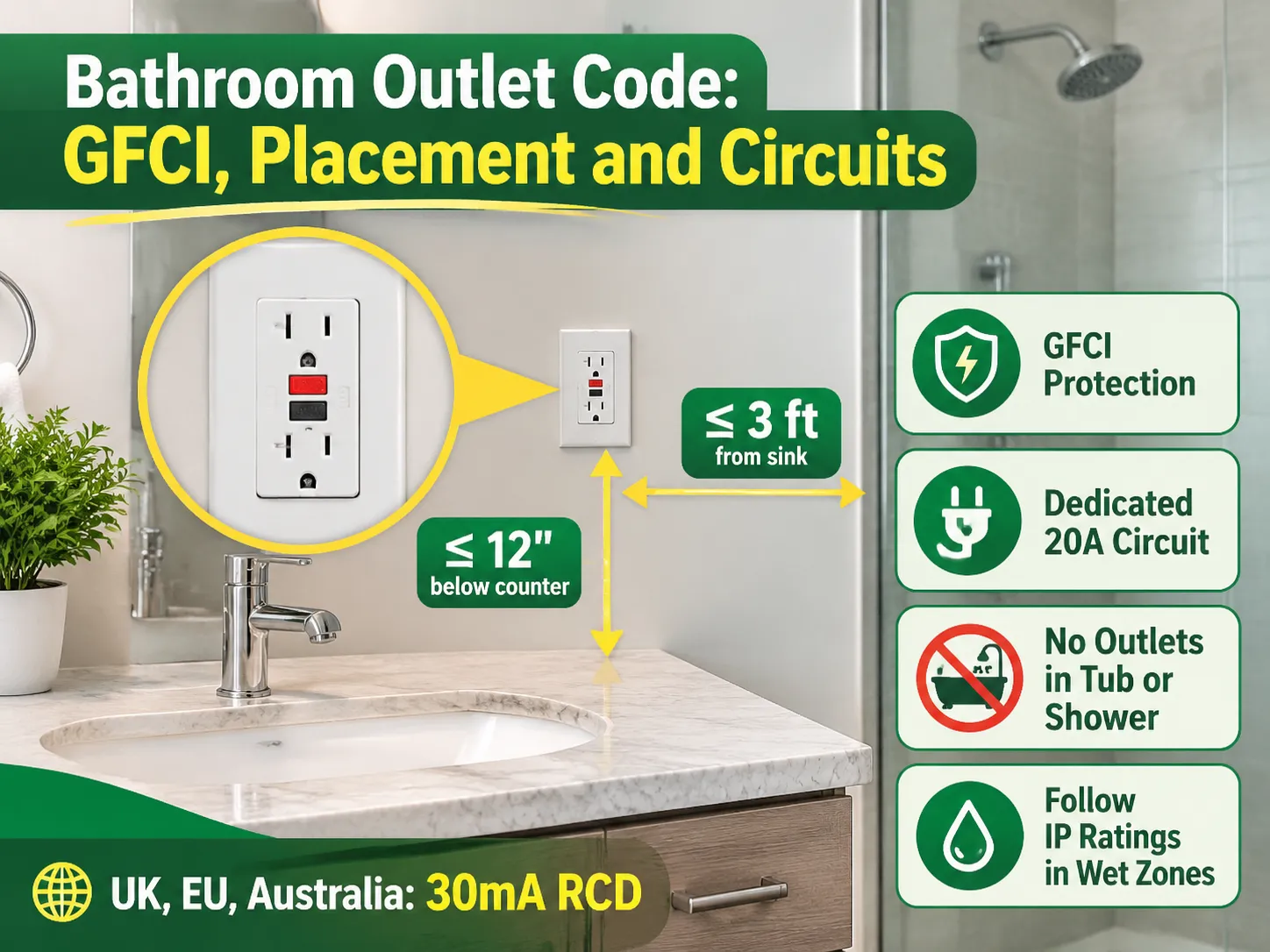
Quick answer: In the United States, every receptacle used for a bathroom must have GFCI (Ground Fault Circuit Interrupter) protection, and at least one receptacle must be within 3 feet of the edge of the sink/basin, and no more than 12 inches below the countertop height. The bathroom receptacles must be located on dedicated 20 Amp (20A) branch circuits that are used exclusively for bathrooms. No bathroom receptacle may be installed in the bathtub or shower areas. The equivalent to North America’s GFCI is 30mA RCD (Residual Current Device) protection in the UK, Ireland, Australia and the EU. Where ordinary receptacles are installed in wet zones they have restrictions, and the receptacles must meet the IP rating for the zone in which they are installed.
The purpose of the GFCI is to monitor the difference in flow of electricity between the hot wire and the neutral wire. When the difference between them is between 4 and 6mA, this indicates that some of the current has escaped. Typically in bathrooms, that means that current was escaping through a person who was standing barefoot on a wet floor. The GFCI will cut off the power flowing to a person (i.e., a person standing on a wet floor with their feet in contact with the ground) in a matter of a few milliseconds after detecting an electrical current escaping from the outlet.
There are three devices that can be used to fulfill this requirement. The first is a GFCI receptacle, which will protect both itself and anything else attached to the receptacle and that will be fed from downstream. The second is a GFCI breaker, which protects the entire circuit, and is the only option that can be used in situations where you have no GFCI receptacle to reset the GFCI’s current to zero or if the circuit is fed by a source that does not provide you the option to use a receptacle (e.g., whirlpool tubs). The third is a “dead front” GFCI, which is a device installed on a piece of equipment where electricity is being supplied but the equipment’s user is not in contact with or in proximity to (e.g., when the equipment is on a shelf).
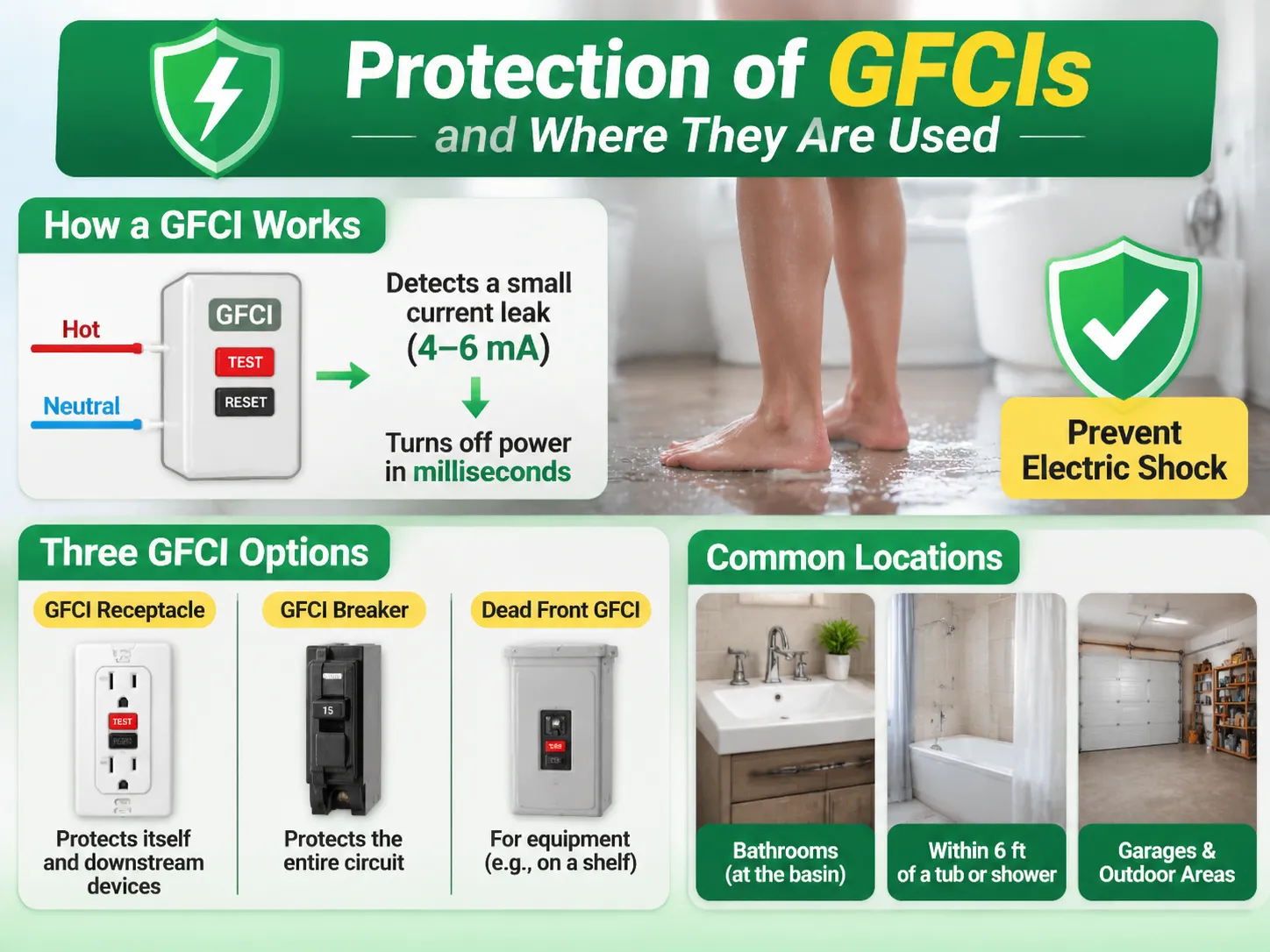
The choice is important for one reason, which is where the GFCI will be reset. A GFCI receptacle located at the basin is very easy to reset and easy for the homeowner to check on a monthly basis for function, which is the reason for it to be the predominant GFCI device used in residential work.
A GFCI (ground fault circuit interrupter) breaker is an important safety device that prevents circuit overloads from occurring in the event of an electrical failure. GFCIs are located in garages or other locations where there may not be enough space to place a GFCI outlet directly in front of the appliance being protected. Generally, a GFCI breaker will trip when there is an electrical failure on the GFCI outlet protecting the same circuit. The breaker trips and directs the occupant outside wearing a towel when the GFCI trips, which is why you will find that most breaker installations occur in areas with a tub or along an outdoor circuit, as well as instances where a receptacle is located behind a permanently mounted panel.
The requirement for GFCI protection extends beyond the actual room in which the appliance is located. For example, any receptacle that is installed within six feet of the outside edge of a tub or shower is required to be protected by GFCI, even if the receptacle is located in an area that does not fall under the definition of “bathroom”, as is often the case in bedrooms where there is a receptacle located near a shared plumbing wall; in these cases, the receptacle is actually located on a bathroom circuit.
Understanding how a GFCI outlet operates and why the 5 mA tripping threshold is located where it is will help the consumer choose the version of either the GFCI outlet or the GFCI breaker that best suits their needs. A complete explanation of how GFCI devices work is available and is required reading prior to selecting either the GFCI outlet or GFCI breaker version of these devices.
The 3-foot basin rule relates to the distance from the outside edge of a basin to the nearest electrical outlet horizontally. Therefore, it is important that you provide a receptacle for all basins. If you have a double vanity with two basins, then you must provide one receptacle for each basin, and it is usually possible to satisfy the basin requirement by providing a single receptacle located in between the two basins as long as it is within both distance requirements. It is important to note, however, that a receptacle located within a medicine cabinet does not count, as it is not considered accessible in the sense intended by code.
One detail that is often neglected by installers is the height limitation relative to receptacle installations.
A receptacle mounted on the face or horizontally on the basin cabinet cannot be more than 300mm below the basin’s top. The height above the countertop can be average for a receptacle that is often around 1,100mm high and at the same centre level as other accessories, but most people tend to place their bathroom receptacles above belly button level so they are easy to reach from the floor.
For example, there is no measurement for the tub and shower area, but rather a restriction or prohibition for installing any receptacles in this area. Any receptacle cannot be installed inside a bathtub or shower stall, but it will be judged by the area measured 3 feet horizontally and 8 feet vertically from the top edge of the bathtub or shower threshold.
The only exception to this rule is with a small bathroom that does not have much wall space. In this case, the exception is limited to a receptacle that can be installed on the wall directly across from the bathtub (and thus close to the wet zone).
Also related to this geometry are the light fixtures. Similar to the receptacle rule, the configuration of the light fixtures is often confused with the placement restrictions of receptacles. Specifically, a fixture installed over a bathtub also has the same placement restrictions as a receptacle (3 feet horizontally and 8 feet vertically) and must also be marked for wet and damp locations.
As for switches, they must be installed where someone cannot touch both a plumbing fixture and the switch at the same time.
I like to think of the 20A Circuit Rule (and reason why bathroom receptacles are different) as a direct reflection of the hair dryer.
A regular unit uses between 1,500 and 1,800 watts, which translates to 12.5 to 15 amps on 120 volts; therefore, a circuit of this size (15 amps) will overload if someone is simultaneously drying their hair and watching television, causing an immediate trip. The dedicated 20 amp circuit allows this level of usage to happen without anything tripping unnecessarily.
For a 20 amp circuit, there are two things to keep in mind to avoid an overload situation: first, the circuit needs to be wired with 12 AWG cable; and second, you can wire multiple receptacles together for one bathroom, provided the circuit does not serve anything outside the bathroom. If you have a single bathroom, according to the exception, the lighting and exhaust fan will be allowed to operate on this same circuit due to the fact a single bathroom is a small load; therefore, there is no justification to run additional circuits.
This second point gives rise to three practical considerations about how these circuits operate. If you install a 20 A receptacle on a 15 A circuit, the receptacle cannot operate. This means that the circuit must be rated the same as the receptacle. Also, the neutral for the circuit must be rated for 20 A; that is important in a case where you may have used a shared neutral in an older installation. Finally, in a multi-bathroom situation, the circuit should never be connected to the lighting circuit; otherwise, if the receptacle circuit trips, it will cause all of the bathrooms to be dark, which is opposite of what the dedicated circuit is intended for.
When working with bathrooms, you will find five types of devices. The one most people think of is the standard duplex outlet.
A GFCI duplex receptacle protects against ground fault currents at the outlet; its shutters open when both prongs are inserted into the outlet. The cost of GFCI duplex receptacles ranges from $18 to $30, and they are most commonly found in bathrooms located near sinks.
A Standard duplex receptacle does not provide ground fault protection; it should be connected downstream of either a GFCI receptacle or a GFCI breaker. The price range for a standard duplex receptacle is between $3 and $8.
A GFCI receptacle with USB chargers has built-in ground fault protection as well as charging capabilities. They are typically used on vanities to charge electric razors and toothbrushes. GFCI receptacles with USB chargers generally cost between $25 and $45.
In European and Australian bathrooms, a shaver supply unit provides electrical power to shavers via isolated transformers (as found in the UK/Ireland). They fit into Zone 2 in British and Irish bathrooms and typically cost $25-$60.
Schuko or BS IP44 sockets are rated for use around water and provide waterproofing (i.e. they seal against splashes), and are therefore typically found in European and Australian bathrooms outside of wet zones. An IP44 Socket generally costs between $10 to $25.
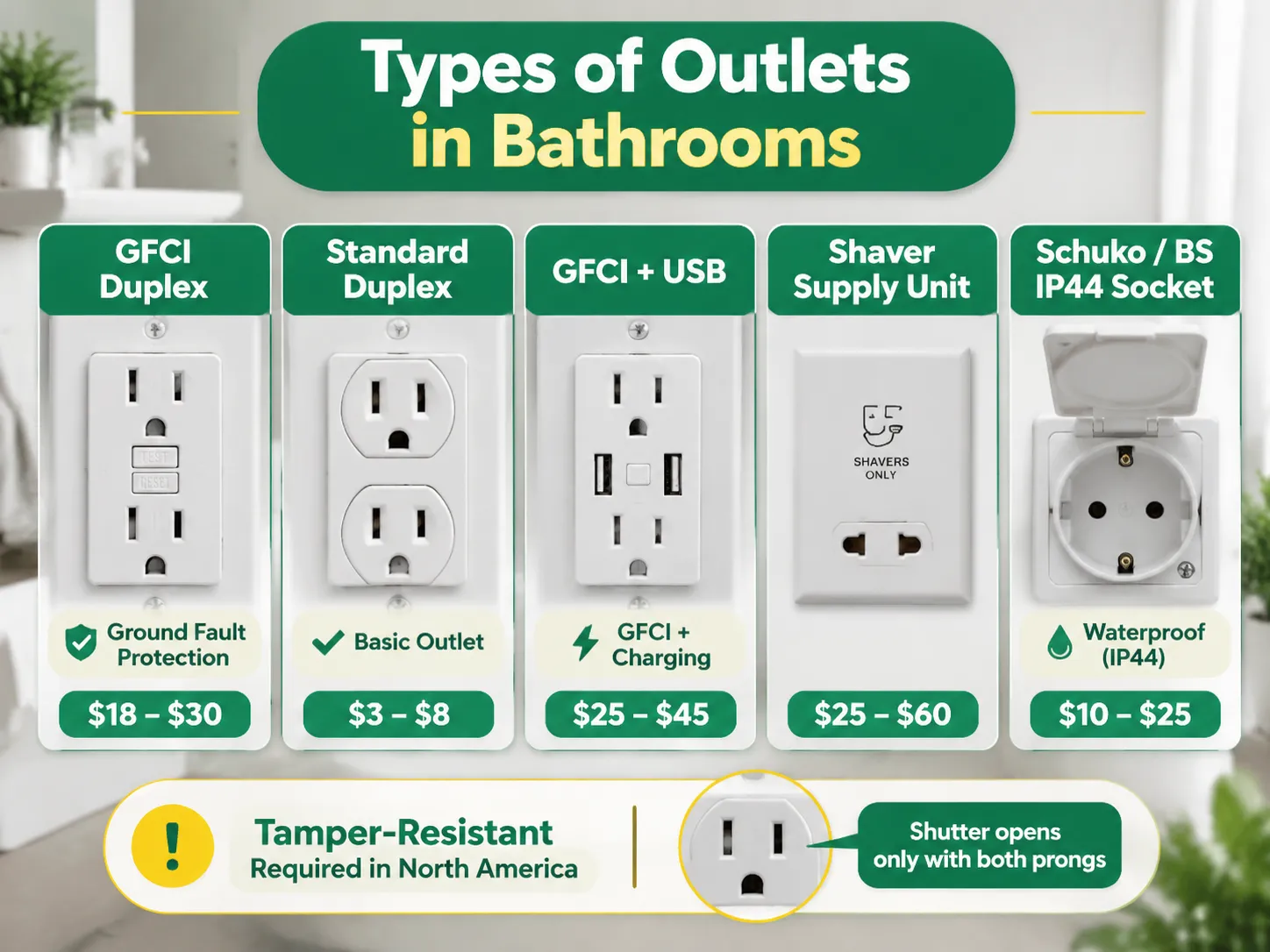
In North America, the code requires that if you replace or install any receptacles, they must include the tamper-resistant shutter. The shutter is spring-loaded and opens only if both prongs are inserted into it; you can expect to pay one or two dollars more for a tamper-resist receptacle over a normal receptacle.
| Outlet type | Typical price |
|---|---|
| GFCI duplex receptacle | $18 to $30 |
| Standard duplex receptacle | $3 to $8 |
| GFCI receptacle with USB chargers | $25 to $45 |
| Shaver supply unit | $25-$60 |
| Schuko or BS IP44 socket | $10 to $25 |
| Tamper-resistant receptacle | one or two dollars more |
The last two rows of this comparison chart reflect what an average European (or Australian) consumer may see when shopping for receptacles. Most bathroom socket outlets in the UK do not have a general-purpose socket outlet at all; instead, UK bathrooms are equipped with shaver supply units that contain isolated transformers located in a zone designated as Zone 2. This is why a UK visitor searching for an electric hair dryer will look for a two-prong receptacle capable of accepting an electric shaver plug, rather than a hair dryer plug.
For orders by the thousand of projects using the American format switch and socket configuration and plate systems associated with NEMA, the first row is where you’ll find the countries of North America. A project order uses the NEMA configuration, and corresponds with the plate systems.
A device rated at 15A or 20A, must match the circuit being used. The relationship only goes one way. A 20A receptacle can be used on a circuit rated at 20A. A 15A receptacle will work too, because the 15A device is protected by the circuit rating and the load it will see. However, using a 20A receptacle on a 15A rated circuit is a defective installation because that device is rated for more load than the circuit can handle.
For bathrooms, the result is that using a 15A GFCI receptacle on a 20A rated circuit is both code compliant and very common. In fact, many 15A GFCI receptacles are rated for 20A feed-through configurations in any case; therefore the 15A designation is for the configuration of the receptacle only, and does not denote how much current can be passed to downstream receptacles.
The exception to this rule is if a dedicated appliance with a 20A plug is to be used, such as a large whirlpool heater, or a commercial hand dryer. In this instance, a 20A receptacle and a dedicated circuit are required. These installations should be specified separately, rather than assumed to be general bathroom outlets.
Every developed country mandates that all bathrooms use residual current protection, but they specify how this requirement will apply based on a variety of factors including device type, zone geometry, and how much residual current protection each will provide. Each developed market has a specific residual current protection for a bathroom but not all developed markets have the same residual current protection devices. In this case, the two differences are represented by the methods used to provide residual current protection.
| Country | Protection method | Socket rule | Zone requirement |
|---|---|---|---|
| United States | (a) 4 or 6 mA GFCI | (b) all bathroom outlets are standard duplex, (c) TR is mandatory | Receptacles are not allowed in the tub or shower area. |
| Ireland & UK | 30 mA RCD on circuit | ordinary socket limited; wall-mounted shaver unit in zone 2 | BS 7671 defines zones 0, 1, and 2 by distance from water. |
| EU | 30 mA RCD, with some circuits limited to 10 mA | IP44 socket is allowed outside of the risks of water | IEC 60364-7-701, IPX4 in zones 1 and 2. |
| Australia & NZ | 30 mA RCD | any socket outlets must have IP rating | AS/NZS 3000 zone geometry and IP rated accessories. |
| Gulf States & Middle East | 30 mA RCD | BS or Schuko minimum IP44 socket outlet | IEC zone geometry; frequently enforced by consultant. |
The primary differences between the North American and European approaches to residual current protection are (1) North America protects a low number of areas at risk due to proximity to a sink, whereas (2) Europe protects the entire entire installation at 30 mA and relies on the IP rating of the equipment at the risk area.
This may clarify why a European bathroom can include an electrical socket while a North American bathroom uses a device that must be specifically designed for use in North America due to their differing country codes and standards related to the required or acceptable product used in each of these regions.
The plug types also work under the same rationale. In North America, an electrical socket in a bathroom is typically a NEMA 5-15 or 5-20, while in the UK it may be a shavers socket, in Germany it may be the Schuko style with a hinged cover, and in Australia it would be a Type I with a weatherproof cover. The reason the various types of plugs in North America require separate electrical sockets is because of electrical requirements and code restrictions for each style of plug.
Most bathroom installations fail to pass inspection for six reasons related to something other than the device itself. A GFCI outlet must be the first receptacle in a circuit so that all of the downstream receptacles on the circuit are also protected. If installed in a location that cannot be accessed by an electrical plug tester (such as in a cabinet), a GFCI will be unable to provide a test signal. If a GFCI outlet is installed without an equipment ground, a plug tester will not be able to test the GFCI. A GFCI outlet installed on a 15 A circuit would not meet the minimum requirement of being a dedicated 20 A outlet. A GFCI outlet located within the bathtub zone is prohibited, and therefore may not count toward the total number of receptacles required for a bathroom. Finally, a GFCI that has been painted over is considered a defect and indicates that no testing has been performed on the device since it was installed.
A seventh reason, which is not necessarily a code violation, but is also a practical issue, is the insufficient depth of the outlet box for the specific type of GFCI being installed.
GFCI receptacles are designed to be deeper than standard duplex receptacles; therefore, If the electrical box installed in the wall during the tile installation is too shallow to allow for proper installation without excessive protrusion of the plaster ring, it will be more expensive to fix than simply checking the depth of the box prior to the installation of tile.
Another consideration is the cable used. To supply a 20-amp circuit in a bathroom, 12 AWG cable must be utilized, and this presents an issue to home builders as the 12-3 cable contains three conductors instead of the normal two. Additionally, extra unused conductors within a box must be properly terminated, rather than leaving them cut off at the back of the box.

What separates a bathroom-rated product from a non-bathroom rated product? Four main things must be considered when selecting a bathroom rated product’s listing to the appropriate standard, counterfeiting is an actual issue on some internet-based sales sites. The shutter mechanism of the tamper resistant outlet must be installed if required by the local electricity code. The terminals’ design must provide better torque retention than backstab connections, as a bathroom outlet sees more plug/unplug activity than any other outlet. Lastly, the plate of the bathroom outlet should be stainless steel or brass. Plated metal will show watermarks as compared to moulded plastic.
When selecting a brand in this category, it is generally less about performance and more about having the correct product available. For example, the larger brands in the United States, such as Leviton, Legrand, and Hubbell, have a complete selection of the many variations of GFCI, TR, and USB products available.
Due to lower cost, manufacturers in China will typically provide the same products as manufacturers in the USA but with one key difference: the product must be listed for the specific market into which the item is being supplied.
Our manufacturing is on the “wholesale project” side of the equation. We produce receptacles and switches for wholesale and project supply, also producing tamper-resistant duplex and GFCI configurations to accommodate both European plate configurations and North American plate configurations, and we are a component manufacturer, not a lighting manufacturer, so our catalogue is organised by device and plate configuration rather than room.
When we tell potential customers what to check prior to purchasing a device, we advise to check the listing, the plate type, and the type of GFCI (self-test vs. non-self-test). A Self-Test GFCI performs an internal check every few seconds (on the power supplied to it) to confirm that it is functioning correctly, and if the device fails, it will lock out. This is the only way to know that your GFCI installed in a bathroom for 8 years will still work when it is needed.
When it comes to compliant lighting, fans, and switches, all three of these devices share the same room, but they have different requirements. The luminaire must be approved for use in a damp location over the bathtub, and any surface that may receive water spray of any kind also needs to be compliant. The fan must be vented to the exterior of the building and never to the roof structure, and on the circuit for the bathroom, it will consume its 20-A of power; therefore, it shares the circuit with the two other devices in the same room.
In the North America, bathrooms require GFCI receptacles. These outlets must also meet any Tamper Resistant requirements set forth by the local jurisdiction. They must be installed on a dedicated 20-amp circuit, with at least one GFCI protected receptacle located no more than 3 feet from each sink or washbasin. In the United Kingdom and Ireland, bathrooms generally require Shaver Supply Units, which should be located in Zone 2, and should not be regarded as General Socket Outlets (unless an extension lead is permitted), and should be connected to a 30mA RCD.
For North America, the typical designation of the protective device is GFCI receptacle or duplex GFCI/TR; the equivalent in the United Kingdom is known as shaver socket or electric shaving supply unit; the common name in Europe and Australia is IP44 socket outlet with RCD upstream protection; so essentially the names are indicative of the method of protection and the type of enclosure in which they are housed but all products perform the same functions regardless of geography.
The circuit must be rated at 20 amps; this means a 15 amp GFCI receptacle (the receptacle outlet listed here) on the 20 amp circuit is allowed and is the standard. A 20 amp receptacle outlet will only be used to receive power from a device that has a 20 amp plug, i.e., large hot tub heaters. A 20 amp receptacle must not be installed on a 15 amp circuit.
The three requirements for bathroom receptacle outlets are: (1) GFCI; (2) at least one receptacle within three feet of the outside edge of each basin and no more than twelve inches below the counter; (3) all receptacle outlets must be installed on a dedicated 20 amp bathroom circuit. No receptacle outlet is permitted to be installed inside a bathtub or shower stall.
The only exception to this is where the dedicated 20 amp circuit serves only a single bathroom. If that is the case, both the lighting and fan may be installed on the same dedicated 20 amp circuit for that bathroom. A dedicated 20 amp circuit may not serve any other room(s).
According to the base National Electrical Code, AFCI protection is not required for bathrooms; instead, the requirement for GFCI protection specifically addresses risks of electrical shock. However, some states have amended the National Electrical Code to require AFCI protection on all dwelling circuits, therefore; a dual-function breaker will provide both protections.
There are three requirements which govern the installation of bathroom receptacle outlets, and there is one prohibition. These requirements are GFCI protection, a receptacle outlet located within 3 feet of the outside edge of each basin, all receptacle outlets shall be connected to a dedicated 20 amp circuit, and no receptacle outlet shall be allowed to be installed within a bathtub or shower stall. All other information in this article is additional detail supporting the four requirements above.
The detail that ultimately determines whether the installation will remain successful is located at the location of GFCI protection. Locate GFCI protection where it is easily accessible; routinely test the GFCI protection monthly and consider purchasing a self-testing GFCI if your budget allows; keep in mind that the failure of GFCI protection systems typically occurs without any audible or visible indications; therefore the room generally has no indications of danger present.
Each of these rules is reviewed in more detail below. The geometry of receptacle placement, the dedicated branch circuit requirement, receptacle types that meet the code, 15A and 20A questions, differences among countries with regard to the rules, installation details that do not pass inspection, what to consider when buying a product, lighting and fan […]

Dubai – Easy market to buy wiring devices and hard market to select correct wiring device(s) for use on any project. All International brands have wide representation in Dubai; delivery of products can occur within one week of order placement; and qualification to pass DEWA inspection is obtained by all suppliers based upon the DEWA […]
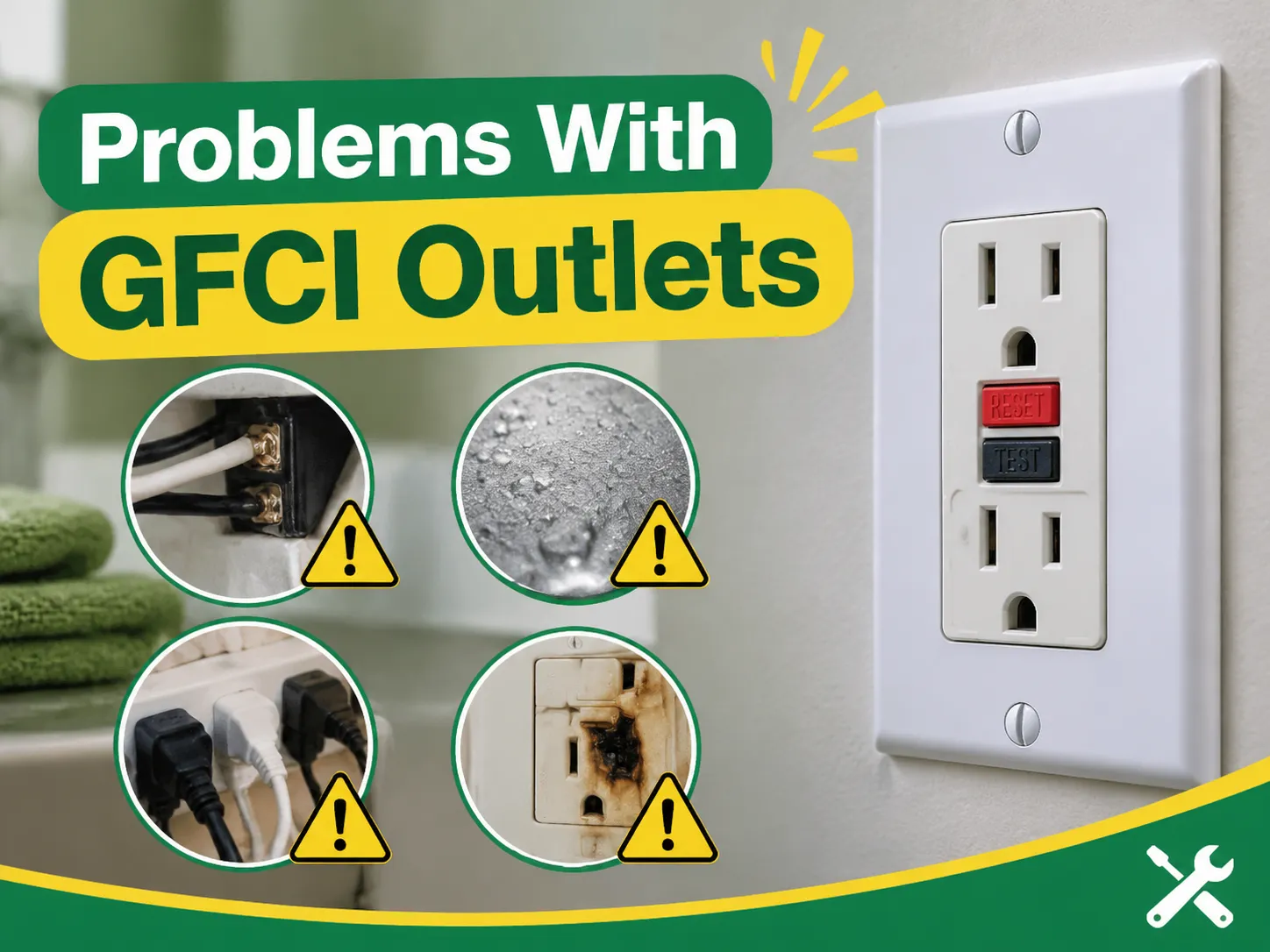
A ground fault circuit interrupter is the only appliance in the house that it is failed in a visible manner. It disconnects at an unexpected time, does not initiate re-setting, or give up after years in the service leaving an illusively safe circuit. Most issues searched by the customers fall into four categories of buyer’s […]

 No.6 Tuozhan Road, Leshang Pioneer Park,Yueqingwan Bay Harbor,Yueqing city,Zhejiang Province


