

Reaching New York, Toronto, or Mexico City while carrying a bag full of chargers from Europe, England, or Australia introduces the traveler to a challenge as the electric sockets in the hotel room will be completely different from those at their country and the current supplied would be less than the equipment could handle. The North American style sockets are identical across the continent, from Canada to Panama, thereby making it a bigger user base but at the same time confusing for travelers.
The guide outlines many useful details about North American sockets and plugs, including the two plug types (A and B), their standards defined by NEMA, the voltage and frequency (120V and 60 Hz), the socket designs, the countries that have similar systems and the requirement for travelers to find out if they would need an adapter, a converter, or nothing at all.
In North America, Type A and Type B plugs and sockets are used, which conform to the same NEMA standard in USA, Mexico, and Canada, and most of Central America and the Caribbean. Type A consists of two flat parallel pins while Type B has the same two flat pins with a round grounding pin that is found below these two pins. The USA, Canada, Mexico, Japan, and large parts of Latin America can use their plugs directly into the sockets. Visitors arriving from the UK (Type G), Europe (C/E/F), Australia (Type I), China, and the majority of Asian countries must use an adapter to change the shape of their plugs.
Type A (also called NEMA 1-15) is the conventional North American two-prong (or flat blade) plug which has two flat blades that are approximately 1.5mm thick and about 15.9-18.3mm long. The distance between the two prongs is about 12.7mm. Type A plug is ungrounded does not have the grounding pin and has the current rating of 15A/125V.
The two blades of a plug are usually polarized. One of the blades is wider than the other; for example, the width of the neutral prong is approximately 7.9 mm while the width of the hot prong is 6.3 mm. The design allows the plug to be inserted in only one direction which assures the safety of the lamp or appliance.
Objects the Type A plug is used: small appliances and double-insulated gadgets like lamps, cell phone chargers, portable radios, two-pin cables in different devices. Users of devices with this US two-pronged plug can find the plugs fitting not only type A wall sockets but also type B wall sockets.
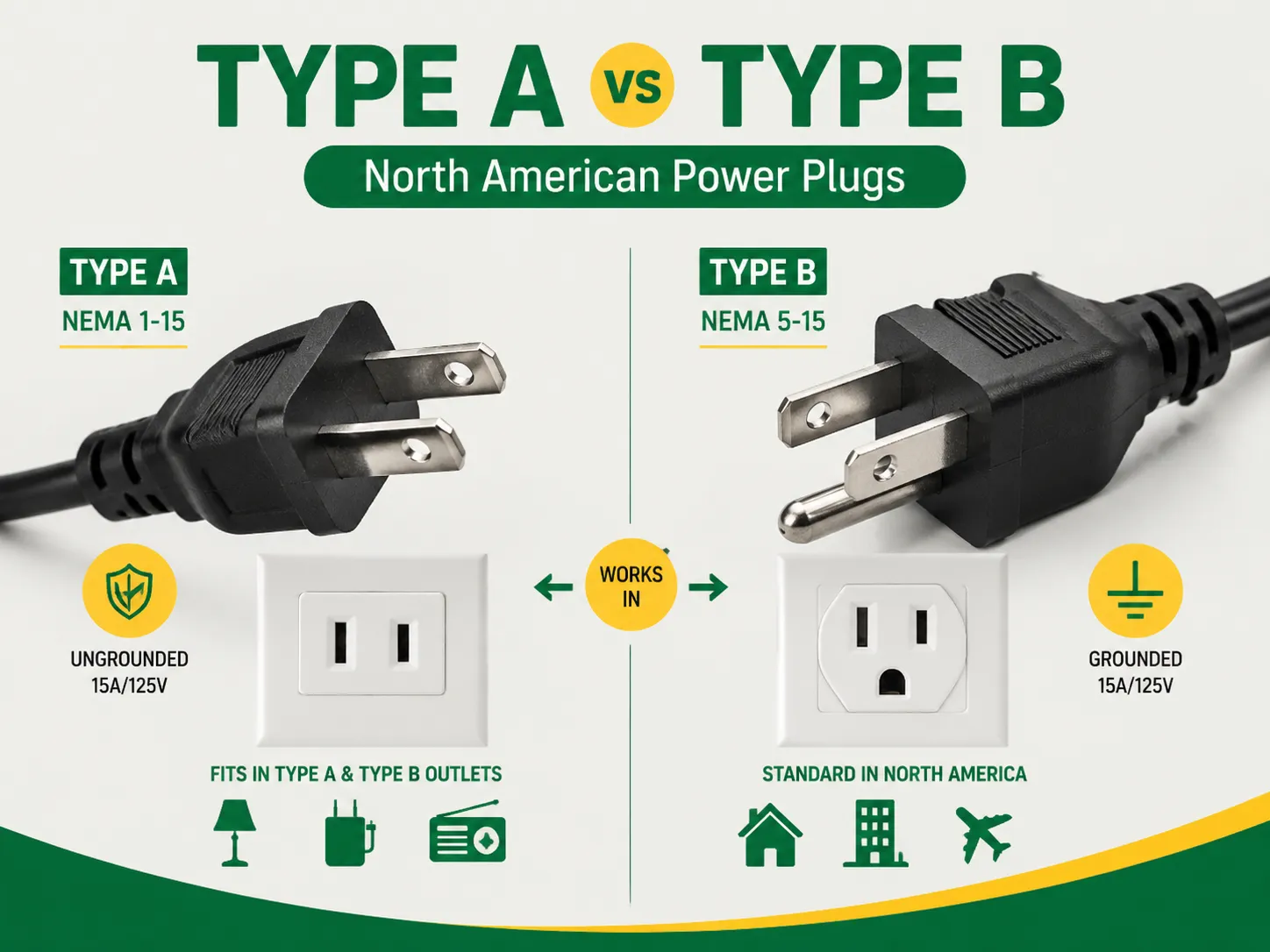
Officially known as NEMA 5-15, Type B has become the standard plug in North America and uses the same dual flat parallel blades as Type A plus a round (U-shaped) ground pin below the blades; this pin has a diameter of 4.8 mm and is somewhat longer than the blades, which ensures that the ground pin gets connected first before the power is activated. The rated current for this plug is 15 A/125 V.
Where Type B is found: anywhere, as this plug has been installed wherever buildings were constructed since 1960s and was used in homes, hotels, offices, and airports in the US, Canada, and Mexico. In most cases, the modern outlet is Type B but has USB-C charging ports, as well as TR shutters now being part of code in new construction. Type A plug fits into Type B outlet, while Type B plug does not fit into Type A outlet (since the ground pin has no way to connect).
If you are upgrading outlets in a North American property, modern receptacles — including USB-integrated and smart options in the IGOTO socket range — follow the same Type A/B/NEMA footprint, so they install into any standard box.
NEMA means National Electrical Manufacturer’s Association, which sets the standards for plugs and sockets in North America. The important codes are:
| NEMA Code | Common Name | Configuration | Rating |
|---|---|---|---|
| NEMA 1-15 | Type A | 2 flat parallel pins, ungrounded | 15A / 125V |
| NEMA 5-15 | Type B | 2 flat pins + round ground, grounded | 15A / 125V |
| NEMA 5-20 | Type B (20A) | 2 flat pins + ground, one blade rotated 90° | 20A / 125V (kitchens, baths) |
| NEMA 6-15 / 6-20 | 240V outlets | 2 flat pins + ground, for 240V appliances | 15-20A / 240V (dryers, AC, EV) |
| NEMA 14-30 / 14-50 | Dryer / range / EV | 4 pins (2 hot + neutral + ground) | 30-50A / 240V |
For travelers, only types 1-15 (type a) and type 5-15 (type B) are relevant— all other types are specialized higher-current plugs. What will be found in every hotel and home is a 120V universal outlet.
North America operates on a 120-volt, 60-hertz system – which is identical in the USA (120V), Canada (120V), and Mexico (although Mexico is slightly higher at around 127V). This voltage level is approximately half of what the rest of the globe uses (220-240V), which forms the other part of the overall compatibility puzzle.
The voltage level also works in:
The voltage level is not compatible with the UK, Europe, Japan, Australia, New Zealand, China, India, Singapore, and most of Africa because they all utilize 220-240V and have different plug shapes.
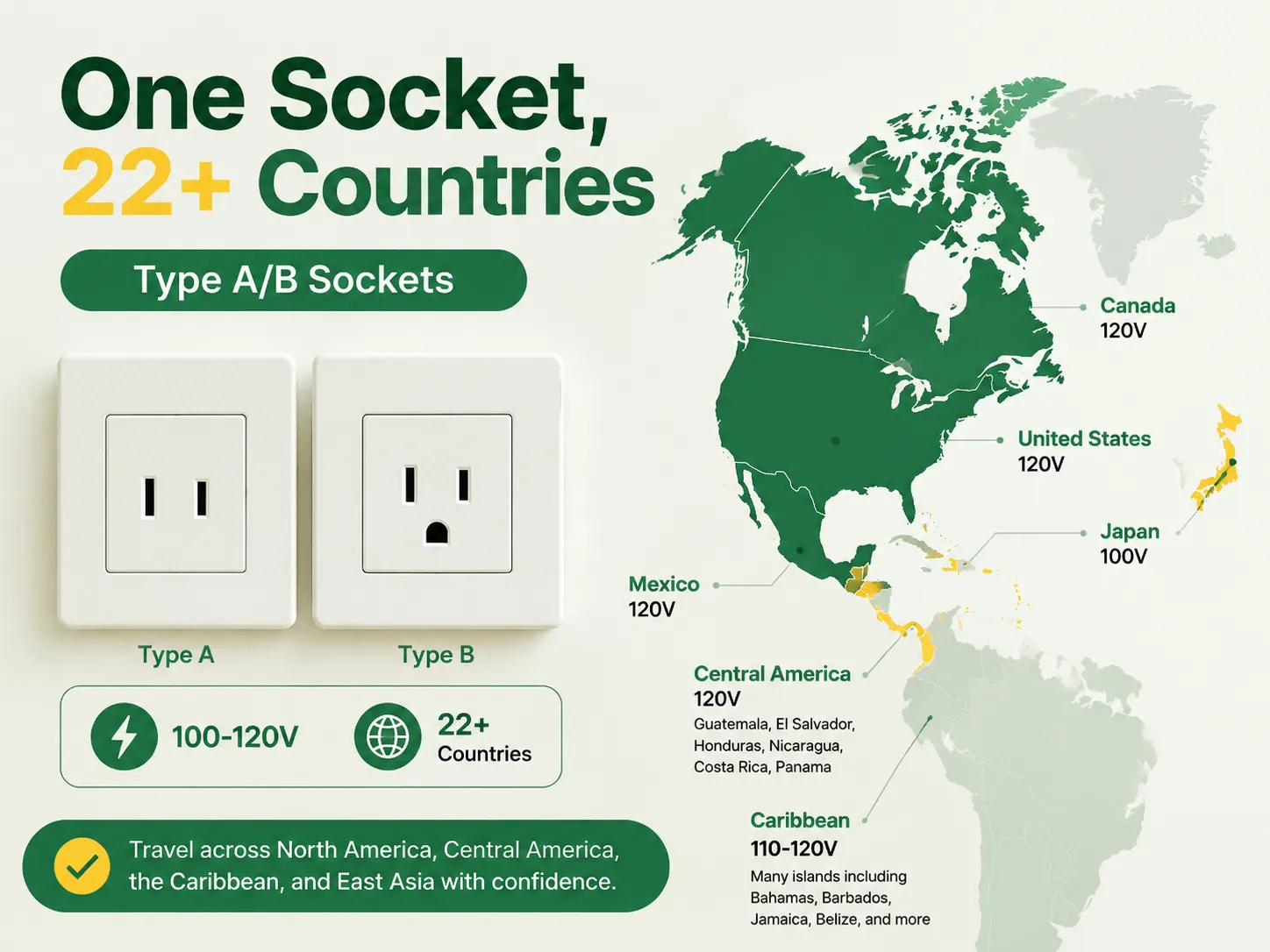
North America’s electrical standardization is unparalleled: one plug design is used in more than 22 countries. In this regard, the plugs are identical in the following regions:
All in all, a person can arrive in Canada from the USA and until arriving half around the world, to Panama, never ever thinking about the plug adaptors which make this electrical system so traveler-friendly for the people from the USA.
| Country / Region | Home Plug | Adapter Needed? | Voltage Converter Needed? |
|---|---|---|---|
| USA, Canada, Mexico | A / B | No | No |
| Central America, most Caribbean | A / B | No | No (110-127V) |
| Japan | A / B | No (plugs fit) | Usually no (100V vs 120V) |
| Taiwan | A / B | No | No (110V) |
| United Kingdom / Ireland | G | Yes | Yes (for 230V-only devices) |
| Mainland Europe | C / E / F | Yes | Yes (for 230V-only devices) |
| Australia / New Zealand | I | Yes | Yes (for 230-240V-only devices) |
| China | A / C / I | Maybe (A fits; C/I need adapter) | Yes (220V vs 120V) |
| South Korea | C / F | Yes | Yes (220V) |
| India | C / D | Yes | Yes (230V) |
Important note: an adapter can only make the shape of the plug compatible but does not make any changes to the voltage. For example, if a British hairdryer is plugged into a US power socket with an adapter only, it will get 120V where it is supposed to get 230V, which means that it will be running barely and heating itself to danger.
General rule: if it says INPUT: 100-240V (or 110-240V), then the device can work on dual voltage and just needs an adapter. If it just says 120V or 230V, it is single voltage, and if it comes from a country with 230V standard it needs a converter in North America. Most phone chargers, laptop adapters, camera chargers, and toothbrush chargers are dual voltage, while most hair dyers, curling wands, and older devices aren’t. For the broader logic of international plugs and sockets — and how the NEMA system fits among the world’s standards — our guides to different kinds of electrical switches and sockets and the dimmer switch installation basics cover the hardware side of wall devices.
A quick check will take just ten seconds; you just need to take a look at either the small label on the device or on its power supply, typically situated in the region immediately around the cable entry.
| Label Text | Meaning | Needed in North America (from 230V country) |
|---|---|---|
| “INPUT: 100-240V, 50/60Hz” | Dual-voltage, worldwide | Adapter only |
| “INPUT: 110-240V” | Dual-voltage | Adapter only |
| “INPUT: 100-120V” | Single-voltage (NA/Japan standard) | Adapter only if from 120V country; converter if from 240V country |
| “INPUT: 220-240V” | Single-voltage (230V standard) | Adapter + converter |
If you are traveling from any country where the voltage is between 220V and 240V, you should either carry a dual voltage hairdryer or use a travel hairdryer provided by the hotel.
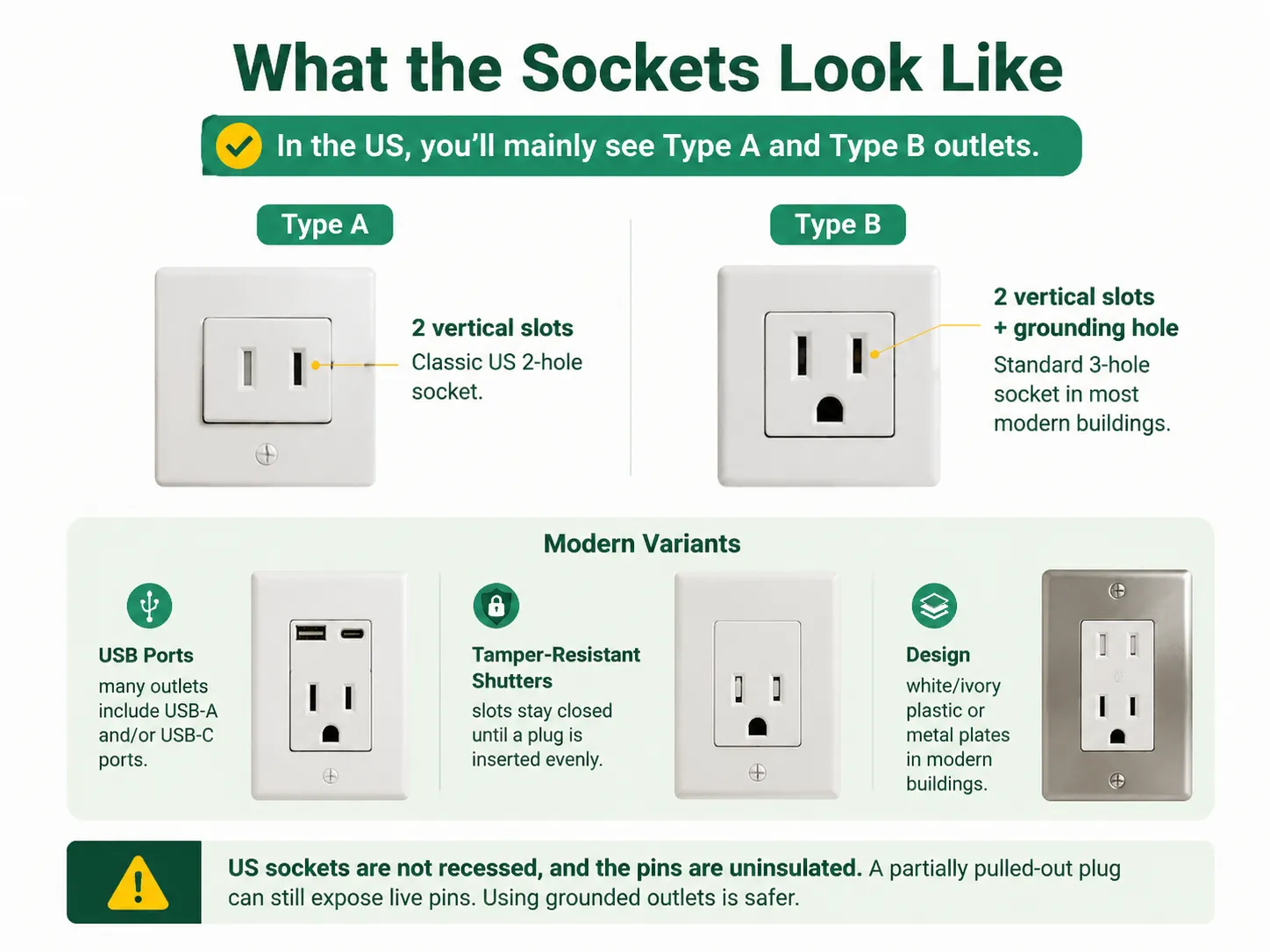
Identifying the connectors helps ease the way of traveling:
The US type socket is very well known for the fact that it is not embedded in the wall, and its pins don’t have any insulation, which means that a plug being only partially inserted still has live pins available. It’s safe enough with normal use, but it’s one more reason to use grounded, certified outlets — like the tamper-resistant and USB-equipped receptacles in the USB outlet upgrade guide, and the smart wall controls available in the IGOTO smart switch range for the same standard North American footprint.
For frequent travelers passing between the regions with 120V and 240V power supply, it is advisable to use high grade universal adapters ($25-$45).
The plugs and sockets used in North America include Type A (with two flat parallel pins that are ungrounded, known as NEMA 1-15) and Type B (with two flat pins and a round pin that acts as a ground — NEMA 5-15). The system is used in the USA, Canada, Mexico, most of Central America, and much of the Caribbean. The usage of Type A plugs fits both types of sockets, while Type B plugs are the new require standard among all contemporary buildings.
There are two types of electrical plugs: type A (NEMA 1-15) which is 2 pin non-grounded used mainly for double insulated appliances and chargers. Type B (NEMA 5-15) is 3 pin grounded plug used for mostly electrical devices and computers. Their rating is also the same at 15A and 125V.
Absolutely correct. Canada, just like the US, uses exactly the same Type A and Type B plugs, the same voltage of 120V and the same frequency of 60Hz. Hence the USA plug and a Canadian plug can be used interchangeably. Standards given by the NEMA in the US and the CSA in Canada dictate the compatibility of these plugs.
In the United States of America, types A (NEMA 1-15) and B type (NEMA 5-15) receptacles are used at 120V/60Hz. The type B is the two slots with vertical openings and one round hole for grounding and is the standard today; on the other hand, type A is obviously the two vertical slots in older buildings where Type A plugs would be usable. Higher power NEMA 14-30 or 14-50 sockets are only for dryers, ranges, and chargers for electric vehicles.
The North American type of socket is an example of standardization. The Type A and B plug system, which operates at 120V/60Hz, is used in more than 22 countries across North America, from Canada in the north to Panama in the south. Therefore, if one uses 120V plugs, it is the simplest connector to use in electricity-related devices. For visitors from 220-240V countries, this standardization is helpful again in that it makes it simple to recognize the answer: type A/B adapter for the shape and a voltage transformer for each device operating at one voltage — based on the ten-second verification of the “INPUT” label.
In other words, for any traveler coming to North America the answer is: the plugs from the US/Canada/Mexico/Japan just fit in; everyone else needs the adapter; travelers coming from 230 V region need to get a voltage transformer for each of their single-voltage devices — labels checked, and bought suitable universal adapter will solve all issues, leaving visitors to only enjoy the beautiful scenery of North America, without worries about burnt chargers.
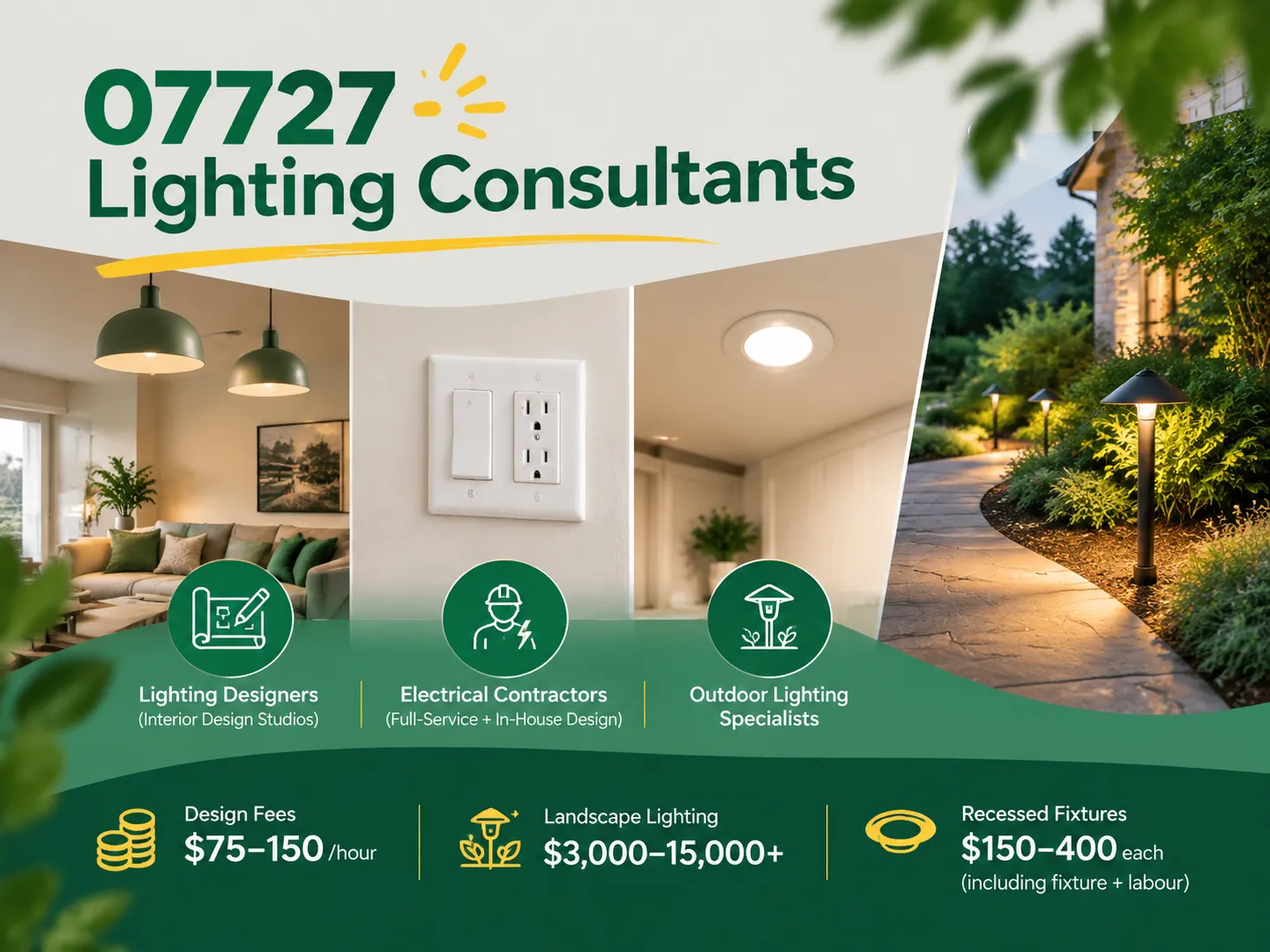
Farmingdale, along with parts of Wall Township and Tinton Falls, New Jersey, share the same zip code of 07727. Most of the houses built from the 1950s to the 1990s still exist today. Most of the homeowners are renovating their houses as opposed to building new homes. Homeowners tend to spend a lot more on […]

The term “07984 lighting consultants” gives people the impression that the five digits represent a postal code of some sort that indicates the place where lighting consultants provide services. This is, however, incorrect: there is no postal area coded 07984, which is only a code of mobile telecommunications in Great Britain. This means that the […]
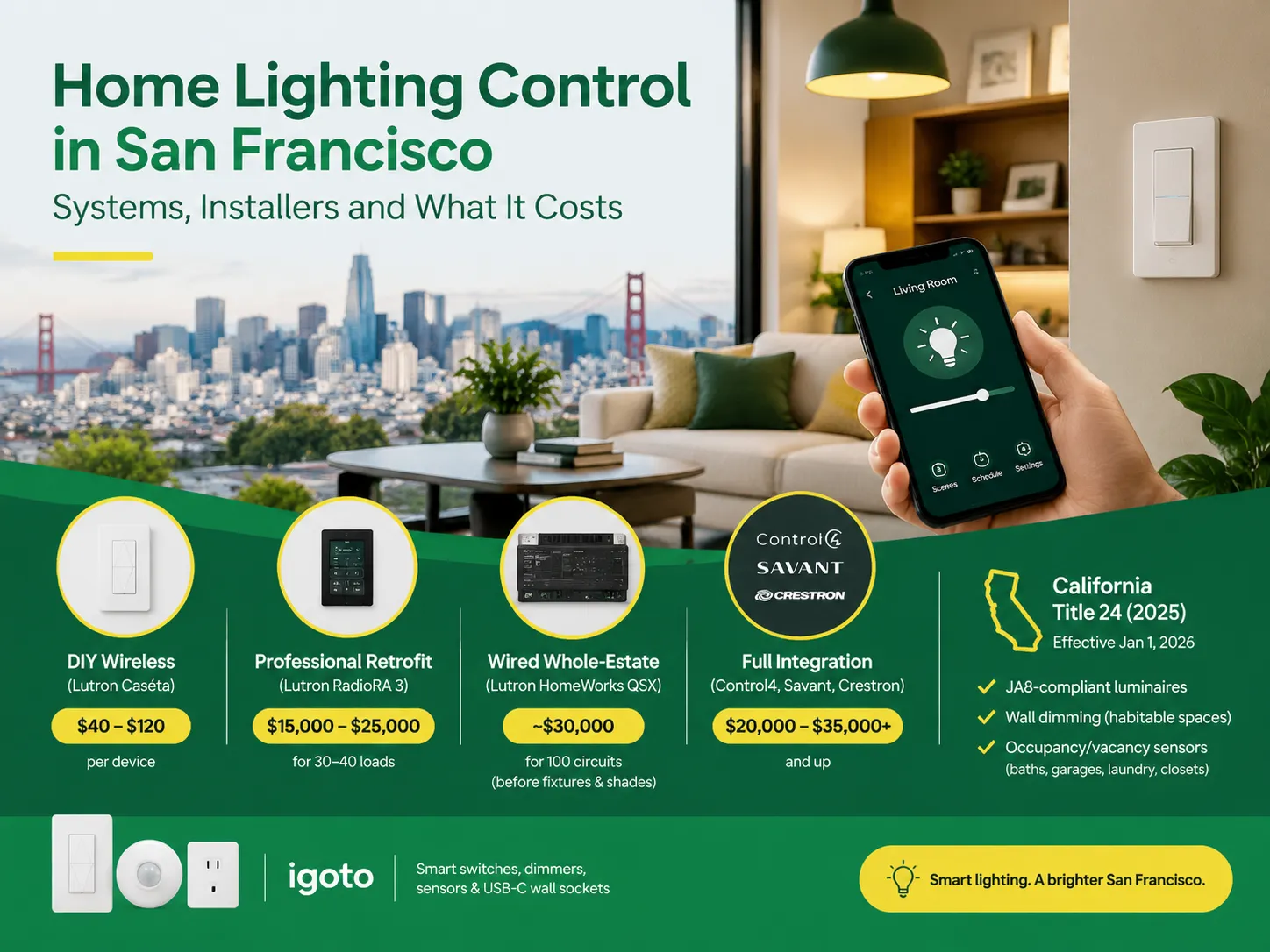
San Francisco is not the average lighting control market. The housing stock is old and dense, and the electrical code does not allow for as many electrical installations as is allowed almost anywhere else in the U.S. Most homes that want complex lighting are Victorian or Edwardian buildings where no one wants to start opening […]

 No.6 Tuozhan Road, Leshang Pioneer Park,Yueqingwan Bay Harbor,Yueqing city,Zhejiang Province


