

Of the very few areas of a house where the electrical code is crystal clear, the outlet located on the front porch is one such example. Since this area is outside, wet, and generally accessed through the doorway of the house, these elements trigger various requirements that have become quite stringent in the last two code cycles. In case you are wondering what the code stipulates, what the reason for these stipulations is, what the outlet needs aside from the GFCI protection, how to reset a tripped outlet, and how much it costs to install a front porch outlet, read on.
In brief, the answer is affirmative. The outlet fitted on the front porch is considered an outdoor outlet. According to NEC 210.8(A)(3), GFCI protection is must for any type of outlets working with voltage ranging from 125 V to 250 V. NEC 210.8(F) states about that requirement being applicable for all outdoor outlets of the household provided that single phase circuit is applied and rated between 150 V and 50 A. The outlet shall be designed in such a way that it is resistant to weather influences. In order for the outlet to be put into operation, a GFCI receptacle that costs between $18 and $30 will be needed whereas the porch circuit installation by the authorized electrician will cost approximately $400-$900.
Three sections of the NEC relate to front porches and address different issues.
NEC 210.8(A)(3), Outdoors. Ground-fault circuit-interrupter (GFCI) protection is required for all 125-volt to 250-volt receptacles used outdoors in dwelling units. In contrast to the previous edition (2017), which mandated this for all outdoor receptacles, this provision now encompasses receptacles with voltages from 125 to 250 volts.
NEC 210.8(F), Outdoor Outlets. In the case of dwellings, all outdoor outlets that are powered from single-phase branch circuits of up to 150 volts and 50 amps must be protected by GFCI. The requirements here have become more comprehensive later than in the previous editions: now all outdoor outlets must be protected even those that do not have typical connection (hardwired equipment).
NEC 210.52(E), location of the outlet. This rule is about how the outlet has to be located rather than how to protect it. Section 210.52(E)(1) prescribes that there shall be at least one outlet that is easily accessible from the ground or being located at the height of no more than 2.0m. As for section 210.52(E)(3), it states that there should be at least one outlet per balconies, terraces etc.
In the end, whenever there is an entrance to the house from the porch the outlet must be present there and it must be protected with GFCI.
Buyers of older homes often discover that their porch outlet was legal when it was installed and is not compliant now. The table shows how the requirement moved.
| Code cycle | Voltage covered | Outdoor scope |
|---|---|---|
| 2017 NEC | 125 V, 15 and 20 A | Outdoor receptacles in listed locations |
| 2020 NEC | 125–250 V | Adds 210.8(F): all dwelling outdoor outlets, receptacles and hardwired, 150 V to ground or less, 50 A or less |
| 2023 NEC | 125–250 V | Extends 210.8(F) to garages at or below grade, accessory buildings and boathouses; replacement of supplied equipment triggers GFCI |
As far as homeowners are concerned, it is important to note that a porch outlet that was installed in 2005 may not be protected against the GFCI, meaning that that porch outlet is considered defective under the current code. In the majority of cases, this will be pointed out during the inspection of the property and will need to be fixed whenever the circuit is modified in any way.
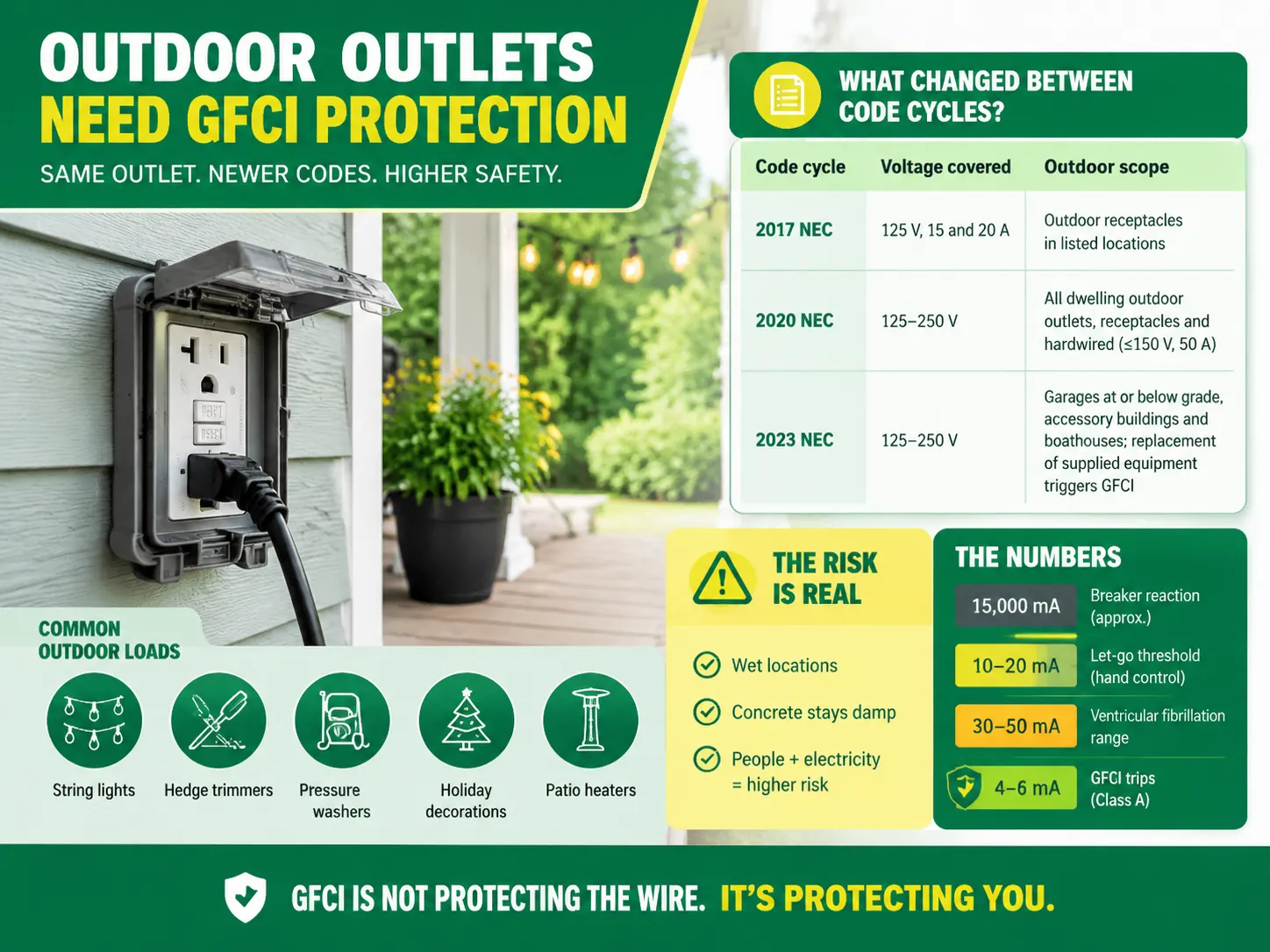
The porch can be referred to as wet locations which is why GFCI protection is required.
Concrete retains moisture even after the rain has ceased. People conduct many activities on their porches that sadly invite incidents associated with electricity: Strings of lights broken, finer appliances like hedge trimmers or pressure washers with extension cords, decorative objects like Christmas trees outside, and finally, one’s laptop charger plugged plugged on the damp table. Any of these appliances may endanger the people on wet surfaces.
With regards to statistics, it is important to provide clear information about the functioning of the normal circuit breaker. An ordinary 15A breaker does not turn off until the current reaches approximately 15,000 mA, which is known as the “let-go” threshold. However, at this current level it is impossible to release the current. A Class A GFCI will trip at the level of 4–6 mA since this current is dangerously low for the whole system. In other words, it does not protect the wire but rather protects the human being.
Both satisfy the code. The choice is about where the porch circuit starts and how many outlets share it.
| Factor | GFCI receptacle at the porch | GFCI breaker in the panel |
|---|---|---|
| Typical cost | $18–$30 for the device | $35–$75 for a 1-pole unit |
| Coverage | Itself plus everything on the LOAD terminals | The entire branch circuit |
| Reset location | At the outlet, where you are standing | At the panel, often in the basement or garage |
| Best when | Only the porch needs protection | Several outlets share the circuit, or the porch circuit is 240 V |
| Main risk | Load-side wiring mistakes at the outlet | Inconvenient reset location |
The receptacle typically comes out on top when it comes to single-family dwellings because the porch is the only wet spot on the circuit and it is more convenient to reset at the outlet than to go to the panel. Here’s a nice detail: just one GFCI receptacle protects all normal outlets connected to it on the same circuit, provided those outlets are attached to the LOAD terminals not the LINE terminals. So if there is also another outdoor outlet at the back of the house on the same circuit, one GFCI will suffice. That is also the reason a tripped porch GFCI sometimes kills an outlet you thought was unrelated, and the reason a “dead” outlet may not be faulty at all — the circuitry involved in that situation, and how a device on a shared circuit behaves, is the same logic described in this explanation of why circuit breakers matter for outlets and light switches.
Electrical outlets that are done properly aren’t done until three conditions are met.
A weather-resilient outlet. NEC 406.9(A) says that the 15 A and 20 A outlets in damp or wet areas have to be classified as weather resistant. If ordinary outlets are placed outside, they will corrode and cease to operate quickly.
A cover that allows for the use of the outlet without disconnecting the plug. NEC 406.9(B) requires the outdoor outlet to have a protective cover that will keep it functional even when the plug is connected. So the outlet has to be equipped with a bubble or a while-in-use cover, not a flat cover that only closes the outlet when it is empty. In some areas the cover must also be marked as of the extra-duty type.
Exemption from cold, water, or other natural effects. NEC 406.12 requires all outlets in places of residence, including outdoor places, to have tamper-resistant outlets. A combination of WR and TR outlets enables meeting both requirements perfectly and smoothly.
The information that should be added about making GFCI devices is that in the case if it is installed in a two-wire system, it does not contain grounding wires, and therefore should have a marking “No Equipment Ground” and “GFCI Protected.” The practical specification differences between weather-rated outdoor products and ordinary indoor ones are covered in this guide to how to choose suitable outdoor power outlets.
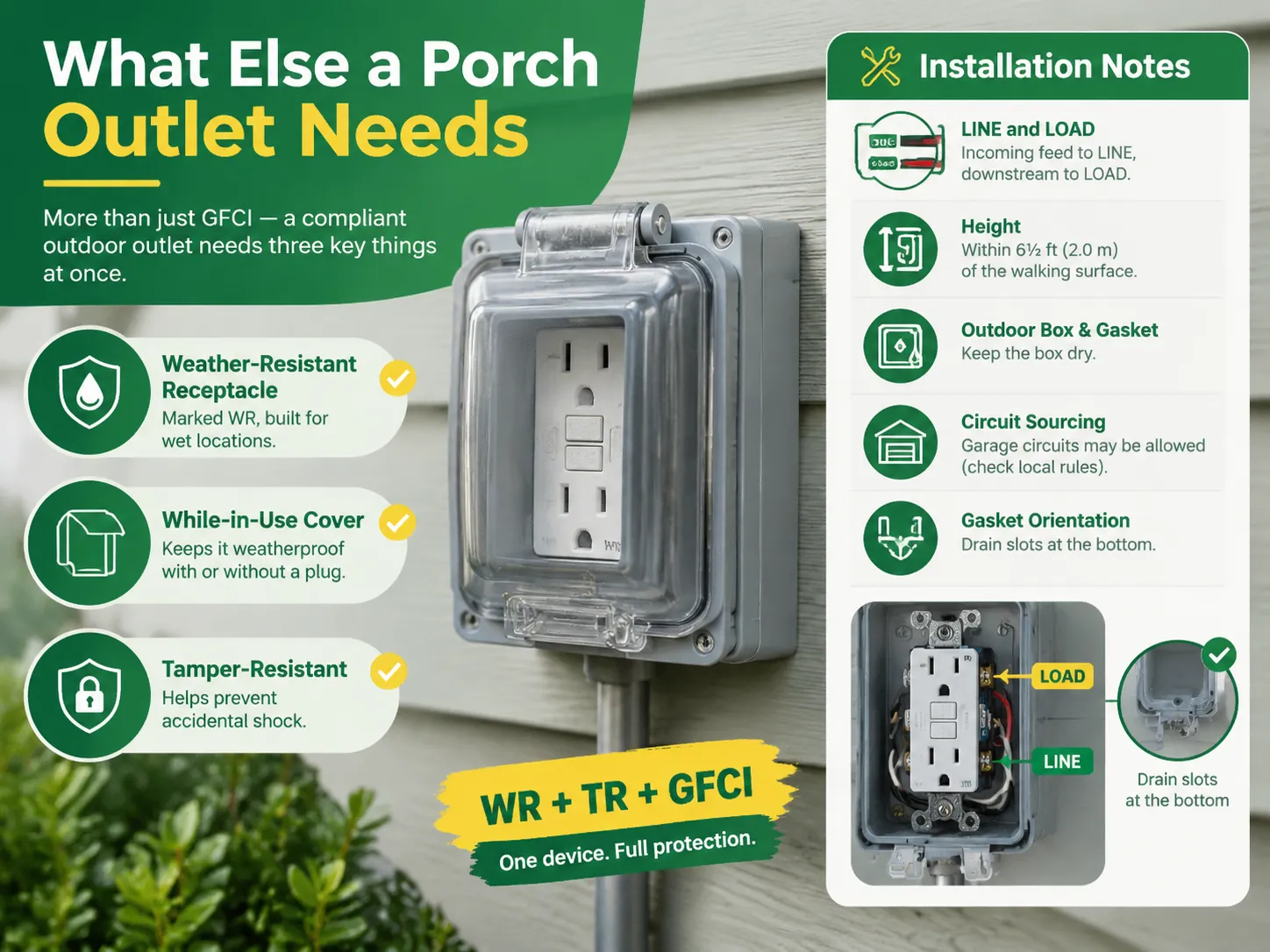
Most of the issues arising with a GFCI on the porch occur in the box instead of the panel.
If the work involves extending the circuit rather than replacing a device in place, the sequence and the clearances matter more than the device itself; the steps and the safety precautions are set out in this guide to how to install a power outlet. Working de-energised and verifying at the box before touching conductors is the part that is not negotiable.
A GFCI device is an electronic life-saver and therefore it must be tested.
Test the device by pressing TEST every month and see if it trips and then hits RESET. UL943 since June 2015 has made it mandatory for GFCI receptacles and breakers to be automatic self-testing, which tests the internal sensing circuit all the time. If the electronics of GFCI are affected, the device will lock out and flash a red light on the display.
One interesting point regarding GFCIs: a plug-in three-light tester will not trigger a GFCI, if there is no ground, because it uses the ground pin to complete the circuit, leading to assumptions of the device being broken down. On ungrounded retrofits, one should simply follow the TEST button instead of the device. And it should also be noted that in case you get to know that your GFCI has been tripped the moment you plugged something into it, you need to search for a bootleg ground.
| Symptom | Likely cause | Fix |
|---|---|---|
| Trips after rain | Water in the box or a cracked cover gasket | Reseal or replace the cover and box |
| Trips when a specific tool is used | Damaged cord or failing insulation on that appliance | Replace the cord or the appliance |
| Trips immediately with nothing plugged in | Wiring fault, bootleg ground, or device at end of life | Trace the wiring; replace the device if it is sound |
| Trips randomly | Shared neutral with another circuit | Separate the neutrals |
| Will not reset at all | Self-test lockout or no supply at LINE | Verify supply, then replace the device |
Costs below are typical US ranges for 2026 and separate the device from the labour, because the two move independently.
| Item | Typical cost | Notes |
|---|---|---|
| GFCI receptacle, 15/20 A WR | $18–$30 | Weather-resistant version costs a few dollars more than indoor |
| Weatherproof while-in-use cover | $8–$20 | Extra-duty listings cost more |
| Replace an existing porch outlet | $120–$350 installed | Includes device, cover and labour |
| Extend an existing circuit to the porch | $250–$600 | Depends on box location and cable route |
| New dedicated porch circuit | $400–$900 | Panel capacity, trenching and permits drive the range |
| GFCI breaker instead of receptacle | $35–$75 plus labour | Costs more but protects the whole circuit |
If you are a skilled do-it-yourselfer, then replacing a device is an easy task, but it is the cost that must be considered. In instances when it is essential to install a new cable, install a new breaker or do some work inside the panel, it is better to ask the services of a qualified electrician as not only is a permit critical in this case, but also a faulty installation may also create problems.The procedure and the pitfalls for a straight swap are covered in this walkthrough of how to replace a wall socket.
Igoto is a manufacturer of wiring devices and not an authorized electrical contractor, and it is important to point out this distinction: the company sells components like receptacles, including both tamper-proof and weatherproof types, switches, wall plates and traver adapters under the name Igoto, to dealers, contractors and OEMs. It does not design circuits, write permits or install devices. The device specification in the US is UL 498 for receptacles and UL 943 for the GFCI functionality; any item destined for this part of the world must conform to these standards.
Our service is in selecting the suitable device rather than the one that is most similar to it that can be found on the market. If a porch is considered to be a wet location, one has to use a WR receptacle and a tamper-proof device; both of these points are clearly marked on the item and do not need to be looked up in a manual.The regional format differences that decide which socket body you need in the first place are set out in this overview of wall socket types.
Indeed, the location has no specific requirement, other than it being outside, hence all receptacles from 125 volt to 250 volts outdoors are covered by NEC 210.8(A)(3). The provision in 210.8(F) expands GFCI protection to all of the outlets outdoors of the dwelling hanging on single-phase circuits rated up to the voltage of 150 volts from ground and current of 50 amperes. While the editions of NEC in 2020 and 2023 widened this greatly compared to 2017, thereby making many old installations non-compliant.
While there are no restrictions regarding the use of GFCI outlets, certain appliances can lead to frequent nuisance tripping. For example, refrigerators and freezers can destroy their contents due to a sudden trip occurring while no one is home. This is why circuits for these appliances are usually excepted from GFCI circuits. The latest edition of the code has included special exemptions for dedicated circuits that serve sump pumps and sewage lift pumps. According to the code, old fluorescent appliances that generate extra noise, appliances that contain electrical components with faulty insulation, and similar devices can be expected to trip GFCI circuits, too.
Four sections are responsible for this work. NEC 210.8(A)(3) mandates GFCI protection for any outdoor receptacle, and 210.8(F) applies this to all outdoor receptacles of dwelling units with a voltage of 150 volts or less and a current rate of 50 amps or lower; 210.52(E)(1) requires installation of at least one outlet that can be reached easily and located not more than 6.5 feet above the ground in front of and at the back of the house; 210.52(E)(3) states that requirement is applicable to the balconies, decks and porches located inside the house; and finally, NEC 406.9 states that the receptacle should be rated as weather-proof and made to retain this property with a plug being connected.
Correctly choose the circuit. A porch power supply should mostly have either a 15 A or a 20 A, 125 V circuit. As such, a 15 A or a 20 A GFCI receptacle will be the right option. In addition, a 20 A GFCI installed on a 15A circuit is acceptable, since the GFCI devices are rated at a maximum of 20 A, while installing a 15 A on a 20 A circuit is not an appropriate option. In case a porch circuit is dedicated to 240 V, which is rare for porches, but possible for outdoor devices, it has to be protected with a breaker – two-pole GFCI breaker in the switchboard, since there is no receptacle-type GFCI for the voltages above 125 V. The most important rule about GFCI device ratings is that it must be equal or superior to the rating of the circuit.
That’s not always true. A porch outlet can use an already existing general-purpose circuit as long as the total load does not exceed the circuit’s capacity and there is GFCI coverage. Under the provisions found in 210.52(G)(1), garage circuits can supply service to outdoor receptacles that are conveniently accessible; garaging circuits are a popular economical option for feeding front porches. A dedicated circuit is worth the investment if heaters, EV chargers, or similar devices that are close to the limit of the circuit will be used on the porch because conflicts with interior usage are the most common cause of nuisance tripping.
It is mandatory to protect any front porch outlet with GFCI. The current codes apply specifically to all outdoor receptacles working in a voltage range of 125-250 VAT, as well as all outdoor plugs located on a circuit rated less than or equal to 150 VAT to ground and less than or equal to 50 A. In case your porch has a door to the main house and outlet.
One must take into consideration three things regarding GFCI. First of all, it is possible to talk about proper GFCI protection only if one ensures that the device is also weather-resistant and has a while-in-use receptacle, as this ensures its survival. A plug-in tester can not trip a GFCI of an ungrounded circuit, therefore the TEST button should be trusted instead of using it. Last but not least, if the GFCI device does not reset after the lockout test, it means that the device has reached its end-of-life.
The only difference between a porch outlet that is compliant with the code and one that poses a danger of electric shock lies in twenty dollars and a bubble cover.
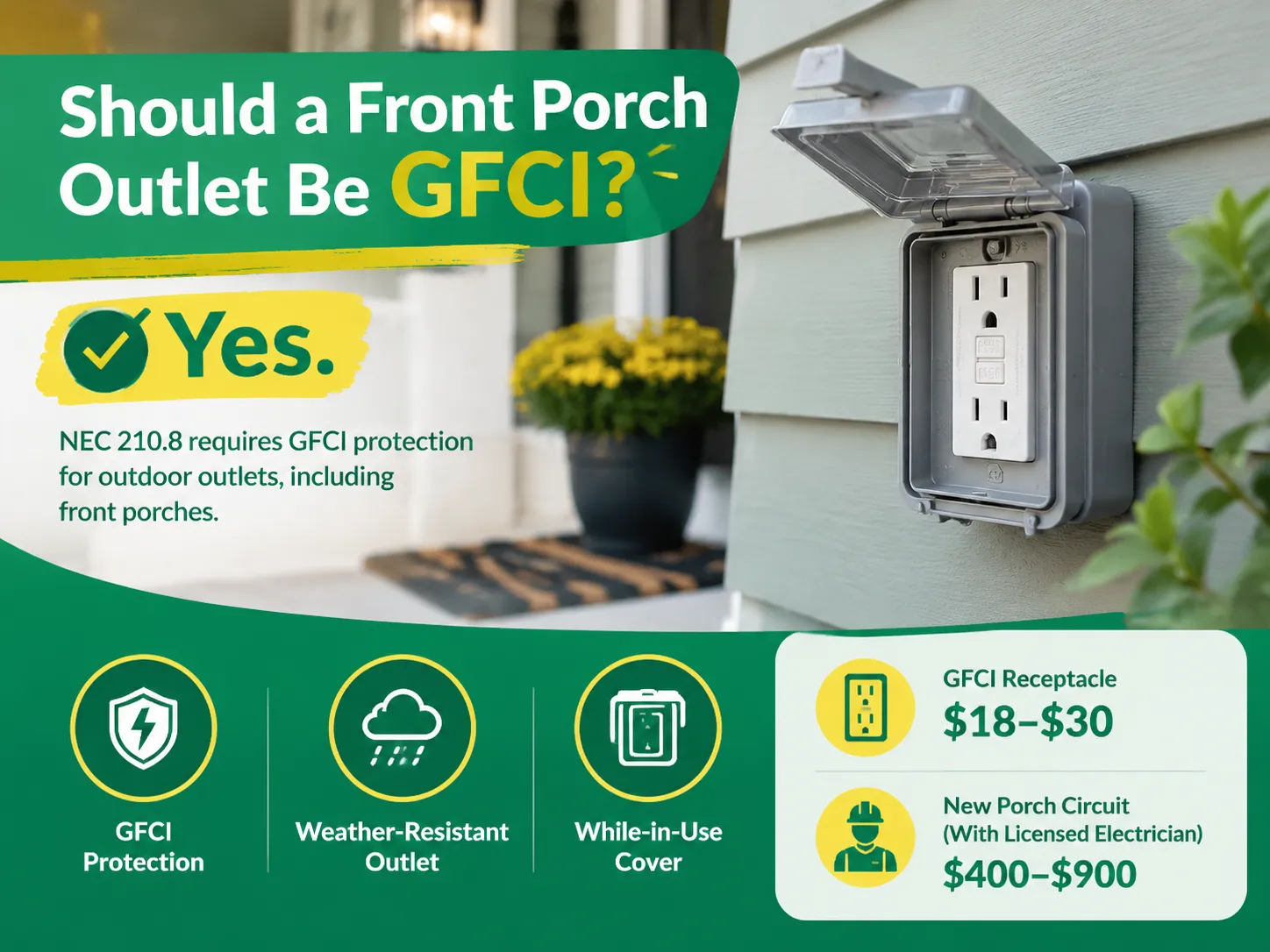
Of the very few areas of a house where the electrical code is crystal clear, the outlet located on the front porch is one such example. Since this area is outside, wet, and generally accessed through the doorway of the house, these elements trigger various requirements that have become quite stringent in the last two […]
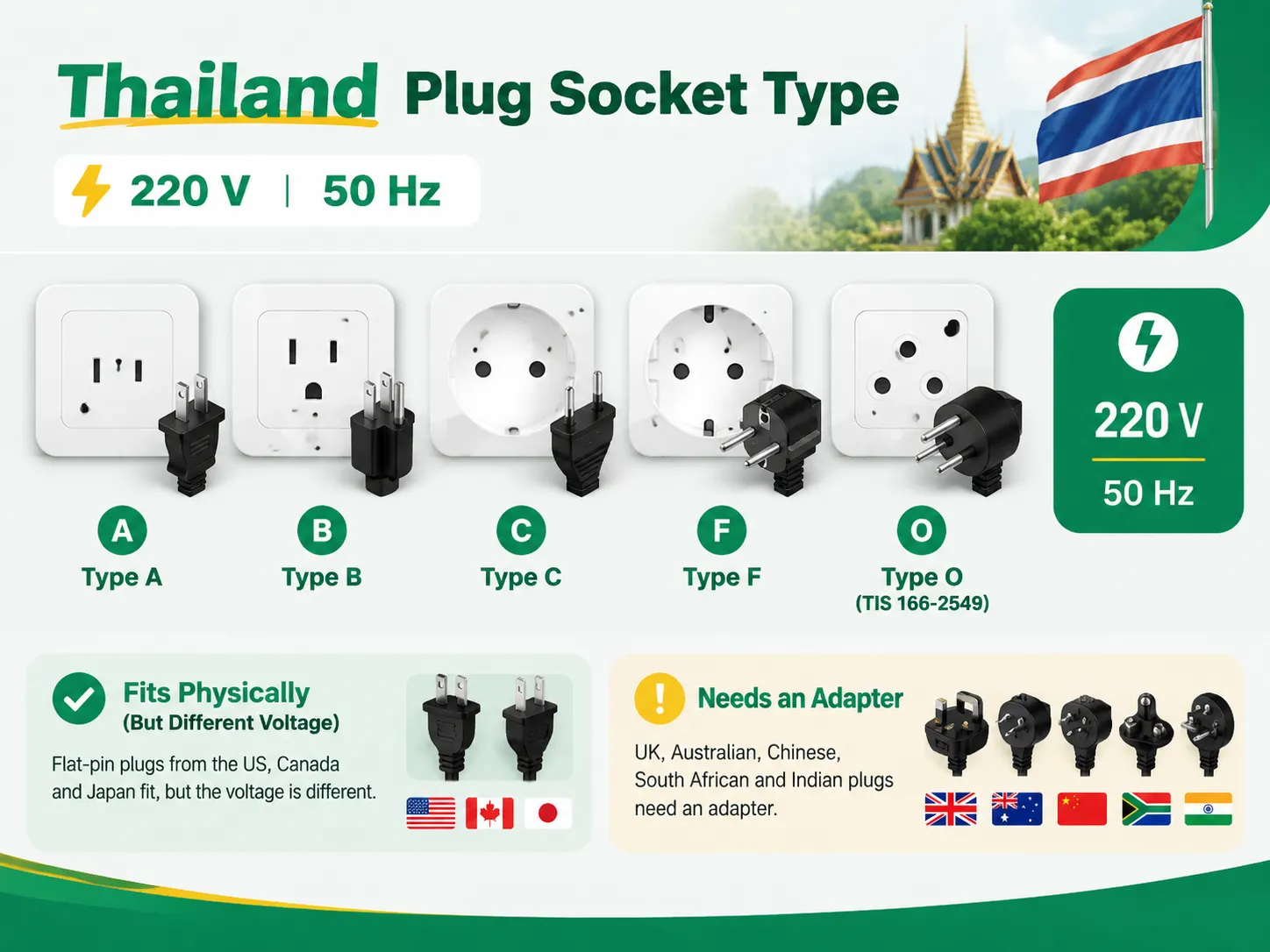
When traveling in Thailand, one of the things that makes Thailand easy for electronics users is that it has multiple types of sockets, but this is also one drawback in that the right plug does not necessarily mean an electrically safe plug. Here is how the sockets in Thailand look and what you will need […]

The Randolph township in Morris County is associated with postal code 07869 which is flanked by Dover in the west and Denville in the east. There is Route 10 which crosses the township; thousands of privately owned houses can be found in this township peppered throughout the green hills and woods. When you entered this […]

 No.6 Tuozhan Road, Leshang Pioneer Park,Yueqingwan Bay Harbor,Yueqing city,Zhejiang Province


