

When traveling in Thailand, one of the things that makes Thailand easy for electronics users is that it has multiple types of sockets, but this is also one drawback in that the right plug does not necessarily mean an electrically safe plug. Here is how the sockets in Thailand look and what you will need to have for getting electricity to your devices there.
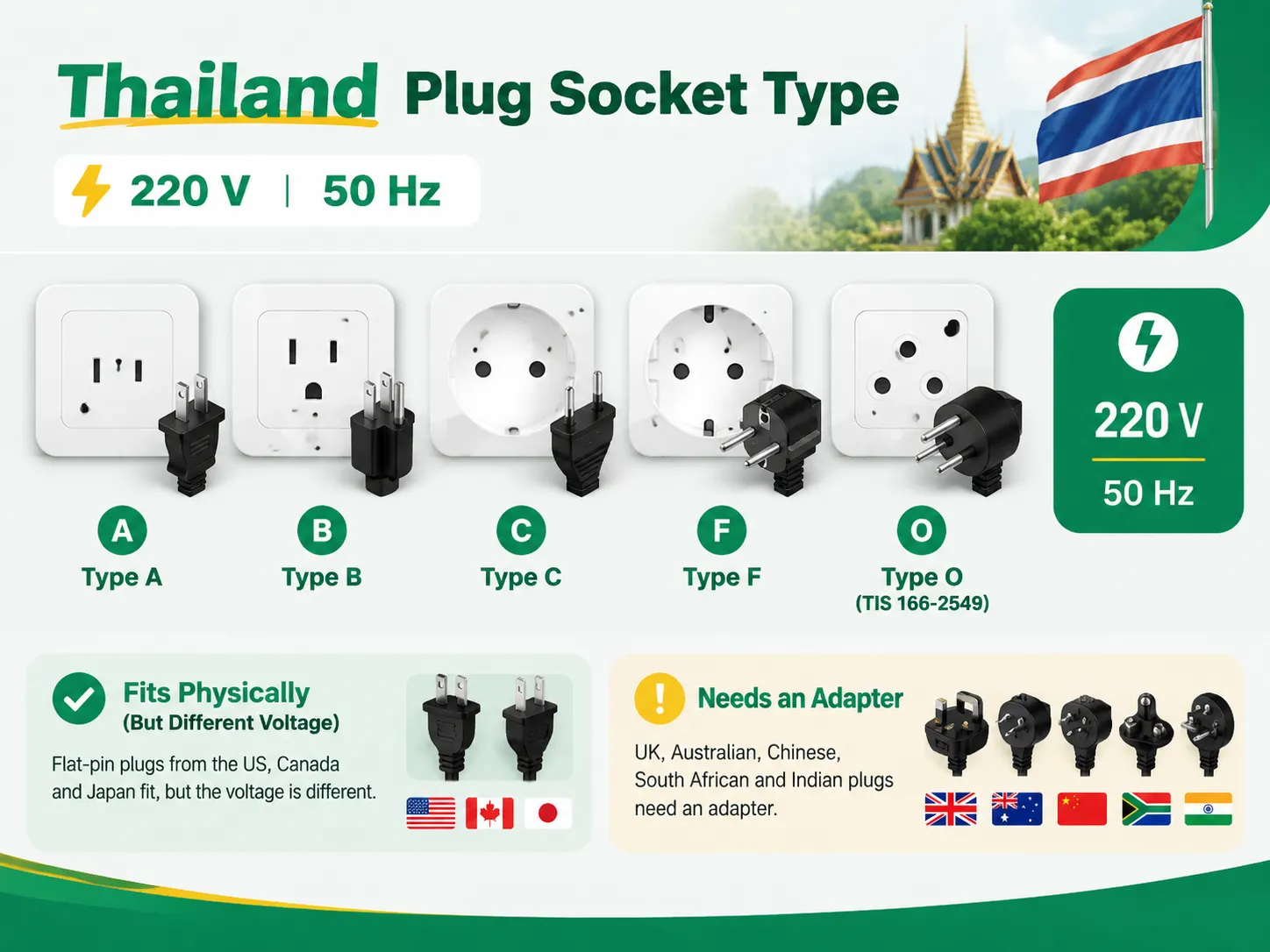
Thailand utilizes 220 volts, 50 hertz of frequency for electricity among different types of electrical sockets which include Type O or TIS166-2549 emissions in addition to Types A, B, C, and F sockets. The sockets were developed in the year 2006 and manufacturers of new hardware have to comply with the rules. In terms of the Italian and Canadian plugs, they can be used as long as they follow the required voltage; however, UK, Australia, China, South Africa, and Indian plugs will always need adapters to get plugged into their sockets.
The first thing to acknowledge is that there is no one-size-fits-all answer to this question. Thailand is not a country that experienced a break from the past, unlike many other countries, and there are still sockets in old buildings, hotels, and shopping centers. The country has older American flat pins, older European round pins, and the new Thai standard on one and the same wall, and often even in the same room.
Fortunately, the majority of Thai sockets are designed with compatibility in mind. Many have areas for American flat pins and European round pins on the same faceplate, which allows visitors from almost any country to find a socket that will work with their device. Nevertheless, it is important to note that while the shape of the plug may be appropriate, this does not mean that the voltage is acceptable. A device rated for 120 volts may well get damaged when being plugged into a socket that operates at a voltage of 220 volts. If you want the country-by-country picture, our reference on Thailand’s electrical socket type covers the standard itself in more detail.
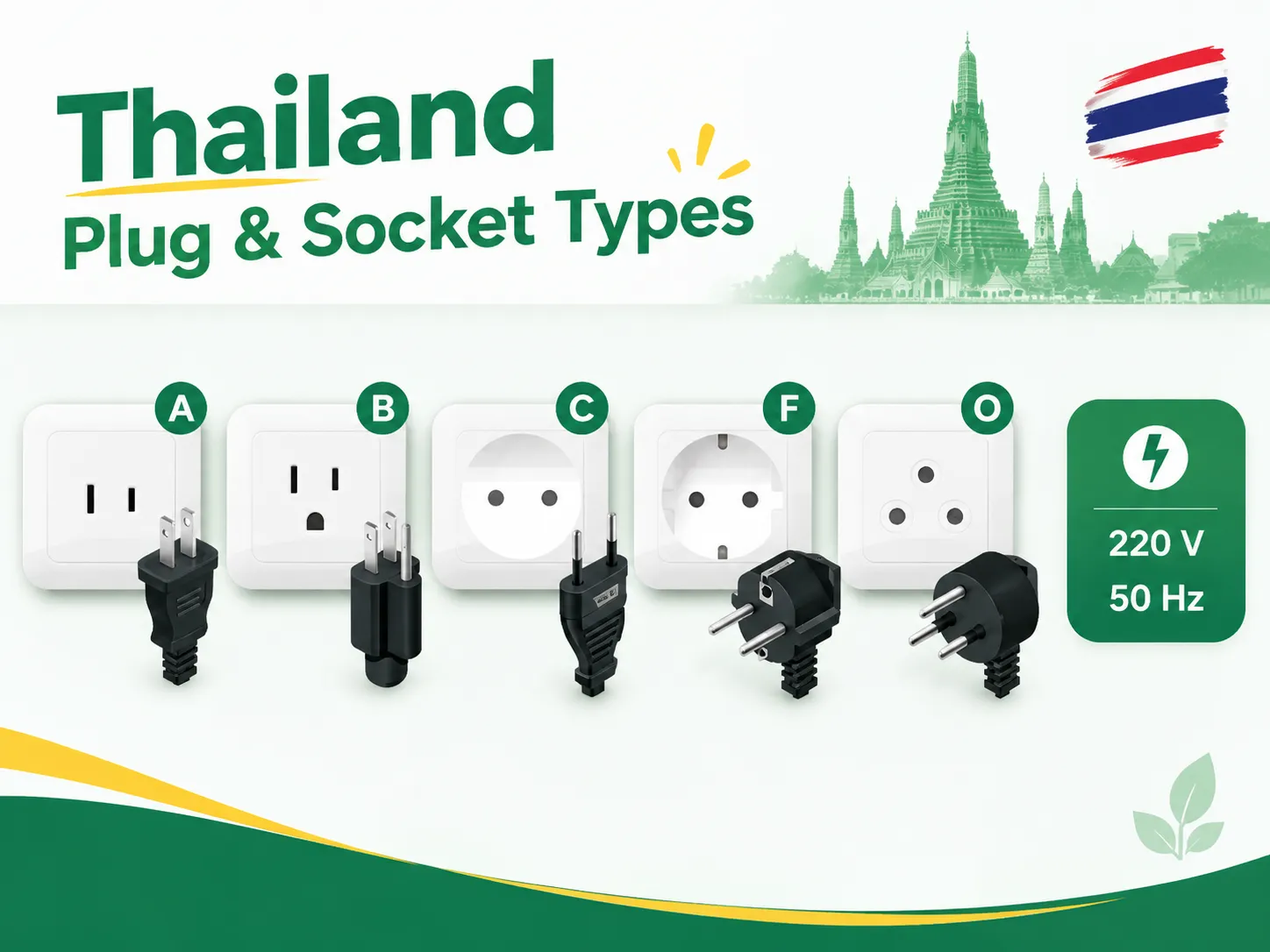
Both Type A and Type C plug designs were used more widely in older installations. Because they supplied North American type rapidly and later the presence of European type C supply has increased.There is a fuller survey of how these designs are distributed internationally in this overview of wall socket types.
220 V at 50 Hz is the supply rate in Thailand. The nominal figure listed in some sources is 230 V, but this poses no issue for the design of the machinery being used.
The 50 Hz part in the equation seems to be ignored by many. Devices with any motors or powered timepieces either will not run or will operate incorrectly; however, some devices do require this voltage factor, namely older sound devices and clock timers. Most gadgets produced today do not care about this fact.
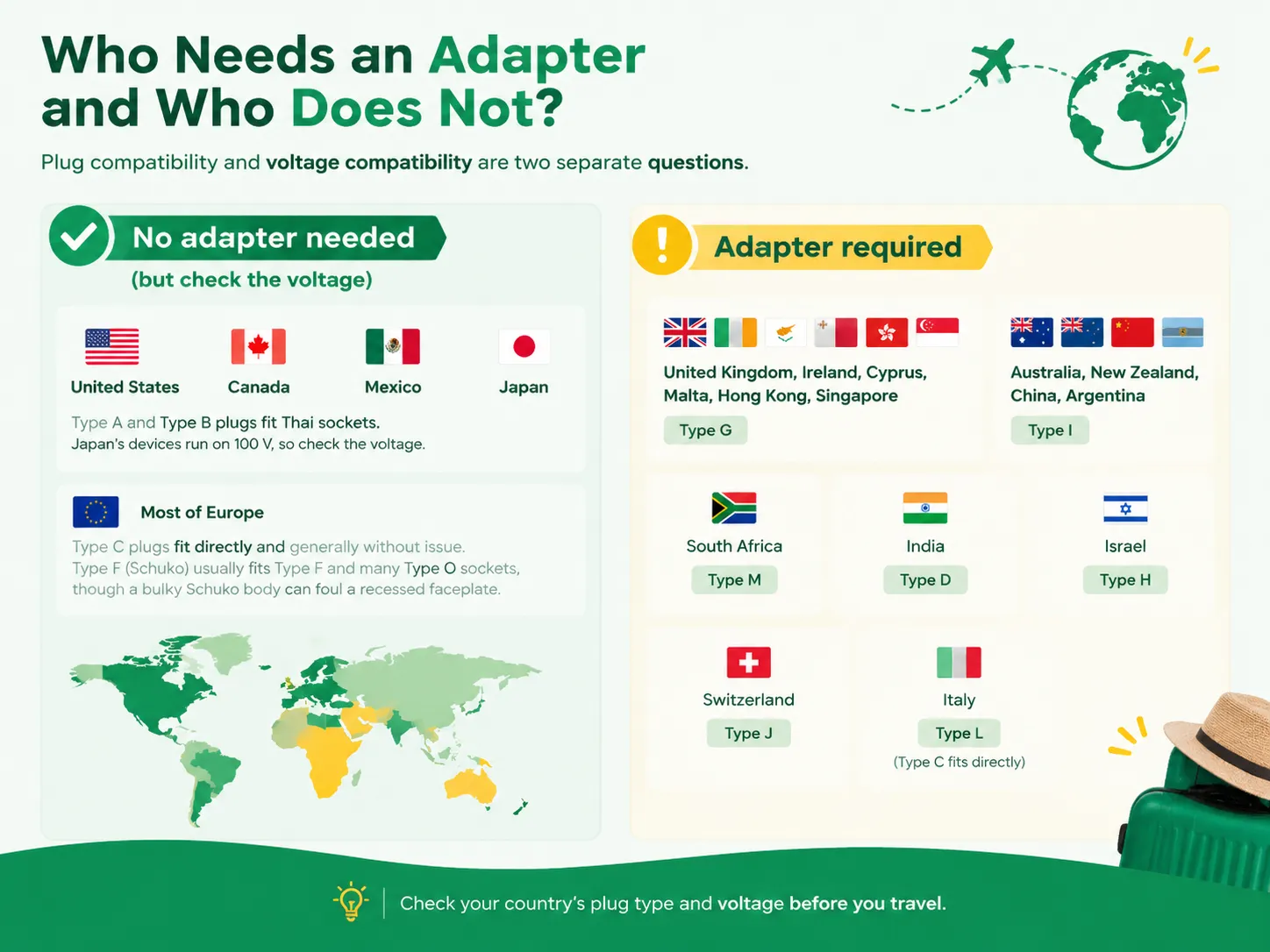
This is where people often go astray because plug compatibility and voltage compatibility are distinct matters.
No need for an adapter, but check voltage
To begin with, the adapter is needed because its usage is required in several countries:
If you are trying to work out which group your country falls into without cross-referencing five lists, our regional breakdown of plug and socket types by region is organised geographically rather than by standard number, which is faster to read when you are packing.
The easiest travelers in the world are Europeans for one important reason.
The Europlug, Type C, is designed in such a way that it can simply force-fit right into Type O sockets in Thailand, which means that there is no need for an adapter. Besides, since both Thailand and continental Europe are positioned at a nominal voltage of 230/220 V and a frequency of 50 Hz, the voltage is not a problem.
The only issue is the use of a Schuko plug, that is grounded. Its pins are spaced 19 mm apart just like all the other plugs, but the body of the plug is wide and the socket has an earth contact on the side. As a result, it can be used in fitting Type F and some Type 0 sockets. However, it might not be suitable for some of the Type F sockets because of using a recessed faceplate. If a traveler has a Schuko plug, it would be advisable to have a Type C-to- whatever adapter just in case.There is more on how the two European designs differ and where each is used in this piece on European electrical plugs and sockets.
In many hotels the bathroom is usually equipped with a shaver socket located by the mirror and most travelers think it is a US or European socket, but in fact, it is neither of those types.
Shaver sockets are specially made, insulated and low-powered sockets — typically rated at 20 VA — which can be used by shavers and electric toothbrushes. It can accept a flat or round two-pin plug, which is what causes confusion. In many cases, it can be used for charging the phone and it won’t work with hair dryers. If the devices are used that draw more than the rated consumption it may cause it to trip and sometimes even the whole bathroom circuit.The full explanation of what that socket is and what it is not is in this answer to the question of whether a shaver socket is the same as a European plug.
Usually, you do not need to purchase one prior to travelling. These adapters can be found at 7-Eleven and Family Mart stores, in certain modern markets like Big C, Central and Robinson, or at almost every electronics outlet at airports. The prices are approximately between THB50-200 (USD1.5 – 6).
There is a warning, though. First, a low-cost adapter does change the shape of the plug and nothing else. This means that it will not protect a hair dryer working on 120 volts from getting plugged into 220 volts, and plugging it from a USD2 adapter is a surefire way to ruin it and sometimes trip the electricity of the room. Second, if you want to use an appliance that consumes electricity, you have to buy a better adapter, since the contact quality of really cheap adapters is not sufficient and so the adapter starts getting warm.
Many modern hotels in Bangkok, Chiang Mai and other resorts do not require using this kind of apparatus because they have universal sockets equipped, but older hotels in poor areas and guesthouses are unable to meet the needs of modern travellers.
The connecting plugs work but the voltage mismatch. US Type A and B plugs can use Thai sockets because the shape of the pins is compatible. The problem is the voltage as it is 120 V in the US and 220 V in Thailand. Dual voltage appliances which can work on voltages from of 100 V to 240 V can be used in the Thai sockets. In contrast, appliances that use 120 V will need a transformer, not merely a plug adapter.
In Thailand, types A, B, C, F and N type O are used. Most tourists will need nothing but their devices with them, because either the sockets are suitable for their A, B or C types plugs, or they have minimal requirement to carry an adapter if they are coming in from the UK, Australia, New Zealand, China, South Africa or India. Just remember to confirm your voltage on the equipment.
If travelling from places like the UK, Ireland, Australia, New Zealand, China or South Africa, a universal travel adapter with A/C/F plug types is needed. If your point of origin is in the US, Canada or Europe, then you may not need to worry much about plug shapes, though it is important to consider a step-down transformer if using any appliance that needs high voltage. In Thailand, adapters are readily available so you can easily buy them from any shop.
The Type O reference point used in Thailand refers to TIS 166-2549, but Type C and Type F plugs are compatible with Thai plug sockets. The voltage and frequency in Thailand are consistent with the ones used in Europe – 220-230 volts and 50 hertz.
No. The UK Type G plug has three rectangular prongs and won’t fit any of the socket types in Thailand. You need an adapter for your plug so that you can use it. If the device is dual voltage, then that is all you need to use it. But if you have a 230-240 V single-voltage device, it will work normally through the adapter.
Thailand’s sockets are quite forgiving, which is lucky and risky at the same time. The plug almost always works. The voltage is 220 V at 50 Hz, and that is what is important — a $2 plug adapter is enough to deal with the connector, but it has nothing to do with the electricity itself.
The steps are quite simple. Check the label on the appliance beforehand. If it is 100-240 V, you only need to worry about the plug. If it is 120 V, leave it at home or take a transformer. If it is 220-240 V, you are safe.
When traveling in Thailand, one of the things that makes Thailand easy for electronics users is that it has multiple types of sockets, but this is also one drawback in that the right plug does not necessarily mean an electrically safe plug. Here is how the sockets in Thailand look and what you will need […]

The Randolph township in Morris County is associated with postal code 07869 which is flanked by Dover in the west and Denville in the east. There is Route 10 which crosses the township; thousands of privately owned houses can be found in this township peppered throughout the green hills and woods. When you entered this […]

When someone asks the question “do GFCI outlets go bad”, they may really be asking how long an outlet will last before failing. There is no definite or absolute answer to that question as every situation is unique; therefore each GFCI outlet should properly work as long as there are no other factors contributing to […]

 No.6 Tuozhan Road, Leshang Pioneer Park,Yueqingwan Bay Harbor,Yueqing city,Zhejiang Province


