

As soon as you walk in the house, the lights go on and dim for a movie, the curtains automatically come down in with sun rays hitting the window facing west. All thanks to the technology of smart lighting and shading, which are among the most popular innovations of the modern-house world. Nevertheless, this market sector is very competitive; there are numerous brands producing smart bulbs, switches, dimmers, and blinds at different prices. The goal of this article is to provide you with a guide of what you need to know about smart lighting and shading.
To sum up: smart lighting and shading set-ups consist of: smart bulbs , smart switches and dimmers, bridges/hubs, and motorized shades.
Smart lighting refers to lighting which you can operate from a distance by means of an app, voice assistant, scheduled and so on. Smart shading refers to similar motorized shades, blinds or curtains, which can be managed similarly. In this way, smart lighting and shading resolve two problems of all rooms at once: the right light level and the right amount of daylight.The typical examples of smart scenes are as follows:
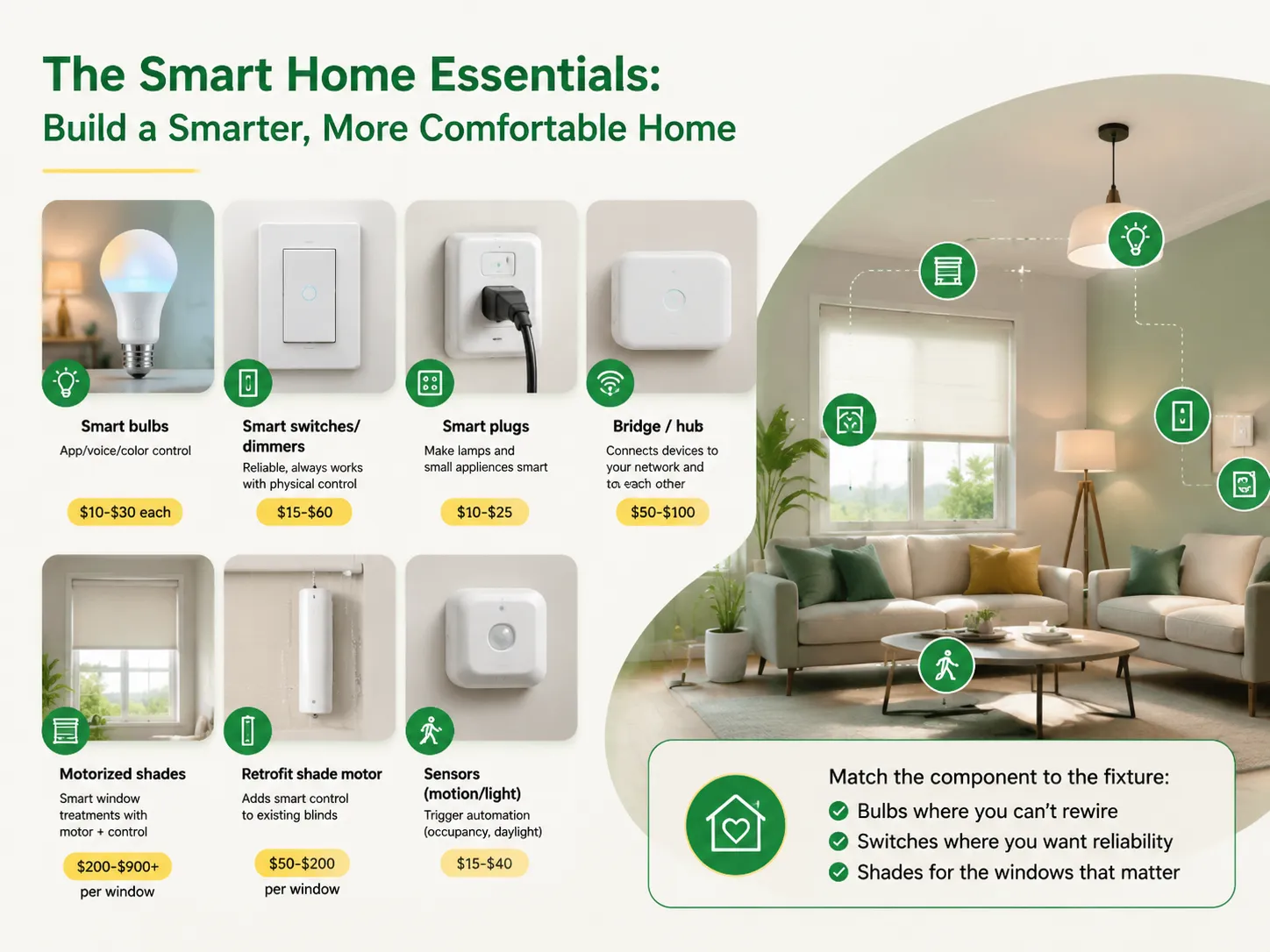
| Component | What It Does | Typical Price |
|---|---|---|
| Smart bulbs | Replace bulbs; app/voice/color control | $10-$30 each |
| Smart switches/dimmers | Replace wall switches; reliable, always works with physical control | $15-$60 |
| Smart plugs | Make lamps and small appliances smart | $10-$25 |
| Bridge/hub | Connects devices to your network and to each other | $50-$100 |
| Motorized shades | Smart window treatments with motor + control | $200-$900+ per window |
| Retrofit shade motor | Adds smart control to existing blinds | $50-$200 per window |
| Sensors (motion/light) | Trigger automation (occupancy, daylight) | $15-$40 |
Most residences do not require all of these items – wise planning is to pair the part with the appliance: bulbs for unrewireable fixtures, switches for optimal performance, and curtains for the right windows.
Smart bulbs represent the simplest entry product in this space; they are easily installed by simply screwing one in, connecting to an app and that is it. They are perfect for renters and anyone who prefers not to deal with wiring.
Smart switches and dimmers are the way to go for rooms that need constant lighting, such as your kitchen, living room, or hallways. Smart switches will substitute the old wall switch and install useful features without changing any wiring.
Most intelligent lighting systems would justify the use of a bridge or a hub for connecting devices to the network and for the coordination of scenes.
Smart shades are the priciest single component, and quality varies dramatically:
| Product | Price (per window, 24×36 roller) | Notes |
|---|---|---|
| SmartWings (Zigbee/Wi-Fi) | ~$225 | Best value; choose Zigbee/Alexa/HomeKit motor; solar panel option |
| Lutron Serena Shades | $740-$900+ | Best compatibility (Alexa, Google, HomeKit, SmartThings); pairs with Caseta; premium build |
| Lutron RadioRA/HomeWorks shades | $1,000+ | Dealer-installed, luxury-tier |
| Retrofit motors (SwitchBot, SmartWings retrofit) | $50-$200 | Add smart control to existing blinds without replacing them |
When purchasing blinds, remember these key aspects. Look at the motor type that suits your needs best (battery vs wire vs solar powered), the material being used (light-filtering vs blackout), and the compatibility with your devices (do they work with your app/voice?). Battery motors will need charging every 4 to 12 months.
Unsatisfied with taking down the old window shades? Retrofit motors fit onto the existing handle or string and provide made app/voice control:
Retrofitting is an inexpensive way to try smart shading solutions before spending on new custom shades.
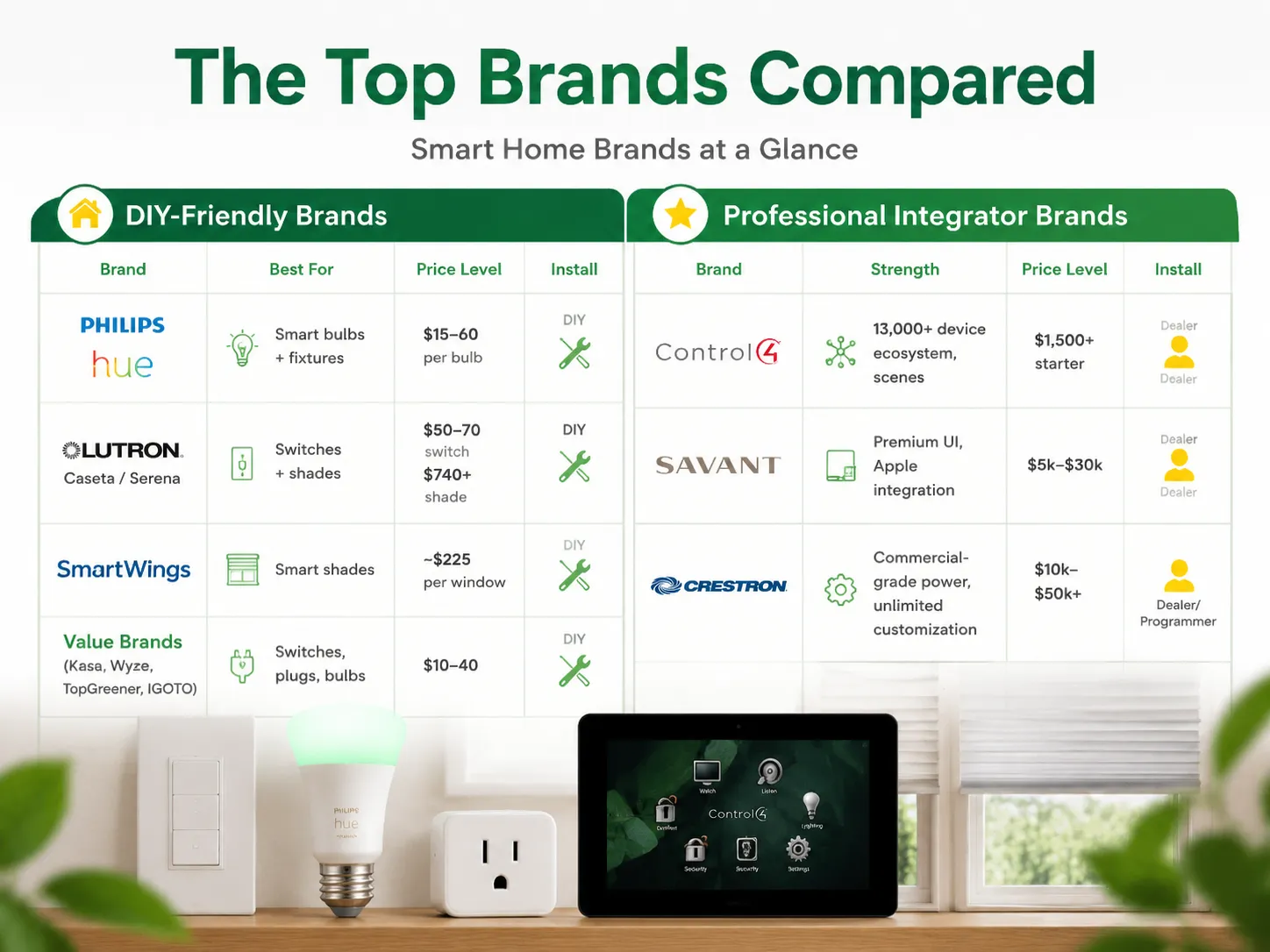
The market splits into DIY-friendly brands and professional integrator brands:
| Brand | Category | Strength | Price Level | Install |
|---|---|---|---|---|
| Philips Hue | Smart bulbs + fixtures | Best color and scene ecosystem | $15-60 per bulb | DIY |
| Lutron (Caseta/Serena) | Switches + shades | Most reliable, best compatibility, no subscription | $50-70 switch; $740+ shade | DIY (Caseta) |
| SmartWings | Smart shades | Best value shades, multiple motor options | ~$225 per window | DIY |
| Control4 | Whole-home automation | 13,000+ device ecosystem, scenes | $1,500+ starter | Dealer |
| Savant | Whole-home automation | Premium UI, Apple integration | $5k-$30k | Dealer |
| Crestron | Whole-home automation | Commercial-grade power, unlimited customization | $10k-$50k+ | Dealer/programmer |
| Value brands (Kasa, Wyze, TopGreener, IGOTO) | Switches, plugs, bulbs | Low cost, app control | $10-$40 | DIY |
Lutron merits a separate mention because it is the only name that stands at both ends of smart lighting and smart shading — which is exactly what this article is focused on.
For the majority of homeowners interested in building a lighting and shading system, Lutron is simply a perfect choice due to its reliability, compatibility, ease of installation, and no additional fees.
| Factor | DIY (Hue + Caseta + SmartWings) | Professional (Control4/Savant/Crestron) |
|---|---|---|
| Cost | $500-$3,000 typical | $5,000-$50,000+ |
| Installation | You do it (mostly plug-and-play) | Dealer-designed and installed |
| Flexibility | Add devices as you go | Deep customization, keypads, scenes |
| Integration | Voice assistants, app | Whole-home: AV, climate, security, shading |
| Support | DIY troubleshooting | Dealer support, maintenance |
| Best for | Most homes and apartments | Estates, hospitality, complex projects |
A straightforward true guidance in the field of home automation tells that DIY is the best choice for the majority of clients — use Hue or value bulbs for colored areas, buy Caseta (or similar) switches for quality control, and use SmartWings shades for economical solutions. Professional systems are worth their price if you need integrated solutions for your entire home or are too busy to operate all the devices by yourself.
A practical approach for making decisions:
| System Size | Components | Estimated Total |
|---|---|---|
| Starter (1-2 rooms) | 2 smart switches + hub + 4 bulbs | $200-$400 |
| Typical home (lighting) | 10-15 switches/dimmers + hub + bulbs | $600-$1,500 |
| Lighting + shading (4-6 windows) | Above + 4-6 smart shades | $2,000-$5,000 |
| Whole-home DIY | All rooms + 10+ shades + sensors | $5,000-$10,000 |
| Professional system | Control4/Savant/Crestron full build | $10,000-$50,000+ |
Shades are the budget driver — at $225-900 per window, 10 windows quickly add $2,500-9,000. Plan shade spending first, then fit lighting around it.
There are many disadvantages when considering home automation. There are costs, complexities, reliance on connectivity, device compatibility, and security. The solutions to these obstacles are in selecting one product family, ensuring your regular controls will still work, and selecting products that allow for local control where possible.
Typically, the best combination consists of Philips Hue for intelligent light bulbs and Lutron Caseta for smart switches and dimmers. For shading devices, you can add Lutron Serena shades as well as SmartWings for affordability. If you want full-home professional setup, Control4, Savant and Crestron solutions are the best. The definition of the “best” will depend on the platform and budget — but it is safe to say that the Philips Hue + Lutron Caseta combination is the best initial recommendation.
Lutron Serena shades and RadioRA/HomeWorks systems have the capability for remote control via the Lutron application, which links with Lutron’s cloud technology. What is unique about the company compared to other smart home companies is that it does not require a subscription to access the remote features. Your shades can be operated from anywhere with the help of an internet connection.
The leadership is divided into two categories. Do it yourself: Philips Hue, Lutron , SmartWings, and affordable brands such as Kasa, Wyze, and TopGreener. Any professional/installation company, including Control4, Savant, Crestron, and Josh.ai, that provides a complete solution for smart homes. Lutron is unique in that it is a leader in lighting and blind systems at the same time. Philips Hue leads the light bulb segment, while Control4, Savant, and Crestron lead among premium integration manufacturers.
Smart lighting and shades are some of the most useful items that you can buy for your home, plus they are easy to use with only simple devices like smart light bulbs for easy usage, smart switches/dimmers for nice controlling, a hub for setting up smart devices and auto blinds for the relevant windows. The best choices for bulbs include Philips Hue, Lutron Caseta + Serena for switching and auto blinds, SmartWings for budget blinds, and finally, Control4/Savant/Crestron for total integration of smart devices in your home and let’s not forget that prices range from $200 to $50,000.If you are interested in the wiring of smart switches, we recommend that you check our guides about types of switches in electricity and step by step for dimmer switch installation to learn what challenges await you with the wall box.

The term “07984 lighting consultants” gives people the impression that the five digits represent a postal code of some sort that indicates the place where lighting consultants provide services. This is, however, incorrect: there is no postal area coded 07984, which is only a code of mobile telecommunications in Great Britain. This means that the […]
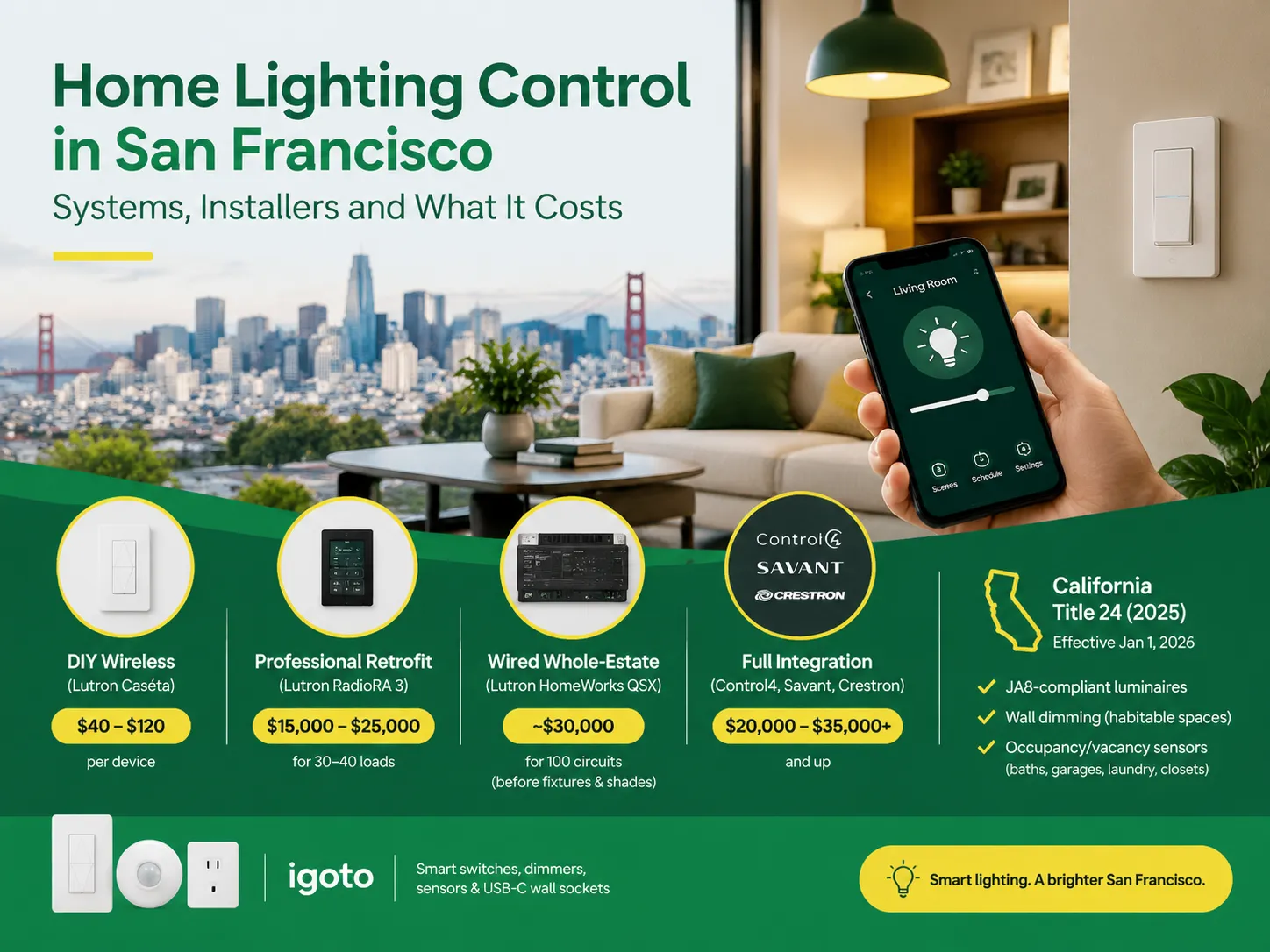
San Francisco is not the average lighting control market. The housing stock is old and dense, and the electrical code does not allow for as many electrical installations as is allowed almost anywhere else in the U.S. Most homes that want complex lighting are Victorian or Edwardian buildings where no one wants to start opening […]
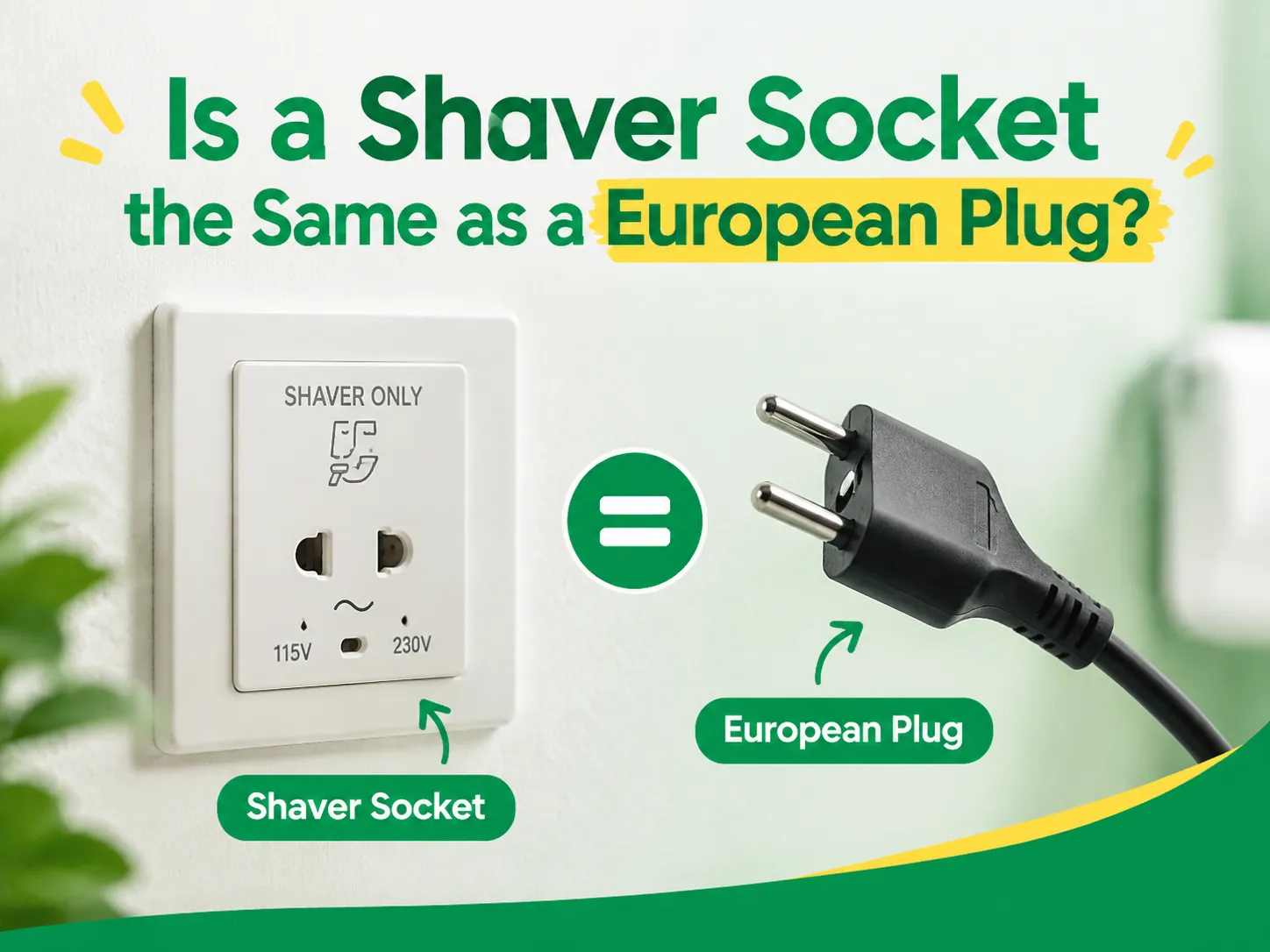
Although they seem to be alike, they both have a round shape with two pins, and they function at a voltage of 230V. This explains why some tourists use a European plug with a British shaver or wonder why a shaver cannot be plugged into a Schuko socket in a Spanish hotel. In reality, they […]

 No.6 Tuozhan Road, Leshang Pioneer Park,Yueqingwan Bay Harbor,Yueqing city,Zhejiang Province


