

When you search for the postal code 07808, you’re not expected to find anything useful. This is because this code has never been used, but it is significant for some places in New Jersey where the lack of lighting can be observed due to some old buildings standing in the area and the lack of electricity in most of the buildings located in there. By getting hold of the Main Streets, the residents of the respective area can receive a refund from the Main Streets with the help of a number of refund options available while filling out an application there. Below is the introduction to the services provided by lighting companies and their cost per hour.
The postal code 07808 can be found in Morris, Sussex, and Warren counties of New Jersey, as well as part of Hunterdon County. Presently, the postal code has not been assigned to any municipality. This postal code covers the towns of Dwhat other towns are located in this area, such as Newton, Sparta, Hackettstown, and Washington. The prices of indoor residential lighting design start from $1,500 and reach up to $6,000 depending on the size of the house. Commercial lighting design is priced from 0.08 up to 0.30 for each foot of height of the lighting fixture.
The greater part of New Jersey’s area code “078” occupies Sussex County, located to the south of New Jersey while being situated to the east of Pennsylvania and to the west of New York City; nonetheless, the Morris River is the true northern limit of the Sussex area. The majority of zip code in this region of Morris County is also included into Morris-Sussex Area Network along with some parts of Warren County being displayed as Warren, a town, and Hackettstown, a population center.Just one location of the northern New Jersey uses the “078” area code and that location is called the Hackettstown region. The Dover/Rockaway/Wharton/Denville/Randolph area is located a few miles to the south. This is the place where all businesses that use “078” area code can find their location in the Dover/Rockaway/Wharton/Denville/Randolph market and develop their business without going beyond Sussex County and Warren.Phone numbers of the area code belong to Morris-Sussex area code of 862 and 973 of Morris and Sussex counties respectively. It also belongs to Warren County 908 and for western Morris County.
Geographic factors of this region will determine the amount and type of businesses that can possibly operate in this area. High-rise buildings or multi-family construction are not permitted in this region. The existing land plots vary from half-an-acre to 10+ acres of land plots developed with construction up to 100 years old on the historic and protected streets of Morris County and numerous industrial sites located near interstates 80, US Route 46 and Route 206.
In the 078xx region, five project types account for the majority of the calls, and they don’t bear much resemblance to one another.
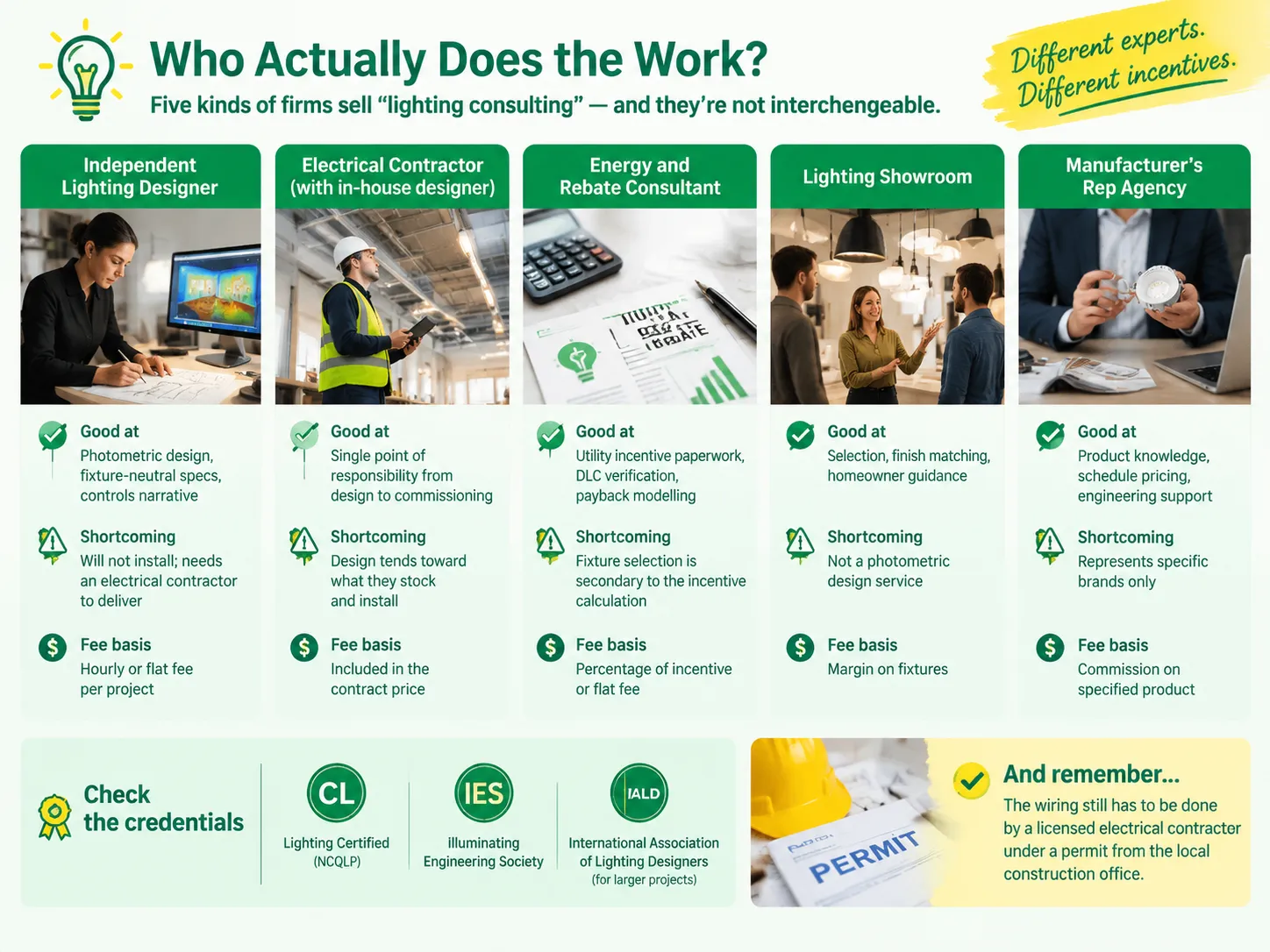
There are five types of firms in this area that offer “lighting consulting” and they are not the same. Knowing which one is being dealt with helps avoid wasting time as incentives differ significantly from each other.
| Firm type | What they are good at | Where they fall short | Typical fee basis |
|---|---|---|---|
| Independent lighting designer | Photometric design, fixture-neutral specification, controls narrative | Will not install; needs an electrical contractor to deliver | Hourly or flat fee per project |
| Electrical contractor with in-house designer | Single point of responsibility from design to commissioning | Design tends toward what they stock and install | Included in the contract price |
| Energy and rebate consultant | Utility incentive paperwork, DLC verification, payback modelling | Fixture selection is secondary to the incentive calculation | Percentage of incentive or flat fee |
| Lighting showroom | Selection, finish matching, homeowner guidance | Not a photometric design service | Margin on fixtures |
| Manufacturer’s rep agency | Product knowledge, schedule pricing, engineering support | Represents specific brands only | Commission on specified product |
The matter of credentials must be addressed directly. Since “lighting designer” is not a licensed profession in New Jersey, anyone can claim to be a lighting designer. You should be able to verify whether or not the person holds the Lighting Certified designation from the National Council on Qualifications for the Lighting Professions; whether the company is a member of the Illuminating Engineering Society; and also, if larger types of architectural projects are involved, whether the company is a member of the International Association of Lighting Designers. You can find out more from the portfolio, photometric calculations, and recommendations than just from the title.
Whichever the title, electrical wiring must be performed by a licensed electrical contractor under a permit issued by the local construction office, which is a separate legal requirement that cannot be substituted by any lighting designer.
Before you inquire about the price, ensure you obtain the list of deliverables, as only then will the price be meaningful. An engagement in this field typically yields seven items.
A site investigation including existing circuit data and pictures of each box and switch, as the depth of the existing boxes dictates which controls are realizable. A photometric simulation in AGi32, Dialux or ElumTools with the levels of footcandles and uniformity established per room instead of in a generalized fashion. A fixture schedule containing the manufacturer, catalog number, wattage, lumens, color temperature, CRI, beam angle and DLC rating. In practice the switch and socket schedule gets bolted on afterwards by somebody else, and how that supplier is selected tends to decide lead time more than price does.A description of controls that explains which elements require dimming, switching, occupancy sensing, and daylight harvesting. A lighting load calculation to be provided to the electrical contractor. Bid documents, including cut sheets. Commissioning support, as well as as-built documentation.
Two of these aspects are omitted more than others, resulting in added costs down the line. Without a verification of the DLC listing at the scheduling phase, it’s too late when the fixtures are ordered, hence rebating is irrelevant. There is a survey of existing boxes discounting the fact that no one thinks about the fact that the smart dimmer won’t fit in the box of the 1980s, which will require a rethinking of the whole switching idea on that day.
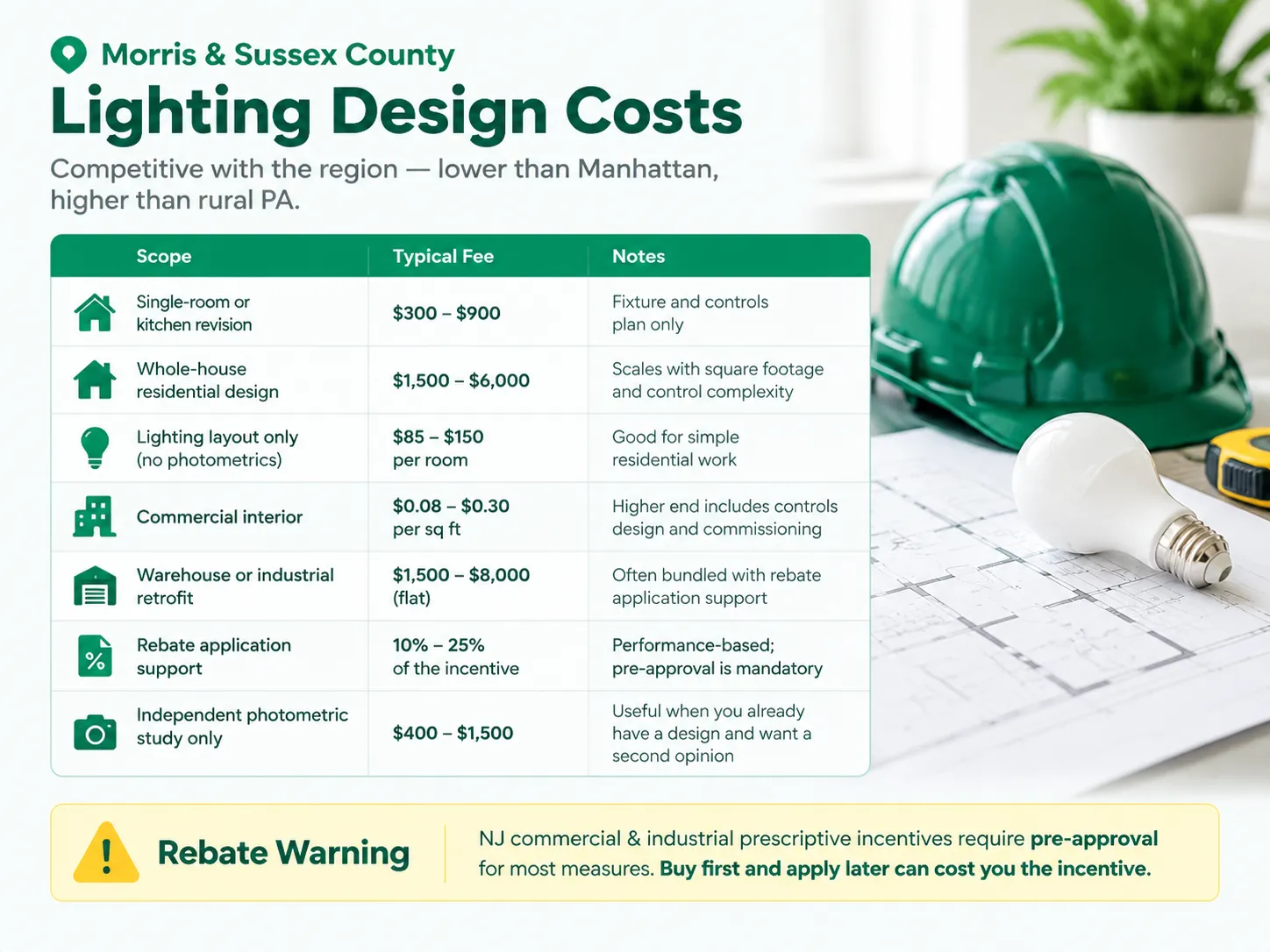
In this situation, costs can be depicted as being lower than Manhattan and higher than rural Pennsylvania, which is just what you would expect from a commuter belt with significant industrial investment. The numbers given here should be considered ranges instead of quotes.
| Scope | Typical fee | Notes |
|---|---|---|
| Single-room or kitchen revision | USD 300-900 | Usually a fixture and controls plan only |
| Whole-house residential design | USD 1,500-6,000 | Scales with square footage and control complexity |
| Lighting layout only, no photometrics | USD 85-150 per room | Fine for simple residential work |
| Commercial interior | USD 0.08-0.30 per sq ft | Higher end includes controls design and commissioning |
| Warehouse or industrial retrofit | USD 1,500-8,000 flat | Often bundled with rebate application support |
| Rebate application support | 10-25% of the incentive | Performance-based; pre-approval is mandatory for most measures |
| Independent photometric study only | USD 400-1,500 | Useful when you already have a design and want a second opinion |
The rebate program should be approached with caution. New Jersey’s primary incentives in the commercial and industrial sector are prescriptive and must receive prior approval for most measures; equipment must not be bought and installed before prior approval is granted, as the application can only be submitted within a limited time—usually 90 days from project completion—while the corresponding documentation should actually be submitted in no more than 15 days from approval. In other words, buying first and applying for the incentives later is one of the most compelling ways to not receive the rebate.
Three different regulations govern every lighting project completed in any particular corridor, and the three regulations are administered by three authorities.
From a controls standpoint, there is one aspect that keeps coming back: a fixture labelled “dimmable” can only be dimmed with a compatible control, and compatibility is a two-part issue that needs to take into account both the driver and the dimmer.Load rating matters as much as type — a device like a 400 W dimmer with an integrated switch behaves very differently behind a circuit full of LED drivers than behind the incandescent load it was originally rated for, because driver inrush current is concentrated into a few milliseconds.
There are things we can talk about with authority and things we cannot. igoto makes switches, plugs and power strips. These are wall switches, plugs, dimmers, and movable power sources regulated as per the US standards (UL 20 for switches, UL 498 for plugs, and UL 1363 for power strips). We are OEM and private label component technology suppliers and we also do not deal with light design or sell light fixtures.
That piece still matters, because it is the only part of the installation the occupant touches every day. A beautiful photometric design with a switching arrangement nobody can understand fails in practice, and the range of switch types available should be settled during design rather than at the counter on the morning of installation.There are 2 instances in designing where we keep messing up: the first is when multi-way circuits are indicated without confirming the switch types, leading to installers having to come up with solutions at the end; the second situation is dimming being indicated by the fixtures without checking if the already chosen dimmer can handle the load and manage the entire driver system. In an era that mostly witnesses renovation projects rather than construction, today we face another issue – box depth since now there exist thus switches that are deeper than the ones previously used.
Then there is a fourth, more subtle issue – the number of receptacles. In this region, kitchens and farms usually require a lot more outlets than intended, and implementing this change after construction is not exactly the wisest choice.
Properties outside Boroughs have poor electrical conditions that a suburban design pattern ignores. Well pumps are large motor loads that start hard. Standby generators are common in areas where electricity is out for days instead of hours, and generator sizing interacts with LED driver inrush in a way that surprises anyone who has only ever sized for incandescent lighting. Long wire runs from the street to the house mean more voltage drop and flickering at the end of the line.
Lighting outside of a ten-acre property makes the control issue more urgent than with a c\subdivision. Nobody wants to go through the trouble of walking to the barn just to switch the lights on, but no one wants to deal with a lot of light fixtures that run from dusk to dawn as a solution. The answer is normally the use of photocell lighting around the borders and switched circuits for lights where they will actually be used.
The amenities that come up in almost every renovation here are mundane but useful: USB charging outlets at the kitchen counter, an outlet in the mudroom for the second freezer, a switched receptacle for a seasonal exterior decoration, and a fan and light combination in bedrooms without the wiring for separate control. None of those are lighting design decisions, and all of them are decisions somebody has to make before the drywall goes up.
You should inquire their calculations software used and whether the photometric model is part of the cost as well. You should make sure who is responsible for acquiring the permit and if their proposal mentions the licensed electric contractor. You should solicit their DLC listing status for every fixture in the schedule, in a written form. Also, check what is going to happen if one of the fixtures in the schedule goes out of production after the design was completed. Ensure you ask how will the controls be documented, as a narrative does not equal a wiring diagram, and also demand two references for the already completed projects of similar size in the same county, as well as give them a call afterwards.
And one question that is even more important than the others: what would they modify if the budget was cut by a quarter? This is a great way to determine whether you have a conversation with someone who knows about priorities or is just utilizing a template working process.
While you can find it in the 078xx zone, which is very much in New Jersey, locations such as Morris, Sussex, Warren as well as some parts of Hunterdon, 07808 actually doesn’t involve any real town. In case you want to check 07808 as an area of service, you can take into account areas such as Dover, Rockaway, Wharton, Denville and Randolph along with some places located in Sussex County nearby.
An electrician is sufficient for replacing fixtures one for another. However, if you want to alter the light in a room, add controls, go for a rebate, or if you have an order for a commercial building, the designing part is not the same as the installation part. In this area of New Jersey, very often, the two jobs are done by two different professionals, and only the one who installs needs to have electrical license.
The cost of a single-room redesign typically falls between USD 300 and USD 900, while redesigning a whole house is usually between USD 1,500 and USD 6,000 depending on the size and complexity of the controls. For simpler projects, a layout-only option is available for USD 85-150 per room without photometric modelling or controls design.
At times it is best to confirm. In regard to the New Jersey Clean Energy Program, prescriptive incentives dictate that a pre-approval is needed to make most measures and the DLC materials eligible, while applications filed afterward have strict deadlines. Some members of the consulting sector include rebate documentation in design costs, while others charge percentages of the incentive, separating this service from design ones.
The measurement of the switch box and its wiring capabilities. In 1970s vintage buildings, it is likely that your wall boxes are between 35 and 40 mm deep and that no neutral has been connected in your switch loop system; this will eliminate a number of smart switches and some dimmers unless you change the box or switch to an alternative design. The difference between ensuring that the job runs smoothly and having to wait for two weeks is the fact that you should budget for the surveys of all existing box in your building during the design stage rather than waiting until you are in installation.
No. Igoto provides its customers with switches, sockets, and power strips – UL 20 switches, UL 498 socket outlet devices and UL 1363 power strips. We are an OEM and private-label manufacturer of these products. In a lighting project, we are responsible for supplying the components of the devices for the wall.
07808 is not merely the name of a city but rather a locality with a postal code of 078XX in New Jersey. Like many localities that are not referred to as cities, the area has many aspects characteristic of such localities. Such elements in 07808 consist of grungy parking lots, vintage light fixtures, Main street-style streets, farmland, urban land, nationwide businesses, as well as numerous multi-functional activities in the area. The costs of home construction in the area are between $1,500 to $6,000, while prices for building a business are around $0.08 to 0.30 per square foot. Effective planning of a project requires three essential conditions to be fulfilled, these conditions are the information about the type of existing transformer and electrical systems, knowledge about the documentation required to qualify for the rebate and knowledge of how the lights are going to operate in the area.
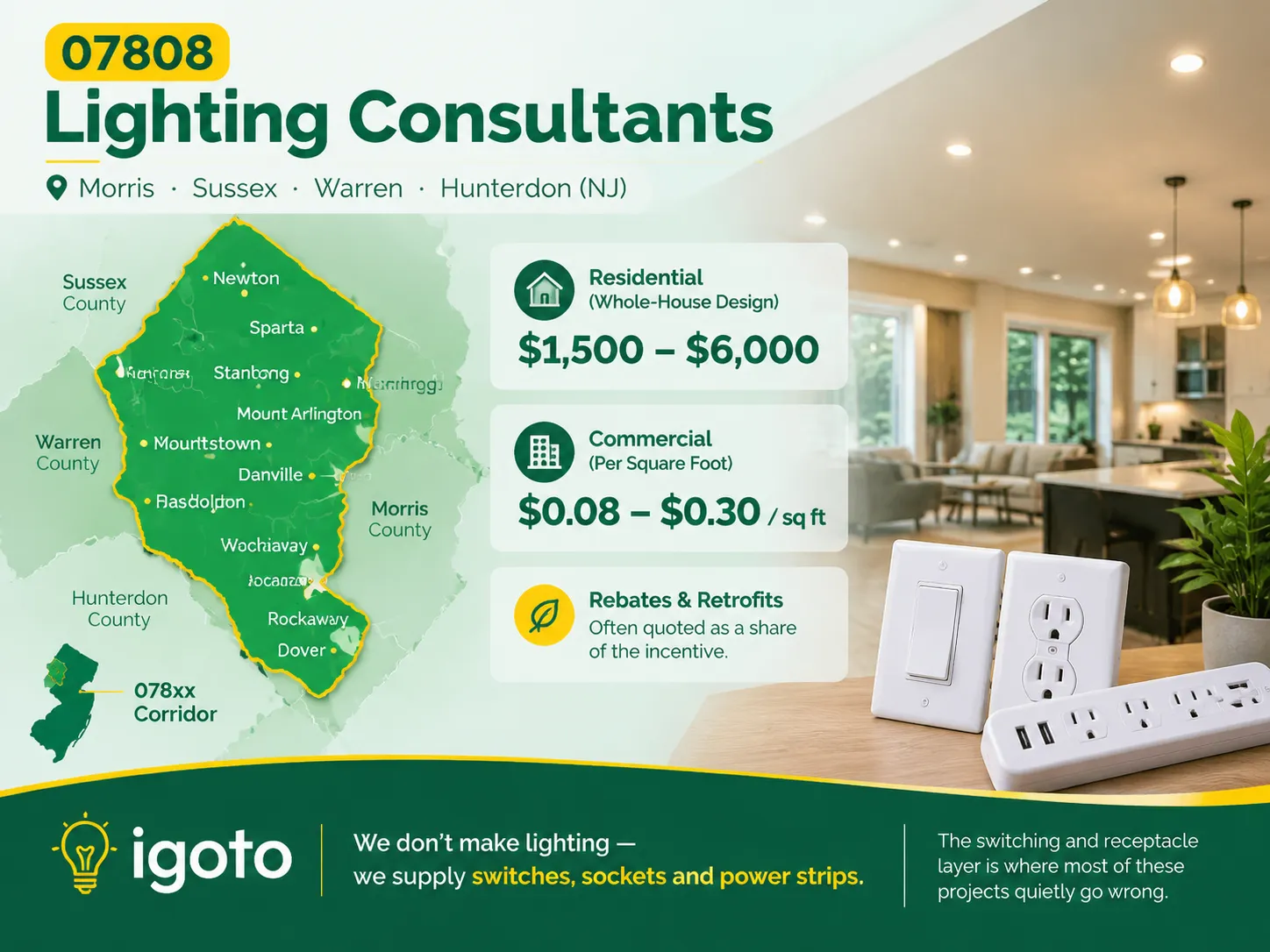
When you search for the postal code 07808, you’re not expected to find anything useful. This is because this code has never been used, but it is significant for some places in New Jersey where the lack of lighting can be observed due to some old buildings standing in the area and the lack of […]
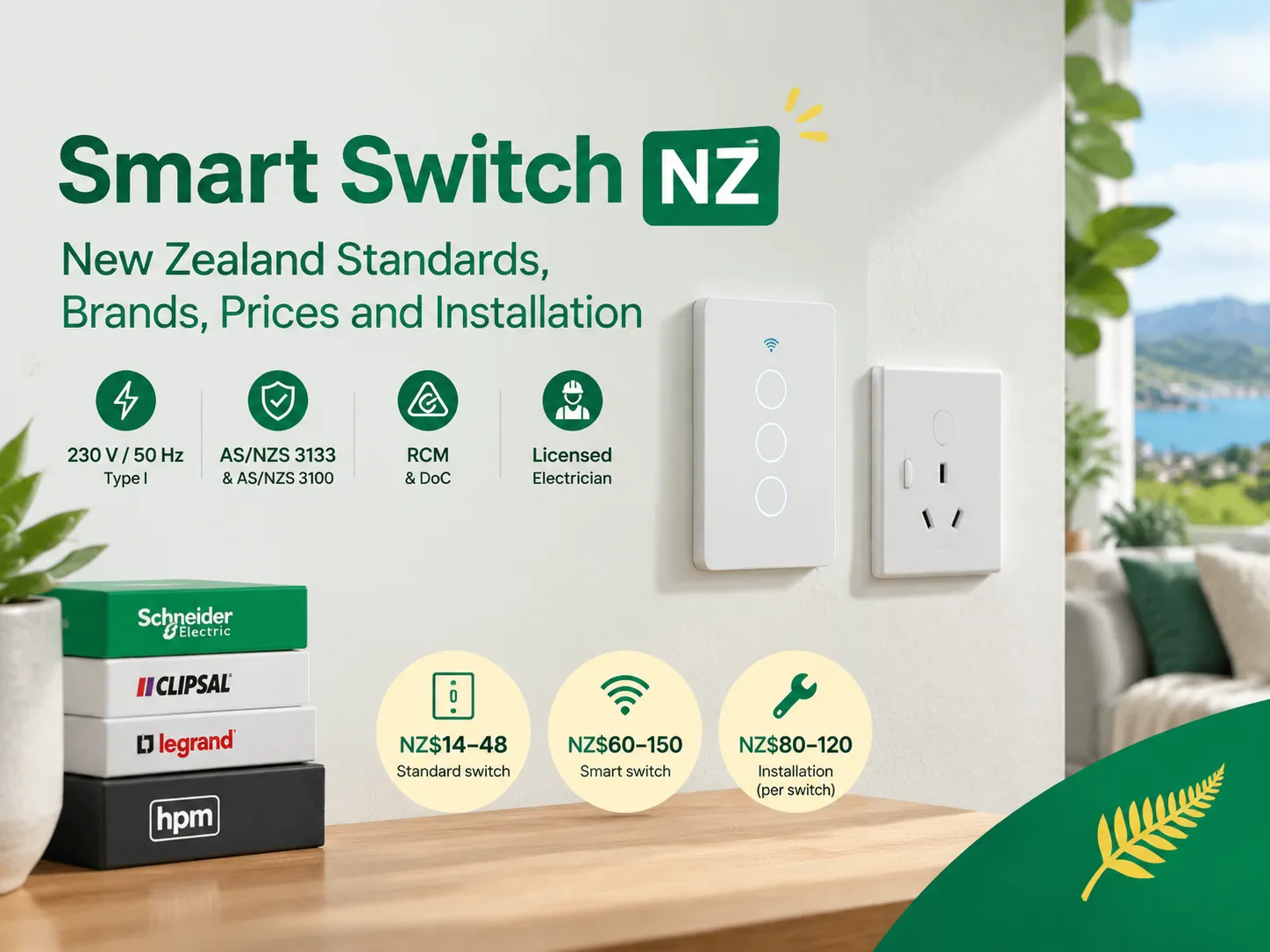
New Zealand is a small but distinct electrical market. If you are buying smart switches in New Zealand, you are dealing with a plug standard that is different from anywhere else in the world, an approval process with its own paperwork, and a wiring system that excludes half of the smart switch models available overseas. […]
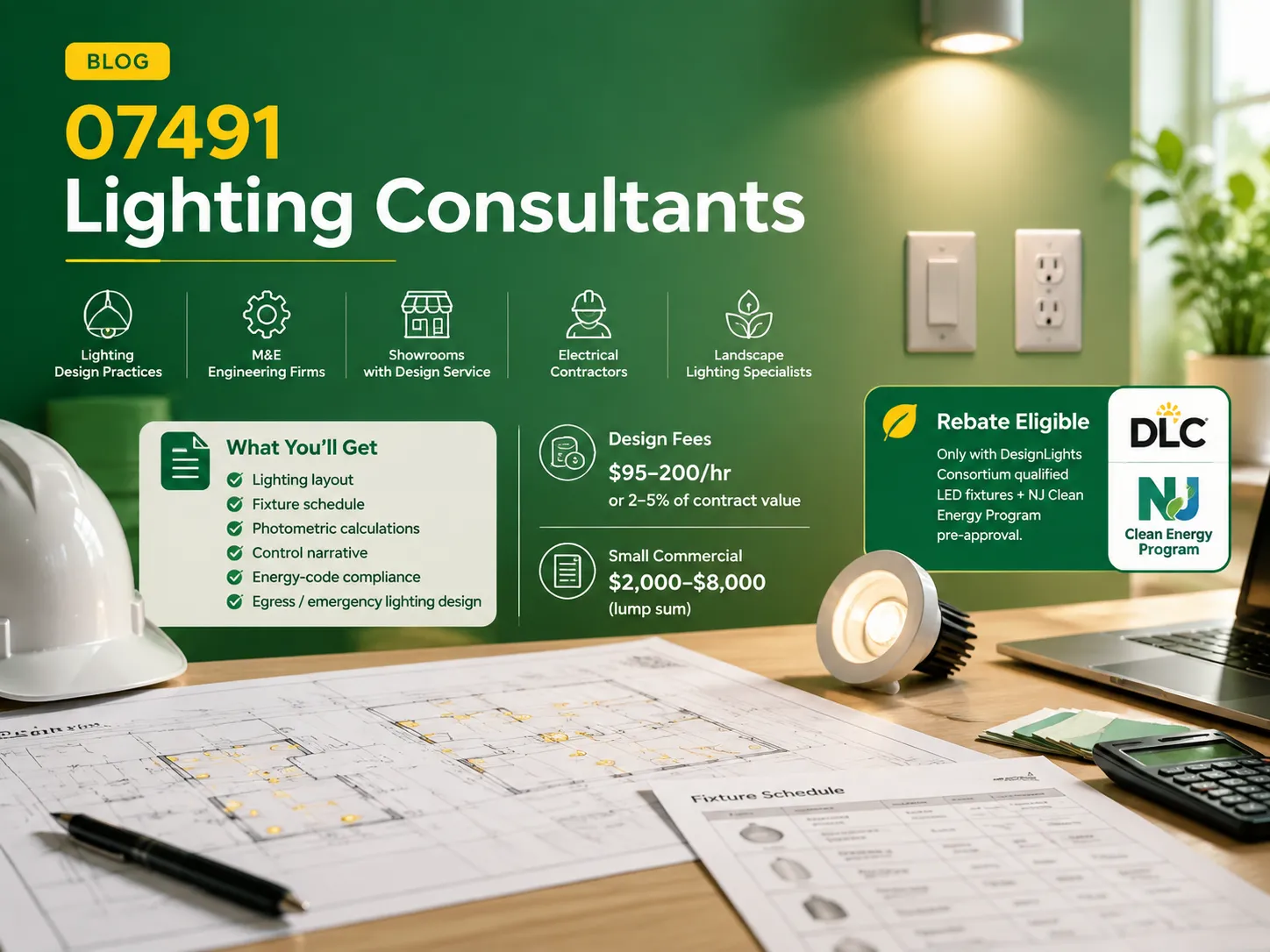
If you need assistance with lighting in the 07491 region, is essential to ask two crucial inquiries: who is operating nearby and how much is charged for the services. Concerning the first question, one can easily find the answer regarding the facts and figures because the market in northern New Jersey is not so broad. […]

 No.6 Tuozhan Road, Leshang Pioneer Park,Yueqingwan Bay Harbor,Yueqing city,Zhejiang Province


