

For North American travelers, Puerto Rico is an attractive island since it uses the same electrical outlet, voltage and frequency as the United States, making it easy to plug in your devices. However, if you purchased any of your electronics in Europe, Australia or Asia, your plug cannot fit into Puerto Rican outlets.
Quick answer: Puerto Rico uses North American Type A and Type B outlets which operate at 120 volts and 60 Hertz. Anyone traveling to Puerto Rico with North American plugs will not need an adapter, but Japanese plugs rated for 100 volts will not be able to connect into Puerto Rican outlets because the design voltage is greater than 100 volts. Anyone traveling with electrical devices from the UK, Ireland, Australia, New Zealand, India and most of Asia will need a plug adapter, and any devices rated for 230 volts will also require a voltage converter to operate in Puerto Rico. Type C and Type F plugs cannot be used interchangeably with Type A and Type B plugs, and neither can they be used interchangeably with each other in every type of outlet.
This article will elaborate on the types of plugs that are used in Puerto Rico, the voltage question, who needs a plug adapter, the confusion between plug types C & F, dual voltage appliances, quality of electricity found on the island, the fragility of the grid and its consequences for equipment selection, our product offerings, and what we recommend that travelers take with them to Puerto Rico.
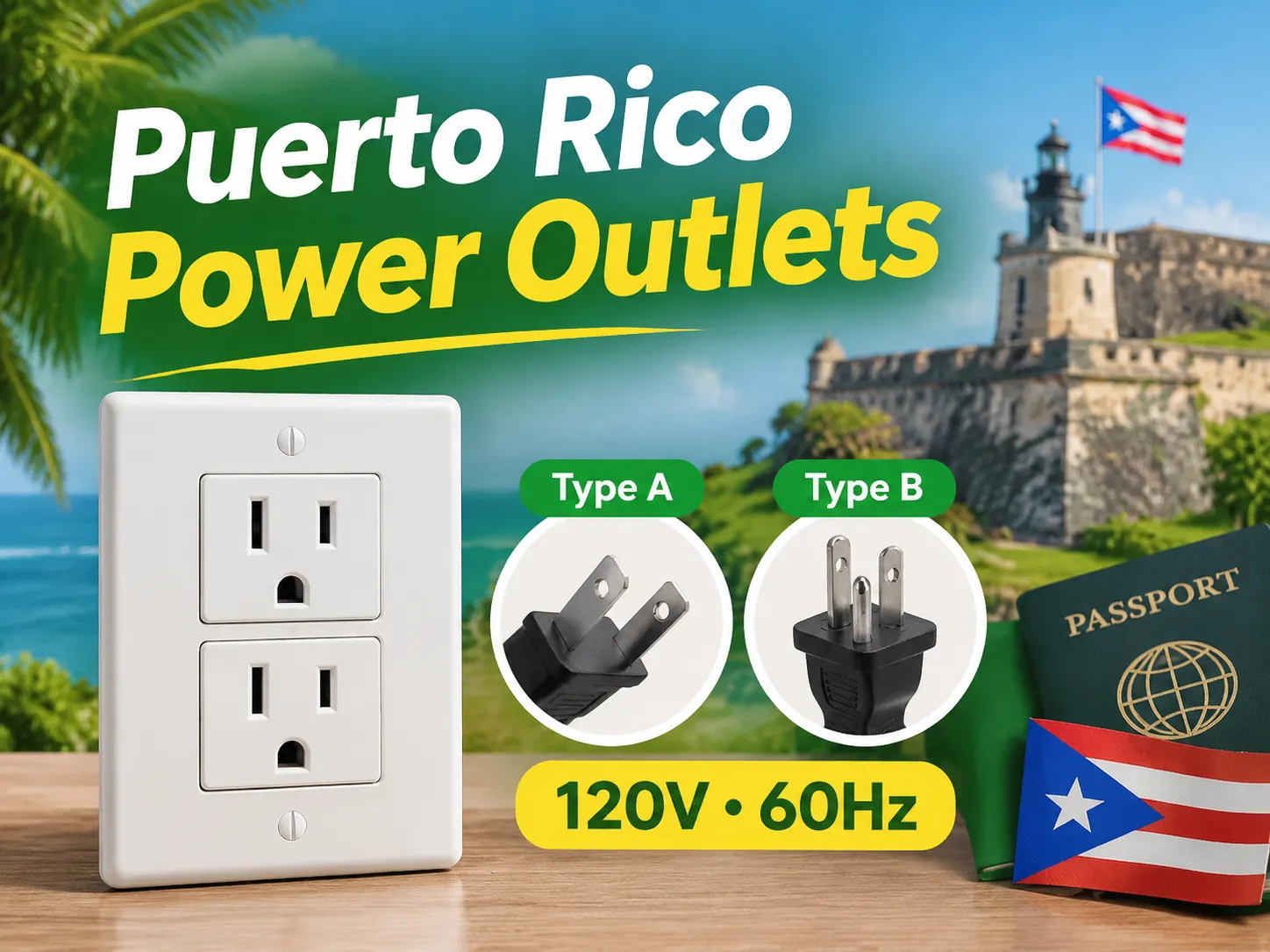
The island of Puerto Rico is a United States territory subject to the regulations of the U.S. electrical system. In Puerto Rico, all sockets are Type A with two flat parallel blades and Type B with a circular earth pin added, and operate at a voltage of 120 V and frequency of 60 Hz, just like they do on mainland USA. All plug types fit into these same sockets, which makes determining what type of travel adapter to use when traveling to Puerto Rico based on your country of origin rather than based on any unique feature of Puerto Rico. For instance, if you are traveling from the USA to Puerto Rico, your plug will fit without issue, while your plug will not fit if you were traveling from the UK or Europe. Puerto Rico also has no local variant of plug types and no mixed standard left over from its colonial period, which is not true of many other Caribbean islands.
Many hotels and newer buildings will also provide a universal socket for use with various plug types, and some will add USB sockets, but travelers should not rely on them as they are not a standard.
Sockets classified as Type A will have two flat blades spaced approximately 12 mm apart. They are ungrounded and the original socket style. Type A sockets are still commonly found in many old buildings and on lighting and small appliances. Because Type A sockets lack a grounding pin, devices using them should not require a ground. All new installations as per current electrical codes now use grounded sockets (i.e., Type B) as a standard.
Type B sockets include a round grounding pin centred below the two flat blades that connect to the socket. In the USA and North America, Type B is always used in residential and business construction. Type B sockets will accommodate both Type A and Type B plugs, which is why most people do not realise they are using different forms of plug.
The ground or earth pin provides complete safety of appliances or devices that have metal housing; thus, in addition to the appearance of appliances, the neutral pin’s position must be considered to ensure proper grounding.
The 15 A socket type has a 15 A and a 20 A option. The 20 A socket accepts the 15 A plug and has the same configuration as the 15 A but adds a T-shaped position for the neutral pin, which is important when specifying equipment rather than travelling. If you purchase a 20 A appliance, it will not fit into a 15 A socket, and the complete North American socket description includes geometric interchangeability and ratings.
The electrical supply to all of central North America is single-phase 120 volts at 60 Hz. For larger appliances like stoves and dryers, there is also a two-pole circuit that supplies 240 volts. This type of supply is exactly the same as that of the continental United States, which means you can buy appliances from the continental U.S. and plug them into your sockets without making modifications.
There are two sets of devices that require attention: The first group consists of Japanese appliances that are rated for 100 volts and will operate on 120 volts; in most cases, switch-mode power supplies accommodate 120 volts. In contrast, 100-volt motors and heating elements will overheat when operated on 120 volts and may fail prematurely. The second group consists of European appliances rated for 230 volts; although plug adapters are available, these adapters do not change the voltage to that of 120 volts and therefore do not permit the European appliance to operate on 120 volts.
Frequency may be overlooked, but it is equally important as voltage. A 50-Hz appliance such as a synchronous motor, clock or timer will run approximately 20 percent faster on a 60-Hz supply.
An electronic appliance with a switchmode power supply is indifferent as to how the electricity is supplied to it. This is why both laptop and telephone chargers can be used on power sources supplied by 50Hz, while 50Hz fans and mechanical timers cannot.
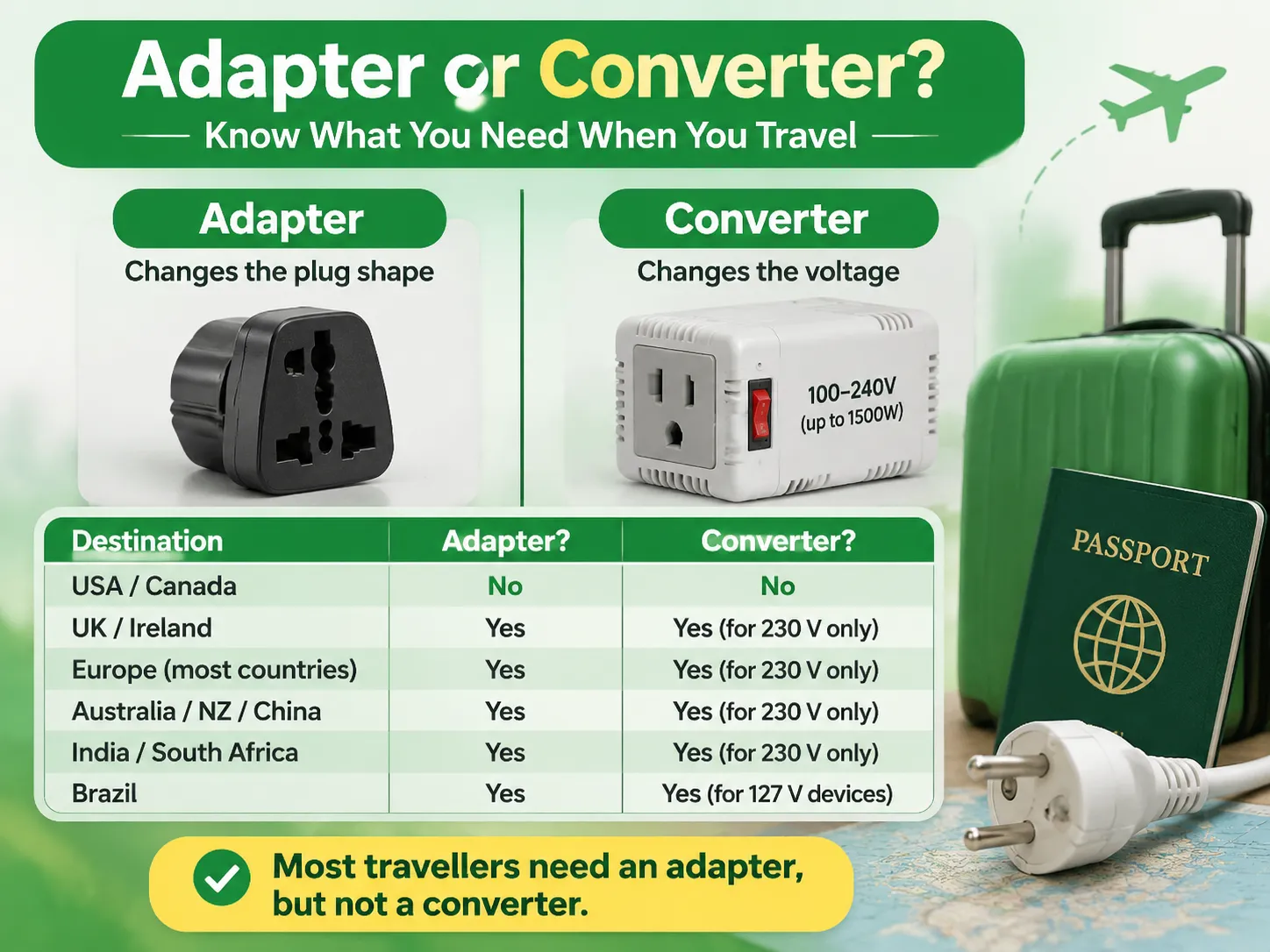
The information in the table below provides an instant answer to the question above. An adapter is used to convert the shape of the plug, while a converter is used to convert the voltage of the electrical supply. Most travellers require an adapter, but do not require a converter.
| Coming from | Plug | Adapter | Voltage converter |
|---|---|---|---|
| USA / Canada | A, B | No | No |
| Japan | A, B | No | Usually no, check label |
| Mexico / Central America | A, B | No | No |
| United Kingdom / Ireland | G | Yes | Yes for 230 V only |
| Europe (most countries) | C, E, F | Yes | Yes for 230 V only |
| Australia / New Zealand / China | I | Yes | Yes for 230 V only |
| India / South Africa | D, M | Yes | Yes for 230 V only |
| Brazil | N | Yes | Yes for 127 V devices, no for 220 V |
The row for Brazil is the most curious as the country uses two different voltages (127V and 220V) and has a Type N plug. Therefore, an individual travelling from Brazil could have devices that work with one voltage, but not the other. A comparison of all plug and socket standards by region provides the quickest method of answering this question. If you’re in another country, the most common assumption is that having a plug adapter and plugging in a device labelled 100 to 240 volts will work; and for devices labelled 230 volts, you also need a converter. The reason for the converter’s size and expense is because you are limited to 1,500 watts; so if you need to use a hair dryer in a foreign country, you will need to locate a converter that has the appropriate wattage rating, which is different from the small travel converters sold at most airports.
Type C refers to the Europlug, which consists of two pins with 4 mm pin diameters and a spacing of 19 mm between the pins, while it has a non-tapered (flat) body. The Schuko type F plug is made of 4.8 mm diameter pins and is generally round and has clips on the sides for the earth connection. Both types of plugs are related but have differences that determine compatibility with certain types of sockets.
A Type C plug will fit into Type F, Type E and Type L sockets as the pins on the Type C plug are thin enough and the spacing of the two pin holes on all three sockets are the same. However, a Type F plug will not fit into a Type C socket due to the fact that Type C sockets are not found on wall outlets in most countries (Type C is designed to fit into sockets created for larger sized plugs).
Neither Type C nor Type F plugs will fit a socket in Puerto Rico (NEMA 5-15) that has flat blades, and regardless of the attempts to bend the pins of either Type C or Type F plug into flat blades, they cannot convert 4 mm round pins into flat blades.
This is why an adapter is needed by European travellers, and a universal adaptor purchased in Europe prior to leaving is a good idea to prevent potential confusion regarding plug types.
When considering the installation of electrical sockets and switches for a project rather than a person, you will need to decide which family of electrical sockets and switches will be specified for the project. This will vary depending on the family of sockets and switches we supply. Therefore, a project in San Juan or a project in Madrid has identical specifications in one catalogue for each city.
The label on the power supply is the only definitive answer to the question of voltage. The device label that reads 100 to 240 V is a “dual voltage” device. It is compatible with both voltage systems and both plug types. Therefore, the device can be used in any country when equipped with the correct plug adapter. Examples of items typically categorized as dual voltage devices include laptops, phone chargers, camera chargers, electric shavers and a variety of personal electronics.
If a device is labeled as 120 V, it may be operated in a 230 V country, but only with a voltage converter. It may be operated normally in Puerto Rico. A 230 V device may operate in Puerto Rico with a converter, but the converter must contain an appropriate rating for the wattage of the motor as it will draw numerous times its running current at start-up.
Products and devices that are classified as “Single Voltage Only” and that tend to be less expensive when purchased locally are generally the following: hair dryers, curling irons, and electric kettles. These three examples of single voltage devices are typically high wattages and, unless otherwise noted in the packaging, are not dual voltage devices.
The voltage supplied to Island-dwelling residents is the same nominally as the mainland’s but the Power Quality differs markedly.
For a long time Puerto Rico has had numerous power quality (frequency/voltage excursions, brownouts & outages) as well as many instances where equipment that may survive well in Ohio fail quickly at buildings that rely on an unreliable voltage source.
When contemplating using valuable equipment on the island, three considerations should be made:
Overall, the risk pattern of the installation is significantly different than that of installations found in the continental U.S. An example of this would be that voltage sags occur more frequently on the island compared to voltage spikes and that voltage sagging can put more stress on a motor than voltage spikes can put on a power supply. The refrigeration compressor at the installation will fail more frequently than the same type of compressor operating in a temperate zone, therefore, it is essential that voltage protection is a required specification to be included with the refrigerator compressor’s purchase order rather than an option for consideration.
The island’s electrical grid system is small, isolated and old. Together, these characteristics make it an extremely fragile electrical system. Therefore, if a power generating unit fails on the island, there is no longer a source of electricity to draw electricity from a neighbouring community until a neighbouring community’s electric generating unit can recover from tripping.Additionally, Puerto Rico’s transmission system experiences the additional danger of being highly susceptible to damage from hurricanes.Finally, many of the electric generating facilities are operated with equipment that has exceeded its manufacturer’s expected life cycle.
The Distribution Network was virtually destroyed by Hurricane Maria in 2017, and the Distribution Network suffered another complete loss across the island due to Hurricane Fiona in 2022, with widespread outages still occurring throughout the system since then.
Operational Methodology has also changed. In 2021, the Transmission and Distribution sectors were transferred to a private, contracted operator, while Generation remains with the government-owned utility. This split causes confusion about whose responsibility it is for an outage because it may not always be clear to customers who is responsible.
As such, building owners must manage their relationship with the utility instead of assuming the utility provides services.
From an Equipment Specification perspective, there are three key points to remember:
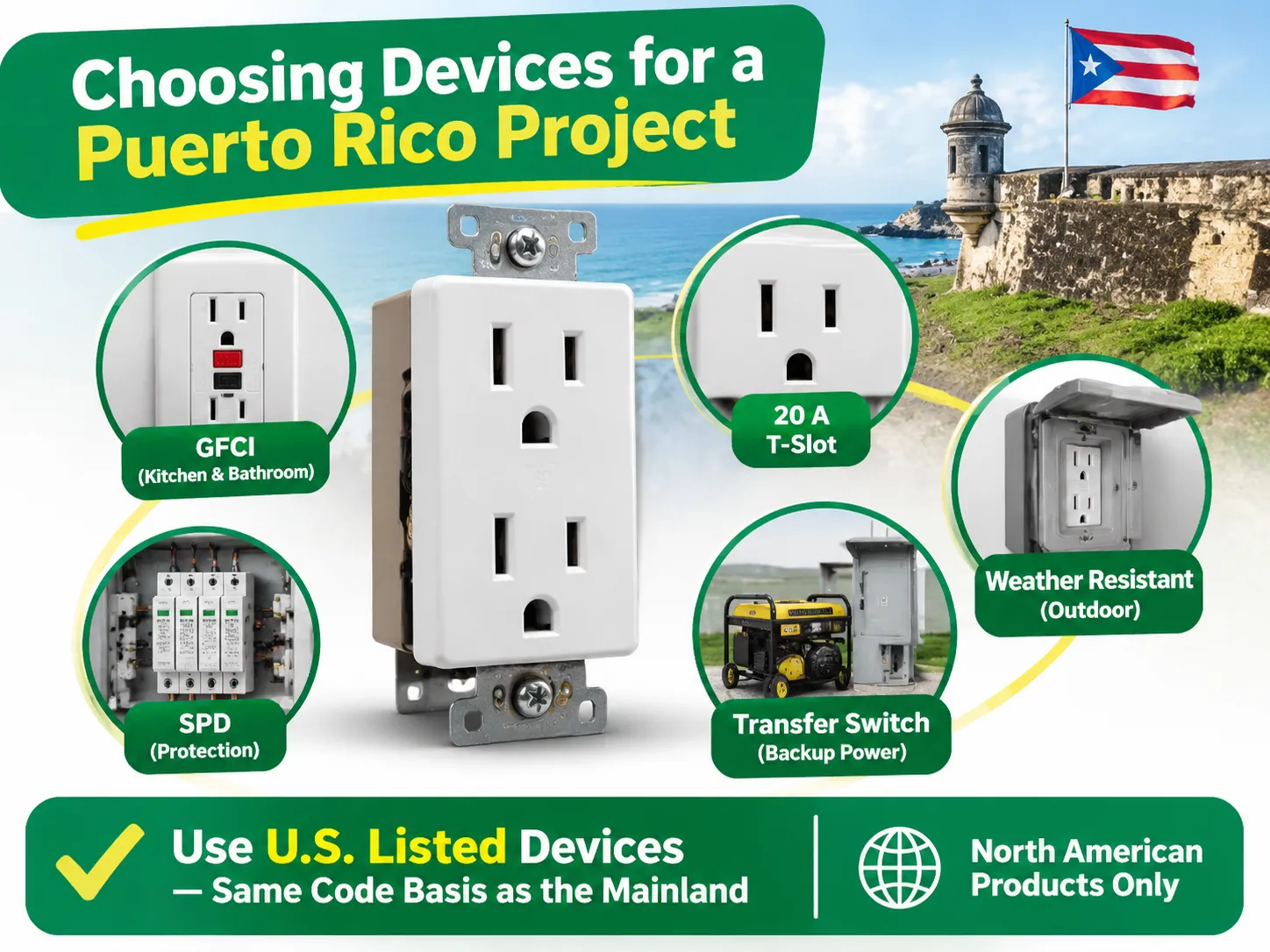
When you select the Devices you are going to use for your project in Puerto Rico, think in terms of products you are going to purchase, and location where you will purchase them from. The following Table contains an example of how you can structure this data.
| Situation | Devices | Consideration |
|---|---|---|
| Residential new construction | NEMA 5-15R duplex, tamper resistant | Uses the equivalent code basis as the mainland; UL listings anticipated |
| Kitchen and bathroom | GFCI receptacles or GFCI breakers | Must be installed in the locations required on the mainland |
| Commercial fit-out | 20 A receptacles, T-slot | Accepts both 15 A and 20 A plugs |
| Hotel renovations | NEMA outlets plus USB modules | Guests arriving with dual voltage electronic devices |
| Outdoor or coastal | Weather resistant, IP rated covers | Salt air and driving rain |
| Backup power | Transfer switch and generator inlet | Interlocked, not a suicide cord |
| Equipment protection | SPD at the panel and at points of use | Lightning and switching transients |
The row concerning the Equivalent Code Base when comparing Puerto Rico to the Mainland is the most straightforward and should be applied to every project. A device that is listed for the United States is accepted in Puerto Rico while European devices will not, thus simplifying the sourcing of products from only the North American product catalogue. This is the same direction used in most Caribbean islands, where the installations can follow either a European or British style. If you were to compare the USA and Panama regarding outlets, you would find that Panama uses the same flat-blade style of socket as Puerto Rico, but its installation practice and import routes are entirely different.
Because we produce both the North American and European family of switches and outlets, a distributor who serves Puerto Rico and the Caribbean can build one complete product line using US configurations for all the islands, and a separate line using European configurations for the French and Dutch territories.
For Puerto Rico, the American format switch and socket range is applicable. This includes the NEMA configurations as well as the plate systems associated with them.
The most important piece of information for this market is the listing, and not the price. When a product is offered in Puerto Rico, it must have a UL Listing for the configuration; therefore, if a distributor is unable to provide a UL Listing for the configuration, he or she will be selling into a market that will reject the product when it is inspected. We provide the test documentation with our product offerings, and our plate systems are manufactured to correspond with the boxes that are currently on the island.
Where we provide no answer is for a project that requires a proprietary building automation system, as this will be a sale of a system and not a sale of a device. Where there is a need for a NEMA duplex, GFCI, USB module or a plate with an existing installation, this is where we focus our attention.
For a traveller, the list is relatively short; you should consider carrying the following items: if you are travelling from outside of North America, you should carry a universal adapter; you should check every power supply label for the 100 to 240 V range; carry a small surge strip, since hotel rooms seldom have adequate outlets and the power is not adequate; and you should decide to purchase a hair dryer or kettle locally and not convert one. For someone who will be staying for a longer period of time or renting a property, two products are recommended for purchase on the island.
A surge protector with the right clamping voltage, as well as a small UPS for your router and desktop computer is essential. Any momentary loss in electrical service of 1 second can cause corruption of a file and reset all the clocks in your entire home.
What is not acceptable to purchase locally is a low-priced universal adapter purchased at a souvenir shop. These universal adapters typically have no UL certification, overheat due to excessive current draw, and cause numerous incidents in hotel rooms due to their unregulated nature.
Yes, Type A and Type B outlets are used in Puerto Rico, at 120V and 60Hz. All outlets follow the same configuration and voltages as seen throughout the mainland US. Therefore, devices using standard US plugs will work without any additional adapters and devices approved for the US will work in Puerto Rico.
Yes, but only one way. The Type C Europlug fits into the Type F Schuko outlet, as both the thickness of the pins and the distance between them agree. However, a Type F plug will not fit into a Type C outlet nor will a Type C plug fit into the Flat Blade NEMA receptacle used in Puerto Rico. Therefore, a European traveler should take an adapter with him/her.
With Hurricane Maria’s destruction of a significant portion of the distribution system in 2017, the loss of power island-wide caused by Hurricane Fiona in 2022 and ongoing widespread departure from the grid since then, an island’s grid is incapable of supplying power when one unit trips or when the grid system is subjected to hurricane conditions. The transmission and distribution systems were sold to a private operator in 2021, while generation remains under the control of the local public utility.
Puerto Rico uses the standard North American plug configurations — Type A (which has two flat blades) and Type B (which has two flat blades plus a round grounding pin). The most common receptacle used in Puerto Rico is a Type B with 15 A at 125 V rating. The 20 A version of the Type B includes a T-shaped neutral slot. The electricity that is supplied throughout Puerto Rico is at 120 V and 60 Hz.
Voltage converters are required for 230 V single voltage devices; all devices marked between 100 to 240 V can be used in Puerto Rico requiring nothing other than a plug adapter. Any device that operates on only 230 V will require a converter equal to or greater than the device’s rated wattage; for high wattage appliances (such as a hair dryer or kettle), the replacement costs may be cheaper than a conversion.
All general circuits in Puerto Rico operate on 120 V at 60 Hz; higher voltage (240 V) for larger appliances can be obtained through two-pole circuits. The North American voltage standard (for general use, appliances) has been established in Puerto Rico therefore Europe appliances will not function correctly even if you use an adapter.
Puerto Rico is a North American electrical market within the Caribbean region, therefore all devices that plug into Type A and Type B outlets will work on 120 V at 60 Hz and all appliances approved by US standards. For all travelers from the mainland will not require any type of converter, however, travelers from Europe or Australia will require a plug adapter and, if using higher wattage appliances will need to purchase a converter as well.
While many people think the electrical sockets in Puerto Rico are the most surprising part of their visit to Puerto Rico, the fact that the generation and distribution grid has failed more than once island-wide in the last decade is a good reason to carry a surge strip and a battery backup for important devices.
For North American travelers, Puerto Rico is an attractive island since it uses the same electrical outlet, voltage and frequency as the United States, making it easy to plug in your devices. However, if you purchased any of your electronics in Europe, Australia or Asia, your plug cannot fit into Puerto Rican outlets. Quick answer: […]
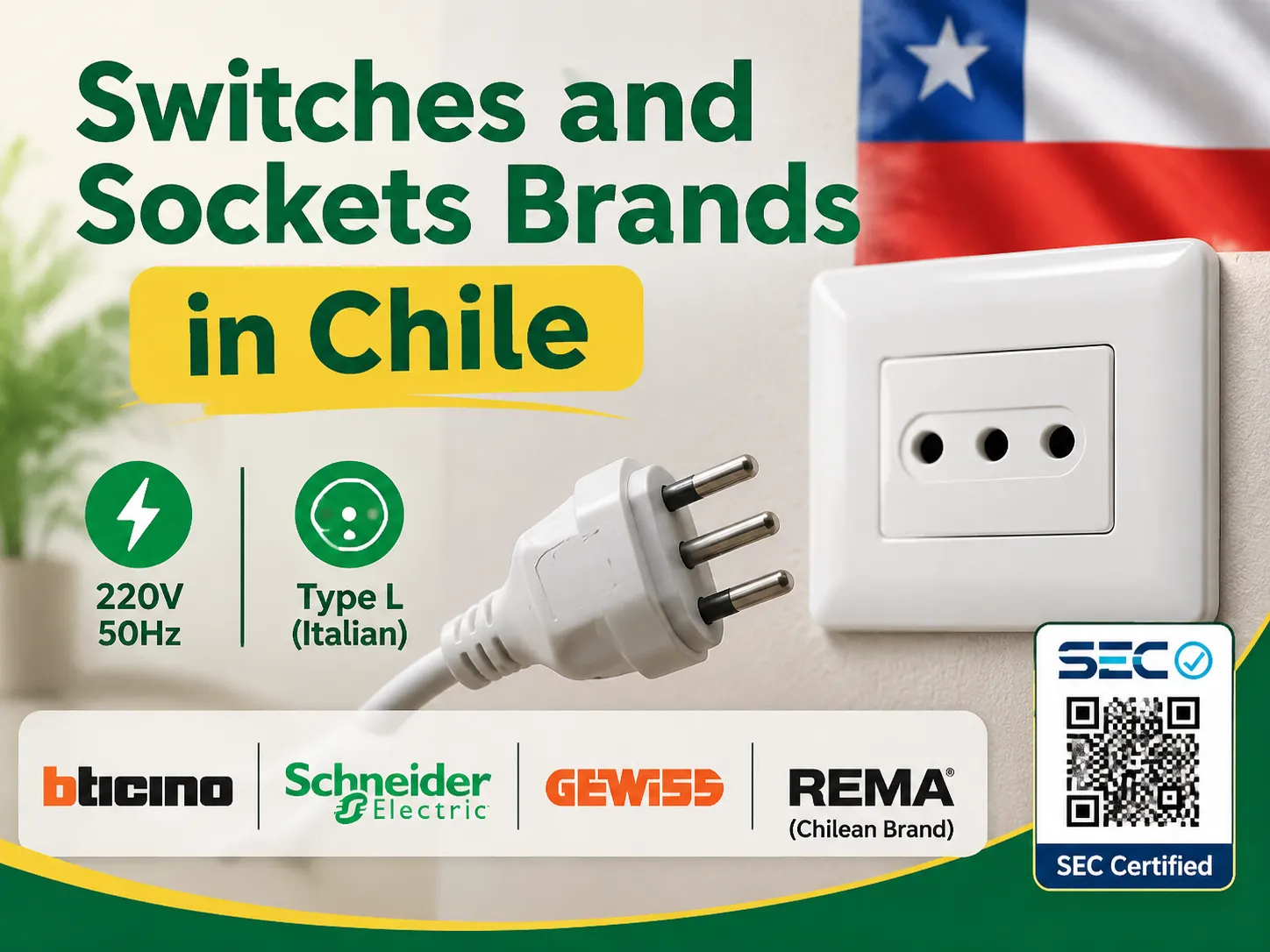
Chile is the easiest country in South America to choose wiring equipment for, but it is also one of the most difficult to get into because of this. All electrical plugs conform to a single type that is referred to as the “Type L” or “Italian CEI 23-50” plug. The only certification for electrical equipment […]
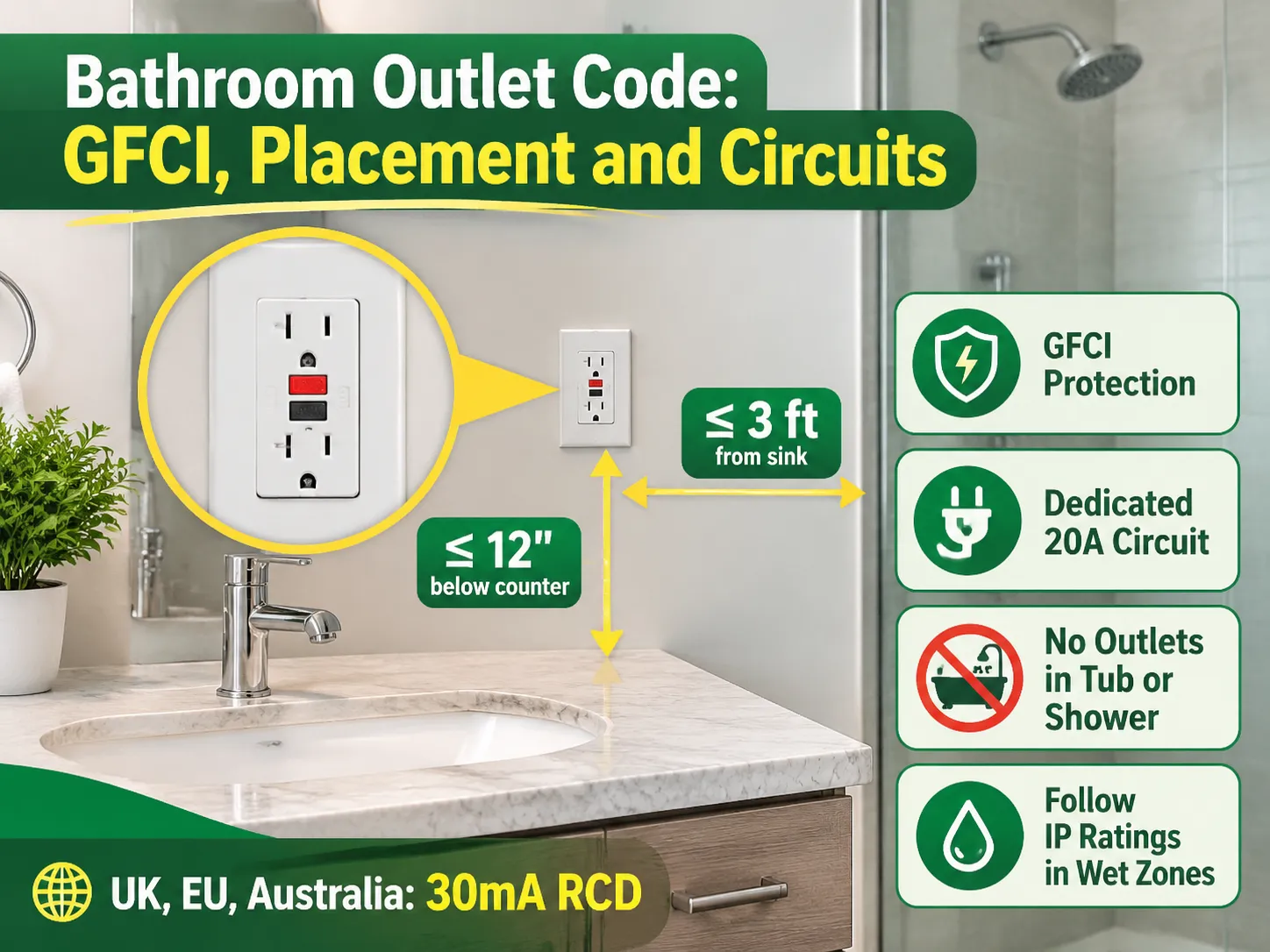
Each of these rules is reviewed in more detail below. The geometry of receptacle placement, the dedicated branch circuit requirement, receptacle types that meet the code, 15A and 20A questions, differences among countries with regard to the rules, installation details that do not pass inspection, what to consider when buying a product, lighting and fan […]

 No.6 Tuozhan Road, Leshang Pioneer Park,Yueqingwan Bay Harbor,Yueqing city,Zhejiang Province


