

When searching for “07498 lighting consultants”, one usually starts with a specific address, that provides approximate routes. In this case, “07498 indicating a location” means that it is a place close to New York border, while the user needs to get the name of some nearby company or agency in order to compare prices. The next section contains answers to three basic questions and a proper analysis of geographical issues and prices.
The first point that must be elaborated is the misconception that could change our answer list. To clarify, in the state of New Jersey, the contractor who carries out the installation chooses the actual lighting fixtures, while the showrooms or designers only approve the choice made by the expert, which is important for the customer to know.
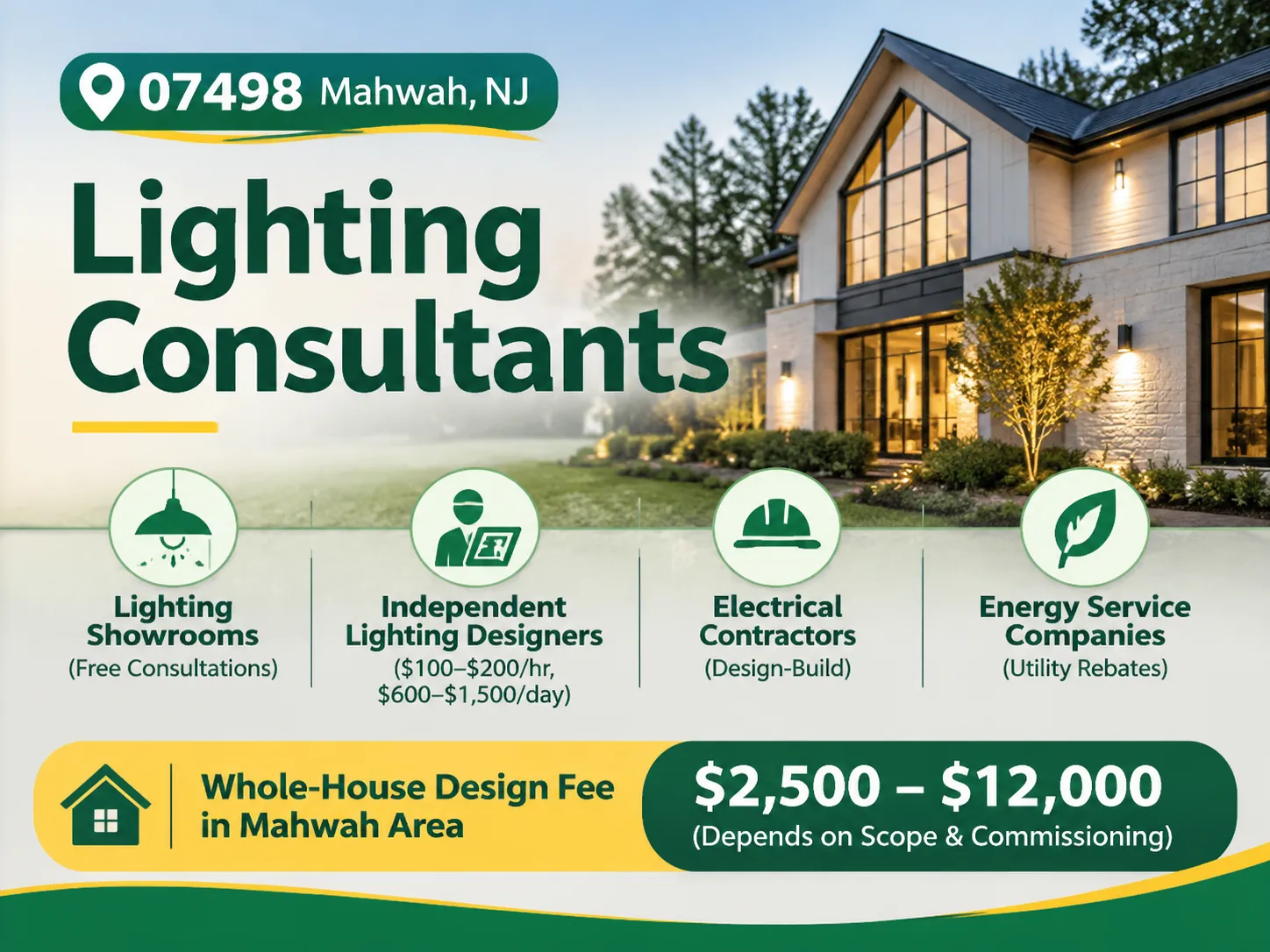
07498 is a ZIP code which belongs to Mahwah, a city in the county of Bergen, New Jersey, situated on the border of New York state. Mahwah can also be reached using 07430 and 07495, but, again, it only refers to a small area and does not cover the entire town of Mahwah. There exist four types of service providers that work in the lighting industry in this area; namely, those lighting companies that provide design services, independent lighting designers, electrical contractors, and energy service companies offering utility rebates. Lighting companies offer consultations for free while independent lighting designers charge between $100-$200 per hour and $600-$1,500 on a daily basis. In case a contractor also provides the design while doing the installation job, the total cost of the project may amount to $2,500-$12,000 depending on the city in which the house is located, including Mahwah, Ramsey, Wyckoff, and Saddle River.
The group of ZIP codes in the 074xx area belongs to the popular region of northern Bergen County, and this series of codes includes some towns, including 07401 Allendale, 07417 Franklin Lakes, 07430 Mahwah, 07436 Oakland, 07446 Ramsey, 07450 Ridgewood, 07452 Glen Rock, 07458 Saddle River, 07463 Waldwick, and 07481 Wyckoff. The town of Mahwah has three ZIP codes, with 07430 assigned to the main delivery area of the county while 07495 and 07498 cover narrow assignments. Therefore, it is very much possible to see 07498 intermingling with various searches, without being associated with any specific town.
This means that if the business operates under the ZIP code of 07498, then it is certainly located in either the Mahwah area or its nearest surroundings. The natural radius of the service goes along Route 17 south-east through Ramsey and Paramus, with further travel northward to Saddle River and Upper Saddle River, and crosses the border into Suffern and Airmont. The importance of the radius of operation is great due to the nature of lighting work, as the fact of being in proximity affects the consultant’s ability to make periods of attendance for a particular client.
Last but not least, it is important to note that ZIP code searches do not return which consultants are what because designers that work in this area do not market themselves by using a ZIP code in their documentation.The same question applied to a 07984 search runs into the opposite problem, where the number is not a postcode at all. Here the number is real; the difficulty is that almost nobody advertises against it.
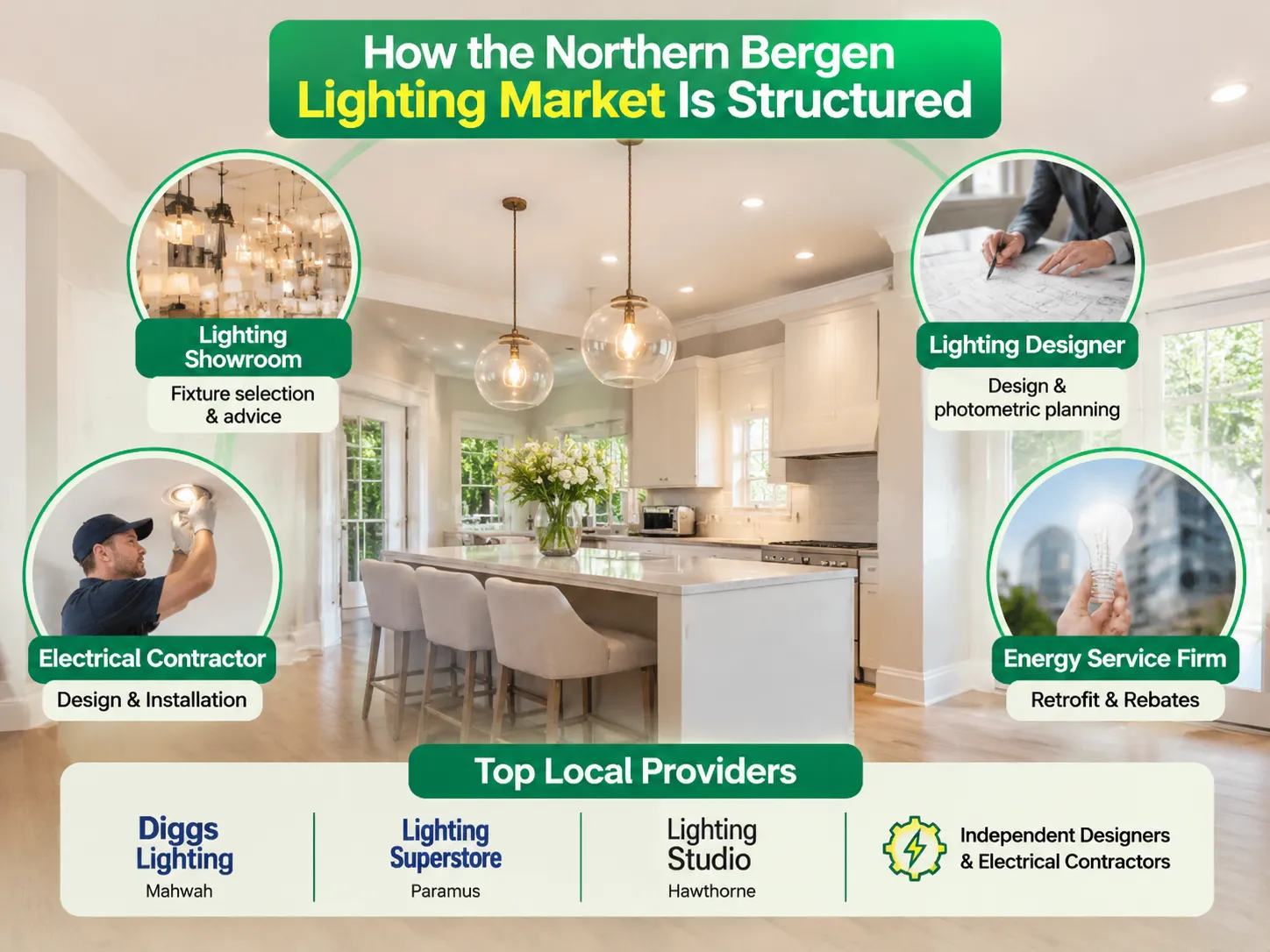
Four provider types do the work in this corridor, and they overlap enough that buyers frequently hire the wrong one and discover it at the first site meeting.
| Provider type | What they do | What they charge | Best fit |
|---|---|---|---|
| Lighting showroom with design staff | Fixture selection, layout advice, supplier coordination, delivery | Free consultation, margin on product | Renovations where fixtures are the decision |
| Independent lighting designer | Concept, photometric calculations, specification, site supervision | $100 to $200 per hour, or project fee | New build, high-end residential, hospitality |
| Electrical contractor, design and build | Layout, circuitry, installation, inspection | Included in the electrical contract | Smaller projects, single-room work, fast schedules |
| Energy service company or lighting retrofit firm | Audit, retrofit design, utility rebate paperwork, installation | Per-fixture pricing, rebate-backed | Commercial, warehouse, parking, multi-family |
The difference that attracts the attention of homeowners is that between the first and the second one. A showroom will assist you in selecting items and will do its job well, but they are not engaged in photometric design, meaning that they won’t calculate the amount of light at the place of work, and won’t take into consideration how downlight, wall washing and daylight work in their interaction. For those who are doing kitchen renovations, this would not be an important factor. However while designing a house with double-height space, stairwell and a joinery wall, it makes all the difference and that is why those who once realized the difference usually hire a designer the second time.
As for the commercial perspective, the structure is completely different. In the case of a warehouse or a car-park it becomes a problem of calculations and usually the service provider of this kind is a retrofit company that works on a utility program with approved product list. The guide to choosing an electrical switch and socket manufacturer is the relevant reference for the hardware side of that work, because the plate and device specification is where retrofit projects quietly go wrong.
The following are businesses that are recognized in this region, along with a brief outline of their respective functionalities.
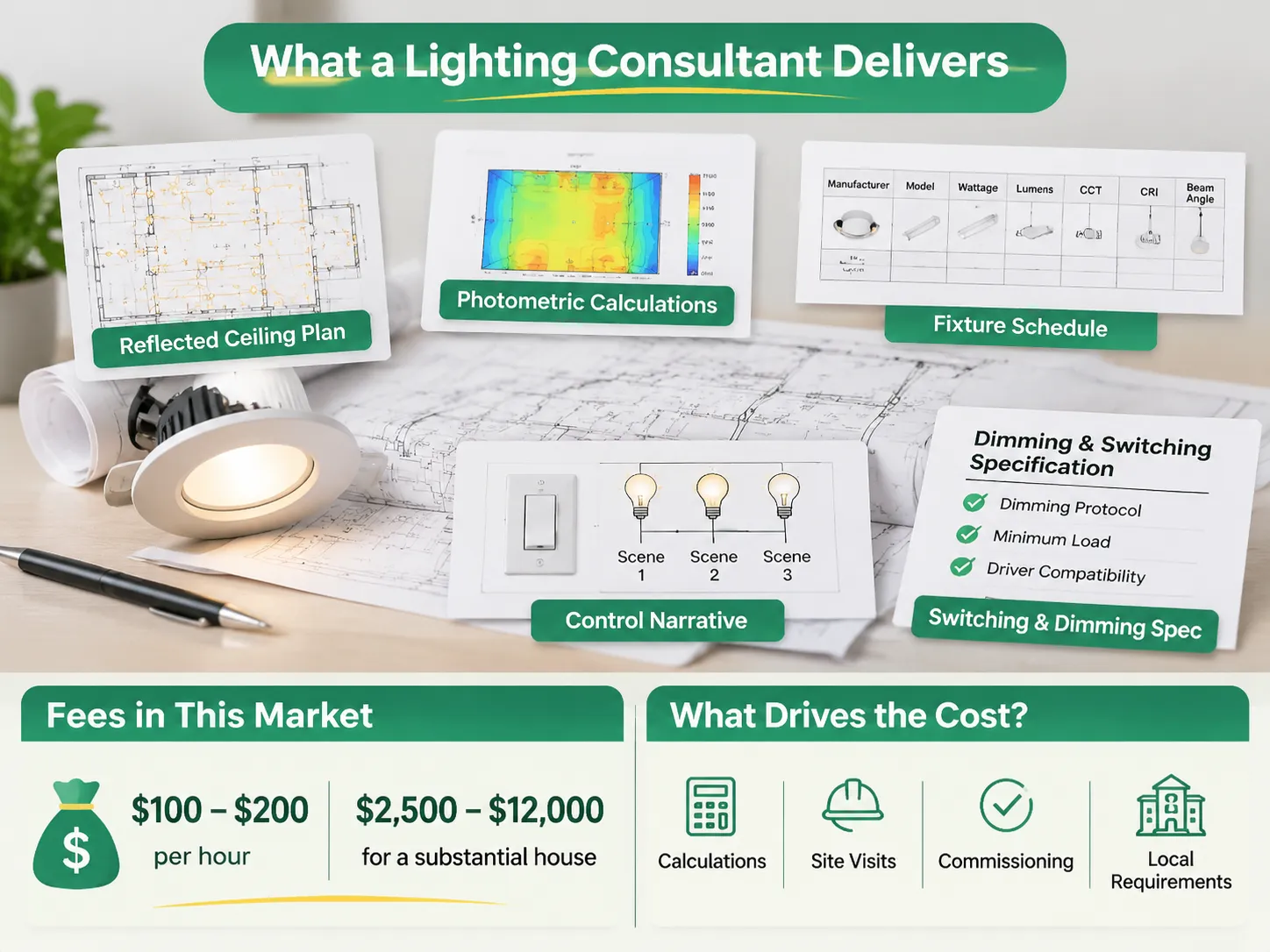
Deliverables are more specific than mentioned in the title, and it is appropriate to request each one by name.
A mirrored ceiling layout displaying the positions of fixtures, their types, and circuitry. The photometric calculations for the relevant areas, with the required maintained illuminance levels acknowledged in foot-candles or lux and the assumptions for the calculations provided since a number alone cannot be validated. The fixture schedule with details on the manufacturer, model, wattage, lumen output, colour temperature, colour rendering index, and beam angle. A written explanation of which switch or dimmer is responsible for which action, as well as the information on what scenes are included. Finally, a specification for the switching and dimming hardware itself, with details about the compatibility of loads.
The last item in this list is the one that makes projects fail silently. If a dimmer is used without taking into account the driver in the fixture, there will be flickering or buzzing at low levels of output, making electricians responsible for errors of specification. The dimmer installation guide covers the wiring side; the specification side is about matching dimming protocol and minimum load before the fixtures are ordered.
Freelance electrical designers and consultants in northern New Jersey bill their fees at approximately $100 to $200 on an hourly basis or $600 to $1,500 daily. A major project fee range, which includes large residential projects, can vary from $2,500 up to $12,000. When it comes to commercial jobs, the fees are suggested as a percentage of the electrical contract value, which is usually 1% – 3% of the amount, or as a specific amount per square foot.
Four factors determine the scale of final estimates more than the amount of rooms. It is the presence of photometric calculations as well as whether the layout is created through eye calculations. It is also whether the designer visits the site during rough-in and regular installation periods that happen two to four times in total. Finally, it is whether commissioning is included. It implies setting the scenes and testing the dimming process. Moreover, whether the construction official is rather strict as to the requirements for documentation also influences the height of estimates.
The least expensive way is not consulting in the showroom, even though it costs nothing. It is actually the electrical contractor who creates the layout without any additional charge and that is indeed the correct solution for limited scope of works. The lot of money can be wasted because of hiring a designer to do a job that could be completed by a contractor without any additional money spent by the client.
Lighting design for a residence in the United States revolves around some key hardware choices that should be decided at the outset because they limit wiring options.
Although we make the plate and switch assemblies, not the fixtures, let us put it straight: an installation is only as good as the equipment that operates it, and designers who choose a finish or a function, leaving the item to an electrician’s van effectively leave the most conspicuous element of their installation to luck. For a project with a defined plate standard across several rooms, the range of USB wall outlets with USB-A and Type-C charging shows how far the device side has moved, and why it is worth specifying, not defaulting.
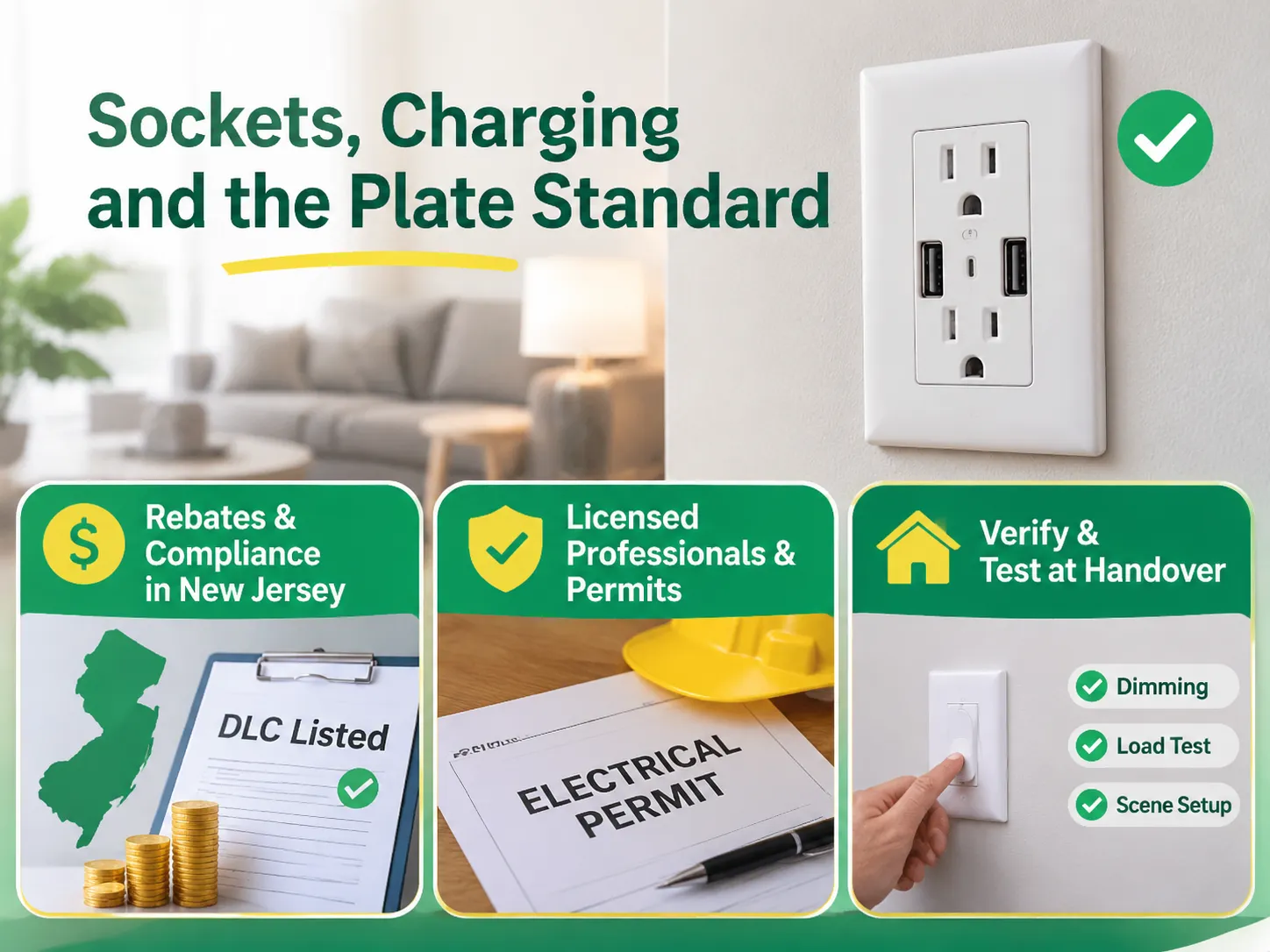
New Jersey has one of the more rigorous efficiency programs in the country, and for commercial projects, the rebate is often the deciding factor between whether or not a project is successful financially. The system is built on the idea of qualified products – in order for a fixture to be counted, it has to be on the DesignLights Consortium list, and if it is efficient but not on the list, it does not count.
This has caused consequences on the specification side. The designers must choose from the listed products, which reduces choices and sometimes forces tradeoffs on the aesthetic side. This is also the reason why retrofit contractors charge on a per fixture basis rather than hourly: the rebate calculation is factored into the design.
On the compliance side, New Jersey’s electrical contractors are licensed at the state level through Board of Examiners of Electrical Contractors, and electrical permits are issued by local construction official under Uniform Construction Code. This means homeowners have to check two things: contractor’s state license number, and permit. An installation that has not been permitted can be unwound at resale, while an insurance company may refuse fire claim on work that was not inspected.
The conclusion of a lighting project does not occur when the light fixtures are mounted but is achieved at the end of the day when environments are regulated and one can walk through the house seeing everything being lighted without any discrepancies.
Besides, there are three things to ask when you are taking over the final utilization. The first thing has to be the dimmer compatibility list – the document containing the information about every individual dimmer, the load associated with it, and the lowest load observed. The next document should be the scene list or switch schedule so that the fellows working next will know what to do with all the switches. The third thing is a spare parts note with the finish code and plate classification, which is necessary because no one should face problems with a single sheet going wrong.
Then you have to test some unusual cases. Make every circuit reach the bottom level and see if there are any flickers. Switch on the vacuum united with the dimmer switched on. Switch on all the devices and make sure that there are no trips.
Begin with the job’s scope and not the contractor’s reputation. If it is just one area with a specific layout, then the most suitable and economical contractor is the one who possesses a good layout drawing. If it is a whole residence, a restaurant or a building with an integrated control system, then it is the designer who is entitled to the payment. For retrofitting over 5000 sq. ft., the contractor who works with the rebates and utility bills on abatements will deliver bigger benefits than the one who does not deal with it.
Then ask the following four questions and pay attention to the answers. What is the design illuminance level that has been established for the main room and on what basis it has been determined? What equipment is included in the list of compliant products according to the utility program? Who is going to visit the site during the rough stage and hanging the fixtures? What will happen in case the driver and the dimmer do not well cooperate after the installation in terms of costs and time?
The forth question is what differentiates the expert from a connoisseur. Everybody says that compatibility will be checked. But the one who has actually done it will explain the procedure: take a sample, check it on the indicated dimmer, monitor its work at the load of ten percent, and verify the minimum expression on the circuit, not just according to the datasheet.
Yes, this is one of the three ZIP Codes that have been given to Mahwah, New Jersey, in Bergen County. The other two are ZIP Code 07430, and 07495. This ZIP code represents a small delivery area, not a town center, which explains why the search is likely to produce very few business addresses related to this ZIP code. Most lighting businesses in the territory use a street address in either Mahwah, Ramsey, or Ridgewood along with their ZIP code. The actual area of service stretches along Route 17 up to the border with Rockland County.
Freelance designers typically charge between $100 and $200 per hour, or between $600 and $1,500 per day. For a whole-house project, the total fee typically ranges from $2,500 to $12,000, depending on whether it includes the photometric calculation, site visit, and commissioning work. For commercial projects, the fee is usually anywhere between 1% and 3% of the electrical contract value. Showroom consultations are usually no cost since they rely on the fixture sales for their fees, and electrical contractors also include the lighting layout in the installation fee.
Hiring an electrician is sufficient when the plan is straightforward and one is thinking about the fixtures used: a bedroom, a corridor, or an uncomplicated kitchen. But hiring a designer makes sense if there are different layers of lighting, a double-height area or a stairwell, built-in lighting fixtures, or some other challenging design. The question is whether there is a need for calculations.
Yes for new circuits, any replacement of lighting fixtures in which wiring changes are made, and any work that takes place in the panel. In New Jersey, electrical permits are issued under the Uniform Construction Code by the local construction official, while the licensing of electrical contractors is handled by the Board of Examiners of Electrical Contractors at the state level. Changing the bulb or shade does not require a permit. However, changes to the fixture in an active circuit may require a permit depending on what the municipality has to say about it, so the question should be posed before the work begins.
The causes of buzzing are the following, in order of frequency of occurrence: First, the dimmer has no LED rating and therefore has a higher minimum load than the combined total load. Secondly, the dimmer operates on well proven forward-phase technology while the driver expects trailing-edge technology, which results in buzzing due to instability at low output. Or the neutral is shared or absent altogether in the switch box, which especially impacts smart dimmers. The best solution is usually a replacement of the dimmer rather than the fixture, which is why testing for compatibility with one fixture before installing the entire room is recommended.
Showrooms will provide guidance on selection of fixtures, finishes, layout and quantity of equipment free of charge, as their profits cover the expenses. However, this assistance usually does not include photometric calculations, control design and site supervision, which are the services that can be offered by independent designers. For a simple renovation the showroom advice may be enough. However, when it is desired that the light behaves in a special manner, the free consultation is just the initiation of the cooperation.
The issue of ZIP codes is rather straightforward. The ZIP code of 07498 applies to Mahwah, and everyone working along the Route 17 corridor, including showrooms, designers, and contractors knows this very fact. All one needs to do is find out what they require from either of the three.
Before you proceed to purchase any item on the list, make sure you have agreed on the layer of control. The problems of the plate standard, the type of the dimmer, the minimal load, and the presence of a neutral at the switch are four issues that have to be solved long before any action is taken in the course of design.
When searching for “07498 lighting consultants”, one usually starts with a specific address, that provides approximate routes. In this case, “07498 indicating a location” means that it is a place close to New York border, while the user needs to get the name of some nearby company or agency in order to compare prices. The […]
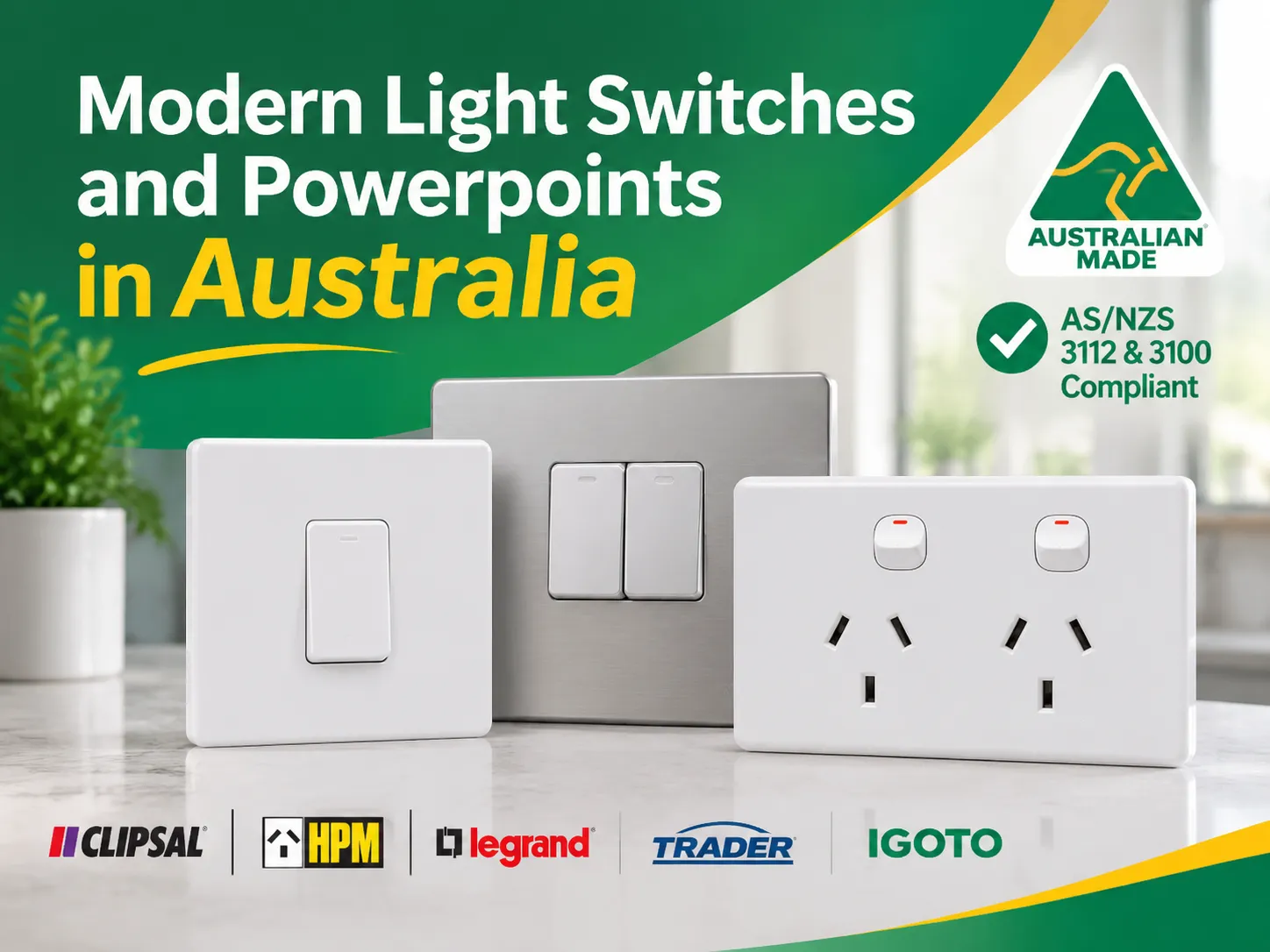
Although marketing switches and sockets in Australia, at first sight, sounds relatively easy, buyers from overseas would soon find out that the going may not always be smooth once they have to deal with imported plates, because they operate on 230V at 50 Hz, the distances between mounting screws are dissimilar (84 mm instead of […]
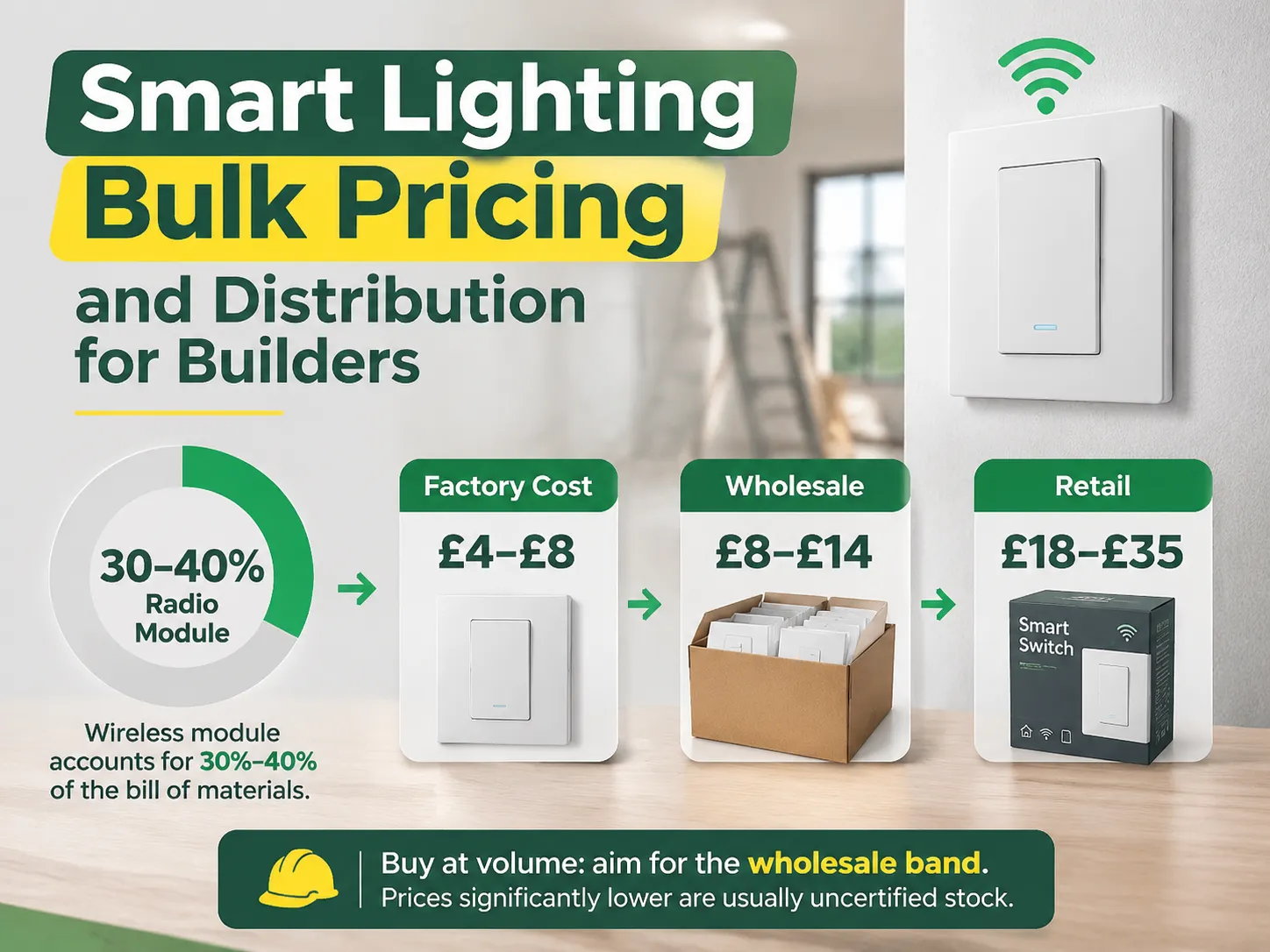
The world of electrical procurement has been transformed by the advent of smart lighting. In the instance of cables or pipes, the cheapest option is easily identifiable and free from risks. Yet when it comes to smart plugs or other connected lighting devices, the product could vary from x1 times to x4 in cost from […]

 No.6 Tuozhan Road, Leshang Pioneer Park,Yueqingwan Bay Harbor,Yueqing city,Zhejiang Province


